

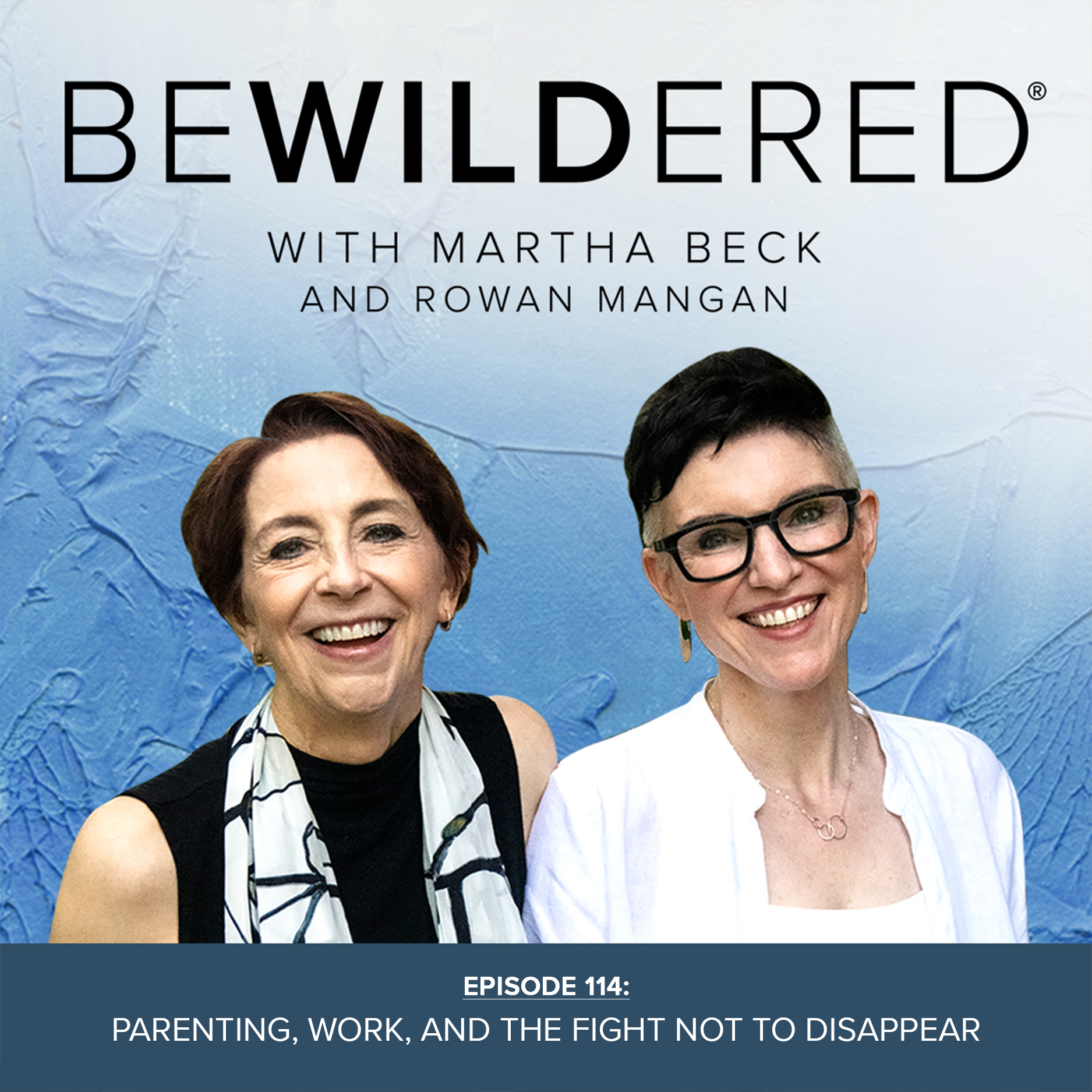
About this episode
Does your life ever feel like a game of Tetris, where you get totally overwhelmed by all the pieces coming at you? In this episode of Bewildered, we’re talking about how to get through the chaos that is modern life: from role fragmentation, to relationship and caregiving pressures, to work responsibilities, to sleep deprivation. Join us for some world-class life coaching (and plenty of metaphors) as we explore how to find a way through the morass of obligations, get some sanity, and rediscover joy.



Parenting, Work, and the Fight Not to Disappear
Show Notes
Does your life ever feel like a game of Tetris, where you get overwhelmed by all the pieces coming at you at ever-increasing speed?
Recently, we were having one of those mornings—running on not nearly enough sleep (especially Ro), with our four-year-old Lila starting her first day of school ever, and about 4,000 tasks on our to-do list—but somehow, we still sat down to record this episode of Bewildered.
This is as real as it gets, folks!
For Ro, this episode became an opportunity to receive some coaching about caring for others, doing a job, doing a life, and just trying to be a human. Basically all the pressures and contradictions that are baked into modern life—for everyone, of course, but maybe especially for women and caregivers.
As we discuss, there are two different value systems that feed into our culture. One comes from traditional societies, where one of the highest values is giving up individual self-interest for the good of the group and to care for others—the web of care.
Then you have our individualized culture where one of the highest values is competing against the group to achieve individual superiority. All the structures of work and school are set up to make you act as an individual at the expense of your connections with others.
But because we humans are part of nature, the way we’re actually designed requires the web of care.
We talk about balancing desires and obligations, self-care vs. self-sacrifice, Spoon Theory, and how to let “Life Tetris” start playing itself. There will be complaining. There will be mixed metaphors. There will be extensive excerpts from Martha’s PhD dissertation…
If you’re feeling like you never have enough time and energy to do all the things you need to do—much less the things you want to do—this episode is for you! Join us as we explore how to make your way through the morass of obligations, find some sanity, and rediscover your joy.
Also in this episode:
- Roundabouts, four-way stops, and “little British penguins”
- You say potato; Lila (and Fred Astaire) say po-tah-to.
- Ro’s phone won’t recognize her face unless she produces multiple chins.
- Martha steps out of the shower dressed in nothing but her cellphone.
- The intricate social rules of joining a parenting “monkey clump”
- How to befriend a bear without getting literally disemboweled
TALK TO US
You can follow us on our Instagram channel @bewilderedpodcast to connect with our Bewildered community, learn about upcoming episodes, and participate in callouts ahead of podcast taping.
And if you’re a Bewildered fan, would you consider giving us a little rate-and-review love on your favorite podcast player? Ratings and reviews are like gold in the podcasting universe—they help people find us, they help build this beautiful community, and most of all, they help us in our quest to Bewilder the world…
Episode Links and Quotes
- “The Thing at Hand” song by Ani DiFranco
- Breaking Point by Martha Beck
- Bewildered episode 15: “Ten Thousand Spoons”
- Spoon Theory
- Jurassic Park by Michael Crichton
- Tetris
CONNECT WITH US
- Follow Martha on Instagram
- Follow Ro on Instagram
- Follow Bewildered on Instagram
- Join us in the Wilder Community!
- Listen on your favorite podcast app
- The Bewildered Show Notes
- Is there something you’ve been feeling bewildered about? If so, let us hear from you!
Transcript
Please note: This is an unedited transcript, provided as a courtesy, and reflects the actual conversation as closely as possible. Please forgive any typographical or grammatical errors.
Rowan Mangan:
Sometimes in this crazy thing we call life…
Martha Beck:
Crazy old life.
Rowan Mangan:
When you’ve had not enough sleep…
Martha Beck:
Not enough.
Rowan Mangan:
And you have a kid who’s having her literal first day of school…
Martha Beck:
Ever.
Rowan Mangan:
Ever. Something in life prevails upon you and says, “Should you really be recording a podcast today?” Don’t you find? Isn’t it always the way?
Martha Beck:
It’s like, yeah, I’ve got 4,000 things to do, and my child’s fate rests in the balance. I’m going to go off and make a podcast!
Rowan Mangan:
I’m going to make a podcast. And if you are me in this situation, and I don’t see why you wouldn’t be, you use the podcast as an opportunity to receive world-class life coaching on just how hard it is to care for people, do a job, do a life, be a human.
Martha Beck:
It’s rough. So you’re going to hear on this podcast, this is as real as it gets. You’re going to hear me flat-out live coaching about role fragmentation and exhaustion, and the pressures on you as a human and caring for other people and your career and everything, and how you can find your way through this morass of obligations and maybe get a little sanity.
Rowan Mangan:
There will be complaining. There will be mixed metaphors.
Martha Beck:
There will be extensive excerpts from my PhD dissertation. Wow!
Rowan Mangan:
What’s not to love? We hope you’ll stay and join us for Bewildered.
Martha Beck:
Hi, I’m Martha Beck.
Rowan Mangan:
And I’m Rowan Mangan. And this is another episode of Bewildered, the podcast for people who are trying to figure it out.
Martha Beck:
Figure it out, man.
Rowan Mangan:
What are you trying to figure out?
Martha Beck:
You said it was going to be easy. You said it was going to be fun. You said it was going to be good.
Rowan Mangan:
What?
Martha Beck:
Living in a city that uses roundabouts. You’re like, “In Australia, we don’t have four-way stops. Those are insane and require people to notice things, but roundabouts are heaven.” I ended up going to Albany, which is literally thousands and thousands of light years away from—because I just—you’re in this roundabout, you’re going round and round and round like you’re on a calliope or something. Wait, what’s a calliope?
Rowan Mangan:
No one knows. For the purposes of the tape, she did not go to Albany.
Martha Beck:
Anyway. I was on the way. I was on the way.
Rowan Mangan:
You were on a road.
Martha Beck:
I didn’t have an exit for nine miles. Just because the distinction between the place I was supposed to get off the roundabout and the place I did get off the roundabout, it was negligible. There was no way to tell the difference. How do you? It’s insane.
Rowan Mangan:
The thing about Americans that I will tell you is the only time when they’re not overwhelmingly confident/borderline rude, is when they’re at a four-way stop when they become the opposite. And they become nervous. Little British penguins. And they’re all like, “Oh no, no, please, after you, I couldn’t. Oh no, I couldn’t possibly. I mean no, I wasn’t paying attention. Oh, which is my right? Oh my other right. Oh, please, please go.” “All right, I’m going.” “No, no, don’t go. That’s a wave. That’s a stop.”
Martha Beck:
Ro, do you see that this is the heart center of American culture? This is the place of compassion and consideration for others. And you replace that with a roundabout, and what do you have? Chaos and heartbreak.
Rowan Mangan:
If you’re on the roundabout that you are yielded to, you yield to the person who is already on the roundabout. It’s so easy. You don’t have to, nobody set your watch to know who arrived first.
Martha Beck:
And so I’m just supposed to, what? Do I just go round and round and round and round? There were decisions to be made and no time to make them because I was going round and round and round and it said, go that way. And so I did. But it just was a slightly different way at first.
Rowan Mangan:
I think the problem is to do with navigation and not so much about rounding.
Martha Beck:
But see, at a four-way stop, I would be like, I see my way here. I’m stopped, which means I evaluate the distance and the direction ahead of me. Not, oh, driving round and round and round. Make a decision now now, now. Oops. Too late. You’re on the road to Albany. Two roads diverged in a roundabout.
Rowan Mangan:
Yeah. And I took the one to Albany.
Martha Beck:
And that has made all the difference.
Rowan Mangan:
Do I say Albany or All-bany in my accent?
Martha Beck:
Say All-bany because it sounds cooler to us. Albany. We say All-bany. I don’t say Al-bany. I All-bany.
Rowan Mangan:
Albany. I can’t make that noise.
Martha Beck:
Albany. Albany. I have a secret wish that our daughter retain her Australian accent because I think it makes her so much more adorable than anyone else I’ve ever met.
Rowan Mangan:
Yesterday she did a performance.
Martha Beck:
Oh?
Rowan Mangan:
Yes. On a stage. There was no audience, but she enjoyed her performance very much. She used a hoop.
Martha Beck:
See, if she goes up to her teacher and says, “I’d like a glass of water,” they’re going to be charmed.
Rowan Mangan:
Water is the hardest one.
Martha Beck:
See, you don’t say water.
Rowan Mangan:
Because I can’t anymore.
Martha Beck:
You say water. Water.
Rowan Mangan:
What does she say?
Martha Beck:
Water. Like a South African or an English person. I don’t know where she gets it.
Rowan Mangan:
I was on a plane and I asked for some water and they were like, “We don’t have that.”
Martha Beck:
We don’t serve alcohol.
Rowan Mangan:
And I’m like, “No, water.” And she’s like, “What?” And then finally I just sat there and I was like, hang on: waater? And it did the trick. And ever since, I’ve never been quite, I’ve never really known where, how to say it.
Martha Beck:
I know. Water. That just really, it’s the lowest way to say water.
Rowan Mangan:
It’s the four-way stop.
Martha Beck:
It’s the four-way stop of water pronunciation. What are you trying to figure out?
Rowan Mangan:
You know how we are a species who have mobile phones as an extension of our own bodies at this point?
Martha Beck:
Yes. Yes. We’ve evolved to need them.
Rowan Mangan:
Yeah, we have. We’ve evolved. They’ve evolved. We’ve co-evolved. Kind of like how wolves became dogs. And then who’s wagging the what, you know?
Martha Beck:
I know.
Rowan Mangan:
Right? So here’s the thing: Usually my phone seems keen to please me.
Martha Beck:
Yes.
Rowan Mangan:
Except in one key way.
Martha Beck:
What is that?
Rowan Mangan:
So when I do shop online, like 11:30pm on a TikTok shop, on a weeknight, I’m making a purchase. And I want to look good.
Martha Beck:
Okay.
Rowan Mangan:
I want to be like, “Yeah, I’m someone who’s making a purchase. Don’t mind if I do, bartender.” You know? But it turns out that the only way my phone will let me make a purchase by saying, “Yes, that is your face” is if I produce three to six chins. Otherwise, it’s like, “Don’t know who that is, who looks so good.” And it’ll just be like “Face not recognized. Do you want to enter the 90,000 character password?”
Martha Beck:
Oh my god.
Rowan Mangan:
And so now I have to—I just had to do it downstairs for the parking, I had to install a new app. And I was on the street, Marty, and I knew you and people. And there was a guy running past on a bicycle yelling about that God loved us and we needed to accept ourselves, but I couldn’t because the only way I could pay for our parking was to bring out all the chins. All the chins.
Martha Beck:
That’s brutal.
Rowan Mangan:
I know, man.
Martha Beck:
I was so photo shy that I actually became editor of the yearbook in high school to make sure there were no pictures of me in the yearbook. There were no photographs of me until I was like 35 and I started writing books and everything. And now it’s like every grotesque angle of my aging body is being accidentally photographed by me.
Rowan Mangan:
Every angle?
Martha Beck:
I think so. Anyway, back to your story.
Rowan Mangan:
No, no, no, no. I think we need to stay here for a minute. What just happened?
Martha Beck:
Okay, here’s what happens. We went into a fancy media of fancy people once in Hollywood. Remember? The one where we had to paint your head? That’s a whole different story.
Rowan Mangan:
Let’s just move on and not explain that at all.
Martha Beck:
Okay, we’ll come back to it someday. But all the fancy people in this meeting, all the women, had their phones on leather straps, like a little purselet thing. So I need that because if something’s not strapped to me, God knows it’s lost.
Rowan Mangan:
It’s lost forever.
Martha Beck:
So what happens is I turn on the camera, to take a picture of something wonderful—like a bear. And then I put the camera down, but it’s touch-activated, so it’s swinging on.
Rowan Mangan:
Touch-activated?
Martha Beck:
I don’t know what they call it. It’s swinging on its strap, and I carry it everywhere. I’ll get out of the shower, put this thing on.
Rowan Mangan:
Ohhhh, I see.
Martha Beck:
Dressed in nothing but a cell phone.
Rowan Mangan:
Oh, accidentally. I was just stepping out of the shower, and I mean, my phone is touch-activated.
Martha Beck:
And so am I. But it actually—oh dear. You have not had nearly enough sleep, have you?
Rowan Mangan:
Oh my God. That was perfect.
Martha Beck:
But it takes pictures you don’t expect. Doesn’t your phone do that? It takes pictures of you doing—
Rowan Mangan:
Yeah, it takes pictures of me with all my chins out.
Martha Beck:
Well, that’s just normal.
Rowan Mangan:
It doesn’t take pictures of me coming out of the shower.
Martha Beck:
But not the way you take a picture artfully of someone. Like, from under my armpit and stuff.
Rowan Mangan:
Okay. All right. I have so many questions that I’m rendered speechless.
Martha Beck:
All I’m saying is that if it used one of those as “face not recognized” and I had to replicate the pose when my camera was swinging freely from its strap and it just flashed a picture of me, there’s no way.
Rowan Mangan:
Okay, wait, wait. So let me see if I’ve got this right.
Martha Beck:
Okay.
Rowan Mangan:
You once went to a meeting in Hollywood. And as a result, you now step out of the shower and immediately strap your phone to your body? No towel. Let’s not waste time with towels. In Hollywood, with their touch-activated phones…I love the way the Hollywood meeting had to come into the story.
Martha Beck:
That’s why the strap. And see, all of those women were so beautiful that literally, you could take a picture of them with a camera just swinging anywhere around them and they would still look beautiful. Not so with yours truly. But I assume that’s why they can tolerate the strap cameras.
Rowan Mangan:
I know that we have because of the not-sleeping… This is good. No, it’s good. It’s all good content.
Martha Beck:
Keep it! Don’t forget the bear. You got the Hollywood meeting, then the bear, which did come to our house and wait politely in the woods while we took its picture before attacking our garbage bin.
Rowan Mangan:
Yeah, well during.
Martha Beck:
So I had a lot of pictures of the bear, but then the camera took all kinds of pictures of me throughout the day from a lot of unflattering angles.
Rowan Mangan:
PSA, if you are the parent of a small child and a bear turns up, try to avoid doing this: “Hello! You’re our friend. Hi, little guy. Are you our friend? You are our friend.”
Martha Beck:
That’s what you said to the bear.
Rowan Mangan:
And then I tried to tell Lila that it was evil. And it literally would disembowel her.
Martha Beck:
Yeah. And I’m not sure she believes. And so that’s why I bought 97 locks—huge deadbolt locks—yesterday. Not to keep the bears out, to keep Lila in.
Rowan Mangan:
The bears are welcome.
Martha Beck:
Yeah, well. They were there first.
Rowan Mangan:
Should we do a podcast, do you think?
Martha Beck:
Why not? Let’s figure that out.
Rowan Mangan:
All right, well actually that’s fair.
Martha Beck:
Yeah.
Rowan Mangan:
Hi there. I’m Ro and I’ll be your podcaster for today. Do you know how to tip your podcaster? It’s actually pretty easy. You can rate our pod with lots of stars, all your stars. You can review it with your best superlatives. You can even subscribe or follow Bewildered. So you’ll never miss an episode. Then of course, if you’re ready to go all in, our paid online community is called Wilder: a Sanctuary for the Bewildered. And I can honestly say it’s one of the few true sanctuaries online. You can go to wildercommunity.com to check it out. Rate. Review. Subscribe. Join. And y’all have a great day now.
Martha Beck:
All right, go ahead and introduce it.
Rowan Mangan:
Every now and again, regular listeners to the show will know that sometimes it’s just all a bit much. And if you’ve ever thought, wow, it must be nice to live with a life coach, these are the days when I am here to tell you, yes it is. It’s wonderful.
Martha Beck:
Aww.
Rowan Mangan:
Because sometimes you don’t know what to talk about on a podcast. So you think: my problems!
Martha Beck:
And well, this is exactly what happened. You are in this phase of life where you’re just getting a kid ready to go to school while we’re moving into a house, while you’re trying to run a business.
Rowan Mangan:
During perimenopause.
Martha Beck:
During perimenopause, menopause. Many pauses.
Rowan Mangan:
She tries to call me a young mother. We have this ongoing—
Martha Beck:
Mother of young is what I really mean.
Rowan Mangan:
But she’s like, “When you’re just a young mother…” And I’m like, “I have gray pubes.”
Martha Beck:
Oh, we did—see, now that you don’t need a strap camera, everyone knows.
Rowan Mangan:
Yeah. I never felt the need to prove it. I just felt the need to say it.
Martha Beck:
Okay, we’ll figure that one out later. But here’s the thing. When I was at that stage of child rearing when I was a mere, a wee lass of like 23, 24 years old, trying to juggle kids and work and getting a PhD and everything, the only way I could get my PhD was to write a PhD about what I was going through. So I wrote about role conflict in American women who were moving into the workforce while still trying to raise children. And I dissected the issue because that meant that it counted as research when I was just lying on the bed going, “I cannot figure this out.” So I did.
Rowan Mangan:
It really reminds me of when I was trying to get my PhD and literally the only way that I could see before me to get the PhD was to write an email saying, “I cannot do this PhD. Bye.”
Martha Beck:
Bye. But it’s kind of the same premise here, because I was so completely pressured, fragmented, torn in a thousand directions, guilty all the time, running all the time, short of sleep, not understanding why I felt so horrible. And so I wrote a dissertation about it and today you were feeling very much the same way. And we said, “Why don’t we do a podcast on it?”
Rowan Mangan:
Very much the same way, but without the dissertation.
Martha Beck:
Yeah.
Rowan Mangan:
Yeah.
Martha Beck:
More of a podcast.
Rowan Mangan:
Yeah. Well actually, yeah, that’s true. A podcast is a dissertation in a way.
Martha Beck:
In a way. I’m not sure it’s a dissertation. Anyway, it’s a discussion. It’s a compare and contrast thing.
Rowan Mangan:
Sure. Okay. All right. Here are my problems. In no particular order.
Martha Beck:
So this is actually, we have not scripted this at all.
Rowan Mangan:
I think that will become apparent. All our listeners are like, “Why do they feel the need to tell us this? It’s pretty obvious.”
Martha Beck:
Okay, go.
Rowan Mangan:
Here are my problems. In no particular order. Well, the gray pubes, for starters.
Martha Beck:
Alrighty. There are chemical solutions to that.
Rowan Mangan:
Oh, no, no.
Martha Beck:
No.
Rowan Mangan:
Okay. So far, the life coach isn’t helping.
Martha Beck:
Not at all. Nobody’s brought that issue before. I wasn’t prepared.
Rowan Mangan:
The next problem is that I think what people don’t realize about doing a podcast, and this is true, is that sometimes you don’t feel like doing a podcast.
Martha Beck:
What?
Rowan Mangan:
Yeah.
Martha Beck:
I always feel like doing a podcast.
Rowan Mangan:
You are so good at doing podcasts and being podcasty.
Martha Beck:
No, I was lying.
Rowan Mangan:
But you don’t even know if you feel like it or not.
Martha Beck:
Oh, that’s true.
Rowan Mangan:
You just turn up.
Martha Beck:
Yeah. Yeah. I’m completely lost to myself and just accommodating culture.
Rowan Mangan:
Do you know what? This reminds me of an Ani DiFranco song.
Martha Beck:
Does it? Oh my God, that’s never happened before!
Rowan Mangan:
Yeah. And I can’t remember it.
Martha Beck:
Now that really has never happened before. But you remember everything Ani DiFranco has ever written down, including, I don’t know…
Rowan Mangan:
I don’t need to know what to say. I don’t need to know where I stand. I just gotta show up for the thing at hand.
Martha Beck:
See? You’re bringing me into your cult. I am. I now adore Ani DiFranco too, and I know a lot of her lyrics.
Rowan Mangan:
It’s not so much a cult as a listening-to-music, but you know.
Martha Beck:
Potato. Po-tah-to.
Rowan Mangan:
Yeah. Our daughter’s been saying “po-tah-to” a lot, and she’s the first person since Fred Astaire.
Martha Beck:
I swear she’s British. She’s got some sort of, not genetic but epigenetic thing where something flipped in her genetic code and made her British.
Rowan Mangan:
No one in Britain says “po-tah-to.”
Martha Beck:
Really?
Rowan Mangan:
No one ever has. No one says it. Do you honestly think people are walking around saying “po-tah-to” and you’ve never heard it?
Martha Beck:
What do they say in New Zealand?
Rowan Mangan:
Potato.
Martha Beck:
What do they say in South Africa?
Rowan Mangan:
They sort of say “po-tee-to.”
Martha Beck:
I think in South Africa they say “po-tah-to.”
Rowan Mangan:
No, they say “potato.”
Martha Beck:
But everybody says “to-mah-to.” You say “to-mah-to.”
Rowan Mangan:
You know, starting to really see why scripting these could be a good idea, moving forward.
Martha Beck:
It could be a good idea. Back to the topic at hand, Roey.
Rowan Mangan:
Our daughter started school today. It was her first day of kindergarten, and I have to do a podcast today, also. And that’s not right, is it?
Martha Beck:
It’s not easy, that’s for sure. And I’ve seen it.
Rowan Mangan:
And also I was up for three hours with her in the night.
Martha Beck:
Yeah. Because she’s still basically a newborn. Only now she’s a newborn who has to act like an executive. And you have to make her do it against her will if necessary.
Rowan Mangan:
Yeah. It really doesn’t seem right. And it’s like all these stages of parenthood, people always say, no one ever tells you. And then the kind of joke that’s built in is that they do tell you, but they don’t tell you.
Martha Beck:
You can’t actually know.
Rowan Mangan:
They don’t tell you how it’s going to feel in your body to actually try and do that shit.
Martha Beck:
No. All they can tell you is, “Nobody told you.” Because when you get there, it is beyond description. It is beyond verbal ken.
Rowan Mangan:
So could you fix me, please?
Martha Beck:
Allright, no problem.
Rowan Mangan:
With your dissertation?
Martha Beck:
I will. Actually, oh gosh, I can’t believe I’m going to do this. I am going to just summarize a tiny bit.
Rowan Mangan:
Of your dissertation?
Martha Beck:
Yeah, there are two.
Rowan Mangan:
From some university?
Martha Beck:
Oh, little place called Harvard. Which I want Lila to pronounce, “Hahvard.”
Rowan Mangan:
Hahvard.
Martha Beck:
Yes.
Rowan Mangan:
I want her to pronounce it, “Never heard of it.”
Martha Beck:
There you go. Okay, so everybody out there can drink—water—because I said “Harvard.” Drink again. All right, so here’s the thing. There are two different value systems that feed into our culture. One comes from traditional societies, pre-industrial revolution, where if you look at pre-modern societies anywhere, one of the highest values is giving up individual self-interest for the good of the group and to care for others. The web of care.
And then you get this sort of individualized culture that started with Enlightenment Europe. I mean it didn’t start with it, but it was taken to a huge extreme by the Enlightenment philosophers of the 18th century. And they imported it all over the globe.—they exported it all over the globe. And in that culture, one of the highest values is competing against the group to achieve individual superiority. So all the structures of work and school and everything are set up to make you act as an individual at the expense of your connections with others.
But everything about mothering, everything about the way humans are actually designed, requires the web of care. And this is the culture/nature split here because in nature, we are social primates. We hang out together, we clump about, we get in little balls. I mean it’s so adorable when we’re in South Africa, if it rains, to watch the vervet monkeys gather into a ball. Like the whole troop, like 20 monkeys will just gather into one ball to keep each other warm.
Rowan Mangan:
Monkey ball.
Martha Beck:
Monkey ball. We call them monkey balls. And it’s fun to be a monkey ball at home, cuddle. And we’re meant to live in troops, in bands, and to take care of each other’s needs in a kind of spontaneous, free-flowing, natural ecosystem kind of way. And then you get modern culture, which is like, “March up the steps of achievement and beat as many people as you can, get more than other people can get, at many stages, and train your child to act in these ways: left hemisphere-dominated, regimented, obedient, sitting still, and then moving fast when they’re told to move.”
So we have this whole premise in the podcast, what’s culture doing to us and how does it contrast with our nature? And how do we get back to our true nature? And what you’re dealing with right now is this horrible death grip of a parent who is trying to get a child not only to be a happy, thriving little person who needs to be with family and parents and constantly attended to and cared for in all these physical and mental ways. You’re trying to raise a happy child while conforming and forcing—it’s a wonderful school, but it’s still the same system, getting the child to conform to the individual system. And you’re also trying to earn a living based in the individualistic system. So you have, and the thing about these two—okay, I’m just going to say one more thing and then I promise we’ll start talking about you.
In the 1960s, somebody took, they did a study where they took a whole bunch of psychologists, psychiatrists, therapists, and they had them make a list, three lists. One was a list of the characteristics of a healthy individual, and they put in strong, assertive, confident, all these things. Then they had them make a list of the characteristics of a healthy male adult and a healthy female adult. They didn’t acknowledge anything else, just male, female. Now the list of things that identify a healthy man, and this was the same as the list of things that identify a healthy person. But the healthy woman, the list of those characteristics was the opposite of what characterizes a healthy person. So instead of strong, independent, capable, self-sufficient, it was observing others, always willing to—
Rowan Mangan:
Sacrifice.
Martha Beck:
Self-sacrificing, sympathetic, empathetic, soft, all these things. So what became apparent is that it was impossible to be a healthy woman by that culture’s definition and a healthy person, which means you were always wrong if you were trying to act like– if you were a woman. But it also pertains to anything men do that is empathetic and sensitive and supportive to others, they would move over into that list of things that were not characteristic of a healthy person, but yes, a healthy woman.
Rowan Mangan:
So we’re not really talking about men and women. We’re talking about the cultural conception of masculinity and femininity.
Martha Beck:
Yes. There was such an assumption that gender and function and life orientation went together that they didn’t even question it. So what we’ve got is we’ve got the caring qualities of a traditional culture seen as not just the antithesis of the admirable qualities of the modern culture, but they actually work against each other. They are mutually incompatible. It’s not just that they’re different. If you’re doing well in one, if you’re self-sacrificing on the job so that you can take care of your family, you’re a bad employee. And if you’re giving up time with your family to do your job, you’re a bad parent. And this is baked deep into the core of our culture. And it results in what you’re going through right now: Almost no sleep, constant fragmentation of attention. Not nearly enough time, not if they give you twice as much as you have. No sense of who you really should be. It gets so fragmented.
Rowan Mangan:
Steady on.
Martha Beck:
Well, you tell me how’re you feeling?
Rowan Mangan:
I’d love to.
Martha Beck:
I asked 300 women how they were feeling and now I’m generalizing to you. I am so sorry, honey. Tell me how you feel.
Rowan Mangan:
I feel harried, fractured, unable to give myself the luxury of total focus on anything because of the ever-present fear that there’s something I should be remembering, thinking, doing, and the sense of needing to be available for those thoughts when they pop up so that I can record them so that I don’t drop a ball that will cause some sort of social shaming or stigmatization.
Martha Beck:
Yes.
Rowan Mangan:
And man, first day of school, oh my God. So what they tell you is: “School: awesome. That’ll be great.” And you’re like, “Yay. Got to get her to school and then everything will be fine”. And then they’re like, oh no. Again, disclaimer amazing school. But they’re like, “Here’s your things that you need to do in order to get your kid into our school.” And that’s quite a lot of work and the summer journal.
Martha Beck:
And it keeps getting more! I mean, when I went to elementary school, I just walked over to the school and showed up. I mean, I think my mother took me the first day and that was that. I mean, it’s not like we did a big journal or there were tons of paperwork to take home every day. When my three older kids got started in school, the paperwork nearly killed me. I mean, just the paperwork, coming home from school every damn day. So yeah, you were given this wonderful school’s amazing basket of opportunity, opportunities to do really difficult and complicated things to make sure that the five-year-old would walk in adequately prepared with a teddy bear in one hand, briefcase in the other. It’s crazy.
Rowan Mangan:
Yeah, yeah. And yeah, it’s such, what’s the word when you’ve got two plates, tectonic plates? Fault line. It’s a fault line, it’s the social element of it all is that there’s a personal social element because now there’s this new clump that I’m trying to clump in with the monkeys, which is the other parents, right? And I’m trying to be in their little monkey clump, and I don’t really know the rules of the clump yet. And I speak weird.
Martha Beck:
And it’s not the accent.
Rowan Mangan:
I accidentally called someone someone else’s name. And the someone else, the person who, well anyway, it was not a complimentary mistake to have made to the person I made it to. And there’s a WhatsApp group, and there’s an email chain, and there’s a parent of the classroom, and then there’s like, what am I doing to her if I don’t do the journal right? What am I doing to her?
Martha Beck:
I know. And she doesn’t want to do the journal.
Rowan Mangan:
She doesn’t want to do the journal.
Martha Beck:
She sounded just like me last night. I heard her. You were trying to get her to do the journal, and she was shouting at the top of her voice, “I don’t want to write anything!” I’m like, oh, that’s my inner voice.
Rowan Mangan:
Yeah.
Martha Beck:
So right away, I mean there’s that joke a comedian made where he is talking about being a math teacher and they’re saying, “Your job is to make children know math.” And he’s like, “Oh, they want to know math?” “No, no, you have to make them know it against their will.” What? That doesn’t happen in nature. So what you’re in is a welter of social judgment and the social anxiety that comes with it.
Rowan Mangan:
Is there social judgment?
Martha Beck:
Oh yeah, there is.
Rowan Mangan:
Or is there just the perception of social judgment?
Martha Beck:
No, there is.
Rowan Mangan:
Why?
Martha Beck:
Because here’s the thing: These value systems are really strong in the culture, and you can find a lot—if you want to look online and get into this rabbit hole, prepare to get yourself torn apart because there’s this idea of what you should do as a parent and how you should be as a parent and how loving and how present and how you should show up at the PTA meetings all the time. And you’re going to get judged if you don’t. But there are also judgments about: Do you have a profession? Do you keep the house immaculately cleaned? Are you doing all the other things that you’re supposed to do? Are you getting enough exercise? Are you doing enough self-care? All these other things, but mainly focused on are you achieving and succeeding? And are you making money, more than anything else. That’s the panic over on that side. But there’s also judgment for a lot of people, less for us because we work at home and we do creative work, but there’s a trauma.
Rowan Mangan:
And we’re total weirdos.
Martha Beck:
Total weirdos. And we’ve accepted it. But for a man, for somebody who identifies as male and is seen as male to go over to the side of more care for the child and showing up the first day of kindergarten, massive social barriers to that. For women who want to be seen as super high achieving, which a lot of women do, like who doesn’t want to be seen well by their society? Who doesn’t want to make lots of money and climb the pyramid, right? But then we end up bringing our kids to work because they’re sick, and there’s social judgment there. So I’m broadening the scope, but what you’re going through is an example of that.
Rowan Mangan:
So I feel like there’s something here that I want to dig into a bit more, not for myself, but because I worry that we’re saying, I always worry in these conversations that we have on Bewildered, I always worry that there’s a tendency to say, “Before the industrial revolution, everything was beautiful and perfect, and now it’s good for men and bad for women.”
Martha Beck:
No, it’s bad for men too.
Rowan Mangan:
It’s really bad for men too.
Martha Beck:
Really bad for men too.
Rowan Mangan:
Or whatever. But this idea, and I was thinking about how you said there was the Enlightenment in the West, and that got exported around the world. And so you are kind of locating that on a timeline, but when I was doing, when I was at a little place called the University of Melbourne…
Martha Beck:
Not too shabby.
Rowan Mangan:
Not too shabby.
Martha Beck:
I’ll have a drink myself.
Rowan Mangan:
And I was studying international politics, and I think I’ve said this on the podcast before, one of the real problems with human rights as a discourse is that it says the human being is the location of the—the one who receives the right is the individual. And what many parties to the United Nations were saying is that’s a reflection of Western values that is not a reflection of our values, which would prefer to locate the unit of rights-having, the subject of the rights, as the community. And so there’s, it’s a continuous thing in time, but here’s my graduate-degree-level analysis of the whole thing is: It was fucked up before when you were in the kitchen.
Martha Beck:
Yes, it was.
Rowan Mangan:
Doing that and raising kids and not able to go to amazing Ivy League institutions like the University of Melbourne. And it’s all fucked up.
Martha Beck:
It’s always been fucked up.
Rowan Mangan:
It’s impossible, right?
Martha Beck:
And also any agrarian society had the stratification where certain people would be the idle rich, and they would make people below them in the hierarchy in terms of power, wealth, and status, do all the grunt work. And so there’s always been this.
Rowan Mangan:
Yes. And I would say class is at least as big a factor as gender in it because in many cases, the individual could be a healthy woman as long as she had a shit ton of servants.
Martha Beck:
Exactly. And I’ve had people tell me, I’ve had—both at Harvard and just in life in general, they’re like, “Well, you do this and this and this and it’s really easy. Always have dinner at six, do this, make sure this happens and this happens and this happens and this happens.” And I’m like, “Yeah, but who does it?” And they say, “Well, the servants. Of course!” So really, let’s take away male and female and let’s say servant and higher-up. You’re in a place where you’re supposed to be the servant who takes care of the domestic scene and also the higher-up, who is going to sit here and make a podcast and tell people what to think. And those two things conflict.
Rowan Mangan:
And I can see how they’re fluid roles that we move in and out of. But what I end up coming back to, and I know that you and Einstein are going to say I’m wrong about this, but there’s only so much time. And it keeps, in my mind, becoming a problem of time.
Martha Beck:
It is.
Rowan Mangan:
And I spend so much of this precious, precious brain space that I don’t have trying to solve it for X with X being, where’s the bit where I get to write? I now have a bathtub near my bedroom. When do I get to take my bath?
Martha Beck:
You don’t.
Rowan Mangan:
No.
Martha Beck:
But let me tell you something else. Even if you had 48 hours a day, it would fill every minute.The nature of this is set up. You use the word fault line. I ended up—
Rowan Mangan:
When I eventually remembered what it was. Yeah.
Martha Beck:
I mean I published a book which sank like a stone based on this, and it was called Breaking Point. Because no matter how much time you have to be a good parent, it will not be enough and you will be judged. And no matter how much time you have to achieve as an individual and make a living and everything, it’s infinite, it’s internally contradictory, and it’s just got its teeth into us that says we have to do infinite things. There is not enough time.
Rowan Mangan:
Right. But in the algebra that I was describing, what ends up—you’re like, something has to give in this because my soul will wither and die at a certain number of years in if all I do is podcasts and wipe bottoms. And so there’s this part of me that needs to spend some time in the driver’s seat of myself. And what, as I try to solve and try to solve and try to solve, the only place that it ends up coming to is it’s either going to eat out of my sleep early in the morning, or it’s going to eat out of my sleep late at night.
Martha Beck:
Yeah.
Rowan Mangan:
And the shitty thing about that formula is that with not enough sleep, occasionally or chronically, you can’t parent, you can’t domestic, you can’t have a job, you can’t do a job, you can’t function. And yet it’s like that—so ultimately that becomes the choice. It’s how much sleep do I surrender for my soul? And how completely inept and feeling awful, but also performing for the culture terribly in my day-to-day life?
Martha Beck:
Because when you give up sleep—I am serious as a heart attack here—you might as well be drinking poison. The lack of sleep is absolutely horrendous, as you know, for everything, every aspect of your health, every aspect of your relationships and performances. And that is the thing people give up. I’ve been talking in generalities, and I did interview all these women way back in the eighties, nineties. So I have in my mind general things that happen. I know what I found the results were, but I’m kind of interested in you as an individual. Because you really are in this state right now.
And the first thing about it is if I tell you the dynamics that are going into it and the societal pressures and everything, what I’m doing is I’m pulling you into an analytical frame of mind and away from the center of yourself. And the one thing I found out, it’s funny, I figured it all out societally and went to my advisors and said, “Incompatible value system, we’re all screwed.” And they were like, “So what’s the solution?” I said, “There is no solution. We’ve got incompatible values.” And they were like, “No, there has to be.” Which was very not scientific of them. There doesn’t have to be. You can just describe a problem and leave it at that. But I was like, “Okay.” And I went back to the data and what I found was that I would do these interviews, and then after the interview was over and I would turn off the recorder, women would start telling me the truth.
And I started looking at the data that wasn’t in the recordings, that was in my notes that I remembered, and I was like, “This is interesting.” And it kind of created the foundation for my whole life and my whole self-help career was teaching people what I found.
But I want to go through it for you because one of the first mistakes that people are taught to make is to abandon themselves emotionally, physically, and intuitively. And if I lecture you about the social dynamics, I’m pulling you away from the ability to center physically, emotionally, intuitively.
Rowan Mangan:
Oh no, please lecture me more on the social dynamics, please.
Martha Beck:
Seriously?
Rowan Mangan:
No.
Martha Beck:
Okay, good, good. Because I love that shit.
Rowan Mangan:
I know you do.
Martha Beck:
I can just go and go and go like a lumberjack.
Rowan Mangan:
Sometimes you forget that it’s just like you and me in the car driving along and you start in on one and finally I’m just like, “Who are you talking to?” Because you’re saying, “And furthermore, your Honor.”
Martha Beck:
I don’t!
Rowan Mangan:
Little bit.
Martha Beck:
I don’t. I never say “furthermore.” Sometimes I say “furthermore.”
Rowan Mangan:
Sometimes you call me “your Honor”, but only in a kinky context.
Martha Beck:
With my camera strap swinging wildly, “Your Honor, your Honor.”
Rowan Mangan:
Taking selfie videos of your armpits from below.
Martha Beck:
I object. Okay. So I’m going to take what I learned from those women. You’re so sleep deprived. It’s really sad. Yeah.
Rowan Mangan:
Yeah.
Martha Beck:
Instead of generalizing, I want to now particularize. I want to come into the present moment because okay, spoiler alert: What happened was that women who were trying to just be good, or people, I was studying people who identified as women. Some of them wanted to be just stay-at-home parents and they were stressed, really stressed, stressed beyond belief. Then some of them decided they were not going to have kids, they were not going to get married, they were just going to pursue their careers. They were stressed because people thought they were bad for not doing those things. And then there were the people who were trying to do both, and they were really on the verge of death, they were so exhausted and conflicted. And then there was one more group, and these women were very different and they weren’t on the spectrum at all. They were not in society.
So my discipline, sociology, starts when people start gathering and making groups, but these women were not doing anything social. They were going wild. This is where Wilder comes from. If it’s a spectrum of places on the ground, they went up. And I do want to tell one quick story of this one subject that blew my mind. She was, her husband—she was Mormon, so was I at the time—but her husband got terminal cancer, and so he couldn’t work anymore. No, she wasn’t Mormon. She was a different religion, but similar. Anyway, she got a job to pay for his care, but then she couldn’t care for him, and his cancer kept getting worse. It was terminal prognosis, but her family told her that it was because she was being evil and working that his cancer wasn’t getting better. She had to stay home and care for him.
So she did that. And then everybody got angry at her because she wasn’t earning anything to support him. So she decided to take his medication and end her own life. She took a whole bunch of his pain medication and bought a bottle of whiskey and took them to a lake, and she was going to take the pills and drink the whiskey. Lights out. And she thought about doing it and then she realized, “I’ll be fine then.” And then she realized she already felt fine. And so she decided to not end her life physically, but to end her life in her own mind. She was dead and gone. She told me, “The woman I used to be was dead. The woman who went back didn’t give a shit about what anybody thought, and she was completely in her own skin all the time.” She went back to work, her husband died, she became a nurse. She did really well with her life after that, but she was like, so that was one case, but then I saw less dramatic examples, but it was always this, “I decided to be myself in a present moment where I let everything else go straight to hell, and it was just me and what I was feeling.”
Rowan Mangan:
Can I ask what—well, no, can I preface my question with: You and I know of someone who had the experience as a kid of their mother deciding to opt out of being at the breaking point, high-level career, two kids at home, and just literally put a sign up on the door: “I’m not doing it anymore.” And that was incredibly horrible for the others involved. And that’s why I feel like there are the two sides of they’ll judge you for this or they’ll judge you for that, but people get hurt if you bring that mystical go up instead of this way or that way. How do you reconcile that with hurting people?
Martha Beck:
Well, I would say I don’t know that woman personally, but I know what you’re talking about. And I know that that person was very politically minded and was thinking in terms—
Rowan Mangan:
The mother, or—?
Martha Beck:
Yeah, the mother was thinking in terms of defying that stereotype and was probably very much in that, I’m still in that way of thinking because what happened with the women who left society entirely was that their underlying operating system came to rest completely on love.
And the first thing they felt, it began with love for themselves uniquely. They began in a moment when there was clarity. So the first thing I noticed about you all day today is that your nervous system is highly frayed. It’s dysregulated. I mean, you cannot go without sleep and do 20,000 things and have a regulated nervous system. So the first thing I was going to do is not lecture you, but just say, and this is for anybody out there who’s feeling stressed, right now, it’s just you and me right here. Let this be all you think about for a moment. I know you’re afraid of dropping the balls you’re juggling. That’s just going to have to be a risk we take for you to be here.
Rowan Mangan:
It’s so funny because I was just thinking as you were saying that, I was thinking this is good. She’s monologuing a little bit. This is the perfect time for me to check my watch and make sure—
Martha Beck:
I saw that.
Rowan Mangan:
—that we’re within our allotted time in the studio.
Martha Beck:
What are we doing? Okay, what are we doing? What are we doing?
Rowan Mangan:
Yeah.
Martha Beck:
And feel the quality of anxiety that drives that. That is so ubiquitous in our culture that we think it’s normalcy. It’s not, it’s not. Animals don’t need that. We don’t—I don’t believe we always need that. I think it’s important, but the constant checking in, the anxiety associated with it, it’s like taking a cheese grater to your nervous system like a thousand times a day. So I’m not saying you don’t check in on things. And it was good to check your watch and say, okay, we have whatever it is. How many minutes do we have, 30 or something? Then just you know that we have this set up so that you’ll know when it’s time. So notice that you’re not really here, that you’re in the scattered—that’s a fight/flight response. What do I have to do? Where do I have to be? Okay. If you’re always in fight or flight, that’s what dysregulates.
Because other animals have moments of anxiety or they run from a predator and then the predator’s gone, and then they come back into regulation. But when someone like you or me comes back into regulation in that scenario, immediately that itself is a trigger to—”Wait, wait, I’m out of control. I’ve got to check, I’ve got to check, I’ve got to check.” And Karen, our beloved third, is an absolute check monster. She’s like, “Have you checked? Have you checked?” Like if I ever relaxed very much as a mom, she’d be like, “Have you checked on the kids? Have you checked?” And I don’t, I’m not saying anything negative about her, we all get into this. And that thing of have we checked is a part of our, we see it as a virtue and a necessity. And in many ways it is necessary, but it’s not a virtue.
Rowan Mangan:
But I don’t think it happens because there’s any confusion about virtuousness. I don’t think.
Martha Beck:
I don’t think it’s articulated, but it’s like if I don’t check on the thing, I’ll forget to do the other thing and then I will do something bad. I’ll forget something, and everything will be bad.
Rowan Mangan:
Yeah.
Martha Beck:
But right now, you can take these chunks of time, and this is why I started meditating. I was so sick after years of this, I was so physically ill from not sleeping and from constantly [gasps]. I mean, I literally would wake up every morning going [gasps]. Always, and that’s if I slept, which wasn’t always.
But the regulation of your own nervous system is the bottom line. And you are carrying—any responsibility you have, it’s like you’re the fire keeper for the people who depend on you. In Scotland where my ancestors roamed the peat bogs in the cold, it’s really hard to start a fire in these damp places. So they would keep this lump of peat burning and someone had to take care of it. And that thing lit the fire for the whole village. And if it went out, they were screwed, right? Your flame, your ember that you have to keep going is to be present with yourself in little islands of time where you just picture yourself pulling off Velcro that’s stuck to you telling you you should check on this, and you should do that, and you have to think things through, and you’ve got to think about her college education. You’ve got to think about it.
Rowan Mangan:
Oh my God, I have not thought about her college education in days.
Martha Beck:
Days. But we talk about it and it’s like things are just clinging to you. They’re like burrs. There’s so many things that are supposed to have your attention. It’s like you’ve run through a field of burrs and you’re covered with them. And you try to take ’em out. They stick into your fingers. They hurt. And you cannot in that state of nervous dysregulation, survive. Forget taking care of things. You can’t survive.
It becomes, and I saw people go from exhaustion to full-on illness to death sometimes. There was one woman who said, “If I go back—” She quit her job because she had cancer and then she could have used her benefits to not work for a while and just take care of her family, but then she found out that the people at work weren’t taking care of her project. And she told me, “If I go back—” this was a client, this wasn’t a subject in the study—”If I go back, I know I’ll get cancer again. I know I’ll die. But I have to go back because I can’t stand to let them do this wrong.” She got cancer again and died. I don’t know if it was causal, but it was weird that she would go back when she told me she knew that. Anyway, I know you know you can’t do this indefinitely. I know you know you’re too tired.
Rowan Mangan:
Yeah. And I want to bring the conversation full circle with the real, how do we come to our senses? So let’s just take a sec and then come back to that.
The sleep thing, to me, I can actually hold the fracturing if I can find—no, no, no—if I can find the time to be creative or to be still or to be silent, but I’m still locked in that sleep or time dilemma. So I don’t know how to…
Martha Beck:
When you said creative, I remembered I flashed to that very period where I was writing that dissertation and I was also writing a novel. And we did an episode way the heck back on Spoon Theory, how much energy you have, and every act you take during the day, get your kid up, get your kid fed, get yourself dressed, it takes a spoon. And some of us have 50 spoons and we can do things all day. And some of us have very few spoons. And my experience of people going through what you’re going through is that the spoons shrink as you get more harried and less, and more responsibilities and less sleep.
Rowan Mangan:
It’s also as if the number of things requiring spoons are more.
Martha Beck:
Yeah, hundreds of spoons. But the thing that we added to Spoon Theory—look it up if you haven’t heard of it, folks—is that you are the one who realized there are activities that actually gave you spoons, which is a thing I never had supposed. And I remember writing my dissertation, my hands would hurt so much, I’d have to put them in casts and just sort of club the keys, and then I would decide to switch documents and go to my novel, and suddenly my hands would unlock. And suddenly my mind would unlock. And this is what these women did. They started, and men do this, I also found it among men in societies where they’d been—tribal societies that had been into—superimposed by modern ones. So it happens to everybody.
If you can come to a place of genuine love for the self. Not sentimental, not sort of, “I’ve just taken a hot bubble bath and had a glass of red wine and I’m a new person.” No, this is a profound respect for the suffering you’re going through and the demands being made on you. And then say, “What do I love to do? What do I love?” Not “Whom do I love?” That’s part of it. But the thing that gets lost in all of this is “What do I love?” And I was in therapy during the time I was doing this, and so I went to therapy, and this is why I started writing the novel.
My therapist said, I was telling her about doing all the research, and she said, “When’s the last time you read a book for fun?” And I didn’t remember. And I went to a supermarket and got Jurassic Park and I read it all night, and I had more energy the next day than I’d had for months.
So I remembered what I loved, and I gave time to that. And I sacrificed sleep, but I gained spoons in some amazing way. And I remember one woman telling me, “Yeah, I totally gave up on my life as I lived it, and I felt the presence of guardian angels.” And then she said, “So now I drive like I always wanted to.” And it’s almost like that. You start to drive like you always wanted to.
And so—if you don’t want to share this on the podcast, that’s fine—but if I were coaching you, I would say block out past and future, come back to the Ro who read and reread books and said incredibly wild poetic things about the moon when you were three years old. And go back to the person who was born into this body. What did she love? What do you want to do?
Rowan Mangan:
Yeah, I want to make sculptures out of language. That’s the same thing. I want to make stuff out of language.
Martha Beck:
Now, this will sound really weird to all of you, but this is how my coaching goes, and I’m actually coaching right now. When you said that, I got a rush of electrical [buzzing] inside the core of my own body. I know when that happens, that someone is coming into truth for them. And I also know—like I can feel myself now sitting up a little straighter—I have more spoons because you said the phrase, “I want to make sculptures out of language.” And it just was like this energy came into the room that wasn’t there before. Do you feel it?
Rowan Mangan:
Yeah. Yeah. God, yeah.
Martha Beck:
And so now you have this really.
Rowan Mangan:
I had the knowledge. I just hadn’t given it, hadn’t verbalized it.
Martha Beck:
You didn’t center it in your attention. What do we care for? The first thing we care for is the ember, and the ember is the thing that gives you spoons. It is not—I mean, yes, obviously you’re going to help someone if they’re drowning or something, but aside from emergencies, the most important thing you can do for the people you love and for your career is to find the ember that lights the fire in your own heart. And it will be something you loved to do when you were little, when you were free, you were comparatively free.
Rowan Mangan:
Mm-hm.
Martha Beck:
And making sculptures out of language is one of yours. What are some others?
Rowan Mangan:
Well, so I love that you’re asking this, but I also feel like I personally have a really good knowledge of what I would love to do and what would light me up and give me spoons. The thing I don’t know is do I sacrifice the sleep? Do I sacrifice the job? Or do I sacrifice the family?
Martha Beck:
Yeah. I started by sacrificing sleep, and it helped in two ways. Number one, it gave me more spoons, even though I needed to sleep the next night. I couldn’t do it every night. But it also, it gave me those spoons initially, and then it showed me that even though I had sacrificed sleep, honest to God, try it and see. Try it and see. I’ve spent 30 years since then coaching people, and it works. When you feed the ember in your heart, the other things go faster. They’re more effective. Things fall into place. It’s like, I know I’m going to sound so woo-woo and New Age, but things start to fall into place because you, following your own truth, is what your reality wants from you. And when you do that in defiance of every part of the culture, when you go wilder, bizarrely, other things fall into place. It’s insane. Okay. So shortly after that, I was going to go to—my oldest had a kindergarten farm day. They were going to the farm. And as my oldest, they/them were leaving for the field trip. They said, “You’re coming with me. I told them you’re coming.”
And my heart just was like stabbed because I was supposed to meet this very impressive professor from someplace who was going to make my whole career work. And I had this meeting set up with her, but I had had this experience of what lights the fire, and I wanted to go to the farm. And so I called and I talked to the secretary of the department and said, “I can’t come in.” And I went to farm day and it was wonderful. And then I dropped my kid off. I went down to my office on campus to do some work and who should I run into but this very impressive professor. Who invited me for coffee, and we sat down and had a much, much better interaction than if I’d gone to the meeting.
And things like that happened over and over and over. You are a prime example of a miracle that happened to me because I was doing what I wanted.
Rowan Mangan:
So it’s magic. We just need to do magic.
Martha Beck:
We need to do what gives us spoons and see what happens. And then it looks a lot like freaking magic, Ro.
Rowan Mangan:
Yeah. So what I—the mistake that I’ve been making is thinking I was playing the Tetris, but what you are saying is go towards the heat and you don’t have to be the one playing the Tetris anymore. The Tetris starts playing itself.
Martha Beck:
The Tetris plays itself, and you realize it has always been playing itself and has been blocking me and blocking me and blocking me to try to get me to let go of the controls so that it can play it in a way that makes my life work. I mean, think about it.
Rowan Mangan:
Oh my God, it’s the perfect metaphor. It’s the thing where you’re building and you’re building and you’re just waiting for one of those long, long ones. And if you could get the long ones, it would all, but it’s like you’re not going to get that long one in time. And that’s the big, huge, open expanse of time. And so you just have to get a line here and a line there.
Martha Beck:
I’m telling you. I mean, why did we meet? Because I was running a ridiculously expensive seminar in South Africa. You were working in Australia. You did not have massive savings. You just said, “Yes, I’m coming to that seminar” and clicked the box that said you had the money. And then what happened? Tell the people, please.
Rowan Mangan:
I got the money.
Martha Beck:
Yeah. They tell them how.
Rowan Mangan:
Someone called me and said, “Could we get you to do some work, but could we pay you before you do it so that we can claim it in this year’s budget?”
Martha Beck:
And it was enough money to come to the seminar.
Rowan Mangan:
That’s exactly right.
Martha Beck:
And you spent it on this ridiculous seminar that cost—you were just a young, working—
Rowan Mangan:
“A young mother.”
Martha Beck:
Wait, you had a kid? You were a marsupial at the time.
Rowan Mangan:
I was literally in my mid-thirties.
Martha Beck:
To me, you were so tiny, but because you didn’t have the role of parent and the role of entrepreneur and all these things you carry now, you felt free to just say, “I’m going to do what I want with that money. I’m going to say, I’m going to do it before I even know how I’m going to do it, and then I’m going to trust Life Tetris to bring me the money.” And it did. And you spent, a lot of people would’ve said, “Oh, good money. I shouldn’t go to that seminar. I should spend it fixing the weather vanes or something.” You just threw it all into the spoon, give-me-spoons category because you felt you didn’t have to be responsible for all these other things.
Rowan Mangan:
Yes.
Martha Beck:
You still don’t.
Rowan Mangan:
Yeah.
Martha Beck:
And the courage to believe that you are more important than any of those social pressures is wild.
Rowan Mangan:
Oh my God. I, it’s about wonder.
Martha Beck:
Yes.
Rowan Mangan:
I—you know, we’ve moved to this new house, and every time I walk into my bedroom, I have this view of mountains and I have made a promise to myself that I will never take that view for granted. And every time I walk in and I see it, I gasp. Still.
Martha Beck:
It is amazing.
Rowan Mangan:
And I have that moment of wonder. And so that’s my touch point for—stay in that feeling and let the Tetris play itself around me because I think we do all have experiences.
Martha Beck:
And you didn’t want to go to that seminar because you were going to “take a treat for myself because I”—it wasn’t something you decided to do out of, that was frivolous. It was something that was very, very deep.
Rowan Mangan:
It was, yeah.
Martha Beck:
And it felt like knowledge. It’s a sense, I call it the sense of truth. This core-deep sense of peace that this is what you’re meant to do. This is what will keep the ember burning.
Rowan Mangan:
When you know because you know because you know because you know.
Martha Beck:
Yeah.
Rowan Mangan:
Yeah.
Martha Beck:
It is an indescribable sense of fit. And when you do it, your whole body opens up, your shoulders move back, and— everybody’s. You start to breathe more deeply. There’s a sense of ease and relaxation, even if you’re making what looks like an insane decision: “I’m going to spend all this money, this huge portion of my income doing a seminar.” It would’ve felt wrong to you if it were wrong to you, and saying that is irrational. I just made a completely irrational statement. I’m sort of claiming that you have some numinous ability to know what’s right for you. Yep. That’s what I believe.
Rowan Mangan:
So I think I love this, and I think where we leap out of culture and into nature is when we take that knowing that I think we all have, and we trust it enough to act on it.
Martha Beck:
We trust it more than we trust the teachers, the spouses, the institutions, the news. We trust it more than anything because choosing to trust anything else is another decision that is just as irrational about who should be the arbiter of your life. When you decide that you’re going to be the arbiter and that your focus is, number one, keep the flame alive. And number two, go where the heat goes. Do what gives me spoons, that the Tetris of life—I’m mixing a lovely metaphor here.
Rowan Mangan:
Beautiful.
Martha Beck:
Is going to start playing itself in your favor. And I believe that, and I’ve seen it over and over, thousands of times.
Rowan Mangan:
Well, you fixed me. I’m going to do that. And I think that we’ve all probably had a lovely little masterclass in how to…
Martha Beck and Rowan Mangan:
Stay wild!
Rowan Mangan:
We hope you’re enjoying Bewildered. If you’re in the USA and want to be notified when a new episode comes out, text the word WILD to 570-873-0144. We’re also on Instagram. Our handle is @bewilderedpodcast. You can follow us to get updates, hear funny snippets and outtakes, and chat with other fans of the show. Bewildered is produced by Scott Forster with support from the brilliant team at MBI. And remember, if you’re having fun, please rate and review and stay wild.
We’re also on Instagram. Our handle is @bewilderedpodcast. You can follow us to get updates, hear funny snippets and outtakes, and chat with other fans of the show.
For more of us, Martha’s on Instagram, themarthabeck. She’s on Facebook, The Martha Beck, and she’s on Twitter, marthabeck. Her website is, MarthaBeck.com. And me, I too am on Instagram. Rowan_Mangan. I’m on Facebook as Rowan Mangan. And I’m on Twitter as RowanMangan. Bewildered is produced by Scott Forster with support from the brilliant team at MBI.
Read more
Questions? Comments? Trying to figure something out? Email us! [email protected]
Credits
Wandering The Path by Punch Deck | https://soundcloud.com/punch-deck
Music promoted by https://www.free-stock-music.com
Creative Commons Attribution 3.0 Unported License



0 comments