

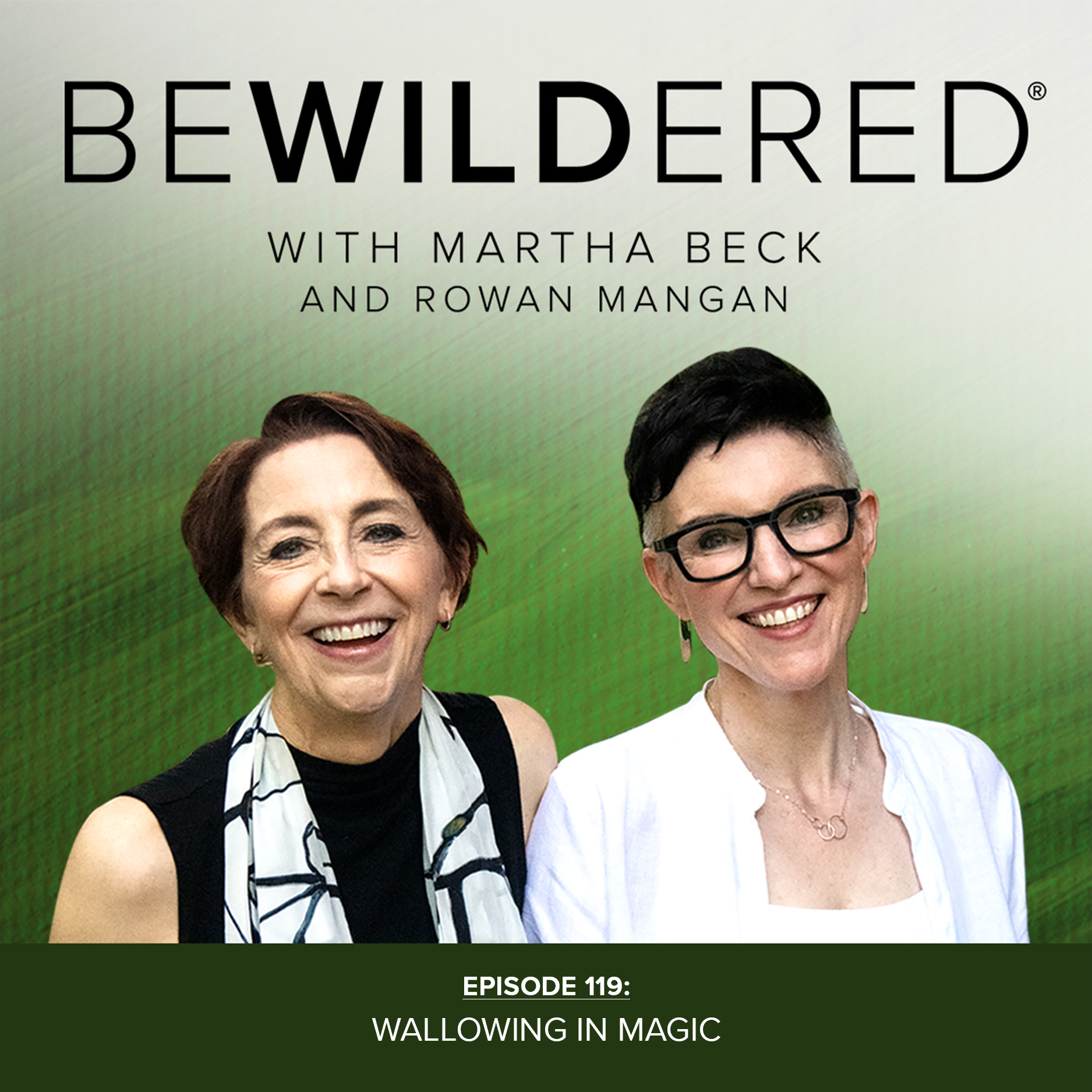
About this episode
What happens once you authorize your knowing? On this Bewildered, we pick up where we left off about authorizing our essential, deep knowing and explore the question: What happens next? We talk about what it means to stop living by the culture's rules and start seeing life as a video game where we’re not just avatars bopping around—we’re learning to write the code of the game itself. To hear stories of synchronicities and big moves that defied all logic, tune in and get ready to wallow in some magic!



Wallowing in Magic
Show Notes
What happens once you’ve authorized your own knowing?
In this episode of Bewildered, we’re picking up where we left off with “Authorize Your Knowing” and wandering into the wild territory of what happens after we let our deep, essential knowing pull us forward. (Spoiler alert: The next steps can seem pretty freaking out there!)
We talk about seeing life as a video game where we’re no longer just avatars bopping around and playing by the rules of the culture, but creators who can learn to write the code of the game itself.
We explore what Martha calls the “technology of magic”: the way that your inner knowing works through yearning, eros, and weird little nudges to pull you toward a life that brings you joy and expands your soul.
We tell stories about flat‑beer careers, beloved horses, and why often you have to “order off‑menu” instead of taking the business‑suit path of culture. We also go into the very specific, very bizarre synchronicities that moved us from Pennsylvania to the Catskills.
Along the way, we share our “three N’s” for playing the game of life your way:
- Notice what sparks real passion for you.
- Narrow it down to the most specific version of that desire.
- Name it (usually once it’s already a done deal).
Finally, we get into what we call “wallowing in magic”: imagining delicious futures in full sensory detail, following synchronicities that appear like Hansel and Gretel’s white stones on your path, and collecting and telling stories until the “dew point of magic” starts to feel normal.
If you’ve ever felt yourself going numb living a culturally prescribed life, or wondered whether your odd little tingles, imaginings, and coincidences might actually be the game inviting you to start writing code, this conversation is for you. Come wallow in the magic with us!
Also in this episode:
- Martha endures some lethally boring small talk.
- The bizarre rituals of Claire, the gravel-eating golden retriever
- Feeling relaxed while face-to-face with a lion
- Leaving toilet paper out in the rain: a metaphor
- Ro’s go-to question: “So…do you have a dog?”
TALK TO US
You can follow us on our Instagram channel @bewilderedpodcast to connect with our Bewildered community, learn about upcoming episodes, and participate in callouts ahead of podcast taping.
And if you’re a Bewildered fan, would you consider giving us a little rate-and-review love on your favorite podcast player? Ratings and reviews are like gold in the podcasting universe—they help people find us, they help build this beautiful community, and most of all, they help us in our quest to Bewilder the world…
Episode Links and Quotes
- Bewildered episode 118: Authorize Your Knowing
- Dr. Lisa Miller
- Sojourner Truth
- “Zizzing” song by Ani DiFranco
- Synchronicity by C.G. Jung
- “MacArthur Park” song by Richard Harris
- “East Coker” from 4 Quartets by T.S. Eliot
- “Vision Board” comedy bit by Maria Bamford
- Finding Your Way in a Wild New World by Martha Beck
CONNECT WITH US
- Follow Martha on Instagram
- Follow Ro on Instagram
- Follow Bewildered on Instagram
- Join us in the Wilder Community!
- Listen on your favorite podcast app
- The Bewildered Show Notes
- Is there something you’ve been feeling bewildered about? If so, let us hear from you!
Transcript
Please note: This is an unedited transcript, provided as a courtesy, and reflects the actual conversation as closely as possible. Please forgive any typographical or grammatical errors.
Rowan Mangan:
So Marty, fun episode coming up. The last time we spoke, it was about authorizing your knowing and giving permission for the deep knowing that goes far deeper than cultural expectations of us and tells us how we really should be living in our true nature.
Martha Beck:
Right.
Rowan Mangan:
And today we kind of picked up on that conversation at the point of: And once you have authorized your knowing, what are the next steps? And those steps are pretty freaking out there.
Martha Beck:
Yeah, I said it was like you’re playing a video game, you’re a character in a video game, but the character is just bopping around and suddenly starts to realize they can write the code of the game itself. And the process of writing the code of the world for your own life is something I call “wallowing in magic.”
Rowan Mangan:
We hope you enjoy this episode and we’ll see you on the other side.
Martha Beck:
Hi, I’m Martha Beck.
Rowan Mangan:
And I’m Rowan Mangan. And this is another episode of Bewildered, the podcast for people trying to figure it out.
Martha Beck:
So bewildered.
Rowan Mangan:
So bewildered. So trying to figure it out. What is on your figure-it-out list this week?
Martha Beck:
Oh gosh. I have been doing a lot of travel. Yes, yes. Interacting with many strangers on a kind of light social level. I know, right? People enjoy this, and I honor them for it, but I can’t.
Rowan Mangan:
I have a way of dealing with this. Do you want to hear?
Martha Beck:
Does it involve explosives?
Rowan Mangan:
Nope. This is what I do. “So do you have a dog?” If in doubt, just like pull out the old, “Do you have a dog?” It’s that moment when you realize you’re supposed to also ask them the question, right?
Martha Beck:
Yeah. I always just ask them if they’ve been attacked by an animal, any animal. I’m sure I’ve said that before on the podcast because that literally is my only go-to thing. But you and I had an experience some months hence, no, hence.
Rowan Mangan:
Does hence mean after right now?
Martha Beck:
No, no. Some months before. Hence.
Rowan Mangan:
No.
Martha Beck:
It does.
Rowan Mangan:
It does. It means—
Martha Beck:
Some months ago.
Rowan Mangan:
If in doubt, let’s go for the word we use every day.
Martha Beck:
“Do you have a dog?” We were sitting in a meeting. I will not say for what. I do not wish the—
Rowan Mangan:
You don’t want to cast aspersions.
Martha Beck:
No. I will cast no aspersions. But I will say we were sitting in there in this room, and there were maybe five or six people. We were waiting for one person who was coming late, and those six people had this conversation that I know you remember unless you’ve repressed it.
Rowan Mangan:
Oh, I remember.
Martha Beck:
I may need medication to forget it. They started talking about the problem with young people today.
Rowan Mangan:
And you always know that’s going to a good place.
Martha Beck:
Yeah. It’s that they don’t know how to make small talk. They were like, “They just don’t say anything. They’re just looking at their phones. And talking about the world, they don’t know how.” And everyone agreed, “Yes, this is the problem with young people.” And then they proceeded to do three and a half days of small talk, just to show us how it’s done.
Rowan Mangan:
It was unbearable.
Martha Beck:
“You know when you go down to the stands over at the KY and they have those lobster rolls? They have big lobster rolls.” “Really? Because I had a smaller lobster roll somewhere else.” “No, you got to go there. They get big.” “How big?” “There as big as your hand.” “Really? That’s a lot of lobster.” “Yeah. And then they sell you the bottled water.”
A five-hour discussion on bottled water. I literally thought I was going to have to die to get out of that room.
Rowan Mangan:
Yeah.
Martha Beck:
I was close to death actually. It was horrifying. And I realized I’m nowhere close, in my dotage, I am still nowhere close to being able to make small talk, which is the main problem with young people today.
Rowan Mangan:
“Do you have a dog? Oh, I’m so sorry. Oh, do you have a dog?”
Martha Beck:
We literally just sat there getting slowly more despondent and unable to function.
Do you remember it?
Rowan Mangan:
Oh, vividly. I think some part of me will always be in that room. Do you know what I mean? It’s like an escape room thing. But they just won’t stop talking about what the different bottled water brands are called and how much they cost. And they started listing prices.
Martha Beck:
The prices of each brand of bottled water, like an hour on that. I was fixated on this painting on the wall behind them. It was a woman and a child in a rowboat. And I began violently correcting the drawing errors in the painting, which by the way had a freaking ton of drawing errors, I have to say. And that it moved me into the right half of my brain so that they were just going, “Blah blah lobster roll, blah blah, lobster roll, blah, bottled water.” It was more bearable then. But still, this whole last month I’ve been traveling so much and somebody says, “Hi, I’ve read your books.” And I’m thinking, “Lobster roll. What do I do now?” I run. I hide.
Rowan Mangan:
Of course you do. How could you not?
Martha Beck:
A normal reaction.
Rowan Mangan:
Yeah, it’s hard. I mean, people are terrifying.
Martha Beck:
Yes, they are.
Rowan Mangan:
And it’s this weird thing where I have a fear reaction to awkward social situations.
Martha Beck:
Oh, me too.
Rowan Mangan:
And I’ve been face to face with a lion. It’s not like I don’t know the difference, but that was relatively relaxing.
Martha Beck:
Yes. Compared to being in that room with those people.
Rowan Mangan:
Why? I don’t know. Why does my nervous system act as though it’s a real threat when what it is is mildly inconvenient?
Martha Beck:
No, it’s a real threat. It’s a real threat. You don’t fit into the troop, see? The social primate troop. Like the baboon or the monkey, they have troops. And you get in if you can sit and groom the others and go, “Lobster roll.” But you have to put the right words in. They made it clear before they started that people who can’t do small talk are bad.
Rowan Mangan:
And young.
Martha Beck:
And young and that they have problems. And then they just took it to town, baby. It was like a virtuoso performance of these six people. Once the topic had been—
Rowan Mangan:
Established.
Martha Beck:
Yes, the gauntlet had been thrown and they all went in to show their skills. They were the most boring human beings being more boring, I think, than anyone had ever been. I’d never even conceived of a universe where people could be that boring, and it was a good thing for them.
Rowan Mangan:
I worry that people might be comparing our podcast with that experience, and I hope that’s not the experience.
Martha Beck:
Experience. I’m not saying you’re wrong. I just like to talk about being face-to-face with a lion. That’s more, to me it’s large talk. It’s what’s-her-face said, who wrote The Bell Jar.
Rowan Mangan:
Sylvia Plath.
Martha Beck:
About her college. “I was not good at small talk, and large talk was not encouraged.” And then she ended up being very depressed for most of her life, short life. So, Ro—she couldn’t make small talk. It’s practically lethal. So honey.
Rowan Mangan:
Yes, my love, my dear.
Martha Beck:
What are you trying, my sweet darling angel, what are you trying to figure out?
Rowan Mangan:
Well, do you have a dog? We used to have a dog.
Martha Beck:
“We,” you and I? Or “we,” you and someone else?
Rowan Mangan:
We, you and I and Karen used to have a dog named Claire.
Martha Beck:
Oh, Claire.
Rowan Mangan:
And I was looking at photos of her this morning, and I was remembering something that she did that I will be trying to figure out until the end of my days. Do you remember, and we might’ve even talked about it on this podcast before, back when Claire was still with us. It’s one of the weirdest things because dogs, most dogs, there’s a sort of range of behaviors, and they’ll do one or two little slightly individual things, but they sort of fit into a general range of behaviors. Claire was a different, Claire was an interesting one. And you didn’t know to meet her because she was a very good-looking golden retriever.
Martha Beck:
Beautiful.
Rowan Mangan:
Gorgeous. So it was weird.
Martha Beck:
Doggy Do Good Camp?
Rowan Mangan:
Well, I wasn’t going to talk about that. That was before my time.
Martha Beck:
We adopted her. She was a rescue dog. We took her to Doggy Do Good Camp where she would learn basic commands and comportment of dogs. And it was a two-week program, live-in, it was like boarding school. And after two weeks they said, “Could we keep her for another two weeks?” And at the end of the next two weeks, she had a vague, vague concept of the word “stay” but she didn’t really believe it. And it came with a certificate that said, “Claire is a very adorable dog. Her scores are very low.”
Rowan Mangan:
So one of the things that Claire used to do, and in Claire’s defense, she was not into small talk either.
Martha Beck:
Not at all.
Rowan Mangan:
She was in her own kind of universe. And in that universe, there were rituals to be observed. And one of her favorite rituals that we would find her doing on the regular, well, first of all, there was just a general personal hygiene thing, which was that her lower undercarriage—
Martha Beck:
Her—no, it’s not really a bikini area. The area between her belly button and her bikini area.
Rowan Mangan:
Yeah.
Martha Beck:
That patch of lower abdomen.
Rowan Mangan:
Yeah, where there’s not a lot of hair, but usually there’s, it’s not completely bald. No. With Claire that was kept completely bald.
Martha Beck:
Did she shave it? Did you ever catch her shaving it? It was absolutely bald and she kept it that way.
Rowan Mangan:
She kept it that way. And the reason that it had to be kept that way is so that the ritual could be observed, which was where she would go out and find herself some gravel.
Martha Beck:
Gravel. That’s true.
Rowan Mangan:
She would find herself some gravel and she would arrange herself just so. If you imagine back legs, oh gosh, back legs splayed. It’s actually, I don’t think a human body can do this. I didn’t even think a dog’s body could do this.
Martha Beck:
Oh no.
Rowan Mangan:
Anyway, her back half would be lying as though on its back. But her front half would kind of be twisted around in order that she could place the individual pieces of gravel carefully on the bald patch of belly. And then once she’d done that, it was safe to begin eating the gravel, which she did, but only if the four mentioned steps had been followed to the letter.
Martha Beck:
This bald area was like the size of a dinner plate. She was doing that right. It was obviously some sort of table setting, but the eating of the gravel, she had multiple surgeries.
Rowan Mangan:
A lot of rocks.
Martha Beck:
For eating gravel, but always in that specific ritualized way.
Rowan Mangan:
Yeah, I mean it’s terrible. We’re talking about a deeply traumatized dog and the things that come out of that. But still funny, but still.
Martha Beck:
Yeah. Her scores were—
Rowan Mangan:
Her scores were very low.
Martha Beck:
Very freaking low.
Rowan Mangan:
Yeah.
Martha Beck:
But we loved her.
Rowan Mangan:
She was always happy, though. Mildly confused, but willing to go along with whatever the group was into.
Martha Beck:
I swear when we got her, she was so nervous. You didn’t know her then. But she got into bed with me and she fully spooned me and pressed her muzzle into my head and I swear to God I could hear her thinking and she was like this, “Hello. I am slightly anxious. Could I please press my face against your face? That helps with my anxiety, please, please.” I actually wrote it into a novel, this feeling of having this snout pressed in my head while the dog was communicating telepathically. Or I was dreaming. Either way, it was the one time that she was verbal. At least in my mind. Whereas Bilbo, the dog we have now, is running a credit-card validation scheme or something.
Rowan Mangan:
Yeah, he’s up to something.
Martha Beck:
Yeah, he’s got a lot of things going on. I think he works for the CIA.
Rowan Mangan:
Karen just said to him with a straight face earlier today, “Come on, Bilbo, it’s time we go pay some invoices.” Bilbo was like, “No rest for the wicked. All right, off we go. Come on, then.”
Martha Beck:
Yeah, it was something. But yeah, we’ve never figured that out, what she was doing.
Rowan Mangan:
No, it will remain a sacred mystery.
Martha Beck:
And it’s really worth looking back on.
Rowan Mangan:
Thank you.
Martha Beck:
The mystery that is worth looking back on, that brings us to our topic.
Rowan Mangan:
Hi there, I’m Ro and I’ll be your podcaster for today. Do you know how to tip your podcaster? It’s actually pretty easy. You can rate our pod with lots of stars, all your stars. You can review it with your best superlatives. You can even subscribe or follow Bewildered, so you’ll never miss an episode. Then of course if you’re ready to go all in, our paid online community is called Wilder, a sanctuary for the bewildered. And I can honestly say it’s one of the few true sanctuaries online. You can go to wildercommunity.com to check it out. Rate, review, subscribe, join, and y’all have a great day now.
So those who listened to our last episode will remember that we left them on a little bit of a cliffhanger.
Martha Beck:
Pretty much.
Rowan Mangan:
Saying “Next time,” and by some miracle we remembered that we had said that. And here we are.
Martha Beck:
Here we are, remembering to do it.
Rowan Mangan:
To remember to do what we said we would do.
Martha Beck:
They have no idea how hard that is for us.
Rowan Mangan:
No idea. None. For you. We do this for you.
Martha Beck:
We do it all for you. Yeah. So last one was called, “Authorize Your Knowing,” and it was about this sort of deep, deep inner knowing that we have that goes beyond the mere cognitive. And the wonderful Lisa Miller who’s a psychologist at Columbia University and a doctor said, “You have to authorize that part of yourself to be your authority.” Authorize it to be your authority. Sorry. Oh my God, I need to go to Doggy Do Good. My scores are very low. So at the end of that, after we talked about authorizing you knowing, I said for the last couple of decades that I’ve been doing that, because I’ve done it quite a bit, it starts to feel like life is a video game, and we’re all just the avatars of ourselves in the video game. And if you authorize your knowing completely, you start to feel and see things that make you feel more that you are actually writing the code for the game. You’re no longer just knocking around dealing with the world as it is. You are somehow creating what’s happening.
Rowan Mangan:
Yeah, instead of playing within the rules, you start to create the rules. And we sort of, I think hinted that the synchronicities start happening, that as you authorize your knowing as you go into this way of living, shit gets weird.
Martha Beck:
It does.
Rowan Mangan:
In the best way.
Martha Beck:
Really, really good.
Rowan Mangan:
Yeah?
Martha Beck:
So good.
Rowan Mangan:
Yeah. So I think the way that it makes sense to me to kick us off is to talk about the, like what is it that we want to create in the video game? What is the thing that if we’re given the, I’m trying to do the video-game metaphor. If we’re able to write the code, what do we want the physics of our world to be? What do we want to create in our world?
Martha Beck:
Well, first of all, I don’t think we can create the physics of it, but there’s a way to work within the physics that you start to feel. So the first thing I want to say is that this will sound like magic. It will sound like magical thinking. And we were talking about this before we came in. It’s actually a way of knowing, and there are a lot of people who are in non-Western cultures who use it very ably. And it’s a kind of technology. I called it the “technology of magic” in one of my books. And the way that they operate in the world looks magical to us. So if you go to the rainforest and met an uncontacted tribe and show ’em your iPhone, they might say, “Magic!” and you say, “No, no. Technology.” And then they go out and pick three different plants and use specific parts of those three plants to cook in a sequence of steps that makes it a very powerful psychoactive drug. And you say, “How did you do that?” And they said, “The plants gave us the recipe. They sing and they tell us the recipe.” And we say, “Magic!” And they look at us and go, “No. Technology.” So that’s what I’m supposing here, that there is a technology of magic. And that is what I was talking about when I said I think you can write code in the game. But you’re right, it has to start out with what does your knowing want to have happen.
Rowan Mangan:
Yeah, and it’s such an interesting thing because you can want something with your brain or your encultured self and it has no oomph. There are things that, it’s like it doesn’t really begin with you. Does that make sense? It’s like something wants to happen, and that’s why I can get super excited about creating this one circumstance in my life, and just the other thing that looks just as shiny, I just can’t care. And it’s almost like the yearning itself is showing you what you can do and what you can’t do.
Martha Beck:
It’s the game inviting you to come write code. That’s what it is. And I was thinking about this client I had who had this problem of not being able to be enthusiastic about anything in her life. She wasn’t depressed, it was just everything was flat beer. And she was very successful. She was just finishing business school, and she’d been given all these job offers. And we talked about which one she wanted. And it was just, meh. She’d be like, “Yeah, that sounds good,” but I could feel that the juice wasn’t there. There was no heat. To use two different metaphors. And I was so puzzled. And we talked around this for three sessions, and then she started to talk about, “Okay, so I’m going to take this one in Chicago and I’ll do that and I’ll have to sell my horse.” And suddenly it was just like [buzzing] and I was like, “Wait, stop. Tell me about the horse.” All her joy in life was coming from this horse and her relationship with it and riding. And they’d go out together, and the horse was literally the being she loved most in this world, and she was going to get rid of it to go take any of these jobs.
And I was like, “Okay, I’m not going to tell you what to do.” But in my head I was thinking, “Turn them all down, stay with that horse.” And she did, ultimately. She came to that by herself, and she still was very successful, but she got to keep the horse. And what the video game of culture says is, “You take the highfalutin job in Chicago, you can’t turn that down. You can’t turn it down for a person, much less a horse. You leave your kids at home.” But that’s not what the game wanted of her. And that would not have been a game that would’ve expanded her soul.
Rowan Mangan:
Yeah, you’ve got to be willing to order off-menu. And the culture is very particular about the menu. And the menu is success, money, status, the appearance of fulfillment, if not fulfillment.
Martha Beck:
Right. Wealth, power, the whole, we all know that. The pyramid of power, wealth, and status is…
Rowan Mangan:
We know it and we don’t. Because you’re swimming around in water and you don’t know you’re wet. I think it’s one of these things that we have to keep reminding ourselves that we are breathing because it does look invisible a lot of the time. So it’s worth sort of saying, “Yeah, that’s not inherent, necessarily, that you want to move to Chicago and be a business suit person.”
Martha Beck:
Yeah, some people are lucky enough to have an Essential Self, I call it, that lines up with what culture looks on. Yeah, go do your Chicago thing, sell your horse if that’s what brings you joy. But there was no magic in it. There was no essence that matched the essence of herself. And so what I think we need to do is be very, very focused on our own knowing—that deep, deep knowing, that essential. I call it essential for two reasons: It’s absolutely needed and it’s the essence of who you are. It’s like a unique flavor that is only you. So you authorize that and then you start to receive ideas of what you want that seem to be collaborative with the world. They’re coming from inside you, but they’re also coming from around you, and they start to line up in this very, very almost spooky way sometimes.
Rowan Mangan:
Can I be really crude?
Martha Beck:
Yes, please.
Rowan Mangan:
So I think the difference between the thing that wants to happen and so you can make it happen and the thing that the culture might be whispering in your ear that that would be very nice, it’s like the feeling of excitement is either there or not. And so I was saying to you, it’s like you can either get it up or you can’t get it up. And I think people know what I mean by that.
Martha Beck:
I think they do.
Rowan Mangan:
Even the lesbians.
Martha Beck:
If not, just take it as a phrase. It means your excitement is up.
Rowan Mangan:
Yeah, yeah, that’s right. Something’s up.
Martha Beck:
But no, this is a really good point because the mind is the slave of the culture and the left hemisphere is the slave of the culture. And that’s what, you know, it makes measurements of what we should want and what we do want. And it will lead us astray. It will lead us straight down the lines of the cultural rules and maybe to our own misery. That woman would’ve sold the most important person in her life to take a job she didn’t want. That’s what your mind will tell you. But the reason the get-it-up analogy works is that it literally is the body. And you could call it the heart, you could call it the soul, but it shows up—I almost said manifest and that’s like a new agey word, but it’s real—it manifests first in your body as a kind of eros, which originally, it meant sexual desire, but it also meant “that which pulls you toward another thing.” Toward a sense of satisfaction you can get no other way. So we limit it to sexuality, but it actually has a broader application here. And your body is what responds.
Rowan Mangan:
Yeah, and it’s there or it isn’t there. And you can’t use will or willpower to make yourself want something that doesn’t want to happen through you. And so I feel like that’s an early part of the discernment that we can make.
Martha Beck:
Have you ever tried to do that? Tried to get it up for something like? Oh, come to think of it, you dated a lot of men.
Rowan Mangan:
Yeah, yeah.
Martha Beck:
There’s one example.
Rowan Mangan:
You can fake it.
Martha Beck:
Yeah. It’s easier to fake it if you’re female. But yeah, I think we’ve all done that. I mean, I tried so hard to want to be a Harvard professor. I really thought I wanted it.
Rowan Mangan:
Yeah, that’s why it’s tricky.
Martha Beck:
Yeah. I did not want a child with a disability. And when I went with the child with a disability, which is what my body, heart, and soul said to do, and my mind was just like, they were all telling me, “You’ve thrown your life away.” And I did, but it wasn’t the life I wanted. There was no eros in it. There was just work.
Rowan Mangan:
And that’s the thing that’s so interesting is the work that you do in the service of one of these things is so joyful. And it’s like having a tailwind. Oh my God, we’re into our metaphor soup. It’s like you have so much energy and so much, it almost feels like support behind you to do stuff.
Martha Beck:
And not just, it almost feels like support behind you. Things happen to help you. And they can be from the most trivial to the most incredible emergency. So when you’re very first starting to play the video game and write the code, there has to be the pull from within and without. And it starts to feel really reciprocal. It’s almost as if something wants you to want something. And it is very much like falling in love, really.
Rowan Mangan:
And there’s those little bits of feedback that come, just these little shiny things that come along the pathway to go, “Very good. Yes, yes. That’s right. You got it. Warmer.”
Martha Beck:
Yeah. And Lisa Miller said this. Synchronicities, synchronicities. Carl Jung had something going on. There will be synchronicities as you start to follow what wants to happen.
Rowan Mangan:
Isn’t that wild how that happens? It is just so fascinating. You can’t force it. Again, it’s like you cannot do this with willpower.
Martha Beck:
Yeah. It’s like Hansel and Gretel leaving the little white stones in the path. It’s just little synchronicities start to line up like they did when we decided to move to upstate New York. Just crazy. You could spend hours talking about the synchronicities that happened to us. And based on that and the feeling of being pulled, we moved our whole life. It was not like we have a job there. We just felt it.
Rowan Mangan:
And that’s the thing is that you almost have to, I feel like we need to step into a broader worldview for a second. So it’s like we did that. We were living perfectly happily in Pennsylvania, and then a series of nudges told us to move to this area, and we did. And the more we turned our head in the direction of here, the more synchronicities piled up.
Martha Beck:
Ridiculous.
Rowan Mangan:
Yes, yes. To the point that it was really silly and it was just—
Martha Beck:
People, strangers, running up to us in airports saying, “You should move to Kingston.”
Rowan Mangan:
Yeah. It was wild. And so what I feel like we need to communicate in here is what do we believe that we would abandon a perfectly okay situation to head into the unknown based on these little nudge? What is it? And I am actually asking you, even though I’m right in the midst of it.
Martha Beck:
It sounds so lame when I say it because culturally we are told that this is a lame reason to do things. But it’s this sense of passion. Again, it’s back to a metaphor of sexuality. There’s something almost erotic about the idea that wants to be born, the place that wants to go on, and you feel it. I feel it in my body as sometimes I feel the chill of truth. I literally get physical sensations of chills washing through me, along with all the synchronicities. And if you believe that following the synchronicities is the way to win the game, is the way to write the code, that is a—I don’t hold any beliefs tightly, but I don’t not believe that. I don’t refuse to believe that we are making the game and we’re programming the game when we follow this pull, along with synchronicities, along the path.
Rowan Mangan:
I think that the belief system is something like there is a quest that you can be taking in this game that will be a very rich and rewarding way to play it. And the sort of language we use is like I texted you and Karen when I first came to this town, “I think we’re supposed to move here.” We’re supposed to. And it’s not anything that we hold in some sort of complex cosmology or anything, but there is this sense of we are being pushed here for a reason. That’s what it is. There’s some sort of reason for us to be here. And it’s not like something bad would happen if we stayed in Pennsylvania, but something more exciting.
Martha Beck:
Yes, something good.
Rowan Mangan:
More shiny, shimmery, positive.
Martha Beck:
Yeah. And the key is we don’t know the reason. It’s like the T.S. Eliot lines that I used to hear in my head all the time: “Wait without thought for you are not ready for thought. I said to my soul, be still and wait without love, without hope, because they would be for the wrong things.” Wait without thought for you are not ready for thought, so you get pulled to a place. And I kind of have ideas about why it might be the right place to be, but actually I don’t know.
Rowan Mangan:
It’s so funny because we never are going to know.
Martha Beck:
No.
Rowan Mangan:
Right? Not in any definitive way. There’s no way to, and there’s no way to test it against any other timeline.
Martha Beck:
Can’t double-bind that shit.
Rowan Mangan:
No. You cannot double-blind that shit.
Martha Beck:
No, no. Double-blind. Okay. I said double-bind. Sorry. You can’t test it.
Rowan Mangan:
So you’ll never know, but we tell ourselves stories about it, which I find so fascinating, and I think humans just do this anyway. And it’s so interesting how storytelling wends its way into this way of living so much because it’s also how we then create the circumstances to let thing that wants to happen happen.
Martha Beck:
I actually think that the component of writing the game is storytelling. You tell it in your own mind, you tell it to your family, you tell it to other people, and if the story has juice, you can get it up for that story. And then there are stories that are like, “I need it. There’s a very good retirement package.” Which for me, I mean for some people, that would have juice. For me it doesn’t. So I think that’s actually the storytelling is the magic. Actually a lot of magical, a lot of writers who write fantasy will talk about the storytelling itself as being the creation of a world.
Rowan Mangan:
I also wonder whether—because I’m thinking to me, it’s so great to have this really recent example of this totally madcap scheme of moving to another state for no reason. And it’s constantly something that people are asking, “So why’d you move here?” I had a feeling, a tingle.
Martha Beck:
Yeah. There were tingles and there were synchronicities and here we are.
Rowan Mangan:
And here we are. But it feels to me as though the experience of when you’ve authorized your knowing and you’re starting to be steered a little bit, not in any directive way, but in a “If you want, you could do…”
Martha Beck:
Yeah, a desire way.
Rowan Mangan:
Through your desire, the storytelling becomes the way that we unite the spiritual or the meta or the part of us that isn’t in form with the part of us that is. Or you might say you bring it through the whole brain by setting a story to something that is largely outside of language, which is just this warmer/cooler feeling.
Martha Beck:
Yeah. The storytelling is the magic that links. I mean the right and left hemispheres, the left hemisphere is the more verbal, and the right hemisphere only uses words for songs, jokes, and poems. But also—that’s what it says in the literature—but I also think that a great story is going on between both hemispheres. So you’re absolutely right. That’s why writer’s block is so hard. When you do dancing or visual art or whatever, you’re just in your art, but with storytelling, you’re painting pictures but with words. So you’re having to use both sides of the brain, and it is actually quite difficult to tell a story that really has life in it. And you’ll tell a story, I mean, I tell myself stories about why we moved to New York that are just flat beer. And then I tell other stories and they’re always just like, “Well, I became obsessed with Sojourner Truth, who was a great Black emancipator feminist, brilliant, genius.” Obsessed. I wanted to be a sojourner. I told you, right?
Rowan Mangan:
Yeah.
Martha Beck:
And you came back from New York going “This place, this place is amazing.” I was like, “Shut up. I want to be a sojourner like Sojourner Truth.” And then you said, “Well, where did she live?” “Kingston, New York.” There’s a national forest named for her here. And I’m still obsessed with Sojourner Truth, but it was just so—where did that come from?
Rowan Mangan:
Oh, there are so many stories. There are even better stories than that that we could tell. But I feel like the storytelling piece is also where we encounter the culture and where the “authorize your knowing” rubber meets the road because you’ve got to, it’s just like all the small talk. It always happens in the small talk. “And so where did you move from and why did you move?” “Do you have a dog?”
Martha Beck:
“Lobster roll!”
Rowan Mangan:
Oh God.
Martha Beck:
It’s horrible.
Rowan Mangan:
And then you don’t have an answer because you don’t know how to tell it in that vernacular anymore.
Martha Beck:
The magics, the real chain of thoughts and events that brought us here, it’s like leaving toilet paper out in the rain. The story just falls apart. So the culture—
Rowan Mangan:
It’s like leaving toilet paper out in the rain? Is it? That well-worn thing that people do?
Martha Beck:
It’s a variation on the song “MacArthur Park” where you leave a cake out in the rain. This is toilet paper. Look it up, folks. My point is there’ll be, if we told the real story—well, we’re telling it. Ro really liked this place, fell in love with ginkgo leaves. We saw one single ginkgo leaf later where it shouldn’t have been.
Rowan Mangan:
We actually talked about this on the podcast.
Martha Beck:
Oh yeah. Okay. So people ran up to us talking about Kingston, New York, for no reason. I somehow had this idea that some of my friends lived there. I had no idea where they lived. Same place. I didn’t know, but I did know in some weird thing. And that’s what I mean, it falls apart because subjected to the culture’s stringent standards of what is important, that just has no fiber, it just falls apart.
Rowan Mangan:
Like toilet paper in the rain.
Martha Beck:
And I don’t think that I can take it. Sorry, that’s from “MacArthur Park.” Now we’re getting to a point here, so I don’t want to lose it. This flimsy story from the culture’s perspective, all the time I’m telling clients to follow that. And then I’m like, “Okay, we need a cover story for you. We need a cultural cover story while you investigate this magic that’s happening in your life.” I’ll say to some kid, “This is what you’re going to make. Your passion will combine these weird courses. We’re going to tell your parents this.”
Rowan Mangan:
You have to frame it up in a way that the culture can understand. And honestly for me, most of the time now in these small-talk situations, it sounds like, “Fell in love with it, came to visit, fell in love with the area, we work for ourselves, so we can work from anywhere. Deal with it.”
Martha Beck:
Sounds like we’re just so wealthy, we can just pop in and buy a home anywhere. “Do you have a dog?” But to us, following that is writing the code. And we’ve been doing it for a while. And there’s a kind of methodology that I use and I call it the three N’s: Notice what gives you the passion. And then start to Narrow it down, more and more and more specifics. And usually only when it’s already a done deal do you come to Naming the thing. So you notice first what you can get it up for. You narrow it down to the most intense version of that feeling and you may find yourself doing something or moving somewhere. Our address only became the name of our home once we’d already moved, when we bought that house. So naming it was the last thing. And mostly you’ll go towards something by noticing and narrowing, narrowing, narrowing until you come up with just a few options and go to the one that has the most heat.
Rowan Mangan:
So we’re talking about when you’re wanting to make something happen in your life, you notice where the excitement lies. Because otherwise you’re just not going to be able to make it happen. It’s just not going to happen.
Martha Beck:
Without that energy, it will not happen.
Rowan Mangan:
So forget it. If it’s just a thought form, it’s most likely cultural. And if not from the culture at large, then from a culture that you have participated in at some point.
Martha Beck:
Family culture, religious culture, whatever.
Rowan Mangan:
Yeah. Sorry. That’s it. That’s not going to work.
Martha Beck:
Not going to work.
Rowan Mangan:
If it’s got juice, you start to move towards it and notice, narrow, and then eventually name.
Martha Beck:
I have to prevaricate for a bit. You can make things work, but they become more difficult and boring and awful the further you push them down: “I’m going to live the culturally approved life.” And when you let go of that and you go with the magical version, with the code-writing version, that’s when things start coming together magically or seemingly by magic.
Rowan Mangan:
So we’ve noticed where the heat is, we are narrowing it, and eventually we can name it. Then what? Then what do we do?
Martha Beck:
So once you’ve noticed what you want and you’re starting to narrow it down, what happens is your imagination starts to create pictures. The storyteller in you doesn’t just have words. It’s actually starting to give you images and almost sensory experiences of what it could be like, this thing that you love.
Rowan Mangan:
Right. And so then it’s almost like your role is not as passive receiver of that, but you actually have to get invested in them.
Martha Beck:
You have to actually imagine the deliciousness of the thing that is going to happen before it has happened. Which is really hard because a lot of people don’t want to get their expectations up because they’ll be crushed. That’s the cultural thing. It’s safer not to trust anything until it’s there. But actually the experience of something coming true is just the final conclusion of somebody imagining that experience in the past. There’s nothing around us that was not made from imagination before it was made from three-dimensional stuff. And in this case, there’s a feeling tone to what you want to experience. So I had this thing, I don’t know, maybe you have one too, but when I was trying to get published, that was back when publishing was a thing, and I had this very vivid fantasy, based on many movies, of going to a Manhattan restaurant with my publisher and my editor and all the publishing people, and they would buy me lunch and talk about my book. And it was years before that came true, but I experienced it every single day for years. It was just a place I went to wallow. It felt yummy.
Rowan Mangan:
So you’re like watching the movie in your head of that happening. And what that means, what you’re situating that in is: “I have a publisher, I have an editor, I am a published author.” Right? And so that’s the thing, that’s the goal. But what you’re doing is you’re telling this really rich and vivid story in your head of going to this restaurant.
Martha Beck:
Full sensory, the smells, the sounds of, I can still remember how I would sit there. And I was alone in Phoenix or taking care of kids who were throwing up, and I could hear the utensils clinking and I could smell that restaurant. And it’s not like I was like, “I’m going to make this happen, so help me God, I’ll imagine into being.” It was easy. It felt like it was given to me, and it went on and on and on. And every single day I enjoyed it.
Rowan Mangan:
And that’s why it’s wallowing and not forcing or eating your vegetables or doing your homework. No, it’s just for fun
Martha Beck:
You think maybe you’re thinking it up, but it also feels like it’s being given.
Rowan Mangan:
So I have one of these, but it’s very embarrassing, and it does make me look like a weird little stalky freak, but that’s not going to stop me. So here we go. I was in Australia, I was reading your books and I was thinking, “Yeah, I think I’m supposed to be friends with her at least, at the very least.” And you have so much stuff out there that you can listen to, and so I would have your voice on in the car or something. And over time I started to, at one point I imagined you and Karen coming to my house in Melbourne and it didn’t really, I couldn’t get a lot of lift in that one. It was fun, and I can still picture it, I can still picture the scene as it played out in my little movie, but that wasn’t it. It was about going to your ranch in California. And I’d heard you say that there was a butterfly gate, a gate in the shape of a butterfly, which is one of your symbols and it was one of the amazing things that drew you to the ranch. But for me it was like a little, it’s like a signal. It’s in the same way that you are like, “Here is my editor. Universe, take note. One does not have a publisher if one is not published.” Mine was like, “I am going to a very specific coordinates of longitude and latitude. Look for the damn gate.”
Martha Beck:
Yeah, yeah.
Rowan Mangan:
So my thing that I would imagine—there were actually two. One was having dinner with you and some of our friends, and the other one was arriving at the ranch to say hi and a reunion of sorts, and it was in such vivid detail. I drove up and I was in a black jeep. I don’t know what that was about. Never been in one, never, that’s what it was. That didn’t eventuate, the universe understood that the car is never the important part, unless it’s a van. And getting out and you, Karen, Adam coming through the gate and walking up and just being like, “Hey!” Like in that “Yay, we made it!” kind of way. And that would just play and in so much vivid detail and it was, it’s like eating an ice cream or something. It wants to play.
Martha Beck:
You’re happy when it’s playing.
Rowan Mangan:
Yes.
Martha Beck:
You don’t actually need to go anywhere else. I remember one time when I was imagining some wonderful glittery celebrity event before I sort of got out of that cultural mode, but I was going to be with these celebrities and one of them called me and she had a problem she wanted to talk through and I literally was like, I was ready to hang up the phone because she was interrupting my fantasy of her. And that’s how delicious the meeting was in the future. And it happened, but she was actually interfering with the deliciousness of my fantasy of seeing her later.
Rowan Mangan:
You’re like, you are gathering the fuel to bring it all the manifesting new age people are like, “You are bringing it from the field of all possibility into…”
Martha Beck:
I don’t not believe it.
Rowan Mangan:
No, no, no. I mean I don’t have an explanation for it. I just know that that’s the fuel that generates the thing happening in these apparent three dimensions, right?
Martha Beck:
Yes. The sense of wallowing.
Rowan Mangan:
Yes. Wallow in advance.
Martha Beck:
Wallow in advance. And our friend Boyd Varty in Africa, who was raised in South Africa, he always said that when the animals wallow in the mud, they go “Ooh loo loo.” And really when you get, it’s not thought construction, it’s an imaginary construction that involves all the senses, and it’s so delicious, you wallow in it. That’s the sound you make: “Ooh loo loo!” And I remember you coming through that gate and the weird sense of joy I had, like “I barely know this woman. Why do I feel so very pleased she’s coming through the gate?” It was almost as if the story was happening to both of us. I didn’t know that you had that story, but your story was strong enough to give me so much energy that when I saw you, it was like the joy of that story in your mind that you’d been basking in, communicated to me, to the point where I was kind of like, “Why do I feel such a strong sensation of pleasure that this person has shown up?” It’s really interesting.
Rowan Mangan:
It is. It’s like the atoms have been polished around the moment and so they’re just a bit shimmery when it happens. I don’t know.
Martha Beck:
And that when it actually happens, you don’t have much time to wallow.
Rowan Mangan:
That’s true.
Martha Beck:
It’s just like when I finally got that lunch with my editor and my publisher and everybody, I got up and went to the restroom, not because I had to, but so I could stand in the restroom, I mean, not stand in the back of the restaurant and smell the smells I’d been smelling for years and listen to the silverware clinking and see the table where we were sitting. And I really took a photograph with my whole mind and body because that was wonderful to wallow in and then I wallowed in it afterward. These wallows are things to keep doing. Ooh loo loo.
Rowan Mangan:
Well, and I think what happens then is that you’re—there’s a word, there’s a cumulative power to having experienced something come true before.
Martha Beck:
That’s right.
Rowan Mangan:
That buoys up like your belief in what you want to create next. You said a minute ago, you can’t test this, and of course you can’t scientifically, but once it has tested out experientially over and over and over that you have this feeling of wallowing, you notice what you love, you narrow it down, then you wallow, wallow, wallow, and it freaking happens? And then you wallow, wallow, wallow some more, you start to collect dozens of stories of this happening. And I think this is why in fairytales, the witches, the sorceresses or whatever, and the sorcerers, they’re always older because they’ve had the experience of the magic working and working and working to the point where they just stop doubting it. And they stop going off after cultural stories and just invite ooh-loo-loo, bring it to me. Right?
Ani DiFranco has a line.
Martha Beck:
I can’t believe you mentioned Ani DiFranco.
Rowan Mangan:
Poet Laureate of the show.
Martha Beck:
Yes, indeed.
Rowan Mangan:
Has a line that I only just realized that this is what she’s saying is what you’re saying. And the line is: “Our magic should be more powerful as the years go by.” And I think that’s it. I think it is. It gets some momentum when you see it work.
Martha Beck:
Yeah, and when you’re trying to build things the cultural way, you tend to get exhausted. Maybe you succeed for a while, but ultimately it doesn’t feed you. So the feeling is deflation even if you succeed. More often, you can’t succeed, and life becomes more and more discouraging. And I think it’s because we’re always being pushed toward learning to write the code. So doing it the cultural way is never reinforced by the game. The game responds when you start to feel the magic and then wallow, wallow, wallow. And the more times you wallow on something that has happened before—this is something I really noticed as we were talking about this—our whole relationship is about wallowing in the moments that have happened and the ones that are to come. And the ones happening now.
Rowan Mangan:
And actually, wallowing in the things that have happened, another word for that is gratitude, right?
Martha Beck:
Yes, indeed.
Rowan Mangan:
It’s looking around. And I mean the other person that you and I both manifested into our lives is our friend Liz Gilbert, our wonderful friend, who separately we were both, “Yeah, probably going to end up being friends with her.”
Martha Beck:
Oh my God. I would have dreams about her, and I would analyze the dream to see what she represented. And she was always just Liz.
Rowan Mangan:
Just Liz.
Martha Beck:
And I went, okay!
Rowan Mangan:
And one of the things that Liz often says, and that we have stolen shamelessly from her, is just that we are the luckies.
Martha Beck:
We are the luckies.
Rowan Mangan:
We ones who are the luckies.
Martha Beck:
And we spent a lot of time going over it in such detail why we are so the luckies. Can you believe that? And by the way, the same time you were first at the ranch, Liz came for the first time. And so I didn’t know you’d been thinking about her as friendship material. I thought it was just me manifesting—not manifesting, that’s so new agey—it was part of the physics of reality that we were already friends. You and I were already friends. Liz and we were already friends, but it all came together in a very, very small space of time, within three or four days, and we’ve been wallowing in it ever since.
Rowan Mangan:
But we’re not insufferable.
Martha Beck:
Maybe we are.
Rowan Mangan:
But what I mean is we’re not smug, we’re delighted. And we’re excited about playing the game.
Martha Beck:
And it’s like you wanted a dog and you went online. This was during the same period basically. And we found the right dog and it was our dog. And ever since then, every time we pet Bilbo Baggins, I’m like, rope totally just pulled him in from the universe.
Rowan Mangan:
And actually that’s an interesting one. I hadn’t thought about that, but remember that feeling that I had? I was just annoyed that our dog wasn’t with us yet. And I was like, “Where’s the dog?”
Martha Beck:
Where is the dog?
Rowan Mangan:
And then Claire would come in like, “Huh?” I’d be like, “Oh sweetie, not you.”
Martha Beck:
She needs surgery again. And I remember going online to look for dogs that needed homes, and we saw him and not many people adopt black dogs. And we saw him, and both of us felt that [buzzes] the magic, and you started to wallow in this. You made a 60-page dossier to give to the people at the shelter about why we should be the ones to adopt this dog.
Rowan Mangan:
To the family that had him, yeah. And they had someone else who’d expressed interest first, but I don’t be putting up with that.
Martha Beck:
The storytelling came on board. These are the places he will run free and be happy.
Rowan Mangan:
I had photos.
Martha Beck:
Of all the places and things that he would have. And they told it, so they called us because you did this incredible storytelling job of “This dog is supposed to be with us.” So they were shaken, or maybe the universe was working with them too, because they called us and they said, “Okay, we would love to meet you and see how he responds to you. His name is Wall-E after a comic book character or movie character.”
Rowan Mangan:
Yeah, little robot guy.
Martha Beck:
And they said he, “He’s never learned his name. It’s quite frustrating. He’s not stupid, but he just won’t come. But if you do [kiss sounds] and ‘Here boy, here boy,’ he will come.” And then you and Karen drove for five hours to the middle of the desert.
Rowan Mangan:
Yes, we did.
Martha Beck:
To meet this little cockapoo. And as Karen tells the story, you got out of the car and we’d already decided what his name was, or we sort of pulled from what we felt, what his name was. You got out of the car and said, “Here, Bilbo.” And this dog came running straight to you. He has always responded to that name.
Rowan Mangan:
He has. Yeah. Little guy.
Martha Beck:
And how much fun is it to wallow in that experience and how you brought him home and how he is the perfect dog. And I mean, Claire was also the perfect dog. They’re all the perfect dog. But Bilbo is an intellectual and very helpful.
Rowan Mangan:
He’s a lover of the finer things.
Martha Beck:
He is a lover of finer things.
Rowan Mangan:
He’s a payer of invoices.
Martha Beck:
He is. He’s a great being. And he was always named Bilbo, apparently, because that’s what we got, and that’s what he got.
Rowan Mangan:
And because you don’t call a fucking dog, Wall-E.
Martha Beck:
I know. You don’t do that.
Rowan Mangan:
You don’t do that.
Martha Beck:
“Do you have a dog?”
Rowan Mangan:
“Do you have a dog? And if so, why?”
Martha Beck:
It can be the tiniest thing, like, “I really wanted some carrot cake. I went to the store, they had carrot cake.”
Rowan Mangan:
Tell the Maria Bamford one. So Maria Bamford was learning from her sister, the life coach, the Martha Beck Life Coach. Hi, Sarah.
Martha Beck:
Hi, Sarah. She’s really good.
Rowan Mangan:
And Sarah was teaching her sister Maria Bamford, most brilliant comic in the history of the world.
Martha Beck:
So funny.
Rowan Mangan:
So funny. How to manifest shit. And please take it from here, Marty.
Martha Beck:
So she said, “Tell the universe what you want, and the universe will give it to you.”
Rowan Mangan:
If you want, stick it on a vision board.
Martha Beck:
And Maria said, “Well, I need a microwave.” And Sarah, according to Maria’s later comedy routine, said, “A microwave? All you want is a fucking microwave? I’ll buy you a microwave.” Boom! Manifested! But it was, that’s the thing, it just—stuff like that keeps happening, and usually it looks really normal. Sometimes it’s so far outside of normal that you’re just thinking, “What the hell made that happen?”
Rowan Mangan:
Three women? Living together? Come on.
Martha Beck:
In a highly satisfying domestic situation.
Rowan Mangan:
That can’t be.
Martha Beck:
But we imagined Lila the same way.
Rowan Mangan:
Yes, we did. That’s our daughter.
Martha Beck:
I mean, in such detail. We’ve imagined. You imagined the garden that you’re making right now. So blood, sweat, and tears are going into doing that. You were outside heaving woods.
Rowan Mangan:
I was playing.
Martha Beck:
Well, you were doing hard physical labor, that’s all. I was not going to go out there and help you “manifest” this. So she was lugging around very heavy objects and doing things that have to do with, I don’t know, where the sun is at different times. What the hell is this? It just doesn’t.
Rowan Mangan:
You cannot get it up for the garden.
Martha Beck:
I can’t get it up for the garden. No.
Rowan Mangan:
And she tries to life coach me out of doing gardening and cooking. She’s like, “No, sweetie, no one enjoys that.”
Martha Beck:
Meanwhile, you’re always trying to get me off the hook for building furniture, which is the one thing I love more than anything else in the world.
Rowan Mangan:
And you’ll say four-letter words and injure yourself and bang yourself in the head with a hammer.
Martha Beck:
I love to hate it. But yeah. So what I’m saying is you put your blood, sweat, and tears into it. You put the muscle into it when the pull is there, when you can get it up. Then you go find the thing you love and you court it and woo it or whatever. And then the whole universe starts to be feeling the same thing toward you. And that’s when it gets really extraordinary.
There’s not enough time to tell all the stories that have happened to me. And as I get older and there are more stories to tell, and I’m wallowing all the time, the world, the world plays the game with me more and more and more directly, to the point where I decided that when the vision of the thing you want has been wallowed in long enough, it starts to feel normal. Magic feels normal, or what we would call the technology of magic feels normal.
So the way I put it is it’s like the dew point of magic is normal. The dew point is the temperature that it takes for water to condense out of steam and become liquid. So if you’re outside at night and the temperature drops and it’s a misty day or a humid day, when the temperature drops low enough, dew forms spontaneously on the grass as if by magic. It’s not magic. This is the way the universe works.
Rowan Mangan:
It’s technology.
Martha Beck:
And when you get to the point where you’ve wallowed in something truly sensuously beautiful for you for long enough to feel like it’s just normal, that’s when it happens.
Rowan Mangan:
Oh, this is the day when I get out of the black Jeep and everyone comes out and says hi. And it’s like, oh, it’s so good to see you again. It’s not a big deal. It’s just, Hey, cool. Oh, that’s going to be so nice. I’m really looking forward to that.
Martha Beck:
Exactly. And the more it happens to me, the more I’m like, “Well, yeah, I wrote the code. Everybody around me is helping write the code. We’re all on the same page. Everything’s conspiring to help us.” It’s pronoia, which is the opposite of paranoia. Instead of being afraid the world is out to get you, become crazily convinced that everything is out to help you.
Rowan Mangan:
I think there’s also, there’s friction in it as well, though. It’s not just whoopee down the water slide. It’s like, to me, there’s also a period of time where the normalness of the movie I’m watching about the thing and the absence of that thing is just very frustrating. It’s like, “But the movie, the restaurant, the silverware is clinking. Why can I not see this now?”
Martha Beck:
And to me, that is the hero’s call to adventure. In the hero saga that is in every culture, it is the feeling of, “I know things are meant to be, I can’t really specify it, but I am feeling like the way things are now is somehow wrong.” And the pull is, “Will you dare to go on an adventure with no obvious outcome except the potential feeling that maybe it’s going to be the right thing?” So it takes you away from the normal world, and the hero always rejects the call. And then it comes again. It won’t stop. And then finally, he leaves the normal world.
Rowan Mangan:
Pennsylvania.
Martha Beck:
He leaves the normal world and goes into the other world, and all his adventures take place there. And it is hard, but the battle is not only with, well, it’s not at all with the circumstance around you. The battle is with your own disbelief that what you’re wallowing in is real.
Rowan Mangan:
Yeah, yeah. Sorry, I got distracted by a meme that I saw the other day that was like, “I’m in my forties now and I still haven’t had a call to adventure. I’m a bit worried that I’m not a protagonist.”
Martha Beck:
“I’m not the protagonist.” And you know what? If culture had its way, nobody would be the protagonist except maybe the people at the very top of the pyramid.
Rowan Mangan:
Well, it would be The Truman Show, and the whole point of The Truman Show was to advertise the pancake mix or whatever.
Martha Beck:
And it’s so deflating. Life becomes really meaningless when that’s all you’re chasing. But if you can find where the heat goes and then start wallowing in it right away, and then it comes and it’s normal, ao you just wallow in it as it happens, and then you keep wallowing…
Rowan Mangan:
And tell the stories of the magic that has happened.
Martha Beck:
Yes. The storytelling, which is the active agent of the creation, it has to keep going. Then it becomes legend about what happened.
Rowan Mangan:
And then the dew point of magic being normal is every day. And so the wonders just keep rolling towards you because that’s normal.
Martha Beck:
And honest to God, for me, there are a lot of days when I don’t necessarily feel that way, but I’d say the majority of days feel like the universe is conspiring to support me in ways that are just flabbergastingly magical.
Rowan Mangan:
Yeah.
Martha Beck:
So I’m going to tell that story.
Rowan Mangan:
So glad we authorized our knowing and that we–
Martha Beck:
Made it write a story. Because it’s an author now.
Rowan Mangan:
That’s right. It’s going to lunch in Manhattan.
Martha Beck:
Yes, it is. “Do you also have a dog?” Yes, I also have a dog. You need a dog? I’ll buy you a dog. Boom!
Rowan Mangan:
Manifested! And that’s how we… stay wild.
Martha Beck:
Stay wild.
Rowan Mangan:
We hope you’re enjoying Bewildered. If you’re in the USA and want to be notified when a new episode comes out, text the word WILD to 570-873-0144. We’re also on Instagram. Our handle is @bewilderedpodcast. You can follow us to get updates, hear funny snippets and outtakes, and chat with other fans of the show. Bewildered is produced by Scott Forster with support from the brilliant team at MBI. And remember, if you’re having fun, please rate and review and stay wild.
We’re also on Instagram. Our handle is @bewilderedpodcast. You can follow us to get updates, hear funny snippets and outtakes, and chat with other fans of the show.
For more of us, Martha’s on Instagram, themarthabeck. She’s on Facebook, The Martha Beck, and she’s on Twitter, marthabeck. Her website is, MarthaBeck.com. And me, I too am on Instagram. Rowan_Mangan. I’m on Facebook as Rowan Mangan. And I’m on Twitter as RowanMangan. Bewildered is produced by Scott Forster with support from the brilliant team at MBI.
Read more
Questions? Comments? Trying to figure something out? Email us! [email protected]
Credits
Wandering The Path by Punch Deck | https://soundcloud.com/punch-deck
Music promoted by https://www.free-stock-music.com
Creative Commons Attribution 3.0 Unported License



0 comments