

About this episode
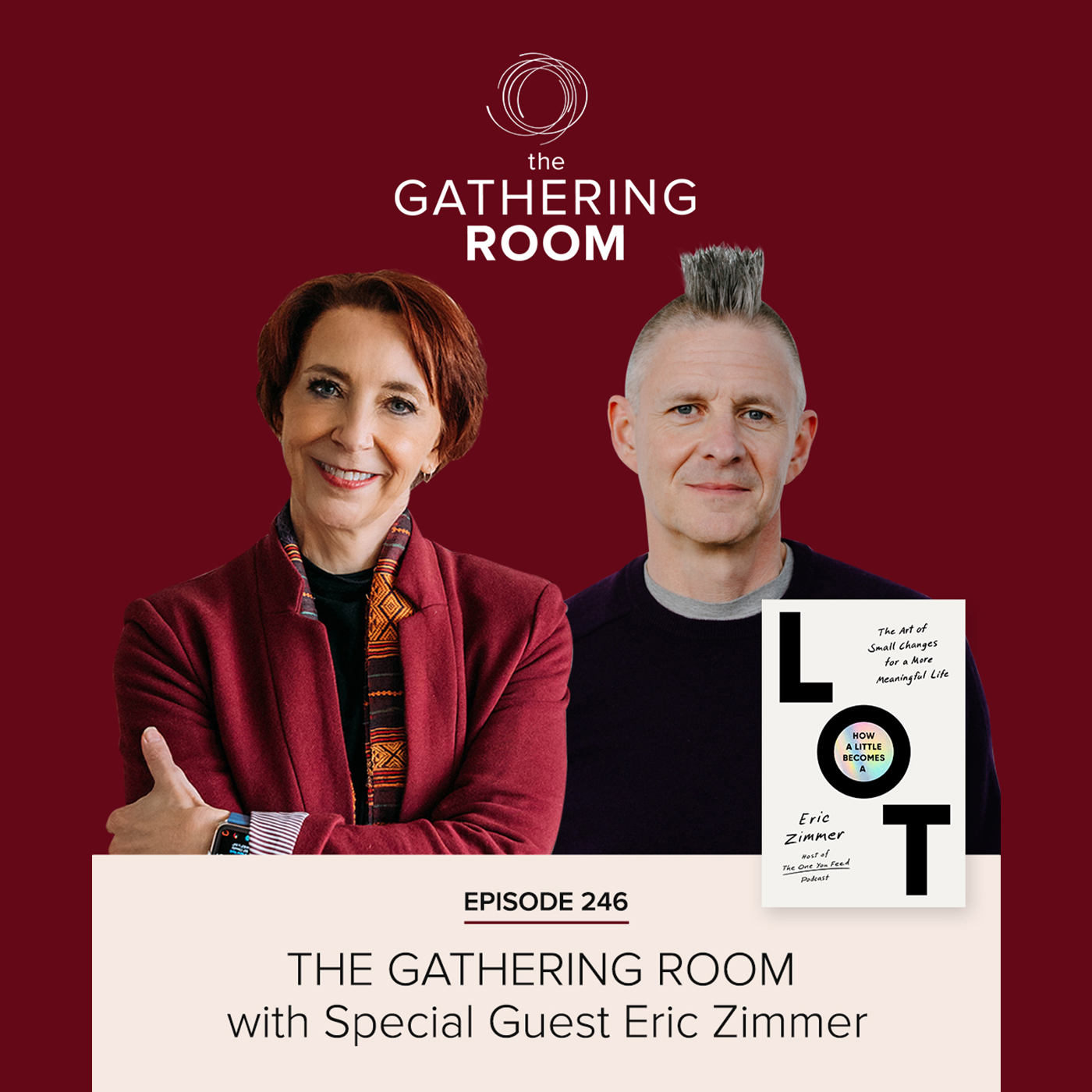
In this special episode of The Gathering Room podcast, I sit down with the brilliant Eric Zimmer, author of How A Little Becomes A Lot—one of those rare self-help books that’s easy to read, backed by science, and deeply spiritual. In our conversation, Eric shares his “still points” for embedding tiny shifts into your busy life, “choice points” for building good habits, and Zen insights on the unbroken unity of everything. It’s a life-changing book and an inspiring conversation, so be sure to tune in!



Special Guest: Eric Zimmer
Show Notes
Meet Eric Zimmer: From Homeless Addict to Wisdom Keeper
Today we have an extremely wonderful treat in store for us, the brilliant Eric Zimmer, author of the new book, How A Little Becomes A Lot: The Art of Small Changes for a More Meaningful Life. I read dozens of self-help books and rarely find anything that is easy to read, backed by science, and also deeply spiritual, which makes it such a perfect fit for The Gathering Room.
Eric himself is amazing. At 24, he was a homeless heroin addict, jaundiced from hepatitis C, and facing up to 50 years in prison. Today he’s an author, teacher, speaker, and host of The One You Feed podcast, one of the top self-development podcasts in the world, with over 50 million downloads across 800+ conversations. His journey isn’t just inspiring. It’s instructional.
Why Epiphanies Aren’t Enough and What Actually Creates Change
We’ve all had that lightning-bolt moment: the come-to-Jesus realization that everything is different now. And then, a week later, we’re right back where we started. Eric explains why this happens and why it’s not a personal failing. The epiphany matters, he says, but it’s everything that happens after that moment that gives it meaning.
Real change is built not in grand gestures but in the quiet accumulation of small, consistent actions: moment by moment and day by day.
What Are “Still Points” and Why Do You Need Them?
This is a concept from Eric’s book that I really relate to. “Still points” are intentional micro-moments, just one minute or less, woven into the existing architecture of your day. No extra hour needed. No cleared schedule. Just a recurring prompt (like an alarm or a trip to the bathroom) and a tiny act of reflection, breath, or presence dropped into that container.
Eric developed this effective method for people with busy lives who don’t have an extra hour and a half to meditate, journal, clear their chakras, or cold plunge.
The Power of Choice Points for Building Better Habits
Still points are about presence. “Choice points” are about behavior. Eric draws a clear line between the two, and the distinction changed how I think about habit-building. A choice point is the exact moment when you are face to face with your decision: Tuesday at 10am, when it’s time to go for that walk you scheduled.
Everything before that moment is structure and planning. Everything at that moment is an internal game. And knowing which game you’re playing is half the battle.
The Six Saboteurs of Self-Control
At the choice point, something usually gets in the way. Eric identifies six recurring “saboteurs”: the thoughts and feelings that steer us away from what we actually want:
- The Autopilot Pitfall: acting without awareness (like mindlessly checking one’s phone)
- Emotional Escapism: avoiding the feeling that the action brings up
- The Self-Doubt Stalemate: thoughts like, “I can’t do this, I’m not good enough”
- Overwhelm: the goal feels too big to start
- Instant Gratification: the pull of the easier, faster reward
- Rebellion: the part of us that resists being told what to do, even by ourselves
As Eric reminds us, you don’t have to eliminate these. You just have to get skillful enough with them to take the next step.
How Extreme Language Creates Extreme Emotion
One of my favorite parts of this conversation and Eric’s book is his insight that extreme language causes extreme emotion. As Eric describes it, when he says his back is “killing” him, he’s not describing reality accurately. Instead, he’s narrating reality in a way that’s more extreme. Because what he actually feels is a slightly tight left hip.
The fix isn’t to “turn that frown upside down.” It’s precision and nuance. Swap “always” and “never” for “sometimes” and “maybe.” Swap “everyone” and “no one” for what’s literally, specifically true. And then feel your nervous system exhale.
The Structure-Story Framework for Lasting Change
Eric’s elegant framework pairs outer architecture (structure) with inner narrative (story). Setting up the when, where, and how of a new behavior gets you to the choice point. But it’s the story you tell yourself at that moment that determines whether you actually follow through.
Both halves are essential. Most of us unconsciously skip one of them…then wonder why change doesn’t stick.
Zen Wisdom on Death, Life, and What Remains
This is the part of our conversation that moved me the most. Eric’s mother was in hospice as we recorded, and he shared what his Zen teacher told him: “Life informs death, and death informs life.”
Rather than narrating his mother’s dying as only tragedy, he found space for it to be a foundationally human experience: one of grief, but also of presence and love.
The three questions he offers us from his book are ones I’ll be carrying for a long time: What am I making this mean? What else could it mean? What meaning is most useful?
As Eric says in his book, “Real change isn’t about never returning to old patterns. It’s about who you are when you meet them again.” If you want to start relating to your own patterns from a place of greater calm and greater wisdom, tune in for the full conversation—and read Eric’s life-changing book, How a Little Becomes a Lot.
Episode Links
- How a Little Becomes a Lot by Eric Zimmer
- “The Way It Is” poem by William Stafford
- “At the still point of the turning world” excerpt from Four Quartets by T.S. Eliot
- Adyashanti
- Beyond Anxiety by Martha Beck
CONNECT WITH US
Transcript
Martha Beck:
Welcome to the Gathering Room Podcast, the audio version of my weekly Gathering Room broadcast. So everybody, welcome, welcome, welcome to the Gathering Room. Today we have an extremely wonderful treat in store for us, especially I do. We have the fabulous author, Eric Zimmer, who has written this book, How A Little Becomes A Lot: The Art of Small Changes for a More Meaningful Life. I read dozens and dozens of self-help books and rarely find anything that is easy to read, backed by science, and also deeply spiritual, which makes it such a perfect fit for The Gathering Room. So Eric himself is amazing. At 24, he was a homeless heroin addict. And now today, he is a famous author, teacher, speaker, and he created The One You Feed podcast, which has over 50 million downloads across more than 800 conversations. So yeah, we’ve got a big, big fish coming to swim in our pond today.
And the thing I love about this book, again, is that it’s not just smart. It is very smart, but it’s not just smart. It’s wise. I remember going into my first therapist and sitting down and she said, “What are you here to get?” And I said, “Wisdom.” And she said, “Well, I don’t have much of that.”
And she didn’t. But Eric does. So Eric, welcome, welcome, welcome.
Eric Zimmer:
Thank you, Martha. That was a very lovely introduction. I’m very, very happy to be here.
Martha Beck:
So can we hear a little bit about your backstory? You’re very generous with that in the book, and I’d love people to know a little more about you. Tell us about the descent into addiction and then how you came out of that to become a wise wisdom keeper.
Eric Zimmer:
Well, I mean, my descent into addiction was… I mean, I think it parallels a lot of descents into addiction. I started experimenting with drugs and alcohol, and I reacted differently. There was a desperation in the way that I pursued it from the very beginning that I think was different than people around me. Although some of the people around me also descended into addiction, so I was with fellow travelers. And I started by somebody offering me a drink and I took a drink and then I loved it and started doing it all the time. I actually, in high school, I had my first couple drinks and I did not drink again, but I drank strangely. I would drink and wake up the next morning, there’d be vodka sitting there and I’d think, “Oh, I’ve heard about vodka and orange juice,” the first time I drank.
And then I started a tutoring program for disadvantaged children. And when I saw what alcohol and drugs was doing in their families to their lives, I was like, “I’m not going to touch it.” And so I didn’t for several years. But when I was 18, my best friend started dating my girlfriend, and that did not feel good. And somebody offered me a drink and I said yes. And I don’t know if—I was rarely sober for the next seven years, probably. It was like a switch flipped and I was off. And so I’m drinking, I’m smoking pot, I’m doing whatever shows up. And several years into that, I’m playing music in bands. I told you about my first band where the drummer banged on trash cans. This was a slightly evolved form of that, but maybe not a lot.
Martha Beck:
Stolen. Stolen trash cans.
Eric Zimmer:
Stolen trash cans. Yes. Let’s be clear. And the people in the band were kind of more messed up than me. And I was like, “What are you doing?” And they were doing heroin. And so I tried it and that really began an acceleration that I’m actually kind of grateful for in some ways because it got so bad so fast that I felt like I kind of had to stop. And so by the end, where the book starts with me in a treatment center, I weigh a hundred pounds, I’m yellow and jaundiced from hepatitis C.
Martha Beck:
Oy.
Eric Zimmer:
The prosecutor’s telling me I might have up to 50 years in prison. I’m homeless. It’s pretty bad.
Martha Beck:
Wow.
Eric Zimmer:
And again, the reason I say I’m grateful is because I think I probably could have kept drinking and maybe smoking pot for a lot longer before the whole house collapsed.
Martha Beck:
Right.
Eric Zimmer:
But the nature of heroin, being illegal, the places you have to go, the amount of money that it costs, the things that I had to do just caused me to get to a really bad and dangerous point early, which I’m grateful for.
Martha Beck:
Yikes.
Eric Zimmer:
I’m grateful to have gotten there at 24, not 37.
Martha Beck:
Right, right. Yeah.
Eric Zimmer:
45.
Martha Beck:
And did you just hit that one rehab and come all the way back or were you up and down? And what was that journey like? How long did it take before you felt okay?
Eric Zimmer:
Well, I had actually been to a couple detoxes, one longer term treatment program, like seven to 10 days. I’d experimented with going to meetings. I mean, I think any addict or alcoholic starts somewhere in their journey trying to figure out how to get this monster under control. And so I had been trying that for years and I’d gone into treatment and I’d done all that. This time, and it’s where the book starts, I go into the detox center basically because I had just been hauled out of work in handcuffs and work was where I got a lot of the money that I needed.
Martha Beck:
So where were you working?
Eric Zimmer:
It was just a restaurant.
Martha Beck:
Okay.
Eric Zimmer:
But the restaurant also had a van. That was where I was sleeping. It was the dead of winter in Columbus, Ohio. And I basically was like, “I don’t know what else to do, so I’m just going to walk into a detox center because I know I’m going to be dope sick and I don’t have anywhere to go and it’s freezing.” And when I was there, they said, “We think you need to go to long-term treatment.” And I said, “No, thank you.”
Martha Beck:
I’m going to take my hundred pounds out the door.
Eric Zimmer:
Exactly, which makes me laugh. But I went back to my room and I just saw in that moment with sort of terrifying clarity that if I left, I was either going to die or go to jail soon. And so I went back and I said, “Okay, I’ll go to treatment.” And that was a turning point. The point I make in the book where I tell that story in the beginning is that was an important moment, but it’s everything that happened after that moment that gives it significance. So from there, I went into treatment and day by day, I didn’t leave treatment. I just stayed. I started doing all the things they suggested. I started going to meetings. I eventually got out of treatment, really immersed myself in 12-step programs. And then at a certain point, about a month out of treatment, this halfway house I’d been trying to get into called me, said, “Do you want to… We have a bed now.” And I was like, “Do I really need to go? I’ve been sober a couple months.” And then I thought if I’m going to make an error, I would much rather err on the side of, “Well, maybe I didn’t need that” than “Damn, I should have gone.” So that’s kind of how it all…the short version of that unfolding.
Martha Beck:
So I’m really curious about the desperation you talk about. Like from the moment you really started using mind-altering substances, you felt the desperation that wasn’t in everyone, it was in someone. What was that desperation about? What was it for, as you look back, and what happened to it as you rebuilt your life? What were you chasing?
Eric Zimmer:
Yeah. I mean, I think it’s easy to build tidy psychological narratives of why we’re the way we are, and I’ve grown to distrust them more over time.
Martha Beck:
Yeah.
Eric Zimmer:
So the nearest I can come up with, though, is that my desperation was to feel alive. I had been a kleptomaniac since I was like 10. I think something about my environment caused me to just deaden everything: Don’t be seen. Don’t be heard.
Yeah. Yeah. That’s my theory on why. Spiritual people would say there was a God-shaped hole inside of me and alcohol and drugs filled that. So in the beginning, I think that was it. By the end, it was, I think addiction, the problem is that as I descended further into addiction, I became less and less the person I wanted to be.
Martha Beck:
Oh.
Eric Zimmer:
And so then that pain becomes painful. And how do you deal with that? You get high, which causes you to become less the person you want to be, and down you go.
Martha Beck:
Oh, that’s brutal. That is brutal. I am so glad you spiraled up again. And I think people spiral down, but they think—sometimes I’ve talked to addicts who are just thinking about rehab and they think they’re going to jump back to okay. And as far as I’ve seen, you spiral down, you have to spiral. I say you fall into it, and you crawl out of it.
Eric Zimmer:
That’s a great phrase.
Martha Beck:
Bit by bit. And this book, y’all, is a wonderful guide to spiraling upward in your life. If you’re in the deepest addiction life-trashing phase, or if you’re really doing well, it’ll still help. It’s really got so much rich, rich, rich information and great exercises. So let’s talk about the book now, if you don’t mind.
Eric Zimmer:
Sure. Sure. Yay.
Martha Beck:
Remember, How a Little Becomes a Lot: The Art of Small Changes for a More Meaningful Life. So you have studied change ever since that experience. I suppose you became an active investigator of the factors that make a life work or not work, and specifically change for the better. And you have all kinds of information in there about how change occurs and how to prep for it, and the transtheoretical model of change. I saw a lot of old friends in your book. It was great. But I know you really speak to the question that people have about, we can have a “come to Jesus” moment, whether or not you’re a Jesus person, it’s a metaphor. You can have a huge epiphany and realize your enlightenment, and then you think everything’s fixed and a week later it all bottoms out and you feel lost again. So could you talk about, speak to people who keep trying to leap forward and then falling back, leaping forward, falling back. That’s so frustrating.
Eric Zimmer:
It is frustrating. I think there’s some of the upward spiral that you talk about, there’s a little bit of that, I think, embedded in the process. We sometimes see a little further ahead and then we don’t know how to live into it yet.
Martha Beck:
Interesting.
Eric Zimmer:
And there can be a little bit of… We could call it frustration or we could call it a yearning.
Martha Beck:
I like yearning. One of my favorite words.
Eric Zimmer:
Yeah. A longing. We see this future out in front of us, whether it’s who we are or what we do or how we relate to the world, and we’re trying to live into that. And so epiphanies and insights are great. And my moment, my epiphany in that treatment center was that I have to get in, I have to figure this recovery out. And then it was a matter of living into it day by day. So it’s the small steps that I think any of us, if we look at how we actually change, we realize that there’s no other way to do it, but moment by moment, little step by little step. And so I think we all know that on one level, but embracing it is really important and recognizing that if we try and take on too much, we often don’t succeed and then we’re talking about spirals upward and downward.
When I say I’m going to do something and it’s a very ambitious goal, let’s say I’m going to meditate seven days a week for 45 minutes, and I end up meditating three days that week for 20 minutes. What happens is I feel bad about myself and I start to say like, “Oh, I can’t do it. I can’t make this change.” And then that story starts to perpetuate the downward spiral because what we know about motivation is it goes up when we feel good about ourselves and our chances of change, and it goes down when we feel bad about ourselves and our chances of change. So to take small steps means we can succeed and when we succeed, we feel better.
Martha Beck:
I do this thing called “turtle steps” because I was chronically ill for a decade. And a turtle step for me is smaller than a baby step. You take the very smallest unit of something, something so easy, you could do it on your worst day and then you cut that in half. And if you can cut it in half again, you do that. And when you get to something that is ridiculously small and easy, that becomes your daily goal because that’s the only way I came back from chronic illness was this tiny bit at a time. So what would a step look like for you? Like the people who are listening out there, they’ve got busy lives, they’ve got kids, they’ve got old parents who are failing, they’ve got shopping and housework and work to do. What’s a step towards something like…you talk about really sublime things at the end of the book, deep spiritual, grounded, but also a weightless sort of beautiful frame of mind. How do people go from their busy hectic lives to something really supernal like that? What’s a step, a day step?
Eric Zimmer:
Yep. So I have a method in the book I call “still points” and I think—
Martha Beck:
Oh! I was just going to ask you about them.
Eric Zimmer:
Yeah. Well, that’s what I would say, right? The still point method was developed for exactly who you just described. I am so busy. I got kids, I got parents, I got demanding jobs, I’ve got health issues, whatever your things are. And somebody says to you, “Well, now what you need to do is find an extra hour and a half a day where you journal, where you meditate, where you clear your chakras, where you do a cold plunge,” right? And we can’t do it. So what still points are, it’s taking the science of behavior change, which says we need prompts, we need to be reminded, and then we do something.
So an example might be for still points, it might be something like, say you’re trying to be more patient with your children. If you set up a series of still points through the day, which is a when, so you set an alarm to go off on your phone four times, and when that alarm goes off, you spend one minute reflecting on why being patient with your children is valuable.
Doing that one time will not change anything. Doing that four times a day for a few weeks, that will change something. And you don’t have to clear space in your life. Now, I’m all for formal practice, like meditation, sitting meditation, or reflective time and quiet time. My experience of working with a lot of people is that people often don’t clear that time. They feel like they can’t. So what is a path forward is these little moments of reflection.
I’ll give you another example. I used to, when I worked in an office, every day when I would walk from my house to my car and from my car to the office and reverse, I would just say, “What are three things I can see right now? What are three things I can hear right now? What are three things I feel in my body?” Doing it once might be mildly pleasant, but doing it, that was four times a day, five days a week. Over a month, my capacity to be present deeply, greatly. So that’s the smallest step I can talk about when it comes to changing how we relate to ourselves and our world, is to embed these little things into the existing architecture of our life.
Martha Beck:
Right. I love that. I love how you took those moments that were already built in. I use washing the dishes, which is one of my jobs in our house. And I’m thinking, because when I had a lot of small children, going from the car to the house to the car and back was not a moment that could be still.
Eric Zimmer:
Precisely. Precisely. Yeah. I mean, you’re hitting the key point there, which is that all of our lives look different.
Martha Beck:
Yes.
Eric Zimmer:
We have to be creative about where we fit it.
Martha Beck:
I have another question too. You reflect on it, but for me, it’s really interesting to reread or memorize short things. You’re the one who taught me, who was memorizing the poem The Way It Is. Is that who it is?
Eric Zimmer:
William Stafford. Yeah.
Martha Beck:
“There’s a thread that you hold.” Yeah. And I find that memorizing short phrases… In fact, the still point is, it brings up T.S. Elliot for me, “At the still point of the turning world, neither flesh nor fleshless ba-da-da-da except for the still point, there would be no dance and there is only the dance.” So the still point that it triggers in me a thing that I have learned that has jolted me into a kind of slightly heightened awareness. Do you ever use things like that?
Eric Zimmer:
Yeah, I mean, the beauty of a still point is we think about how to architect them into our day. So perhaps your still point, your when, is like every time I go to the bathroom. That’s a great one. Okay.
Martha Beck:
23 times a day.
Eric Zimmer:
I was going to say, for those of us thirsty and older, that’s going to be a… But you can drop whatever you want into that still point.
Martha Beck:
Yeah.
Eric Zimmer:
You could drop four deep breaths into a still point. You could drop reading a poem into a still point. You could drop a prayer into a still point. I think of them as like containers. I think of them as these little containers that get strung throughout our day, that we can put whatever we want into them.
Martha Beck:
I think about the way kids here put fireflies into jars and they flicker like that. You can put something into that moment the way you put a firefly into a jar.
Eric Zimmer:
Beautiful.
Martha Beck:
That’s beautiful.
Eric Zimmer:
That is a happy memory as a child for me is doing that.
Martha Beck:
Isn’t that wonderful? It’s so beautiful. Just remembering that is kind of a still point. So there’s another kind of point you talk about that I also thought was amazing. The “choice point awareness,” the choice points. These are different from the still points. The still points are just like breathe into the infinite or whatever. Talk to us about choice points.
Eric Zimmer:
Well, so if we’re talking about making a change in behavior, you’re either doing something or not doing something. I think there are two core skills we have to learn. The first I call structural. It’s like, what am I doing? When am I doing it? Where am I doing it? How am I doing it? All of that. And if we do that right, it forces us to a choice point. And the choice point is that moment when it’s us and our decision. So say for example, I want to build an exercise habit.
Martha Beck:
So this is based on having a desire or an objective?
Eric Zimmer:
Yeah.
Martha Beck:
Okay. Okay. Then you are going to need a, then you’ll meet a choice point. Okay, sorry. I just needed to clarify that.
Eric Zimmer:
Yeah. So I do the structural work so that I get to a choice point because a lot of us procrastinate in a very ambiguous way. We never force ourselves to an exact moment. But if I say, “Okay, Tuesday morning, 10:00 AM, I’m going to go for a walk around the block.” Tuesday morning, 10:00 AM comes, I get reminded to do it, and now it’s me and the choice.
Martha Beck:
Ah.
Eric Zimmer:
And that’s a different skillset. Up till then, it’s a structural, it’s organization, it’s planning, it’s environmental setup. In that moment, it becomes an internal game. It’s what am I saying or feeling in that moment that either is causing me to go the direction I want to go or the direction I don’t. And if we are going the direction we don’t want to go, the beauty of being at a choice point is we can analyze that very closely. Instead of having to wonder broadly, “Why do I not do the things that I want to do?” and going into Jungian analysis for two years, which is a great thing, but in that moment, what I need to do is “How do I get myself to do the thing? What am I thinking or feeling?” And in the book, I identify something I call the “six saboteurs of self-control.” And these are, we’ll see if I can remember them all. But what they are is I tried to categorize the sort of thoughts and feelings that we have at the choice point that cause us to go the direction we don’t want to go. The very first one I call the “autopilot pitfall,” which is we don’t even realize we’re making a choice. Our phones are the best example of this. I pick this thing up so many times a day with, and I’m not thinking, “I will now interrupt where I am in order to pick up and look at my phone.” It just happens. And so that one is: How do we bring awareness into the choice? For me with the phone, my digital tick is checking my email. So I just have a little thing when I click my email, a little pop-up comes up on my phone and makes me take a deep breath and asks me, “Do you really want to do it?” And very often I go, “No, I don’t. This is just a habit. I just didn’t… I don’t want to do this.” So the autopilot pitfall is one. Another I call “emotional escapism,” right? Which is that whatever doing that thing brings up inside us, we just want to escape from.
Martha Beck:
Sure, sure.
Eric Zimmer:
And so that’s kind of just like, “What am I feeling right now and how can I calm that feeling just enough to do the thing that I want to do?”
Martha Beck:
Oh, I love that. Wait, just a second. I have to repeat that. Calm the feeling just enough to do what I really want to do. Calm the feeling. That is a really, really good phrase. I want to hear the rest, but how do you calm the feeling?
Eric Zimmer:
Well, very often, right, there’s a phrase I’ve heard, which is “when you name it, you tame it.” So by being able to say, “This is what I’m feeling right now. I’m feeling really anxious.” Okay. Then can I take a few deep breaths? Can I remind myself that I’m safe? Can I… Just a little bit. And again, we’re not trying to solve anxiety. We’re trying to get it under control enough to take the action towards what we value.
Martha Beck:
Right, right.
Eric Zimmer:
And so it’s kind of an emotional regulation. It’s about learning what allows me to be more effective in these moments or what allows me to bring the feeling down.
Martha Beck:
And when you were newly sober, clean and sober, that is an enormous job to calm down that level of anxiety when you’re not only, you’ve got your basic whatever sent you to the addiction, but the addiction itself is a monster. What worked in the depths of those times?
Eric Zimmer:
I mean, for me, the thing that worked was other people.
Martha Beck:
Right. Yep.
Eric Zimmer:
Right? I just went to a lot of 12-step meetings, and I’m not suggesting that 12-step is the right thing for everybody, but for me, it was everywhere and it was ubiquitous. And that’s what I needed. I couldn’t regulate myself in those early days. It’s why I stayed at a treatment program for 30 days because they helped regulate me. But I think that’s often the case very early on is we have to borrow hope or things from other people, but there’s other ways to get that. We can listen to a podcast that calms us down. We can call a friend. We can journal, which might settle us down. I mean, there’s lots of different tools, but for me in the beginning, it was really other people that were the primary tool.
Martha Beck:
Yeah. I think that’s probably the most powerful for sure. Wow. And I always think that in a society like ours where even religion has become very hierarchical and sort of social .. I always think 12 steps fills the function that ceremony used to fill in tribal peoples where there’s a routine, there are prayers that you say, you gather in certain ways. It’s not religious, but it’s very, very much like a spiritual ceremony that we might have evolved to practice. Did you ever… I mean, you’re nodding, so I assume you’ve thought of this.
Eric Zimmer:
Yeah. I mean, it’s a really beautiful thing. It’s not the right fit for everybody. And I don’t do it much. I don’t do it a whole lot anymore, but when I go, I’m struck very much by what you say. I’m struck by the beauty of it. I’m struck by… It is non-hierarchical. There is no hierarchy in AA at all. You might have a person who’s chairing the meeting, but they’re just chairing the meeting for that month.
Martha Beck:
That’s as far as it goes. Yep.
Eric Zimmer:
Everybody’s on the same level. I mean, one of the most beautiful things is somebody stands up and says, “I’ve got today clean.” And the whole room goes crazy cheering for that person. How beautiful is that?
Martha Beck:
Sweet.
Eric Zimmer:
And then we talk about really important, deep and meaningful things. Again, not something that happens real often. And I think sometimes the work that you do with your programs, that I do with my programs is I’m trying to give people who aren’t qualifying for a 12-step program some of that beauty and meaning and connection.
Martha Beck:
Absolutely.
Eric Zimmer:
That’s the point.
Martha Beck:
Right. Right. So I want to talk a little bit about the distinction you make between the external architecture of change, which you’ve just sort of illuminated for us. It could be a 12-step meaning, it could be journaling or whatever. And this internal moment of choice at the choice point. And in the book, you call it the “structure story framework.” And as you said, if you name it, you tame it. So could you help us understand what the name structure story framework looks like so that we can pull that out and use it when we need it?
Eric Zimmer:
Sure. So let’s take the example of me writing this book. I needed a structure. I needed to know… I wasn’t just going to spontaneously write. That’s not me and that’s not the way this would work. For some people it might, but I know myself. And so I was like, “Okay, I can clear Monday mornings, Thursday afternoon, and Friday morning. So these are going to be my chunks of time where I’m going to write.” And so I set up a structure where I cleared the space. And then I was very specific in the way I did it. I did it 30 minutes at a time. I would set a timer and my goal for that 30 minutes was just to stay in it. So there’s the structure. I have a playlist that I put on every time. There’s a clear structure. The story is that choice point moment again. It’s like when I hit that choice point, what story might I be telling myself? And for me, in the beginning, the story was all self-doubt. It was all, “I can’t do this. Because I’m not a writer. I haven’t been writing. It’s my first book.”
Martha Beck:
Oh, you’re brilliant.
Eric Zimmer:
Well, in the beginning, believe me, what was coming out was not brilliant. You know that. Where you start and where you end are really different. And I didn’t have the experience of that. Now I do. Now I go, “Oh, okay, this can be really crappy right now and eventually it’ll be good.” But I didn’t know it then. And I interview people like you and Susan Cain and I mean, great writers. And so I’m like, “I can’t do that.” So for me, the story was of self-doubt. And so that’s another of the six saboteurs that I talk about. I call it the “self-doubt stalemate.” And again, I didn’t have to eliminate self-doubt because I don’t think you can. Right?
Martha Beck:
No, I think that would actually be quite unhealthy.
Eric Zimmer:
Exactly. All I have to do, back to the point earlier, is I just have to work with self-doubt skillfully enough that I start writing. So for me, that was just some version of, “Okay, do I know I can’t write a good book? No, I don’t know that. Do I believe that if I focus for this 30 minutes that I’ll get better and that I’ll have a better chance?” And the answer is yes. And so that’s what gets me over the hump to do my 30 minutes. So that’s the structure story work. And both parts are really important. A lot of us miss one or the other. We either don’t set up the structure right so that we never are… Or we don’t know how to work with the feelings and thoughts that come up at that choice point.
Martha Beck:
Right. I really want to talk a little bit more about that because to me, the great liberator of the human mind is when you realize that your narrative is not the way things are, that the way you narrate things, the way you describe things. So why does the way we describe an experience change how we experience it? This is a very Buddhist concept and you are… I love the way you reference Buddhism, but like describing the internal experience of your life changes it. Tell us how you’ve experienced that.
Eric Zimmer:
Well, I think fundamentally what you’re saying is it’s the core truth, right? Our brains narrate reality and that narration is not accurate.
Martha Beck:
Never. Only never.
Eric Zimmer:
And you can’t not do it. It’s built in. And so I say in the book, there’s no view from nowhere. There’s no view that isn’t conditioned by experience. And since we can’t turn it off, the only thing we can do is question it.
Martha Beck:
Yes. Yes.
Eric Zimmer:
Right? So that’s one point that I make is like, we make meaning, how do we question it? The other point I make around description, I talk about extreme language causes extreme emotion.
Martha Beck:
Oh, I love this part. Please tell us more about that because I thought this was such an easy, clever, incisive way to start fixing relationship issues, issues with health work, everything. It was really, really a good part of the book. So please talk about that.
Eric Zimmer:
Yeah. I mean, the way we describe it to ourselves. So the example I use in the book is it happened this morning. I woke up, my back hurts. It just happens. I’ve had back pain on and off for a lot of years. It’s pretty well managed. And there are days I wake up and my back hurts. And when I’m not conscious, what I notice is my brain says this, “My back is killing me.”
Martha Beck:
Ohh.
Eric Zimmer:
So I’m walking around saying that in my head at a very, just almost not conscious level, but it’s there if I pay attention. If I pause and I check in with the actual sensations from my back, it’s a whole lot more like, “Oh yeah, my left hip is a little bit tight and there’s a slight ache in the center of my back.” That is a far cry from killing me, right? And I kind of roll my eyes at myself at that point and I’m like, “Okay, I don’t think a tight lumbar is going to be the cause of my demise.” So I have a little humor with it, but we use words—”always” and “never” are an example.
Martha Beck:
Yeah. I love how you say, “if you want to start a war with someone, just tell them they always or never do something.”
Eric Zimmer:
A hundred percent. If you said to me, “Eric, you always do X.” I would immediately look and go, “No, I don’t. There’s times I don’t. Sometimes I do X.” But also internally, right? “I always screw up. Things always go wrong.” I’m narrating reality in a way that is more extreme. This isn’t about turning your frown upside down and pretending that things aren’t what they are. It’s about how do I narrate things more accurately and nuanced?
Martha Beck:
Yeah. I mean, the turning the frown upside down is kind of a lie, but so is the frown. It’s based on things like “my back is killing me” that aren’t literally true.
Eric Zimmer:
100%. That’s a great way of saying it. “Everyone” and “no one,” this is another one, right? “No one knows.”
Martha Beck:
Oh, right, right, right.
Eric Zimmer:
“No one loves me” or “everyone thinks I’m stupid.” Well, what that really means is “I just gave a presentation at work to five people and I don’t think it went well.” That’s accurate. “Everyone thinks I’m stupid” is not accurate because that’s simply not true. And this is a really easy thing to do. In the book, I have these sort of red-flag words. My poor mother, I tease her, but her word is “horrible.” “It’s horrible.” Right? And when you describe a doctor’s visit that didn’t go well as horrible, some people… This is happening with the way people describe the world today.
Martha Beck:
Oh yeah. Online in particular.
Eric Zimmer:
We’re talking about the state of the world.
Martha Beck:
Oh, right. Yes. Online and everything.
Eric Zimmer:
Yeah. So it’s not that there are not real challenges in the world today. There are. There’s always been real challenges. The phrase I hear most often from people is “It’s a sh*tstorm.” Or “The world is a dumpster fire.” There’s lots of challenge in the world. And at the same time, there’s so much beauty and goodness and kindness and decency everywhere. So it’s not to say that the bad isn’t happening, but to describe all of reality as a dumpster fire? I don’t think serves any of us very well in our ability to respond to the challenges we actually have.
Martha Beck:
Yeah. Yeah. I do this thing in my own head when somebody is really ranting like that and they say it’s a dumpster fire, whatever. The two words I use are “sometimes” and “maybe.” And it sort of helps you. Like, “You’re always doing…” “Well, sometimes,” and it makes me really calm, strangely.
Eric Zimmer:
“Sometimes” is one of my favorite words.
Martha Beck:
Because everything is just sometimes.
Eric Zimmer:
Exactly. “I’m feeling tired. Yes, sometimes I feel tired. Sometimes I don’t.” “Oh, I’m feeling sad. Sometimes I feel sad. Sometimes I don’t.”
Martha Beck:
I love that.
Eric Zimmer:
Yeah. I mean, that is a word I love. So that’s a great… I’m glad that we share that word in common.
Martha Beck:
Yeah. And that phrase that “sometimes I do, sometimes I don’t.” That’s a great… Like that’s another point moment that I’m going to install in my life. If I’m in a conversation Iand I get exercised, I’m going to think “sometimes.” Because you can also calm down if somebody’s accusing you of something and they say, “Oh, you’re just a liar.” “Sometimes.” It’s like, oh, they do have a point.
Eric Zimmer:
Exactly.
Martha Beck:
I have lied. Yeah.
Eric Zimmer:
Yeah. Yep. Me too.
Martha Beck:
So, I mean, I just wrote a book about the brain and anxiety and it talked a lot about, or in my research I found that you get these bursts of sort of primordial anxiety when you deal with a new situation, something unfamiliar. And then the story told in the head is something like, “I’m in danger for… They’re attacking my way of life or whatever.” And it feeds back to the more primitive parts of the brain. The story feeds back as the truth. And most people never question that their ongoing narrative of life is the truth. So you talk about how many of us believe our stress is caused by circumstances, but it isn’t. Can you really parse that out? I think that is the most important thing we could learn in this life.
Eric Zimmer:
Yeah. I mean, I’m nuanced in that because I do believe circumstances matter. There are some people, it’s like, “It’s all in your mind.” And I’m like, “Well, yes, and circumstances matter.” My mom is in hospice right now. That is a circumstance that matters.
Martha Beck:
It’s pretty horrible.
Eric Zimmer:
Yeah.
Martha Beck:
I think horrible would work for that. Yeah.
Eric Zimmer:
And it’s just a natural part of what happens in life, right? So it’s both. It’s both.
Martha Beck:
Right. Sometimes.
Eric Zimmer:
Sometimes. But if we don’t question the reality, if we don’t question the—
So my mother is in hospice. So there’s that part of circumstance that matters. And the stories I tell myself about my mom being in hospice really matter also.
Martha Beck:
Ooh, say more.
Eric Zimmer:
I can treat it as all tragic. But I can also think that’s what happens at the end of life. And I was with my zen teacher last week and he said, “Life informs death and death informs life.” And so all of a sudden it’s like, my mom is facing an opportunity that is foundationally human. How do you deal with the end? She has an opportunity. I have an opportunity to learn. I have an opportunity to be a person of comfort. Now, again, that’s not to say that the really bad isn’t there too. It’s so sad. They’re both—
Martha Beck:
Difficult. Yeah.
Eric Zimmer:
They’re both here. But if I’m not questioning what it means, and so I have three questions in the book that I think are really, really useful, which is: What am I making this mean?
Martha Beck:
Right.
Eric Zimmer:
Which just allows us to realize that we are creating meaning all the time without fail. What else could it mean? Just like what are other interpretations? And what meaning is most useful?
Martha Beck:
I love that.
Eric Zimmer:
So if we go back to my book, right? Now I have a bad day.
Martha Beck:
There it is. How a Little Becomes a Lot. Read it, buy it.
Eric Zimmer:
Yeah. I have a bad day writing.
Martha Beck:
Okay.
Eric Zimmer:
At the end of the day, I say to myself, “See, I knew you couldn’t write. You’re just not very good at it. You’re not cut out to be a writer. These people have been writing for decades. You’re just starting. You’re not any good.” That’s one meaning. Another meaning I could have is, “Yeah, you just had a bad day. You didn’t get enough sleep last night. You were tired. Everybody has off days.”
Martha Beck:
Right.
Eric Zimmer:
Which one is more true? I have no idea. The future isn’t written.
Martha Beck:
Right.
Eric Zimmer:
Which one is more useful? I think we can see really clearly which one is more likely to get me to write a good book. The same thing with my mom. I can focus only on the tragedy aspect of it, which I don’t even know if to say that somebody who’s 84 dying is a tragedy. It seems kind of like what happens.
Martha Beck:
Unless everything is tragedy. Yeah, it’s what happens.
Eric Zimmer:
Yeah. So I can focus only on the sadness, the hard part, or I can focus on some of the other stuff that I talked about. I can focus on the fact that she’s getting to see family members she doesn’t see as often. There’s a lot of beauty there too. So it’s including the full picture.
Martha Beck:
Yeah. Yep. Oh, that’s brilliant. And I’m going to do it for, I’m going to pay special attention to it for the rest of today and then try to keep it going. But I won’t succeed without exception. And you say—that makes me feel better because you say that “people who succeed at change aren’t the ones who never have a regression, but the people who know how to reset,” like rupture and repair in relationship terms, the strength of a relationship is based not on it always being good, but on its power to rupture and then repair. So you kind of have that with change in general. Can you tell us more about that? How do you reset and become more resilient?
Eric Zimmer:
That’s a really helpful connection to rupture and reset actually, because it is—or rupture and repair. So resetting is recognizing—I have a little framework in the book. You know, we all have to come up with clever little frameworks when we write a book like this.
Martha Beck:
They’re useful.
Eric Zimmer:
They are. And I call mine RENEW, which basically means, the R stands for “Recognize it’s normal to get off track.” We all do. Right? I understand from your person who you work with, Nataly, that you’re off to Africa soon. So some of your day-to-day routines, they’re going to be gone. You’re off to Africa. And when you get back, you’ll have to reestablish those. That’s normal. We get off track. So recognize it’s normal. E stands for “Embrace the why.” Like, why am I doing this in the first place? Let me come back to why. The N stands for “Neutralize the emotional drama.”
Martha Beck:
Love it.
Eric Zimmer:
And this is really important because it’s the story we tell about getting off track that matters the most.
Martha Beck:
Yeah. Yeah.
Eric Zimmer:
Because if that story is, “See? I never stick with anything that I start. I’m the kind of person who can’t.” I’m whatever it is. If we think back to me and my addiction, I had to somehow be able to set the story aside that I can’t get this.
Martha Beck:
Right. Right. That’s so pivotal.
Eric Zimmer:
I don’t have to fully believe it that I’m going to get it, but I at least have to set aside the story and recognize, oh yeah, addiction’s hard and lots of people do it. Lots of people recover. The next one is “Embrace the lesson.” So if I’m off track, why did it happen? Is there anything I can learn?
Martha Beck:
Right.
Eric Zimmer:
For you, the answer, the lesson is just “When I go away on a trip, I know that when I get back, it’s important for me to really focus those first few days on reestablishing habits.” That’s the lesson that we can learn. And then W is just “Walk forward.” What can I do to honor the value that this behavior is intended to support?
Martha Beck:
Perfect. Oh, I’m so going to use that when I get back from Africa. And when I go there too, because you always, every time you shift environments, every time you have a shift in your health or your home, your family structure, whatever, you have to reset everything. And that—sorry. I was just going to say that ability to reset is what creates resilience, which is what creates a good life.
Eric Zimmer:
100%. I could not agree more.
Martha Beck:
Fantastic. Okay. So here’s a paradox though. In a book that is about how to change, how to teach ourselves to change, how to successfully change, your last chapter is about allowing everything to be exactly as it is. Again, a very Buddhist way of being, but it sounds to the Western ear like a paradox, like an opposite. Can you parse that out for us please?
Eric Zimmer:
Sure. I mean, I believe that we have the ability to change. I believe that we have the ability to become better people, happier, all of that. And if that’s the only mentality we have to life, we miss a big portion of what life is about, which is about being and contentment and gratitude. And so I’ve always felt this tension. And I’ve been asking a version of that question, “What do I accept? What do I change?” for 12 years with the podcast.
Martha Beck:
Yeah.
Eric Zimmer:
And what I’ve realized is that it’s actually almost always both. So let’s take an example like mental health. I’ve suffered with depression as an adult a fair amount, and I still have a tendency in that direction, right?
Martha Beck:
Sure. Me too.
Eric Zimmer:
So is that something I accept or I change? Well, the answer is I’m actually doing both. There are things that I know to do that help me mitigate my depression. There are actions that I can take. And sometimes the very best thing I can do is just go, “Oh, here it is again. No big deal.”
Martha Beck:
Hello, old friend. Yeah.
Eric Zimmer:
Hello, old friend, right? So I’m doing both. And so part of the reason I end where I do is that there’s a certain type of person, and I would say I probably fall into this camp. You might also, and I would suspect a lot of the people that follow you or follow me fall into this camp, which is we turn life into a constant self-improvement project.
Martha Beck:
Yes.
Eric Zimmer:
Right? And that’s not the goal, right? There is a place for that. That is a direction, but there’s also learning to just be. And that’s my challenge. Change comes more naturally to me. That’s me. Improve it, change it, make it better, problem solve it. I know how to do that. I’m really good at it. And part of the reason I’ve spent so much time in Buddhist practice is to cultivate the opposite of that, which is to say, “Right here, right now, the moment is sufficient unto itself.”
Martha Beck:
Yeah. Yep. Beautiful. Yeah. It reminds me of the old Anglican hymn that says, “Change and decay in all around I see, O thou who changes not abide with me.” It’s like in the middle of this river of change, you find the river bank, you find that which contains it all, and that thing never changes. Again, back to the still point, when you get really still and you connect with that which changeth not, it is this extraordinary experience, for me, of renewal. It is very much like a spring of water on a hot day. It’s like a continuous replenishment of joy and energy from something that does not move at all.
Eric Zimmer:
Yes.
Martha Beck:
Very paradoxical. Very paradoxical. Once you sort of taste that, it is like a taste almost for me, the way cold water on a hot day tastes not a real flavor, but something incredibly quenching about it. That became the heroin I need to get over and over and over, but you don’t get dope sick.
Eric Zimmer:
No, no, you don’t. And I’ve had some really deep experiences of that. In Zen, we would call it Kensho or Satori. They’re enlightenment experiences and really…
Martha Beck:
So tell us about one of those. I’m fascinated by them. Could you just share one, if you feel like sharing it.
Eric Zimmer:
Sure. I actually tell the story in the book, in the chapter about allowing everything to be exactly the way it is. And I’m on retreat at Omega. I know you’ve taught there, I’ve taught there, but I’m on a retreat at Omega and it’s not going very well. Meaning when I’m sitting in meditation, it’s just my back hurts, my mind’s racing, or I’m falling asleep. It’s not going great. But the teacher, you know him, I would imagine Adyashanti, who’s just a beautiful soul, is talking about this idea of saying yes to life. And so I go to dinner that night and I’m at Omega and there’s a beautiful outdoor porch and it’s a nice evening and I’m sitting just inside, but lots of people are going out to the porch and there’s a door and it’s a door that’s on a spring, meaning when you open it, it slams shut.
Martha Beck:
Yikes.
Eric Zimmer:
And I don’t like, I’m noise sensitive. So it’s just bam, bam, bam. And I’m just getting more and more frustrated. And I’m thinking like, “Don’t these morons know that we’re on a silent retreat?” I’m about as unspiritual as you can be in this moment. And I remembered the teaching from earlier that day about saying yes. And so I just started trying to say yes. You know, bam, yes, bam, yes, yes. And then I was like, “I’m just going to keep doing it.” So that whole night, anything that came up, yes, yes, to the best of my ability, yes. And the next day we’re sitting in meditation and same thing, I’m falling asleep, yes to that. My back hurts, yes to that. My mind’s racing, yes to that. Yes, yes, yes. And I started to feel this energy building up in me, and it’s there with the back pain too and I walk outside and it was just like, boom.
Martha Beck:
Wow.
Eric Zimmer:
And it was this, again, these experiences, words don’t ever do them justice, but I suddenly felt like it’s an old bad hotdog joke: Make me one with everything, right? But I felt like I was one with everything. Now, I could look over there and see you and I didn’t think I was you, but I also wasn’t not you.
Martha Beck:
Exactly. Yeah.
Eric Zimmer:
And the sense of peace and freedom was the only thing I’ve ever experienced close to it indeed was heroin. And of course, heroin was not… I mean, it was all… Anyway, whatever. It’s not a great approach.
Martha Beck:
No, it isn’t. And go the spiritual route, you’ll have the high and you get to keep your teeth. This is it. It’s better.
Eric Zimmer:
Yes. Precisely. No hepatitis C. And that lasted for me, that was one of the foundational experiences of my adult life. It changed me in deep and lasting ways. And it wasn’t like a moment. It was weeks into months, but eventually it fades.
Martha Beck:
Hm. Yeah.
Eric Zimmer:
And I remember I went back to Adyashanti and I asked him, I said, “I had this and it’s not here now in the same way.” And he said one of the most beautiful things I’ve ever heard, he said, “Devote yourself to what remains.”
Martha Beck:
Oh, that’s beautiful. Wow.
Eric Zimmer:
And to me, yeah. And so all of a sudden it became like, “If I believe that what I saw then is true, and I do, how would I live and behave if that was true?”
Martha Beck:
Beautiful. Beautiful.
Eric Zimmer:
I mean, that takes effort because I can only touch that in glimpses, whereas I lived in it for a while, but I know it’s real.
Martha Beck:
Yes. This is really hitting me where I live, Eric, because I’ve had such sublime experiences, and then what you see is the change in decay and everything. You see the sham and people talking about how it’s the end of the world and their backs are killing them and they never do this and they always do that. And it’s not as if the reality comes back and takes hold. It’s as if the old story comes. And strangely enough, the things that have felt truer to me than anything are the things I have to reconvince myself to believe. It’s so weird.
Eric Zimmer:
It is so weird. I mean, in the tradition I’ve studied in the most, Zen, they talk a lot about the relative and the absolute. And I love this. In the tradition I’ve studied in the most, Zen, we talk about the relative and the absolute a lot. And I love this because the relative is the day-to-day world. It’s the change and decay that you talk about. It’s I’m Eric and you’re Martha and I’m on a ship and if I hit my head, your head doesn’t hurt. And it’s real. It’s absolutely real.
Martha Beck:
Yes.
Eric Zimmer:
And there’s the absolute, which for lack of a better word, I would just say is an unbroken unity of everything, just to put it in a sentence that doesn’t keep. And what Zen says is they are both true. They are both actually the same thing. You could look at them one way, you could look at it other. They call it form and emptiness. Emptiness is form. But what I love about that is it doesn’t try and prioritize one over the other. Now, however, for most of us, the relative is where we live 99.999% of the time. And so to your point, I have to keep convincing myself that the absolute is also true.
Martha Beck:
Right. Yeah.
Eric Zimmer:
And trying to redirect in that direction because it’s not that it’s any less available or real, it’s just not the way my brain works natively.
Martha Beck:
Right.
Eric Zimmer:
And so—
Martha Beck:
It’s not less real. We become less connected to it. Yeah.
Eric Zimmer:
That’s a beautiful-
Martha Beck:
No, we’re always connected to it. Less aware that we are connected to it.
Eric Zimmer:
Of the connection. That’s a beautiful way to say it. That’s a beautiful way to say it. Yes.
Martha Beck:
And finally, you say in the book, “Real change isn’t about never returning to old patterns. It’s about who you are when you meet them again.” So who are you now? What does this mean? And who is Eric Zimmer right now talking to me on this podcast?
Eric Zimmer:
Well, my spiritual answer would be that I am a collection of all kinds of things. But what I mean by that is that I think of, we talked about spirals earlier. I think about change and I think about a spiral staircase. And on a spiral staircase, as you go around, let’s imagine there’s a big piece of art on the wall. As you go around the first time, you see that piece of art. When you go around the second time—you see it every time. And imagine that art is your struggle, your challenge, whatever the thing is. And when you see it again, you’ve done some healing work and you see it again and you think, “Oh my God, I’ve gone nowhere. This thing is still right here.” Right. But actually, you’re up at just a slightly higher level.
Martha Beck:
Yeah, yeah.
Eric Zimmer:
And then I do another round through. It’s still there. It’s still there, but I see it differently. The light shines on it differently. I’m slightly different. And that’s the way I like to think about change is that. It’s not that our patterns disappear. I have certain patterns that seem to be the shape of Eric Zimmer, and yet I relate to those very differently than I once did.
Martha Beck:
And so now you relate to them from a place of greater calm, greater wisdom, and a lot of information. Like all of those, the calm, the wisdom, the information, they’re all in this book, How a Little Becomes a Lot. It is a life-changing book from a master of life change. And Eric, where can folks find you as they’re going, as they want coaching and to go to your speeches and all the things?
Eric Zimmer:
OneYouFeed.net. That’s all spelled out. O-N-E-Y-O-U-F-E-E-D.net.
Martha Beck:
Yeah. And if you haven’t listened to that podcast, where have you been? 50 million downloads. Hello, get with it.
Eric Zimmer:
Go listen to the at least two, if not more interviews with you, Martha.
Martha Beck:
Oh yeah, we’ve done a few, haven’t we? It’s been such an absolute honor. An honor and a pleasure to finally get around to promoting your book, which is, despite your modesty, brilliant. So thank you again, Eric. Thanks for being here. I hope to see you again soon.
Eric Zimmer:
Thank you so much, Martha.
Read more
Questions? Comments? Trying to figure something out? Email us! [email protected]
Credits
“Illuminate” by Punch Deck | https://soundcloud.com/punch-deck
Music promoted by https://www.free-stock-music.com



0 comments