

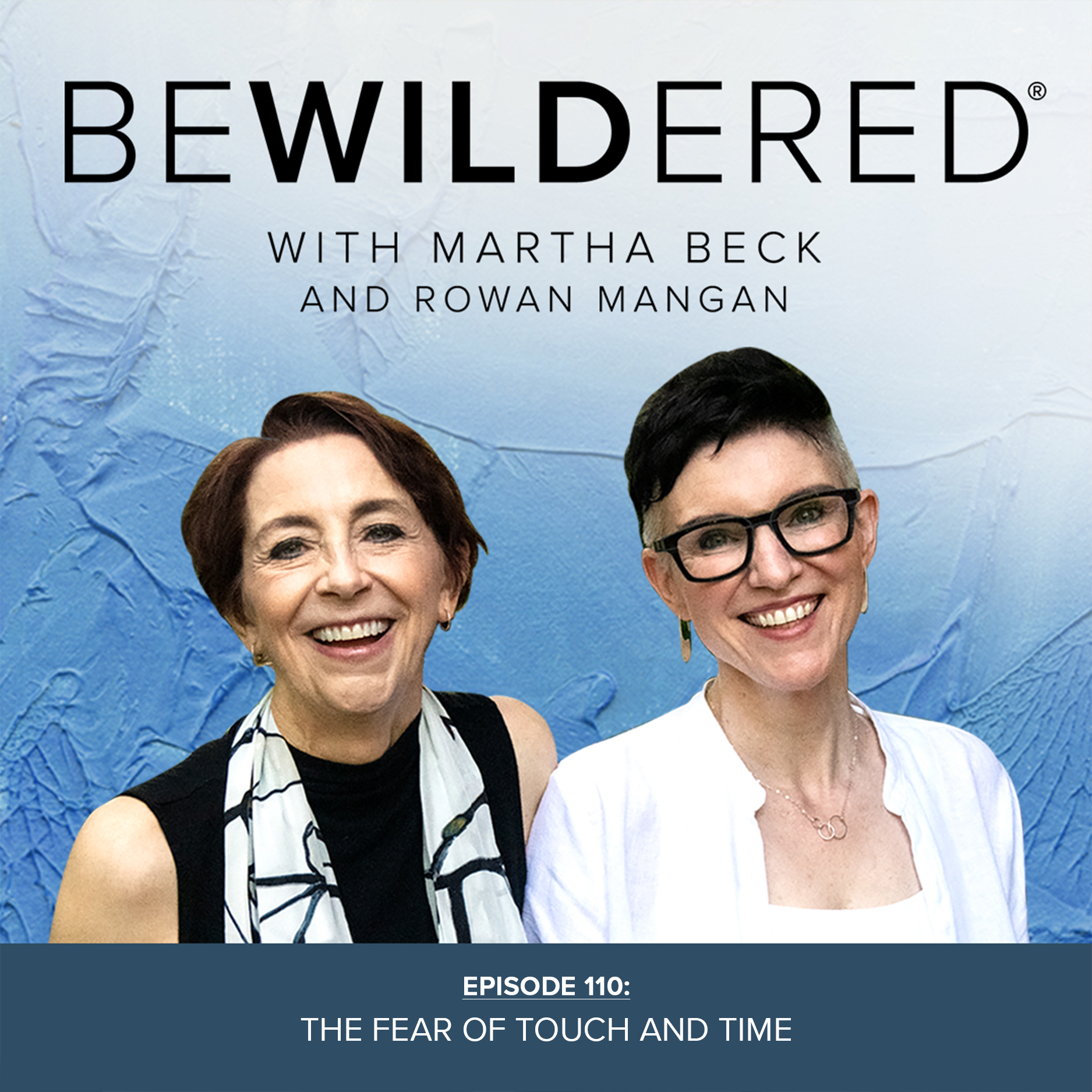
About this episode
What does a text about chickens have to do with the meaning of life? We're glad you asked! In this episode of Bewildered, we examine how our culture teaches us to avoid touch, fear time, and forego relationships for transactions. We dive deep into how we’ve been pushed away from nature and each other by systems that value money most, and we explore the things that really make life worth living: genuine connection, sensory experience, and living in the moment (which includes cuddling chickens). Join us!



The Fear of Touch and Time
Show Notes
We got a delightful text from our friend Kate the other night after a rainstorm that literally said:
“How many chickens would you say you have in your living room right now because the yard flooded?” Which is Kate’s very cute way of saying, “I’ve got chickens in my living room!”
It was a complicated evening… But just that one text led us into a really interesting conversation about the way our culture teaches us to avoid the things that make life rich and full—like cuddling chickens—and it substitutes for them hollow, pixelated abstractions.
There’s something about our culture that is so mechanistic and so into dividing us from nature that it tries to put money in place of all the things that happen in a tactile and biological sense.
It wants us to monetize everything: We want to be free to cuddle chickens whenever we want, but “The Man” won’t let us!
There’s an existential crisis happening where our biology expects us to touch the world, to touch the things that make life worth living, to hug each other more, to go out looking and seeing what the footprints in the earth are actually telling us, but our culture pushes us away from all of those things.
We’ve outsourced everything from storytelling to haircuts, and we’re terrified of the two simplest, richest parts of being alive: touch and time.
Our culture is afraid of touch and time because they can’t be easily monetized or scaled—and it also preys on the fear of the future. We’re always thinking about how we can get piles of money and resources so that we won’t have to deal with scarcity in the future.
(Certain billionaires even seem to believe that hoarding wealth will allow them to cheat death…)
The culture teaches us:
- “Don’t waste time!” (But you can’t waste time just as you can’t waste space.)
- “Touch involves risk!” (But most touch is not sexual; it’s simply a human need.)
- “Security comes from having the most!” (But hoarding actually makes us feel more anxious.)
True abundance comes from our interdependence, from seeing ourselves as part of a living network—what in South Africa they call “Ubuntu,” meaning “I am because we are.”
In contrast, our culture takes the opposite, individualistic attitude: “We are because I am.”
To quote Ani DiFranco as we love to do, “The wild things are not for sale any more than they are for show. So I’ll be outside in love with the kind of beauty it takes more than eyes to know.”
Join us for the full conversation as we explore all the beautiful wild things that truly make life worth living—meaningful connections with others, tactile experience, and living fully in the present moment—and why a hug might be more valuable than a Pilates session.
Also in this episode:
* Martha tells Duolingo AI about the transformation of human consciousness.
* Lila floods a hotel bathroom in fifteen seconds flat (aka “the incident”).
* Ro discusses chicken periods and the linguistic injustice of “mongooses.”
* Martha investigates the Mystery of the Scorpion Claws.
* Kraft-paper girls in a material world and the frozen head of Walt Disney
* And speaking of segues…
TALK TO US
You can follow us on our Instagram channel @bewilderedpodcast to connect with our Bewildered community, learn about upcoming episodes, and participate in callouts ahead of podcast taping.
And if you’re a Bewildered fan, would you consider giving us a little rate-and-review love on your favorite podcast player? Ratings and reviews are like gold in the podcasting universe—they help people find us, they help build this beautiful community, and most of all, they help us in our quest to Bewilder the world…
Episode Links and Quotes
- The African STAR at Londolozi
- Cape grey mongoose
- Genet
- Cryogenics
- Ubuntu Philosophy
- “Half-Assed” by Ani DiFranco
CONNECT WITH US
- Follow Martha on Instagram
- Follow Ro on Instagram
- Follow Bewildered on Instagram
- Join us in the Wilder Community!
- Listen on your favorite podcast app
- The Bewildered Show Notes
- Is there something you’ve been feeling bewildered about? If so, let us hear from you!
Transcript
Please note: This is an unedited transcript, provided as a courtesy, and reflects the actual conversation as closely as possible. Please forgive any typographical or grammatical errors.
Rowan Mangan:
So Marty, I got a text from our friend Kate the other night that literally said, “How many chickens would you say you have in your living room right now because the yard flooded?” Which is Kate’s very cute way of saying, “I’ve got chickens in my living room!”
Martha Beck:
Three chickens!
Rowan Mangan:
Three chickens, two cats.
Martha Beck:
Yeah, it was a complicated evening. And just that one text led us into a really interesting conversation about the way our culture teaches us to avoid the things that make life rich and full, and it substitutes for them hollow, pixelated abstractions. So yes, touch is the thing we avoid, and time is the thing we fear, and we went into a deep discussion about it.
Rowan Mangan:
Yeah, I think we pretty much solved the meaning of life. So hope you enjoy it, everyone. See you on the other side.
Martha Beck:
Hi, I’m Martha Beck.
Rowan Mangan:
And I’m Rowan Mangan, and we’re already laughing here on Bewildered, the podcast for people trying to figure it out.
Martha Beck:
Trying to figure it out, dammit!
Rowan Mangan:
Yeah. Today on Bewildered, we are very lucky to be welcoming Martha Beck.
Martha Beck:
What? I’m barely, barely there Martha Beck. What are you trying to figure out, Ro? Just tell us. Just cough it up.
Rowan Mangan:
All right, here’s what I’m trying to figure out. You know how, all right, children, okay, first of all, just children.
Martha Beck:
I know children.
Rowan Mangan:
I don’t really need to say more, but I will. So we’re at one of those funny phases with our daughter where you know how development isn’t linear, so they’re trying to fill in a color-by-numbers painting of the world, but they get unexpected things early while they’re still missing the other things?
Martha Beck:
They’re delightful. It’s the way I am in Spanish.
Rowan Mangan:
They’re so delightful. I love it how in your Duolingo, we got the AI version so you get to have conversations with a cartoon character, and Marty has been telling her about the transformation of human consciousness.
Martha Beck:
She comes in and asks me, “What do you do for work?” And I say, “I am attempting to embody the transformation of human consciousness,” which I have to look up from Google Translate to even know. And then I read it off it and she’s like, “Oh, that’s very ambitious.” And I say, “Well, tell me about it. I’ve been working on it for 50 years.” Anyway, one day I will be able to say it fluently from my mother wit, but tell us about our daughter, who is so much better at English than I am at Spanish.
Rowan Mangan:
We took her away to a different part—
Martha Beck:
We took her away to a farm upstate.
Rowan Mangan:
We literally did. It was a hotel room upstate, and we were there. She is scared to shower. So I showed her that in this particular shower there was one of those ones where you could hold it yourself. And I thought she likes control, she likes power. This is going to go great, in you go. Probably about 15 seconds later, the bathroom was flooded, like a good couple of inches. And I was screaming and yelling and—
Martha Beck:
I attest to this. I was in a different hotel room, and it was completely obvious what was happening. “Lila, the bathroom, why?”
Rowan Mangan:
Fast-forward to 10 minutes later, she never actually got wet, by the way, during her shower.
Martha Beck:
And while she was aiming the shower head outside the shower into the bathroom general, she was literally shouting, “I can’t help myself!” Also like her mother.
Rowan Mangan:
Aw. Yeah. Anyway, about 10 minutes later I am saying, “No, you can’t get on the toilet right now because before you do, I’m going to wipe the toilet seat.”
Martha Beck:
Which was covered with water.
Rowan Mangan:
And she looked at me and said, “Because of the incident?” And I was like, “Yes.”
Martha Beck:
It’s just become an incident.
Rowan Mangan:
Like, “Yes, Lila, the incident that happened 10 minutes ago where you poured shower water all over this bathroom that I’ve subsequently been cleaning. Yes. Because of that incident.” It’s like it’s got its own FBI file that’s been, what do you call it, when they censor—
Martha Beck:
Sounds like The X Files, in fact.
Rowan Mangan:
—and they only leave two words and it’s all been crossed out: “The incident.”
Martha Beck:
Redacted. Once I asked her what she was hiding behind her back and she said, “Items.”
Rowan Mangan:
We were in the car a few weeks ago and we’d been listening to a song called “Blank Space” by a little artist that I personally think is going to make quite a splash in the years to come, good little-known singer called Taylor Swift, who has an obscure number called “Blank Space.” And we sang it and we sang it and we sang it.
And then Lila said thoughtfully, in this silence after the song, “Speaking of blank spaces, what is one?” And it reminded me a lot of a friend’s daughter at dinner once, and she was like 17 at the time, and we were talking about those things that you stand on and lean forward and they drive forward. They’ve got buses, you step up onto it, you lean forward. And we were talking about those.
Martha Beck:
You mean like a Segway?
Rowan Mangan:
And she said, “Speaking of Segways,” which is a segue.
Martha Beck:
What is one?
Rowan Mangan:
No, it’s a segue. The speaking of is a segue.
Martha Beck:
Oh!
Rowan Mangan:
She meta-segued. She segued the Segway.
Martha Beck:
Wow. Hang on a second. Hang on.
Rowan Mangan:
Yeah, you got to go deep.
Martha Beck:
I have to metabolize this. Yeah, that is deep, man. That is deep. Was she on something?
Rowan Mangan:
Anyway, Lila told me not to forget to comb my mustache, Missy.
Martha Beck:
That’s right.
Rowan Mangan:
When I left this morning.
Martha Beck:
“Don’t forget to comb your mustache, Missy.”
Rowan Mangan:
And—
Martha Beck:
It’s a problem we talk about behind Ro’s back a lot. But she just said it right to her face.
Rowan Mangan:
How hard is it to comb a mustache? It’s like—
Martha Beck:
Well, yours.
Rowan Mangan:
Yeah. Marty, for God’s sake, what are you trying to figure out other than how to make me comb my mustache?
Martha Beck:
Mine’s not as good, but it is something I literally was trying to figure out. Literally true. So I spent a long time in South Africa this year, had an absolutely fantastic time at Londolozi, our favorite game preserve. And I was sleeping in a thatched cottage and there was a day bed outside. And every day I would—obviously you have to sleep with the doors closed so that leopards—
Rowan Mangan:
So you won’t get eaten.
Martha Beck:
Lions, whatever, do not come in, hyenas or whatever. But the first thing in the morning I would go out and I would want to sit on the daybed and do my meditation and whatnot. But there was clutter. And I do not mean this in the human sense.
Rowan Mangan:
There was non-human clutter?
Martha Beck:
Yeah. It was non-human clutter. It had a weirdly human-clutter vibe. It really looked like someone had been binge-watching a TV series and eating snacks and taking their socks off. It had that kind of, “I’ve been here a while and having a good time”, but when I examined it closely, it consisted sometimes of moth wings, but always—every single day—of scorpion claws.
Rowan Mangan:
Huh. Interesting.
Martha Beck:
And a few tails thrown in as well, but mostly the claws.
Rowan Mangan:
Were the tails also scorpion?
Martha Beck:
Well, the tails are long.
Rowan Mangan:
Well, I just didn’t know it was from a different animal or the same animal.
Martha Beck:
Same. Same.
Rowan Mangan:
Got it. Okay.
Martha Beck:
And it’s weird because we kill lobsters, which are kind of the same shape as a scorpion, and then we eat just the claws. But whatever was eating the scorpions was not even the claws.
Rowan Mangan:
Do we not eat the whole body of a lobster?
Martha Beck:
Oh, that’s true, we do. But the claws are especially tasty, right?
Rowan Mangan:
I have no idea.
Martha Beck:
Well, I guess the claws of a scorpion are not tasty at all because they were always remaindered. They were always just lying there. Every single day there was a little pile of scorpion claws. And of course then people would clean it off every day because the place is immaculate. But I was very much fascinated by it. And there were bats directly above it. In fact, at first I thought they were bat droppings, but they looked too much like somebody had been—
Rowan Mangan:
Too much like scorpion pieces.
Martha Beck:
Too much like scorpion claws in the end.
Rowan Mangan:
To be bat shape.
Martha Beck:
So I went on a big detective binge. I was going to solve this mystery and it was literally something I had to figure out. And you had gone home already. I was staying to wait for some people who were coming after we finished our retreats down there. So I had this time of just being in the cottage with the scorpion claws. And I became obsessed with the mystery of the serial killer of scorpions. It was really fun. I looked up every animal that could possibly be eating—
Rowan Mangan:
So it wasn’t the bats?
Martha Beck:
Oh, I thought the bats. But then I thought, wait, they don’t have, how are they going to hold a scorpion so as to take off its claws and munch it? And do they even— wait, they hunt on the fly. It’s kind of what they do. Scorpions are not in the air. So it’s not bats. Okay, it’s not bats. If bats were up there, I’d be like, “Hi, bats.” But the scorpion-tail mystery was not. I started calling it the Scorpion Killer. You know how, wasn’t it when there are serial killers, they give them fancy names? The Hill Moss Killer, whatever. They don’t deserve it, but they get them. Anyway, I narrowed it down.
Rowan Mangan:
I just want to say something. No, no. I have to say that that scorpion clutter was being left there as a warning to you.
Martha Beck:
What?
Rowan Mangan:
And I don’t think you were heeding it. Yeah, it was being left there as a warning. Like, “You’re next.”
Martha Beck:
Like, “I will eat all of you but your claws.” Something was saying that to me?
Rowan Mangan:
Yeah. I mean you have to consider the possibility.
Martha Beck:
Now, I’m afraid.
Rowan Mangan:
Well, you’re a very long way away from it now, but tell me about your detective binge.
Martha Beck:
Well, I did a lot of, I went round and round the cabin trying to find tracks of something.
Rowan Mangan:
The outside or the inside?
Martha Beck:
I went round and round the inside because that was more convenient.
Rowan Mangan:
Last year when she went, she walked around and around the inside of the cabin because she was training for a walk.
Martha Beck:
I did. I walked like 8,000 steps a day round and round that cottage. Inside.
Rowan Mangan:
This time you were outside hunting for a killer.
Martha Beck:
I was outside and I was more crouched and peering at the dirt. And I didn’t get any clear tracks. I got some, they were smallish. I knew the thing had to have paws. And then I went to the Google, which is the substitute for experience and wisdom, and I narrowed it down to two animals that had the digital dexterity to manhandle a scorpion in that fashion and also a taste for the little critters and that it had to be either a Cape Gray mongoose or a genet. Yes. And I have seen—
Rowan Mangan:
Some people won’t know what either of those things are.
Martha Beck:
Well, I didn’t either, but I have seen two kinds of mongooses at Londolozi in the past. Pygmy mongooses, who are tiny little brown things. They’re adorable. And then banded mongooses, which are much bigger and they run around in mobs like terrorizing neighborhoods and stuff.
Rowan Mangan:
I know I’m not really letting you get your story out, but it is a criminal linguistic thing to have to say mongooses and not mongeese.
Martha Beck:
I know. I had to look it up long ago. I thought about mongai.
Rowan Mangan:
Mongai.
Martha Beck:
Mongae, like algae. Mongae. It could be anything. But no, it’s mongooses.
Rowan Mangan:
It’s like how in French if you were to say “my” you say “mon.” So it’s like mon goose. Mon goose. Of course “goose” isn’t “goose” in French, so it breaks down halfway through. But yeah.
Martha Beck:
For a while there it was great. Now I’m trying to remember the word for “goose” in French. We’re moving on here.
Rowan Mangan:
I’m so sorry. I’m going to let you tell your story now.
Martha Beck:
It’s really cool because here’s the thing. I had narrowed it down on the Google. I was sitting on the daybed and I’d narrowed it down to a Cape grey mongoose, which I’d never seen there but would’ve been about the right size with the right predilection for munching scorpions. And I thought, “No. I think those, first of all, I’ve never seen one here.” And then I’m not kidding. I’m looking intensely at this animal that’s a Cape grey mongoose. Why are you touching your face?
Rowan Mangan:
I didn’t mean to touch my face. It was just because you went, “So then I thought, hmm.” I love the idea of you thinking “hmm” to yourself.
Martha Beck:
So anyway, this is the cool part, and this is what always happens at Londolozi. I’m thinking about a Cape grey mongoose and how I’ve never seen one, and I look up from the daybed, and as I live and breathe, standing on the lawn in front of me about 10 feet away was a Cape grey mongoose!
Rowan Mangan:
Trailing scorpion claws.
Martha Beck:
No, he wasn’t. No, because he couldn’t because it was happening at night, and there he was in the middle of the day. So I checked it out. Mongooses are diurnal. The scorpion killer was hunting and eating at night. That left genet.
Rowan Mangan:
One suspect.
Martha Beck:
So then I enlarged the field of my trekking. I went round and round the cabin in a spiral form until I found in some fine dust about 50 feet away from the cottage, the clear tracks, like tiny leopard paws, of a genet.
Rowan Mangan:
What’s a genet?
Martha Beck:
A genet is like a tiny leopard with paws. It’s beautiful. It’s a little catlike animal. It’s sort of like halfway between maybe a cat and a weasel, but spotty and very fluffy and absolutely gorgeous. One of the things that’s so amazing about Africa and South Africa in particular where we go, there is so much biodiversity that I constantly see animals I’ve never ever seen before and don’t even know what they are. I’d never even seen this in a book. The thing that was cool about it, and I’m still trying to figure out is every time I visualize an animal really vividly at Londolozi, it just shows up. Like the Cape grey mongoose. I mean, I’ve never seen one. I’ve been going there for 20 years. And then the other thing.
Rowan Mangan:
It showed up just to say, “I’m diurnal. No, yeah, I’m diurnal, you moron. What kind of jungle detective are you?”
Martha Beck:
And by the way, its feet don’t look anything like a genet’s little paws-es. I don’t think—it would’ve done a much rougher job of shredding the scorpions.
Rowan Mangan:
Listen, I owe you an apology, I think.
Martha Beck:
Yeah, you do. It’s about time. How long have we been married?
Rowan Mangan:
I think I shouldn’t have left you there by yourself. I feel like you weren’t in a good place.
Martha Beck:
It was fabulous. I did forget to eat and get a little lightheaded for a week or two.
Rowan Mangan:
Crouching in the dust, looking for mini leopards.
Martha Beck:
It was so fun. And here is the thing about this entire podcast, it’s about how participation in nature is so enlivening. I mean, I came back here and read the news and practically wanted to just go jump in the Delaware, which is not far away.
Rowan Mangan:
It’s a river.
Martha Beck:
Being out there in nature trying to figure out, the only thing I was trying to figure out for those few days is what was eating scorpions. And let me tell you, compared to the stuff we’re dealing with here, it was such a lovely break, such a lovely break.
Rowan Mangan:
I’m really happy for you.
Martha Beck:
Thank you. Someday I will learn to touch you like a genet. And I’m trying to figure out now whether I will be the genet touching you or I will touch you the way I would touch a genet. Either way, you’re going to love it.
Rowan Mangan:
What’s going on right now? I’m terrified.
Martha Beck:
Don’t worry, we’re in separate rooms. Relax.
Rowan Mangan:
Oh my God. It’s an interesting way to— speaking of segues, it’s interesting way—
Martha Beck:
Speaking of segues—
Rowan Mangan:
To bring us into today’s topic.
Hi there. I’m Ro and I’ll be your podcaster for today. Do you know how to tip your podcaster? It’s actually pretty easy. You can rate our pod with lots of stars, all your stars. You can review it with your best superlatives. You can even subscribe or follow Bewildered, so you’ll never miss an episode. Then of course, if you’re ready to go all in, our paid online community is called Wilder: a Sanctuary for the Bewildered. And I can honestly say it’s one of the few true sanctuaries online. You can go to wildercommunity.com to check it out. Rate, review, subscribe, join, and y’all have a great day now.
Martha Beck:
We have a story, the most exciting thing that’s happened to us here in Pennsylvania for a very long time, which will show you how exciting our lives here in Pennsylvania really are. Tell them what happened.
Rowan Mangan:
Our friend Kate got chickens.
Martha Beck:
She got chickens!
Rowan Mangan:
She got chickens and she got three.
Martha Beck:
Serious chickens, they’re alive.
Rowan Mangan:
She’s wanted them for many years. And she finally got them.
Martha Beck:
Three chickens.
Rowan Mangan:
Three little chickens. And we get photos of the chickens. We haven’t been to meet the chickens yet because they need, they’re not used to their new home yet.
Martha Beck:
She’s only had them for four days.
Rowan Mangan:
So there’s like an adjustment period for the chickens. But I did get a very delightful text from Kate last night after a rainstorm that says, “How many chickens would you say you have in your living room right now because the yard flooded?” And I just love that there’s no non-chicken-related content coming from our friend Kate anymore. All the content is chicken related. And that’s great because for a long time it was just devastating political news.
Martha Beck:
Right. And then it’s just, “I got chickens.” And suddenly you’re back into something that feels nourishing to the soul. And I started thinking about what a kind of miracle it is that we’re all very worried about eggs, the price of eggs, the diseases of eggs, the way they keep chickens that’s horrible and inhumane to get us all the eggs. And I thought here she has these chickens and she said if she’d bought them as new chicks, they could have been like five bucks a piece. So you spend $15 to get three chickens. Then she said she spent like 20 bucks on a 50-pound bag of feed. And if you feed them, they give you eggs.
Rowan Mangan:
They give you eggs.
Martha Beck:
Like, just eggs.
Rowan Mangan:
Well, let’s just be super clear here because I don’t want to—they will lay eggs, and she will steal them.
Martha Beck:
Oh, that’s true. That’s true.
Rowan Mangan:
Okay, so there is still some exploitation, but we can—
Martha Beck:
Do you want to tell them what you said to me when we were talking about this?
Rowan Mangan:
Oh yeah, well, that eggs are chicken periods, and we steal their periods and eat them. And I just think we don’t talk about that enough.
Martha Beck:
Oh, sorry, I just had a scorpion-barfing moment. But no, it’s true. Every month a woman after a certain age and before another certain age lays an egg and no one comes to steal it.
Rowan Mangan:
If you are lucky.
Martha Beck:
And those who do are imprisoned.
Rowan Mangan:
So we were like, why—if it were purely about the money, we would all have chickens because return on investment, very high, five bucks for a chook. Sorry, we call them chooks in Australia. That’s what we call them. And the chooks are there, they give you the eggs, you eat the eggs, you eat their monthly. I mean it’s okay. We don’t need to—
Martha Beck:
Oh God, Ro. I may never be able to eat an egg again. The stolen periods of the fowls of the air.
Rowan Mangan:
And also we don’t truly know if we have consent from the chickens, so.
Martha Beck:
Oh, we don’t.
Rowan Mangan:
No. They want a baby. Look. Have you seen how cute baby chickens are? Of course they want one.
Martha Beck:
They’re really, really cute. Anyway, you’re right. And here’s the thing. The reason we’re so excited about the chickens and the reason Kate wanted them, and I know a lot of other people who live in cities and keep chickens, they get permission for some reason, and it’s great, they have all these eggs.
Rowan Mangan:
Who are you getting permission from? The chicken warden?
Martha Beck:
Well, it seems like your HOA or somebody.
Rowan Mangan:
Excuse me, is that the chicken? What the fuck is that? That doesn’t mean anything here. How could you do— Isn’t that just like the epitome of culture is you have to ask someone to have a chicken. “Can I have a chicken please?”
Martha Beck:
What? No. How dare you have a chicken.
Rowan Mangan:
How dare you have a chicken? But no, I just want to say that’s not on. I’m not having The Man telling me whether or not I can steal a chicken’s period and eat it for breakfast on sourdough.
Martha Beck:
Oh no, you added sourdough, and now I’m thinking other thoughts about, oh no, I won’t speak of it. Listen, here’s the deal.
Rowan Mangan:
This is a story about capitalism.
Martha Beck:
Dude. Here’s the thing. We have to ask permission to have interactions between living things that are profoundly normal for human beings over the massive majority of time that we have existed. You could just get a chicken. You didn’t need to have permission. And now what you said, if it were about the money, we’d all have eggs?
Rowan Mangan:
Chickens.
Martha Beck:
Actually, I challenge you on that. I think it is about the money, but not in the way you meant it. You meant if it were just to be economically viable and feasible and rational, we would have chickens and get eggs. But it’s all about the money in a different way. There’s something about our culture that is so mechanistic and so into dividing us from nature that in place of all the things that happen in a kind of tactile and biological sense, it is trying to put money, money, money, money. I remember as a young mom at a little place called Harvard, don’t know if I mentioned it.
Rowan Mangan:
Drink.
Martha Beck:
Drink. I started popping out pups there in 1986.
Rowan Mangan:
Someone fertilized those eggs.
Martha Beck:
I threw my first calf at 26 and that was a long, no, I was 23. It was 1986 and there weren’t a lot of people having babies around the place.
Rowan Mangan:
You know how the eighties were.
Martha Beck:
I just didn’t meet a lot of women at Harvard who were having babies at that time. I don’t know what it’s like now. They won’t let me back anymore because I keep saying it on podcasts. But here were all these things. I had to take my little kid to a daycare and pay for that. And then I had to make sure that I was paying for formula, when my body was busily producing exactly what it needed. But I couldn’t always be there to nurse the baby.
Rowan Mangan:
It was pre- the pumping closet in the office.
Martha Beck:
That’s a whole thing. We should do a whole thing on, yeah, just breast milk. Nobody wants to talk about it.
Rowan Mangan:
You can buy a cheese from human breast milk. Did you know that?
Martha Beck:
Oh my God. It wasn’t bad enough with the eggs and the periods?
Rowan Mangan:
We need to embrace fertility in all its forms, and you need to be a little bit less squeamish.
Martha Beck:
So anyway, it was like, I just started thinking, and I’ve told the story over and over about how this sociologist told me children don’t require any effort until they’re five and then you have to drive them to school because that’s when he had had to deal with five-year-olds, and nothing else existed outside of his worldview. And he was an expert of human social behavior, and he believed that. But what it boiled down to was if I didn’t have enough money to buy someone to clean the apartment and someone to take care of the kid and someone to formulate breast milk and do all these things so that I could live in this highly artificialized society, if I didn’t have money, I couldn’t have the things that human beings always just had during most of our evolution.
Rowan Mangan:
Women.
Martha Beck:
So I thought—
Rowan Mangan:
Women.
Martha Beck:
We’ve monetized everything.
Rowan Mangan:
But especially women.
Martha Beck:
What?
Rowan Mangan:
Well, I mean all those, the things he couldn’t see were the things women do. I was thinking about caring and as a very valid pursuit and the way that people spend their lives caring for other people and how in the US particularly, there’s just no—
Martha Beck:
No support.
Rowan Mangan:
No reimbursement. And so people still have to do it. And there’s like I heard someone who works in this area saying that at any international conferences and stuff for carers, they say in most of our social systems there’s money allotted for carers, and in America they just have women.
Martha Beck:
Yep. Women who are trying to do all the other things too. And I mean everything is being removed from basic contact with other biological systems and going through monetized, professionalized, mechanized things. Advice giving. I did not go find the village elder and say, “What the hell eats scorpions and leaves the claws?” And I’m happy to have Google. I’m thrilled that I get to look things up online, but I don’t go to people for advice the way I did when I was a kid, you know, for storytelling. When we sit around the fire in the evenings and people tell stories about their adventures out there in the bush, it’s so bonding and it’s very much you’re there in a flickering light and hearing stories, and a TV is a flickering light that tells you stories. And it’s a huge industry to make these stories now. And you have to be a professional actor and be part of this huge system. And it’s awesome, but it’s not storytelling around a fire. You could say that all these things are better, that the advice I get from Google is better than any given village elder or whatever.
Rowan Mangan:
I don’t think anyone would be arguing that, although one of the sort of things that our society has done as it’s become so technocratic is that it used to be that the more years on earth you’d amassed, the more valuable experience you had to pass on. And now there’s a strange inversion of that where more plastic your brain is, so the younger you are and the more you engage natively with technology, you’re more likely to be the person bearing the how-to’s—like how do you program the VCR? To use a very dated reference.
Martha Beck:
You just gave us a perfect example of what it means to “age out” of technology.
Rowan Mangan:
But it’s interesting, isn’t it? We will say it takes a village. It’s one of those things that is just constantly said to you when you have a small kid, usually as a way of demonstrating that we don’t have enough help.
Martha Beck:
Yeah, please help me.
Rowan Mangan:
Please help me. It takes a village. Yeah. Anyway, but “it takes a village” is not just about raising a child, it’s about every aspect of our life. It actually should take a village and a lot fewer professional roles.
Martha Beck:
I actually, thinking about this all because Kate got chickens, it struck me that we’re so divorced from so much of what we evolved to do that there’s almost an existential crisis happening where our biology expects us to touch the world, to touch the things that make life worth living, to hug each other more, to go out looking and seeing what the footprints in the earth are actually telling us.
Rowan Mangan:
Put hands in soil, put seeds in soil, pull food from soil.
Martha Beck:
Yes. Yes. And when I talk to people who garden a lot, it’s life-giving to them in more ways than one. And the touch of the soil and the friendship, if you want to say that, of the plants, because they are, now we know from botanists, they’re pretty much conscious. We’re always just busy trying to amass more of this weird abstraction called money so that we can pay to keep our biological systems running when the real joy of life may be in doing those things in the way we evolved to do them instead of having to chase money, always thinking about “I will need this in the future” so we’re never present in the now. And constantly obsessed with how lonely we are at the same time.
Rowan Mangan:
Yeah, and trying to find a pharmaceutical or professional or technological solution to that rather than establishing friendships and stuff. And it’s not like we’re saying we’re outside of this. We’re very much observing it from the inside, from being in these same sort of paradoxes. And it’s like this weird tendency that goes along with where society is right now is all these business terms kept coming to me as we were talking about this topic, Marty. And it’s like this is outsourcing, right?
Martha Beck:
Oh yeah, yeah.
Rowan Mangan:
You’ve got something that you want done, but in this country it’s too expensive to hire people to do it. But at this point, AI isn’t—so we’re going to outsource it to India where they don’t have to pay, where they don’t have to pay people as high wages. So we’re outsourcing to systems and products, commodities, the functions that kind of define what it is to be alive. And it’s weird because we also have this kind of paradoxical idea that, of materialism, right? Oh, I’m a real materialist, “living in a material world, and I am a material girl.” Wow. Today is the real dated references podcast.
Martha Beck:
Speaking of material girls, what is one?
Rowan Mangan:
What is one? I always thought that song was about fabric. It was really strange growing up. I was like, “Congratulations? I mean that’s nice.”
Martha Beck:
I’m a kraft paper kind of girl myself. But you do you.
Rowan Mangan:
Exactly. So you’re materialistic, but actually increasingly what that means is that you are much more interacting with pixels than material, three-dimensional materials. It’s like that. It’s actually quite an abstracted thing where materialism is grocery delivery services and Netflix queues, my queue of what to watch next. And then so what I realized is that the kind of spirituality that we’re usually banging on about on this show, which is a sort of secular spirituality, is very much about getting into the body and the senses, and what is it to be in this human form? And that’s actually—that’s more material.
Martha Beck:
It is! It’s so weird. And actually that’s kind of one of the things I do because an industry around like, yoga teaching. You go to a place so that you can have someone gently touch your hips and tell you to stay in your body. And I don’t teach yoga, but I get paid for helping people get back into their bodies. And they experience that. I’ll say to a group of businessmen, “Okay, what does your stomach feel like right now?” And they’ll be like, “That’s too woo-woo for me. I don’t do the spiritual stuff.” And I’m like, “I just asked you about your stomach.” It’s literally the most material thing about you. Anyway. It’s funny, isn’t it? I totally agree that this is very paradoxical and very weird. So this, as I see it, this is the issue that we’re talking about today.
Rowan Mangan:
We want to cuddle chickens.
Martha Beck:
We want to cuddle chickens.
Rowan Mangan:
Yes.
Martha Beck:
And the occasional—
Rowan Mangan:
And The Man won’t let us.
Martha Beck:
The Man is taking our chickens.
Rowan Mangan:
Fuck the police.
Martha Beck:
Amen. So it’s the culture/nature split, right? We’re always looking at where have we been unaware of the fact that culture has pulled us way out of our nature to the point where we may be getting sort of psychologically desiccated by it all.
And Kate’s chickens led straight to the conclusion that we live in a culture that is afraid of touch and time. It’s afraid of touching anything because that doesn’t monetize it and it doesn’t make it, it doesn’t mean you can profit from it. And it also preys on the fear of the future. So we’re always thinking about how we can get piles of money and resources so that we won’t have to deal with privation in the future, which by the way, is very much our culture. There were thousands of cultures all over the world for ages that were not obsessed with hoarding things against time. They trusted nature to provide things in different seasons. So that the obsession with hoarding up huge amounts of something for the future is really related to the whole guns, germs, and steel obsession with the materialistic world that grounds the culture we’re talking about.
Rowan Mangan:
Wouldn’t you say it predates that, though? Like it’s once we started agriculture, wouldn’t that be like, agriculture sort of predated a sort of colonial—
Martha Beck:
You make a solid point.
Rowan Mangan:
But it’s interesting, right? Because it created the possibility of surplus because while you’re just living in nature, according to the seasons, you can’t store anything, and therefore you can’t hoard. And therefore a silo is the beginning of the sort of capitalist mindset, right?
Martha Beck:
Yeah. The last 5,000 years, the construction of the hierarchical, pyramid-shaped uber society started. You could trace it back to that for sure. If you’re out in a non-agricultural setting, when you do things, there is an incredibly intimate relationship with other parts of your ecosystem. Some living, some structural like rocks or water. And yes, it can be very, very much harder to get them, especially if you’re alone. You need your village. But that’s part of it. The intimate contact with the village that says, “We’re all needed for this.”
Rowan Mangan:
Yeah, that’s right. We’re all needed for this Now at this time, at this moment, it just strikes me that what we’ve traded is we’ve traded relationship for transactions.
Martha Beck:
Absolutely. Yeah.
Rowan Mangan:
And that in a very strange way, what culture is saying in all this is like, “Ew, gross. Get it off me. Ew.” Like what it is to be human is kind of gross. And it’s like, don’t change me.
Martha Beck:
Oh no, don’t change me.
Rowan Mangan:
I am this product that’s rolled out that stays young. And so don’t grow old and don’t trust.
Martha Beck:
No.
Rowan Mangan:
You must hoard against possible future scarcity or else. And you can never feel safe. And it’s like, so the actual act of hoarding, storing, saving, we would call it saving.
Martha Beck:
We’re basically going to come out of this telling everyone to cash out their savings accounts. I mean, you need—
Rowan Mangan:
401k is The Man.
Martha Beck:
Yeah. You need—we’re not saying you have to drop all these structures. We’re just pondering on them and the way that they’ve affected us.
Rowan Mangan:
Martha Beck Incorporated does not take any liability.
Martha Beck:
Well, we, yes. Sign a waiver.
Rowan Mangan:
Yeah, I mean Martha talked about surplus value, right? When you are in an exploitative system—I’m not a Marxist, okay? I’m just saying that there is definitely something thing strange about a hoarding mentality which, says what you are doing is worth more than what you are getting for it. And I’m going to pick up that marginal value. That’s that money. I’m going to have that because I am here and you’re there.
Martha Beck:
And it feeds the pyramid of power and it reinforces the structure of the oppression of the many by the few. So yeah, we are the great money-hoarding culture in the history of the world, even more than anything that went before. And the effect of that is that it kills our sense of abundance. We have more stuff than—I mean piles and piles, especially in the US, there’s so much stuff. And people feel impoverished in the middle of it. They can be drowning in clutter and feel impoverished. It’s not at all uncommon.
Rowan Mangan:
They can be drowning in clutter and be impoverished.
Martha Beck:
And be genuinely impoverished, yeah.
Rowan Mangan:
In fact you’re more likely to be unable to access services if you are working in the landfill economy. But what’s odd is even not the clutter, I think even stranger is the way that we love the metaphor for the value, which is what money is, right? Like the pixels in the bank account or whatever. That’s what we’re hoarding. It’s not anything, it’s not even cash anymore. And so this weird metaphor for trade or for value or for this exchange of abundance that used to happen in the now, in relationship, now happens in a potential future in pixels, in transactions.
Martha Beck:
And it’s all—coming right from South Africa into that culture (again, because I was there for so long this time), it struck me that what we’re hoarding is a lack of a value system that includes something in South Africa they call Ubuntu, which simply means that—not simply, it’s actually a really deep and multilayered turn, but in its barest essentials, it means “I exist because we exist,” that I am in relation to you, that I do not consider myself something separate from you or from anything. I consider myself something participating in being with you. And that is what gives me—
Rowan Mangan:
“I am because we are.”
Martha Beck:
“I am because we are.” And you went to be with me once to a conference for a wonderful company. I won’t say what they were. I had a lovely time. The people were amazing. I love their products. I think they’re ethical. And they had got this concept of Ubuntu and they were going to—
Rowan Mangan:
They were going to monetize the shit out of it.
Martha Beck:
Make it the theme of the conference they were going to just play. They loved the concept of Ubuntu, and they had adopted it, and they weren’t culturally appropriating it. They gave full credit to it. And all over the conference were these huge signs that said, “We are because I am!” Exactly the opposite of Ubuntu, the individualism saying, “You can come and join me and we’ll be people because I am here.” It was so individuated and separatist and completely non-ironic, they just did not see it. They had it exactly backwards. They’re hoarding metaphors instead of Ubuntu.
Rowan Mangan:
And so with the chickens.
Martha Beck:
Oh, always with the chickens.
Rowan Mangan:
With the chickens, the relationship is symbiotic. That’s what—a transaction can never be symbiotic because it’s not an exchange in the moment. It’s a hypothetical future exchange. And so look, I just want to cuddle a chicken and I think that would be nice.
Martha Beck:
And then, you know.
Rowan Mangan:
But The Man.
Martha Beck:
And you would be stealing their periods and making yourself a capitalist.
Rowan Mangan:
Delicious periods.
Martha Beck:
So disgusting.
Rowan Mangan:
You’re—hey, I’m not owning that one.
Martha Beck:
In a state of nature, it wouldn’t be disgusting. So whatever.
Rowan Mangan:
So why are you so scared of haircuts?
Martha Beck:
Oh yeah, good segue. “Speaking of segues.”
Rowan Mangan:
Speaking of segues.
Martha Beck:
No, we were talking about this, how the actual physical connection, there are a few places where it’s needed and where it occurs in my life, I go pay someone to do something, but they have to actually touch my body. So my hairstylist has to cut my hair, which grows from, I don’t know if you’ve noticed this, my head. And so I have to take my head in there and have its hair cut. And here’s the problem. When someone starts touching my head, I become their friend. I went for 20 years cutting my own hair with a tiny pair of sewing kit scissors.
Rowan Mangan:
Oh my God. This is literally true, listeners.
Martha Beck:
And I didn’t realize the back of my head was completely covered with cowlicks and that it wasn’t working.
Rowan Mangan:
It’s not working.
Martha Beck:
At all.
Rowan Mangan:
It was a real surprise the first time I met the great Martha Beck and saw the back of her head. These little scissors, like literally the little, they’re not even scissors.
Martha Beck:
They’re not even sharp. You basically have to just push on the hair.
Rowan Mangan:
Another way of characterizing.
Martha Beck:
I could not get my hair cut without making friends with my hairstylist. And that maintains to this day. David, I love you.
Rowan Mangan:
So another title for this episode of Bewildered could be two Autistic Women Blaming Capitalism for Their Social Anxiety.
Martha Beck:
That would be a good alternate title, actually. Yeah.
Rowan Mangan:
So the business term that comes to me now as we discuss this is literally we’re talking about touch and time, and we, I’ve never even thought about the fact that we call “high-touch” products that aren’t scalable. So we do retreats, right? People fly to a different part.
Martha Beck:
In-person retreats.
Rowan Mangan:
In-person retreats. It’s kind of funny, isn’t it? Because the notion of retreating, to me, would involve no other humans.
Martha Beck:
No other people at all.
Rowan Mangan:
So it’s not a very successful—
Martha Beck:
It’s not a retreat to be in a clump.
Rowan Mangan:
Yeah. It’s more of a gathering.
Martha Beck:
Again, two autistic women trying to figure it out.
Rowan Mangan:
And so where the question is by the culture is: How do we scale it? How do we mass-produce it? How do we replicate it for no extra labor via pixels? What ends up having value to us? It’s like it the proves the rule: it’s the high-touch stuff, which involves us, you, sitting together, sharing a moment.
Martha Beck:
Yeah.
Rowan Mangan:
And sometimes touching each other’s bottom?
Martha Beck:
Sometimes touching each other.
Rowan Mangan:
But not like that.
Martha Beck:
Not like that.
Rowan Mangan:
Not in a bad way.
Martha Beck:
Yeah. I wrote down earlier, “We are professionalizing every situation where one person’s body touches another person’s body.” And then immediately I was like, “I can’t say that on a podcast. It sounds way too sexual.”
Rowan Mangan:
Sex workers should unionize is what we’re trying to say.
Martha Beck:
There you go. That’s a whole ‘nother podcast. But even the fact that I have to, when I say “one person’s body touches another person’s body,” it is immediately sexualized. That shows how much the culture has moved away from the concept of touch as something that is natural, necessary, and multiform. It takes many, many forms.
Rowan Mangan:
Another thing we had in our notes for this episode was the note, “a different kind of grooming.”
Martha Beck:
Oh. Oh, you weren’t going to go there, babe.
Rowan Mangan:
No, but it’s true because social primates, when you were a kid, did girls play with each other’s hair? That was a really big thing.
Martha Beck:
All the time. Oh my gosh. My oldest sister had this beautiful hair, and one of my biggest privileges was to go in while she read and gently brush her hair. I had no idea that it was pleasurable for her. I just loved it.
Rowan Mangan:
You were being exploited.
Martha Beck:
I was, seriously, I should actually—
Rowan Mangan:
But that’s relationship, not transaction, right? It’s actually—
Martha Beck:
There you go.
Rowan Mangan:
You were getting something from it.
Martha Beck:
And it was—as a little kid, my natural, I’m a social primate, I cuddle. I wanted to be cuddled. I wanted to comb my sister’s hair. And I remember once I was sitting with one of my sisters out on our front lawn, and we were sitting close together and she put her arm around me and hugged me. And some people driving by in a car screamed, “Lesbians!” We were like five and nine.
Rowan Mangan:
It’s true, though. I mean they were very perceptive.
Martha Beck:
Exactly. I am in fact a lesbian. She is not. Different sister. Anyway, all I’m saying is that any kind of touch is sexualized, even pathologized, right? And it kills connection. The fear of touch kills connection and the fear of time kills the genuine abundance.
Rowan Mangan:
Yeah, because real abundance exists in time.
Martha Beck:
Well, in the moment. So if you think of time as this flow where you’re always thinking, oh, what’s going to happen next? What’s going to happen next and you’re afraid of time because of the future, you’re always afraid of the future, never of the present moment. Even if something’s chasing you, you’re afraid of the moment it catches you. I’ve studied this at length. So abundance is in now. It’s not in a left-hemisphere-dominated, abstract sense of future, which is the kind of time we fear.
Rowan Mangan:
Like the billionaires, this sort of cliche of the billionaires hoarding more than could ever be spent in a hundred lifetimes and still wanting more. And it’s very hard to avoid the conclusion that, “What is money,” I wrote in the notes, “if not fear of death?” It’s like the final frontier is mortality. And I started thinking about cryogenics, right? That’s what rich white men do.
Martha Beck:
Well, you’re talking about Walt Disney, right?
Rowan Mangan:
Yeah.
Martha Beck:
The first thing that happened when he got super rich, but the very first thing he’s tried to do was become immortal.
Rowan Mangan:
Yeah, and now it’s like stem cell IVs and whatever else. There’s all these, that optimize, biohack sort of mentality. Look, it’s natural to us. We’re doing this because that’s a compulsion that we have. It is part of the experience is being aware of death, resisting the inevitability of death.
Martha Beck:
The inevitability of it. Yep. What you’re basically saying is money is intimately linked with the fear of death, amassing so much value that you think you can buy everything, including life itself.
Rowan Mangan:
And the idea that things are finite, right? Because it’s so weird that as we get into this mentality that’s all about scaling up, what we’re actually doing is making everything more and more finite. We are not like that distrust of nature and that protecting against possible hypothetical futures. And there’s this sort of way in which we’re huddling down, we’re denying life, because life flows in and out of us. No big deal. It’s just flowing. But no, like, “I, Walt Disney, need to be the exception to nature.”
Martha Beck:
It is really strange and it doesn’t happen in other animals to the same extent. And the irony is that by being obsessed with keeping life longer, we lose life because life always happens now and only now. So how do we come to our senses? I mean this is a big cultural cluster of weirdness and we all are breathing it in with every breath we take from infancy onward. How do we come not to consensus, which is culture, but back to our senses, which is nature.
Rowan Mangan:
And we’ll tell you this after quick ad break to line our bank accounts.
Martha Beck:
So Roey, how do we come to our senses in a culture that fears touch and fears time and is driven out of being by those two fears?
Rowan Mangan:
Yeah. Well, I think it’s always going to be in some way remembering who we are and when we are and this moment. So I think this, to get rid of the idea of “time can be wasted” would be one first step. Because escaping the finite, this mentality of scarcity is like you can’t waste time. Time is not an asset, right?
Martha Beck:
It’s like saying, “I’ve wasted,” people do say, “I’m a waste of space.” You can’t waste space. Space. It just is. For me it’s about, it has always, and this will sound weird and grim because this is the way our culture makes it sound because we’re so terrified of death. But to make a friend of death is the way I kind of get my bearings. Because for example, right now, we’re packing up the house. We just got back from a trip, and my bedroom is kind of a mess. And somebody came over to help with Lila and they saw inside the room, and I thought, “I should have cleaned that up” or paid someone to clean it up, right? Always pay someone. And then I say to myself, “Okay, we’re all going to die. How much does it matter, given that we’re all going to die?” And suddenly what’s important is that the babysitter got to play with Lila in my room, not what the babysitter thought of it or what I had done or not done in the room. So for me, when I lose money on something, that’s supposed to be like, “Oh! Oh no! You bought high and sold low!” Okay, I’m going to die pretty soon, like 20 years, 20 minutes, I don’t know. We’re all going to die. I don’t really care, suddenly, about the scrimping and saving, I get more relaxed with it.
Rowan Mangan:
Which is abundance.
Martha Beck:
Yesterday I hugged my Pilates instructor. I used to not hug people because I was afraid of touch, but we’re all going to die. Well, oh my God, hug everybody—we’e dying! Who cares what he thinks? Who cares what anybody thinks. I adore this man. I’m going to hug him because when I’m actually doing death, I’m going to look back and say, “I’m glad I hugged him that time. It made my life rich.”
Rowan Mangan:
So there’s that switching out of the idea of abundance into: What if true abundance is touch and time? What if it was just that? Let’s revel in those things and that’s the opposite of wasting them.
Martha Beck:
Yeah, to revel in them. Do you have, I don’t know why this, I think this, but I have this weird idea that you might have a quote from Ani DiFranco that might apply?
Rowan Mangan:
Ani DiFranco, poet laureate of this show?
Martha Beck:
Yes.
Rowan Mangan:
Yeah, yeah, Well, as that happens, Marty.
Martha Beck:
Hit me.
Rowan Mangan:
At any given moment on this planet, there is a perfectly apt little bit of Ani DiFranco lyricage that I can share.
Martha Beck:
When you’re right, you’re right.
Rowan Mangan:
There’s a great song by Ani called “Half-Assed.” I can’t say it. This is the bane of my existence as an Australian.
Martha Beck:
Half-assed.
Rowan Mangan:
I can’t say “Hawf Arsed” because clearly that’s not the name of the song. It’s not “Hawf Arsed,” so I have to say, but I can’t say “half.” I can say “ass,” I can’t say “half.” Oh my God, it’s so hard to be me.
Martha Beck:
It is. It really is. You need chickens. Okay, they won’t care. They don’t care. “Hawf Arsed,” “Half Assed”—they don’t care. They’re going to die. They’re laying eggs that will never hatch.
Rowan Mangan:
They’re quite—
Martha Beck:
So grim.
Rowan Mangan:
You bitch. Oh my God, let’s not tell them though. There’s so much hope.
Martha Beck:
Okay. Oh God, now I hate myself. Okay, we got to take, there are so many additional episodes that we need to spin off this one. Say what the Ani quote is.
Rowan Mangan:
“Meanwhile, the wild things are not for sale any more than they are for show. So I’ll be outside in love with the kind of beauty it takes more than eyes to know.”
Martha Beck:
Outside in love with the kind of beauty it takes more than eyes to know, the kind of beauty that we can touch and we can lie down in and we can swim in and grow things and feed things and take the chickens into the living room because the yard is flooded. This touching life and not thinking forward into the future as much as we think about what we’re doing now, they’re kind of like gateway drugs to a state of connection to all things, in a state of presence, which takes us into the state they call it flow, but not as something moving in time, but something so present that life becomes rich, rich, rich.
Rowan Mangan:
Mm-hm.
Martha Beck:
It’s really that simple. Shift the perspective that way and suddenly for damn sure that a hug is worth more than paying someone for a Pilates session.
Rowan Mangan:
And that’s how we—
Martha Beck:
Stay wild.
Rowan Mangan:
We hope you’re enjoying Bewildered. If you’re in the USA and want to be notified when a new episode comes out, text the word WILD to 570-873-0144. We’re also on Instagram. Our handle is @bewilderedpodcast. You can follow us to get updates, hear funny snippets and outtakes, and chat with other fans of the show. Bewildered is produced by Scott Forster with support from the brilliant team at MBI. And remember, if you’re having fun, please rate and review and stay wild.
Rowan Mangan:
We hope you’re enjoying Bewildered. If you’re in the USA and want to be notified when a new episode comes out, text the word WILD to 570-873-0144. We’re also on Instagram. Our handle is @bewilderedpodcast. You can follow us to get updates, hear funny snippets and outtakes, and chat with other fans of the show. Bewildered is produced by Scott Forster with support from the brilliant team at MBI. And remember, if you’re having fun, please rate and review and stay wild.
We’re also on Instagram. Our handle is @bewilderedpodcast. You can follow us to get updates, hear funny snippets and outtakes, and chat with other fans of the show.
For more of us, Martha’s on Instagram, themarthabeck. She’s on Facebook, The Martha Beck, and she’s on Twitter, marthabeck. Her website is, MarthaBeck.com. And me, I too am on Instagram. Rowan_Mangan. I’m on Facebook as Rowan Mangan. And I’m on Twitter as RowanMangan. Bewildered is produced by Scott Forster with support from the brilliant team at MBI.
Read more
Questions? Comments? Trying to figure something out? Email us! [email protected]
Credits
Wandering The Path by Punch Deck | https://soundcloud.com/punch-deck
Music promoted by https://www.free-stock-music.com
Creative Commons Attribution 3.0 Unported License



0 comments