

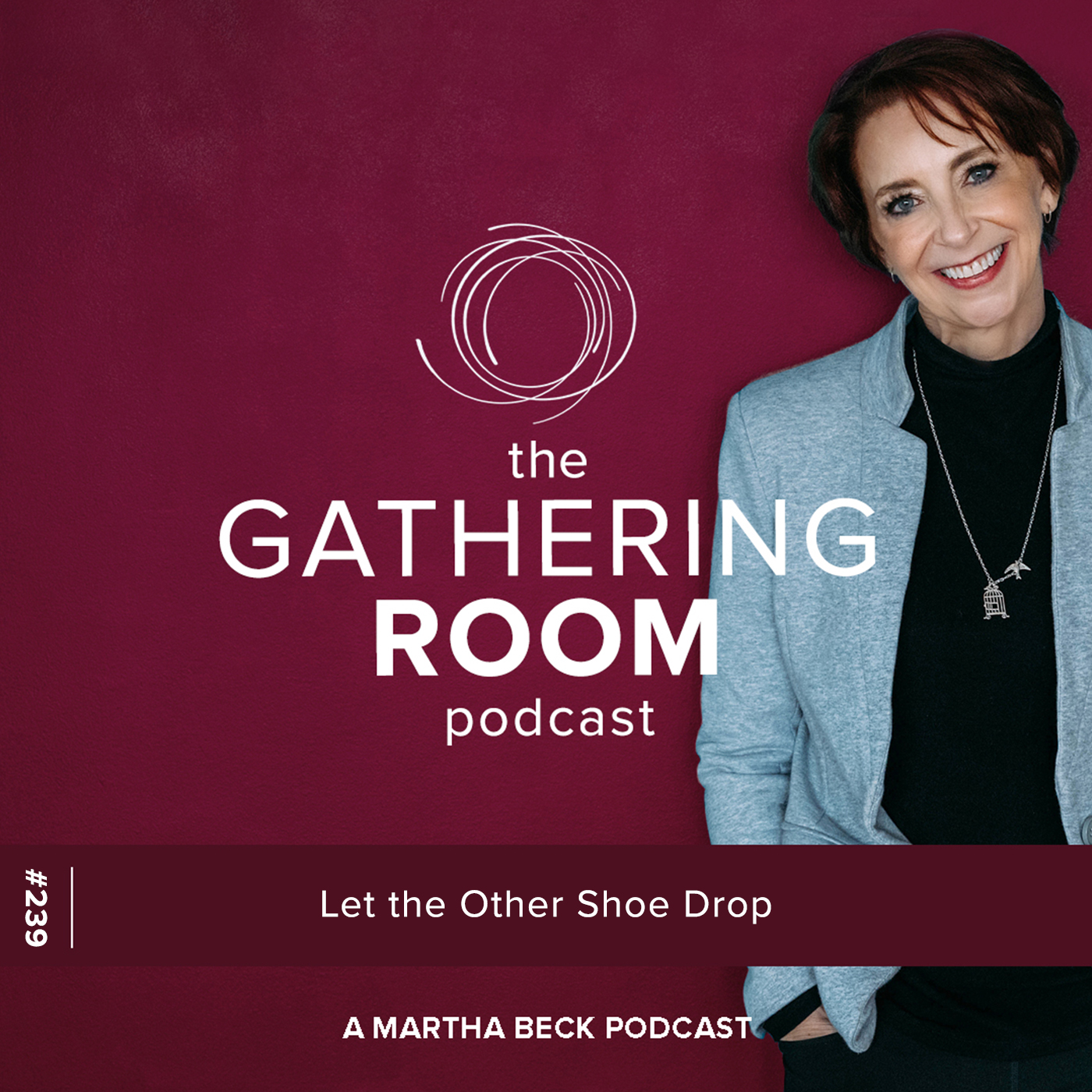
About this episode
In this episode of The Gathering Room, I share how a perfectly wonderful, creative day unexpectedly led to a moment of anxiety, and how that experience transformed my understanding of fear, struggle, and even death. We reframe the old familiar saying “waiting for the other shoe to drop” to acknowledge joy as our true, natural state. Join me for this conversation to explore how “dropping both shoes” can take you out of left-hemisphere anxiety and suffering and back to freedom, connection, and bliss.



Let the Other Shoe Drop
Show Notes
Welcome to The Gathering Room! In this episode, I share how a wonderfully joyful, creative day I had turned into a classic “other shoe dropping” moment, and how I used it to completely reframe the way I see anxiety, difficulty, and even death.
The day before this broadcast, I had what was, for me, a perfect day: I painted, I worked on a new teaching project, I lifted some light weights, I plinked on the piano. Basically I got to bounce between art, movement, and connection with my family, and it was the most fabulous day.
The next day I woke up thrilled to keep that going…until Ro reminded me I had The Gathering Room in an hour, and my left hemisphere went into full freak‑out mode!
Our culture always wants us operating in the left hemisphere of the brain (spreadsheets, coding, “instruments,” all the logical stuff) and that side of the brain tends to generate anxiety, negative stories, and the feeling that something bad is always about to happen.
That’s where the phrase “waiting for the other shoe to drop” originates: in the assumption that joy is temporary and suffering is what’s “real.”
To the left hemisphere, we are all just little material objects bonking around meaninglessly, suffering until we die. The suffering is one shoe, and the death is another shoe.
But you know what? I don’t believe that.
Let’s consider a Byron Katie-style turnaround of that story. Instead of “Things are good now, but the other shoe will drop and ruin everything,” I invite you to try on the opposite. When things are hard, think, “Soon the other shoe is going to drop, and I’ll be happy. I’ll be free.”
I once wrote an article for O, The Oprah Magazine about elderly people nearing death and the way many of them will try to take off their clothes and shoes because they feel they can fly. It’s reminiscent of people who’ve had near‑death experiences, where they describe death as blissful and returning to the body as putting on a tight, clammy suit.
From this perspective, “dropping both shoes” becomes a metaphor for ultimate freedom and joy rather than nihilistic doom and gloom.
To try a Byron Katie–style turnaround on a “shoe” in your life, learn more about joy being our true default state, and practice a meditation to shift from left‑brain anxiety into right‑brain presence, be sure to tune in for the full conversation.
I’ll also answer listener questions about:
- Using other people’s calm to regulate your anxiety
- Anxious attachment in a long‑distance relationship
- Watching loved ones suffer while building a better life for yourself
- Leaving a marriage and facing overwhelming fear
- The difference between trusting your heart, gut, and mind
- Raising a child with Down syndrome in a world that excludes her
Joy is our baseline and “the other shoe dropping” is always a return to freedom. You don’t have to believe it…just try not not believing it for a while and see what happens. ✨
Episode Links
- Beyond Anxiety by Martha Beck
- Expecting Adam by Martha Beck
- I Am That by Nisargadatta Maharaj
- Byron Katie
- Eckhart Tolle
- The Telepathy Tapes podcast
- Wilder Community
- Wayfinder Life Coach Training
CONNECT WITH US
Transcript
Martha Beck:
All right, let’s talk here today. So yesterday was like a perfect day for me. I got to do all my things. I just set up this little circuit in my room where I went from working on a painting to working on a new project for teaching and coaching and everything, to doing a little workout on my little workbench and my yoga mat and then going and like plinking on the piano and then back to the art project, back to the teaching project, back to the piano, back to the weights. It was like the most fabulous day. I got so much done.
And I just got up this morning, rolled over and started in again because I was so excited. And I worked on my project, my teaching project for about, I don’t know, I woke up at like 6:30. Anyway, an hour ago, I was still working on it. And Ro said to me, “What are you going to do the Gathering Room on?” And I said, “I don’t know. I’ll think about that tomorrow.” And she said, “But it’s in an hour.” And I was like, “But today is Sunday.” And she said, “No, it is Monday.”
This is how it goes. So I put down the project I was working on. Now it was different today and here is why. I was working on making instruments—is what social scientists call them—like a quiz with automatic scoring that feeds out into a scoring system. And to do that, I had to do some spreadsheet stuff, and I had to know the Google sheets and the codes that would go through and which things have to be coded or reverse coded. It was all very left hemisphere.
Now, I have written a book about how our culture favors the left hemisphere and it gets us all up in there and tells us that’s what’s real. And it’s the right hemisphere that experiences things like timeless joy and love and creativity and connection. So since I wrote that book, I pretty much stay in my right hemisphere. That’s where I was yesterday, like creativity and movement. That’s all I was doing, just bouncing around. And then I got to be with my family. Creativity, movement, and connection. It was heaven.
But today, I’d been in my left hemisphere and as I got ready for The Gathering Room, I noticed that what I wrote in that book is really true, at least for me, the more left hemisphere we get, the more anxious we get. Because the anxiety lives in a little circle on the left hemisphere of the brain and it takes any experience we’re having, filters it through something that calls it dangerous and negative, and then starts telling stories about how dangerous and negative it is that loop into the anxiety.
So it’s like this: “I have to do something in an hour? Oh no, I will do a very bad job. I have prepared somewhat, but not entirely.” Gosh, I’m really giving it to you, aren’t I? And then that story is like, “Ooh, things are quite bad. This will be a disaster.” And it feeds back into the anxiety. And the cycle of anxiety goes round and round and round and it keeps amplifying negative experiences.
And I thought, “You know, that’s how it is. You’re having a fun day, and then the other shoe drops.” And I thought how often on this very broadcast people have used that phrase “I’m waiting for the other shoe to drop. The other shoe dropped and now I’m not happy. I was really glad, I thought everything would be great, and then the other shoe dropped.”
So this is a phrase in English if you’re watching in another language somehow, like subtitles, yes. “Waiting for the other shoe to drop” is when things are going well, but we expect something to go badly. And when something bad happens, we say, “That was the other shoe dropping, and that’s reality: dropping both shoes into misery.”
So this is how the left hemisphere talks to us about reality. It believes that we are just little material objects bonking around meaninglessly and that life is suffering and then we die. So the suffering is one shoe, and the death is another shoe. And the ultimate is sort of this nihilistic pessimism. And I thought, “You know what? I don’t believe that.”
I was watching my own brain and I know the mechanisms. I know we have a negativity bias, so if anything happens, the left hemisphere will push it into its most negative meaning or most negative format. I know we have this anxiety spiral that goes around and around and makes anxiety increase, even without any change in the external environment. And I know that the left hemisphere is obsessed with its own reality as being the only possible interpretation of reality.
And I watched it all happen, and I thought the left hemisphere is doing its best, but it lies. It lies because it doesn’t see the whole picture. The right hemisphere does not cut out—the left hemisphere narrows our vision, it’s like it puts these blinders on. Pretty soon we’re going to do the meditation we always do, and one of the effects of that meditation is it softens your eye gaze and allows your brain, your attention field, to take in everything around you instead of just exactly what your eyes are focused on.
So the right hemisphere includes everything. The left hemisphere is—it’s called hemi-spatial neglect. It puts on its own blinders and it says, “The way I’m seeing the world right now is the ultimate truth and the only truth.” So then we get stuck in this negative bias of saying, “If anything good happens to me, the other shoe’s going to drop and then I’ll be miserable. And miserable is real. Happy is just waiting for the other shoe to drop.”
Well, I put that into the filter in my brain and found that it made me anxious. And that means, in my book, it makes me tense, it makes me tight, it makes me captive. That means it cannot be true because the truth sets us free. And I’ve tested that enough times to believe it. The truth sets us free. And usually the direct opposite of our most frightening thought is our next step toward our own awakening. So I do a Byron Katie turnaround of a thought that hurts. So the other shoe dropped and everything’s miserable, turns into—one of the turnarounds is—”the other shoe dropped and everything’s wonderful.”
Now, as I thought that thought, I remembered writing an article for Oprah magazine about people caring for the elderly, elderly parents, elderly loved ones. And one of the things that they talked about—I did more research for that than I’d done on any of the other articles I’d written, like 200 articles over the years. And this was the one where I really, I went down the rabbit hole. I read what there was to read and I went deep. And I found a lot of themes and I found a lot of anecdotal evidence, stuff that were just common stories. And one of the most common was that toward the end of life, if people aren’t completely together in their heads, they often start taking off their clothes and trying to leave their houses, leave the elderly care home, leave the hospital, and they want to take off their shoes.
And it talked about how people end up sort of corralling folks who are just entering the phase of dying, walking around naked outside. And if they try to pull them back into the house, they’ll go, “No, no, I have to go. I have to leave.” And if they say, “But you’re not dressed,” they’ll say, “I don’t want this. I don’t want this. ” And if you say you’ve got to have shoes, they say the most interesting thing. Very often they say, “I don’t need those. I can fly.”
I remember reading that and going, “Oh my God, I think they’re right.” I think when they get to that space between this life and the other, it’s kind of like a very extended near-death experience. And one of the things near-death experiencers tell us consistently is that the death experience is blissful, joyful, unencumbering, and that when they came back to their bodies, because of course I’m hearing this from people who are still alive or alive again, they say that getting back into the body was like putting on a tight, clammy, dirty suit of clothing that just felt so confining and shoes feel like big clubs on the end of their feet.
And I thought the truth is that when—I’m going to entertain the possibility that the truth is that the ultimate freedom is dropping both the shoes. So what that turns into is a complete reframe of the experiences of your life. Instead of having a good experience and saying, “Oh, the other shoe’s going to drop and I’ll be miserable,” switch it around. When you’re experiencing something negative or difficult, say, “Pretty soon the other shoe’s going to drop, and I’ll be free. Pretty soon the other shoe’s going to drop, and I’ll be happy.” Because all of life is just a progression of pleasures and pains, right? Nisargadatta says, “What you call pleasure is just the space between two pains.” But you could also say, “What you call pain is just the space between two pleasures.”
So I want you to do something for me right now. I want you to think of a time when you were super, super, super happy, but you don’t always go back to it because thinking about it makes you sad and nostalgic because you think things like that will never come again, or that is over, or that was when I was young, okay? So I want you to imagine, go back to that place, go back to the place where you were 25 and in love with life and falling in love for the first time. Whatever it was that made you happiest, I want you to go there in your mind and I want you to feel the feeling of that. And if the thought comes up, “No, I can’t feel that way. It’ll be too sad when it goes away,” here’s what I want you to realize: That feeling of bliss, of joy, of relief, of whatever it was, that was the first shoe dropping.
Whatever negative thing has come in between that is just filler, experience, education. The other shoe’s going to drop, and that feeling is coming back. I’ve done this so many times. And when I’m in a down space, I can think the other shoe dropped and I’m there, but when I’m in an up space, which is much more of the time than I used to be, I can say, “Oh good, the other shoe dropped. This is reality.”
The dark, the cold, the difficult, that is not the reality. That’s the clammy suit of clothes. This joy, this lightness, this freedom, this eternal youth, this is all reality. And when, at the end of my life, I take off the last shoe, which is this body, and let it all go, that will be the return of every joy I’ve ever experienced. That will be the greatest happiness of my life times a million and extended infinitely.
I mean, just play with it. You don’t have to believe it. Just try not not-believing it for a while. Just experiment with saying, “I’m going to go to that happy feeling and I’m going to imagine what it would be like if I truly believe that this is my constant state. This joy is the state I am meant to stay in. And if I don’t feel that way, pretty soon the other shoe will drop, and I’ll be back in bliss again.” And at the end, the other shoe will drop, and I’ll really be back in bliss again.
So play with that. Play with that because when I started doing basically that with my life, I have a lot more joyful days than I do sad ones. And that’s part of my privilege, but I’ve actually gone through some difficult things and still maintained this background noise of joy, of peace, even when circumstances were going up and down pretty dramatically in my life. So if you can play with that during our Space, Silence, and Stillness meditation, I’d really like you to.
I’d like you to start by remembering a time when you were deeply, deeply happy, when you felt no fear or as little fear as you’ve ever felt. You felt belonging, you felt inclusion, you felt loved. It could be one moment when you got a new puppy and the puppy looked into your eyes and you looked into the puppy’s eyes and you knew there were angels in there. It could be the slightest thing, but go to it and drop everything else and just return to that memory whenever your attention gets pulled away, okay? So just keep that in your mind.
And now I’d like you to allow your eyes to be still looking forward at perhaps at the screen you’re looking at, perhaps at something else if you’re listening without the video. And I want you to ask yourself the strange question that we love: Can I imagine the distance between my eyes? Return to the joy space. Can I imagine the distance between my eyes and the object I’m looking at? Can I look at that? Return to the joy space.
Can I imagine the stillness under everything that is happening? Can I feel that stillness in the space between the crown of my head and the base of my spine? Can I imagine the space inside my heart since my atoms are almost completely made of space? Can I imagine the silence in which my heartbeat is happening and the stillness in which it moves? Can I imagine this continuous with all space? Can I imagine this continuous with infinity? Can I imagine that all of space is conscious and that its nature is love and that my destiny is peace?
Can I imagine the space, the stillness, and the silence inside my body? Feel that space, stillness, and silence holding everyone on this gathering. It’s got us all, all at the same time. And I believe it wants us to have a really wonderful life. Oh, my goodness. It’s so lovely to have you here. I know it sounds like, “Oh, that’s just over-optimism.” That’s what the left hemisphere of the brain will tell you. I would ask you to drop back into connection to the space, silence, and stillness and allow it to tell you what’s real. Allow it to buoy you up when you hear yourself say, “I think when the other shoe comes off, it’s a good thing.”
Questions now. Okay. “Is it possible to move the brain from that anxiety spiral by putting ourselves in front of someone who is in the right hemisphere and then mirror neurons would switch off the anxiety in favor of peace?”
Absolutely! This is the quickest, easiest way. It’s phenomenal. This is why I watch Byron Katie’s weekly videos. I watch Eckhart Tolle’s videos online, and I listen to them too. You don’t even need to see someone. They don’t even have to be in the room. If you can be in the room with them, it’s really powerful. Then you not only have mirror neurons reflecting each other, you also have something called entrainment where their brain rhythms and heart rhythms are going to synchronize with yours and pull yours into the calmest possible frequency. So yeah, if you can be around a master, go hang out with them.
But even if you can’t, just listening into the voice of someone who I would say is awake, will put you into a state of such right-hemisphere peace. And oh, it’s like coming home. That’s how you know that’s where we’re meant to go when the other shoe drops. What a good question. Very smart, very quick. Why do the work ourselves? Other people have done it for us. Oh, and by the way, even reading, like Nisargadatta Maharaj, he wasn’t even alive to be filmed much, but his book, I Am That, puts me right in that state of bliss.
Okay. Next question: “I have an anxious attachment style, and I’m in a long-distance relationship with an avoidant partner.” Oh, y’all, if you don’t know what that means, it is a perfect storm of abandonment fear. Okay. “I truly love him and I’m seeing him in 27 days. Got any advice of how to stay in integrity? Thanks.”
Yeah. First of all, this anxious attachment style is really locked into the left hemisphere of your brain. So if you can tell a different story or stop telling stories at all about the attachment, about being away from your partner, everything verbal, well, almost everything verbal is being processed in the left hemisphere. So if you can go to things like kinesthetic movement, if you can go for a walk, if you go to connection, play with a dog or a baby, a simple, sweet relationship. Go to running water and walk beside it because that will take you into your right hemisphere. Drawing, music, dance, all these wonderful, all the creative arts will take you into your right hemisphere. That’s why our culture doesn’t value them very much, doesn’t teach them in school. They’re not as important as mathematics and all that. They’re at least as important. Okay, in my humble opinion.
So yeah, stay in a place of joy. And when you’re afraid that your partner doesn’t love you, or you’ll never be able to stay together or whatever, just know that that’s an anxious story. It is not the truth. How does it affect you? If it makes you tense, tight and miserable, that’s not the truth. The truth will set you free. And that means try on the opposite story. Love never dies. Love literally cannot be lost. It supersedes mortality. It supersedes distance and physical space. Play with that thought. Does it make sense to the left hemisphere? No. How does it make you feel? It opens—well, I’ll speak for myself—it opens me to say that. It relaxes me. It puts me in peace and joy, and that makes me a much better partner. But we’re not doing this to be a better partner so that then we can keep our partner and not be anxious. We’re doing it to get rid of the anxiety right at the root so that we can be the person who fell in love with that partner, be the person who’s in love with themselves, be the person that the whole world will fall in love with.
Because anyone who is truly themself is incredibly lovable. That kind of joy and ebullience is just, it’s irresistible. So practice going there, practice going there. Anxious attachment is not a death sentence. We can change our brains. We can rewire them. We can do brain surgery without surgery just by continuously taking negative stories and saying, “No, I’m going to look at the opposite of that and believe what makes me feel most free.”
Okay. Question: “How do you hold to hope and expectation when you’re witnessing the suffering of loved ones and feel unable to help while you yourself are trying to create a new and better life for yourself?”
The first thing you have to do is get rid of the idea that suffering when someone else is suffering is love. It’s more like, I’ve said this before, I’m going to say it again, if you broke your leg and I came in the room with you and I was like, “Oh my God, you broke your leg!” and then I broke my leg and lay down beside you so we were both hurting, that’s not love. That’s just codependency in the extreme.
So when someone you love is hurting, there’s a grief you have to experience. It is real. And you can grieve for the fact that they are experiencing suffering, but grief is not infinite. It’s a process. We call it the grieving process. There’s grief, there’s anger, there’s denial, there’s bargaining, there’s a whole big mishmash of all those things, but it ends with acceptance. And at the point where we can say, “I wish my loved one weren’t suffering, but they are. And now I’m going to accept that and find joy so that someday I may be able to contribute joy.” Remember what I just said about being in the room with someone who’s regulated? It regulates people. It helps people out of suffering. So that method, that way of going into joy, that is the ultimate thing you can do for anyone and everyone who is suffering.
Okay: “I relate to much of Martha’s story.” Yay. “Especially coming out of religious stuff. I’m in the process of leaving my marriage, but how do I stand up to the waves of fear that come from me to keep me stuck?”
Well, I was lifting weights yesterday, but very light weights, because if you’re lifting heavy weights, you need a spotter. Otherwise, you could drop a barbell and hurt yourself. So if you’re trying to lift something very heavy, like the fear that comes in when you’re leaving a marriage, you probably need a spotter. That can come in the form of a therapist, a really best friend, even a book. I mean, I’ve done things with just books on how to do it to help me, but you can’t get stuck unless you start to believe negative stories. These negative stories, when they are believed, are so frightening that you don’t even think of alternate stories, alternative stories. But if you have a scary story, oh my gosh, fear always comes with a story about the future. It’s never here now. Here now, we’re okay, right? We’re all okay. Yeah, the divorce is still going on for you, but right now you’re just sitting in a chair somewhere or standing or wherever you are, you’re okay.
So if you can take the scary stories about the future that are keeping you stuck and believe the opposite, “This will destroy me.” What’s the opposite? “This will create me.” Play with both sentences, see which feels truer and go with what sets you free. Nothing can make you afraid without a false story about the future. That’s why in 12 steps they say fear stands for “false events appearing real.” Although I’ve also heard it means “F everything and run.” But that’s not true. That’s just funny.
Okay. “Ah, my dear Martha,” someone says, “I have read the amazing Elif Shafak book, 10 Minutes and 38 Seconds in a Strange World. She makes a difference between following the heart and the gut. The main character finds herself in awful and dangerous situations when following her heart while her gut is the voice of reason. This distinction has confused me so much I can’t see to let it go.”
Okay. Let me just tell you something. Everybody who sits down to write a book, especially about the psyche and how it works—in particular, allegorical work—is making it up as they go along. Yes. Everything I write, I’m making it up as I go along. I do a lot of research, but ultimately it’s what I put on the page is how I see it. So if she wants to have that codification of “the heart will lead you into danger, but the gut is the voice of reason,” okay. There is a brain in the gut, a cluster of nerves in the gut that’s been there for like 300 million years, and a cluster of nerves in the heart, as well as in the brain.
And it is true that when you get a gut sense of something, it’s often an intuitive hunch that you should steer clear of something. I once ate a salad that would give me a parasite and at the first bite, I felt something in my stomach say, “No!” but I just kept eating because I was following my mind. See, in my codification, your gut is right, your heart is right, your mind is kind of like for sale to the highest bidder—it will betray you. So I think you trust your gut, you trust your hear—they’re the same thing—and the “voice of reason” that tells you the other shoe’s going to drop and then you’re going to feel awful, that’s a lie, and it comes from your mind. So I don’t know if that helps at all, but just remember, you don’t have to believe anything in any book or anything that anybody says, especially not me. Okay? Find something that makes you feel free, go with it. Yeah.
Okay: “Tips for structuring your day like you did yesterday so we can have a deep day of flow and creativity?”
Yeah. Fake your own death. You have to fight hard for those days, and sometimes it’s impossible. Like when you’re, say, a working parent, it’s just not going to happen for a while, probably, but always be on the lookout for it and always intend to create it. Ro and I will sit down and say, “What if we just did that every day?” And just imagining that helps us go forward and helps us make those days more frequent.
All right. I think, okay, we have one minute left. Here’s another one: “How can I accept isolation when the world constantly tries to exclude my child who has a disability? My daughter is 16 years old and she has Down syndrome.”
I would gently suggest that you might want to listen to a podcast called The Telepathy Tapes. I would also gently suggest that you could read, maybe you already have read my book, Expecting Adam, which is about my son who has Down syndrome. And I would really encourage you to let the experience of having a different child throw the gates of your mind wide open.
When Adam was diagnosed before he was even born, what I decided to do was throw away the worldview I was learning, getting my PhD at Harvard. I was going to chuck the left-hemisphere-only worldview, and I was going to adopt left-plus-right. So not only logic and reason, but the right hemisphere’s mystery, magic, imagination, wildness, joy. Adam threw the doors open for me before he was even born because his life didn’t make sense to me in our rigid, viciously competitive, lonely, cultural mode. His life didn’t make sense in that, so I didn’t throw away him, I threw away that mode. And this is an opportunity to see where your daughter is connecting in deep ways that may not even be possible for someone who has a typical chromosome count. It encourages you to look beyond the barriers of everything you think is important for something that is more beautiful and more loving.
So what happens when you do that is you end up in the mystery. And that’s kind of where I want to end here. Ending up in the place where you have good days and then you have bad days, but the other shoe drops, and you have another good day. And then maybe you have some bad days because you’re going to die, but then you die, and you take off the other shoe and you find out you don’t need that—you can fly.
I really believe we’re meant to fly all the way from here to there. So thank you, thank you, thank you for joining me. I love you. Have a wonderful day, night, or whatever it is in your part of the world, and I’ll see you again soon. Bye.
Read more
Questions? Comments? Trying to figure something out? Email us! [email protected]
Credits
“Illuminate” by Punch Deck | https://soundcloud.com/punch-deck
Music promoted by https://www.free-stock-music.com



0 comments