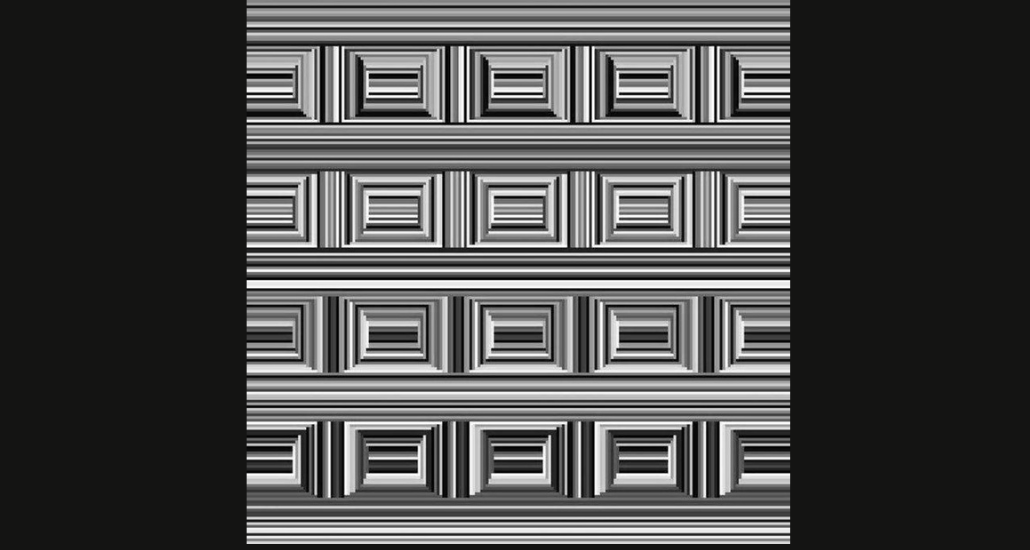
Here’s an image that recently blew my little mind. It’s called the “Coffer Illusion.” When you look at it, you’ll either see four rows of rectangles or sixteen circles. You probably won’t see both. But the rectangles and the circles are all right there, in plain sight.
When I first saw the Coffer Illusion, the circles were thin on the ground. Absent, in fact. Squinting didn’t help. Crossing my eyes didn’t either. Then my gaze relaxed slightly, and sixteen circles seemed to pop into existence. Then they were gone. The rectangles took over again. But now I knew the circles were there.
After faffing about for a while, I learned how to make the circles “pop.” My method is to stare at the vertical lines, ignore the horizontals, and repeat a kind of mantra: There are circles. There are circles. There are circles.
This made the circles easy to see. Then I could go back to seeing only rectangles, or switch back and forth, or even see some circles and some rectangles at the same time.
Why am I telling you all this?
Because it shows—not metaphorically but literally—that something can be right in front of our noses and completely escape our attention.
When researchers showed the Coffer Illusion to people who live in circular huts in Namibia, they initially saw only circles, no rectangles. Most Westerners grow up surrounded by right angles, while the Namibians lived in an environment that favors roundness. We tend to see what we’ve been taught to see, and miss everything else.
To me, this hints that the world may be far more interesting than we know. If we learn to switch focus, our minds might open to new realities that have been right there all along, waiting in our blind spots.
So what are the other “circles” we may not be seeing? What are we missing? What’s hiding in front of our noses?
Noticing the Mystery
There was a time when this question became my central preoccupation. I loved science, and I believed in strict materialism: Reality is what we can measure with our five senses, and nothing else.
Then, to my own astonishment, I began having “psychic” experiences.
It happened at the same time I became pregnant. I sometimes saw what was happening to loved ones far away, or vividly felt their emotions. When I checked with them, they confirmed that what they had done and felt exactly matched what I had “received.”
At first I found this so strange that I simply pushed it out of my attention. It worked beautifully; the anomalous experiences disappeared from consciousness almost as soon as they happened.
Then, late in that pregnancy, I learned that my future baby had Down syndrome. Grieving and terrified, I turned my attention back to the mysterious events I’d been experiencing. My child would almost certainly suffer in this world. He would have significant disabilities.
But what if there were abilities I had never considered, abilities a person with Down syndrome may have in abundance?
I still loved science, but I began to contemplate the possibility that there is much about our world that science has not yet explained. I called it magic—not because I think it defies reality, but because, at least for now, we have no explanation for it.
“There is magic,” I would repeat to myself when fear threatened to overwhelm me. “There is magic. There is magic.”
Slowly at first, then with increasing ease, I began to notice how many uncanny things had been happening to me throughout my life. Often, I felt the tangible presence of a gentle, flowing power that held me as if I were a newborn myself. A warm pressure flooded my chest, as if someone had placed a hand over my heart. Comforting words appeared in my mind like dew.
When I told people about this, most of them thought I was deluded by emotional disruption. But to me, then and since, the “magic” in the world is simply, observably there, as real as the circles in the Coffer Illusion.
Keeping Our Eyes Open
Once we come to see something we’ve never seen before, even though it was clearly present all along, our minds can begin to open to the possibility of virtually anything else.
Our culture generally trains attention not only toward materialism, but toward dark forces: danger, destruction, death. Our vision is shaped by these invisible conventions, just as surely as our eyes have been trained to see corners and ignore curves.
But we can learn to see that other truths are also present, and always have been. For example:
We learn history as a series of wars, plagues, and conflicts. But human beings have spent far more time cooperating than fighting one another. Every single one of us receives thousands of hours of care from the moment of birth. Focus on that as you contemplate humanity. Repeat to yourself:
“There is love. There is love. There is love.”
We may see nature as “red in tooth and claw.” But hungry polar bears have been known to play with sled dogs instead of eating them. Ducks sometimes offer some of their own seeds to fish. Alligators have been observed giving “boat rides” to otters, who ride on their backs.
“There is delight. There is delight. There is delight.”
Millions of people live in desperate circumstances. Their suffering is real, as is the moral imperative to help when we can. But nature still floods into human eyes and ears, no matter where they are. The sunset flares. The stars appear. A tiny spider laces its geometric silk across a gap in a fence.
“There is beauty. There is beauty. There is beauty.”
Again, I’m not saying we should avert our eyes from horror and pretend that only sweetness is real. I’m saying we can learn to see what lies beyond the biases that shape our worldview. We can learn to switch back and forth, or even to see it all at once.
Expect Amazement
The point of this, I think, is not knowledge but humility.
It is illogical hubris to believe that what we have seen so far—any of us, or all of us—is everything that exists. And while our minds may balk when we look for the unseen, I think our hearts goad us onward.
Long after that difficult pregnancy, I can see that I had always longed to believe in “magic,” in the vital flow of the Mystery. And as we look at the darkness and horror that sometimes seem to be everywhere, part of us knows enough to keep looking for something radically, entirely different.
What should we expect to see if we keep looking?
I have no idea. I can’t see it yet.
But I’m keeping my mind open to the possibility that astonishing things are right in front of me, entirely invisible to my ordinary habits of mind. I anticipate many moments when those new realities will “pop” into my perception.
Until then, I walk the world with my eyes wide open, repeating to myself:
“There is more. There is more. There is more.”