

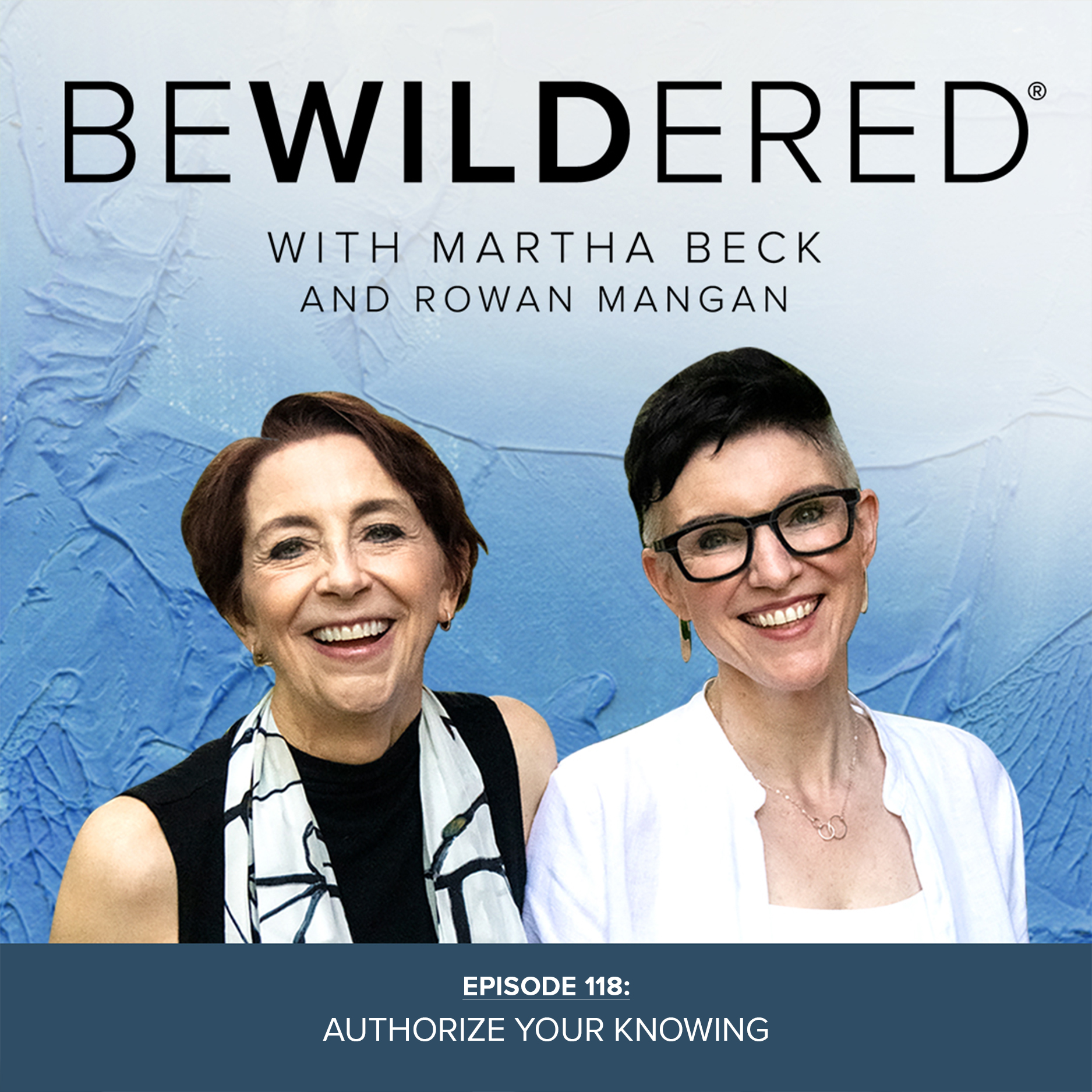
About this episode
Ever feel like the world is telling you what to think, do, or believe—until you’re not even sure what you know anymore? In this episode of Bewildered, we’re talking about “authorizing your own knowing”—a concept we picked up from the incredible Dr. Lisa Miller. We explore how to reclaim your own inner guidance, trust your instincts, and stop outsourcing your authority to others. If you’re ready to stop spinning and start discovering what you know to be true for you, join us for the full conversation!



Authorize Your Knowing
Show Notes
What if the wildest thing you could do is trust yourself completely, no matter how much the culture tries to make you doubt yourself?
In this episode of Bewildered, we’re diving deep into the heart of the deceptively simple command “Authorize your knowing,” and what it means to take back possession of your own guidance through life.
Not too long ago, Martha got to interview the brilliant Dr. Lisa Miller of Columbia University, whose research on spirituality and mental health is truly inspiring. When Lisa dropped the phrase “authorize your knowing” in that interview, it hit us both so hard (in a good way) that we wanted to do a whole podcast about it!
So, what are we talking about when we talk about knowing?
We don’t mean knowing factoids about the world. It’s not even about knowing what other people are feeling or thinking. This is a very specific kind of knowing, feeling things to be true down “deep in your waters.” In other words, you just know that you know that you know.
Our culture systematically teaches us—from early childhood—not to trust this inner knowing, to outsource everything to external authorities. For the culture, our knowing is practically seditious because it threatens the hierarchical, pyramid-like order of things.
Dr. Lisa Miller’s research is clear: Spirituality has a massive positive effect on mental health, especially in women. But how do we forge and trust that connection to our knowing?
We suggest this two-step process:
- First, start making choices from what you deeply know, even when it isn’t “logical.”
- Second, dare to speak from that place, becoming the author of your experience.
Living this way may feel a bit like insurrection at first, but reclaiming your authority from the culture is always worth it. When you step off the culture’s pyramid and do what’s true for you, a kind of strange magic kicks in, and synchronicities start piling up the moment you dare to follow your inner compass.
Want to try this wild experiment of trusting your knowing so you can “rewrite the code” for your own life? Then join us for this rollicking conversation!
Also in this episode:
- Martha waddles around the house in a “femme-butch” tool apron.
- A rogue saw, a burst pipe, and expletives sung in falsetto
- Ro’s unpredictable encounters with the local bureaucracy
- High-water pants and the wittiest bullies in Utah
- Where life coaching falls on the list of esteemed jobs (hint: not at the top)
- Martha and Ro decode capitalism.
TALK TO US
You can follow us on our Instagram channel @bewilderedpodcast to connect with our Bewildered community, learn about upcoming episodes, and participate in callouts ahead of podcast taping.
And if you’re a Bewildered fan, would you consider giving us a little rate-and-review love on your favorite podcast player? Ratings and reviews are like gold in the podcasting universe—they help people find us, they help build this beautiful community, and most of all, they help us in our quest to Bewilder the world…
Episode Links and Quotes
- The Awakened Brain by Lisa Miller
- The Gathering Room with Special Guest Lisa Miller
- The Knowing by Ani DiFranco
- The Upanishads by Swami Paramananda
- Max Weber
- Elie Wiesel
- Byron Katie
- Stephen Mitchell
CONNECT WITH US
- Follow Martha on Instagram
- Follow Ro on Instagram
- Follow Bewildered on Instagram
- Join us in the Wilder Community!
- Listen on your favorite podcast app
- The Bewildered Show Notes
- Is there something you’ve been feeling bewildered about? If so, let us hear from you!
Transcript
Please note: This is an unedited transcript, provided as a courtesy, and reflects the actual conversation as closely as possible. Please forgive any typographical or grammatical errors.
Martha Beck:
So, Ro.
Rowan Mangan:
Oh yeah.
Martha Beck:
Can you tell the peoples what basically they will be hearing in the upcoming episode, please?
Rowan Mangan:
The forthcoming episode of Bewildered is a wonderful, rollicking ride through the concept of authorizing your own knowing. What does it mean? Well, I’ve brought along Martha Beck to tell you that very thing.
Martha Beck:
And that’s just a party.
Rowan Mangan:
We’ll talk about what it is to know what you really know. And P.S. you do really know. We’ll talk about…
Martha Beck:
How to take back possession of your own guidance through life.
Rowan Mangan:
And why when we’re at home, Marty insists on wearing an apron.
Martha Beck:
Hear us now. Understand us later.
Rowan Mangan:
Maybe.
Martha Beck:
Hi, I am Martha Beck.
Rowan Mangan:
And I’m Rowan Mangan. And this is another episode of Bewildered, the podcast for people trying to figure it out. What are you trying to figure out these days, Marty?
Martha Beck:
Oh Lord, I’m trying child so hard to get my proper lesbian credentials in the tool-using category. I don’t have a tool belt. I do have a tool belt.
Rowan Mangan:
I will say you have a tool apron, which—
Martha Beck:
I have a tool apron, which is—
Rowan Mangan:
Lame.
Martha Beck:
Well, it’s kind of a femme-butch hybrid.
Rowan Mangan:
Yeah. Yeah, it is.
Martha Beck:
Hybrid? Hybrid. Yes, I have a tool apron. I do.
Rowan Mangan:
It’s just not impressive.
Martha Beck:
I waddle around the house with various tools. They’re very heavy, so you should admire me for that. But in between my zillion trips around the world this last few weeks, I had one day where Karen, Kerry-Koo, our third.
Rowan Mangan:
Our beloved.
Martha Beck:
Yes. She had gotten the proper blade for our electric saw, which we purchased, you will remember, to make this very podcast when we were just doing all kinds of random things.
Rowan Mangan:
We did a little bit of DIY at our old house trying to make a studio.
Martha Beck:
Literally sawed down walls and desks.
Rowan Mangan:
Yeah. Drew would not have approved.
Martha Beck:
Yeah. So I had this saw, the blade was lost in the move, so Karen got the blade and then she said, “Saw through this board in my bedroom for that I think there is moisture behind it.”
Rowan Mangan:
If not actual mice.
Martha Beck:
Yes, we definitely thought there was wildlife involved. There usually is in the house we just got.
Rowan Mangan:
Sometimes mold is so advanced that it becomes wildlife.
Martha Beck:
Yeah, yeah. It starts to move as a unit, like slime mold, and then it starts forming opinions.
Rowan Mangan:
Yeah, it becomes self-aware really early.
Martha Beck:
Yeah. And that’s what’s happening. But Karen didn’t want it happening in this particular closet.
Rowan Mangan:
So she went, “Get your apron out.”
Martha Beck:
I put on my tool apron. It’s heavy. It’s a heavy tool apron.
Rowan Mangan:
It’s a fucking apron.
Martha Beck:
Yes it is. Well, it’s made of shiny stuff. I’m just going to say tough shiny trampoline, no parachute fiber. It’s a butch apron. Anyway.
Rowan Mangan:
It’s a very femme apron.
Martha Beck:
So I went in and this thing, it weighs like 45 pounds, the saw, and it’s violent. Like to turn it on it goes, “Rawwwr!” It’s not like a [gentle whir], no. “Rawwwr!” And so I applied it to the board and turned it on.
Rowan Mangan:
this is inside? I just want to paint a picture.
Martha Beck:
In a closet.
Rowan Mangan:
You’re in a closet inside the house.
Martha Beck:
There’s a boarded-off section for some reason, and we want to get in there. So I take this massive portable saw and I put it to the board and I turn it on: “Rawwwr!” And the ricochet from it, it throws me across the closet because the blade is moving so violently, and I was not holding it tight enough. I didn’t realize there would be the, it’s not the ricochet. What is it when you—?
Rowan Mangan:
It’s the blowback, right?
Martha Beck:
No, when you fire a gun.
Rowan Mangan:
Kickback, recoil.
Martha Beck:
Recoil! Kickback. That’s political, silly.
Rowan Mangan:
That’s a bribery thing.
Martha Beck:
Yes, but you can do it in a closet if you want. Anyway, so the recoil, I factored that in. I was brave because this, it was like fighting an alligator or something. And I applied it to the board and I turned it on and I held solid and it ripped through the board and water started spraying out of this thing, which still only had an incision about two inches wide. But out of that was spraying all this water.
Rowan Mangan:
Can I just pick up the story for a second? For, I was sort of present for this in the next room, in the living room with our daughter being a real lesbian thinking, “Wow, I sure wish we’d just gotten a man in to do this like my grandmother would’ve.” And so they’re in there doing their thing and I’m just like, “I’m taking no part in this. I have no interest in this.” And then I just see both, two lesbian falsettos going, “Fuck! Fuck!” And it was pathetic.
Martha Beck:
It was.
Rowan Mangan:
It was the falsetto expletive of a lesbian in an apron.
Martha Beck:
And so I was like, “What do I do now?” I still couldn’t get behind the board. It was a huge board. So I tried to saw different areas of it.
Rowan Mangan:
Did you not abandon the mission at that point?
Martha Beck:
Well sort of. But to get to whatever was spraying water, I had to get that board away. So I threw the saw down and started just yanking on it with my body. But it was a large board and it would not come free. And it was built in many ways and there’s still water spraying out. So I started shoving things out of the closet because there were things…
Rowan Mangan:
[singing] “Fuck!”
Martha Beck:
It wasn’t that mellifluous. It was much more a high-pitched shriek.
Rowan Mangan:
Yeah. Well both you and Karen were doing it.
Martha Beck:
It’s so interesting how children, they hear us swear and they pick up all kinds of interesting words. Lila has started saying things like, “There is a certain time when I wished to go to bed,” just a large vocabulary, but I never heard her really drop an F-bomb until she walked in and saw the water spraying out of that closet and said in her little baby voice, “Fucking shit!” And so yes, we ran around about and ended up—
Rowan Mangan:
It was pathetic.
Martha Beck:
Ended up under the house catching water that was dripping through floors in a bucket.
Rowan Mangan:
Before that—I know, I’m sorry, I have to set the record straight here. Before that, there was a lot of shouted demands for towels as though towels were going to do the job.
Martha Beck:
Oh, they helped. They stemmed the tide. You were not in that closet. You weren’t there, man! They stemmed the tie. And then I thought of using the plastic tubs that we’d been storing clothes and blankets in, just chucked it all out onto the bed, went under the house, put those plastic tubs in there. It’s dark. We’ve got flashlights. It’s like pouring rain under our house.
Rowan Mangan:
“Call 9-1-1!”
Martha Beck:
I kept saying, “Call the fire department!” Because there’s a firehouse really close to our house. They’d just walk over, right? Anyway, I never did get the board sawn apart when we—
Rowan Mangan:
Minor detail, hon.
Martha Beck:
Is “sawn” the right conjugation? Okay. But the weird thing was we had just had that under the house, like the crawlspace or whatever, had been covered with plastic.
Rowan Mangan:
We had the basement, we had a moisture vapor barrier.
Martha Beck:
Oh God, all these things. All these things because everything in the house wants to kill us. It’s like the Amityville Horror, but we love it.
Rowan Mangan:
The trials of the house continue for regular listeners.
Martha Beck:
There are like three people who are in the middle of house repairs who are going, “Yeah, tell me more.” And everybody else is like: [snores].
Rowan Mangan:
Yeah.
Martha Beck:
Anyway. Yeah, it was good because the moisture barrier meant that we weren’t neck deep in mud under there. So we are counting our blessings. But then the real saw people came.
Rowan Mangan:
The real saw people.
Martha Beck:
With their saws, which is like another horror movie, isn’t it?
Rowan Mangan:
Well, first the plumbers came.
Martha Beck:
That’s true. They did.
Rowan Mangan:
Yeah. And what I really enjoy about this story is how quickly you and Karen regrouped to telling the story in a, “It was just meant to be because we’d had the basement done and otherwise it would’ve been muddy. And it’s just so perfect that I sawed into a wall into something I couldn’t see with an electric saw and was surprised by.”
Martha Beck:
There should not have been pipes back there. There should not have been, by all the logic in the universe, there should not have been pipes back there. That’s just what I’m saying. I have a tool apron, Ro. I would think twice before you contradict me. It was horrible.
Rowan Mangan:
It was great. It was hilarious.
Martha Beck:
It was. And then Lila put the F-bomb away in her back pocket to use the next time we do something that’s stupid, which will probably be in an hour.
Rowan Mangan:
Can I just say something off topic real quick that she said last night while she was—no, yesterday afternoon while she was having, not a meltdown, but like a cry, a good cry in the back of the car about me taking her to the doctor before the school day was over. Because it was Willa’s birthday and “Well, I dunno if it was her birthday today. I think her birthday might’ve been two days ago if I recall correctly.” If I recall correctly.
Martha Beck:
She said “If I recall correctly”?
Rowan Mangan:
Yeah. I think what’s happening is she is watching Minecraft playthroughs on YouTube and “if I recall correctly” is a common abbreviation on the internet. And so I think all these autistic kids doing playthroughs of Minecraft, they just think it’s normal to go, “If I recall correctly.”
Martha Beck:
Yes. So what are you trying to figure out dear? Oh, you hate it when I use the word “dear.”
Rowan Mangan:
Hate it when you call me that.
Martha Beck:
“So dearie, now that I’ve got my apron story done.”
Rowan Mangan:
“Get me a cup of tea, dear.”
Martha Beck:
I’m just trying, by the way, that never said anything about what I’m trying to figure out, which is how the hell to use that saw. Anyway, what are you trying to figure out, honey buns?
Rowan Mangan:
It’s not the word, it’s the implied threat in how you used it just then. All right. Kind of liked it.
Martha Beck:
Okay, we’ll talk later. Okay.
Rowan Mangan:
I’m trying to figure out how to be a sort of nervous people-pleasey Australian who’s now a New York state resident.
Martha Beck:
But that’s what you are.
Rowan Mangan:
Well, and I’m working on it.
Martha Beck:
Okay. Okay.
Rowan Mangan:
Can I share? Is this a safe space?
Martha Beck:
Well, yes, please.
Rowan Mangan:
All right. “Well that’s what you are, and that’s it.”
Martha Beck:
You’re done.
Rowan Mangan:
You’re done. So I went, we moved to the Hudson Valley, I went to the pharmacy to ask if I could have my prescription from the same pharmacy in Pennsylvania. There was a little bit of palaver, you’ll be shocked to learn. And so I went in and I was ready. I was ready for the full CVS experience, sorry to name them. And sure enough, the woman behind the counter goes, “What is it?” I’m like, “Well, I have this prescription.” You have to imagine her with the accent. I’m not going to try and do the accent. “I have this prescription. I was wondering if you could fill it here.” And she goes, “Well, if I fill it here, your insurance won’t apply.” And I’m like, “Okay, well I got to have my meds so I’ll just pay cash.” And she goes, “No.” And I was like, “Wow, I’m sure getting this CVS experience here.” No. And I was like, “Okay…” I didn’t know if it was like a computer says no at the moment.
Martha Beck:
Right, right, right. No use trying.
Rowan Mangan:
Yeah. But instead she was like, “No, I would never do that. I never do that. I will find you a discount card.”
Martha Beck:
Ohh.
Rowan Mangan:
And I was like, “What’s happening here?” Because she didn’t change her affect at all. No. She was just like, “I’ll find you a discount card.” And I was like, “I’m sorry.” And then she goes, she’s like doing my card and everything, got me my meds. And she’s like, “I have the same hair as you. You just can’t tell because it’s tied back. I think it’s fantastic.” And I was just like, “Okay, I love you.” But it’s disorienting, right? And then just before we did this podcast, I had another one. You were there. We had to do a DMV thing. A DMV experience being much like a CVS experience. I don’t if it’s like those three letters just turn it into a bureaucratic hellscape.
Martha Beck:
Any three letter thing, yeah. NAS. IRA. Everything. Keep going.
Rowan Mangan:
Okay. DMV. Marty—sorry, I have to say it. Marty doesn’t know the difference between the IRS and the IRA. I keep telling her there’s a pretty big difference. So we go to the DMV, we’ve brought every piece of paper you could possibly imagine possibly needing. We didn’t have the right piece of paper, so we were told that if we went to the county clerk’s office, maybe they would give us a different kind of title about our house that would magically unlock the computer to a computer says yes. And so we went to the county clerk’s office, and I encountered the most officious bureaucrat.
Martha Beck:
She was quite something.
Rowan Mangan:
And she wasn’t like CVS New York. She was like a sort of, I don’t know, a different flavor New York.
Martha Beck:
She’s actually quite New Englandy, like New Hampshire. Like tight upper lip, not stiff upper lip. No, that tight upper lip that comes from being cold all winter long. Anyway, go on.
Rowan Mangan:
My whole story is about New York.
Martha Beck:
Okay.
Rowan Mangan:
You don’t New Hampshire—
Martha Beck:
She drifted south. She drifted south.
Rowan Mangan:
So she says, “There’s no point me giving you the title.” And we’re like, “No, the DMV—” And also I was very hungry and my blood sugar was low. And I was like, “But the DMV lady said if we came in here…” And she’s like, “No, absolutely not. It’s not going to work. It’s got your Pennsylvania address on it, it won’t do any good.” And I was like, “But they’re were…” [whines] And meanwhile another woman comes in, recognizes Marty, and they start having a sort of fan-girly conversation where Marty’s pretending to remember her from California.
Martha Beck:
I do remember her. I remember that day. It was one day, though, I mean, like 10 years ago.
Rowan Mangan:
Yeah, no, in fairness.
Martha Beck:
And she was amazing. And there she was. Both of us were there.
Rowan Mangan:
Marty’s worried she’s listening. She’s not.
Martha Beck:
I see you.
Rowan Mangan:
Okay. So county-clerk lady says to me, “The only thing you can possibly do at this point is get one of those, get a bank statement or one of those things.” And I’m like, “Where can I get that printed in this godforsaken state?” And she’s like, “Oh, there’s nowhere. I mean there’s nowhere unless you just wrote it to my personal email address right now, and I printed it out on my work printer.” And I’m like, “Do you mean you’re willing to do that?” And I’m like, “Would you do that?” And she’s like, “Of course I would.” It’s hard.
Martha Beck:
It was so weird for me because I was in on the conversation to where “It’s absolutely no good. You are basically screwed.”
Rowan Mangan:
Screwed.
Martha Beck:
Yes. Then I have my encounter over on the side and when I came back, you two were practically slow dancing. She was like, “Yes, I will do that for you.” I think it’s just because she probably was quite taken in by you once I was out of the picture.
Rowan Mangan:
Can I just say “taken in” is not the same as “taken.”
Martha Beck:
Oh, taken. She would take you in. I think she would take you into jail, to many things. No, she had a little crush on you after the first minute and a half.
Rowan Mangan:
All right. Yeah.
Martha Beck:
No, she was really lovely.
Rowan Mangan:
She kind of had a—
Martha Beck:
Maybe she’s listening.
Rowan Mangan:
A sort of soft dumpling Martha Stewart kind of air. Yeah. All right.
Martha Beck:
Yeah.
Rowan Mangan:
I could, yeah.
Martha Beck:
Soft dumpling Martha Stewart. I don’t think those go together.
Rowan Mangan:
Like if Martha Stewart was softened and dumpling’d.
Martha Beck:
Oh yeah. Yeah.
Rowan Mangan:
You know, a bit more powder on the face.
Martha Beck:
Anyway, I’m not sure Martha Stewart would’ve printed out our bank statement on her own personal account.
Rowan Mangan:
She might have.
Martha Beck:
I just realized.
Rowan Mangan:
She would’ve printed it, put her name on it.
Martha Beck:
Yes. Now this rando woman from the county clerk’s office has all our banking details. I just noticed that.
Rowan Mangan:
Oh boy.
Martha Beck:
She doesn’t seem like an organized crime kind of person, but…
Rowan Mangan:
She’s very organized.
Martha Beck:
I’m not sure how well they pay over there, so…
Rowan Mangan:
Very organized. And that’s step one in organized crime. Do you know what? Should we do a podcast?
Martha Beck:
Yeah.
Rowan Mangan:
Hi there, I’m Ro and I’ll be your podcaster for today. Do you know how to tip your podcaster? It’s actually pretty easy. You can rate our pod with lots of stars, all your stars. You can review it with your best superlatives. You can even subscribe or follow Bewildered, so you’ll never miss an episode. Then of course if you’re ready to go all in, our paid online community is called Wilder: a Sanctuary for the Bewildered. And I can honestly say it’s one of the few true sanctuaries online. You can go to wildercommunity.com to check it out. Rate, review, subscribe, join, and y’all have a great day now.
So what are we talking about today, Marty?
Martha Beck:
We are talking about a phrase that you and I both picked out of a longer set of words. I had the honor of interviewing a really great scientist and psychologist named Dr. Lisa Miller who is from Columbia University.
Rowan Mangan:
She’s amazing.
Martha Beck:
She is incredible. You told me not to fangirl too hard, but it’s hard not to.
Rowan Mangan:
I know.
Martha Beck:
Because she’s a great scientist and well, go look her up, follow her work.
Rowan Mangan:
She’s a spiritual scientist and a scientific spiritual teacher and it’s a really, sorry, sexy combo.
Martha Beck:
It is. It really is. Yeah, you get that one free. Anyway, as she was talking about it, she was saying that basically she’s done all this statistical analysis of huge data sets on depression, anxiety, and stuff and what is related to that in our behavior. And she has found—and this is where she just went maverick—she found a few variables that measured people’s spirituality or participation in spiritual thinking and whatever, and found these massive effects on diminishing depression and anxiety, especially in women. And when you start talking about spirituality in the Ivy League, and she was a Yalie who then went to Columbia, very top-tier scientist, and she got up in academic meetings and said spirituality has this incredibly positive effect on people’s mental health. And she got pilloried for it. She got bullied for it. And she wouldn’t let go because she knows she’s got the science, right?
Rowan Mangan:
And it’s a really fun story in a weird way for those of us who have a strong spiritual dimension but also have to work within the culture and know something about—
Martha Beck:
Well and trust science.
Rowan Mangan:
Yeah, and so it’s just like, because I think most of us know how materialists can have that condescending, “Oh, did you have a feeling? Oh congratulations sweetheart.” And she’s like, “Yes, I did. And here is my triple-blind, whatever thing…”
Martha Beck:
“Well, here is my incredibly highly statistically improbable result.” The statistical evidence for this relationship between spirituality and mental health is just, it’s undeniable. It’s huge. It’s a huge correlation. So I was interviewing her and she said, I said, “So how do we do this? What’s the practical implication?” She said a lot of things, but in the course of explaining a lot of things, she used the phrase, “You have to authorize your knowing.” And I sat there—and she’d said other things and they were great too, but I was like, “Authorize your knowing.” And then I looked over at you and you had taken one note and it said—
Rowan Mangan:
All caps. Bold.
Martha Beck:
“Authorize your knowing.” And it was like that one hit us both so hard in such a good way that we want to do a whole podcast about it.
Rowan Mangan:
So I think, and tell me where you differ. So to me that “authorize your knowing” in the context of what Lisa was saying is I feel like I said this to you earlier, what she’s saying is, “You know that thing that you don’t know how to do? Yes, you do.” And to us, that felt like such a rich topic for this podcast because it’s the culture that tells us, “No, you don’t.”
Martha Beck:
You don’t know.
Rowan Mangan:
You don’t know.You have no idea.
Martha Beck:
Yeah, you can’t do that. You don’t know enough. You’re not important enough. And I said, “Okay, so tell us about this knowing.” And she said it is not a mental way of knowing. It’s a deep inward sense of something being true or not true. And I had a therapist friend who used to say that you know that you know that you know. And that seemed to somehow reach that same place. And what I always joke about with life coaching is that the whole practice could be just this: Somebody comes in and they say, “I don’t know what to do with my life.” And you just look ’em dead in the eyes and you say, “Oh yes, you do. You know exactly what to do with your life.” And then they start to cry and then they give you money. And that’s the whole profession.
Rowan Mangan:
I love it.
Martha Beck:
Yeah, it works well. I knew to do it. I knew that I knew that I knew. But really, I mean there’s more than a grain of truth in that. When somebody comes in and they feel totally confused and you just tell them, “But you know.” It takes them to something different.
Rowan Mangan:
Yeah. And I feel like it’s like it short-circuits all the cultural layers of “you can only know because of you’ve got a degree or you’ve got a certification or you’ve got some sort of”—we externalize knowing. And that’s fine because I don’t, just as a totally random example, if I needed to cut into my own house with a saw, I would probably call someone who’s done it before. But I mean that’s just me.
Martha Beck:
Do you know that there’s a pipe? No, you absolutely don’t. You need a plumber. Go on.
Rowan Mangan:
And so one of the things that I first loved about your work is the idea that we do always know and that a lot of our education, our experience in the culture, the way that we develop as someone who can interface with society is about teaching you to distrust what you know to the point that you no longer know that you know it. And that’s like the best trick the devil ever pulled.
Martha Beck:
Yes. You have no authority over your life. And that’s why I think we both grabbed the phrase “authorized your knowing” because where do you look to? Where do you look to. Who are we supposed to look to? The authorities. “We should call the authorities. You don’t have the authority to say that.” And what she was saying is grab that back and put it inside you.
Rowan Mangan:
Authorize your own knowing.
Martha Beck:
Make your knowing the authority. And also, I mean that’s doing what you know to do. And then saying what you know to do makes you the author, which means to speak out, the one who speaks it. So the center of truth and establishment of your sense of rightness and how you talk to the world. If you authorize your knowing, it really flips the script. It really takes you right out of culture that fast.
Rowan Mangan:
So there’s two directions I want to go in and one is what does the culture say about that knowing? And the other is, if we’ve been that divorced from our knowing, how do we reform that connection? So let’s start with that one, right?
Martha Beck:
Okay.
Rowan Mangan:
If we don’t know at this point how to access the knowing, what does that look like? Where do you feel it? At what point did your friend say you know that you know that you know that you know?
Martha Beck:
At what point did she say—
Rowan Mangan:
Like you were saying that she would say that to clients. But she wouldn’t say that to clients, “You know that you know that you know that I’m on the second floor.”
Martha Beck:
Right.
Rowan Mangan:
It’s like a specific moment.
Martha Beck:
Yeah. It’s not knowing information about the factoids about the world. It’s not knowing what other people are feeling or thinking. It’s a very specific kind of knowing. And I think we get cut off from it as children because we’re trying to—we naturally follow our inclinations, our true nature, right? And I think the moment– I think it starts so young. A baby cries and is told not to cry and sucks it up. Or a little kid says, “I want to go home now.” And a parent says, “No, you don’t.” You start to have your own knowing questioned really, really early because the adults around you are trying to make you fit into society. That’s their job.
Rowan Mangan:
Yeah. Or “You, no, you had a super fun day today. It was a super fun day. Mummy and Daddy worked very hard for you to have a really fun day. So you did.”
Martha Beck:
Yeah. And then you get to, and there are things like going to school and thinking, “I look fabulous today!” and having kids bully you for the way your pants are too short or whatever. That happened to me once. I’d grown over the summer and I loved my new pants, but the second I got to school they were like, “Where’s the flood?” And I was so confused because they were called “high waters” when your pants weren’t quite long enough.
Rowan Mangan:
So it’s a very witty way of bullying.
Martha Beck:
Oh yeah. I went to a school with a lot of witty bullies. It was witty bullies.
Rowan Mangan:
They put that on the brochure.
Martha Beck:
Elementary school.
Rowan Mangan:
“Wittiest bullies in Utah.”
Martha Beck:
But you start to get undercut a lot. But just the simple relaxation with following your natural inclinations that you can see in any dog or cat. Well, dogs not as much. Cats, definitely. They just go with what they know. You can say to a cat all you want, “There’s nothing dangerous in there.” And they will be like, “Fuck you sideways.” A dog will go, “But it scares me.” Dogs are more like us. But yeah, that divorce from the self, the split starts really young and then there’s a sensitivity. It’s like it cuts a wound open inside us, and then each cut that comes after that hurts more until we learn to always look outside ourselves for what to do next and never to authorize our own knowing because that means putting it out there to be ripped apart by an electric saw wielded by an apron-wearing lesbian.
Rowan Mangan:
Well done.
Martha Beck:
Thank you.
Rowan Mangan:
That was excellent.
Martha Beck:
Thank you.
Rowan Mangan:
What kinds of knowing are we talking about here, and what kinds aren’t we talking about? Because I feel like we are going deeper and deeper, and I want to say it’s on the “What should I do next in my life” level, right? It’s not on anything like, “What should I do this weekend? Should I go out or should I stay home?”
Martha Beck:
I think you have to split it at the level of where you know something. There are things only from your internal, you would know them sitting in a room by yourself. You could sit and think, “What can I know right now?” And then there are things that you can only know by getting data. You can only get, like, if I want to know what you’re thinking and feeling, I need to ask you. If I want to know what’s the capital of Uzbekistan, I have to go check. I can’t just know those things internally. So when you are making a decision: “What do I need to do to get my New York driver’s license at the DMV?” That’s an external way of knowing where you have to go to the authorities. Oh boy, do you have to go to the authorities.
Rowan Mangan:
Because that’s culture. It’s the culture. The county clerk was an invented category and so was a bank statement, Sandra.
Martha Beck:
And then there are things that you can only know by going inward, but people look outward for them, like, “How do you want to spend whatever is left of your wild and precious life that you cannot know from the external authorities? What do you want?”
Rowan Mangan:
That’s really the question, isn’t it? That’s the question that you’d guaranteed know the answer to if you can just fuse that connection again.
Martha Beck:
Yeah, it’s funny. I could say, “You know exactly where to go to lunch,” and people would go, “Not really, I’ve never been here before.” But if I say, “You know exactly what to do with your life,” they’re like, “Holy crap, I do.”
Rowan Mangan:
Isn’t that interesting that the process of confronting someone with that knowledge, it’s almost like when you slap someone to break a paralysis or something, you know that, it’s like the shock of being told something countercultural is enough to push us back into a precultural—
Martha Beck:
I think we’re also always yearning to go back. So the moment someone external—because we’re used to externalizing everything—you go to a life coach like me and I’m an externalized authority and I say, “You know what to do.” And suddenly this thing that has been robbing you of authority is bounced back to you. And it may take you, it says in I think The Course in Miracles, “It has taken your whole life to take you away from what you were, but it takes no time to become what you really are.” And they just go, you tell someone, “You know these deep things,” and it just snaps back in place. It really is, joking aside, it is one of my favorite things about what I’ve done with my life, telling people that stuff.
Rowan Mangan:
She knows. So, first we reforge the connection. And ironically, one way to do that, people are listening to this. It’s like, you know.
Martha Beck:
You do.
Rowan Mangan:
Okay? She’s an authority, she’s got a PhD. Don’t know if you’ve heard of a little place called Harvard.
Martha Beck:
Do we have to?
Rowan Mangan:
Yes, we do. And so that authority has now spoken. You now are authorized to your own knowing. Now you have to authorize it yourself. You have to become the authority of your knowing. And what does that entail?
Martha Beck:
Two steps. And they’re both, it’s that play on words of authorize. First thing is you have to start choosing your activities based on what you know. I kept asking Dr. Miller, “But how do you know?” And she said, “You just know.” Like there’s no other place to go with that than just it is in you and you know it, and you make your decisions about activity based on that.
And it’s not every single step of the day. You can decide where to go to lunch five different places and they’ll all be equal. But then for some reason you’ll decide whether you want to go to a meeting or go home. And for some reason there’s an inner knowing that says, “Go home.” Maybe you’re getting sick. Maybe you’re just picking up with your spider senses that someone is at home sawing through a board with an electric saw. But there will be these odd places when you’re given permission to authorize your knowing, you will start to realize that you have lots of degrees of freedom with most stuff. But then sometimes this deep knowing says, “Do this now.”
Rowan Mangan:
And it’s not here in your brain box. It’s like a sort of settled, lower down feeling in your waters.
Martha Beck:
In your waters.
Rowan Mangan:
I feel it in my waters
Martha Beck:
Or down deep in your plums, if you’re a man.
Rowan Mangan:
Men can have waters.
Martha Beck:
Okay, down deep in your waters. Could I give, I mean kind of a serious example. I think I’ve talked about this before, but I had, just very briefly, I had this surgery when I was 29 that I had kind of a near-death-experience thing happen, and the anesthesiologist was told to give me more medication because I reacted to what I was experiencing by crying and the doctors could see it. And later he told, I asked him, “What did you give me?” Because I wanted to know if it was a drug effect that I’d experienced. And he just looked at me and he said, “I was going to give you more medication. And something just said, ‘No, don’t do that. She’s happy.'” And he looked at me, I’ll never forget his round eyes just saying, “Did I do the right thing? I just did it. I just did it.” And I was like, “No, no, I wasn’t in pain. You did great. You were awesome.” But that thing of just during the surgery when the chips were really down, he just accepted what he knew. That is the first way of authorizing it.
Rowan Mangan:
I haven’t thought a lot about that scenario in terms of how deeply countercultural his move was there. I mean, talk about the most loaded situation: in an operating theater with all these surgeons, you are the anesthetist, you are, the buck stops with you and they’re telling you to give more meds and to go against that, that’s massive.
Martha Beck:
They’re telling you the patient is feeling the operation. This is absolutely untenable.
Rowan Mangan:
You’re causing pain.
Martha Beck:
You are allowing this horrific thing to be happening. And he just went to do it. I mean, I was looking at him even though my eyes were shut. I know that sounds weird, but I remember him doing this and then just stopping and relaxing completely.
Rowan Mangan:
Wow.
Martha Beck:
It was so interesting. Anyway, that was a really dramatic one. But because I’ve been listening to my inner self for a long time, I’ve noticed it’ll come up at the strangest moments and you can’t really predict when it’s going to come. But it’s like this little weather vane inside you that goes, “Nope, that way. That way. It’s not this. That.”
Rowan Mangan:
And I think what you’re suggesting is that by using the muscle, once you’ve made that connection, starting to use the muscle of trust. Because trusting it is the biggest thing, right?
Martha Beck:
Authorizing it. Yeah.
Rowan Mangan:
Yeah, but then taking the first physical step in the real world to the knowing and away from the external authority.
Martha Beck:
And you know what happens? It’s so interesting to remember that maybe I imagined it seeing him do that, but it seemed so crystal clear in my mind. And it’s the same thing that he did. You move in the direction of knowing even if it’s totally countercultural. And what happens is you just sink into a kind of rightness that feels profoundly relaxing. And that’s how you know it’s right. Not because you’ve got a list of things that you could hold up to other people to prove, but because everything in you relaxes and fits in that moment.
Rowan Mangan:
That’s so interesting because I think that so often where we go wrong with this is when we are trying so hard to do something the right way.
Martha Beck:
Yes.
Rowan Mangan:
And it just so clearly brought up for me the process of having a baby and having a newborn. And I mean from, because we did IVF and that was a rocky road, I’d really surrendered my authority over my body and its processes and all of that long time ago.
Martha Beck:
Long time ago.
Rowan Mangan:
And was sort of letting myself be a little—
Martha Beck:
It’s horrendous.
Rowan Mangan:
—like a pawn in the system. And I didn’t have to, but I’d done that. I had just decided the safest thing to do is let outside, because I’ve never done this before, trust the authorities, trust the authorities. But to the point that I think probably that fourth trimester, that newborn time, I was going entirely on “What do the message boards say? What do the books say?” I had all the books and I was fanatical. And I was never relaxed. I was not present.
Martha Beck:
Now I remember. Now that you’re saying it, I remembered the sense, when I think about you now where you parent very much by inner knowing. And when I think about you then, the image that I have, I know it’s not true, but it is of you physically spinning. You seemed to always be spinning between “This person says this and that person says that and there’s, but if this condition, if X equals R, then…” you know, it was just constantly looking to authority of all kinds on the internet. You can find authority of all kinds on the internet. And now you’re so settled. Just like that same [vocalizes] reaction, like a puzzle piece clicking into place. You’re right. You really, I don’t know when it switched over, but it did.
Rowan Mangan:
I think we should have another baby.
Martha Beck:
Oh God!
Rowan Mangan:
So that I can get it right this time.
Martha Beck:
You know what? I deeply know that we should not.
Rowan Mangan:
Weirdly, now that you say that, so do I.
Martha Beck:
At least not that we know of, haha. Yeah. So boy, when you give your body over to that IVF process, it’s horrific and not coincidentally, Dr. Miller had the same, she went through IVF too. So you’re just being stabbed and your body is completely taken over and yet you still have even deeper that—you cannot get deeper than one’s own knowing.
Rowan Mangan:
Yeah. And I was so scared of doing it wrong that it never occurred to me that I had access to a set of instincts that I could steer by at that time. I mean I was on the other side of the world from all my family and my female family and the people who would’ve been my village around that time, my cousins.
Martha Beck:
It was pandemic.
Rowan Mangan:
It was the pandemic. So we were so isolated, and I can see myself doing that, making that decision because it’s, there is a sense of relief. I think it’s why people who have spiritual experiences sometimes end up very embroiled in a church.
Martha Beck:
Yes, an external authority.
Rowan Mangan:
Yeah, exactly. It is that you want to affiliate with an institution because they have it all figured out.
Martha Beck:
Yeah, yeah. And actually that’s so interesting because I was in the middle of trying to do that when I had that experience in surgery and because I’d just had Adam, I had the whole Down syndrome thing. I had weird psychic experiences and I was, I thought, “Okay, so there’s something to this. People know the truth, there are authorities that know the truth.” And I was reading every spiritual text of all religions, spinning, just the way you said. And I was spinning so hard and so confused. And when I went into that surgery, I remember pacing around in the waiting room in terrible pain going, Who knows? Who knows for sure? Who knows for sure? Who knows for sure? Who knows for sure?” And just thinking about all these different opinions and then coming out of the surgery going, “I know for sure. I know for sure.” And then so that’s the choosing your path. And then there’s the second meaning of “author”, which is that you speak. As an author, you write down, you speak, you communicate from your own knowing instead of replicating or leaning on authority figures other than yourself.
Rowan Mangan:
And this is the second step with what you do.
Martha Beck:
Your behavior and then what you say. And what happens then. This is so weird. Oh gosh, this is so weird. I came out of that, I realized that I had to speak from that place and I started, that was the year I decided I wouldn’t lie for an entire year. And I didn’t. And my entire life blew apart. It was great. And I would have to stop and think when people asked me questions like, “How are you?” I’d be like, wait, I’d have to go in and find it. And then I’d say the truth for me. And what happened is people started thinking of me as an authority figure. And they still do. I write this stuff down in books, “Trust yourself.” And they’re like, “On page 93, when you said trust yourself, I’m having an argument with a friend about what you really meant.” I’m like, “What do you fucking care what I meant? I just made that up in the middle of the night. You know!” They immediately try to authorize me. It’s crazy.
Rowan Mangan:
Why do you think we do that?
Martha Beck:
I think it’s because we’re social apes that are highly dependent at birth and very intelligent as compared to many animals as adults. And therefore we are biologically programmed to completely hand over our authority because adults really do know better when we’re infants.
Rowan Mangan:
Right. And we’ve talked before about the way that we structure our society being a version of the parent-child kind of thing where you get your homework and then you get your allowance and then if you’re good, you can get a 401k or whatever. And so it’s like, all right, so we have this tendency, it feels safer to be the child than to step into the adult role. So I’m guessing that in that bit where the recognizing our knowing becomes authorizing it in the real world, not just internally.
Martha Beck:
Yeah, with behavior and with words.
Rowan Mangan:
That’s going to take courage.
Martha Beck:
I think that’s really where the line is drawn between child mind and adult mind.
Rowan Mangan:
Yeah.
Martha Beck:
“Where are the people in charge?” becomes “I am the people in charge.” Shoot.
Rowan Mangan:
No one knows.
Martha Beck:
Like, “Call the fire department.” See? We reverted right back. Wait, conflation. That really was a place where the authorities outside us knew better than we did how our plumbing worked.
Rowan Mangan:
Like I’ve been saying.
Martha Beck:
Because you knew to call the plumber.
Rowan Mangan:
I just knew to sit back and wait for what was going to unfurl.
Martha Beck:
It unfurled.
Rowan Mangan:
So let’s just take a minute then to look at what the culture actually says about our knowing, because I think that, and tell me what you think about this, but to me, I reckon that the culture is threatened by our knowing. The culture, for the culture, our knowing is perfidious.
Martha Beck:
Yeah, it’s more than that. It’s seditious.
Rowan Mangan:
That’s actually the word I was looking for.
Martha Beck:
It’s also perfidious.
Rowan Mangan:
What does perfidious mean?
Martha Beck:
It means just generally scoundrel-like.
Rowan Mangan:
Oh yeah?
Martha Beck:
Yeah. But it’s also ubiquitous. What did I even say? Okay.
Rowan Mangan:
Seditious.
Martha Beck:
Seditious.
Rowan Mangan:
Ubiquitous.
Martha Beck:
It’s insurrectionist. It’s a lot of ists, okay? Yeah, because the whole, once you’ve abandoned your own knowing as a child, you start looking around for authority and you immediately notice the pyramid of authority in the culture and that getting to the top is the place, that’s your goal in life. And that, oh, there’s a way of going up, and it has to do with fulfilling steps that have the authority figures tell me that I’m authorized to know.
Rowan Mangan:
Dude.
Martha Beck:
Yeah.
Rowan Mangan:
I think we’ve just decoded capitalism.
Martha Beck:
Well yeah.
Rowan Mangan:
Because what we’re told is, “Get to the top of the pyramid. The way to do that is to be the child and say that the person right above you is the adult.” So you’re never going to get to the top as long as you stay the child.
Martha Beck:
The promise is you’ll get up to the very top and you will kick in the face the few people that are at your level up there, and you will reign supreme at the top. And then you can say whatever the hell you think, and they have to tell you you’re right.
Rowan Mangan:
Right, but you don’t ascend its own structure by obeying what it tells you to do, which is to stay obedient. And so you have to invert that as the first step and refuse to externalize authority when it comes to your own life.
Martha Beck:
So I’m confused now, is that how you actually climb the pyramid? By refusing to—are you saying that authorizing you knowing…?
Rowan Mangan:
Okay, let me figure this out. This is very fresh. All right, so what you invert is the externalizing of the authority. Not to climb the pyramid, but to know, to be in integrity, for whatever goal. You’re not— Actually, you probably will climb the pyramid, but it’ll be a byproduct.
Martha Beck:
Yeah, because that—
Rowan Mangan:
I mean, look at you.
Martha Beck:
I know. It’s like—
Rowan Mangan:
You make people cry and they give you money.
Martha Beck:
I know. And I left a very prestigious career path to do one that was like, I always say—
Rowan Mangan:
“I’m a life coach.”
Martha Beck:
“I’m a life coach.”
Rowan Mangan:
“Hi, I’m a life coach.”
Martha Beck:
Here’s the status: Supreme Court Justice, Harvard professor, dentist, cosmetologist, sex worker, life coach. That’s the order in which those things get esteem. And I chose the lowliest thing, and yet somehow it’s like people still authorize me because all I wanted to do was stop spinning.
Rowan Mangan:
And that’s another trick of the pyramid is the second you stop climbing—
Martha Beck:
You rise. Well actually it’s different. You enter a different set of, a different area of physics almost.
Rowan Mangan:
Yeah. But what I’m saying is within the pyramid, you are being authorized. You are becoming the object of the external.
Martha Beck:
That’s the weird thing. Yeah. Well, hm, interesting because—
Rowan Mangan:
This is quite fun.
Martha Beck:
Well I don’t know, and I’m about to get very sociological, so I hope buckle up. I know you love it when I talk sociology. The original spark that takes a group from being just a bunch of people to being a group with a group identity is that one person, or more, but there will be one person in the group who has a connection to the gods. This is what Max Weber said. And he brought a word out of obscurity to use to describe that one person, and the word was “charisma.” But it literally meant the person who is listening to the gods and not to anybody else.
So just as we have an internal biology that makes us want to turn to authority figures, we also have an internal biology that says we don’t like to spin. And when we go off by ourselves and authorize our knowing, something clicks in, and we’re on a whole different trajectory now. And pyramids will start to form around us. Like we, because the sense of having one’s own authority is so strong, it actually communicates to everyone else. And they start to try to build another pyramid. And the people who are really charismatic—your Buddhas, your Jesuses—are like, “Why are you trying to prop me up? There’s nothing here. There’s nothing here.” You know, if you see the Buddha on the road, kill him. Don’t believe that anyone is superior to the authority of your own deep knowing. Yeah.
Rowan Mangan:
Or as Bob Dylan said, “I would hate to be Bob Dylan.”
Martha Beck:
Yes, exactly.
Rowan Mangan:
So people are going to try and build the pyramid around you, then, for the exact reason that you’ve stepped away from the pyramid. So then what do you do?
Martha Beck:
You have to just continuously give it back to them all the time. But weirdly, the more you give people their own authority back, the more they love you, the more they value you. But it’s not the kind of utilitarian, transactional relationship that you get on the pyramid where you’re groveling to someone in authority and kicking people below you in the face and all of that stuff. It’s like if I just keep giving you back to yourself and then I just go away, you will not disconnect from me. There’s a kind of tie between souls, I think, that when someone gives you back the authority of your own knowing, one thing you know is that they’re part of it. They’re going on their deep knowing. And now you are going on your deep knowing. If you don’t make the mistake of thinking, “I’m an authority figure in the hierarchy,” and by this I mean anyone, if you don’t make that mistake of seeing it as a vertical relationship, if you really go to your own knowing, what you experience with other people who are in that state is just love. So I interviewed Lisa Miller, she’s this great scientist at Columbia. I’m all fangirly, but she doesn’t want my fangirly.
Rowan Mangan:
No, that’s true.
Martha Beck:
She actually stopped me and pushed, she said, “I’m going to push back.” And she gave me back to myself. And now we’re equal. And it’s not because we have educations, it’s because she always gives people back to themselves. And I try to do the same thing. And here’s the weird thing. It’s like relationships. The moment you say to someone, “I set you free,” they don’t want to leave.
Rowan Mangan:
There’s so many paradoxes in this that it becomes unavoidable that there is a certain amount of magic. So how do we figure this all out, Marty? How do we come to our senses?
Martha Beck:
We will talk about it right after this.
Rowan Mangan:
Yay.
Martha Beck:
So, Ro.
Rowan Mangan:
Yes.
Martha Beck:
What is our takeaway from this? How do we go from consensus to our senses? How do we go from culture to nature?
Rowan Mangan:
Well, I think that we should turn to the authority on these things. The poet laureate of bewildered, Ani DiFranco.
Martha Beck:
Of course.
Rowan Mangan:
Who wrote a children’s book, if you can imagine such a thing called, no coincidence, The Knowing.
Martha Beck:
There it is.
Rowan Mangan:
Also available as a lovely song.
Martha Beck:
It is a beautiful song.
Rowan Mangan:
One of Lila’s favorites. And it’s just this very, very cool idea with a child kind of reciting some things about herself or himself and then saying, “But this is not all of who I am. Underneath this is something more. All of these things are just what’s showing. Underneath all that I know is the knowing.” And that feels so true to how we’ve been discussing it today, is that it really does feel like something that’s at the foundational base level, otherwise known as my waters.
Martha Beck:
I actually think that that’s one of the best phrases to connect us with the sense of what that is because it defies language really. You get to the word “know” and you’re just sort of stuck with it. But to say “Underneath all that I know is the knowing.” It’s like The Upanishads, I think it’s The Upanishads, that say, “Not that which the eye sees, but that whereby the eye can see, know that to be Brahman the eternal. Not that which the mind thinks, but that whereby the mind can think, know this to be Brahman, the eternal.” And it goes through all the senses, not what the senses do, but the possibility by which they are made conscious, that is the eternal, that is the knowing.
Rowan Mangan:
Or the line about “You are the sky. Everything else is just the weather.”
Martha Beck:
Yeah, that’s a good one too.
Rowan Mangan:
Yeah.
Martha Beck:
Or you are the sun, the clouds come and go, but the sun is just shining away up there.
Rowan Mangan:
Yeah. So okay, then give us the how-to. You’re the life coach.
Martha Beck:
Oh yeah. Well, I learned a lot of how to from, not just one, but
Rowan Mangan:
From The Upanishads?
Martha Beck:
Well, yes, partly.
Rowan Mangan:
From Brahman, the eternal?
Martha Beck:
Okay. Yeah. You mock! You mock my knowing after all this.
Rowan Mangan:
The Upanishads are an external authority. Tell me what Martha Beck thinks.
Martha Beck:
So is Ani DiFranco.
Rowan Mangan:
Acknowledged! Gladly.
Martha Beck:
Well, as I said, after I had my surgical white-light experience and then didn’t lie for a year, I got really much, much more closely in touch with the knowing. And I thought I was steering that way pretty much. And then I went to see, not one, but two authors. Authors, I use that word advisedly, that I greatly respected: Byron Katie and her husband, Steven Mitchell. Katie is a spiritual teacher and Steven is a brilliant translator and writer. And I read both their bodies of work and thought they were absolutely amazing, like foundational for my life. So I got a chance to be in the same interview thing with Katie. And they did it at Katie’s house, so Steven and Katie were both there.
So I was like, whoa. And went down, did the interview, got to watch her being interviewed. I got to talk to Steven and I was just so in hero worship. And I had stayed at a hotel near their house. And the next day I was eating breakfast and someone brought me a phone and said, “Are you Martha Beck? Steven Mitchell wants to talk to you.” I was like, “Did I break something in the house?” And he said, “We want to drive you back to your house.” Which was a three hour drive. I think I’d come down with someone else. And I was like, “What?” I mean there were 10 people there being interviewed. And Steven said, “Yeah, we’re going to drive you to your house.” And I said, “Why?” And he said, “Because Katie knows to do it.” And I was like, “Really?” So I get in the car with them, don’t really know them yet, and I’m like, “Katie knew to do it?” And Katie just beamed at me and said, “Yes, I knew to do it. Don’t you to do it?” And I was like, “Well, I do. I know to do it.”
Rowan Mangan:
Now that you mention it, Byron Katie.
Martha Beck:
Exactly. And Steven has that, he was a zen monk for a while, so he has that way of always turning you back to your own, not your mind, but turning you back through your own confusion until you find that thing that is bedrock. And so I got to sit in the car with them for three hours and get just this incredible lived example of people who had fully authorized their own knowing. And it changed the way I did everything. And now it’s like, “Do I know to do it? Do I know to do it?” I just got a wonderful invitation to do something fabulous, looks like a fabulous career move. And I went inside and I’m like, “Nope.” All the external factors say, “This is great. You must do this. You’d be an idiot to pass this up.” And I go in and it’s like, “Absolutely not.”
Rowan Mangan:
And maybe that’s the key to how we come to our senses is someone presents you with an opportunity and to a prestigious place, do exciting thing, and brain and surface and culture. The culture that we have internalized says, “Absolutely, of course they will.” But you said so then I—how did you put it? “I turned inwards.”
Martha Beck:
Yeah. Then I went into my knowing. I checked with the knowing because it doesn’t even feel personal to me. It is the knowing, and it just says no. And I feel it in my body. I feel it. It’s just a really difficult sensation to describe. I kept trying to get Lisa Miller to describe it too. And she’s like, “You just know that you know that you know.”
Rowan Mangan:
Hm.
Martha Beck:
And my brain is freaking out: “Why are you turning this down? This is insane.” And the people who organized it are making the offer sweeter. And I’m like, “I cannot do it.” And they’re like, “Why not?” Yeah. Another time that I did this, I was a columnist for Oprah’s magazine for 17 years, never missed a month. And the day I was supposed to sign—I got an offer from that magazine the day I was going to sign up with another magazine for a sweet deal. I was going to be a columnist, but also they were going to pay me a fortune. They were going to give me a personal wardrobe assistant and a wardrobe budget.
Rowan Mangan:
To write a column?
Martha Beck:
And fly to New York once a month to be on Good Morning America. And then, yeah, so I was going to sign that contract on a Monday. On Friday, the editor of the Oprah magazine called me and said, “Would you do an audition piece for us?” And I sent it in the next day. I was very excited. And she wrote back and said, “We’d really like to work with you, but here’s what we can do.” And it was pathetic compared to what the other magazine could do. So I went out and I bought a copy of each magazine. I read the one I was going to sign with, and I was like, “That’s a nice women’s magazine.” And then I read this copy of the Oprah magazine, and it had a very long article by Wiesel, the guy who lived through—Eli Wiesel. He was a Holocaust survivor. And they put in this long, beautiful, philosophical essay by him. And I sat there with the two magazines and I said, “I can’t believe I’m going to turn down all this money and attention and wardrobe. But I know I have to.” I knew that if I went the way my entire culture brain was taking me, I would regret it. Who can tell?
Rowan Mangan:
I love the idea, just to take a little side moment, of you having a wardrobe assistant as a columnist and having someone go, “So to write this month’s column, I think you’re going to wear this. It’s really cute. It’s a great color on you.” And then cut to you at 12:30 AM in your bed, covered in crumbs, in this cutest outfit.
Martha Beck:
In an apron. I’ll be in that.
Rowan Mangan:
Just the cutest thing, in your bed, like munching on cookies.
Martha Beck:
Sitting in there in Sax Fifth Avenue. Yeah.
Rowan Mangan:
Yeah.
Martha Beck:
Covered in paint.
Rowan Mangan:
Can I make this weird?
Martha Beck:
Oh, please do. I love it when she says that.
Rowan Mangan:
So, I think that as we talk about this and look at it from different angles and everything, and I’m thinking about my own experience of accessing the knowing. And I just think that, and actually Lisa Miller said this too, is that once you start honing your receptivity to the knowing and then being brave enough to step forward to do what you know to do, shit gets really magical.
Martha Beck:
Shit does.
Rowan Mangan:
And I feel like there’s this, all right, so we are walking around going to the DMV and stuff and pretending that we’re just these little animals, la la la.
Martha Beck:
Yes. Creatures of the system.
Rowan Mangan:
DMV stamp this piece of paper. Yay. 10 points. Off I go. And, but we’re not. This is all, it’s a fun game.
Martha Beck:
Yeah. It’s just a video game. We’re living in a video game.
Rowan Mangan:
And so one of the little tricks that they’ve built into the video game is the second you start playing it on the other level and you start going, “Good one, culture. I see what you’re doing there. I’m going to step this way.” Because even though my brain’s saying, “It’s a career opportunity of a lifetime, you’ll have a wardrobe assistant,” over here, there’s this beautiful, calm lake of knowing. And as you move in that direction and you start playing in that way, the universe is like, “A ho, I see. I see. Okay, we’re going to do this. Now here is a synchronicity, and here is an impossible scenario taking place that you would never have thought possible. And I’m going to see your playing the knowing, and I’m going to raise you the weirdest stuff that’s ever happened to you.”
Martha Beck:
It’s really cool. Well, when we went to see Ani in concert, she played that song. No, she played a different song. She played ’em both actually. But she said, “There’s a line in the song I’m going to sing that is I’m not my body, I am not my mind.” And she said, “I just want to explain before I sing this, that there is something that is not body and that is not mind, and that thing is what I have become.” And she said, “I just drifted away from the rest.” And I was almost fainting with joy in the audience because that is the essence of the experience of going wild. Or call it enlightenment or whatever. I really think that she has literally experienced what Byron Katie’s experienced, what Zen monks experience. And it is magic. It’s magic.
Rowan Mangan:
And it’s playful. It’s a playful way to be where there’s that, you’ve used the expression a lot, the splendor of recognition. So we might’ve talked about this on Bewildered before, but the process by which we came to live here, we picked up our lives, went through untold inconvenience.
Martha Beck:
Still doing it.
Rowan Mangan:
I cannot even begin to describe the amount of palaver that has been involved. And almost every day it feels like I have a conversation with someone who’s like, “So why’d you move?” And I have to, I don’t know what to say. It’s like those people who want you to go for that brilliant opportunity at the moment.
Martha Beck:
Exactly.
Rowan Mangan:
And they’re like, “But why wouldn’t you?”
Martha Beck:
I think I’m getting old and craggy enough to just use Byron Katie’s phrase and just say, “I just knew to do it.” And if they don’t like it, they can put it in their pipes and smoke it. I’m just not even going to explain anymore. I knew to do it.
Rowan Mangan:
And that’s maybe a fun note to leave it on is that we don’t have to explain it. And maybe if we try to explain it, we’re going to end up back on the pyramid. And maybe it’s only in going, “I don’t know.”
Martha Beck:
I want to say one more thing about it and that is when you’re authorizing the culture, you’re playing the video game of life and it’s hard and there are traps everywhere and things keep kicking you, killing you so you have to go back and get more lives and whatever.
Rowan Mangan:
More documents.
Martha Beck:
More documents. And when you authorize your knowing, what happens then is that it’s like you are a character in the video game who learns to write code for the video game. Yeah. Because that knowing is writing the code for the video game.
Rowan Mangan:
And that’s why all the synchronicities start happening.
Martha Beck:
Exactly.
Rowan Mangan:
Oh, that’s fun. I love that.
Martha Beck:
Yeah. We could talk more about it because this has been my experience of the last 30 years of my life is there’s a code and there are ways to write it. And you do it with your knowing.
Rowan Mangan:
Okay, we have to do that next episode.
Martha Beck:
Okay, I know to do it.
Rowan Mangan:
But will you remember? That’s always the question.
Martha Beck:
I will not.
Rowan Mangan:
And staying in the uncertainty of “Will she remember?” is one way in which we…
Martha Beck and Rowan Mangan:
Stay wild!
Rowan Mangan:
We hope you’re enjoying Bewildered. If you’re in the USA and want to be notified when a new episode comes out, text the word WILD to 570-873-0144. We’re also on Instagram. Our handle is @bewilderedpodcast. You can follow us to get updates, hear funny snippets and outtakes, and chat with other fans of the show. Bewildered is produced by Scott Forster with support from the brilliant team at MBI. And remember, if you’re having fun, please rate and review and stay wild.
We’re also on Instagram. Our handle is @bewilderedpodcast. You can follow us to get updates, hear funny snippets and outtakes, and chat with other fans of the show.
For more of us, Martha’s on Instagram, themarthabeck. She’s on Facebook, The Martha Beck, and she’s on Twitter, marthabeck. Her website is, MarthaBeck.com. And me, I too am on Instagram. Rowan_Mangan. I’m on Facebook as Rowan Mangan. And I’m on Twitter as RowanMangan. Bewildered is produced by Scott Forster with support from the brilliant team at MBI.
Read more
Questions? Comments? Trying to figure something out? Email us! [email protected]
Credits
Wandering The Path by Punch Deck | https://soundcloud.com/punch-deck
Music promoted by https://www.free-stock-music.com
Creative Commons Attribution 3.0 Unported License


0 comments