

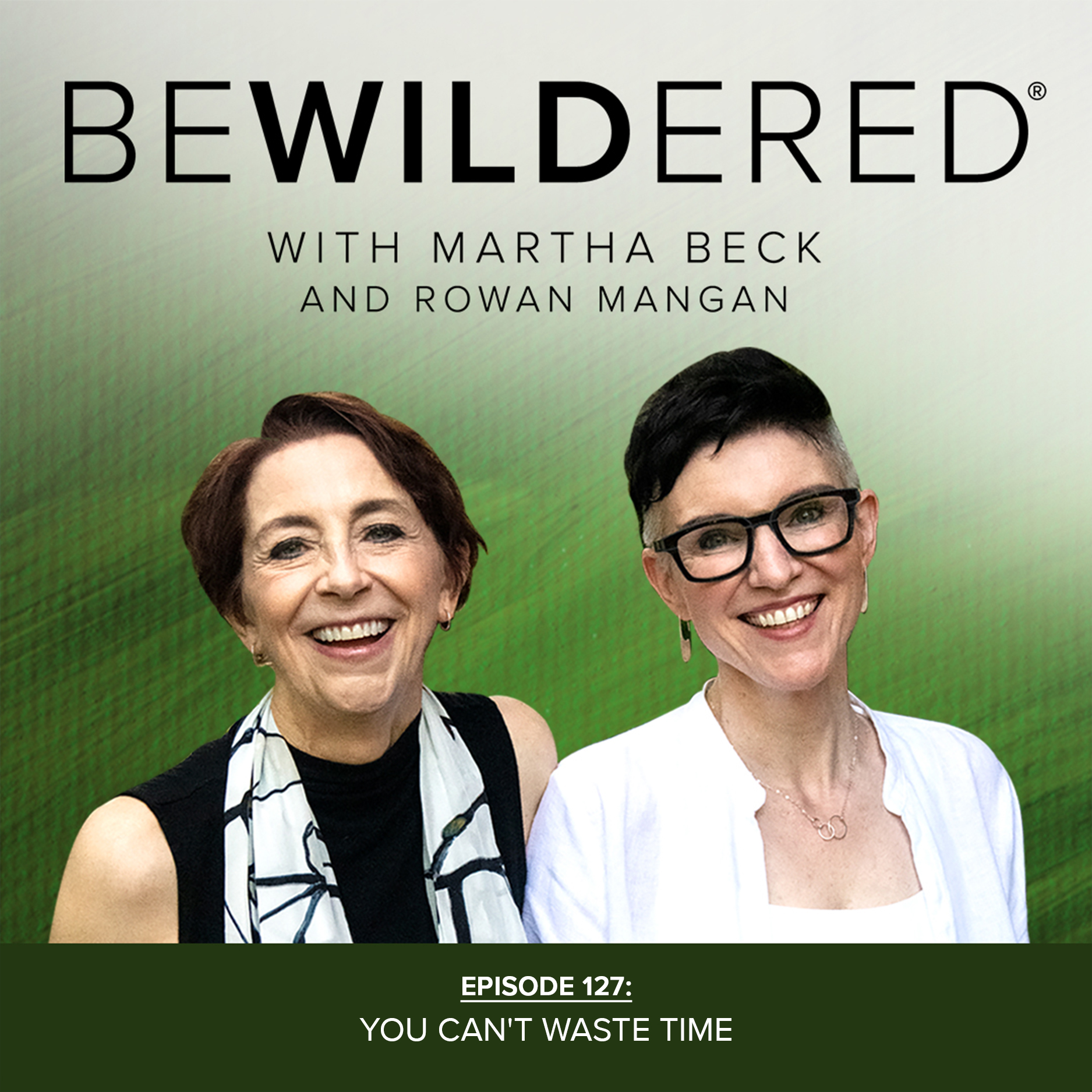
About this episode
Have you ever mastered something...and then felt the urge to throw it all away and start fresh? In this episode of Bewildered, we explore the rhythm of growth and why change is not failure—it’s our true nature. We talk about the sunk cost fallacy, the cultural pressure to never lose your spot at the top of the pyramid, and the radical idea that it’s actually impossible to waste time or money. If you’re feeling the itch to shed your skin and grow into something new, this episode is for you. Join us!



You Can't Waste Time
Show Notes
Have you ever gotten really, really good at something…and then felt the itch to throw it all away and start something new?
In this episode of Bewildered, we’re talking about growth, the way the culture views any change (including growth) as a failure or waste, and how we’ve decided to see it differently.
We start out with a story about a dear friend of ours (we’ll call her Petunia) whose life and house imploded at the same time…and in ways that were not at all subtle. Foundation rotten. Roof gone. Tree through the wall. Everyone she loved getting sick.
And then, at the end of her hellish year, Petunia turned around on a dime, looked at her magnificent, completely rebuilt house, put it on the market, and bought some land to build a new house on. Boom. Mic-drop moment.
It got us thinking about the rhythm of growth and how, like snakes, we start out in a shiny new skin, then we outgrow it, slough it off, and start again. That continuous dance is what gives it joy. This turned out to be one of our favorite metaphors for what it feels like to shed a life and grow into a new one.
Nature, which we’re all part of, is constantly changing. And yet our little minds and our little culture think that there’s a way to encase a state of being in amber and that it will stay there for thousands of millions of years.
We talk about the sunk cost fallacy: why people tend to pour time and money into things that aren’t working, just because they’ve invested so much already. (Martha taught this fallacy at business school using a disguised version of the Challenger disaster, and the students were always shocked to get it wrong.)
And we propose the super countercultural idea that it’s actually impossible to waste time or money. What if life on earth contains nothing but useful time and useful money?
To fall for the sunk cost fallacy, you have to believe it’s possible to waste time and money. And we don’t!
Martha even makes a compelling case that lying on the couch for a year and a half being depressed about your failure is also a valid course of action. Because having an experience is the whole point. There is no wasted time or wasted effort.
If you’re feeling any sense of constriction in your life, and you’d like to learn how to stretch into it, you won’t want to miss this conversation. Let’s all do something we’ve never done before, as long as it feels like a delicious stretch. Join us!
Also in this episode:
- Introducing…Potatoes Galore and Sleepytime Marty!
- Martha talks about baby pigs in her sleep.
- Want to stop snoring? Ro’s got a gadget for that.
- Snake eggs and metaphor trucks
- An animal psychic speaks to an ovulating iguana.
- Pandiculation, fibromyalgia, and tracking lions at Londolozi
TALK TO US
You can follow us on our Instagram channel @bewilderedpodcast to connect with our Bewildered community, learn about upcoming episodes, and participate in callouts ahead of podcast taping.
And if you’re a Bewildered fan, would you consider giving us a little rate-and-review love on your favorite podcast player? Ratings and reviews are like gold in the podcasting universe—they help people find us, they help build this beautiful community, and most of all, they help us in our quest to Bewilder the world…
Episode Links and Quotes
- Breath book by James Nestor
- Stephen King
- Josh Waitzkin
- Elizabeth Gilbert
- The Sunk Cost Fallacy
- Buddhism’s Four Noble Truths
- The Way of Integrity book by Martha Beck
- Martha Beck’s African STAR at Londolozi
CONNECT WITH US
- Follow Martha on Instagram
- Follow Ro on Instagram
- Follow Bewildered on Instagram
- Join us in the Wilder Community!
- Listen on your favorite podcast app
- The Bewildered Show Notes
- Is there something you’ve been feeling bewildered about? If so, let us hear from you!
Transcript
Please note: This is an unedited transcript, provided as a courtesy, and reflects the actual conversation as closely as possible. Please forgive any typographical or grammatical errors.
Martha Beck:
Hi, I’m Martha Beck.
Rowan Mangan:
And I’m Rowan Mangan, and this is another episode of your favorite podcast and mine, Bewildered.
Martha Beck:
A podcast for people who are trying to figure it out.
Rowan Mangan:
Oh my God, you shifted it up.
Martha Beck:
I know. I learned that.
Rowan Mangan:
Whoa, this is crazy. Everything is new.
Martha Beck:
I know. We’re just changing everything.
Rowan Mangan:
We’re leaving convention behind.
Martha Beck:
It’s probably unwise.
Rowan Mangan:
Oh, I feel like you’re bumping up against today’s topic.
Martha Beck:
What is that, Ro?
Rowan Mangan:
Well, today we’re talking about growth. Not growths, not anything to worry about, nothing to take to your doctor and get checked out. Just sometimes we’re doing things, we’re good at them, and something in us says, “I feel like I want to do something a bit different.”
Martha Beck:
Something totally different that I’m not good at at all.
Rowan Mangan:
Yeah. And the culture says, “No, don’t do that.”
Martha Beck:
And we say something different.
Rowan Mangan:
Yeah. So let’s get started.
Martha Beck:
So what are you trying to figure out right now, Roey?
Rowan Mangan:
Nothing. I’ve got it all figured out. Luckily I finished.
Martha Beck:
Okay.
Rowan Mangan:
Yeah.
Martha Beck:
That’s the end of the podcast forever then.
Rowan Mangan:
Yeah. No. What am I trying to figure out? I’m trying to figure out what’s wrong with us, and is there any hope?
Martha Beck:
Are you talking about humanity in general? Are you talking about you and me?
Rowan Mangan:
Us in particular. No. We were having a conversation the other day that brought on this train of thought where I was dreaming about future gardens that we might have, and we were going to have sweet potatoes galore.
Martha Beck:
Galore, yes.
Rowan Mangan:
Other potatoes, galore.
Martha Beck:
Every kind of potato.
Rowan Mangan:
Potatoes galore.
Martha Beck:
How could it go wrong?
Rowan Mangan:
That’s my porn name.
Martha Beck:
Potatoes Galore? I’ve heard them called melons. I’ve heard them called many things.
Rowan Mangan:
Mine are always called mashed potatoes.
Martha Beck:
Oh, Mashed Potatoes Galore.
Rowan Mangan:
Yeah.
Martha Beck:
Okay.
Rowan Mangan:
So yeah, I was going to grow all these things in our future hypothetical garden. Turns out sweet potatoes don’t grow very well in this region.
Martha Beck:
Not at all. They’re tropical, actually.
Rowan Mangan:
Well, it was worth a try. Anyway, so I was doing my sums. We’ll do this much ground and this will be the potato patch and this will be the sweet potato patch. This will be the pumpkin patch. And I did it all my sums and I had my little calculator. And then I was like, oh shit, this is going to give us like 600 pounds of sweet potatoes and 250 pounds of potato potatoes. And you just looked up at me and I was just like, “Oh my God, that’s so silly.” And you were just like, “That’s fine. Two pounds a day.” And I was like, “Is that each?” Because you seemed to have done internal mathematics and you were like, “Two pounds a day.”
Martha Beck:
We could eat two pounds a day.
Rowan Mangan:
Well, that was my thought too.
Martha Beck:
We’re really active. But no, I’ve thought about it because there were like 200 years of history where the Irish, and you should know this, I don’t have Irish ancestry, you have Irish ancestry, lived on nothing, but potatoes and milk products, like the vast majority of Irish people lived on those two foods. So yeah, I did sit and think, how much would you have to eat if you only had to have potatoes? Probably two pounds a day, I thought.
Rowan Mangan:
Oh, my ancestors are turning in their graves. It’s fine. It’s fine. We’ll talk about that a little more.
Martha Beck:
Did I break your dream?
Rowan Mangan:
No, no, no. Just it’s a bit more complicated than that with the whole potato thing. But yeah, there was actually thriving agriculture.
Martha Beck:
And it was all eaten by the English.
Rowan Mangan:
Colonial power, shipping it overseas, just saying.
Martha Beck:
And I have plenty of English ancestors, unfortunately.
Rowan Mangan:
So let’s take it outside. Mofo.
Martha Beck:
Okay. Yeah. The Troubles.
Rowan Mangan:
The troubles are brewing again.
Martha Beck:
Here they are. They always come up.
Rowan Mangan:
My God, we’ve kind of got like an intersectarian marriage.
Martha Beck:
Oh my word.
Rowan Mangan:
Wow. We could be like part of a gritty 80s Belfast based kind of play where we dance.
Martha Beck:
My grandmother was Swedish. Does that mean I get to be Viking and invade?
Rowan Mangan:
You’re not in my genre of play. No. This is very much like a 1980s, 1970s, 80s gritty.
Martha Beck:
Vikings never go out of style.
Rowan Mangan:
I beg to differ
Martha Beck:
Were they Swedes, the Vikings, or was that somebody else? I know that it was up north.
Rowan Mangan:
Listen. We are just getting so off for the point.
Martha Beck:
That’s right. Okay. We got to get back. Get back. To where you once belonged.
Rowan Mangan:
Two pounds a day. So, Marty, what are you trying to figure out?
Martha Beck:
Oh, you’re done with yours, is it? Okay.
Rowan Mangan:
Yeah. Potatoes Galore. In short.
Martha Beck:
As you know, I have this thing with integrity where I wrote a whole book about it and I’m always on an integrity cleanse, which means to be one thing whole and undivided. So know that one thing is integrity, and two things is duplicity. And I try to… I mean, I really, really scour my life to see if I’m in integrity.
Rowan Mangan:
Can I just ask something? You know when you’re watching a TV show on your phone and you can make it small and then also play solitaire on your phone when you’re in the bath, for example, hypothetically. Is that being two things?
Martha Beck:
No, it is “stare at box in bed.”
Rowan Mangan:
Okay. Yeah.
Martha Beck:
No worries. Not in my moral lexicon. But I’ve recently realized that I do have a double life and I cannot help it.
Rowan Mangan:
Wow.
Martha Beck:
Yes. Also, I don’t know how I ever get out of bed feeling rested because I have a highly active life while I’m asleep that Wake-up Marty doesn’t know anything about.
Rowan Mangan:
Wake up, Marty.
Martha Beck:
Wake up.
Rowan Mangan:
Wake up, Marty. It’s sleepy-time Mparty. Let’s go out and play.
Martha Beck:
Okay. So Sleepy-time Marty does all kinds of things in my sleep. Wake-up Marty tapes my mouth.
Rowan Mangan:
[sings] Wake up, Marty, I think I got something to say to you.
Martha Beck:
You sing that to me every day, don’t you? No, actually, because I would slap you around the ears. That’s not a way to wake someone up.
Rowan Mangan:
Around their ears?
Martha Beck:
About their head and face. You know what they say in legal documents or whatever about people assaulting other people.
Rowan Mangan:
No.This is fine. This is all content.
Martha Beck:
So everybody who reads the book, Breath, excellent book. You should really read it. Ends up taping their mouth closed. I know so many people who do this now. And you do it? We all do.
Rowan Mangan:
No, I don’t do it.
Martha Beck:
Oh, why not?
Rowan Mangan:
Because it gave me a terrible injury.
Martha Beck:
Oh, dear. Did it smack you about the head and face?
Rowan Mangan:
It did not. It caused me to erupt in little red dots around the area.
Martha Beck:
Very sensitive.
Rowan Mangan:
I have very fine skin.
Martha Beck:
Yes, you should eat more potatoes.
Rowan Mangan:
Potatoes galore.
Martha Beck:
Mashed potatoes galore. Anyway, I put this little surgical tape on my mouth. You leave a little room at the sides so you can cough in your sleep, right? And it’s great. You sleep better, you snore less, whatever.
Rowan Mangan:
But I feel like this hasn’t been adequately contextualized. You’ve got to breathe through your nose. That’s the way to do it. So you tape your mouth shut and that it fixes everything. It’s like part of the new biometrics. Yeah.
Martha Beck:
If you have to breathe through your mouth only without breathing through your nose, you’d die in a week or something. It’s horrible for you. But if you breathe only through your nose, you flourish for centuries, something like that.
Rowan Mangan:
I solved this a different way.
Martha Beck:
How?
Rowan Mangan:
I bought this thing on the internet that I stick up my nose and it dilates my muscles.
Martha Beck:
Is it called cocaine?
Rowan Mangan:
It’s amazing. I’ve never slept better.
Martha Beck:
I’m so confident in my sleep.
Rowan Mangan:
Sleep is for the week. It’s called a nasal dilator. I know you like to tease me by saying I’m obsessed with getting the perfect tool that nothing else—
Martha Beck:
You are. You are.
Rowan Mangan:
This is a nasal dilator.
Martha Beck:
You know that most of us have only heard dilate in one context.
Rowan Mangan:
Well, that’s not true.
Martha Beck:
Well, you ended up having a cesarean perforce.
Rowan Mangan:
Pupils dilate.
Martha Beck:
Yeah. But once other parts of you have dilated, and out came a human being, it tends to just sort of wash everything else away into a dim fog. Anyway, can I please tell you what’s going on?
Rowan Mangan:
Absolutely not. Sorry.
Martha Beck:
So I put tape on my mouth to go to sleep, and I know I’ve slept well and peacefully if I wake up and it’s still there. Most of the time it’s not. And lately it’s been, I’ve been getting really elaborate with it.
Rowan Mangan:
Sleepy-time Marty?
Martha Beck:
Wakey-wake Marty puts the surgical tape on my lips. And I go to sleep, but softly snoring now because my mouth is taped shut. And at some point during the night, Sleepy-time Marty takes the tape off, tears it carefully in two length-wise, and bandages both my thumbs.
Rowan Mangan:
Wow.
Martha Beck:
Yeah, I know. And then furthermore, I’ve been waking up. My neck kind of has a crick in it. I’ve been waking up in the morning asleep, like not on a pillow, holding up my own head with my hands. So I wake up in this position with bandages on my thumbs and I think, “Who the hell am I when I’m asleep?”
Rowan Mangan:
This is like seriously the plot of a horror movie.
Martha Beck:
It is. I know. I’m thinking I should call Stephen King and have him write it up. I just can’t be bothered.
Rowan Mangan:
I love it because the Sleepy-time Marty, first of all, that’s appropriately creepy.
Martha Beck:
That’s my porn name. Potatoes Galore and Sleepytime Marty.
Rowan Mangan:
Sleepytime Marty is… I mean, we can definitely work up the screenplay for sure. No worries. Stephen will get in on the ground floor. But your sleeping self, I happen to know, is the sweetest, most adorable person.
Martha Beck:
You’ve already told the pig story on here.
Rowan Mangan:
I’ll listen. I’ve told it so many times and I will never stop telling it because there is someone listening to this right now who has never heard this story whose day is going to be brighter after hearing it. Have you heard it, Drew? Okay. Drew hasn’t heard it. Once…So once Marty was like three quarters asleep, Sleepytime Marty was like more or less driving the desk at that point. And suddenly her little voice comes and goes, “A pen is a house for a pig.” And then there’s a long pause and I think, oh yeah? And then she comes back with a smile in her voice and says, “A baby pig.”
Martha Beck:
That’s so dumb.
Rowan Mangan:
It’s the most adorable. I think about that probably two, three times a day.
Martha Beck:
You have a very sad life, Potatoes Galore.
Rowan Mangan:
I don’t. I don’t, Sleepytime Marty.
Martha Beck:
Anyway, there’s stuff going on in our house at night that we don’t really know about.
Rowan Mangan:
So Sleepytime Marty rips the tape, bandages the thumbs.
Martha Beck:
Yeah, that’s not an easy thing to do even wide awake.
Rowan Mangan:
It’s so interesting. We need to put a camera in your room. Capture this behavior.
Martha Beck:
I know.
Rowan Mangan:
All right.
Martha Beck:
So Potatoes, what are we actually talking about?
Rowan Mangan:
I’m glad you asked, Sleepytime. Today we’re talking about growth, and I don’t mean the things that come up on your body.
Martha Beck:
Not plural growths.
Rowan Mangan:
Not growths. Growth.
Martha Beck:
One is so good. And the other is so bad. Right?
Rowan Mangan:
Fascinating. That in itself is a topic.
Martha Beck:
Fascinating.
Rowan Mangan:
So we’re talking about the way that we grow as people.
Martha Beck:
As people.
Rowan Mangan:
As people. I grow as a people via growths. And we had been reflecting on a friend of ours, and I’m going to tell you a little story about this friend of ours. Let’s call her Petunia. Petunia was having a very rough year recently. And as her life imploded, so too did everything in her house start to break.
Martha Beck:
Right.
Rowan Mangan:
I know we talk about our housebreaking. Petunia is not us in this story. That would be confusing.
Martha Beck:
But on the outside, everyone she knew and loved got either terminally ill or sick.
Rowan Mangan:
Diagnosed with something disgusting.
Martha Beck:
She had to go help, and she was the only healthy person in her whole circle. So she was caretaking everyone around her.
Rowan Mangan:
Terrible things.
Martha Beck:
Yeah.
Rowan Mangan:
And then her house started breaking in these really like “this is a metaphor” kind of ways. It wasn’t subtle. We’d get on the phone, “How are you doing?” “Well, now apparently the foundation is rotten.”
Martha Beck:
Yeah. The roof needs to be replaced. Oh, they’ve bashed into a wall, so we have to take down the walls. Now there’s been a slight shift in the earth, and the whole entire foundation has to be replaced. It was that old original axe story where the guy keeps replacing the axe head and the handle and he keeps replacing them, replacing them, but it’s still the same axe. That’s what her house was like.
Rowan Mangan:
Yeah. So that was interesting that her life was in shambles. It was so funny, our friend’s life was in shambles. Anyway, we thought this is podcast content. And then her house was in shambles. But the thing about it that was so interesting to watch is that… I mean, this friend of ours, she is tough. She will roll with it, roll with it, roll with it. Unbelievably. And she was patching everything, fixing… No, not patching the house.
Martha Beck:
Totally replacing the house.
Rowan Mangan:
She was fixing the house. And it was like she was in the process of making her house that she’s lived in for a while, magnificent. The most amazing foundation. The most amazing roof.
Martha Beck:
Ship shape. Everything perfect. Solid.
Rowan Mangan:
And then the tree fell down.
Martha Beck:
That’s right. It fell into the house.
Rowan Mangan:
Something. And it just kept going and kept going. And then it was like her favorite tree. And then there was that to go through and then we’d plant a new tree. Anyway, the point is, she got to the end of her hell year. Everyone was sort of dispatched or dead and she turned around on a dime, looked at her magnificent house, put it on the market, bought some land to build a house on. Boom.
Martha Beck:
Mic drop. Well, I hope not. I hope she keeps the mic because it’s going to be a long build. She didn’t just make a final statement. She made an initial statement, right?
Rowan Mangan:
Yeah. And so it’s like this thing where we think we’re headed towards one destination, but I think our soul is like the—oh my God, guys, you heard it here first. It’s not about the destination. It’s about the journey.
Martha Beck:
What really?
Rowan Mangan:
It’s about the friends we make along the way. But the soul’s like, “Cool. That was fun.” Our little human cultural selves are like, “Yay, we made it. Now we just sit on the couch for 40 years and then we die.” And the soul’s like, “Nummy-num, I loved that. Let’s do it again.”
Martha Beck:
Yeah. And it really, really is understood that you’re supposed to get to a place where you’re comfortable and everything is easy and everything’s put together and you don’t have to stress or worry anymore. And then sure enough, you get up and you say, “Let’s do something else.” And this is particularly intense for us, not intense. This is particularly meaningful to us because we always have this idea that the space you live in is a metaphor for your inner life. I’m sure we’ve said it on the podcast.
Rowan Mangan:
Oh, we have.
Martha Beck:
Something I teach coaches to do, like ask, if you write down, seriously, if you write down, you who are listening to the podcast, a description of your living space right now and then read it back, you will have written a metaphor for your inner life. So we watched this and she knew that, and she’s thoroughly acquainted with that concept. So as her house disintegrated and she replaced all of it, and as her life situation was disintegrating and she was replacing all of it, we talked about it, but it still was happening. Some sort of weird three-dimensional illustration of what we were talking about just kept happening to her. And she’d call us laughing and say, “Guess what needs to be replaced now?” But she did. She got it all put together and bought some land and decided to build from scratch.
Rowan Mangan:
Because she’s ike, “I’ve gotten used to having contractors around all the time 24/7.” It’s nice.
Martha Beck:
It’s nice. You can do things to please them. You can do things to bother them.
Rowan Mangan:
In Australia, you get, they’re called tradies in Australia, you get your tradie a cup of tea. I don’t know what you do in America, and so I usually just run away. I don’t know what the etiquette is.
Martha Beck:
That’s what you’re supposed to do.
Rowan Mangan:
Oh, cool. Sweet. I’m killing this. Yeah. So growth, right?
Martha Beck:
Yeah. And we were talking about this and how, this is how I came to this idea of there’s the house metaphor, but then there’s something else that Lila and I got into the other day.
Rowan Mangan:
Oh my God.
Martha Beck:
I came into the room where my whole family is and Lila’s sitting there with her back to everyone else watching a video. And she said to me, “Muffy, come see the snake eggs.” Well, what am I going to do?
Rowan Mangan:
Marty sat down next to Lila and didn’t move for 45 minutes. She had not greeted anyone in the room. We were all sitting there for family time, which if you’re a regular listener, you know that that’s kind of a sacred part of our day. And sometimes called wine time.
Martha Beck:
We don’t drink though.
Rowan Mangan:
Anyway, it’s called what it’s called.
Martha Beck:
All right. And I did Adam who named it.
Rowan Mangan:
Yeah. And I didn’t say it wasn’t “whine time.” We can whine.
Martha Beck:
All right. It’s okay. Everybody there was whining together except for me.
Rowan Mangan:
You and Lila were… And I was at the point where I said to Karen, “Is she pissed off? What is going on?” Because we would ask her things. She’s come in, she hasn’t said hi. She sat down and we would ask her things and Martha would do this particular voice that’s like she would use if you were a telemarketer or something, she’d be like, “Roger that.” Or something. And just would not move. And Karen was just like, “No, I think it’s just snakes.”
Martha Beck:
Yes. She knows me well. Snake eggs, Roey. Now, I had never seen the like. I’ve read about it, but I’d never seen it. There was a snake in her little cage in her terrarium and she was there with her eggs and you’d expect—like, a chicken lays an egg and you could imagine that egg fitting inside the chicken. But what if a chicken laid a dozen eggs at once, so many eggs that they were the same size as the finalized chicken after the length. This snake, if you had put these eggs in this snake tube, they would’ve filled it entirely. It was fascinating. And they had to squish her to make sure she got them all out.
Rowan Mangan:
Wow.
Martha Beck:
Yeah. I once heard an animal psychic communicator talk about doing a reading with an iguana and it was a pet iguana and it’d started acting upset. And they brought her the iguana and said, “Tell us what’s wrong with him.” And she did.
And the iguana said, “I have eaten far too many grapes, and they’re in my tummy and they won’t come out.” And she said, “Do you give your iguana grapes?” And they were like, “No, we don’t want to give him grapes.” And she went back and asked the iguana about it. And it turned out she said, “First of all, your iguana is not a he, it’s a she.” Secondly, she’s very attracted to you to the extent where she literally used the phrase “fallen in love.”
Rowan Mangan:
Aww.
Martha Beck:
And that triggered the iguana to ovulate a whole bunch, and her tummy was full of these little grape-sized eggs and she couldn’t lay them in an enclosed space so they had to let her out in the yard and roam around to find a place to lay the eggs. And then she did and she was done. Isn’t that sweet?
Rowan Mangan:
That’s not a metaphor. That’s just a story.
Martha Beck:
That’s just a story. But I think people’s lives will be different having that story. Anyway, this snake.
Rowan Mangan:
I’ll tell you how my life will be different thinking about that snake getting its eggs squished out of it.
Martha Beck:
Yes?
Rowan Mangan:
What if they missed some and then the egg hatched inside?
Martha Beck:
Some snakes do that and then they come out alive, the babies.
Rowan Mangan:
It’ll wiggle out?
Martha Beck:
Yeah. Some of them sort of hatch in there. But no, these eggs were so big that if one had been left in there, you would’ve been able to tell. It would’ve made a huge bump and you have to squish it out. And then, then they hatched. Yes, they did. And these tiny, lively little snakes came out and it was amazing. And I wasn’t going to miss that. I wasn’t going to miss an instant of that, all of this to say that I think when your soul has come out of its egg, it squiggles around, it gets used to its new environment, and then it says, “I’m going to shed my skin. My skin is itchy.”
Rowan Mangan:
Wait, so it’s shed its egg.
Martha Beck:
Yeah. The egg is like the first skin you shed. It’s getting… Sorry. It comes out—
Rowan Mangan:
We’re going to decode a metaphor for you now.
Martha Beck:
All right. The little snakes were all shiny and slippery. Okay? And then, they had to put them in little terrariums with rocks to rub against because soon the snake is going to start getting, feeling kind of tight in its skin. And then the lenses of its eyes start to separate because that’s part of the skin it’s going to shed. And then you have to give it a rock to rub against so it can get itchy old skin off. And then it sheds its skin, it comes out, it’s got a bright, shiny, loose skin. And here’s what it has to do then. It has to inhale and then hold like an opera singer or whatever and puff up while its skin kind of gets leathery and harder because if it doesn’t do that, the skin will firm up around it and it won’t be able to grow.
So it has to grow inside. Then once the skin is hard and little, it goes, or how it, whatever it does. And then it’s littler and the skin is looser and baggier. And I think that that’s what we have to do. We get to the point where the house is perfect, where the inner life is perfect, where it’s easy and it’s done. And everybody says, “You have made it.” In some way, in some way. I don’t know. I’ve never experienced anyone telling me that.
But other times when I was like, “This is good. This is not bad at all.” I think I’ve raised my children, and then you show up and it’s like, “Nope, another one on the way.” I thought, whoo, did that, all done with that. And then it’s like, no, no, this skin is… I want to start again.
Rowan Mangan:
Just when you think it’s safe to go back in the water.
Martha Beck:
That’s right. That’s right. So what do we take from this, Ro?
Rowan Mangan:
I’m speechless. Okay. So first of all, the thing that really struck me about the metaphor was I started having a little mini panic attack when I imagined being an itchy snake that’s just scratched off the old skin. But what if I forgot, or do you ever have that thing where if you’re getting a massage or something and someone says deep breath, but you’ve just taken a deep breath and then they’re like, deep breath and you’re like, “Do I quickly breathe out and then do the performative deep breath in? I literally just breathed in. What do you want me to do?” And so then I try to breathe in further.
Martha Beck:
I think making that sound is the key because you can do it even if you’re not breathing in. And then they’ll be like, “Wow, that was a deep one.”
Rowan Mangan:
And you feel approved of. That’s what I’m looking for in a massage. So I imagined, what if you forget to take the deep breath and then you’re stuck in a skin that’s too small? And I started having a little bit of a claustrophobia reaction.
Martha Beck:
I think that actually happens to people, in all seriousness. I think there are people who arrive because, so the culture nature split here is the culture says you arrive and then you just hang on for dear life. Don’t give up the seat at the top of the pyramid, right? Just hang on there. You may have to climb a little higher, but that’s it.
Rowan Mangan:
You have to kick some people down who are trying to get up.
Martha Beck:
Exactly. But I think our nature says we climb to the top of something and we go, “Well, that was fun to climb.” And we roll back down and start up another mountainside. And I think people are afraid to do that because of cultural sort of patterning of what your life’s supposed to look like. They’re afraid people will think they’ve failed if they don’t succeed at what they’ve already succeeded at. If you’ve gotten really good at being… There’s this guy who’s a brilliant chess master and he was like the best in the world. His name’s Josh Waitzkin. He’s amazing. And then he started doing this Taiwanese martial arts called Push Hands and he became like the best in the world at that. And then just when he was getting a big fan base there, he switched to doing finance stuff. He just, he likes to learn. He loves… He’s brilliant and he loves to learn. And the people around you are like, “Wait, wait.”
Rowan Mangan:
It’s about getting to the point where you have learned.
Martha Beck:
Yeah. And I sometimes call it the kindergarten complex: to start again in your life, to start something you don’t know where you really feel like you’re in complete shambles and you don’t know, you’re a beginner at age 40, 50, 60, 70, whatever it is, right? That looks to many people in our culture like failure, and the stink of failure is what we want to avoid above…well, some people want to avoid it above all else.
Rowan Mangan:
It’s funny, isn’t it? I don’t know how much of it is of this culture or is a feature of how our ego or whatever is sort of set up that expertise is what we feel like we want to do. We want to just be there going, “Hmm, I wouldn’t do it that way if I were you.” It’s so interesting that there’s so little humility in how we look at growing towards.
Martha Beck:
Yeah. It’s very left hemisphere: “I’ve got all the right answers. You cannot contradict me without fear of successful contradiction from me. I have it all. I know it all. I’m doing it all right.” And then there’s the part that says, “I’m going to start something else and I don’t know what I’m doing.” And we’re so afraid to just say, “I don’t know what I’m doing.”
Rowan Mangan:
The only thing worse than “I don’t know what I’m doing” is “I want to not know what I’m doing. I’m seeking out that state.”
Martha Beck:
“Why would you throw away everything?” Yeah. That’s actually what they told me when I was pregnant with Adam, “You’re throwing away your life.” If you have a baby with Down syndrome and you have a choice and you choose to keep the baby, you’re throwing away your life. And I remember the obstetrician at Harvard telling me that and going back to my apartment and thinking, “I don’t think I really want this life. I might as well throw it away.” And I did. They were right, but what’s wrong with throwing away a life that wasn’t very happy? I was fighting as hard as I could to be “successful,” but I wasn’t happy because I was busy fighting to be successful.
Rowan Mangan:
Yeah. There’s something about the sunk costs fallacy.
Martha Beck:
Ah, say more about that.
Rowan Mangan:
So if you are heading in a certain direction and, as it were, investing in that direction, whether that’s time or money is where it comes from. So you’re heading towards something and everything that has led you towards that is only useful in the way that it serves the presumed destination that you’re heading towards. And anything that deviates from staying on that exact course is a waste.
Martha Beck:
Yeah. And if you’ve already invested a lot in gaining some particular end, then you don’t want to stop pursuing that end because you’ve already put so much money into it. When I used to teach this as a business school case, we would use a disguised version of the space shuttle. Which was the one that blew up? Was it Challenger or something?
Rowan Mangan:
I think it was Exploder.
Martha Beck:
Oh, Rowan. Too soon.
Rowan Mangan:
Too soon.
Martha Beck:
Okay. So one of them blew up. I don’t remember. But the business case was disguised as car racing. And this car company had poured all this money into creating this incredible machine. And the reason the space shuttle blew up was that the O-rings didn’t, these things called O-rings, I don’t know what they did, but they didn’t do it at low temperatures. And the engineers, three engineers went and told people, “Look, if you take off in a low temperature, they might fail.” And that in fact is what happened. But in the case, it was a race car. Do you put the guy in the race car? There’s somebody telling you, an engineer telling you that some parts may fail. Do you put your driver in and run the race? And every time I taught that case, people always said, “Yeah, you have to put the car in. You’ve already put so much into it that you’ve got to run. You’ve got to keep pursuing that goal.” And then so they’d do the case, and then you’d reveal this was actually the space shuttle. And the students would get so angry. They were violently, they were like, “If you had told us it was a spaceship, we would never have gone for it.”
Rowan Mangan:
“If you told us it was a car in space, instead of on land, that changes everything!”
Martha Beck:
But I mean, they were so driven to the sunk cost fallacy. And that is one of the main reasons businesses fail. They pour money into something that isn’t working, but because they put so much money into it, they pour more in to sort of prove that they were on the right course the first time.
Rowan Mangan:
Do you know what I think might be a super countercultural idea that I want to explore a little bit? What if you can’t waste time, or money? What if it’s impossible to do that? What if life on earth does not contain anything but useful time and useful money?
Martha Beck:
I love this. I actually believe this.
Rowan Mangan:
I do too. I mean, that’s the thing because you have to believe that it’s possible to waste time or money in order to fall for the sunk cost fallacy.
Martha Beck:
Yeah. And it goes to what is the purpose of getting this thing in the first place? Am I wasting time if my whole intention is to put a spaceship into space? Well, I can waste time by not doing it right or whatever. But if my entire objective is to have an experience, simply to have an experience, it’s like, “Okay, that didn’t work. We’re going to throw away that plan. We’re going to ditch that spaceship. We’re going to build another one.” Okay, you wasted time? No. The whole objective was to have an experience. So, done!
Rowan Mangan:
Yeah. Let’s do a different one. Let’s go on a different ride now.
Martha Beck:
Or let’s lie on the couch for a year and a half being depressed about our failure. That’s still an experience.
Rowan Mangan:
Nummy num num.
Martha Beck:
No wasted time. No wasted effort.
Rowan Mangan:
Impossible.
Martha Beck:
I actually believe that. And I live like it.
Rowan Mangan:
Let’s get back to that couch. It’s funny, isn’t it? There’s all this conquering language and everything and the journey and the destination and this straight line that we walk towards our destination and doop-de-doop-de-doo. And then we get there and then we put our feet up on the couch and we pick up our remote control and we’re done. And you know, it’s very beguiling because I love the feeling at the end of the day when I can put my feet up and grab the remote control. It’s like, “Oh, that’s lovely.” But at a certain point, it’s going to get old. You can enjoy it for an hour and a half before bed, but if that is your whole life, because we’re talking about it in terms of arriving somewhere, the possibility of arrival.
Martha Beck:
So what we’re sort of saying is the cycle of being fresh and shiny in our skin and then outgrowing it and then sloughing it off and getting all full fed and fat and going, “I am a full snake in my skin. I’m going to enjoy this.” And then the next day getting up and go, “I think I’m going to become an entirely new snake.” That’s the rhythm that gives it joy.
Rowan Mangan:
Absolutely. And it’s funny how often these conversations that we have sort of end up in a place where it’s like, things change. That is what our true nature is, is that change happens. And our little minds and our little culture think that there’s a way to encase a state in amber and it will stay there for thousands of millions of years.
Martha Beck:
Yeah, that something is permanent.
Rowan Mangan:
Yeah.
Martha Beck:
It breaks the first Noble Truth of Buddhism. No, first Noble Truth is “Life is suffering.” And the next one is “Nature is impermanence.” Everything is impermanent. And if you’re in a state of wanting things to be permanent, you start to destroy them because their nature is to be impermanent. And the place I see this most is with people’s romantic relationships. People get together and they’re like, “This needs to be permanent. You are always going to feel about me exactly the way you feel right now.”
Rowan Mangan:
Yeah. Write this down, sign it. It’s a legal document saying, “You have to feel the same way about me tomorrow that you do today.”
Martha Beck:
We were watching a show last night at Trinity Time, which is just really a staple, along with wine time and morning communion, it’s a staple of our throupled relationship. We were watching this show about a woman who starts to worry that her husband doesn’t love her. So she books a really romantic restaurant and then books a hotel afterwards where they can go and make love and she dresses… And he’s working on a case, right? He’s a cop working on a case. And they’re in their, what, 50s at least?
Rowan Mangan:
Early 60s?
Martha Beck:
So they’ve been married a long time. And the whole idea is they’re supposed to feel exactly, she wants him to feel exactly the way he felt on their first date or the first dinner they had after they got married or something. And basically, if he has changed, he’s going to catch hell because you’re not supposed to feel different from the way you feel when you’re first falling in love. Hormone-saturated, bleary-eyed, obsessed with the other person’s glory. It moves. It changes in wonderful, delicious ways, but it changes. And I think our culture in particular is obsessed with the one romantic relationship being the thing you achieve, you lock it in and then by gum, you just ride it till you’re dead.
Rowan Mangan:
But also career, right? Yeah. I mean, I think so. Yeah. I think we’re sort of starting to come to a point, at least in the kind of waters of the culture that we swim in where people are doing more different sort of entrepreneurial things that are sort of being enabled by combination of technology and the pandemic. So it’s a little bit, but I think the narrative about career and success are still very dominant.
Martha Beck:
Yeah. Yeah. And so I think this is what I’m taking from this. I want to find the places where I’m stuck thinking “I’ve made it and now it’s easy, so I’m going to keep it being easy.” I did this with art a little while ago. I worked with pencils my whole childhood, my whole life. Then I got into oils when I was in my 30s and 40s and my kids were old enough not to eat them and die. And then a couple of years ago I just thought, “Watercolor, the hardest kind of painting.” And I don’t want to do a loose, sloppy watercolor. I want to do these ridiculous watercolors that people in Asia who’ve been working with brushes since they were born, they can do things that are, oh my God, they’re magic. I could not do that on my best day, not for a second. So what do I do? I’m obsessed with it.
Rowan Mangan:
Karen and I have a joke that we talk about behind your back where it’s like, “Why does Marty want to do that?” “Oh, someone told her it was really hard.”
Martha Beck:
It’s true. It’s true. And I don’t ever get good at them.
Rowan Mangan:
Oh, come on.
Martha Beck:
I don’t. I don’t have a single watercolor I really like.
Rowan Mangan:
Yeah, but it’s not about what you like. You’re not a good judge of your own work.
Martha Beck:
Meh. Anyway, why? I was getting up at five every single morning for months just to do a style of watercolor painting that I could not do. After spending decades of sunk cost learning other media, I’m like, “Fuck that. I’m doing something impossible.”
Rowan Mangan:
And that’s cool. I love that because there’s a way to build the narrative because it all fills out under the category of art or even of painting and drawing, that pencil and then you went to ink, you went to oil, and then you went to watercolor. And so it defies the sunk cost thing because you can say, well, you were just developing as an artist, but actually you were taking on a completely new thing. And so what if it becomes where you have said “art” and you can fit all these things under it so that you’re both following a line and reinventing. What if we had, okay, so instead of art, we have life and in life you put down the pencil and you pick up the oils and the oil brush, but what if that’s you put down accountancy and you pick up paragliding?
Martha Beck:
I’m not sure paragliding pays in quite the same way accountancy does.
Rowan Mangan:
But that’s such a cultural way of looking at things.
Martha Beck:
That’s exactly it. It’s about the time and money. Are you wasting time and money?
Rowan Mangan:
Are you going to earn at an equivalent level?
Martha Beck:
Oh, that’s such a vicious trap, isn’t it? Because if you’re going by the soul, and I like what you said about it, the ego’s job is to stay in the sweet spot of having everything done and right and all that, but the soul is like, “No, we’re doing something completely different.”
Rowan Mangan:
The soul is like, “That was fun. Let’s do another one.”
Martha Beck:
It probably would be something that’s just weird. I remember I used to be, for like a year, I was a spokesperson for one of the diseases that I have. I would show up to the—
Rowan Mangan:
Congratulations.
Martha Beck:
Hello.
Rowan Mangan:
I’m raising awareness of disease. Behold. Are you aware of it?
Martha Beck:
So it was fibromyalgia. I had suffered from it horribly for like 12 years. I could barely get out of bed. And then I found a way. I had a career as a writer. I write lying down, still do, lying down on my bed with a laptop on my thighs, on my knees, and just tapping away. And so I made books and things happened and I got asked to be this spokesperson. But in the meantime, I started doing things I really liked. And my whole thing is, if I don’t do what my soul wants, the fibromyalgia gets… It grabs me. Talk about being clubbed about the face and neck. It just pounds my body into a little puddle of pain and assonance. Is that what it is when you… Consonance. A pathetic puddle of pain. Okay. Anyway.
Rowan Mangan:
Alliteration.
Martha Beck:
Alliteration. That’s it. So I have to do what my soul wants, and when I do what my soul wants, I have no symptoms. So they called me one day, the people who were running this foundation, and said, “We want to put out an inspirational story about what you’ve been able to do yesterday or the day before, because you have used this method of living your joy and it makes your symptoms better.” And I was in an airport talking to them. I’m like, “All right.” They were like, “So what did you do yesterday?” And I said, “I tracked lions! My friend took me out to track lions, and we did run on the track of a lion for like hours.” And there was this long—I thought they would be so impressed—and there was this long, appalled silence. And then they were like, “Okay, we need you not to talk about that.” They were practically saying, “You are identified as a weak and feeble person. Let’s stay in your lane.” And they’re like, “Maybe you could talk about… ”
Rowan Mangan:
“Maybe you went to the store. Well done.”
Martha Beck:
Yes. They actually said gardening, but I think gardening’s way hard. You garden. Anyway, they were not pleased with this dramatic change of activity. And people might say, like the accountancy/paragliding thing, like sitting around writing books, doing things, doing interviews on Zoom or whatever, that’s for your gainful employment, such as it is. But lion tracking, you will never get paid for lion tracking.
Rowan Mangan:
Wrong again!
Martha Beck:
Wrong again, Dr. Watson. Yeah, because I mean, there are things you can learn tracking at Londolozi, our favorite place in South Africa, that you can learn no other way. So my friends there, I was like, “You’re teaching me to track. It’s changing my life. Let’s bring other people.” And they will give us money, and we will teach them these things and they will have a completely revolutionary experience just like I did. And they do.
Rowan Mangan:
If I knew you, your personality, but not your life, and you announced that you were lion tracking yesterday, I would immediately assume that it was a metaphor. And so it’d be like, “You were ‘lion tracking.’ So it was like you were following the…” And I would try to unpack it. And then I was thinking, as you were talking, it’s like, but I know your life, so I know that that was literally true. And then you brought up, “But you can’t make money.” And then I was like, “How does she make money?” By turning it into a metaphor?
Martha Beck:
Exactly.
Rowan Mangan:
Literally do it, but make it a metaphor, rather than making a metaphor and running with the metaphor.
Martha Beck:
So I actually, this is reminding me of what Liz Gilbert said about going to Greece, and she taught herself the Greek alphabet and she started to read things. It’s fun to read the Greek alphabet because these symbols that look really unfamiliar suddenly are speaking to you the way the English alphabet is. I love that in Greece. But she said, “There’s a company somewhere in Greece called Metaphor because like every truck on the Greek islands is delivering something called Metaphor or it’s working for a company called Metaphor.” Turns out that “metaphor” just means to carry things from place to place.
Rowan Mangan:
Transport.
Martha Beck:
Transport. Yeah. And I think, yes, I think that is one thing that I do is…
Rowan Mangan:
You transport ideas?
Martha Beck:
Well, I love, I live by metaphors and I think that might—
Rowan Mangan:
Literally?
Martha Beck:
No, metaphorically, of course. So it may sound like I’m rambling incoherently. It generally does.
Rowan Mangan:
No.
Martha Beck:
But no, I have point here and it just came to me. I was going to say, this scuttles our thesis because we’re talking about always being willing to change to a new thing, but my whole life has been extending metaphors, from the house metaphor to the snake metaphor, to the truck metaphor. But what if it’s my ego that wants to remain static, and the one thing my soul loves is to literally transfer things, is literally to move, to grow? If the snake’s real purpose in life is not to be a certain size, but to keep growing.
Rowan Mangan:
Yes, that’s it.
Martha Beck:
So instead of, “Here I am in my thing and I better not show myself to be a beginner at anything. I’m not going to leave this thing ever. I’m not going to stop pouring money after my sunk costs,” or whatever it is. Instead of that, which is culture, you move to your nature, which is, “Am I feeling itchy? Do I feel like my skin’s not quite big enough for me right now?”
Rowan Mangan:
Yeah. “I want to just, I find myself wanting to just rub against a rock. Has anyone got a rock that I could borrow? I just want to rub against it and start getting this skin off me.”
Martha Beck:
Potatoes Galore comes back to mind in this. No, it’s true though. It’s like, remember when we used to swaddle Lila, and I’ve watched babies on the internet do this too. When you swaddle them, they love to be tightly wrapped at night. It makes them feel at ease. But then you take off the swaddling and every single morning—
Rowan Mangan:
They’re all like folded up inside. They’re folded up like a little baby.
Martha Beck:
That’s how they’ve been for nine months. And then you take off the swaddling and they bring their little tiny, tiny arms up and they just stretch them as high as they can above their heads, and they kick their legs out and they’re just entering the new day with so much joy. They’re bigger than they were the day before. And the love of the feeling of, “Ah, I’m out of that skin again.”
Rowan Mangan:
Maybe that’s why everyone can relate to how good it feels to stretch, like to stretch when you wake up, stretch, and yawn. Oh, best feeling, right?
Martha Beck:
Yeah.
Rowan Mangan:
That’s the feeling that we’re—like I would rather chase that than some sort of abstract idea of destination, right?
Martha Beck:
Okay, this is so—I’m sorry, I’m going to apologize for this, but while I was on my tour with the fibromyalgia thing, a man came up to me and he said, “I also cured my fibromyalgia.” And I said, “How?” And he said, “Pandiculation.” And I was like, “Do we really want to talk about that here?” All pandiculation means is the stretch when you get out of bed. That’s the whole thing it means. And he said, “I watched cats and I watched the way they would get up and stretch and I started mimicking their movements.”
Rowan Mangan:
This conversation is literally making me yawn.
Martha Beck:
It’s true.
Rowan Mangan:
Isn’t that amazing?
Martha Beck:
You’re very vulnerable, my love.
Rowan Mangan:
I’m suggestible.
Martha Beck:
You’re suggestible. But yeah, and so I thought, “Okay, I’m going to imitate a cat.” And I started doing that and it really does. It super helps your body.
Rowan Mangan:
Did you do it in your capacity as fibromyalgia spokesperson? “Hello. I cured my disease by pretending to be a cat. Watch.” Ba-doop-a-doop.
Martha Beck:
Oh, hey, everybody out there with fibromyalgia, we’re not making fun of you.
Rowan Mangan:
Don’t just be a cat.
Martha Beck:
It’s a terrible, terrible disease, okay?
Rowan Mangan:
I was not making fun of fibromyalgia. I want to be very clear. I was making fun of you.
Martha Beck:
Okay. Let’s just hold onto that people. She’s making fun of me.
Rowan Mangan:
I think the people were not confused about that.
Martha Beck:
Good. Well, anyway, we keep coming around to this point that the stretch, the itch followed by the release, and the constant growth.
Rowan Mangan:
Because if you hold that growth at bay, your skin is getting leathery and you’re basically… That feeling I had before, that claustrophobic feeling of, “Oh my God, I’m stuck on an elevator and I can’t get out.” That is the worst. Our souls don’t want that to be our experience on planet Earth.
Martha Beck:
Yeah.
Rowan Mangan:
Like, that’s a waste of time.
Martha Beck:
There you go. So feel for the sense of constriction and start stretching into it in whatever way. Do something you’ve never done before, as long as it feels like a delicious stretch.
Rowan Mangan:
Yeah. As long as it makes your ego feel confused and like it’s probably a waste of time.
Martha Beck:
That’s right. And you’re afraid people are going to think that you’re failing.
Rowan Mangan:
Or a beginner.
Martha Beck:
And that you’re stupid for throwing away all the time and money you put into becoming the thing you used to be. And if those things are all happening, you’re probably—
Rowan Mangan:
Evolving.
Martha Beck:
You’re probably following your soul’s sort of flight through life.
Rowan Mangan:
And that’s how we…
Martha Beck and Rowan Mangan:
Stay wild!
Rowan Mangan:
We hope you’re enjoying Bewildered. If you’re in the USA and want to be notified when a new episode comes out, text the word WILD to 570-873-0144. We’re also on Instagram. Our handle is @bewilderedpodcast. You can follow us to get updates, hear funny snippets and outtakes, and chat with other fans of the show. Bewildered is produced by Scott Forster with support from the brilliant team at MBI. And remember, if you’re having fun, please rate and review and stay wild.
We’re also on Instagram. Our handle is @bewilderedpodcast. You can follow us to get updates, hear funny snippets and outtakes, and chat with other fans of the show.
For more of us, Martha’s on Instagram, themarthabeck. She’s on Facebook, The Martha Beck, and she’s on Twitter, marthabeck. Her website is, MarthaBeck.com. And me, I too am on Instagram. Rowan_Mangan. I’m on Facebook as Rowan Mangan. And I’m on Twitter as RowanMangan. Bewildered is produced by Scott Forster with support from the brilliant team at MBI.
Read more
Questions? Comments? Trying to figure something out? Email us! [email protected]
Credits
Wandering The Path by Punch Deck | https://soundcloud.com/punch-deck
Music promoted by https://www.free-stock-music.com
Creative Commons Attribution 3.0 Unported License



0 comments