

About this episode
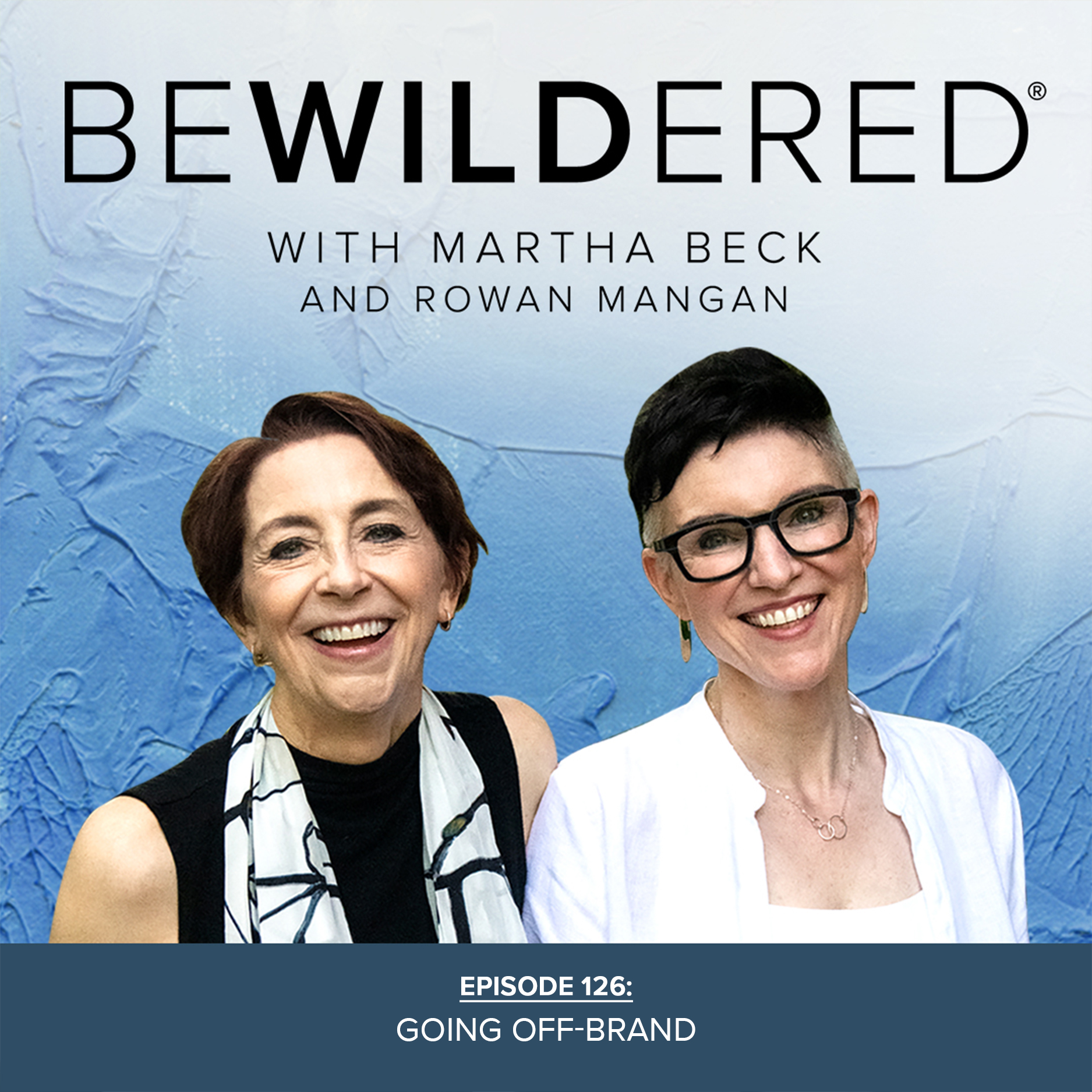
When you hear “branding,” do you think of burning a hot iron into the side of a cow? Probably not, but that’s what a brand originally was. And metaphorically, it still is. A brand is a mark that defines where you belong, and our culture says it's never supposed to change. On this Bewildered, we start out in the world of branding culture and end up in the deep waters of impermanence and identity. We explore how the less you grip your brand, the more you find out who you actually are. Join us!



Going Off-Brand
Show Notes
This time on Bewildered, we’re going to some pretty deep places starting from a very superficial beginning: the wild and wooly world of personal branding. Sounds exciting, right?
Hashtag superficial. Hashtag deep. Hashtag paradox. (That’s how you do it, folks.)
We’re talking about personal branding because Ro has become an influencer. Specifically, a gardening influencer. What happened was she spent too much money on gardening stuff, wrote to the company, and they “forced” her to be given $300 worth of their supplies.
Now she’s supposed to figure out her brand, which led us to wonder: What even is a brand?
Branding started with livestock. A hot iron on the side of an animal: that’s what your brand is. It defines where you belong, and you can never change it. Somehow this concept got schlooped up into the machine of culture, which says each of us must be one single thing…all the time.
This means you’ve got to pick a color palette. You’ve got to confine your clothes and your house to those colors. And remember, in an attention economy you’ve only got three quarters of a second before someone scrolls past you, so make your brand simple and make it consistent!
Our culture has been shaped by the mentality of selling and advertising, and the branding that came along with it. So even if you don’t want a brand, if you stick your head above the parapet, you will be branded by others.
However, we humans contain multitudes. Walt Whitman knew it. Ani DiFranco knows it. She wrote a song/children’s book called The Knowing, and there’s a line in it that we love:
“I have beliefs, and someday those beliefs might change. I have blocks that I like to arrange and rearrange.”
That’s really it. That’s the whole thing. And to stay with the Ani theme, there’s this: “Ani DiFranco is a shirt.” She said it herself in The Spirit of Ani, her new book with Lauren Coyle Rosen. She talks about how everyone who buys a t-shirt at her merch stand gets a different version of her.
There is no essential, fixed person. There never was. These bodies and minds of ours are continuously changing like a sand dune or a river. We’re not even things: We are events.
So what happens when we want to drop our present identity a.k.a. change our brand?
Martha ran a little experiment with 200 coaches, all of them stressed about identity and who they were supposed to be. She told them: “Don’t be anybody for 50 minutes. Don’t be anything. Don’t do anything. When that timer goes off at the hour, you can go be whatever.”
And their stress instantly melted away. People were writing in, “I just heaved the biggest sigh of relief. Oh my God, this feels so good.”
We’re so afraid to be nobody, but it’s really delicious. Because the more you give up on the fixed identity walking around in this body, the more present in your body you actually feel: blood singing, completely receptive, just seeing, hearing, and knowing.
It’s one of those wonderful paradoxes about following a spiritual path: The more you give up on this identity that’s walking around in this body, the more delightful it becomes to have a body.
As our friend Stephen Mitchell put it: “If you would be given everything, give everything up.”
And in the whole branding thing, that’s what we do. We have to give it up to find out who we truly are. Because that’s how we #staywild.
If you’d like to hear the full conversation (or have it forced upon you like $300 worth of gardening supplies) you can listen wherever you get your podcasts. Join us!
Also in this episode:
-
- The GPS leads Martha to a goat and an abandoned silver mine.
- Crunch, crunch, crunch: Ro’s infamous gravel walk
- Zebra imprinting and revenge self-branding
- What Ro’s mum has in common with Miss Marple
- How Martha accidentally found herself holding a frog
- Just a normal lesbian throuple raising an adult man and a 5-year-old
TALK TO US
You can follow us on our Instagram channel @bewilderedpodcast to connect with our Bewildered community, learn about upcoming episodes, and participate in callouts ahead of podcast taping.
And if you’re a Bewildered fan, would you consider giving us a little rate-and-review love on your favorite podcast player? Ratings and reviews are like gold in the podcasting universe—they help people find us, they help build this beautiful community, and most of all, they help us in our quest to Bewilder the world…
Episode Links and Quotes
- Song of Myself by Walt Whitman
- The Mohonk Preserve
- “American Gothic” 1930 painting by Grant Wood
- Committed by Elizabeth Gilbert
- The Signature of All Things by Elizabeth Gilbert
- The Talented Mr. Ripley (1999 film)
- The Knowing by Ani DiFranco
- “The Thing at Hand” song by Ani DiFranco
- The Spirit of Ani by Ani DiFranco and Lauren Coyle Rosen
CONNECT WITH US
- Follow Martha on Instagram
- Follow Ro on Instagram
- Follow Bewildered on Instagram
- Join us in the Wilder Community!
- Listen on your favorite podcast app
- The Bewildered Show Notes
- Is there something you’ve been feeling bewildered about? If so, let us hear from you!
Transcript
Please note: This is an unedited transcript, provided as a courtesy, and reflects the actual conversation as closely as possible. Please forgive any typographical or grammatical errors.
Martha Beck:
Hi, I’m Martha Back.
Rowan Mangan:
And I’m Rowan Mangan, and this is another episode of Bewildered, the podcast for people trying to figure it out.
Martha Beck:
Trying to figure it out. What’s our topic today, Ro?
Rowan Mangan:
Today we are talking about the wild and wooly area of personal branding.
Martha Beck:
How exciting. It sounds like a business seminar.
Rowan Mangan:
I know. Welcome to marketing with Ro and Marty. We don’t know what we’re doing. So we’re going to demystify and also destabilize the idea of branding and reducing these complex beings that we are into a series of hashtags. And we end up… I think we’re going to go to some pretty deep places starting from a very superficial beginning.
Martha Beck:
That’s right. Hashtag superficial.
Rowan Mangan:
Hashtag deep. Hashtag paradox. That’s how you do it. So I hope you will listen and enjoy and we will see you on the other side of Bewildered.
So what are you trying to figure out?
Martha Beck:
Well, as so often happens. I am basing this on a visit to the doctor.
Rowan Mangan:
That does happen a lot.
Martha Beck:
It’s not that I’m at the doctor all the time. It’s just that something was said by my doctor several months ago that has come to haunt me. I can’t forget it.
Rowan Mangan:
What was it?
Martha Beck:
Well, we were talking about… We’re about the same age, so your metabolism slows down, whatever, and my doctor goes, “Yeah, and your eye sockets get bigger.” And I was like, “Wait, what? Go back. Wait, what? Go back.” That’s like my new mating cry. “Wait, what? Go back.” Maybe not mating, just to cry, but yeah.
Rowan Mangan:
Just to cry.
Martha Beck:
Apparently yes.
Rowan Mangan:
Cry in the darkness.
Martha Beck:
As you age, your eye sockets get bigger and I have this… Now I’m haunted by this feeling like my eyeballs are just in there, like lost souls wandering around in these vast eye sockets.
Rowan Mangan:
Do your eye sockets get bigger or do your eyeballs get smaller?
Martha Beck:
Or both. It’s probably both. But anyway, that’s not what I’m here to talk about. No, because I was thinking about how my eyeballs were like lost souls wandering in my eye sockets, my increasingly enormous eye sockets. And I was driving Adam to the doctor in Philadelphia. Ourr son Adam who needed to have stitches taken out of his eye.
Rowan Mangan:
Eyeballs.
Martha Beck:
Yeah. Eyeball.
Rowan Mangan:
I mean one eyeball, singular.
Martha Beck:
Oh goodness. Anyway.
Rowan Mangan:
Not his eye testicles.
Martha Beck:
This is all wrong. Stop laughing. You’re making me laugh. Between the eye testicles and the huge eye sockets…
Rowan Mangan:
It’s your fault.
Martha Beck:
But it’s an eye-related theme so it made me think about it. But I set off to drive from Woodstock to Philadelphia where he had his eye surgery done.
Rowan Mangan:
That’s fun to drive.
Martha Beck:
Yeah. And I started driving, and it said that it would be like five hours and 30 minutes, which is—I thought it was three hours, but apparently it was rush hour or something, right? So I toodle off and I’m going by the GPS. I’m following the GPS. I’m blamelessly following the GPS. Up into the Catskills mountains, into a series of tiny mining towns. There’s only a goat and an old silver mine that hasn’t been used for centuries. I’m like, “Where am I going? Why am I at the top of a mountain? Where’s Philadelphia?” So I called Karen and I said, “When you go to Philadelphia,” because she does sometimes, “Do you have to drive through the mountains in tiny silver towns?” And she’s like, “Where are you?” And I’m like, “I think I’m in a town called… or a hamlet, more of a hamlet called something like Conk Colk.” Everything is Conk Colk in the Catskills. “I’m in Conkcoltville.” And she was like, “That’s insane. What are you doing there?” And I said, “I’m following my GPS.” So she’s like, “Put in Highway 287.” So I put in Highway 287. It says six hours to highway, just any stretch of highway 287. We’re up there. It’s snowing. Adam’s got stitches in his eye. I’m completely lost. The GPS has betrayed me. No matter what I say, I’m like, “I don’t want the six-hour trip to 287. I just want to go straight to it.”
And it says, “This is the fastest you can get there given traffic conditions.” And I’m like, “Traffic conditions? There’s a bald eagle. That’s all I can see in the way of traffic. Why are you taking me on this path?” It turned out, after much calling, I was like, “Karen, I’m turning off the GPS. I’m going to need you to navigate.” And she was like, “Roger, that.” It was like a movie. She’s like, “Okay, I’ve got you on the map.” I’m like, “Okay, now I’m going to Conkconkconkyhonk.” They’re all called—
Rowan Mangan:
Oh my God.
Martha Beck:
Is that terrible?
Rowan Mangan:
Yeah. I think you’re insulting a whole raft of people right now, but you know.
Martha Beck:
I’m sorry. It’s just the way it sounds. Did you know skunk is, I think it came from this part of North America. It was an indigenous word for a skunk. There’s no non-indigenous word for skunk, which I think is great. Anyway, sorry. Anyway, as I passed the Mohonk Preserve, and that is a real place in the mountains. I stopped at a parking lot to check on the map, and everything changed because you had been brought into the picture. And you were like the Tom Cruise character when Jack Nicholson is like, “You’re damn right, I ordered the Code Red.” Karen and I are like, “We’re navigating.” You’re like, “Have you checked the settings on Marty’s GPS?” “What do you mean?” There’s a setting on my GPS that says, “Avoid highways.” Avoid highways. Go 300 miles or 200 miles south without ever going to a highway, all in tiny villages. It was going to take me six and a half days to get my son for eye surgery to Philadelphia. It would have been faster with a horse.
Rowan Mangan:
Well, I mean, if the horse was willing to go on highways.
Martha Beck:
On highways too. But here’s the thing is, on one hand, you saved the day because I went in and I found the setting, and it was set to avoid highways. Other thing is, though, I think you may have caused the problem in the first place.
Rowan Mangan:
Oh, yes?
Martha Beck:
No one else knows how to go into my GPS settings, just you.
Rowan Mangan:
Here’s what I think happened. I think you got overruled by the GPS itself that just went, “I think for safety’s sake, let’s just turn this on.”
Martha Beck:
“I’m not sure you should be on a highway.”
Rowan Mangan:
Yeah. Let’s just stick to the slow roads, dear.
Martha Beck:
Yes. So I think there’s got to be a traitor because somebody had to go in and do that. And I don’t think Lila’s… Lila would do it if she could. She would do it in a heartbeat.
Rowan Mangan:
Our daughter probably would, but I just want to point out that in your narrative, I’m just like, I’m brought in onto the stage from the wings at a certain point to perform my duties. I also have a subjective existence in the world.
Martha Beck:
What?
Rowan Mangan:
And what I was doing at this time was trying to convince a prospective babysitter that we were normal, a normal…
Martha Beck:
Oh a normal family.
Rowan Mangan:
A normal lesbian throuple raising an adult man and a five-year-old.
Martha Beck:
Not someone screaming from the wilderness of the Catskills, “Help me. I’m trying to find Philadelphia. My eyes are wandering in those sockets.”
Rowan Mangan:
And so periodically, Karen would come in and be saying, “All right, now she’s crying and saying that she’s up a mountain.” And I would just be like, “Oh yes, this happens sometimes. It’s very normal, just like normal people do.”
Martha Beck:
It took me six hours to get to Philadelphia.
Rowan Mangan:
All’s well that ends well.
Martha Beck:
True that. Yep. His eye is fine. What are you trying to figure out?
Rowan Mangan:
What am I trying to figure out? I’m trying to figure out, as usual, really, if it really comes down to what, I’m trying to figure out from where do I get the audacity? Do you know?
Martha Beck:
I’ve often wondered that about myself, but also about you.
Rowan Mangan:
Hey, we’re audacious people.
Martha Beck:
Where did you get the audacity to change my settings? We’ll talk about that later. Why are you trying to…
Rowan Mangan:
Only one person would be able to press the button that means settings.
Martha Beck:
You’re the only person I’ve ever known who could do that. All the people I know are busy trying to see out of their own eye sockets. I’ll stop. Okay. I want to know why you are worried about your audacity and whence it cometh?
Rowan Mangan:
I had a memory recently of a moment in my life that was, it was a difficult moment and it was a long, difficult moment.
Martha Beck:
Okay.
Rowan Mangan:
And it happened when my mother came to visit us in California.
Martha Beck:
Your lovely mother. She really is one of the loveliest people in the world.
Rowan Mangan:
I’m not denying that. I stipulated, lovely person. Nevertheless, I used to be inside her body and then I came out and became a human, and so she’s my mum. Oh. And she came to stay with us on the ranch in the middle of nowhere where we were living.
Martha Beck:
I remember.
Rowan Mangan:
And I hadn’t quite had the conversation yet with my mother who lived on the other side of the world about… “So there’s some updates to my love life situation.”
Martha Beck:
You didn’t just change it on Facebook to “throuple.”
Rowan Mangan:
No, I just changed it to, “It’s complicated.”
Martha Beck:
Oh, that’s good.
Rowan Mangan:
Yeah. And so we were recently together, you, me, Karen—the whole catastrophe, some people call us.
Martha Beck:
Us among them.
Rowan Mangan:
And so I was pretending… Oh God, this is so embarrassing to talk about.
Martha Beck:
Say it. I think I know where you’re going with this.
Rowan Mangan:
So there was a bedroom on this side of the house and there was a bedroom on this side of the house. And I had very strongly implied, if not outright stated, that I was sleeping in this bedroom because we’re all just good friends.
Martha Beck:
That’s right. Just friends.
Rowan Mangan:
And so I thought, “No problem. Mum’s in the house. I’ll just… We don’t need to have this conversation. This exquisitely uncomfortable conversation that is coming.”
Martha Beck:
Oh, I remember this. It’s one thing to come out to your mom. It’s another thing to come out under those circumstances.
Rowan Mangan:
Well, I didn’t. I just went out and I went out and decided I was going to walk around the house, forgetting perhaps that that house was almost entirely made of glass.
Martha Beck:
It was built by nudists who really wanted, they didn’t just want no clothes on. They didn’t want walls either.
Rowan Mangan:
Yeah.
Martha Beck:
We heard a lot of stories from the neighbors, but yeah, it was basically a see-through house.
Rowan Mangan:
Yeah, it was a see-through house surrounded by gravel, which is also something that I hadn’t… I didn’t not know it, but I hadn’t really thought deeply about the implications of that until the moment when I started marching from where I had actually slept to where I said I had slept.
Martha Beck:
Supposedly slept, yes.
Rowan Mangan:
So as to perpetuate the illusion…
Martha Beck:
The ongoing illusion.
Rowan Mangan:
…that we were just good friends.
Martha Beck:
Such good friends.
Rowan Mangan:
Oh my God. And so my mom’s sitting in the kitchen, like a good girl, drinking a cup of tea or something, proper like that. And I’m scurrying around and I’m like, “This is perfect. What could possibly go wrong?” And then I get to the gravel and I go: crunch, crunch, crunch. And then I detect my own mother in my peripheral vision. Clearly right there. But I’ve committed. I’ve committed to what I’m doing. And so I crunch, crunch. And my mother kind of looks over and I’m just like, crunch. “This is not happening. It’s just not happening.” Crunch. Crunch. Crunch. And I just kept going, “The glass, the glass.” Crunch, crunch, crunch. And where were you? Were you there?
Martha Beck:
I was hiding in the other bedroom.
Rowan Mangan:
Oh, that’s right.
Martha Beck:
I was waiting for you to stealth—come around. Karen and I were waiting for you to come around the side of the house and we’d all have a very like, “Good morning, ho!”
Rowan Mangan:
“Good morning to you, ma’am.” Yeah. Oh my God. “Hello, fair person of my acquaintance.” Yeah. So it went on and on and on. And she was there and I was here and it was just glass. Every footstep was like crunch.
Martha Beck:
Isn’t that horrific?
Rowan Mangan:
And then I got round and I went in, came into the house through the door, and then it got even worse because then I had to open the door into the room where my mother was.
Martha Beck:
Oh no.
Rowan Mangan:
And it was like we both knew what had just… It was like there was no person who didn’t know that we both knew and we knew that we knew and we knew that we knew that we knew. And still, I: “Oh, ho, ho, did you sleep well? I slept great.”
Martha Beck:
But this is why your mother is… I mean, she is a saint. She just went along with it.
Rowan Mangan:
She’s a good egg.
Martha Beck:
When did we finally actually say the words?
Rowan Mangan:
Oh, you weren’t there. I was in Australia with her many moons later.
Martha Beck:
What did she say?
Rowan Mangan:
And I said, we were having some sort of come-to-Jesus about things we hadn’t spoken about from the past. And I was like, “Oh, this is a good moment.” Speaking of things we haven’t spoken about, and she’s like, “Yes?” “Well, you know with Marty and Karen?” And she goes, “Yes.” And I said, “Yes.” And she said, “Yes.” And I said, “Yes.” And she said, “Does that mean that next time I come, you’ll be able to come out the normal door, with which we can skip the whole gravel routine?”
Martha Beck:
Oh God.
Rowan Mangan:
I immediately died and fell on the floor and was buried and had a lovely funeral.
Martha Beck:
She is so great. She pretended that whole time. She was just blissfully ignorant. She knew.
Rowan Mangan:
“Oh! Good morning.”
Martha Beck:
Thing about her is she is so lovely and mannerly with the perfect diction and the perfect posture and the cup of tea.
Rowan Mangan:
Well, she went to elocution classes, darling.
Martha Beck:
She’s so just put together and gracious and all this. And you think that she’s just this sweet lady. And in fact, she’s lived with hippies out in the bush and walked 500 miles across Scotland and stuff. She can go there.
Rowan Mangan:
She’s hardcore.
Martha Beck:
But she pretends that she’s just blissfully like Miss Marple.
Rowan Mangan:
She goes under the radar. Yeah, very, very Miss Marple-like. And then just when you relax, she’s like, “So you’re going to skip the gravel next time?”
Martha Beck:
Oh, zing!
Rowan Mangan:
Yeah. Okay.
Martha Beck:
You know, it’s good to get that out in the open. You have to come out about how you came out, I think.
Rowan Mangan:
Yeah.
Martha Beck:
Give it 10 years and come out again.
Rowan Mangan:
Oh, please no. I never want to do that again.
Martha Beck:
Paula, still happening.
Rowan Mangan:
Yeah.
Martha Beck:
No gravel.
Rowan Mangan:
Should we do a podcast?
Martha Beck:
Why not? Let’s do it. So let’s get into it. Okay. What’s the topic?
Rowan Mangan:
Today, we are talking about refusing to be one thing. Because the culture wants us all to be one thing. And this popped into my head because we were driving into town to record the podcast. We were like, “We should talk about something on the podcast.”
Martha Beck:
On a highway, probably. I don’t remember. Anyway, go on.
Rowan Mangan:
Yeah, because it was me driving. And I can be trusted.
Martha Beck:
You can.
Rowan Mangan:
And we started talking about a potential topic, and then we realized that if we talked about that topic, we would end up almost certainly contradicting something that we’d said in a recent episode.
Martha Beck:
Directly refuting the last thing we said.
Rowan Mangan:
Yeah. And I thought that is interesting because do I contradict myself?
Martha Beck:
I contradict myself.
Rowan Mangan:
I am large. I contain…
Martha Beck:
I contain multitudes.
Rowan Mangan:
Mr. Walt Whitman. And it just strikes me that… Oh, well, I should say by way of context that I have decided to become an influencer.
Martha Beck:
Oh, yes. Talk about this. Okay.
Rowan Mangan:
Yes.
Martha Beck:
Because it’s the truth. It is true.
Rowan Mangan:
A little professional news.
Martha Beck:
She’s been influencing me all week.
Rowan Mangan:
Yeah. I’m very influential.
Martha Beck:
So tell them about your influencing career.
Rowan Mangan:
I spent too much money on garden stuff, so I wrote to the gardening company and I said, “Can I influence about you? And then you can help me pay for all my gardening things and my gardening stuff addiction.”
Martha Beck:
You said the most interesting thing. I think it’s the most elaborate victim statement I ever heard because they sent you an email saying, “Yes, you can be an influencer and now you can have $300 worth of our things.” And you said to me, you’re looking at your phone, you said, “Marty, they have forced me to be given $300.” I was like, “Wow, that’s elaborate.”
Rowan Mangan:
You got to really want the victim story in that.
Martha Beck:
Right. Anyway, it’s awesome.
Rowan Mangan:
Yeah.
Martha Beck:
And you started influencing right away, I think, didn’t you?
Rowan Mangan:
No, I haven’t. I haven’t started influencing. Well, it’s like been a soft launch? I’m influencing just privately, I’ll say to people, “You know what’s good? Gardening. Would you consider it?” And so as a recent influencer, I’ve been thinking a lot about personal branding because if I’m going to be, and this is true, this is serious. If I’m going to be literally doing ads for a company, then I’m creating an identity that is sort of fused with that company online, right?
Martha Beck:
Yeah.
Rowan Mangan:
And then it becomes my brand that I do this. And this idea of branding is so freaking interesting. It’s a brand. It’s like you put on a cattle, it’s ow! Hot, hot.
Martha Beck:
Yeah. It defines you. It says where you belong. And when I first heard about it, someone was saying, “I do branding for a living.” This was like 30 years ago. I’m like, “What the hell? You’re searing the sides of cattle?” And then they were just saying, “No, no. I create an image for a thing, for a person.” And I was like, “Why would you?” But apparently, that is how you “succeed in business.” As you said, it’s like that culture being Western, industrialist, capitalist, patriarchal, white supremacist nonsense. Okay? So yeah, apparently the whole thing of “I’m going to brand my cattle and there will only be mine and I can never change my brand because that’s my brand” has just monged over into, “I always have to be the same person all the time and I have to present…” It’s presentation of self, yeah?
Rowan Mangan:
Well, yeah, I guess so. It’s like saying, “This is what you’re about and thou shalt not contain multitudes.” And it’s, I think catering to a very simplistic idea of what people can handle in terms of complexity of the way that you present yourself. I mean, online is largely what we’re talking about now when we talk about personal brand.
Martha Beck:
Yeah.
Rowan Mangan:
And… ew.
Martha Beck:
Well, fill me in on this because I’m not really so into the social media thing, right? But I have started companies and things and I’m always being told, “Do that, not this, because that’s more on brand.” For example, I started going into the woods a lot. They were like, “Whoa, we’re going to have to… ” The people that were working right around me, they were like, “We’re going to have to switch your brand for that.” I’m like, “Okay, let’s switch all my online things so I’m always in the woods.” And then I was like, “Now I’m moving to a city,” and I’m like, “Okay, do I have to still go out and photograph myself in the woods?” There’s this weird thing of being captured in social media and people appear thinking of you as this kind of caricature and you can’t go out of the caricature. And for somebody with enormous amounts of ADD who just wanders from thing to thing, getting hyper-focused, it’s very hard to even understand a world in which you’re always supposed to present as one thing. Is that the demand being made now in the sort of “out there”?
Rowan Mangan:
I think part of it is the attention economy. It’s like saying you’ve got three quarters of a second to get people’s attention before they scroll past you. So be incredibly clear in that three quarters of a second in terms of what you are and make it one thing and make it easily identifiable and make it—
Martha Beck:
To what end?
Rowan Mangan:
Because you’re selling something.
Martha Beck:
It’s always about selling something, isn’t it? It’s about monetizing and commercializing literally everything. We’ve talked about this before, just the fact that we live in a society that monetizes things that used to just be nature.
Rowan Mangan:
Yeah. But I think people aren’t only doing personal brand for money. I think it’s insidiously spread into the culture so that people are kind of accustomed to the, “I am this, this, and this. I can only have three hashtags.” Or it’s just, “I have to be visibly comprehensible as one out of a set of maybe 10 things.”
Martha Beck:
So if you’re not selling something, you still want that? I mean, I had a social media coach once who tried to tell me, “You’ve got to have a really clear brand and you’ve got to stick with it.” And I was like, “Dude, I don’t stick with anything from day to day. What do you even mean?” And I wasn’t trying to sell anything at the time. And he’s like, “No, because you’re an author and everything, so people need to associate you with a very strong branding image.” And I tried, and I literally started to have nightmares. He was like, “Always show up funny and hang out with the people, brand yourself as being accessible and lovable because you’re a self-help author” or something. So I would try, and that was kind of part of my personality, but then I was supposed to be pushing it and driving it. And I literally ran away. I started having terrible nightmares, and I ran away to the woods and I never went back. And that’s why I’m asking you these questions. I have no idea why people would be doing this unless they’re a gardening influencer.
Rowan Mangan:
Well, obviously. And I’m not really sure either because I’m not deep in that world, but I do have someone that I met a while ago who is like my kind of glimpse through the porthole or whatever into the world of influencing. This is someone who makes a living through influencing.
Martha Beck:
Ooh, okay. Now we’re talking.
Rowan Mangan:
And I just follow this, literally follow this person online and just watch. And I’m always like, “Oh, what’s that?” Well, I mean, to the brand thing, it’s like have a color palette. And I’m like, “But your clothes and your house don’t all conform to the color palettes.” “Well, they should.”
Martha Beck:
Really? You actually have…like I only get certain colors for the rest of my life?
Rowan Mangan:
Well, this is what this person does. Don’t interrogate me. I’m not under oath here. Okay. I will take the fifth.
Martha Beck:
You can’t handle the truth.
Rowan Mangan:
I can’t handle the truth. I can’t even understand the truth. I don’t.
Martha Beck:
I think we just switched roles. Anyway, go on. So I think I know what you’re talking about. And the interesting thing is that the person’s life did not stay on brand.
Rowan Mangan:
Yeah. And that’s the tricky thing about being a biological organism in a hashtag world, because it’s like, yeah, this person was building a brand around a certain type of image. Their life sort of imploded and looked different. And it’s so interesting online to watch the struggle to rebrand around that. And it’s like rebranding is such a fascinating thing when you’re talking about being a human. It’s like you have to whole-cloth step out of one identity and into another, announce it, hard launch it. Ugh, yeah.
Martha Beck:
So I’m remembering a podcast I used to listen to, it was made by a couple, and then the couple broke up and they tried to keep recording their podcast.
Rowan Mangan:
They were lesbians, so it makes more sense that they tried as exes.
Martha Beck:
That’s true,bBut I see it with straight couples too, where they try to keep going on and it just…And everybody says at the beginning, “Oh, we’re going to carry on consistently in terms of everybody around us. We’re not going to change our identities at all. We’re not going to change the identity of the relationship, even. It’s just a slight change of status. Nobody will even notice it.” And the energy shifts so dramatically that it’s like looking at two different people, even though they’re trying to be the same.
Rowan Mangan:
Are you breaking up with me right now?
Martha Beck:
Yes, I’ll be launching my own new podcast
Rowan Mangan:
Called Singlemartha.com.
Martha Beck:
“Through with Throuple.” Now I don’t even like saying that. That hurts my feelings. I like being a throuple. No, but we would have to deal with it, would we not? It’s quite a daring thing because here’s the deal.
Rowan Mangan:
Tell me.
Martha Beck:
We just wanted to make a podcast. We weren’t like, “Let’s be our lesbian throuple brand.” It was just like here we are.
Rowan Mangan:
In fact, as we talk about, we kind of actively resist that.
Martha Beck:
But basically, here’s the thing, you’re supposed to brand as an artificial thing. We’ve got the cattle branding as the start of it, but what does it mean? In a corporate brand, it’s where you create an image, you create a look, you create slogans, you create a mission statement for your company, and then you just are consistent with that all the way through. Okay. So then you take just ordinary people like us, you get the internet involved. Whatever we do then gets schnucked up, just schlooped up by the big branding machine that says, “Everybody who is…” It went to radio, then it went to TV, now it’s online, but it was like, oh, everything we see on TV has to be recognizable, has to fit the brand of the company, or we won’t look at it anymore. It can’t change too much Or it will make us nervous. Which is one thing when you’re watching a TV, a soap opera or a sitcom where I remember once I wrote a premise script for a sitcom and I read up on how to do it and they said, “Here’s the thing, it has to be exactly the same every week with different things.” If you write a situation comedy episode that departs from the brand, the whole thing blows up. It has to be the same every week, but fresh. And I thought, as you’re talking to me now, I’m thinking, do we try to show up and be the same thing every day on social media, the same thing every year?
Rowan Mangan:
Well, I mean, I think you’re conflating two different things in a way, because you were saying first it was TV, then it was this, it was radio, blah, blah, blah, as though there’s some external force. But what’s interesting with social media that differs is that it’s people are choosing to do this. And that’s what I was meaning about attention economy and everything, right? It’s like what gets you the engagement, what gets you the thing. So you’re opting in to this and wanting to become comprehensible in these very narrow categories. And it is interesting because while we can try and sculpt the image that we present in our own social media, I was just thinking about what you were saying about the throuple thing. And you can be branded with something. If there’s something interesting and unusual enough, like you’re a little bit notorious and we have an unusual home life, right?It looks unusual. It’s actually pretty freaking boring.
Martha Beck:
Yeah, it is.
Rowan Mangan:
And so if I Google my name, it’s like, “Throuple, throuple, throuple, she is such a freak.” It doesn’t even matter. We could break up right now. I would have that brand on my hide.
Martha Beck:
Yeah, you would.
Rowan Mangan:
And I don’t want that. And I agonized over it. People were like, “Oh, you’re the one who’s in the throuple with the famous lady.”
Martha Beck:
Oh God.
Rowan Mangan:
And then anyway, it’s this love/hate thing where you will be branded if you stick your head above the parapet. And then so then is it empowered to “revenge self-brand”?
Martha Beck:
Revenge self-branding.
Rowan Mangan:
Hashtag revenge self-brand.
Martha Beck:
That’s really interesting. Can you even do that? Because I think what you’re saying is there’s a culture that is shaped mentally to the mentality of selling and to the mentality of advertising and branding that came along with it. And I’m sure that was always a thing back in the artisan days, but with mass media, it really became huge in the 20th century. So you’ve got this society that is used to seeing everything advertised and branded, and then it sees someone else who just shows up and says, “Hi, I’m a person. I’d like to talk to you.” And immediately it goes, “Okay, what’s your brand? How do I label you? How do I pigeonhole you so that I know what to expect? Okay, now you’re going to be that.” So if you tried to show up and say, “I’m just a gardener,” and people would say, “No, you’re a throuple. How are you going to influence people for gardening when your brand is throuple?”
Rowan Mangan:
Well, because then, so then what you do is you say, “All right, if I want to sell some fucking gardens, what I’m going to do is I’m going to create the handle Gardening Throuple with all three of us, but three of us doing that. Who’s that painter who has the farm couple?
Martha Beck:
I don’t know. American Gothic, that’s all I remember. I don’t remember the artist’s name, but it’s called American Gothic. Google it, folks.
Rowan Mangan:
If anyone’s watching the video, this is all you need to know. It’s like this. And there’s you, me, and Karen in that bier, right? And then that’s our profile photo. Gardening Throuple. And then we’ve got two markets, right? We’ve got the freaks from the polyamory community. They love us. We’ve got the freak-show-curious, right? And then we’ve got the gardeners.
Martha Beck:
So that is just expanding your brand, that’s not revenge rebranding. That’s like, “I can bring many things into my brand here.”
Rowan Mangan:
Yeah. I mean, to a point, right? That’s two things, but I think two things is probably about the limit because it’s all about essentialism. It’s about saying, “I don’t contain multitudes. I’m really easy to understand. I’m this, I’m this noun. And at best, I can have an adjective.”
Martha Beck:
Yes. That saucy throuple. Random adjective, any adjective: monstrous.
Rowan Mangan:
My brain just came up with nine things I can’t say out loud. And so yeah, so you might be able to get away with an adjective, and that might be like a cool little niche clarifier that gets you more drilled down. But I think that the point of it is to completely take ambiguity or spontaneity out of the equation of how we perceive each other.
Martha Beck:
Yeah. Right? That’s so interesting. I remember committing this very crime against nature when I first met Liz, Liz Gilbert. We were speaking at the same conference and I had just, I think it was right after Committed had come out, and I read all her books. I loved them. I loved her. And we ended up at the same table like signing books or something. She had 400 people. I had 12. And I said…
Rowan Mangan:
You don’t want to go head to head with Elizabeth Gilbert.
Martha Beck:
No, you don’t. In any area of the woods. You just sort of sit there and be amazed. She’s awesome.
Rowan Mangan:
Just bask.
Martha Beck:
Yeah, you bask. “Basque” sounds better though. Never lose that accent. It’s your brand.
Rowan Mangan:
It’s what they speak in Northern Spain.
Martha Beck:
Aw. Back to the topic. Now I’m thinking about Basques.
Rowan Mangan:
Hashtag ADHD.
Martha Beck:
Yeah. ADHD, herding in the Pyrenees, Basque culture.
Rowan Mangan:
Brand.
Martha Beck:
I’m talking to Liz, right? And I say to her, in a break with my line having ended and hers having to take a break because they’ve been standing there so long. And I said, “So what are you doing now? What are you writing?” And she’s like, “I don’t really write anymore. I garden.” And I was like, “What am I going to read, then?” I was like, “Gardening? What is this? You’re Liz Gilbert. Elizabeth Gilbert doesn’t garden.” Well, I didn’t know she was going to write The Signature of All Things, which is 100% about moss. Well, no, it’s about 10% about moss. It’s about many things, but that came out of her gardening.
Rowan Mangan:
Some people say it’s about moss and masturbation.
Martha Beck:
Well, yeah. We didn’t talk about that so much at the book signing. But the interesting thing about Liz is she makes everything into something. I mean, now I just see her as a creative genius and that’s sort of, but I’ve branded her again. I need a simple pigeonhole.
Rowan Mangan:
So this is the thing that I’m trying to pin down is that I think our brains do a shorthand. And the example from my life is mums at school drop off, right? Mums and dads, parents actually, in defense of the dads, there are a lot of dads at dropoff. And I can see my brain going, it’s got three flashcards for each person at most, so that if I’m awkwardly flung into conversation with them, I’ll be like, Bam! “Are you thinking of starting a garden? Because if I got an affiliate link for you.”
Martha Beck:
I will force you to be given gardening.
Rowan Mangan:
Yeah. No, my big one is like, say something about how we’re not American and you’re from England and I’m from Australia and that means we have things in common. Yeah. And then they’ll just be like, “Oh, I love it here. I love everything about it.” And I’m like, “Sorry.”
Martha Beck:
But you could say things like, “We’ve both been on an airplane.”
Rowan Mangan:
We’ve both been on an airplane, huh? They love me at the school gate.
Martha Beck:
I know they do.
Rowan Mangan:
Ah, they love me there.
Martha Beck:
I avoid them. So I think that may be natural. And as you’re speaking, I’m thinking about zebras, of course, because that is how they—
Rowan Mangan:
It’s not the first time on this podcast that zebras have come up.
Martha Beck:
No, what’s so interesting about them is that when the babies are born, the mothers have to go off from the herd and they have to keep the baby from seeing the herd for a couple hours after they’re born because for a couple of hours, it takes them that long to imprint on their mother’s stripe pattern. They have to know the exact one because every zebra has a different stripe pattern than every other, and the baby has to know its mother. Yes. Its mother which will politely look the other way as it walks across the gravel into its zebra throuple. But it needs to be able to have shorthand, “Okay, that’s my mom. She’s got the weird stripe on the flanky flank” or whatever. And you have zebra-stripe patterns of the parents at school. I think you’re right. I think the brain does need little brands in a way.
Rowan Mangan:
So then that tendency in our brains gets co-opted and kind of commodified, right?
Martha Beck:
Well, I think it did. Yeah.
Rowan Mangan:
It is happening all around us all the time.
Martha Beck:
Well, I do think advertising and marketing, when they went vast and global, just drilled hard into that tendency of the brain and made it even more.
Rowan Mangan:
And what’s so interesting, speaking of shorthands, on this podcast we have a running shorthand, which is, “The culture inflicts upon me…I’m just trying to be wild in the woods. Poor me.” We are all participants in the culture, right? The culture is only ever going to be an exaggerated upscale fractal form of what the average person is, right? Writ large.
Martha Beck:
Yes.
Rowan Mangan:
Culture, though we don’t treat it this way, actually contains multitudes. What?
Martha Beck:
What? What? Yes, it does.
Rowan Mangan:
But it also has sort of broad tendencies and broad trends, right? And then, so what I’m trying to say is that the really distinct thing about personal branding in this time, one, you’re not talking about a company, you’re talking about an individual, right? Who may or may not be selling something, but they are chasing engagement and clicks for something or other, even if it’s just eyes on their stuff. Maybe it’s “Versatile and environmentally sustainable raised beds for your garden. Spring’s coming.” And so there’s this tendency…no, what is it? It’s like you learn to participate in the workings of the algorithm. Here’s this sound clip that’s the trending sound clip that is going to get you more eyes on your thing. We’re going to do this weird thing where we do a dance while words come across the screen because that’s the trend on TikTok. And so we’re not having it done to us. We’re not being forced to be given $300 worth of garden.
Martha Beck:
Forced to be given a brand.
Rowan Mangan:
Yeah.
Martha Beck:
We’re taking it.
Rowan Mangan:
I’m saying we’re not being forced to. We’re actively doing it.
Martha Beck:
That’s so interesting.
Rowan Mangan:
And what do you do then when your three-dimensional life is not on your color palette and the story that you’re telling the world becomes so important to you and you’re so invested in it because the whole way of presenting is “I’m only one thing, it’s really clear, I’m this one thing.” And so when life doesn’t participate, which inevitably it won’t at a certain point, then what?
Martha Beck:
This is a really fascinating idea. And it reminds me, if you go to the absolute extreme situation, did you see the film, The Talented Mr. Ripley?
Rowan Mangan:
Yeah.
Martha Beck:
So it’s about this man played by Matt Damon, who is closeted and gay, but he also pretends to be very upper class when in fact he was raised poor and he pretends to be a member of all these upper-class things. And he goes, I think it’s in Europe, so he’s like trying to be feted by all the royal families and he’s this little nobody from nowhere. And he creates this brand of himself. And this is where I think your comments intersect with what I’m thinking. Once you’ve created a brand because you want eyes on you in that way, you want to be admired, you want to be celebrated, there’s this sort of push toward fame for God’s sake, I don’t know why. Fame is a terrible thing. Wealth and power, more useful, but fame, some people want it and I don’t know why, but they want it and they want positive attention and they’ll do anything for the positive attention. In The Talented Mr. Ripley, because it’s a movie, when people start seeing through to parts of him as he really is, he starts killing them. Sorry, spoiler alert, folks. But he ends up having to destroy people, including people he loves, because his brand is so important to him.
Rowan Mangan:
To protect the brand, you’ll do anything.
Martha Beck:
So where do we actually violate our nature to protect a brand that wants to change? We want to be made of multitudes, but we have a brand that we now cherish because it’s got eyes on us, and people’s opinions of us are being influenced by how we show up. And now we’re changing, and do we keep trying to present the brand? A lot of people do. Something bad happens to them, they try to pretend they’re the same as ever. Or when we’re ready to just go totally off-brand, how do we handle the cultural pressure around that?
Rowan Mangan:
Yeah. And thinking again of this person I know that I was talking about before, who’s the influencer and very, very branded, very on-brand, it’s so interesting to watch them try to do a rebrand as though the next thing can hold in a way that the last thing didn’t. And it’s like we really are participating in the idea that what is organic and constantly changing can be pinned down like a butterfly on one of those disgusting boards.
Martha Beck:
This is exactly what you were doing creeping around the back of the house. Yes. You were this…
Rowan Mangan:
“Don’t worry, Mum, your daughter’s not a complete freak.” Crunch, crunch.
Martha Beck:
“I’m just a free spirit who travels the world staying with friends.” Crunch, crunch.
Rowan Mangan:
Oh my God.
Martha Beck:
Yeah, but that’s exactly what we were doing. We were trying to preserve the brand. And it’s hard because I think whether biology or the nature of our social constructs right now or whatever it is, there’s a strong push to create a brand and be consistent. Make it simple, make it consistent. And our culture reinforces that, and we feed into that. But by nature, we do contain multitudes, and things could change radically at any moment, simply with an epiphany inside our heads or with something that happens in our lives.
Rowan Mangan:
I just had that epiphany.
Martha Beck:
Say more.
Rowan Mangan:
This is a pretty out-there thing to say, but I’m going to say it.
Martha Beck:
Okay.
Rowan Mangan:
I think it’s possible that on some deep psychological level, the need for a personal brand, which is only the most recent way of saying a fixed persona or whatever, like it’s not specific to this, it’s to this moment, but it’s exaggerated, that desire to appear as something that is unchanging and thereby or therefore inorganic is basically about wanting to avoid facing our own death. Because if you change, then you are going to die.
Martha Beck:
100%. That person is dead.
Rowan Mangan:
Yeah. Well, is dying, right? To change is to be dying.
Martha Beck:
Yeah. The caterpillar never makes it out of that cocoon alive.
Rowan Mangan:
Poor bastard.
Martha Beck:
I know. The angel comes out, it’s a butterfly.
Rowan Mangan:
Can I tell you something really cool that I just found out?
Martha Beck:
Yes. Is it about gardens?
Rowan Mangan:
It’s got nothing to do with anything we’re talking about.
Martha Beck:
“But that’s not on brand.” Tell me.
Rowan Mangan:
Do you know, it’s actually so on-brand for us. That’s why I feel comfortable talking about it like this is a safe space.
Martha Beck:
Say it.
Rowan Mangan:
I got a message from someone who lives in the area we’ve moved to saying, “Right now is the time when the salamanders and the frogs need to cross the road.” And she was saying her friend and she, when she was living in right where we are, would go and stand on the road and direct the traffic around so that the salamanders and the frogs could make it across. And she’s like, “They can live 30 years if they just don’t get squished.”
Martha Beck:
Oh my gosh. I saved so many salamanders in the fall. I just started seeing them and I thought they would always be there, but it was just this one day.
Rowan Mangan:
Yeah. And now it’s another day. They’re going back. They’re going to have sex with each other. Not the frogs with the salamanders.
Martha Beck:
I can hear them on the gravel. Do you know? Sorry, I have to do this. Totally. Last night I was—
Rowan Mangan:
It’s on-brand for us to not be able to follow up on—
Martha Beck:
So last night I was going on from the main house over to my little apartment studio.
Rowan Mangan:
Crunch.
Martha Beck:
Yes, crunch, crunch, runch. And I’d put some cardboard boxes outside because I was going to take them to recycle. So I went outside in the dark and I reached down holding the flashlight with one handing going, “Bears, bears, I’m here.” Because that’s what you’re supposed to do. You’re supposed to say that.
Rowan Mangan:
No, you are.
Martha Beck:
You’d rather I get eaten by a bear?
Rowan Mangan:
No, I gave you a bear stick. I made you a bear stick.
Martha Beck:
So I went down while looking for bears with my eyeballs, and I picked up the cardboard boxes, only my hand was on something weirdly squishy and I thought, “This cardboard has gotten very, very wet.” And I looked at my hand and I was holding a frog.
Rowan Mangan:
And what did the frog say?
Martha Beck:
The frog said, “Help.” I just hope that I didn’t have any soap on my hands or anything because their little skin is delicate, but it was very, very weird to reach down for a cardboard box and bring my hand up with a squishy living creature in it. But it’s so on-brand for me, right? I will never lose my brand of being obsessed with animals, ever.
Rowan Mangan:
It’s so cool because this is called Bewildered. Our brand is that we don’t know what we’re doing.
Martha Beck:
We’re literally wandering around like me in the woods with no highways or my own eyeballs in their sockets, wandering.
Rowan Mangan:
You’re really trying to make this eyeball-socket thing fly. And I just don’t think it’s got a strong momentum.
Martha Beck:
It hurts me when I think about it.
Rowan Mangan:
It doesn’t easily get incorporated into the existing brand.
Martha Beck:
Oh, damn it.
Rowan Mangan:
Yeah. It’s a little bit edge-case. Just stick with animal stories, cute animal stories.
Martha Beck:
Frog in hand, bear not there yesterday. What were you saying? Salamanders.
Rowan Mangan:
Yeah. Cool, right?
Martha Beck:
Yeah, really cool. They’re orange with little—sorry, we need to get back to the…
Rowan Mangan:
Let’s get back to the serious discussion of zebras.
Martha Beck:
But I am going out there. Okay. Now here’s what I think is so interesting because the way to come to your senses, so the coming to consensus is like we all buy into the necessity of having our brand consistent. I mean, think about Jane Austen’s novels. Somebody loses fortune. They spend their lives trying not to show it, right? They have to look like they’re the same person.
Rowan Mangan:
Yeah, I thought you were talking about Jane Austen’s brand and I was like, “Yeah, good point. Very consistent.” Boom, ends with a wedding.
Martha Beck:
No, but all the people are desperate with presenting themselves in certain ways. So hierarchical societies are even more that way than others. So the culture pulls us into a consensus that says, “Get a really strong, positive brand and just live it out your whole life.” But coming to our senses is like, “I’m not the same person I was when I got out of bed this morning. I don’t know who I’ll be in an hour. I have no brand and no idea.”
Rowan Mangan:
Poet Laureate of the show, Ani DiFranco.
Martha Beck:
Oh, let’s hear Ani.
Rowan Mangan:
Wrote a song/children’s book called The Knowing, which I am…
Martha Beck:
Slash children?
Rowan Mangan:
Slash children’s book.
Martha Beck:
Don’t slash children. But read the book.
Rowan Mangan:
Yeah. It’s a short read. It’s a picture story book. It’s so sweet because the refrain is, it’s a kid talking about themself and their life, and then they’re saying, “But all of these, this is not the whole of me.”
Martha Beck:
“I have a name, I have a place where I was born, I have a story of favorite food” and all that stuff.
Rowan Mangan:
“But this is just what’s showing. Underneath all that I know is the knowing.”
Martha Beck:
Give that a second. I love that line so much. “Underneath all that I know is the knowing” and it just pops you right out of the cultural frame of reference.
Rowan Mangan:
It sure does. But the line that I really wanted to highlight because it’s just so perfect in its simplicity: “I have beliefs and someday those beliefs might change.” And then she just follows it up with the most wonderful line, which is, “I have blocks that I like to arrange and rearrange.” And I’m like, “That’s my brand!” I am just like a series of blocks and the blocks will always be there, but they’re just going to be in different shapes.
Martha Beck:
And yet I think she wrote that song partly because when she tries to change—like she gets identified as gay, then she marries a man—people get mad at her because she fell in love with the “wrong” person because they’re in favor of being, of “love is love.” Well, doesn’t that kind of mean she’s okay married to a man?
Rowan Mangan:
Right. Exactly.
Martha Beck:
I thought you were going to quote a different song though. It literally talks about branding. “I don’t need to know where I stand. I just didn’t need to show up for the thing at hand”. And I think that’s the coming to our senses.
Rowan Mangan:
Well, yeah. And I think we’ve bound to have talked about the present moment is the wild state, right? Is the uncultured state because the culture is going to be in the past and the future or imagining the past and imagining the future. And the wildness, as I’m sure we’ve said before, is being in the present, completely in the present, not in our fantasies about the past, which is all we have of the past or our fantasies about the future, but to actually genuinely be present in the moment, show up for what’s right in front of me. What is the moment we’re living in? Because I think the extent to which we can be in the present, we can be outside culture.
Martha Beck:
Yeah.
Rowan Mangan:
Do you think that’s true, Martha Beck?
Martha Beck:
I absolutely do. And this is kind of rocking my socks because you’re reminding me of what it’s like to meditate for a long time until you forget what you are.
Rowan Mangan:
People always say that to me.
Martha Beck:
And then they force you to be given a garden. A trowel.
Rowan Mangan:
People are like, “When I’m with you, I feel like I’m sitting in silence, bored off my tits for hours on end, the more you talk.”
Martha Beck:
“I forget who I am. What’s my brand? Why am I not highway?”
Rowan Mangan:
I’m so sorry. Talk about meditation.
Martha Beck:
No, it’s really interesting because when you get to that point when you’re absolutely present, and it’s very elusive for a while, and it took me hundreds of hours before I even was introduced to that space because it’s always gone. As Byron Katie says, “Even the present is now in the past,” right? It’s gone. But when you get to it and suddenly you’re in it, there’s a sense of not existing to your old personality or anything. And in that moment, what you are is watching. What you are is listening. What you are is feeling. What you are is absolutely receiving input from everything around you. And it’s as though it never happened before and you don’t need to be anybody.
I just did a teaching session with a bunch of coaches before I came. Literally, like we walked here from there, and we were talking about when something shocks your life and you have to change who you are, and they were all asking questions in the chat on the Zoom thing, “What’s happening to me, blah, blah, blah.” And then I said, “Okay, we’re on this call for 50 more minutes. Here’s the deal. Don’t be anybody for 50 minutes. Don’t be anything. Don’t do anything. When that timer goes off at the hour, you can go be whatever.” And then I said, “Put in the chat what happened to your stress.” And 200 coaches were like, “Zero, zero, zero.” And we’d put in numbers before and they were more stressed than that. The one thing they thought would be most frightening, which was to let go of all identity, when I said, “Okay, let’s do it.” People were writing in, “I just heave the biggest sigh of relief. Oh my God, this feels so good.” We’re so afraid to be nobody, but it’s delicious.
Rowan Mangan:
I just got the image of all of us walking around, not just now in this specific culture, but as part of the psychology or whatever of being human, it’s like we’re walking around with the selfie camera turned on all the time. And we’re like, “How’s this angle? How’s my hair?” And that’s what identity feels like. That’s what believing in identity feels like is just constantly like, “How’s this angle?” And if you’re in the present, you can just put that down and you can just be behind your own eyes and behind your own ears and receptive, like you say. I had this epiphany last week I was telling you about where I was walking along the street and I had that moment of like, “What am I wearing? What am I doing?” Like one does.
Martha Beck:
Like you have coming, stumbling out of someone else’s apartment every other day. “What? Why am I wearing this?”
Rowan Mangan:
And I text you, “What are you wearing?” And I suddenly realized the person for whom it matters least what I’m wearing and how I look is me. I’m the only one around here who does not have to put up with that shit. It’s so great. I can’t even really smell myself. You know what I mean? After a while.
Martha Beck:
Most of the time.
Rowan Mangan:
But after a while, it just kind of, whatever, you get used to it.
Martha Beck:
Yeah. That whole sense of being self in as a social primate, like obsessed with hierarchy, obsessed with relationship and everything. It’s not even that you’re saying, “I’m just looking out from behind my eyes.” They’re just eyes. They’re not even my eyes. They’re not even my ears. Just seeing, just hearing, just knowing.
Rowan Mangan:
I don’t know if I’ve ever mentioned a musician called Ani DiFranco in the last five minutes, but…
Martha Beck:
I have no idea who you’re talking about.
Rowan Mangan:
She recently put out a book with a woman called Lauren Coyle Rosen called The Spirit of Ani. And it’s like brilliant conversational format of describing a kind of spiritual perspective, right? And one of the chapters, I think one of the chapters or one of the things that she says in it is this line which I can just almost meditate on: “Ani DiFranco is a shirt,” she says.
Martha Beck:
Oh, that’s great.
Rowan Mangan:
Isn’t that great? It’s like this idea of something. And so she’s there, and she’s a touring musician with a merch stand, right?
Martha Beck:
Right.
Rowan Mangan:
And there’s her face on the t-shirt and everyone who buys the t-shirt has a different version of her, like the facsimile of the image. And there is no essential person. It doesn’t ever…
Martha Beck:
This body, this mind, none of it. It’s all continuously changing like a sand dune or a river. It is nothing. It’s not anything because it’s not stable. It is continuously changing. It’s just an event. This here? We are events. We’re not even things.
Rowan Mangan:
At best. Yeah.
Martha Beck:
Yeah.
Rowan Mangan:
We’re just like the moment where a dust mote catches the wind in the afternoon.
Martha Beck:
But the weird thing is we resist that, but when you come to nature and you let it be so, everything in you comes home.
Rowan Mangan:
Yeah. It’s an enormous relief. And it’s so funny to be these funny little creatures where we torture ourselves with lies even after we’ve shown ourselves that the truth feels so much more relaxing.
Martha Beck:
I know. I say this stuff and then I go home and when I’m washing the dishes, I narrate: “She’s got the forks now. She’s doing very well.” It’s like the sports commentary of myself washing the dishes. I’ve been doing it since I was a child. I can’t help it.
Rowan Mangan:
Do you do it when you’re doing other things other than the dishes?
Martha Beck:
Sometimes picking up boxes.
Rowan Mangan:
“She thinks it’s a box. It turns out it’s a frog.”
Martha Beck:
It’s a frog.
Rowan Mangan:
“It’s an easy mistake to make, anyone could do it. Let’s give her the benefit of the doubt. I mean, you could put something inside the frog, conceivably.”
Martha Beck:
I think after this though, I am going to go home and try to be just the knowing more. Try to be just the seeing, just the hearing.
Rowan Mangan:
When you started talking about the being and the present and the way… And I don’t know if it’s… For me, I don’t know if I’ve thought about this a lot or practiced this a lot, if it’s as easy for other people as for me, but when you started talking about it and I started trying to drop into that state, the first thing I noticed was how present in my body I felt. I could almost feel my blood sort of singing. Do you know that feeling?
Martha Beck:
Oh yeah. Yeah.
Rowan Mangan:
And it’s one of those wonderful paradoxes about kind of following a spiritual path, it’s like the more you give up on this identity that’s walking around in this body of that being anything, Ani Di Franco is a shirt, then suddenly it becomes so delicious to have a body.
Martha Beck:
It reminds me of a line from our friend, Steven Mitchell.
Rowan Mangan:
Oh, thank God. It’s not Ani DiFranco.
Martha Beck:
It’s very simple. It says, “If you would be given everything, give everything up.”
Rowan Mangan:
Yeah.
Martha Beck:
And that’s, I think this whole branding thing, that’s what we do. We have to give it up to find out who we are because that is how we… Stay wild.
Rowan Mangan:
Hashtag stay wild.
We’re also on Instagram. Our handle is @bewilderedpodcast. You can follow us to get updates, hear funny snippets and outtakes, and chat with other fans of the show.
For more of us, Martha’s on Instagram, themarthabeck. She’s on Facebook, The Martha Beck, and she’s on Twitter, marthabeck. Her website is, MarthaBeck.com. And me, I too am on Instagram. Rowan_Mangan. I’m on Facebook as Rowan Mangan. And I’m on Twitter as RowanMangan. Bewildered is produced by Scott Forster with support from the brilliant team at MBI.
Read more
Questions? Comments? Trying to figure something out? Email us! [email protected]
Credits
Wandering The Path by Punch Deck | https://soundcloud.com/punch-deck
Music promoted by https://www.free-stock-music.com
Creative Commons Attribution 3.0 Unported License



0 comments