

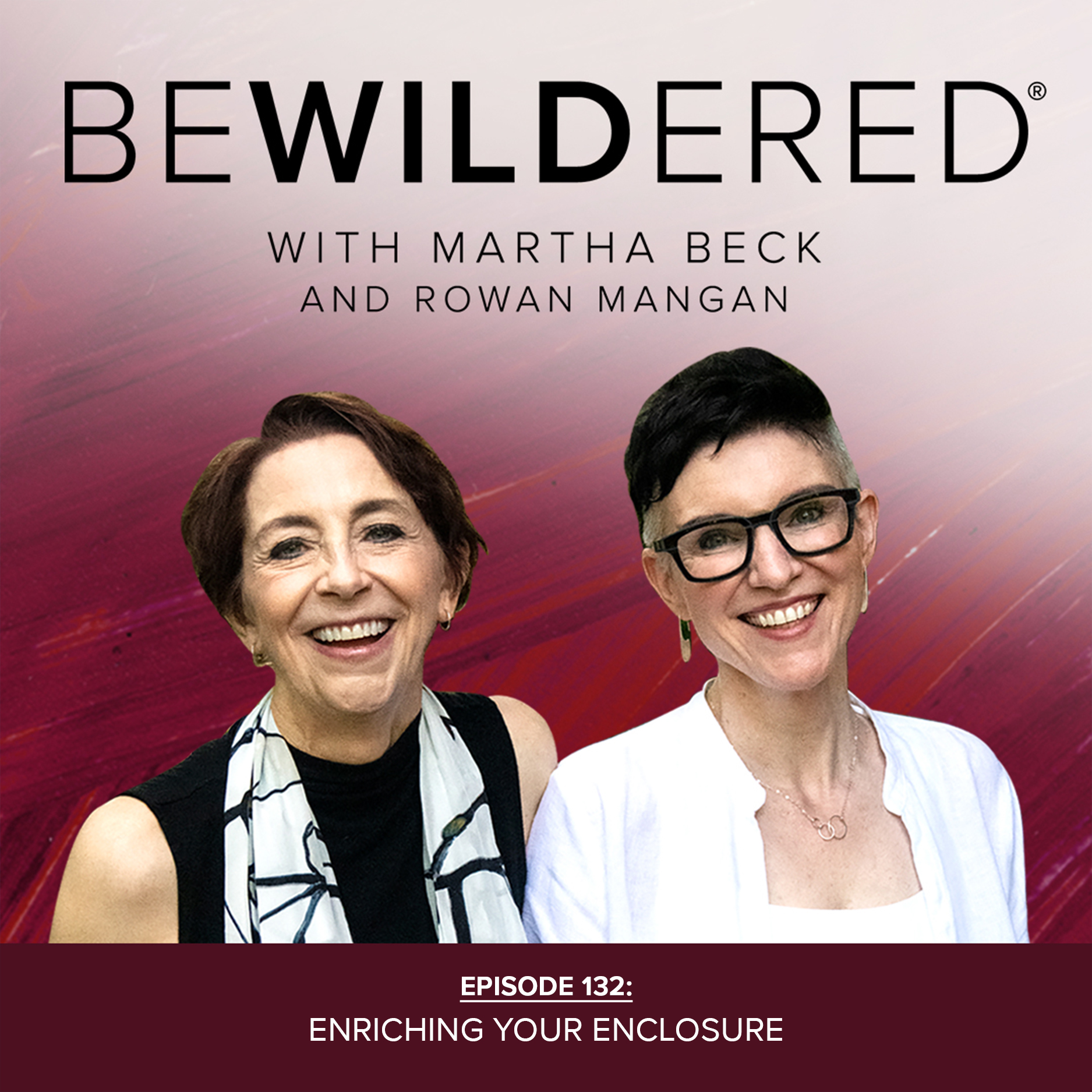
About this episode
We all need more hobbies…and we’re not joking. In this episode of Bewildered, we dig into why the culture dismisses hobbies, pushing them to the margins, when really they can be radical forms of rebellion. We talk about how to “enrich your own enclosure” rather than waiting for someone else to do it, how money can kill creativity (but doesn’t have to), and why interdependence is better than self-sufficiency. This episode will help you see hobbies in a whole new light. Tune in and join our revolution!



Enriching Your Enclosure
Show Notes
You know what we all need? More hobbies. (And no, we’re not joking.) In this episode of Bewildered, we’re talking about seditious, radical, heavy-duty stuff—hobbies—and why we think they might just be the revolution.
Why Hobbies Are Seditious
Before industrialization, people weren’t destroyed by their jobs. They had more interaction with the natural world. Their hours weren’t horrifying like factory hours. But since industrialization, things have gotten really ugly. So we say: let’s put that right in our own lives by doing the things we love.
The culture wants all our attention all the time. It needs us in a state of blank availability: available for advertising, available to be told what to do and what to buy. When you’re hyper-fixated on something you love and down a rabbit hole of your own devising, you’re no longer in that blank space where the advertising pings at you. That’s why hobbies are dangerous to the culture. And that’s exactly why we need them.
What Even Is a Hobby?
What makes something a “profession” versus a “hobby”? It’s not about skill, sophistication, or brain power. It comes down to this: Does the culture see it as central to the continuous production of material wealth?
If yes: It’s a profession and therefore respectable. If no: It gets pushed to the margins and called a “hobby” or a “passtime.” You know, something you do when you’re too old to function anymore, or too young to function yet. Well, we have something to say about that.
Enriching Your Own Enclosure
There’s a meme we keep coming back to: “Am I depressed, or is there just not enough enrichment in my enclosure?” It’s funny because it’s so bone-chilling. People feel like rats in enclosures. And if we’re stuck working so much that we barely scrape by, there’s no time or energy left for enrichment.
But here’s the thing: You can hope enrichment will reach your enclosure, or you can enrich your enclosure yourself. When you get really interested in something, you take on the agency of a person with a hobby. You’re no longer the passive one receiving advertising. You’re the active one shaping your own algorithm. And we mean this literally and metaphorically.
How Money Can Kill Creativity (But Doesn’t Have To)
The moment you introduce money into a pastime you love, something shifts. Studies in creativity have found that financial reward levels your creativity. We’ve seen this over and over in our own lives and the lives of our clients: “I tried doing the thing I love for money, and I just went dry.”
It doesn’t have to be that way. We talk about hacking your own psychology: reframing the thing from Sunday-scaries mode into exciting mode. Remember that money equals points, and start by making something—anything.
The Power of Interdependence
You don’t have to be the one doing everything. You can be the one who makes the thing, and someone in your community who enjoys photographing the thing can do that part. No matter how introverted we are, we just keep landing back in community—because it’s never supposed to be about self-sufficiency. It’s always supposed to be about interdependence.
That’s what the culture’s monetization of everything makes us forget: It doesn’t always have to be a transaction. It can just be a favor.
We saw this happen at our Pure.Wild.Self retreat in Costa Rica. There were twenty-five people there, and Liz Gilbert happened to drop in one day, and the whole thing turned into people rejoicing in each other’s genius.
Everyone connected with someone whose joy would help them make their joy into something sustaining. They were trading passions, trading specialties. It was a little village of 25 people, just bursting with interdependence.
If you want to learn how to enrich your own enclosure, reshape your algorithm, and rediscover the passions that culture has been dismissing as “hobbies,” this is the episode for you. Tune in and join our revolution.
Also in this episode:
- Karen advocates for the recycling man: “That’s gross to him.”
- Ro pollinates her tomato plants with an electric toothbrush.
- Martha identifies birds at 4:00 am with the Merlin app.
- Rhubarb hemorrhoids and baboons in heat
- Art Toad, Pac-Man, and the mycorrhizal network
- How Siri answers the question: “What is the nature of reality?”
TALK TO US
You can follow us on our Instagram channel @bewilderedpodcast to connect with our Bewildered community, learn about upcoming episodes, and participate in callouts ahead of podcast taping.
And if you’re a Bewildered fan, would you consider giving us a little rate-and-review love on your favorite podcast player? Ratings and reviews are like gold in the podcasting universe—they help people find us, they help build this beautiful community, and most of all, they help us in our quest to Bewilder the world…
Episode Links and Quotes
- Beyond Anxiety by Martha Beck
- Pure.Wild.Self. A Bewildered Retreat
- Radiant Rest by Tracee Stanley
- Iain McGilchrist
- Elizabeth Gilbert
- Jill Bolte Taylor
- “Studying Stones” song by Ani DiFranco
- “Comfortably Numb” song by Pink Floyd
- Merlin bird ID app
CONNECT WITH US
- Follow Martha on Instagram
- Follow Ro on Instagram
- Follow Bewildered on Instagram
- Join us in the Wilder Community!
- Listen on your favorite podcast app
- The Bewildered Show Notes
- Is there something you’ve been feeling bewildered about? If so, let us hear from you!
Transcript
Please note: This is an unedited transcript, provided as a courtesy, and reflects the actual conversation as closely as possible. Please forgive any typographical or grammatical errors.
Martha Beck:
Hi, I’m Martha Beck.
Rowan Mangan:
And I’m Rowan Mangan, and this is another episode of Bewildered, the podcast for people trying to figure it out.
Martha Beck:
Yeah. And today we’re talking about something that is really heavy. It is seditious. It is radical. It is heavy-duty stuff. It is…
Rowan Mangan:
Hobbies.
Martha Beck:
Yeah.
Rowan Mangan:
Have a hobby. Listen, if you want to fight all the oppressive systems, this is how to do it. We’re talking about it today. It’s going to blow your freaking mind.
Martha Beck:
We’re not joking, actually.
Rowan Mangan:
Do I look like I’m joking?
Martha Beck:
You always look like you’re joking. Let’s do a podcast.
So what are you trying to figure out for real?
Rowan Mangan:
I have got a theory and I’m trying to figure out for real if it’s for real. What if the way that a household deals with its garbage is some sort of not metaphor, but key to the dynamics of the household and the players?
Martha Beck:
I’m with you.
Rowan Mangan:
Right.
Martha Beck:
I’m with you. I don’t know where you’re going, but I like it.
Rowan Mangan:
Well, so it’s an interesting way for me to… I don’t know what you’ll say about me in this, but I have two partners, one of them’s you, one of them’s Karen, and I feel like our approach to garbage is very telling. So for you, for instance, we have a recycling bin, obviously. Your decision-making process about should something go in the recycling or not, I believe, goes something like this: “This item in my hand, can I imagine a way in which in any world, in any universe, this kind of thing could be recycled?” And because you are very bright and have a wonderful imagination, almost always you will go, “Yes, again, I can think of it.” And in it goes. And with love, honey, it is the most random shit that goes.
Martha Beck:
In my defense, forget imagination. I have eyeballs. There’s the little three arrow symbol and I can find that on almost any item.
Rowan Mangan:
I’m sorry. The cellophane that surrounds an ice, like a box of–?
Martha Beck:
Well, that’s just an accident.
Rowan Mangan:
No, I think maybe you’ve gotten better, but there is some random stuff.
Martha Beck:
I’ve had to get better. I think you’re going to get to this in a minute. I have been forced to get better. “Better,” they call it. Different.
Rowan Mangan:
So we believe in supporting small local businesses. And one of them, I should mention the name, but I shouldn’t mention the name.
Martha Beck:
Yeah, probably not.
Rowan Mangan:
Because I want to give him advertising, but I also don’t want to say bad about him. He’s great.
Martha Beck:
Because you’re about to.
Rowan Mangan:
No, I’m really not. It’s just that he’s like a real go-getter and he’s like one guy with his truck, and he will come right up to your house instead of having to take it down the road. We have a lane and he will come to your house and he will do it, but… And it’s reassuring that it’s really getting recycled because you can recycle so few things according to him.
Martha Beck:
So few. And it has to be in mint condition.
Rowan Mangan:
Yeah. And it makes me think how much stuff in our lives have we thought we were diligently recycling that was just getting chucked in landfill. So it’s like a two-edged sword, right? Because on the one hand, I’m like, yeah, these two things.
Martha Beck:
Yeah, there are two things a week that are actually qualified.
Rowan Mangan:
But the thing with Karen, and this is what I’m really talking about, is that she lives to serve, and this go-getter with his truck has really stolen her heart, I think, to the point that when there was a lot of snow, it was hard for him with his truck to get up to our house. So she’s like, “Don’t worry about it. I’ll bring it down to the road.” Even though our neighbors, the whole point of them recommending him was that you don’t have to take it to the road. And then I said to Karen, “We don’t have to take it to the road. There’s no snow.” And she’s like, “Oh no, it’s just easier for him.”
Martha Beck:
Yes. She’ll start taking it to his place of business very soon now.
Rowan Mangan:
But then the best thing was not long agom when we were having one of our periodical discussion, not periodical, periodic discussions about—
Martha Beck:
We could put it in a magazine.
Rowan Mangan:
Why not? It’s that interesting—about what gets recycled and what doesn’t. And it’s so funny because Karen loves this man so much that she’s like his defense attorney in our house.
Martha Beck:
Yes. Oh my God.
Rowan Mangan:
And Marty’s like, “Well, but this has the number” or whatever you said. “I can put it in there. It’s supposed to work.” And Karen goes, I swear to God, “He doesn’t like that, Marty. That’s gross to him. That’s gross to him.” And I was like—
Martha Beck:
It’s like a can.
Rowan Mangan:
He’s chosen to go into waste management. What did Tony Soprano supposedly do?
Martha Beck:
Waste management.
Rowan Mangan:
Waste management. He’s chosen to go into waste management. How trigger happy is his gag reflex? When she was like, “That’s gross to him.”
Martha Beck:
I don’t even remember what it was. It was something like if you put in a—that’s what it was—if you put in a soda can and it hasn’t been thoroughly drained and washed. What?
Rowan Mangan:
That’s gross to him.
Martha Beck:
That’s gross to him. “Don’t crush the can. That’s gross to him.” Now you make a solid poin,t though. I had not thought about the fact that he may be in air quotes “waste management.” In other words, maybe he’s just in the mob and he has to do this as his role. Maybe he’s not a made man yet and he has to gather recyclables.
Rowan Mangan:
I feel like the mob would be less picky.
Martha Beck:
Probably.
Rowan Mangan:
I don’t know. It’s interesting. Anyway, it’s interesting to sort of see the lens of what goes in the recycling, how Karen tries to help our garbage man be a garbage man.
Martha Beck:
And it’s interesting in light of our whole theme on this podcast, you know, away from culture to nature, because our leftist leanings make us want to recycle that, sort of, regarding nature.
Rowan Mangan:
Yes.
Martha Beck:
But Karen is so slavishly devoted to the recycling man that she’s taken it all the way around and become highly acculturated. Like we have to do everything in the world to please the recycle man.
Rowan Mangan:
And not to gross him out.
Martha Beck:
And not to gross him out, to keep his culture.
Rowan Mangan:
Sorry, Karikoo. It’s funny.
Martha Beck:
We love you. It is funny. It is.
Rowan Mangan:
Yeah.
Martha Beck:
Would that you were as picky about the things that are done to you.
Rowan Mangan:
Yeah. Well.
Martha Beck:
She’ll let anybody… She’ll give them a pass on almost anything, but don’t cross the recycle man. No.
Rowan Mangan:
That’s gross to him.
Martha Beck:
That’s gross to him.
Rowan Mangan:
Well, I’m going to have to make a tagline or something out of that. It just delights me so deeply.
Martha Beck:
A little sticker.
Rowan Mangan:
Yeah. So there you go. That’s what I’m trying to figure out. What about you? What on earth are you trying to figure out?
Martha Beck:
I’m exhausted. And I’ll tell you for why. Okay. Merlin.
Rowan Mangan:
Here we go.
Martha Beck:
It’s your fault.
Rowan Mangan:
Yep.
Martha Beck:
Yes, you have introduced me and y’all, you bird watches out there already know this, but I just recently found out about the app called Merlin.
Rowan Mangan:
We know we’re late to the party, by the way.
Martha Beck:
Yes. You turn it on, you put it in a place where there are birds singing, and it will identify the birds that are singing for you. And oh, the first time I turned it on and it’s spring in upstate New York now and all the migratory… And suddenly one bird after another starts popping up on this. It’s just delightful. So now, the birds wake up so damn early, right? Like 4:30. And I’m like, is that a chickadee or a towhee? Oh God. What is it? Is it a dark-eyed junco? I’ve got to get up and see. I’ve got to get up and see.
Rowan Mangan:
This is so you to turn this into a chore.
Martha Beck:
I’ve started wearing earplugs because I’m lying there exhausted. I’m like, “But I have to know if it’s a red-shouldered hawk.” So that’s been happening. And then it was terrifying to me, especially in my sleep-deprived state to hear the call of a red-bellied woodpecker inside our house.
Rowan Mangan:
Oh God.
Martha Beck:
The house is melting to begin with. We’ve talked about that before, no offense to the house and those who built. It’s just showing its years little. But I didn’t want a woodpecker inside it. Woodpeckers once grounded the space shuttle, those buggers can really, they can peck.
Rowan Mangan:
They can peck wood.
Martha Beck:
They can.
Rowan Mangan:
If anyone can, it’s them.
Martha Beck:
That’s true. So I’m like, “Oh my God, there’s a bird in the sunroom where Ro is growing all her tomato plants, her vast tomato plants.” And I mean, they’re not just big. Really “vast” is the only word that really describes them.
Rowan Mangan:
If I was not cutting them back on a near-daily basis…
Martha Beck:
We would have to move out to give them space. So I’m like, “Oh my God, there’s a red-bellied woodpecker in the sunroom. I have to deal with this and it’s night. What am I going to do? ” And I go in there, and there you are standing going [brrrt] or some noise. You’re making a noise that is, I swear to God, the call of the red-bellied woodpecker. And what are you doing? You are, let me find the right word, stimulating the blossoms of the tomato plant, which you used to do with an electric toothbrush.
Rowan Mangan:
I’m supposed to do it with an electric toothbrush, but it was upstairs. And so I was trying to emulate the electric toothbrush with my finger.
Martha Beck:
Emulate the stimulate, just the way you’re holding your finger now is really disgusting to me. That’s gross to him, Ro.
Rowan Mangan:
That’s gross to him. And if you’re going to try and stimulate a plant with your finger, you have to go [brrrt] so that it thinks it’s an electric toothbrush.
Martha Beck:
I’m turning on Merlin. That’s it.
Rowan Mangan:
[Brrrt] But this is like you don’t think you’re being watched.
Martha Beck:
Or listened to.
Rowan Mangan:
Or that you’re going to have to face a deposition.
Martha Beck:
You have to make the noises, right?
Rowan Mangan:
Yeah. [Brrrrt]
Martha Beck:
If you have the visual, just the sight of Ro like fingering the tomatoes and going [brrrt] or whatever you’re doing. Yes. You can understand…
Rowan Mangan:
Pretend to be an electric toothbrush.
Martha Beck:
So it’s a conflation of our hobbies. You have this grow enormous plants all over the house as well as outside the house and also manually stimulate them. I mean like what God meant to be done with an electric toothbrush. And then you give me Merlin, which turns me onto the call of the red-bellied woodpiper.
Rowan Mangan:
Turns you on, does it? Interesting. Interesting choice of words.
Martha Beck:
To the call of the red-bellied woodpecker, my woman. Why did I—I’ve never called you my woman.
Rowan Mangan:
That was, I mean, I enjoyed it. You can keep going.
Martha Beck:
My man. My good sir, but you’re not. So I had to get my pronouns right.
Rowan Mangan:
All right.
Martha Beck:
Yeah. And it was disturbing because now it’s going to cut off my sleep at both ends hearing these bird calls and then getting up and finding you doing things that leave me with disturbing images.
Rowan Mangan:
Listen, you being like raised fundamentalist, like it’s just the birds and the bees. [Brrrt brrrt] That could be either. They’re actually—-
Martha Beck:
Speaking of which, have you ordered a box of bees by mail lately? Different episode, folks. Listen to it.
Rowan Mangan:
I just think that you take natural stuff and turn it into weird stuff. And I just think you need to let go of the culture in your own mind that sexualizes what is natural and beautiful. Like, did you or did you not call my rhubarb a hemorrhoid?
Martha Beck:
I did, but not the part that you eat. Something’s growing on those things that should not be found in nature.
Rowan Mangan:
Babe, it’s a flower.
Martha Beck:
It’s someone’s face, but it’s not good. It’s not a flower. Have you touched it?
Rowan Mangan:
Have you touched it?
Martha Beck:
Yes, I’ve touched it.
Rowan Mangan:
Why?
Martha Beck:
Look, because it looks like a hammerid and I thought the plant needed help. It looks like a part that shouldn’t be displayed in the open air.
Rowan Mangan:
Every listener is like, this is so gross to them.
Martha Beck:
Have you looked at our rhubarb?
Rowan Mangan:
No.
Martha Beck:
They are fundamentally, that shit is fundamentally wrong.
Rowan Mangan:
No, disagree. Hard disagree. It’s just God’s glory just showing itself coming out of our earth. It’s beautiful.
Martha Beck:
Well, I dare you to decorate the table with it or anything. It looks like something that… It looks like something in heat, like a baboon in heat.
Rowan Mangan:
We might get approached by Preparation-H to start doing ads for them.
Martha Beck:
Influencer ads.
Rowan Mangan:
Because I know that Las Culturistas do Preparation-H ads.
Martha Beck:
Oh, so if I’m like crouching by our rhubarb hemorrhoid and going and I’ll be like, “Ro, remind you of anything?” And you’ll go, “Not anymore. I’ll use Preparation-H.”
Rowan Mangan:
I think you should just rub some on the rhubarb and see if it helps.
Martha Beck:
Helps shrink swelling of hemorrhoidal tissues caused by inflammation.
Rowan Mangan:
This is so gross. This is gross to me.
Martha Beck:
Oh okay. It’s gross to me too. It’s got to stop. Let’s do a freaking podcast.
Rowan Mangan:
So actually, hobbies.
Martha Beck:
Yes. I was just talking about them.
Rowan Mangan:
Like some of the things we were just talking about are kind of the topic for today.
Martha Beck:
Yes. I wanted this topic because I am of the opinion that we all need more hobbies and that it is a fundamental… like it’s a gap in our lives because I currently have four hobbies on the go. And by hobby, I mean something with which I am truly obsessed, something that makes me so deeply happy. And we’ve talked sometimes about people we know who don’t seem to have anything like that. I think there’s an inherent natural need to have these things, and it’s been scraped out of us by culture.
Rowan Mangan:
Okay. So a few points to bring up.
Martha Beck:
Oh boy.
Rowan Mangan:
I started to think about the fact that I used to spurn the very notion of hobby, and then the thought that came to my head was, it’s partly because the word sounds so stupid.
Martha Beck:
It does.
Rowan Mangan:
And then I thought, that’s the fault of the hobby lobby. And then I thought, oh my God, I’ve just landed on something. Hobby Lobby. Isn’t that a store?
Martha Beck:
It could go political or it could go mercantile.
Rowan Mangan:
And in this society it’s going to go mercantile.
Martha Beck:
And then it’ll go mercantile and need a lobby. So works both ways.
Rowan Mangan:
The irony is that if the lobby did its job, the word hobby would be changed. It would no longer rhyme with lobby.
Martha Beck:
It would be like a jobby lobby. The opposite of a hobby is a jobby.
Rowan Mangan:
Okay.
Martha Beck:
And we have way too many jobbies and not enough hobbies.
Rowan Mangan:
Okay. And in some cultures, jobby can mean other things, but that’s fine.
Martha Beck:
Oh can it? Oh no.
Rowan Mangan:
That’s all right. No, it’s fine.
Martha Beck:
Once the sexual innuendo starts, it does not stop.
Rowan Mangan:
Oh, well. Nevermind.
Martha Beck:
I did not know that. I have learned things here today. The jobby lobby.
Rowan Mangan:
Let’s not talk jobbies. Let’s talk hobbies.
Martha Beck:
Okay. Here’s the deal.
Rowan Mangan:
She tries to claw dignity back. “Listen, I’m Martha Beck. I don’t know if you know this, but I know Oprah. And I’m not talking about jobbies. I’m talking about hobbies.”
Martha Beck:
All right. So I have a little soapbox and I may have climbed on it before here, but I’m going to climb up on it again because I think it’s worth doing. Wherever I go—I’ve moved around the US quite a bit—and I like to find out what the First Nation people were that lived there and learn about their culture and learn how they lived… I’m fascinated by that and it grieves me so horribly what happened with colonization. But anyway, I remember going, when we moved to California and reading all about the people that were in our area and how they had lived there for 6,000 years, that they were sure these people had been there. And their daily lives consisted of things like fishing, hunting, gardening, making music, telling stories, decorating their clothing and their living spaces. And I was like, wait a second, they’re doing hobbies and they managed to survive for 6,000 years having a really beautiful culture, and they didn’t have jobs the way we have them today. What they did to live are the things that we say we will do one day when we have a long holiday. Or maybe on weekends. And the reason is we evolved to like those things because that’s how we were meant to survive. And then industrialization came in. Before industrialization—you just sent me a meme, a thing on Instagram—Iain McGilchrist, my absolute obsession, my boy toy, he’s a very distinguished Oxford professor. Please pardon that, Sir Iain. I don’t know if he’s a sir or not. Yeah, nevermind. I’ll take it up. “That’s gross to him.”
Rowan Mangan:
It’s gross to him.
Martha Beck:
No. And then these occupations came in and McGilchrist was saying before industrialization, people were not destroyed by their jobs, by what they did to survive. They had more interaction with the natural world. Their hours weren’t horrifying like factory hours. And since industrialization, things have gotten really ugly. So I’m like, let’s put that right in our own lives by doing the things we love. Even if we can’t do them as a job or as a centerpiece to our life, we can do it as a centerpiece to our attention or something. I just think we all need more hobbies.
Rowan Mangan:
It’s funny that hobbies are so… There’s something unserious about… And that’s sort of what I was getting at with the hobby lobby. It’s not for serious people. It’s for people who have too much time on their hands, too much time on their hands. There’s so much cultural judgment loaded into it. And I do think the word does disservice and—
Martha Beck:
Where does it even come from?
Rowan Mangan:
I don’t know. Should ask Siri. Marty asks Siri literally this tiny-brained robot who can, at best, convert Fahrenheit to Celsius and she’s like, “Hey Siri, what is the true nature of reality?”
Martha Beck:
It’s worth asking.
Rowan Mangan:
She’s like, “I can’t access that while you’re driving.”
Martha Beck:
We don’t know where the word “hobby” comes from, but it doesn’t do service to these things. What should we call them? Because you’re right.
Rowan Mangan:
Pastimes.
Martha Beck:
Pastimes.
Rowan Mangan:
But again—
Martha Beck:
No, that’s still—
Rowan Mangan:
No, no, no, no. Wait, hang on. But pastimes is okay.
Martha Beck:
Better.
Rowan Mangan:
Because it’s only culturally that we judge something as a pastime. I was thinking about truly things like knitting and whatever, there is a component that is during times when we can’t be outside running around, we can do these things. There are things to do.
Martha Beck:
Although if you’re bird watching—one of mine—you are outside running around, right? So you have a hobby. It’s not defined by that. What it’s defined by is: Does the culture see it as central to the continuous production of material wealth? If it sees it that way, it will say that’s a profession and that is respectable. If you have something you love to do that takes a tremendous amount of brain power and sophistication and skill and know-how and can provide things for people, but it’s not part of that core industrialization/post-industrial whatever, then it gets pushed to the margins and called a “hobby” or a “pastime” or a “little game” or something you do when you’re too old to function anymore or too young to function yet. It’s a plaything and it’s not worthy.
Rowan Mangan:
Yeah. And I’m just trying to think, I’m trying to figure out where the issue is with the culture. I think the culture wants all our attention all the time, and the idea of having things that you do and you’re interested in—and I don’t think it’s just… like someone we know knits and they’ve said to us, “It used to be a hobby; now it’s just a fidget” because they’re so good at it and they’ve done so much of it that it’s just muscle memory, no brainpower involved sort of thing. But I think when something’s a hobby, especially when it’s relatively new, it’s something, at least to me, that…it’s not just something that your hands can do. It’s something that you’re embracing that you learn about and that there is a certain novel complexity to it that you’re trying to get new knowledge on board. And I feel like there’s ways that we are discouraged from learning new things once we’re done with formal education.
Martha Beck:
Yeah.
Rowan Mangan:
And so that alone makes the hobby dangerous to the culture. But I think about… there shouldn’t be any challenge there, but there is. And I think the reason is that what we’re meant—the state we’re meant to be holding by the culture is blank availability.
Martha Beck:
Yes.
Rowan Mangan:
And what are we available for? We’re available for advertising, basically, in one way or another.
Martha Beck:
Tell me what to do, tell me what to buy.
Rowan Mangan:
That’s right. And if we’re hyper-fixated on something and down a rabbit hole, even if we’re using the culture’s devices and the culture’s wormholes and everything and tubes, we’re still off on a mission of our own devising and not in that blank space where advertising is pinging at us because it’s a mindless scroll. It’s not a mindless scroll anymore.
Martha Beck:
That’s really true. And the whole thing, another soapbox of mine, how the way I was schooled, I think schools are working hard to break this now, but when I was growing up, it was a system specifically designed to create factory workers, put all these same-size kids in same-size desks in a row, have everybody do the same task, even though it doesn’t need doing because they’re all learning to wash away everything else from their attention because the way children learn best, the way we all learn best is outside moving around, using all our senses and creating something that’s meaningful to us then.
Rowan Mangan:
What they’re learning is to sit still and answer questions that the teacher already knows the answer to.
Martha Beck:
Yes. And I remember taking my oldest child around to schools when we moved from Utah to Arizona, which that’s a whole different story. But I remember going around to different schools and the teachers saying almost universally, “Well, it’s not the children who are interested in the subject matter who really do well. So don’t think you’ll do well just because you like a certain subject.” It’s the children who are able to conform best and who don’t do anything except… They do everything they’re asked to do, they dot every I, they cross every T, and they don’t do anything else. And I remember just thinking—well, number one, it was not the right place for my kids, another story—but I remember thinking this makes no mortal sense in terms of actually educating a human. They’re making a machine. And it’s exactly right. They don’t think of…a kid doesn’t show up as a tabula rasa, as John Locke said they did. They show up as a full, vibrant, excited individual part of nature and they are turned into tabulas rasa.
Rowan Mangan:
There’s an attempt to turn them into that.
Martha Beck:
Yeah. And once you’re all the way through high school, but certainly all the way through college, you’ve learned to go blank, I would say.
Rowan Mangan:
Yeah.
Martha Beck:
And then do what you’re told.
Rowan Mangan:
It’s interesting, isn’t it? We have the blankness thrust upon us in order that we…
Martha Beck:
I mean, think about, and I wonder if people listening to this can remember going slowly numb. There’s a kind of tragedy for me because I’ve coached people so much. And it’s like they just went numb to what they like and what they want and what fascinates them, and sometimes they can track it backward to the place where they stopped being joyful and passionate and interested and started being good and right and appropriate.
Rowan Mangan:
This is going to blow your mind. There’s an Ani DiFranco lyric about this.
Martha Beck:
What?
Rowan Mangan:
Yeah.
Martha Beck:
Oh my God. I didn’t think she’d written more than one or two songs.
Rowan Mangan:
No, seriously. There’s just to this…
Martha Beck:
Well blow me away, baby.
Rowan Mangan:
Do you want to hear it?
Martha Beck:
Ani, we love you so much.
Rowan Mangan:
Do you want to hear it?
Martha Beck:
Yes, of course I do, honestly.
Rowan Mangan:
It’s cute. It’s one of the cute ones. They stick in my mind. Okay.
Martha Beck:
They all stick in your mind.
Rowan Mangan:
They all stick in my mind. She says, “Numb is an old hat. It’s old as my oldest memories. See, that one’s my mother and that one’s my father and the one in the hat, that’s me.”
Martha Beck:
Oh, wow. And Pink Floyd’s song, “I have become comfortably numb.” That is a horrifying, beautiful, wonderful…
Rowan Mangan:
Well, that song’s about hard drugs.
Martha Beck:
I know, but it’s a brilliant… But that’s the thing. If you are in a system that is trying to turn you into a machine, and you are not allowed to act out and you’re not allowed to fight your way free…There are the famous rat park experiments that actually aren’t famous, but they were some of the most famous deserving-to-be-famous experiments that were never publicized. It’s when they took rats out of cages. They were heroin-addicted rats taken out of cages and put into an enclosure where they could be happy rats. They had grass and they had leaves. I’ve talked about it before and they were given a choice of heroin in the water or water without heroin. They all went cold turkey and dealt with the withdrawal. They were fine not being comfortably numb when they were in the place they were meant to be. And then they put them back in the cages and they numbed out. Both, I think, with heroin and probably with whatever else a rat has at its disposal to numb itself, I think the culture requires us to go numb or else we will be miscreants. We will run off the page and into the margin and we’ll be uncontrollable.
Rowan Mangan:
And I think it’s… God, it’s so interesting. I think one of the… online, there’s this meme that I’ve encountered a few times that’s sort of about that very thing of, “Am I depressed or is there just not enough enrichment in my enclosure?” And it’s funny because it’s bone chilling. It’s like people feel like rats in enclosures and that we can reach a point if we’re too much in, like most people, stuck in working so much that you just can scrape by. There’s not time and energy for enrichment in your enclosure. And so things like the scroll or the TV, it’s like you’re so exhausted.
Martha Beck:
And they help you tolerate a state of numbed exhaustion. They help you not just start running screaming for the hills. It feels like a checkmate in the culture.You’re underemployed, you’re barely making enough money to support, you’re not even making enough money to support your family. You’re scraping by, you’re paycheck to paycheck, and all your life energy is going into this. And how do you tolerate it? With substances, with brain-numbing, scrolling, with I don’t know, rage. People do what they can, I think.
Rowan Mangan:
So here’s where I reckon we can really dig into “hobbies are seditious” or “are the revolution” because if I’m… This is going to come across a privileged statement and we can unpack that. If I’m waiting for someone else to put enrichment in my enclosure, I’ve got to hope that I’m one of the rats in the rat park experiment.
Martha Beck:
That’s all you can hope.
Rowan Mangan:
That’s it. That’s all you can hope. But if you can get really interested in gardening and you can train your algorithm to just be chickens dancing and…
Martha Beck:
This is your latest. You’ve always got an obsession going.
Rowan Mangan:
I know.
Martha Beck:
Always, darling.
Rowan Mangan:
I know. And that’s why the man hasn’t caught me yet.
Martha Beck:
That’s right. That’s right. And right now it’s chickens.
Rowan Mangan:
Chickens and my garden, still.
Martha Beck:
Did you get to do anything with chickens and an electric toothbrush? Because I don’t want to be there.
Rowan Mangan:
Listen, we’ll talk in the car on the way home. That’s a whole thing. My God, where do I begin?
Martha Beck:
I feel I have stumbled onto something horrific.
Rowan Mangan:
No, no, it’s fine. It’s fine. Someone posted a cute picture of their chicken in a Facebook group and the first comment said, “I don’t want to worry you, but that’s exactly what my chicken’s butt looked like two hours before it died.” Chicken lovers groups are no joke. Yeah.
Martha Beck:
That’s a thing. A really great hobby. We give it these infantilized names, but in fact they’re raging passions.
Rowan Mangan:
Right. So get this. So this is my thing. The scroll, or if you take the scroll, you take the drugs, like the sedating drugs, you take anything that is available to put into you, to top you up and your attention up. That’s the easiest thing and so understandable. But if you can find something in there that is more interesting than the other stuff, then you take on the agency of a person with a hobby and all of a sudden you’re the active one. You’re not the passive one receiving advertising. You’re the active one shaping your own algorithm. And I mean that literally and metaphorically.
Martha Beck:
Oh, that’s so cool.
Rowan Mangan:
Right? We should do an episode about shaping your algorithm in the three-dimensional world.
Martha Beck:
Absolutely. And I feel like that’s what’s happening to me because we went through this long, hard winter, and a lot of what I have spent my time on since we moved to this house is housework. It’s either keeping the place moderately clean or actually working on the house in some degree. And I finally unpacked my whole art studio and I’ve never had an art studio before and set it up for painting and then I was like, “Well, I guess I should paint.” And so I’d been unpacking boxes literally for five minutes a day just to get… so many boxes got stuck in there because it was the sort of random room. So I went in and I started painting. I didn’t have a lot of enthusiasm for it at the beginning, but I start putting something on the canvas and then I’m like, “Oh.” Then it starts to catch, like a fire that you’re starting to light, and then I’m like, “Oh, ho ho ho ho.” Then time disappears. Then Art Toad comes up. If you haven’t heard of my Art Toad, that is my—
Rowan Mangan:
That’s her alter ego that paints.
Martha Beck:
My alter ego.
Rowan Mangan:
It’s three years old.
Martha Beck:
It’s Mr. Toad from The Wind in the Willows who’s obsessed with driving a motor car. And he’s like, “I am the Toad. Watch me drive.” So Toad grabs the wheel, and I start to paint and it’s like the joy…. It makes me late for all my appointments, and it makes me tired because I will go in there and not come out for a long time. Well, then I thought, “Well, I also have my piano. I haven’t touched the piano for a long time.” I never really learned to play it. I thought, I’ll just do it five minutes a day. And I’m like, “Oh.” I had that weird phenomenon after you’ve learned a language and then not spoken it and then you go to the country and weirdly you speak it better than you used to. I’ve had that with a number of languages. At first I was like, I can’t even find the notes. And then it was like, oh, but suddenly I can. And oh, that chord structure makes sense. When did I start thinking about chord structures?
So I am obsessed, and I’m too anxious to ever play in front of anyone. My dog used to come into the house and I would fall apart because I would be so worried about him judging my piano playing.
Rowan Mangan:
You’ve spoken before about the time when I was in the house and you thought I wasn’t in the house and you were playing “Bridge Over Troubled Water” and you threw yourself to the floor in horror.
Martha Beck:
I did. I fell down on my face in shame. I’m still not over it. But the thing about my piano now is it’s an electric one and you can plug it in and put earphones on and nobody hears you. And then Merlin comes and there are birds, birds. And I was obsessed with birds when I was a kid and now I’m obsessed with, like, I’m traipsing around the woods at five in the morning going, “Baltimore oriole? How did I get so lucky?” And that’s just three things, and I am on fire. I am tired, but my life feels so rich and full. And nobody’s going to pay me for these things unless somebody wants to buy a damn painting.
Rowan Mangan:
Hint, hint.
Martha Beck:
I mean, that’s the only thing I could even conceivably do with it that’s part of the culture’s value system.
Rowan Mangan:
And we should talk about that, but I just want to point to, again, just this thing of you can hope enrichment will reach your enclosure, or you can enrich your enclosure. And it’s such a rebalancing of the scales when you take it on as like, “Oh, I’m interested in this.” And it’s then you use the master’s tools against the master by shaping your algorithm and watching a lot of chicken videos on Instagram. I use that hypothetically. And so yeah, all of a sudden, you’re the master of your destiny.
Martha Beck:
And I have to say, it’s not—I mean, definitely I’m living a life of incredible privilege, but it’s not like I just had an empty day. I didn’t have time. My day was fully leveraged every day. Try to find an appointment on my calendar in the next month: good luck. I am fully leveraged time-wise—or so I thought. But I started sneaking it in, sneaking in little. And I thought if I just touch it every day. Now if I start writing a book, it’s all over, Ro, I’m never going to come to the surface.
Rowan Mangan:
Here’s the thing. I think it’s the culture that tells us that these things have to exist in time because we know perfectly well that you can do six things at once. That’s the only reason women function and women stay alive in the world. So what I’m getting at is it’s not like—I’m thinking about chickens right now. Now some would say I’m doing a podcast—not very well, but—some would say I’m doing a podcast, but no, I’m literally thinking about a video about chickens that I saw this morning.
Martha Beck:
And you know what I’m doing? Swear to God, I didn’t make this up or anything. I can hear this song I was learning this morning and I was learning to improvise, not just play the melody line, but improvise. And I’m sitting here and my fingers are twitching as I hear it in my head. They’re looking for the chords, and it’s not like I’m a pianist. I am a beginner, right?
Rowan Mangan:
Marty, pronounce it the right way.
Martha Beck:
Beginner?
Rowan Mangan:
Pianist.
Martha Beck:
Oh a pianist.
Rowan Mangan:
Yeah.
Martha Beck:
In Utah, they’re “pi-ann-ists” because “pianists” sounds like something you don’t want to talk about ever. It’s that joke where the man comes into the bar and says—
Rowan Mangan:
Yeah, 12 inch. Yeah.
Martha Beck:
Yeah.
Rowan Mangan:
So you were talking about like money before and making a living and how do hobbies fit into that? And it is like a puzzling one. Right? It’s a puzzle because everyone knows, who has a hobby, the first thing that people say to you when they discover your hobby is, “Do you have an Etsy shop?”
Martha Beck:
That’s right. Could you sell it?
Rowan Mangan:
Yeah.
Martha Beck:
Always.
Rowan Mangan:
Yeah. No, no, it’s usually, “You could be selling that.” That’s the compliment.
Martha Beck:
You could be selling that. Yeah.
Rowan Mangan:
And then, in fairness, as someone who says that to people all the time…
Martha Beck:
I do too.
Rowan Mangan:
It seems like the solution. It seems like it should be the solution. That’s how you circumvent the system is by doing what you love and paying for your food and shelter with that thing.
Martha Beck:
Supporting your family with the thing you love. That’s everybody’s Dream.
Rowan Mangan:
What’s the problem with that, Marty Moo?
Martha Beck:
The problem with that is the moment—when they do studies in creativity, what they have found with monotonous regularity is that if you give people creative challenges, like how do you use these objects to accomplish a certain task and you have to be quite creative to make it work. And people will sit there and figure it out and get quite interested, like little kids figuring stuff out. They’re quite happy. And then you say, “If you get it right, I’ll give you $5.” And they fall apart. It’s not just that they can’t come up with a good solution. They just freeze. It levels your creativity to be paid for something. So over and over and over in my own life, in my kids’ lives, in my client’s lives, it’s like I tried doing the thing I love for money and I just went dry. I couldn’t do it anymore. I don’t know what happened.
Rowan Mangan:
And how do some people make money doing it?
Martha Beck:
I think it’s because—I mean, I was able to do that with writing, which is to some extent I get lost in it the same way I get lost in art.
Rowan Mangan:
But it’s not something that you, you wouldn’t be sitting there writing self-help.
Martha Beck:
Exactly. Oh, no. No, no, no.
Rowan Mangan:
Respectfully.
Martha Beck:
That shit? And I didn’t start out that way. I started by writing what I thought would be a novel, it turned into a memoir, and that was really like me, I remember trying to write my PhD dissertation at the same time. I did write it at the same time and the PhD was like, “Ugh, kill me now.” And then I’d go to the novel and be like, “Ooh, I’ve forgotten what time it is and I’m up in the middle of the night full of energy.” It just made me happier. Anyway, here’s the thing: I never prized writing the way I prize a hobby. It was like a functional thing I could do that I could always do. And I tell my clients it’s like, “Whatever you could do falling-off-a-log easy.” So that was what that thing was for me. And so I was able to kind of crowbar in some creativity. Once I had it in a place where, okay, they’re going to pay me for this, how do I make it not unbelievably boring? How do I fit my passion to what I’m now doing? And I think some people are able to do that with their jobs. They love people. They’re a people person and so they’re working with people and they don’t like the job, but they like the people they’re working with, right?
Rowan Mangan:
But that’s not what people are testing. We’re talking specifically about creative stuff, right?
Martha Beck:
I’m talking about doing what you love and getting paid for it.
Rowan Mangan:
Right. Okay.
Martha Beck:
So some people can do it just… I mean, you and I are both quite introverted, but if you watch The Office, which is that brilliant—
Rowan Mangan:
Everyone knows what The Office is.
Martha Beck:
Yeah. About a paper company. Nobody there is passionate about paper. It’s about the relationships with the other people in the office. A lot of people who work in corporate America or whatever, corporate world, wherever, have that. So there are these ways that you can put the joy of your heart and the part of your brain that’s creative into the culture, but it’s lame and it pulls your time away and it always involves jobs that are horrible. And if you try to go off like, “I’m going to leave the whole scene and go off and be an artist,” then you run dry. Again, it feels like a checkmate. So I think there’s got to be a way to find… So I wrote a book about anxiety and what I found was that we all know, I mean, everybody in the literature knows that anxiety will kill your creativity. My question was, does creativity also kill anxiety? What if you start by being creative and see what happens then? Because we know the two seem to be toggling one way. And so I experimented with people who’d come on these large hundred to a thousand people on Zoom and I’d say, “What’s your anxiety level?” Then I’d have them do creativity exercises. Then what’s your anxiety level now? And it would always go way, way down, often to absolute zero. So then I’m like, okay, if you can find a way to put your creativity and your hobby in the center of your heart, in the center of your attention, as you said, even if your time is taken up by the culture, can you begin to get that space and create that excitement that you’re talking about, that little bit of wiggle room that means you’re controlling your internal, the enrichment of your internal environment enclosure.
Rowan Mangan:
Enclosure. Yeah. Yeah. How far back do those studies go that you’re talking about, about creativity?
Martha Beck:
I think the ’60s was when, like a long time ago.
Rowan Mangan:
About the ones where doing creative stuff for money? Okay. So I’ve got a theory about it, which is, so parts psychology is just a way of, like a lens that you can use for understanding that we contain multitudes basically.
Martha Beck:
Yeah. We all have different parts and part of me wants to do this but part of me doesn’t. Okay, two parts.
Rowan Mangan:
So what if what stops you from doing your creative joy for a living isn’t you don’t dry up at the desk, you dry up on the way to the desk. So your Art Toad does not give a shit whether or not he gets paid. That doesn’t look like anything to him. That’s gross to him. The very question. That’s gross to him. He’s just making colors and pretty. So I’m just so interested in this, like this moment where we’re walking to our desk where what we love and we’re telling ourselves it’s time to go to work. And I think about, do you know the Sunday scaries?
Martha Beck:
Yes.
Rowan Mangan:
You know, like just that Sunday afternoon comes and the pit and your stomach starts to grow and maybe it’s that we start thinking about anything that makes money as being an enclosure with no enrichment in it.
Martha Beck:
Yeah. And often it is. I mean, that’s justifiable.
Rowan Mangan:
Right. Yeah. No, for sure it is. But maybe what I’m saying is maybe the enclosure is how we’re walking to the desk, not what we’re doing at the desk.
Martha Beck:
Yes. And you said something that is very telling. You said, “We’re telling ourselves it’s time” because the part—it’s all the prefrontal cortex, but on the left side predominantly you get language and time tracking. On the right side, you get creativity. Generally. I know I’m simplifying.
Rowan Mangan:
She thinks everyone who listens to this is a neuroscientist.
Martha Beck:
I corrected about it on an interview last week and I knew. All right. Anyway, when you tell yourself it’s time, you have opened the lock of the enclosure, stepped in, and thrown away the key. You tell yourself it’s time. If you stop talking and you stop timing, well, here’s what happens. If you let the—Jill Bolte Taylor would say the part of your brain that is the adventurer, the creative adventurer, if you let it go play, then it doesn’t talk and it doesn’t tell time. So what I have to do is I use the left side of the brain. I create a space that I’m going to dedicate to my hobby. And at first, like when I said I’m going to start painting again, it literally was five minutes. I’ll go in there, I’ll make a mark, I’ll leave. And then somehow I’ve learned this skill and I used to do it with writing too, but I’d have to stay up all night to do it. Here is an eight-hour period. There will be no interruptions. I will not sleep that night, but I will fully dive into the process of writing. I will not be doing it as checking my watch and seeing will my editor like it? I am going to tell a story now because that’s the only way this is going to be interesting to read. So it’s this, you have to have these careful little mental gymnastics to create an enclosure. You can create an enclosure that is barren and serving the man, culture, and that’s what they teach you to do. Or you can insist on even the littlest space where you’re going to create the enclosure where you, it’s like all outdoors. It’s wild. I mean, when I think— this morning when I woke up and the birds were singing and I wanted to ID them and I thought, “I’m going to play that song on the piano that I learned yesterday and I’m going to paint today. ” The word was “wild” and I just said the world was wild, and this is Bewildered because we’re talking about being “wildered” and I had this overwhelming sense of going wild this morning, but then you can create an enclosure for the wild thing the way they do at really good zoos or restoring a habitat.
Rowan Mangan:
Or like the kind of spa where you go for a week or something that you can voluntarily get out of.
Martha Beck:
Well, yeah, but like—
Rowan Mangan:
I don’t want to use a metaphor of a zoo. It freaks me out. Makes me feel anxious.
Martha Beck:
Oh, I’m thinking of a restored habitat where you just don’t let anyone come in with the wrong stuff. You’ve created, you go into the game preserve, you’re not allowed to hunt, right? And it’s not a cage, but it’s a habitat that you hold sacred and you have rules around it. I remember reading in one of my how-to-write books when I was in my 20s about a woman, I think it was an artist actually, and she put a sawhorse in the middle of the lane that went to her house where she was. And when she was working, she would put a sign on it that said, “Get away from here. I mean you. ” Because that’s how ferociously she was guarding it. I kind of think that’s how it should be.
Rowan Mangan:
I agree with you and I also think we have to guard it from the parts of ourselves that are going to, because we’ve been acculturated to think what I do to earn money makes me feel like shit and that’s the equation. I go here, I feel like shit, therefore I get money. If I then, I will then project that fluorescent-light, awful environment onto my greatest love, of course that fucks it up.
Martha Beck:
Oh yeah, you’re shoving your wildness into the cultural enclosure and killing it because it can’t live in captivity.
Rowan Mangan:
Right. We’ve been talking in our lives about how to get the culture or the pyramid shape, to use the language that you use, out of how we are actually living and finding all the places where we have our blind spots around where the culture is unknowingly shaping our expectations and our thoughts. And I think this is one of them. It is I approach the thing that I make money doing in, like I get to say, I get to be the agent of how I approach it. And so if the fact that it brings money, I can reframe that to be a joyful thing. It’s only the culture, man, it’s “the man” who makes working for money a disgusting proposition.
Martha Beck:
Yeah. Because he’s milking your labor to make excess, which is not how nature works. And I think, I totally agree with you, and I believe that the best approach to it is kind of a sneak attack, not only on the culture itself, but on the culture in your mind. So I’ve been reading this book, I love this book, it’s called Radiant Rest by Tracee Stanley. And she is a brilliant, she’s a yoga teacher and it’s about these deep forms of yogic rest that are… I mean, it’s a fantastic book. And one of the things I love most about it is she is not writing to people of privilege. She is writing to everybody. So she’ll say things like, “If you’re incarcerated, try it this way.” And I’m like, “Oh my God, so many people are incarcerated in this country. Of course I should be writing to them. Why wasn’t I thinking that?” Actually, I often think about that because somebody told me once when they tossed the cells in this woman’s prison, they found copies of my Oprah columns in there and I’ve always… Anyway, sorry, distraction. But see, that is a way I sneak. If I put the person who’s there and I’m writing to them from heart to heart, that’s a way I sneak past the barrier, and I’m in a communion with a person, and that’s wild to me. Anyway.
Rowan Mangan:
I think that’s different. I don’t think you can equate because we’re talking about hobbies and I just don’t believe you’re writing these… Like you’re writing for sure as a hobby, but I don’t think you’re writing to those people as a hobby in that category. It’s very good that you do that, but it’s different.
Martha Beck:
Yeah. I’m talking about a way of dodging the enclosure in my brain by making it something I’m doing for another person.
Rowan Mangan:
Yeah.
Martha Beck:
But then it’s a cultural caretaking thing, especially for women, that’s the thing.
Rowan Mangan:
Joy. Joy has to be the track, right?
Martha Beck:
Yeah. It’s interesting how I keep sliding into different cultural tracks because here’s the thing Tracee Stanley says in this Radiant Rest book that I really am taking to heart. She’s writing to people who have no time, no money, terrible jobs, lots of people to care for, no time, no energy. And so she very expertly…she doesn’t assume you’re going to a yoga class for two hours ever. She says, “If you’re on a bus and you have five minutes, send your mind and body to this place. If you’re outside having a cigarette break, do this, try this if you want.” And for her, it’s this incredible kind of mission she has to get people rested, which I think that’s a whole different podcast, but is wildly necessary. But that’s how I’ve always sneaked my hobbies into my life a tiny bit at a time.
Like this morning I couldn’t paint, I didn’t have time. I photographed the painting I’m working on, which is large, printed it out on our printer and doctored it with colored pencils so that when I go back to the studio, I can cut through. I won’t have to dick around as much. I’ve done it with a colored pencil on a printed page. I was able to do that for 10 minutes, but it kept me alive. It kept the joy alive.
Rowan Mangan:
Yeah. And so we’re taking it out of “I have to.” And this is one of my challenges is I have to be in the exact environment and the exact everything must be exactly a certain way and taking it to where can you bring the enrichment with you wherever you are.
Martha Beck:
So if I were to talk to you about poetry, which is almost a vocation for you. The word “hobby” doesn’t do it justice and yet the culture would probably consider it one. I don’t know. Yes, you have a desk to do it. You have probably a bespoke quill or something you use. A poet’s blouse with puffy sleeves. I don’t know.
Rowan Mangan:
Yes, yes.
Martha Beck:
Is there a way, but by and large, you haven’t had a lot of time to write poetry.
Rowan Mangan:
Or I haven’t taken.
Martha Beck:
Yeah. Is there a way you could enrich the enclosure just as a test case for this?
Rowan Mangan:
Yeah. And this is such a helpful conversation for me because I’m looking for all these hacks. I’m looking for how we can game the system and one of them is like the reframing of the thing, even if you’re making money from it into exciting mode, not Sunday scaries mode. And then the other actually follows on from that about money. And what if we have to trick ourselves? We have this psychology that doesn’t, that is in some cases like anachronistic for our environment and all of that sort of thing. So we’re always trying to hack our own psyches in a way, right? And I remember when I was trying to write a book and I was talking to a friend of ours who’s a writer and I was saying to her like, “At this moment, at this moment now, what is it that is pushing you to your desk to get this book finished every day?” And she looked at me and she goes, “Well, I’m really looking forward to getting paid.” And it was such a great moment for me because it was such a “cut the bullshit,” like “cut all the highfalutin stuff.” And so maybe part of the hack is to set it up because as we I’m sure have discussed on Bewildered before, money is points and if you can get your little Pac-Man part of you engaged in money, it becomes like nit-nit-nit, no, no, no, no, nit-nit.
Martha Beck:
Well, I love this and I think one way of tricking it that way so that you can move toward the money thing and not get stopped by the switch into like panic, “I have to do a job now” is you can start by just making something, anything. When I’m anxious or when I feel like I have to make money, I have to make things happen or whatever, I am completely without ideas and I’ve tried to like get blood out of a stone, squeeze the stone to get idea that doesn’t happen. But if I start to make anything and if there’s such resistance, my brain is like, “No, no, I have to fix my life before I make something.” But if I start making anything that requires engagement, especially with my hands, what happens is your brain literally, this is not a metaphor, it literally calls on parts of your brain that can’t get too involved in anxiety.
It goes to the right hemisphere, it starts to solve problems that can only be done by creating neuron connections in that hemisphere. It pulls electrical energy away from the part of the brain that’s anxious and time-bound and obsessed with reward and counting and grasping. I goes into the part that’s like, “Huh, what’s interesting. I wonder what bird that is? What if I get an app that shows me which bird? I could go up and build a bird blind.” The moment you start making anything, your whole brain changes.
Rowan Mangan:
So part of the hack can maybe be exploiting the fact that we are different people in different moments. The parts psychology thing is that while we’re creating, we’re not making money, that’s absurd. Art Toad can’t make money. Art Toad doesn’t know what money is.
Martha Beck:
Art Toad could give a flying fuck about money.
Rowan Mangan:
Yeah. It’s not anything. And so let’s say, “No problem. That part is for someone else on a different day.” I know this is not true for everyone, but for me, if I’m in the right mindset, I can creatively engage with packaging up something and making it look pretty to sell it.
Martha Beck:
Yep. And that ends up being what you have to do anyway because to write a book, I have to create a little island where I can go in and be a storyteller, which it would be harder for me if it were my passion. It’s not. So I’m not that upset about it. It’s a job I do. But I go into a space that’s more creative, and that’s fine. And then I know that when I send it to my agent, I have to become a completely different person. I have to become an editor and a marketer and all kinds of things that are not very particularly natural to me. And so I call on a different part of myself.
Rowan Mangan:
And I think this is important. You call on other people.
Martha Beck:
Oh, I do.
Rowan Mangan:
There is a part of you that has to sell and show up and do interviews. And it’s so wonderful for me that you happen to be really good at talking as well as writing because a lot of writers aren’t and that you can show up really well for that. But I just keep thinking like those people who someone says, “Do you have an Etsy store? You could sell that. That would be amazing.” It doesn’t have to be you. You can be the one who makes the thing and someone in your community, like me, who enjoys photographing the thing can do that part. And this is this thing that we keep landing on no matter how autistic and introverted we want to be, we are, we just keep landing back in community. And it’s never supposed to be self-sufficiency. It’s always supposed to be interdependence. And this is how it works is you can have a part that makes the art and you can have a part that does other stuff, but you can also externalize that to actual other people and we can help each other. What a concept. And that’s part of what the monetization of everything makes us forget is that it doesn’t have to be a transaction. It can just be a favor.
Martha Beck:
That is so good. I’m remembering, as you say this, I remember this seminar that we did in Costa Rica called Pure.Wild.Self, this gorgeous place in the jungle. And we were there and there were like 25 people, and Liz Gilbert happened to be in the neighborhood—literally. So she came one day and the whole thing turned into people sort of rejoicing in each other’s genius. And I remember seeing person after person connecting with someone whose joy would help them make their joy into something sustaining for themselves. People were trading passions, they were trading specialties, they had like training and it was this little village of 25 people and it was just bursting with interdependence.
Rowan Mangan:
Well, it makes sense, right? Because we’re part of nature, we’re not fucking separate from nature. And nature works on ecosystem, symbiosis. Of course someone can step in and do that for you and you can step in and do that for someone else and everyone’s paying it forward in a thousand directions.
Martha Beck:
It’s the mycorrhizal network of the forest, the mushroom and fungus that goes underneath the soil and sends sugars to the right plants, which makes me laugh because we went to a class last, I forget what day, but it was a mycology class, a fungus class taught by someone who is so passionate about fungus that you just wanted to sit. And I was gripped by the whole thing.
Rowan Mangan:
I was cold.
Martha Beck:
I was also freezing cold, but he got such joy out of it. It was definitely his hobby and his passion. And we were all there wanting to learn. And I was like, “You go and learn which mushrooms are poisonous by trying them.” Because he seemed really bent on doing that. And I was like, “Good, you come tell the rest of us about that.” And it was another reminder that there’s somebody who’s passionate about things that you wouldn’t necessarily be passionate about. And that is literally, and here figuratively, the ecosystem of how we survive and in fact how we…
Martha Beck and Rowan Mangan:
…Stay wild.
We’re also on Instagram. Our handle is @bewilderedpodcast. You can follow us to get updates, hear funny snippets and outtakes, and chat with other fans of the show.
For more of us, Martha’s on Instagram, themarthabeck. She’s on Facebook, The Martha Beck, and she’s on Twitter, marthabeck. Her website is, MarthaBeck.com. And me, I too am on Instagram. Rowan_Mangan. I’m on Facebook as Rowan Mangan. And I’m on Twitter as RowanMangan. Bewildered is produced by Scott Forster with support from the brilliant team at MBI.
Read more
Questions? Comments? Trying to figure something out? Email us! [email protected]
Credits
Wandering The Path by Punch Deck | https://soundcloud.com/punch-deck
Music promoted by https://www.free-stock-music.com
Creative Commons Attribution 3.0 Unported License


0 comments