

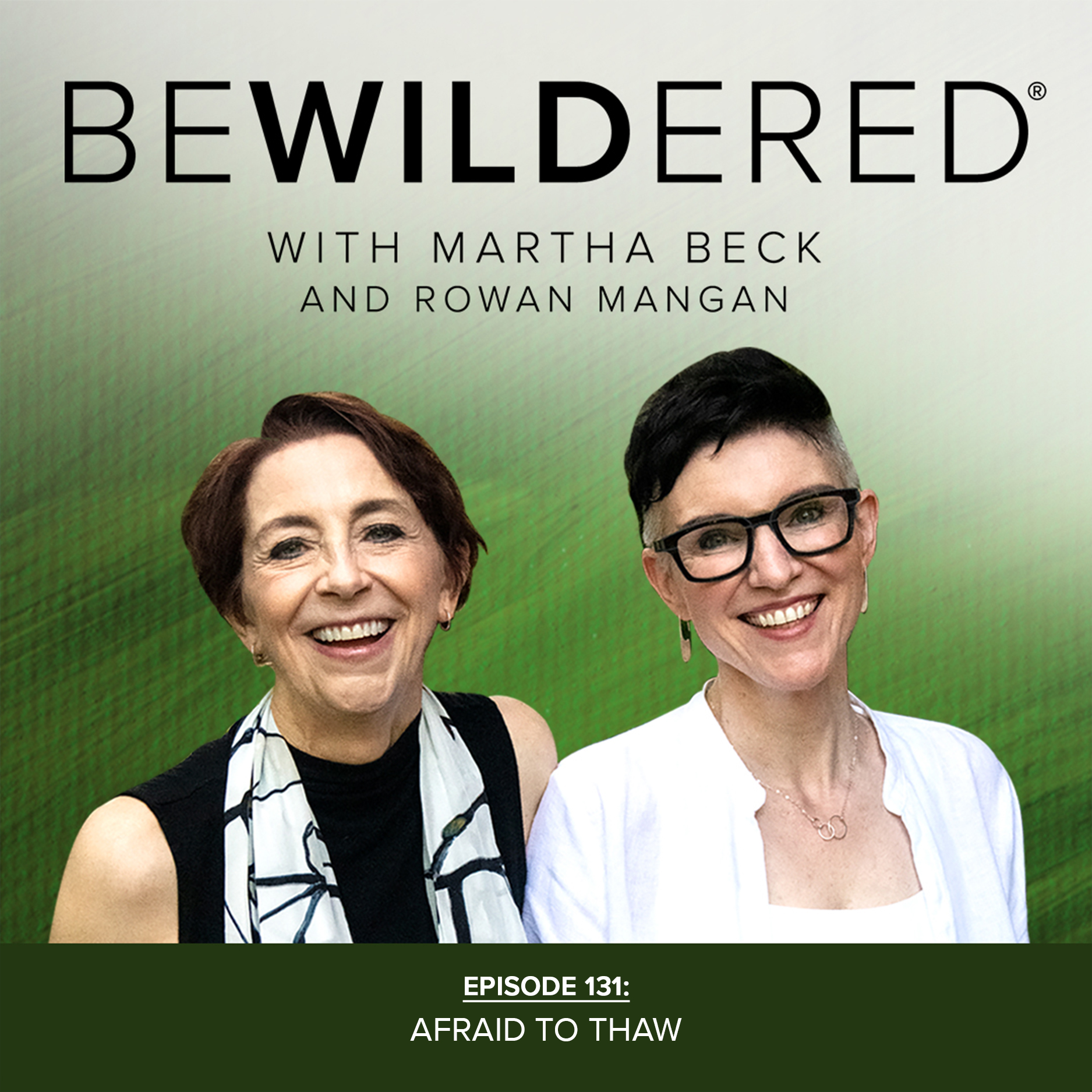
About this episode
This time on Bewildered, we’re talking about the human tendency to brace against good things happening—to freeze in place, even in the middle of a summer day. The culture teaches us that if we let go of our pessimism and caution for a second, something will get in through the chinks. So we look at the greenest landscape and our vibe is still: “Winter is coming.” But the ultimate suffering isn’t the cold itself…it’s refusing to thaw. Join us for the full episode and let’s figure it out together!



Afraid to Thaw
Show Notes
Martha has a confession to make: living in “the north country” has broken her. Spring has arrived, the tulips and daffodils are out, the blossoming trees are doing their thing, but all Martha can think is: Winter is coming.
This time on Bewildered, we’re talking about the human tendency to brace against good things happening, and how we can follow nature’s example instead.
Why We Brace Against Good Things
The culture teaches us that an unadulterated “Hooray!” is a dangerous thing. There’s the idea that once that cold or darkness has passed, we must remain braced, lest it get in sneakily sideways. If you let go of your pessimism and caution for even a second, something will get in through the chinks. But if we’re not always on guard, what is it that we think is going to come in and get us?
At a very primitive level we’re thinking, “Never let this happen again. You will suffer, or even die.” So we stay iced up: braced against joy, braced against softness, braced against the beautiful abundant landscape right in front of us. We produce hysterically and enjoy nothing.
“Winter Is Coming” and Other Stories We Tell Ourselves
We trace this bracing posture to cultural forces, from the tight-lipped “Don’t enjoy it because you’ll ruin it,” to the negativity bias that kept our ancestors alive in their burrows, to the post hoc ergo propter hoc fallacy: “I was miserable and I survived, therefore my misery is what saved me.”
The trouble is, we never stop. Even in summer, we’re thinking about the next snow.
Dante, Ice, and the Real Meaning of Suffering
Here’s the thing about the Inferno that most people get wrong: the devil isn’t in fire and brimstone. In Dante’s Divine Comedy, the devil is locked in a frozen lake. The worst of the sinners are frozen in ice alongside him.
This is the ultimate suffering: when we freeze everything because we’re so enraged, suspicious, fearful, and controlling. It is the bracing that causes us to die while we’re still alive.
What It Actually Looks Like to Thaw
So how do we thaw? How do we convince our lizard brains that it can be safe enough to just relax and enjoy?
We explore how to let yourself soften physically, emotionally, and culturally. Start by shifting your focus from death onto life, from scarcity onto plenty. Slowing down and sighing resets the nervous system because a deep sigh of relief tells the rest of the brain that it’s safe to relax.
To hear more about staying present to thaw into whatever is happening, join us for the full conversation. Let’s figure it out together!
Also in this episode:
- Martha shows up for an 11 o’clock appointment at 10:59.
- the unflappable Adam Beck and his Yoda-like wisdom
- Clydesdale horses vs. Bilbo the cockapoo
- groundhog gasps and the unadulterated hooray
- Ro can’t resist doing her impression of Bob Dylan.
- Sky the bear’s cubs, Johan and Donkey Teeth
TALK TO US
You can follow us on our Instagram channel @bewilderedpodcast to connect with our Bewildered community, learn about upcoming episodes, and participate in callouts ahead of podcast taping.
And if you’re a Bewildered fan, would you consider giving us a little rate-and-review love on your favorite podcast player? Ratings and reviews are like gold in the podcasting universe—they help people find us, they help build this beautiful community, and most of all, they help us in our quest to Bewilder the world…
Episode Links and Quotes
- “Spring” from The Four Seasons by Vivaldi
- The Dirty Life by Kristin Kimball
- Good Husbandry by Kristin Kimball
- Post hoc ergo propter hoc fallacy
- Bears documentary by Disneynature
- Martha Beck’s African STAR retreats
- The Divine Comedy by Dante Alighieri
- “Girl from the North Country” by Bob Dylan
- José Ortega y Gasset “Tell me what you pay attention to…”
CONNECT WITH US
- Follow Martha on Instagram
- Follow Ro on Instagram
- Follow Bewildered on Instagram
- Join us in the Wilder Community!
- Listen on your favorite podcast app
- The Bewildered Show Notes
- Is there something you’ve been feeling bewildered about? If so, let us hear from you!
Transcript
Please note: This is an unedited transcript, provided as a courtesy, and reflects the actual conversation as closely as possible. Please forgive any typographical or grammatical errors.
Martha Beck:
Hi, I’m Martha Beck.
Rowan Mangan:
And I’m Rowan Mangan, and this is another episode of Bewildered, the podcast for people trying to figure it out.
Martha Beck:
And what are we talking about today, Roey?
Rowan Mangan:
Today on Bewildered, we’re going to be talking about the human tendency to brace against good things happening.
Martha Beck:
Yes, yes. To freeze in place, even in the middle of a summer day.
Rowan Mangan:
Or the beautiful thawing of springtime where we could be skipping through meadows, enjoying wildflowers, or we could be looking at blossoming trees like you did today, Marty, and going, “They’re so stressed out because they don’t have a very long growing season, so they have to get growing really fast. There’s a lot of pressure on them because we live in a very unhospitable climate.” And at the same time, all around, the birds and the bees and the pollinators and the joy is like [hums “Spring” by Vivaldi]… So that’s what we’re talking about.
Martha Beck:
Yeah, we’re talking about how I’m a weird ogre with a very deep voice and Ro is like—
Rowan Mangan:
A happy fairy.
Martha Beck:
You’re like Maria Von Trapp in The Sound of Music, just dashing through the Alps.
Rowan Mangan:
You know the creepiest thing about that?
Martha Beck:
What?
Rowan Mangan:
The hills are alive.
Martha Beck:
This is even worse than I thought. Anyway, listen and find out.
Rowan Mangan:
Let’s talk about it.
Martha Beck:
So Roey, what are you trying to figure out?
Rowan Mangan:
I am trying to get a glimpse into the soul of Mr. Adam Beck. Your son, my stepson, who lives with us. He has Down syndrome. He’s a man in his 30s. Very much a sort of Yoda figure in our lives, I want to say, like a source of great wisdom, spiritual guidance. But he’s so even. He’s an even-tempered gentleman.
Martha Beck:
Even keeled.
Rowan Mangan:
Yeah. And so every now and again, when anything ruffles his feathers in any way, it’s deeply fascinating to me and I’m trying to figure it out.
Martha Beck:
It’s like a total eclipse or something.
Rowan Mangan:
Yeah. He rolls with things. He doesn’t like to there to even be any suggestion of him not being even keeled. If I ever ask him if he’s excited for something that’s coming up, absolutely not, just happy all the time. That’s all there is to it. But I love him, and I like to say that quite a lot. I’m an effusive kind of person. And so my way in general is just spontaneously and regularly to say, “I love you, Adam Beck.” And to which his reply, without exception, is “Okaaay.” And I love it, and it’s like our thing. And when he says, “Okaaay,” he really means “I love you too.” But then sometimes when people are so chill with my exuberances, it makes me want to get a bit more exuberant just to see if I can do a little like, “Hey.” So anyway, “I love you, Adam Beck.” “Okaaay.” The next day, “I love you Adam Beck.” “Okaaay.” And then finally, I was just like in passing, not laboring the point, but I did say to him, “I love you, Adam Beck.” And he said, “OKAAAY!” Which you never hear.
Martha Beck:
No, you don’t.
Rowan Mangan:
So it’s like with the power of my love, I finally pushed Adam into exasperation.
Martha Beck:
Oh my goodness. I hope you don’t go around loving other people because they’re not as even keeled. They could go off like TNT at any moment.
Rowan Mangan:
Well, how do you find it?
Martha Beck:
It is delicious and tasty. And when you don’t say, “I love you, Martha Beck.” You never say “I love you, Martha Beck.”
Rowan Mangan:
Well, no, because that would be weird because Martha Beck’s an author.
Martha Beck:
Oh God, yeah.
Rowan Mangan:
That would be so weird.
Martha Beck:
But yes, I love your exuberance and I love your expressiveness.
Rowan Mangan:
Good.
Martha Beck:
And it gives me great delight to watch Adam being a grumpy old man in the face of the most exuberant love. He’s like, “Ew.”
Rowan Mangan:
Not so much grumpy. He’s like taciturn and contained.
Martha Beck:
Yeah. Contained.
Rowan Mangan:
He reminds me of the father in Mary Poppins.
Martha Beck:
Yes, very much so. Without the banking and the lot of money, which I wish he would change. It would be really nice if he were a banker with a lot of money. He’d be at the bank going, “Okaay” to everyone.
Rowan Mangan:
What are you trying to figure out, Marty?
Martha Beck:
Oh, heavens. I’m trying to figure out myself.
Rowan Mangan:
Oh boy. That’s a big one.
Martha Beck:
Yeah, because here’s the thing. As you know, you become on a regular basis enraged by what I am. Yes. Not, I mean, there’s just screaming and yelling. It’s all just subtle and energetic, but it always is about the same things. It’s that I had a very important interview or a business meeting of some kind or I’m teaching a class online and I either did not…like, I come over 15 minutes before it supposed to happen and I’m dressed in a potato sack and I’ve got leaves in my hair and you’re like, “Do you know you have to be interviewed on nation worldwide whatever, on the worldwide web?” And I always say, “Fuck!” And then I run and get ready and leave you in your state of irateness. Who could blame you? And then the other thing is that I know it’s coming up. So I’m absolutely comfortable showing up, if I’m supposed to go out at 11 o’clock, 10:59 is a win. But then there are these clusters of other people who do things like edit recordings and stuff and they start to frantically— first they text me, “Coming up in 30 minutes, you’ve got your interview.”
Rowan Mangan:
Which we’ve agreed that there’s a system that if you know it’s coming up in 30 minutes, least possible effort, you just acknowledge the text.
Martha Beck:
I’m supposed to send back the text and then—
Rowan Mangan:
Just a thumbs up.
Martha Beck:
But I don’t. And I will tell you for why. Because of all the interviews, I frequently am in “do not disturb.” And there’s another thing that I do. If something comes up like a text, I look at it and then I get distracted by things like beetles. Not the Beatles. Just beetles. The kind with six legs. How many legs did they have? They had eight legs if you count all the Beatles together.
Rowan Mangan:
So they should have been the arachnids.
Martha Beck:
Yeah, they’re more like arachnids. Oh God. Anyway, see, this is the kind of thing I get into and then of course I’m not going to send a text back. I’m busy trying to get my coif to do something that is not repulsive. This doesn’t work. Never does, and yet I try. So then I get on at 10:59, but in the meantime, they’ve been panicking and texting you.
Rowan Mangan:
My hands are sweating just at the thought of this. This is so stressful for so many people.
Martha Beck:
And then afterwards—
Rowan Mangan:
Because no one knows if she’s aware or not at all.
Martha Beck:
I don’t know.
Rowan Mangan:
No one has a clue. And it’s worse now because she’s in a separate building from me.
Martha Beck:
It’s delightful. And so after the thing, I get the irateness. “You could have looked at your texts as we have agreed to do four billion times.” And I’m like, well, here’s the thing. Every single day I get up and I tell myself, Marty, today don’t forget anything and always check everything even if you’re distracted. Don’t get distracted. In fact, do it right. Do everything right.
Rowan Mangan:
Don’t make any mistakes.
Martha Beck:
Because people are very angry at you and you have got to stop making mistakes and getting distracted and forgetting things. And I say that. I say it earnestly. I say it cruelly. I set up alarms and as I’m setting up the alarm, yes I do, but as I’m setting it up, I’m saying to myself, Marty, when this goes off, do not just turn it off and go on with your day. No matter how many times that happens, I feel that if I just promise myself, I will not just turn it off and forget why it’s on, but myself never obeys. And I sometimes think that you and all the other poor people are going, “She just gets up and says, ‘I’m going to get distracted. Fuck all of them. I’m not paying attention to this alarm.’ Like I’m some sort of evil genius making plans to see how upset and anxious I can make everyone around me. I’m trying and it never works.
Rowan Mangan:
Can I just add my perspective to this? It’s a little bit like when you’re dealing with a coma patient and you’re trying to figure out whether or not they’re conscious and it’s like all I’m asking, what is the leap, just squeeze my hand. If you can hear this, give me some sort of sign that you are here in the room, just anything, please. Or think up a system that will work better some way, somehow.
Martha Beck:
You’d think, wouldn’t you?
Rowan Mangan:
Oh, I do.
Martha Beck:
With all the electronics, with us basically living in the same place. And with like now I’ve had a hundred years of practice being distracted and screaming, “Oh fuck and running to get ready for something.” And then seeing, “Oh, it’s 10:59. I’ve got all the time in the world before 11:00.” Yeah, I have years and years and years of telling myself, “Don’t make any mistakes,” But I do.
Rowan Mangan:
And it’s like a factor of my brain box that I am absolutely convinced somehow, somewhere, there will be a system that can beat this issue, that can stop everyone from panicking unduly every time you have an appointment.
Martha Beck:
See, here’s the thing I think. I think you all should stop panicking. I think you should all say, “This person is fundamentally unpredictable. On the other hand, she generally shows up more often than not. Sometimes we think it’s because we’re panicking.” Two times out of three, that’s not the case. Two times out of three, I actually know what’s coming and just fail to communicate that.
Rowan Mangan:
So this is being recorded. I would just like to clarify that what you’re committing to right now is no reminders, no frantic calls, you’ll just do fine.
Martha Beck:
No, you have to do all that.
Rowan Mangan:
Because other people are involved.
Martha Beck:
You have to do all that. But it’s just as I tell myself, “No distraction,” what all of you have to tell yourself is, “You have to do this, but be happy doing it and never be upset. Never, ever.” And I will never, ever make a mistake. It will be amazing.
Rowan Mangan:
It’d be amazing.
Martha Beck:
It’s like the promised land.
Rowan Mangan:
I just have to get in the quality of your panic when you inevitably do forget, one time out of three. It is like it’s never happened before.
Martha Beck:
It hasn’t. To this person, it never has. It is absolutely new.
Rowan Mangan:
Yeah. And the shock is like, “Oh my God!”
Martha Beck:
But that’s what fueled my success.
Rowan Mangan:
Adrenaline.
Martha Beck:
Yeah. Adrenaline, self-loathing, panic. But I can panic, just don’t anybody else.
Rowan Mangan:
Okay.
Martha Beck:
Yeah. I will never forget anything or make a mistake. And all of y’all will run herd on me in a state of euphoria.
Rowan Mangan:
Deal. All right.
Martha Beck:
I want you all…I want bliss. Let’s do that. You guys get to bliss, and I will panic.
Rowan Mangan:
Okay.
Martha Beck:
For the brief time it takes me to get the leaves out of my hair.
Rowan Mangan:
Okay. You got it. Shall we do a podcast?
Martha Beck:
Oh, all right.
Rowan Mangan:
Hi there. I’m Ro, and I’ll be your podcaster for today. Do you know how to tip your podcaster? It’s actually pretty easy. You can rate our pod with lots of stars. All your stars. You can review it with your best superlatives. You can even subscribe or follow Bewildered so you’ll never miss an episode. Then of course, if you’re ready to go all in, our paid online community is called Wilder: A Sanctuary for the Bewildered. And I can honestly say it’s one of the few true sanctuaries online. You can go to wildercommunity.com to check it out. Rate. Review. Subscribe. Join. And you all have a great day now.
So Marty, you have an issue today that we would like to bring up that it may be figured out in this safe place.
Martha Beck:
All right. Excellent. This is where I like to work out all my psychological issues.
Rowan Mangan:
Me too.
Martha Beck:
In front of the peoples.
Rowan Mangan:
Yeah.
Martha Beck:
All right. So I recently read two excellent books. One of them I reread. It’s called The Dirty Life. The next one is called Good Husbandry. And they’re both by a really, really wonderful writer named Kristin Kimball, who is also an organic farmer.
Rowan Mangan:
The Dirty Life and Good Husbandry could also be titles for erotica.
Martha Beck:
Absolutely that. Why do you think I read them? Turns out they’re about farming, which is also fairly erotic for her. She meets this guy and he’s covered with mud and pulling vegetables and she’s like, yeah. So yes, she loves farming, but they do it like they don’t even use machines. She’s five foot two, tiny little woman and she’s driving this team of those huge horses. I think they’re called warmbloods or something. The Budweiser horses, they’re massive. So she wrangles them and she plows fields and she marries this guy who’s six foot five and they look like they’re different species. It’s fascinating. Read them. Anyway, their farm is in upstate New York.
Rowan Mangan:
Is that right?
Martha Beck:
And now, guess who else is in upstate New York?
Rowan Mangan:
Who?
Martha Beck:
You. And me.
Rowan Mangan:
Oh my God, you’re so right. I mean, some people quibble about how upstate you have to be to be considered upstate.
Martha Beck:
Yeah. I think they’re much more upstate because it’s even colder there.
Rowan Mangan:
We’re like downstate, upstate.
Martha Beck:
Yeah, downgrade, upgrade. So I read The Dirty Life years ago when I was living in Phoenix. That’s another Adam Beck: “Years ago, when I was a different guy in Phoenix.” But I read it in Phoenix and didn’t really have an image of the kind of weather and the environs. And then I read them again. Well, I read The Dirty Life and then I read Good Husbandry, which is just as good, amazing. A second memoir as good as the first. Sorry, I can’t get over these books. Anyway, because you turned farmer, honey, and it’s very erotic to see you out there.
Rowan Mangan:
I know. I know. I can’t help it.
Martha Beck:
Putting together irrigation equipment. So my point is, she talks about how long and hard the winter is and now I know what she means.
Rowan Mangan:
So do all our podcasts listeners.
Martha Beck:
Yes.
Rowan Mangan:
Thanks to us stumbling in here.
Martha Beck:
You’d think I wasn’t raised in the mountains with snow, but I was.
Rowan Mangan:
Have you ever lived in the Northeast at all, Marty?
Martha Beck:
Oh, I wouldn’t say that far north. Closer to Boston, really. Oh, please no. Actually, she went to Harvard too.
Rowan Mangan:
Oh, well there you go.
Martha Beck:
There you go. So I feel better because she came out of Harvard and ended up pulling weeds all day, every day for decades. I went out of Harvard and became a life coach. So it’s not like you have to be something that the culture would admire on its face.
Rowan Mangan:
Bonnie Raitt went to Harvard. What do you say now?
Martha Beck:
I say, I guess really cool people go to Harvard. Okay. My point, sorry for the snarling and growling.
Rowan Mangan:
Oh, it’s all right.
Martha Beck:
It’s vaguely autistic. I was trying to get my mind back to the topic. There’s also a lot of eating in these books. They eat what they grow. And there are pigs and other livestock. All right.
Rowan Mangan:
I feel like I’ve just been transported into a live reenactment of the song Old McDonald Had a Farm.
Martha Beck:
This is why…This is why I can’t get ready for things. I can’t text you a thumbs-up when I’m thinking about all the animal sounds. Yeah. Like I recently found out groundhogs go [gasps] when they’re upset. Okay. Back to the topic. Why do you do this to me?
Rowan Mangan:
Oh my God.
Martha Beck:
Listen, she talks about how in the north country the winters are long and hard, and then spring comes and everything goes bananas. Except there are no bananas, but all the other plants go bananas because they’ve got like 20 minutes to germinate, grow up, have seeds of various kinds and send on their genetic line and then bam! It’s winter again. So I’m reading this and I’m like, we’re just coming out of a winter in the north country and everything is just starting to go, “Oh, we gotta get going, we gotta get growing!” And now I’m haunted by Kristin Kimball’s reminder that it’s going to be the dead of winter again in 20 minutes.
Rowan Mangan:
So what you’re doing is you’re seeing the landscape transform into blossom and tulips and daffodils and you are interpreting it as… “Well, enjoy it. Don’t enjoy it because it’ll be over in five seconds. It’ll be winter again.”
Martha Beck:
Game of Thrones keeps coming. “Winter is coming. Now winter is coming. The white walkers will come across the wall.” So yeah, I look at these gorgeous displays of flowers and the beautiful new green leaf coming in all over around me and I’m like, “We have to do this as fast as we can because it’s about to be horrible again.” Yeah.
Rowan Mangan:
Interesting. So you’re not only looking at joy and new life and seeing death in it, but you’re also interpreting it as pressure to do more.
Martha Beck:
Yes, to grow faster, make fruit fast.
Rowan Mangan:
Because now you’re in upstate New York. More machines. No more machines, just draft horses. We’re going to have to… We don’t have a huge horse. I’m going to have to harness Bilbo, our cockapoo. Yeah. And plow the raised beds that you bought. Oh, you didn’t buy them. You got them for being an influencer.
I’m an influencer. Yeah. Don’t know if I’ve mentioned it, but yeah. I’m an influencer now.
Martha Beck:
Yeah. Instead of, “Oh, what a beautiful season it is,” I’m casting my mind forward to the difficult times. And I feel that I have been prompted to go there by cultural forces because nature doesn’t seem to be that worried about it, but I am.
Rowan Mangan:
I’m worried about you.
Martha Beck:
That makes two of us.
Rowan Mangan:
It’s really fascinating. And I also happen to know that you’re a bit tired at the moment. Like you haven’t slept particularly well for a few days. And so it’s funny to me that as we were driving in here today, you were expressing this worldview of death and despair and pressure. And I just love the way that…you know how you talk about how you have your top 10 tunes? Everyone has their little—
Martha Beck:
Mental stories.
Rowan Mangan:
Yeah. Mental stories that they use to flagellate themselves with.
Martha Beck:
Yes.
Rowan Mangan:
You just got aroused when I said “flagellate.”
Martha Beck:
Well, I’m thinking about you out there in your little dungarees, like pulling weeds and flagellating. It’s pretty cool.
Rowan Mangan:
Oh my Lord.
Martha Beck:
I mean, you shake them to get the dirt off the roots. Flagellate doesn’t have to be sexual. Why do you always go here?
Rowan Mangan:
Oh my God. This is out of control.
Martha Beck:
It is. That’s my problem. Yes. Yes. Say what you were saying.
Rowan Mangan:
I have no idea what I was saying.
Martha Beck:
Flagellate selves. I remember flagellate.
Rowan Mangan:
Top 10 tunes.
Martha Beck:
Oh yes. Got it.
Rowan Mangan:
And so I started thinking about projection, the psychological tendency described by who?
Martha Beck:
Projection?
Rowan Mangan:
Psychologist.
Martha Beck:
I know Freud did it already. I don’t like to credit Freud with much.
Rowan Mangan:
No, no. The psychology—
Martha Beck:
Let’s say Cognitive Behavioral Therapy. I don’t know.
Rowan Mangan:
So we don’t see things as they are; we see things as we are. And so you look at the most beautiful landscape that is really almost embarrassingly beautiful and abundant, and your vibe is “Stop fucking telling me I need to do more.” You found a way.
Martha Beck:
You think I need to produce that many flowers?
Rowan Mangan:
I’ve just had a really long winter.
Martha Beck:
Long winter. Yeah, but it’s also, I thought about people who live in the north country or maybe in the deep south, like in New Zealand too, but like where it’s really cold. And I had a Swedish grandmother. Karen’s mother came from Denmark, so all her ancestors are Scandihoovians of various kinds. And I do think that there’s a kind of like a tight-lipped, “Oh boy, things aren’t going to go very well in a few weeks” that I think may come from this intense cold because Karen, our third person in our trio, she has that. I’ll get a royalty check and I’m like, “Oh! Let’s go out to dinner” or whatever. And she’s like, “Yeah, once the taxes are paid, that won’t go far.” There’s always that “better get adjusted to it. It’s going…” You know, “Enjoy it while you can.”
Rowan Mangan:
Yeah, but “Enjoy it while you can,” meaning, “Don’t enjoy it because you’ll ruin it. If you let go of your pessimism, suspicion, caution for a second and have an unadulterated hooray… That would be a good name for this.
Martha Beck:
Yes. Unadulterated hooray. Wow.
Rowan Mangan:
So we have some unadulterated hooray, you’re unprotected in that moment from… It’s like they can get you. It’s very superstitious. It’s a very, like I’m getting pictures of like… Oh no, I shouldn’t say because it’s going to sound like—
Martha Beck:
What are you getting pictures of? Come on.
Rowan Mangan:
I don’t know. People living in little burrows. Suspicious people. Superstitious people.
Martha Beck:
Suspicious and superstitious people live in burrows.
Rowan Mangan:
I’m thinking like, I don’t know, medieval people is what I’m trying to say.
Martha Beck:
Okay. All right. Of course. So they’re in their burrows, these medieval people. I bet they escaped the plague just because they were dug in.
Rowan Mangan:
They escaped the plague because they were scared of the plague and they survived and therefore the only…post hoc ergo propter hoc—West Wing reference, not that I went to Harvard, just went to West Wing School. Post hoc ergo propter hoc— “after it therefore because of it.” The fallacy that something—
Martha Beck:
Because you were miserable, you were saved from something that you expected to be miserable.
Rowan Mangan:
Yeah. And I reckon, like, I don’t do research on neuroscience because I have you to do it for me.
Martha Beck:
Because my brain is so weird that you can just watch it. Go on.
Rowan Mangan:
No, because while I’m stressing out about your calendar, you’re reading neuroscience and not getting on Zoom.
Martha Beck:
That’s true.
Rowan Mangan:
You have told me that we have evolutionarily a negativity bias in our brains that is like if you were living in a burrow somewhere in the old days, that’s what they did in the old days. It is. It’s called evolution. And you hadn’t seen something before, be suspicious of it until you know for sure. And so our brains are like in that posture of “be suspicious of it until you’re absolutely sure that it is a positive thing.” And it’s like an appendix or something. It’s like this thing that we don’t really need.
Martha Beck:
We kind of do still need it. I mean, it is still probably smart to be suspicious of an environment you’ve never been in.
Rowan Mangan:
Okay. But I’m saying tulips and daffodils.
Martha Beck:
Well, if you’ve never seen them, they could look vicious. And actually, no, I take your point, and I like it. I do think it’s worth when you get an impulse of, like a fear impulse towards something you’ve never seen before, you also become curious and start to try to figure it out because that’s sort of the alternative.
Rowan Mangan:
You poke it with your little finger.
Martha Beck:
Yeah. On one side of the brain, there’s more avoidance on the other side of the brain. There’s more like, “Ooh, I want to see what that is.” So there’s that, but I actually think this, and it may be related because I don’t know any real neuroscience, just layman’s neuroscience. It may be, I think this is like a trauma response. So here I have to side with the youngsters that something can be traumatic, even if it’s just winter, right? If you get cold enough—believe me, last winter, as our listeners know, was a full-fledged trauma for me. That made me feel bad because some people are going through full-fledged trauma, and winter really wasn’t, but I am scarred. And I do think that when something, when you’ve been through something that’s like, “Oh my God, that was hard” because it was such a hard winter, I thought I was fine and then it just got harder than winter had ever been for me.
Rowan Mangan:
Well, in fairness, you had no walls.
Martha Beck:
I had no walls, our house melted, the whole thing. Yes. And I think it may be the sort of bracing and this goes to the cultures of people who live in the far north who are sort of braced all the time for like, “It’s coming again.” And I actually think our darling Karen robs herself of the joy of summer sometimes and in all these ways. And I think that that is sort of the cultural, it’s one kind of cultural trope that says, “Yeah, if something bad happened and you always bear it in mind even when good times come, you’ll be able to cope better in general.” And I think that’s absolutely false. I do it. I have it. I’ve been doing it. But as we talked in the car and you said, “Flowers are nice.” And I was like, “You fool! Don’t you realize what’s happening? Kristin Kimball says they have to grow frantically and make fruit because…”
Rowan Mangan:
They’re really stressed.
Martha Beck:
They’re very, very worried about a traumatic winter. And just parenthetically, you started noticing how I anthropomorphize all of nature, like trees. “That tree is worried. That’s why its blossoms are coming out so hard and fast.”
Rowan Mangan:
It’s under a lot of presure at work.
Martha Beck:
That’s right. So funny once we, again, parenthetically within the parentheses…
Rowan Mangan:
This is the most like autistic-ADHD thing is parentheses within parentheses within parentheses.
Martha Beck:
Multiple times. Like Russian nesting dolls.
Rowan Mangan:
It’s so fun talking to you because we both have that way of thinking. We just put them into sentences.
Martha Beck:
Right in the middle of it, when you have 19 parentheses, you forget them all.
Rowan Mangan:
And you just go completely blank. And that’s called enlightenment.
Martha Beck:
There you go. How good. I’ll stop because I was telling myself, Martha, don’t go blank. Don’t go blank in high-pressure moments.
Rowan Mangan:
Great idea.
Martha Beck:
Stop doing it. Stop it.
Rowan Mangan:
What a great idea.
Martha Beck:
Okay. So anthropomorphizing and how we project, coming back to that, one of our beloved Starlings, we call them, who go to the African STAR retreats where you and I met, he was really athletic and we were out safariing and we saw a leopard in the daytime.
Rowan Mangan:
Oh yes.
Martha Beck:
In the daytime, just lying there, because big cats do a lot of just—all cats do a lot of just lying there. So later we had them do a little journal thing and he wrote and read to us, “The leopard is free to relax because she has finished her workout.” I said, “That’s so sweet. Everybody thinks that everything in nature is on their wavelength.” And so yeah, I was very stressed out on behalf of the trees and flowers having to produce so quickly.
Rowan Mangan:
Yeah. Isn’t that amazing? I mean, I do think it’s fascinating to kind of picture. I’m always fascinated by the idea of subjectivity, like the idea of living behind this one set of eyes through which the world looks like every experience you’ve ever had and the tiny tinge of color that each moment brought is what constitutes everything you can see around you. And the idea that instead of like, oh, it’s a lens through which, like all our experience is a lens through which we’re seeing the world. It’s like, no, we’re just seeing our own perspective.
Martha Beck:
Yeah.
Rowan Mangan:
And everything that we see is just like a Rorschach blot telling us back to ourselves our own biases and stories and our top 10 hits, right?
Martha Beck:
Absolutely. Yeah. And it’s encouraged. Culturally it’s assumed. Like I love nature documentaries and if they’re by somebody like Richard Attenborogh, they’re generally quite scientific.
Rowan Mangan:
David Attenborough.
Martha Beck:
Did I say Richard?
Rowan Mangan:
Yeah.
Martha Beck:
Different Attenborogh. He was an off-brand Attenborough that I used to hang out with a lot. Real name was Derky Scrubbs. No. Okay. Back to the topic, which I’ve completely forgotten. But like movies and even documentaries back in the day before they got really scientific, have I talked about the bear?
Rowan Mangan:
Oh, I don’t know, but you must again. This is great.
Martha Beck:
A movie called Bears and it was about bears. And in the movie a bear comes out of hibernation with two little cubs, and her name is Sky because that’s how bears do. So she comes out with her cubs, Johan and Donkey Teeth, and they’re like scampering around the spring landscape and they need food like the bears who are scampering around our landscape right now and they’re very polite. They never do anything bad. But she comes out and she’s—
Rowan Mangan:
But they are under a lot of pressure.
Martha Beck:
They’re under a lot of pressure. So Sky comes out and she’s like blinking at the sun. She’s—
Rowan Mangan:
This is in a nature documentary.
Martha Beck:
Yeah. She’s woken up from her hibernation. She’s a little groggy, but she’s had a good sleep. There are two babies that popped out while she wasn’t looking. She’s like, “Oh, those are cool.” And then—
“I will call her Donkey Teeth.”
Donkey Teeth. And she goes to a kind of mossy embankment and lies down on her back and spreads her enormous paws out like this and throws her head back and the little cubs come and they’re nursing. And I know from experience that when your brain produces oxytocin like it does to get mammals to have milk, you go into a kind of blissful euphoria. That’s what everyone should do. All of you, when I’m about to have an appointment, should start nursing, not on each other, just nursing something.
Rowan Mangan:
Nursing is a very old fashioned euphemism.
Martha Beck:
Breastfeeding. You shall feed the breasts. You shall all begin breastfeeding anything alive. A plant will do.
Rowan Mangan:
All right.
Martha Beck:
Just breastfeed something.
Rowan Mangan:
I always do.
Martha Beck:
You’ll go into—yes, I know. That’s why it occurred to me. So Sky the bear is just like in this tidal wave of oxytocin and mild grogginess and it says—what?
Rowan Mangan:
Just that you’re projecting your experience of breastfeeding onto the bear.
Martha Beck:
That is my point.
Rowan Mangan:
I know, but it’s funny because you’re like, “But I’m right.”
Martha Beck:
Well, you have to admit, you’ll see it, the expression on that bear’s face. It’s just bear-like. Bears have many expressions.
Rowan Mangan:
So what did the narration say?
Martha Beck:
The narrator says, “Everything’s okay for now, but Sky is worried about her milk supply.” And I don’t believe it.
Rowan Mangan:
No.
Martha Beck:
I don’t believe that bears worry about their milk supplies. I mean, they get hungry, but I think that may be just about it. This is why I think the culture, in general, number one, anthropomorphizes all of nature. Number two, thinks we should all be worried about our milk supply: “Produce now fast because bad times are coming.” And so I think that movies like that go to my point, which is that number one, we anthropomorphize everything in nature: bears, plants, what have you, rocks even. I do. And number two, we have this bias that says, “Everything is worried because winter is coming.” And then we have our fear of mortality, which is like the ultimate winter. And basically, you get a lot of people trying to produce hysterically, trying to produce a lot of fruit and flowers while not enjoying anything.
Rowan Mangan:
And it’s interesting you were saying “braced” because there is something so physically true about there is a mode that we can go into physically if, or at least I speak for myself. There is a way that if you’re like, “I will not allow myself deeply to feel cold in this moment,” you can almost hold it at bay internally. And I can do that with fear as well.
Martha Beck:
Really? You can embrace against it.
Rowan Mangan:
I can say, “I refuse to allow this fear in.” And there’s been a lot of scary moments in my life, like in foreign countries traveling alone and stuff where I’ve just had to be, “I will not, in this moment, succumb.”
Martha Beck:
Like a soldier.
Rowan Mangan:
So you can brace against certain things. And winter, it’s kind of a great example, I think, because winter and cold, the feeling of coldness, we can literally physically involve ourselves in trying to resist it and it kind of works, at least I feel like it does. But then the idea that once that cold is passed, we must remain braced lest it get in sneakily sideways… So to expand it a bit from coldness or darkness or fear or whatever into just, here we are in the world and what is it that we think is going to get in at us through the chinks if we don’t harden at all times? If we’re not on guard, what is it that’s going to come in and get us?
Martha Beck:
I think deep down it is fear of mortality. Like, “You will die.” At a very primitive level we’re thinking, “Never let this happen again. You will suffer. If you don’t brace, you will suffer.” And the ultimate suffering in the imagination is to die. I think if people are literally afraid that they will suffer to death if they don’t brace, but what it turns into is a kind of motto that I just realized, which is “Never thaw. Don’t do it. Stay iced up.”
Rowan Mangan:
Yes. Yes. Hold the ice position even as the sun is shining because softness and vulnerability to pain or to suffering are the same thing. So stay hard all the time and then you can’t suffer. And of course, the very obvious irony is that holding, is that being ice…
Martha Beck:
…is the suffering. Which I think Dante was all over this because people think the inferno means flame. It doesn’t. It just means what’s underneath. And the devil in The Divine Comedy is not in a place of fire and brimstone. The devil is locked in a lake of ice. It’s a completely frozen sea, almost. And like the worst of the sinners are there, frozen into ice with the devil. And that is the image, I think, Dante was saying: This is the ultimate suffering when you freeze everything because you’re so enraged, suspicious, fearful, controlling, like all these cultural things that we actually value. That image to me said, it is the bracing that is causing you to die while you’re still alive.
Rowan Mangan:
Yeah. We push this hardness and then we push the expectation of hardness. And I kind of mean that there is a physical bracing that goes along with this attitude of “Be careful, be alert.”
Martha Beck:
It’s interesting that as we speak, you and I both have like frozen shoulders.
Rowan Mangan:
I know.
Martha Beck:
Our left shoulders, each of us, I don’t know why. We turn to see each other the way C-3PO does in the original Star Wars.
Rowan Mangan:
“Have you seen my glasses?” “They’re over there.” “Where?” “There.” [makes robot sounds] Yeah, that’s pretty…
Martha Beck:
Yeah. You can only turn from the waist.
Rowan Mangan:
So we’ve just got to learn to thaw. Our shoulders must thaw.
Martha Beck:
Yeah, I mean, I think it may be related. We clenched up quite severely to get through that winter. And we did it financially, we did it emotionally, and we did it physically. And now the word frozen is applied to the shoulder because it’s locked in like ice, and maybe we just need a good thaw.
Rowan Mangan:
All right. So let us explore what it means to thaw. So we’re all holding ourselves. We’ve got these braced attitudes that if you stop and enjoy things, then you will suffer because something’s going to get you if you’re not ready.
Martha Beck:
If you’re not in the north country, maybe you’re afraid of the rainy season or drought or whatever. We all have things that we are afraid to face.
Rowan Mangan:
Or mean people, or like we can extend the metaphor beyond weather, I think.
Martha Beck:
You think?
Rowan Mangan:
“Maybe you’re afraid of thunder. Maybe you’re afraid of flooding.” Our daughter’s so afraid of flooding. I don’t know what has got hold of her, but she is like asking me questions all the time.
Martha Beck:
We live on a hill.
Rowan Mangan:
Listen, I don’t know.
Martha Beck:
We had that flood. I mean, the house melted.
Rowan Mangan:
The house did melt, in fairness.
Martha Beck:
So she’s braced. Okay.
Rowan Mangan:
All right. She’s braced.
Martha Beck:
There was water pouring from our ceilings most of the winter. Okay. So…
Rowan Mangan:
And that was before you started sawing into the pipes.
Martha Beck:
Hey, I was requested. That was not my fault I’ve never worked an electric saw before. Okay, go forward. What are we talking about?
Rowan Mangan:
Okay. Why do you think we are so attached to our own braced posture in life about everything? Why are we afraid to thaw?
Martha Beck:
Self-protection and living continuously in the future.
Rowan Mangan:
So how shall we thaw? How shall we convince our lizard brains that it can be safe enough to just relax and enjoy?
Martha Beck:
Ah, what an excellent question. There is a person whose name I’ve forgotten, but he said something very interesting once. He said, “Show me to what you pay attention, and I will show you what you are.” And I’ll look it up after the podcast so we can put it in the show notes or whatever. But I’ve been wandering around the north country…
Rowan Mangan:
[Sings] “If you’re traveling to the North Country Fair.” I’ve suppressed doing that every time you’ve said “north country” in this entire episode, and it has been killing me.
Martha Beck:
Well, see, that’s to our point.
Rowan Mangan:
“Weather sits heavy on the borderline.” It’s Bob Dylan.
Martha Beck:
Oh, because when you sing that, you squeeze your eyes shut like you’re having an appendectomy without anaesthesia.
Rowan Mangan:
“Remember me to the one who lives there.” Well, it’s not easy to do a good Bob Dylan.
Martha Beck:
That’s true. Some would say. So I’ve been wandering around and the green is coming on and the flowers are all around and I am thinking, “Think about the snow, think about the snow, focus on the snow, look at these walls that melted during the snow.” All the things happened.
Rowan Mangan:
Even the walls were brave enough to melt.
Martha Beck:
They melted. That’s true. They thawed, the whole damn place thawed, except the outside of it.
Rowan Mangan:
Maybe we should rethink this whole thing: “Just don’t thaw. Stay braced.”
Martha Beck:
But really, the image of the world really changes, depending on where your attention is. So if you’re thinking about the return of something difficult, you don’t see the flowers and you don’t see the green. And the nature is 100% just being green again. That’s all it’s doing right now. I don’t know. Maybe I’m anthropomorphizing again, but it’s a good bet that nature is not sharing my particular worldview, all of nature. So I think what it’s saying is “Look at the flowers. Don’t think about the snow.” And in fact—
Rowan Mangan:
Did Jesus ever say anything about this?
Martha Beck:
He did. And even though I am not a Christian, I really love this part of the New Testament. Would you like me to quote it because I was raised Mormon and I had to read it 80,000 times? Even if you don’t, too late now. Winter’s coming. “Consider the lilies of the field. They toil not, neither do they sow. Yet Solomon in all his glory was not arrayed as one of these. If God so clothed the grass of the field, which today is and tomorrow is cut down and cast into the oven, how will he not clothe you, o ye of little faith?” So what he’s basically saying is…
Rowan Mangan:
Put grass in the oven.
Martha Beck:
Put grass in the oven. Shut the fuck up. It’s fine.
Rowan Mangan:
Yeah. So I love that it doesn’t toil and it doesn’t sow, and you have internalized this message as a child and then you literally see a cherry blossom and you’re like, “Oh my God, the deadlines that you are facing. I mean, there must be so many spreadsheets.”
Martha Beck:
It may be reap, not sow. Now I’m having a Mormon kerfuffle about, inner kerfuffle about did I get the scriptural reference right. It’s basically okay. Look at the flowers. Look at the flowers. I got most of the words. We’ve got most of the time now. It’s beautiful.
Rowan Mangan:
So I think as a farmer myself.
Martha Beck:
And an influencer
Rowan Mangan:
And a farm influencer. What I would say Jesus was getting at there is that you are a perennial, you are not an annual.
Martha Beck:
What? Say more, Farmer Ro. I don’t get the difference. I do.
Rowan Mangan:
Well, so if you are a perennial, and then the fall comes and everything goes blech, right? Everything.
Martha Beck:
Especially me.
Rowan Mangan:
I know. And then it’s winter. Just being winter, everything’s kind of boring. And then after winter, spring, and then you go, “Oh!” Like Sky the bear.
Martha Beck:
“Oh! Here I am.”
Rowan Mangan:
“Here I am again. I came out of my burrow.” Everyone has a burrow.
Martha Beck:
It’s about burrowing.
Rowan Mangan:
It is about burrowing.
Martha Beck:
That’s the key. Burrow. Thaw but burrow. Anyway, go on.
Rowan Mangan:
Oh my God.
Martha Beck:
Perennials.
Rowan Mangan:
So we are going to pop up again after the winter. And it is only because—I think you’re right—there’s always this weird mortality overlay in all our psychological bullshit. And mortality is bullshit anyway because we are perennials. We’re not annuals.
Martha Beck:
And that makes mortality—so we’re never going to die?
Rowan Mangan:
No. Death is not real.
Martha Beck:
Oh, interesting.
Rowan Mangan:
So, but that’s like, I’ve just extended the metaphor further than the conversation really wants.
Martha Beck:
Yeah, with a whole different podcast.
Rowan Mangan:
Come back to the burrow with me, child. Don’t be afraid.
Martha Beck:
Come, little one. I have a house made of candy.
Rowan Mangan:
Yeah. So I think the thing is that we think we’re annuals. We think that the winter is going to kill us and kill us dead forever and that someone will have to get a whole new seed and plant us anew. But no, the bulb is under there, just waiting. It’s fine.
Martha Beck:
So the bulb is under there all winter. Now I am a really tough case because as you’re thinking that, I’m thinking, “Well, one day it won’t come up.” But here’s the thing. The way nature works it, even if it never comes up again, the reason it comes up is to create new life. It’s actually, it’s not just blooming for the hell of it. It’s actually the continuation of life through generations and years and millennia and like millions of years, creatures and plants have been blooming, dying and then…
Rowan Mangan:
Compost.
Martha Beck:
And composting. And then up things come again. This is what I’ve learned from watching you farm. I used to think, like the tomatoes that are now all over our house, they’re bearing fruit. It’s not good. Because…
Rowan Mangan:
Well, I mean, in fairness, it is good that they’re bearing fruit.
Martha Beck:
But you said the fruit isn’t good. The tomatoes are not good.
Rowan Mangan:
Well, they would prefer to be growing in the wild.
Martha Beck:
So, okay. So the whole house is full of tomato plants that are like, “Hello. I have red things for you, but they’re not very tasty.”
Rowan Mangan:
Wow.
Martha Beck:
Whoa. Talk about negativity bias. You had to go there? Red is a beautiful color. Listen to me. Our house is full of tomatoes because we didn’t actually believe that those little tiny dry seeds would become huge tomato plants with thousands of tomatoes groaning on the stems.
Rowan Mangan:
We were braced.
Martha Beck:
We were braced. We believed nothing would happen because we didn’t—we had more faith in death than in life.
Rowan Mangan:
Oooh.
Martha Beck:
And I think the way you thaw is to shift your focus from death onto life because the way I’ve been doing it is I see life and shift my focus onto death. I see plenty and shift my focus onto scarcity. And it’s as easy to reverse that as it is to think it in the first place. And I do believe that Sky the bear and the groundhogs in our yard and the deer and whatever, they’re going, “Well, hey howdy! Look at this. It’s fabulous.”
Rowan Mangan:
You know what I think is a factor here is I think the fact that we tell ourselves stories with language adds some sort of imprint over the tulips and the daffodils that makes them more than what they are. Instead of just going, “Ah,” we’re like, “Here is a thing that has a lot of deadlines and it is a representation of life, but also…” Whereas Sky the bear is just like, “Cool.”
Martha Beck:
You know what? This goes back all the way to what you brought as your first thing about Adam Beck because he doesn’t have as much story in his head. And he also doesn’t censor expressions of delight. So I have to put an eye drop in his eye every night because he had a cornea transplant, and he does something and he does this whenever something enjoyable happens. So to get his eye drop in, he sits down on a chair, a soft chair, puts his head all the way back so he’s looking straight up at the ceiling, and every single time I come in and say, “Okay, add on time for your eyedrop.” And he gets himself in position and he leans his head back and then he goes, “Ahhhh.” Like it’s so, my head is resting right now. It’s going to last for literally one second, but he is tucking in like he’s on vacation at the beach.
Rowan Mangan:
Yeah. And actually I just think about how he loves his video games, and he likes to analyze the difference as he upgrades from like Switch One to Switch OLED. There’s a lot of analysis, and the analysis usually is, “You know, on the Switch OLED, different colors. There’s more colors.” True. And then he gets a Switch 2 and he’s like, I mean, I’ll paraphrase: “Since I got this new Switch 2 and it has a 4K screen and everything, it’s a lot more colors. The colors are a lot.” It’s more or less a verbatim quote actually, but that’s the thing is it’s like that is him enjoying it. He doesn’t need to be like, “Oh my God, the resolution is blah, blah, blah, pixely doo-dah.” He’s like, “The colors.” And that’s what it is, that’s what the tulips and daffodils are. They’re the fuckin’ colors.
Martha Beck:
They really are. That’s brilliant. And you know what else I’m realizing? That he does that when something goes wrong. And I actually am just now perceiving this. You can say to him, “We’re going for a hike. It’s going to be a beautiful day.” And he gets all ready. And then you say, “Oh, Adam, it’s starting to rain.” And he was really looking forward to it. And he goes, “Hm.” He gets grumpy for like half a second and then he goes, “Ahh.” And he says, “I’ll be okay.”
Rowan Mangan:
“I’ll be okay.”
Martha Beck:
He always says that, but there’s that— instead of “Ugh! Brace! Freeze!” there is difficulty, thaw. Thaw into what’s actually happening. [Deep sigh]
Rowan Mangan:
It’s like thaw into what is.
Martha Beck:
“I’ll be okay.” And that whole focusing on the deep sigh, it actually resets the nervous system because the brainstem, when you do the sigh of relief, tells the rest of the brain that it’s okay, and that’s how he encounters change. Well done, Adam.
Rowan Mangan:
Yoda. He is the Yoda of our house.
Martha Beck:
Because staying present and thawing into whatever is happening, that’s how we…
Rowan Mangan:
Stay wild.
Martha Beck:
Stay wild.
Rowan Mangan:
We hope you’re enjoying Bewildered. If you’re in the USA and want to be notified when a new episode comes out, text the word WILD to 570-873-0144. We’re also on Instagram. Our handle is @bewilderedpodcast. You can follow us to get updates, hear funny snippets and outtakes, and chat with other fans of the show. Bewildered is produced by Scott Forster with support from the brilliant team at MBI. And remember, if you’re having fun, please rate and review and stay wild.
We’re also on Instagram. Our handle is @bewilderedpodcast. You can follow us to get updates, hear funny snippets and outtakes, and chat with other fans of the show.
For more of us, Martha’s on Instagram, themarthabeck. She’s on Facebook, The Martha Beck, and she’s on Twitter, marthabeck. Her website is, MarthaBeck.com. And me, I too am on Instagram. Rowan_Mangan. I’m on Facebook as Rowan Mangan. And I’m on Twitter as RowanMangan. Bewildered is produced by Scott Forster with support from the brilliant team at MBI.
Read more
Questions? Comments? Trying to figure something out? Email us! [email protected]
Credits
Wandering The Path by Punch Deck | https://soundcloud.com/punch-deck
Music promoted by https://www.free-stock-music.com
Creative Commons Attribution 3.0 Unported License



0 comments