

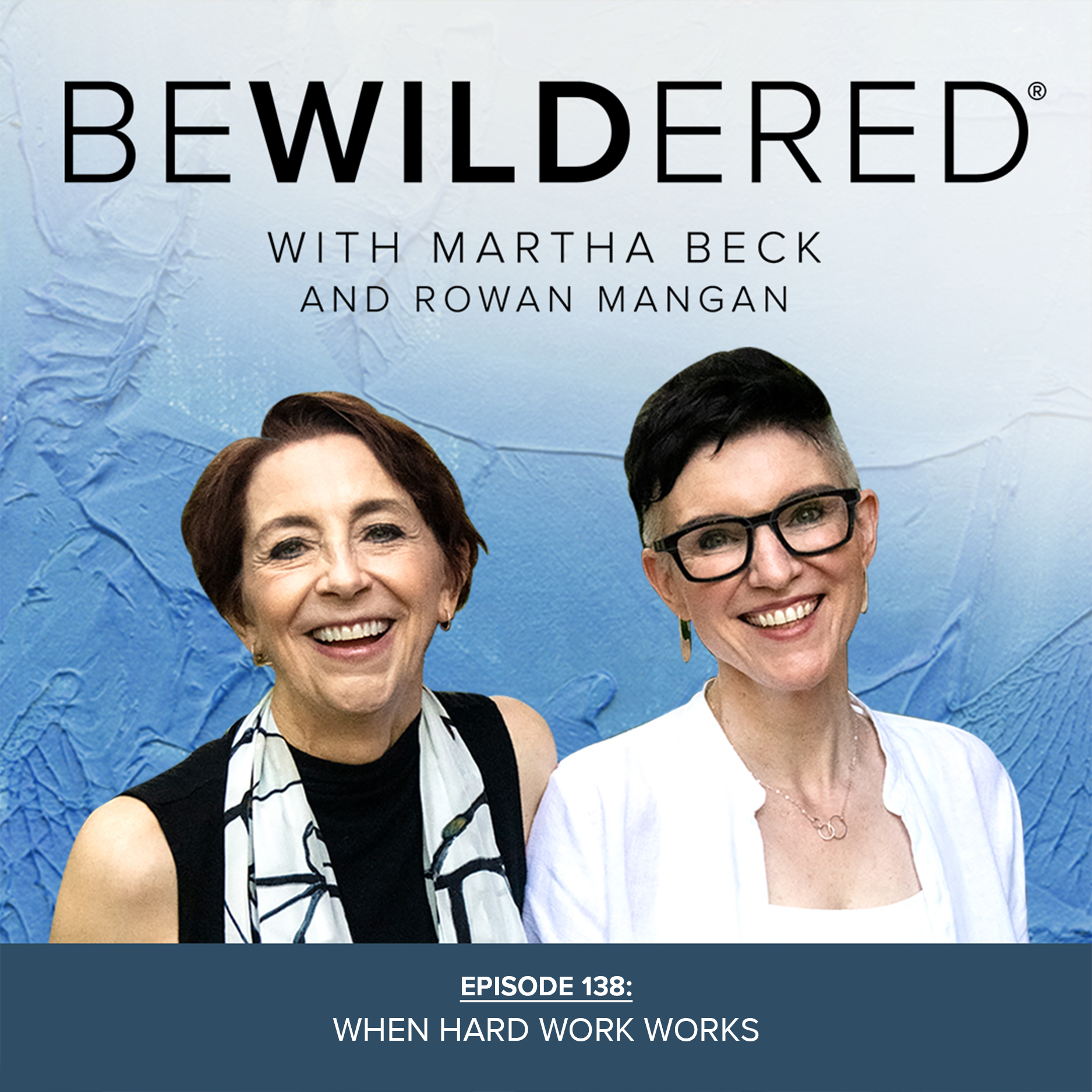
About this episode
Most of us would probably agree: We wish to work less, but not get paid less. Is that countercultural, or just common sense—or both? On this episode of Bewildered, we’re looking at the distinction between working hard for the culture and working hard for our own true nature—and how to tell if you’re spinning on a hamster wheel or actually getting some traction. We also talk about trust, chickens, and the difference between clumping as culture and clumping as community. Tune in and let’s figure it out!



When Hard Work Works
Show Notes
We wish to work less. Perhaps you’ve heard us mention this before? It seems to have come up in every podcast recently, as well as in our daily conversations at home. So this episode, we finally sat down to figure out: When is hard work actually taking us somewhere, and when are we just spinning our damn wheels to convince ourselves we’re busy?
Why Do We Work So Hard, Anyway?
Working less, but not getting paid less: It’s countercultural because the culture says, “In order to get paid same, must work same.” Right now Ro is deep in the long-term project of building systems for her work. But building the systems that will (hopefully) let her work less in the future is a lot of work right now.
That raises the scary question: Is she creating something that will free her up later, or just building a more complex machine that will take up even more of her time?
We talked about how we’re funny little human monkeys with funny little heads, and sometimes when we’re anxious, overworking is just a way to quell that anxiety. We live in a culture that teaches us, “Idle hands are the Devil’s workshop” and that hard work is its own reward. So the list of things to do just keeps getting longer—and if you’re a good person, apparently it should.
Martha shared a story from growing up Mormon about a boy who straightened bent nails from old fence posts for hours—even though the nails could never be used again—just because doing the task was considered a virtue in itself.
Culture Versus Nature
How do you know if the hard work you’re doing is driven by culture or by nature? Every predator that hunts in winter puts out a lot of energy to get food that will sustain it through the season. So hard work isn’t purely cultural, it’s natural too. But working yourself to death for no reason, like Boxer the horse in Animal Farm, is a cultural trope, not a natural one.
Ro brought in the perfect metaphor from the show Alone Australia: Participants spend their first, most crucial hours building their shelter before they even get food or rest. So the question for each of us becomes: Are we building a shelter, or are we building a factory machine that will need endless maintenance?
We decided that hard work solely for culture is a bad reason to do it, but hard work for nature—building something that genuinely serves your true self—is a good reason, even if it’s grueling.
The Distinction Between Culture and Community
Ro realized that the moment she starts worrying about creating more future work is exactly when she starts bringing humans into the system, instead of just systems upon systems. Humans, as we discuss, are “tricksy.” They’re not software—they don’t run on “If this, then this.”
As Terence McKenna put it, “One person in a room is one person. Two people is culture. Culture is the third guest at the table.” Ro’s brain went straight to a different word for the same phenomenon: community. Both are true, but they feel like two sides of a coin.
Martha shared her own experience of culture without community—the parasocial weirdness of being connected to Oprah, receiving huge, heavy, odd gifts in the mail that Martha was somehow meant to deliver to Oprah. She says it felt like being a deer surrounded by well-behaved but strangely watchful wolves.
Trust, Traction, and Running Up That Hill
The real test, we decided, is an internal sensation: traction versus slippage. When Ro reaches out to people she’s building community with and feels trust, her voice goes down at the end, instead of going up in an anxious high register. She has the calming sense that she’s tending something that will ultimately grow and flourish by itself.
Martha talked about her years-long “integrity cleanse,” where she told zero lies and registered people’s behavior as data over time. She noticed if they showed up when they said they would, or if they said things like “We care ‘til the check clears.”
Ro tied it together: Doing her current work, even when it’s hard, she feels like she has traction under her feet. She’s not going round and round on a hamster wheel; she’s running up a hill, gripping the ground as she goes.
Learning the Hard Way (Or the Joyful Way)
Martha closed with her own parallel experiment: trying to learn piano by switching from note-by-note sheet reading to learning chord structure. The moment she understood chords, everything changed. Instead of grueling “target practice,” it became a shiver of joy every time a chord resolved correctly.
This led us to James Carse’s idea of finite versus infinite games, and whether the difference between the hamster wheel and the traction hill is whether the work is a game you love playing.
If you’ve ever wondered whether your own to-do list is building you a future or just feeding your anxiety, join us for the full conversation. We’ll figure out how to keep running up that hill—because that’s how we stay wild.
Also in This Episode
- Ro contemplates what sounds are appropriate during a massage.
- Martha narrowly escapes a humiliating text-message disaster.
- Birthstone flipflops and blown-glass pheasants for Oprah
- The cognitive capabilities of deer: “That came out one day.”
- Für Elise, lion’s mane mushrooms, and a passel of youngins
- The sage advice: “Rub, rub your butt a long time.”
TALK TO US
You can follow us on our Instagram channel @bewilderedpodcast to connect with our Bewildered community, learn about upcoming episodes, and participate in callouts ahead of podcast taping.
And if you’re a Bewildered fan, would you consider giving us a little rate-and-review love on your favorite podcast player? Ratings and reviews are like gold in the podcasting universe—they help people find us, they help build this beautiful community, and most of all, they help us in our quest to Bewilder the world…
Episode Links and Quotes
- Bewildered episode 79: All the Way to Heaven Is Heaven
- Michael Pollan
- Animal Farm by George Orwell
- Roxane Gay
- Terence McKenna
- Bambi (Disney film)
- Byron Katie
- “Running Up That Hill” song by Kate Bush
- Finite and Infinite Games by James Carse
CONNECT WITH US
- Follow Martha on Instagram
- Follow Ro on Instagram
- Follow Bewildered on Instagram
- Join us in the Wilder Community!
- Listen on your favorite podcast app
- The Bewildered Show Notes
- Is there something you’ve been feeling bewildered about? If so, let us hear from you!
Transcript
Please note: This is an unedited transcript, provided as a courtesy, and reflects the actual conversation as closely as possible. Please forgive any typographical or grammatical errors.
Martha Beck:
Hi, I’m Martha Beck.
Rowan Mangan:
And I’m Rowan Mangan. And this is another episode of Bewildered, the podcast for people like you, like me, like her, who are trying to figure it out.
Martha Beck:
Yes, indeed. And today we’re talking about hard work. It’s a thing.
Rowan Mangan:
It’s a thing. I’ve been doing some of it lately and it worries me.
Martha Beck:
Yeah?
Rowan Mangan:
Yeah. I get worried that am I working hard to any end, or am I just spinning my damn wheels to tell myself I’m busy?
Martha Beck:
Right. Because we live in a culture that says work hard, it’s its own reward. Don’t ever stop, you loser, keep working harder. So how do you tell the difference between just working harder for no reason, and working hard because it’s going to get you somewhere good?
Rowan Mangan:
Yeah.
Martha Beck:
Because everything that is worth doing has a period of hard work, I think.
Rowan Mangan:
But then hopefully we get to the bit where it’s idle hands…
Martha Beck:
…are the devil’s workshop. That’s a whole ‘nother topic.
Rowan Mangan:
Let’s talk about it.
Martha Beck:
What are you trying to figure out?
Rowan Mangan:
Well, Marty, I had a massage.
Martha Beck:
Oh, and you’re still trying to figure it out. It’s confusing, isn’t it?
Rowan Mangan:
Yeah, it is. It wasn’t my most relaxing moment.
Martha Beck:
Okay.
Rowan Mangan:
I had a neck issue and a shoulder issue and I took myself off to be rubbed. And I always say that like, “Oh, I’m going to go to be rubbed,” because that’s what a massage is, you get rubbed. Sorry, massage for the Australians who don’t know what I’m talking about. Massage. So I went in there and I was like, “This is going to make me feel better.” So I was quite optimistic. And then the massage therapist said to me, “So what are we doing? How’s it going? What are we working on today?” And I don’t want to be like, “Do this and then do that,” because it’s a really nice thing to get rubbed by someone.
Martha Beck:
That’s true. There’s a weird sort of parasocial thing that you feel. Like do I have to marry you now? That kind of thing.
Rowan Mangan:
Well, it’s so funny you should say that. So I wanted to just express to her that anything she did would be great. And I may have said, “Please just do what you usually do and rub me into a state of bliss.”
Martha Beck:
Oh dear.
Rowan Mangan:
So that happened and I was like, I won’t say I thought about it the entire 90-minute massage, but I thought about it a lot. And I also have this people-pleasey thing in massages that I don’t know if you have this as well, where I wish to express to the massage therapist that they’re doing a good job.
Martha Beck:
Oh God. I know where this is going because it’s happened to me.
Rowan Mangan:
So you want to make a noise that suggests that it feels good, but in a very professional way. And there’s an art to this that I have spent way too much time thinking about on massage tables.
Martha Beck:
It’s awful that you have to think about it while naked too.
Rowan Mangan:
I never even thought about that.
Martha Beck:
You can’t even think clearly about how to relate to someone that you’ve just met when you are naked and they are not.
Rowan Mangan:
I didn’t even think about the fact that I was naked. I just thought about the fact that for some reason I didn’t understand when I first got a massage from my next door neighbor, but one, Mary, great massage. She started laughing every time I expressed my appreciation.
Martha Beck:
What exactly were you doing?
Rowan Mangan:
Because I think I was doing—okay, so here’s the thing. I think that the right way to non-verbally, vocally express your appreciation for your massage is you’ve got to make a noise that goes down at the end. If it goes up, it’s like ahhh?
Martha Beck:
Like a question.
Rowan Mangan:
Yeah. Or an exclamation.
Martha Beck:
I’m going to make that one. If I ever get another massage, I’m going to be going, “Oh! Boy howdy!”
Rowan Mangan:
Whereas to me, what I think is perfect is the kind of, like, it’s got to kind of almost be a grunt.
Martha Beck:
Well, yeah, but not—
Rowan Mangan:
But a grunt that’s just like, “I’m comfortable and relaxed, but not getting excited.”
Martha Beck:
Right, exactly.
Rowan Mangan:
So you kind of go down at the end. You’re like, “Mm. Mm.”
Martha Beck:
That’s kind of like eating a sandwich sort of a grunt.
Rowan Mangan:
But not like, “mmmm.”
Martha Beck:
No, no, you don’t do that.
Rowan Mangan:
So you got to put the little—
Martha Beck:
It is a razor’s edge you’re walking on there.
Rowan Mangan:
It’s a minefield.
Martha Beck:
It is.
Rowan Mangan:
It’s not very relaxing how much I have to think about this after I’d already said, “Please, will you do what you always do and rub me into a state of bliss?” And then she just looked at me, and I just looked at her and there was silence. And I didn’t know what to do because if I verbalized what I’d just done, then that would be out there. And if I didn’t, then we could just kind of pretend. But there was a very long silence where no one knew what to say because it wasn’t a little bit wrong. It was a lot wrong.
Martha Beck:
Yeah.
Rowan Mangan:
Yeah. So that happened and, uh…
Martha Beck:
Still trying to figure it out, I can tell.
Rowan Mangan:
I will be trying to figure that out until my…
Martha Beck:
You know, that’s kind of embarrassing.
Rowan Mangan:
What are you trying to figure out?
Martha Beck:
A related thing, and a really specifically related thing.
Rowan Mangan:
Oh yeah?
Martha Beck:
Yeah, yeah, yeah. Only way worse.
Rowan Mangan:
Ooh.
Martha Beck:
Way worse.
Rowan Mangan:
Oh, good. That will make me feel better.
Martha Beck:
So I have a friend who lives not terribly far from us, and I was very excited to move sort of into the same area because I’ve known her for years. She’s very esteemed, gracious. She’s a well-known person. And from time to time, she did invite me to go do retreats and things. She’s this classy, elegant lady who’s now I think in her mid-seventies and just gracious and courteous. So I’m going to go teach something for her later on this month. And we went for a walk. We arranged to go for a walk together in the morning. So she and I went for this walk. And I was kind of happy and jolly and hanging loose on our walk. So I was saying things that I did not realize were kind of maybe not landing exactly right with her.
Rowan Mangan:
Okay, like “Rub me into a state of bliss”?
Martha Beck:
Yeah, something like that. You’ll see. So I was talking about, “Yeah, I love watching near-death experiences online. I totally believe all that stuff.” She got quieter and quieter, and at the end she said, “You’re not going to be teaching this, right?” I was like, “I’ll take the temperature of the group, see how woo-woo they want to get.” She was very quiet and I’m thinking, “Oh God. I’ve overestimated her degrees of freedom for woo-woo silly behavior. I’ve got to clean this up.”
Rowan Mangan:
Right.
Martha Beck:
So I go home and later she sends me a long text, a beautiful long text with kind of a piece of an essay I think she’s written and it’s about how teaching can really lift an entire group of people into a different state. I’ll read the end of it to you. She said, “When someone else brings an atmosphere that is peaceful, kind, and openhearted, we all begin to feel more of that in ourselves. If the teacher is tuning the consciousness in the room to a higher frequency, then we all start vibrating to the same thing. And that’s the kind of community you feel blessed to experience.”
Rowan Mangan:
Beautiful.
Martha Beck:
Yes.
Rowan Mangan:
Spiritual, kind of grounded, earthy but inspirational.
Martha Beck:
Yeah. So I leave it open and I think I’ve got to write back something good. And then you and Karen came in, and we got settled to watch our nightly TV show.
Rowan Mangan:
Trinity Time.
Martha Beck:
Trinity Time. And you and I had been talking about our various aches and pains and the desire to go get massaged.
Rowan Mangan:
Right.
Martha Beck:
Yeah. So you’ve got to figure out the noise thing.
Rowan Mangan:
Oh right.
Martha Beck:
Okay. So we were talking about—and how when you get lower back pain, you just want someone to go in there and rub your glutes, but it’s embarrassing and it’s better that you get it at home or something. I don’t know what we said. Anyway, you know how sometimes your phone just spontaneously starts picking up what you’re saying and then it transcribes it into a text field?
Rowan Mangan:
Yeah. So it’s like you turn on voice to text.
Martha Beck:
Yeah. Only, it turns on without you knowing it.
Rowan Mangan:
Without you knowing it.
Martha Beck:
Yeah. And I’ll look down and there’ll be something that’s like, “Do we have peanut butter?” And it’s totally random and it’s non sequitur. It doesn’t always pick up everything you say and it makes assumptions and fills in the blanks. Now this is why I looked down at the text thing after TV.
Rowan Mangan:
So she had sent this long text about tuning the consciousness of the room.
Martha Beck:
This beautiful, the kind of community you feel blessed to experience and how the teacher brings this higher vibration. I looked down and I was within a hair’s breadth of pressing the little blue arrow and sending a text that came down from something I said during our conversation, bits of what I said during our conversation. I looked at it and got a shock through my entire system as if I had seen that it is a live scorpion.
Rowan Mangan:
Go on.
Martha Beck:
I managed to make myself take a screenshot before I cleared that because this is what I almost said to this woman when I was trying so hard to rebuild my reputation with her. It says this, “Darling girl, my beautiful beloved. Rub, rub your butt a long time. Rub, rub your butt a long time. Food like substance.” Oh, we were talking about nachos after that. “Food like substance. They taste like metal and they make me sick. They taste like metal and they make me sick. Sometimes I just need trash.” That was the text.
Rowan Mangan:
Just read that first part again.
Martha Beck:
Okay. “Darling girl.” Well, let me just say, you know how in texts, you don’t have the tone? You have to be careful because you never know what they’ll hear. So let me read it as she may have seen it.
Rowan Mangan:
Okay. Yes.
Martha Beck:
“Darling girl, my beautiful beloved. Rub, rub your butt long time. Food-like substance. They taste like metal. They make me sick. Sometimes I just need trash.”
Rowan Mangan:
Rub, rub your butt long time.
Martha Beck:
Rub, rub your butt long time.
Rowan Mangan:
So if you had been her, and you had sent the text about bringing the room to a higher frequency with the quality of your teaching and elevating the consciousness of all those who share space with you and she got “Rub, rub your butt long time…”
Martha Beck:
What I think is that, well, I showed it to Liz Gilbert, right? She was visiting and she said, “If you’d sent this, no matter what she responded, you would just write back in all caps, “I SAID WHAT I SAID.” Oh my God, her thing. “If the teacher is tuning to a higher frequency, then we all feel blessed to experience…”
Rowan Mangan:
“Rub, rub your butt.”
Martha Beck:
Long time. Long time. And make noises that go down.
Rowan Mangan:
But not too far down.
Martha Beck:
Yeah, no. So apparently we’ve both been having issues with massage and related topics, and we should probably just avoid not just massage itself, but all mention of it ever again.
Rowan Mangan:
In fairness, I think the problem is me.
Martha Beck:
Huh? Why?
Rowan Mangan:
Because it was my butt that you rub, rub long time.
Martha Beck:
That’s true. I was talking about rubbing it a long time, rub rubbing it.
Rowan Mangan:
Yeah.
Martha Beck:
And the food-like substance.
Rowan Mangan:
Yeah, that’s a Michael Pollan. That’s a Michael Pollanism.
Martha Beck:
A food-like substance?
Rowan Mangan:
Food-like substances are what he talks about as basically processed food isn’t food because it carries no nutrition.
Martha Beck:
Well, in this case, I think it implies, certainly, that the food-like substance is your buttocks.
Rowan Mangan:
Oh.
Martha Beck:
Yeah. They taste like metal.
Rowan Mangan:
They taste like metal.
Martha Beck:
And they make me sick, but sometimes I just need trash.
Rowan Mangan:
You just need trash. I hadn’t thought about it that deeply.
Martha Beck:
I have. I’ve thought about little else since.
Rowan Mangan:
I bet.
Martha Beck:
I never texted her back. I was so appalled that I just had frozen.
Rowan Mangan:
Right, because if you just tried to write, “Yes, the consciousness and the community, blessed, blessed we are,” what if it just came out and just started going, “Rub, rub, rub, rub”?
Martha Beck:
Yeah, it makes you think, you know how some things, there are certain relationships that you cannot get right and nothing ever comes out smoothly, it’s always awkward and strange?
Rowan Mangan:
Yes. I do know that.
Martha Beck:
This is one of those for me. And that one— something in the universe is trying to deeply sabotage my reputation with her, I believe.
Rowan Mangan:
You know how Roxanne Gay has a nemesis?
Martha Beck:
No.
Rowan Mangan:
Roxanne Gay has a nemesis, and everyone’s obsessed with her nemesis.
Martha Beck:
Really?
Rowan Mangan:
Because no one knows who it is.
Martha Beck:
Oh, really?
Rowan Mangan:
Yeah. And it’s really fun.
Martha Beck:
Who is it?
Rowan Mangan:
I don’t know.
Martha Beck:
You should.
Rowan Mangan:
One person guessed it right many years ago on Twitter.
Martha Beck:
Really?
Rowan Mangan:
Yeah. But anyway, I just feel like maybe this could be, what I’m saying is maybe this could be a regular bit that you do for the podcast, the travails of your textual relationship with this individual.
Martha Beck:
This one individual. Yeah. It’s getting pretty, it’s getting, I feel like I’m on a high wire with no net at this point. That thing almost—can you imagine if it sent?
Rowan Mangan:
I have, yeah.
Martha Beck:
I would have to leave the country. There’s just no other option. “Darling girl, my beautiful beloved, rub, rub your butt long time.”
Rowan Mangan:
It would be so great if there was some way to send it, have a camera on her when she received it, and then rewind time so that that didn’t happen, but you still got to see her face.
Martha Beck:
I love that. Let’s hold that for a different podcast. Let’s do that topic. Let’s invent that and then present it.
Rowan Mangan:
Love it.
Martha Beck:
Shouldn’t be hard.
Rowan Mangan:
Love it. Great. In the meantime, should we do a podcast today?
Martha Beck:
Oh, why not?
Rowan Mangan:
Hi there. I’m Ro, and I’ll be your podcaster for today. Do you know how to tip your podcaster? It’s actually pretty easy. You can rate our pod with lots of stars, all your stars. You can review it with your best superlatives. You can even subscribe or follow Bewildered so you’ll never miss an episode. Then of course, if you’re ready to go all in, our paid online community is called Wilder: A Sanctuary for the Bewildered. And I can honestly say it’s one of the few true sanctuaries online. You can go to wildercommunity.com to check it out. Rate, review, subscribe, join, and you all have a great day now.
Martha Beck:
What are we talking about today, Roey?
Rowan Mangan:
Well, Marty, I have a predicament.
Martha Beck:
Yes?
Rowan Mangan:
And I wish to discuss it on our podcast that we do for work.
Martha Beck:
For other people to listen to.
Rowan Mangan:
Yes.
Martha Beck:
Let’s talk about each other and ourselves.
Rowan Mangan:
Let us just talk about me, my minor problems, my life in general. Is that okay with you?
Martha Beck:
Works for me.
Rowan Mangan:
Fabulous. All right.
Martha Beck:
Now that we’ve lost everyone, let’s have a chat.
Rowan Mangan:
Let’s just have a chat. Okay. So here’s the deal. I wish to work less.
Martha Beck:
Ah.
Rowan Mangan:
Regular listeners will be aware of it.
Martha Beck:
Yeah. It seems to have come up recently in every podcast.
Rowan Mangan:
Every podcast, every conversation, every—
Martha Beck:
Yeah. Every morning.
Rowan Mangan:
Every morning.
Martha Beck:
Every dinner.
Rowan Mangan:
I wish to work less. Okay. And so I’m engaged in this long-term project, which is set up systems around our work. We are entrepreneurs. We run our own business, so there’s a lot of freedom in terms of designing our days, but I wish to—so here’s the tricky part.
Martha Beck:
Yeah?
Rowan Mangan:
I wish to work less, but not get paid less.
Martha Beck:
Ohhh.
Rowan Mangan:
Right? You have to follow the logic.
Martha Beck:
Oh, subtle. Subtle distinctions.
Rowan Mangan:
And it’s countercultural.
Martha Beck:
Oh, it is. Yes.
Rowan Mangan:
Because the culture says, and maybe the laws of physics, in fairness, say, “In order to get paid same, must work same.” But I say no, or at least maybe not.
Martha Beck:
Maybe not. It’s interesting because for the people at the top of the capitalist pyramid, the whole thing is “We work less because you work more.” But for those of us peons down in the lower realms of the economy, it’s definitely “Work more to earn more.”
Rowan Mangan:
Yeah. And so what I find myself in is a situation where I’m trying to design a system that will enable me to work less. In designing and building the system, I’m working a lot, right? So that’s the setup. Now, you and I have been having a lot of conversations in recent months about the tendency that we sometimes have as funny little human monkeys in our funny little heads that sometimes when you’re anxious, working and overworking is one of the ways that we make ourselves feel better and to quell our own anxiety, right? And so I’m in this situation, I’m working a lot, and it’s like I’m either working towards building something that will make me work less, or I’m working towards having a bigger, more complex machine, which will require commensurately larger amounts of my attention and time. And it’s really scary because there’s not really a reverse mode on this stuff that I’m doing.
And it’s like, shit, I don’t know which one of these two things I’m doing. Am I just creating more work to make myself feel better and to perpetuate the story that I won’t have to work as much later?
Martha Beck:
I don’t know. It reminds me, back in my day, it was, “I’m going to have me a passel of youngins to help on the farm,” but then with a passel of youngins, you have to work very hard for the rest of your life.
Rowan Mangan:
A what now?
Martha Beck:
A passel of youngins.
Rowan Mangan:
A passel o’ youngins.
Martha Beck:
Yeah. Sorry.
Rowan Mangan:
I liked their early work.
Martha Beck:
Good band. Yeah. I mean, I think in business it’s called “initial investment cost.” You have a high—
Rowan Mangan:
I think in anything it’s called that.
Martha Beck:
An initial investment. Yeah. But you set up a factory at huge cost, so the factory then mechanizes the production of huge amounts of stuff, and it doesn’t cost as much. But if you end up with a factory that has all kinds of bells and whistles you didn’t know you had to take care of all the time—I’m just riffing on a metaphor. Suppose you had to take care of the factory all the time, and the factory turned out to be an absolute monster to maintain, and you ended up building this thing that was churning out, I don’t know, toothpaste, but you were working harder than you’d ever worked to maintain the system that you had created to save you labor.
Rowan Mangan:
Yeah.
Martha Beck:
Am I getting this right?
Rowan Mangan:
Outlay. There’s a word.
Martha Beck:
There you go. Outlay.
Rowan Mangan:
Outlay. And so in my version, it’s not that I’m trying to make tons and tons more money. I’m just trying to make same money, less work. So the outlay is my energy and attention and whatever, labor, I guess.
Martha Beck:
So there are two issues.
Rowan Mangan:
Yes.
Martha Beck:
The first one is that we have a really strong cultural standard of thinking we have to be doing tasks all the time.
Rowan Mangan:
Yes.
Martha Beck:
Especially remunerative tasks, things that earn money. We’ve talked about this a zillion times because it is, let us face it, the monkey on the back of almost every person alive right now.
Rowan Mangan:
Yeah. And in some ways the opiate of the masses in this particular culture.
Martha Beck:
That’s the other thing is that because we’re taught that “idle hands are the devil’s workshop,” right, “Don’t you dare stop working,” because we’re taught that as a virtue, we feel more comfortable, less anxious when we’re actually doing some kind of task. And so the tendency to add tasks, add tasks, sometimes you say, “Is my list of things to do ever going to stop getting longer or am I just going to keep adding to it?
Rowan Mangan:
Right. This is it. Exactly.
Martha Beck:
Yeah. So there’s that, “Am I just addicted to listing things and then doing them because anything else makes me feel anxious?” I’m reminded, growing up, I don’t know if I’ve ever told you this, but I grew up Mormon.
Rowan Mangan:
What?
Martha Beck:
Yes. We would hear the stories—
Rowan Mangan:
That must have been intense.
Martha Beck:
It was. We would often hear the stories of the great leaders of the church and how they were brought up and stories about their childhoods. And there was one guy who was the prophet at a certain point, and he would come home from school every day, do his chores very quickly and efficiently because he was so good at it. And then his father had him go out and take nails out of old fence posts and then straighten the nails with a hammer and put them in a box. And he would spend hours doing this. Now, the point is, and we were told this point, they could never use the nails again. They were ruined by having been bent and then straightened out. He was just doing it to do it because doing it is a virtue.
Rowan Mangan:
And then he went on to get a job that proves to me that Mormonism is the ultimate American religion. Being a prophet should not be a promotion you can get. Being a prophet is kind of like something that happens or it doesn’t, right?
Martha Beck:
Well, you may think so.
Rowan Mangan:
But it just goes to show. “Well, I got the promotion, I’m now—”
Martha Beck:
The Lord was at work when he was straightening those nails so he could rise to the top of the world, not just the population there, but the world and make everybody straighten nails for no purpose because that is a virtue. Okay. So the first thing I’m talking about is that there’s this very strong “idle hands are the devil’s workshop”, work, work, work, work, work. You’re not good unless you work. So if your list keeps getting longer, at least you’re virtuous.”
Rowan Mangan:
Well, your list should keep getting longer.
Martha Beck:
Right. Yeah. If you’re a good person, it just gets longer. So the second thing is there is a rational reason for you to work more right now. So you’ve added to the list now because you genuinely think that a higher outlay of work now is going to result in less work for the same money later, correct?
Rowan Mangan:
Well, I think that I think it, but maybe I’m being hoodwinked.
Martha Beck:
Yes.
Rowan Mangan:
By the culture and my psyche.
Martha Beck:
And we all do that. I mean, there’s this whole thing about having children. I keep talking about the youngins, but it really is true.
Rowan Mangan:
They come in passals, I understand.
Martha Beck:
They come in passels.
Rowan Mangan:
How many in a passel?
Martha Beck:
Twenty.
Rowan Mangan:
Oof. Yeah. It’s quite a passel.
If you grow up Mormon, it’s nothing. I had ten passels myself. So here’s the thing. You put in a lot of work when your children are brand new. It is insane. Why do people ever have children? There’s plenty of us. Why do we keep doing this? Because it is criminally insane how much work it takes to raise a baby if it’s not a village, if it’s just like one woman or one couple.
One throuple.
Martha Beck:
Even a throuple. I mean, we’re hard pressed, right? But the whole idea, and I kept telling you this when Lila was little, this will go—the horrors last another about a year. Then the nightmare goes on between a year-and-a-half to three. Three to four is the demonic age. And then when they get to be five, they suddenly go, “I can speak in language and think in terms that are longer than the next 15 seconds.” And you’re like, “Okay, we have a pause here. They’re going to motor themselves. They can get their own clothes and stuff.” So we put in that—
Rowan Mangan:
Will they? That’s another question, but they can.
We put in that massive amount of work in the beginning because this tiny baby is going to grow up to be something that if it’s cared for well, will then learn to take care of itself. So there’s this whole thing about setting up objects so that they work better. Totally viable. The idea of setting up people, relationships, creatures so that they will—we’re doing it now with chickens. They’re running around. They have to go into their coop at night. Sometimes they do. Sometimes they run right out at the last minute and get locked out.
Sometimes they just wait at the door until it closes and then go [vocalizes chicken sounds].
Martha Beck:
And then we have to go out and save them from bears.
Rowan Mangan:
Ridiculous animals.
Martha Beck:
They have not laid a single egg because they are but children, although they are large, scratchy children. They’re passel. They’re adorable, but they haven’t done anything for us yet.
Rowan Mangan:
Marty, those chickens are content.
Martha Beck:
That’s true.
Rowan Mangan:
They’re part of my new chickenfluencer career.
Martha Beck:
All right. So anyway, we hope that on some glorious day, we will go out there and these sweet little idiots will have started producing eggs for no reason.
Rowan Mangan:
Yes. That is the plan.
Martha Beck:
Parenthetically, I used to think that animals were these, I would communicate with them and everything. And you see Bambi, the deer. Have you seen Bambi, the show, the Disney show?
Rowan Mangan:
I know the gist.
Martha Beck:
And the mother deer is like, “Bambi, go play with your friend Thumper. Your father was a mighty stack. I’m going to drink myself to death wondering where he is,” or whatever. That’s the way the deer mother talks. I see deer in the forest when I go for my walks, and they’ll be there with their beautiful little fawns. And you know what they say to me?
Rowan Mangan:
What?
Martha Beck:
“That came out one day.” They’re like, “That came out.” You walk around. I don’t know. “That come out, come out.”
Rowan Mangan:
“That come out one day.”
Martha Beck:
So none of these animals are rocket scientists, which means you have to, like, you created a coop, you created a career as a chicken influencer. You brought in bags of cedar chips.
Rowan Mangan:
Turns out those are toxic, by the way.
Martha Beck:
Of course they are. Everything’s toxic. These pants are giving me dementia right now. I’m not even kidding. I read online that these pants are going to give me dementia. I think it’s already happened. Okay. My point, and I do have one, is I’m hoping that the egg thing comes to pass, and all your carrying of toxic chips around is going to be time well spent. Okay. So what is the relationship between “I’m addicted to my list” and “I’m afraid my list is just going to generate more diabolical lists”?
Rowan Mangan:
So I wish to be free of the yoke of work, right?
Martha Beck:
“Yolk” as in chicken egg?
Rowan Mangan:
“Yoke” with a KE at the end.
Martha Beck:
Yes.
Rowan Mangan:
So that it’s a burden that I wish to put down to whatever extent is feasible. The culture says that’s bad.
Martha Beck:
Pretty much.
Rowan Mangan:
The culture says, “Don’t put that down. Don’t put that down until you’re too old to carry it anyway.”
Martha Beck:
That’s right.
Rowan Mangan:
So in trying to—I go in circles of how much… We talk about culture worms in the head, like a certain high-up government official who is known to have a worm in his brain.
Martha Beck:
I think they all do.
Rowan Mangan:
I think we all do—culture worms. And so it’s like when is the culture worm talking, and when is my inner true nature talking? That’s actually the whole point of this podcast.
Martha Beck:
Culture versus nature.
Rowan Mangan:
So, lucky I brought this along today for show and tell.
Martha Beck:
But you make an interesting point because usually we talk about this is what the culture has trained us to do and this is what we’ve been doing, but look, this is not making us happy. Wait, let us go seeking the natural sort of antithesis to this cultural theme and then maybe we’ll find our way back to our true selves. Yeah?
Rowan Mangan:
And as we walk along the path away from culture, I fear that culture is up ahead, hiding behind a tree, waiting to jump out and grab me all over again.
Martha Beck:
That’s another issue that we’re going to talk about when you’re properly medicated, honey. No, I hear what you’re saying. So my point was, in this case, what you’re talking about is you’re doing something, you’re heavily involved in the work of it. You’re overworking almost. You’re worried about overworking in the future, and you can’t tell whether it’s culture or nature.
Rowan Mangan:
That’s exactly right.
Martha Beck:
Because we could say, “Oh yeah, this culture says we should work and work and work. And that’s why I’m working and working.” But you’re saying, “No, maybe you work and work and work at something in nature like a baby and then it grows up and it’s less work in the future. Maybe that’s really why I’m doing this or maybe I’m just working myself to death.”
Rowan Mangan:
Alone Australia. Spend your first—this is actually the perfect metaphor. It’s always to be found—
Martha Beck:
I think we should tell them what Alone Australia is.
Rowan Mangan:
I’m getting there.
Martha Beck:
All right.
Rowan Mangan:
It’s always to be found in reality TV. Alone Australia, the show Alone, people are put alone in a place, Australia in this instance. Alone Australia, figure it out. It’s all there. The answer’s in the question. But here’s the thing, get there and you put a huge amount of energy into building your shelter before anything else, before you get food, before you lie down and relax.
Martha Beck:
That’s true.
Rowan Mangan:
So that is the metaphor I’m looking for is that, am I building a shelter, or am I building a factory machine?
Martha Beck:
Yeah, that has to be constantly…and it has to do partly with the way you go about building it because if you build something inexpertly, it’s going to take a lot more rebuilding.
Rowan Mangan:
Yes. And if I’m doing it expertly, it takes so much energy and mental energy and makes me so exhausted that it feels like I’m in the drudgery, but I suspect that I might not be. And I want to talk about how—I know we once did an episode called “All The Way to Heaven Is Heaven,” in which I don’t remember what we said, but I imagine it was something like, “If it’s supposed to feel good, it will feel good all the way.” I don’t think that’s what we said. I doubt it.
Martha Beck:
I think we said something close to that, but I don’t think it was quite that simplistic.
Rowan Mangan:
No. And so I want to sort of say sometimes it is a bit drudgerous in the getting towards the “idle hands that are the devil’s workshop,” which I love and that’s where I want to live.
Martha Beck:
Yeah, sometimes you can work yourself to death because you’re being forced to do it on the hamster wheel of some corporate ladder that goes to nowhere—nowhere satisfying. And so you’re working yourself to death for no reason. And other times it is really worth working yourself half to death to get the shelter built before the weather comes in. So there is this period of working yourself hard, and I’ve seen it with entrepreneurs of both genders or all genders trying to build their empire, build their little business, whatever it is. I work with a lot of entrepreneurs. I’ve seen it with parents wanting to put a lot into children’s early years so they can have functional children going up later, people really focusing on their health so that they—so anyway, what I’m saying is this dilemma comes up over and over whenever you set out to construct anything that is useful in the long term or that will make things easier for you in the long term.
Rowan Mangan:
The initial outlay in order to get the long-term success.
Martha Beck:
And that is nature because every animal that goes out to hunt in the winter, any predator that goes out to hunt has to put out a lot of energy to try to get the food that’s going to make them able to function for the rest of the winter. So this isn’t a cultural phenomenon. Working yourself hard is not just a cultural phenomenon. It’s part of nature.
Rowan Mangan:
Yes.
Martha Beck:
But working yourself hard is also a cultural trope that is absurdly like Boxer the horse in Animal Farm, working himself to death for no reason.
Rowan Mangan:
Yes. God, yes. Thank you.
Martha Beck:
The straightening of the nails for no particular purpose, that is a virtue. No, it isn’t. That’s idiocy. Excuse me, Mormons. Yeah. So this is our task now: to parse out how can we tell if our decision to work very, very hard is based on a cultural driver or on a natural, useful, helpful reality of some kind.
Rowan Mangan:
Are we coming to consensus with the culture or are we coming to our senses with our nature?
Martha Beck:
That’s a very good question and I think we should answer it right after this.
Rowan Mangan:
So I don’t know. Am I doing too much in the service of culture? Am I doing too much in the service of my own true nature?
Martha Beck:
Which would be just enough. If you’re doing it in the service of your own true nature, it’s enough. I know people have gone on hundred-day meditation retreats in the best interest of their true nature. Grueling work. Totally worth it.
Rowan Mangan:
Yeah.
Martha Beck:
All right. Here we have hard work for culture: bad reason. Hard work for nature: good reason.
Rowan Mangan:
“That came out one day.”
Martha Beck:
“That came out. I don’t know. Don’t have a clue.” So, when you get to these kinds of questions where you can’t tell one from the other—what are you laughing about?
Rowan Mangan:
“That came out one day.”
Martha Beck:
That’s what you say about Lila sometimes in the morning. “That came out one day.”
Rowan Mangan:
“That came out one day. I don’t have a clue.”
Martha Beck:
Anyway, you slow it down and you start to look at it, observe it much more closely. This is what actually happens in meditation that you slow down every process and you start to examine its components with a lot of leisure, like you have a whole hour or two hours or whatever it is just to watch how something feels to you. And it actually, at first it spins a lot, at least it did for me. And then it started to slow and then it’s kind of like mud subsiding and the truth emerging into clear water. It’s like, oh, that feels terrible and that feels better. But when you’re in the daily grind, when you’re exhausted and harried and busy and you’ve got a million things, it’s hard. So first of all, let me just say that. The culture has made it hard for us to parse this because I think that’s in the culture’s best interest to keep us unable to know what is nourishing us and what’s depleting us. All right. But what I want to do right now with you, because you’re in it, is use nature’s forms of observation, stillness, careful attention and introception. Instead of just saying, “What are the variables? What am I being told?” You go inside and go, “All right, what do I actually experience here? What do I feel?” Let’s just do it, okay? So first you take a minute and get still, as still as you can. Now you think you’re working super hard. You are. I’ve seen it. I see it as I wander by going, “Maybe I’ll learn to play the piano. I don’t know. I’m working less hard than I’ve ever worked.” Okay. But you’re up to your elbows in everything. And in the midst of this, you don’t know if it’s going to work out. It sounds like you have a fear that you’re just building more tasks into your life for the future.
Rowan Mangan:
Yes, definitely.
Martha Beck:
All right. So go to something that, and this is for all our folks out there who have this same issue, you’re working yourself to death and you’re not sure why. Go to a time when you’re doing a task and this thought comes up, “Am I just doing this? Is this just going to make it worse for the future?” Can you find a time when that worry comes up?
Rowan Mangan:
Yep.
Martha Beck:
All right. Now, without being too specific, because nobody—
Rowan Mangan:
Nobody cares.
Martha Beck:
Nobody cares. No one’s interested, frankly. What are you doing when that thought arises in you? This uneasy, “Ehh, I don’t know.”
Rowan Mangan:
It’s interesting because I just realized that what I’m doing is bringing humans into the system. That’s when I get worried.
Martha Beck:
Oh.
Rowan Mangan:
Instead of just systems upon systems, like creating something in a software situation or even a hardware situation. Now I’m bringing more humans on board and suddenly it’s like this is a very unknown quantity. Humans have been known to be very time consuming. “That came out one day and was time consuming.”
Martha Beck:
You’re making a really solid point because you know what other humans are called in a collective group?
Rowan Mangan:
Passel.
Martha Beck:
Culture. Only if there are 20, and they came out one day. Yeah. When you start working with human beings, you’re working in a culture defacto, right? You can’t help it. As Terrence McKenna says, “One person in a room is one person. Two people is culture. Culture is the third guest at the table.” What?
Rowan Mangan:
I just blew my own mind.
Martha Beck:
Why? How?
Rowan Mangan:
Because you said, “What’s that called? It’s called culture.” And my brain said, “What’s that called? It’s called community.” And both are true, but boy, oh boy, they’re like two sides of a coin that feel completely different.
Martha Beck:
Wow. This is blowing my mind too, for very specific reasons.
Rowan Mangan:
Tell me them.
Martha Beck:
Okay. So I was reading over some of my journals the other day. I haven’t kept a journal for a long time, but I used to keep a lot of them and there were a whole bunch of them. And someone was asking me about looking in my old journals. So I looked at them and I looked at one. I have them back to when I was in my teens, right? So I talk about this and that, I complain a great deal in my journals. Then it goes through my 20s and my 30s and I’m having rough times and life is difficult. And then my dreams began to come true and the books that I wrote went onto the New York Times bestseller list—briefly, but there they were. And I started writing in my journal about how no one treated me normally anymore. I was in a culture, but I was not in a community.
Rowan Mangan:
Right.
Martha Beck:
It felt dangerous. It didn’t feel like I was with other deer going, “That came out one day.” It felt like, “Oh, I’m a deer and some of these are coyotes and some of them are wolves and they seem very intelligent and well-behaved, but they look at me strangely.” And that was a culture without community, and I kind of, for two decades almost, just became more and more isolated and just wanted to go into the woods. That was the cultural trope that drove me out of culture, was this weird parasocial thing where people think they know who you are because they’ve read your books. Even more importantly, they think you’re somehow a connection. Because I worked for the Oprah Magazine and I was on the show a few times. It was like in that day, if you could get to Oprah, your fortune was made. So people would show up with proposals for me. “I know karate. You know Oprah. Bada bing, we’re rich.” What? And it happened all the time. Huge, weird gifts arriving in the mail. “I’ve sent you 23 of the flip-flops I made with my daughter’s birthstone in them. Send them to Oprah.”
Rowan Mangan:
Send them to Oprah.
Martha Beck:
Oh, it was always stipulated.
Rowan Mangan:
Can I just say that a lot of those things that those people invented that they needed to get to Oprah were known for being extremely heavy? Like, “Oprah will love it. It’s so heavy. Here’s three.”
Martha Beck:
I know.
Rowan Mangan:
“Take them to her. Or just take them around in case you bump into her.”
Martha Beck:
“I would like to present you with this blown-glass, life-size pheasant for you to take in your carry-on luggage.” Oh, that’s not a problem. It was very weird. It was very weird, but I came to think after a couple decades that that was just everything in culture. And because I’d lost community somehow. It didn’t help that I abandoned my entire culture of origin. So I didn’t have anything from my childhood or teens and then nothing after I was 30. So it was just a weird existence.
Rowan Mangan:
Right. So there’s two ways that humans clump. I mean, there are infinite numbers of ways that humans clump. “Rub, rub your butt long time.”
Martha Beck:
Or if you clump correctly, you make just the right grunt.
Rowan Mangan:
“That was a clump grunt. Can you tell? Rub, rub, rub.”
Martha Beck:
What? There are two clumps.
Rowan Mangan:
Don’t you “what” me as though you were being on topic and I wasn’t.
Martha Beck:
Always.
Rowan Mangan:
You were off topic.
Martha Beck:
Always. How do people clump?
Rowan Mangan:
They clump as culture and they clump as community. And this is so exciting to me to feel this distinction because it is a feeling and you were saying go inward. And what I feel is yes, when you bring humans, when you bring the organic into a system that’s running on inorganic, in this case, we’re talking about an online community running on software and then bringing more people into doing stuff with it. And it’s like, yeah, automatic X factor. Who knows? Humans are tricksy, right?
Martha Beck:
Interesting.
Rowan Mangan:
They’re tricksy. They’re not going to be this automation “if this, then this,” right? That’s not how they work.
Martha Beck:
They’re not software.
Rowan Mangan:
But in recognizing that what I’m dealing with, the humans I’m dealing with are a community, I suddenly realize that I’m not running on a hamster wheel in my tasks upon tasks. I’m running on a hill. “I’m running up that hill.”
Martha Beck:
Really?
Rowan Mangan:
Yeah. I’ve got traction under my feet. I can grip this ground. So yeah, I’m working really hard, but I’m getting somewhere because the context that I’m moving through is community centered rather than culturally centered. And I’m meaning those words in the very ways that we’re talking about them here.
Martha Beck:
Right, but I think we have to sort of define them.
Rowan Mangan:
Let us define our terms.
Martha Beck:
Let us define them.
Rowan Mangan:
Okay. All right. Nasty people: culture. We don’t like them. Nice people: community. That’s great. Anything to add?
Martha Beck:
I think you’ve said it all. Close down sociology.
Rowan Mangan:
What about that song where it’s like, “You say it best when you say nothing at all.” I feel like that’s not the nicest song you could sing to your lover.
Martha Beck:
Probably. Is that what you’re singing it to me right now?
Rowan Mangan:
You were sort of singing it to me a minute ago.
Martha Beck:
Sorry, baby. Okay. So the thing is, I would still ask the question, how do you know the difference between community the way you’ve defined it—yes, yes, love, love—and culture, the way I was experiencing it as in, “Oh yes, yes, love, love. I want, I want.” Actually, there’s a phrase from Byron Katie, one of my favorite poet laureates of the podcast that I think gets toward that. She once said, “Personalities don’t love. They want something.” And here’s what I think. If you are setting up—so machines let us grant that if you set up a really good machine and it’s working really well and you put a lot into making it a perfectly designed machine, it will work well and it will do things for you. And that’s relatively rationally consistent. We can go, “Okay. Yeah. If you make the machine, it will work.” But when you throw people in the mix, what you could be doing, what I think was happening around the whole Oprah juggernaut when the Oprah show was huge is that people, when you set them up with a lot of investment of money, time, love, attention, sometimes instead of saying, “That was delicious. I’m going to live my own life,” they say, “Oh good, you’re my source for everything.” And it’s very likely that people go there in our culture because this culture infantilizes everyone. Don’t question why you have—like, what is an office job? You go and you do your chores, you’re not sure why. The parents, your middle managers or your top managers who drive you crazy and you hate them, but you have to obey them because they control everything, they will give you your allowance if you do the tasks assigned, but nobody really likes each other. So there’s that whole thing. So humans are very, very, in this culture, are very geared toward becoming infantile. And then if you give them something, they don’t think, “Oh, that’s how to work for myself.” They say, “Oh, you’re the answer then. Give me more.” And sometimes it gets like—
Rowan Mangan:
This is so interesting.
Martha Beck:
What?
Rowan Mangan:
There’s two words that come into my mind. One is hope. When you are presented with a group of people, you hope to get something from them.
Martha Beck:
Okay.
Rowan Mangan:
Right. “I hope that if I give you this glass pheasant, you will give it to Oprah and then my dreams will come true somehow.”
Martha Beck:
Somehow.
Rowan Mangan:
And the energy of hope is quite a [vocalizes]
Martha Beck:
Okay.
Rowan Mangan:
Right. And one of the people that I reached out to recently wrote back and said, “Thank you for trusting me to do this.” And I think that’s what it is. That’s where, to me, for the sake of this conversation, a group that is culture and a group that is community are different, is that I would hope that something would happen in the culture. And that’s the feeling of the wheel spinning, the hamster wheel, right?
Martha Beck:
Okay.
Rowan Mangan:
Here, when I’m doing this, I do feel a sense of trust, and that is my boots are gripping the ground as I’m running.
Martha Beck:
Okay. So we’ve talked about the different types, but what we’re actually zeroing in on is an internal sensation of the difference between, “I hope these people are okay” and “I trust that these people that are a part of the work I’m doing now”—whatever your work is, family, company, anything—”I trust that the direction I’m going in now will create community, not just avarice, not just a pyramid-shaped clot of people climbing over each other to get to the top. So that sensation of trusting, this is what strikes me when you say that. I think there is an incredibly subtle instrument inside our psyche somewhere, our bodies, our minds, that knows when we can trust and knows when we shouldn’t trust. And it’s incredibly subtle, and it can’t predict the future maybe, but when I look back on the relationships that formed that were sort of parasocial for me because people clearly wanted something from me that had nothing to do with whether they even knew who I was, they just knew that I was a link to Oprah— which I was not, by the way. Just lost all our listeners right there. Okay. So part of me could feel the no traction of it. Traction is a really, really good word for it, the way it feels inside my body.
When you sit down with somebody who’s, “Yeah, oh my God, aren’t we such good friends?” Because there was a lot of that in the sort of wellness community. “I love your work. I love yours too.” And sometimes I could feel the manic quality of it and inside there was no traction. I used to use the word “slippage” to describe it.
Rowan Mangan:
Yeah, I was just going to say “slippery.” It’s a slippery sensation.
Martha Beck:
Yeah, and then other times I would talk to somebody that I thought was in that vein. This is how I met Liz at an Oprah thing, and it just felt like traction. It just felt like, “Oh, that’s real. That’s real.” And it was very rare for me to feel that in those days. So it’s interesting to look back on it and now go, “All right, let’s see how this applies.” Actually, when you came into my life, right around that time was when I went on my integrity cleanse. I’ve been on many in my life. This means I don’t lie at all for a year at a time or two years or whatever it is. And yeah, I decided not to tell a lie for another—well, I’m kind of still on it, even though I slip a lot now, but for five, six, seven, 10 years, I really, really, really was obsessively honest inside myself, around, and it was because I did not trust anything anymore, nothing. And I’d gotten cynical and jaded about anything human. I was only interested in animals and objects. And what happened is another cycle of a bunch of people leaving my life very quickly.
And now that I look back, there was slippage in all those relationships. They just were sort of convenient, and everyone was very enthusiastic on the surface. So I wonder if everybody, if you go back over your memories, and I know you don’t like this method, I always go back through my own life and parse things and look at it. What, when you’re working hard, felt like traction and what felt like treadmill? What was climbing the hill and what was the treadmill just going nowhere for the same amount of work?
Rowan Mangan:
It reminds me a lot of when you’re trying not to sound sexually aroused during a massage, and it’s all about does the voice go up at the end or does the voice go down at the end? So where I feel like there’s traction, where there’s a spirit of community, where there’s a sense that I am tending something that is going to grow and flourish by itself, ultimately, my voice goes down at the end.
Martha Beck:
Oh, interesting.
Rowan Mangan:
What you’re talking about, the, “Oprah, hi. I hope this is going to work.” It goes up. And so as I look at it, and it’s so interesting that really the bit where it became unknown to me or it felt unknown to me was when it went into the human space where I too have had a lot of different sorts of experiences. Then suddenly part of my brain went, “You don’t know how much work this is going to be.” But in having this conversation with you, what I’m realizing is that I do know that I can trust these people because these people are community. They are my community. They are not my infantilized little creatures running around. They’re not underlings in any way. They’re my community. So we’re in this economy of offering joyfully, receiving gratefully, and my voice goes down at the end in a kind of grunt.
Martha Beck:
“Rub, rub your butt a long time, and that’s how I know you’re my community.”
Rowan Mangan:
Please, someone, quote that out of context.
Martha Beck:
Okay. I want to play devil’s advocate for a minute because my hands are idle and idle hands are the devil’s advocate. Sorry. We can say, and I’m totally with you, this community we have is just like right from the beginning I was like, “My friends!” It didn’t feel like the slippage community or culture. It felt like real people, but anyone could join for any reason. So let’s say there’s somebody out there who has decided that somehow this is the path to getting what they want, and they join up with very culture-like expectations. How would you know? Would it stay this yummy, delightful traction feeling, or are you glossing over the fact that everybody’s different?
Rowan Mangan:
Well, in this, it’s tricky because you’re asking me to universalize something that was a specific experience, which was that I reached out to certain people to ask them for something and I felt trust towards them.
Martha Beck:
Oh, okay. I thought you were just talking about anybody who is connected to this, you totally trust them.
Rowan Mangan:
No, no. I’m talking about within the wider community, the people that I’ve been approaching around this are people that when I actually authorize my knowing, I do trust because they are community in a larger, truer, more organic sense than just being able to join a membership.
Martha Beck:
Interesting. The word trust, I want to go back to it because I literally remember a time when I would think, “I don’t trust these people, but I’m going to trust them anyway.”
Rowan Mangan:
Oh, wow.
Martha Beck:
Yeah. I mean, how can I say this without incriminating myself? There were times when I worked with people that I though were quite corrupt, and I could tell. They would talk about, I remember one woman saying, and very much in the wellness space, I remember her saying, “Yeah, we care till the check clears.” And I was like, “What?”
Rowan Mangan:
Wow.
Martha Beck:
And so many times people told me—
Rowan Mangan:
“Just use a credit card.”
Martha Beck:
Let’s talk, yeah. I remember people saying, “Yeah, we can talk about how to make people happy, but we’re really here to sell books.” And I was like, “No, I’m here to make people happy.” If I had to choose one or the other, I genuinely would take, “Make them happy” and I turned down a lot of gigs and things because it was all like, “We’re really here to move some units.” No, that wasn’t what it was about, but I didn’t know that there were people you could trust. I really didn’t. Lost my whole childhood. Never been close to anybody in my adult life except the few people I was working with, and I was having a passel of youngins and so it was really an isolating life. And it strikes me now that I thought you were doing that. You were trusting people without knowing you could trust them.
And this is what I’m trying to get to. When you feel the sense of traction, when you feel the sense of “This is real, this is progress,” even if it’s very hard work, it’s taking me somewhere I want to go. It’s not a treadmill that just keeps speeding up.
And when you bring people into it and there’s a cultural component, you say, “All right, this is working. The traction is that I feel I can trust these people.” Now it’s time to bring in your scientific observation and see if, for example, they show up when they say they’ll show up, or they say things like, “We care till the check clears.” You watch the evidence of it, and then you adjust. Are these people acting in integrity? That was my big question on my integrity cleanse. I went to absolute integrity for myself as closely, I was actually wound so tight for a few years because I was like, “Oh my God, I ate an extra string bean. That wasn’t integrity.” I was parsing hairs with I had to be absolutely honest with everything. I was desperate for honesty. And so then when people weren’t honest, I would register it as data and say, “Okay, I initially trusted this person. Now I’m going to trust them less. I initially didn’t trust this person, but look, they keep showing up. I’m going to trust them more.” So the internal feeling, the qualitative feeling of “I feel like I can trust people” has to match. The math has to work. The data on the outside also has to work over time. Am I—?
Rowan Mangan:
Yeah, no, no, it does. That’s true. And I think, I almost feel like there’s a whole other conversation here about relationships and trust that would be fun to explore. But I think in realizing that it was the peopley bit that had made my brain think, “Oh shit, I might be just creating more work for myself,” it’s so interesting watching, trying to dig through the layers of our own bullshit. But recognizing that when I’m working on this thing that I’m trying to get off the ground so that I can have my devil’s workshop and my idle hands, that I’m gripping the ground underneath my feet. That’s the only way I can think to describe it. Or you’re climbing something and you can find the rough spots that your hand can grip if you’re climbing a rock face or something. And so in relationship with people, that feels like trust, which has that same sort of low center of gravity, earthy, grounded sense and not this up high in the head and up in the high register, which feels manic and unsafe in some ways. But I think there’s a quality that you can almost kind of draw out even when it’s not specifically about relationship. So there’s a quality to. I mean, Drew and I had this conversation about work and piecing together a kind of portfolio career and everything and all the uncertainties of that. And I think when you’re approaching work, if for me, okay, out of this conversation, remembering to look for, “Am I running on a hamster wheel or am I running up that hill?” Thank you, Kate Bush. “Am I getting somewhere?” If I ask myself that, I actually find that I know.
Martha Beck:
You know what? Yeah, yeah. You know what it reminds me of? I was joking a minute ago about “Maybe I’ll learn to play the piano,” but I actually have been thinking that because I heard that if you take lion’s mane mushroom, it increases your ability to remember and learn. So I’m just doing an experiment to see if I take this mushroom, can I learn to play the piano the way a child can? It has yet to be seen. But here’s the deal. I have tried doing the, I am reading music, I have what, “Für Elise” by Beethoven is up here and I have to learn that that line or that space means that key on the piano and then I have to hit them in order. And it’s like doing target practice with your fingers. You look at the target with your eyes and then all 10 fingers have to hit the right targets.
And it’s grueling and progress is very slow. But then I thought, “Okay, well, I’m going to try just doing this thing because I’ve heard about it all my life” that if you just know chords, you can kind of improvise a lot of stuff if you practice enough. So I thought, “Ah, this is the thing to try to practice to see if I can learn like a child.” And so I started going to online YouTube videos. And as soon as I started understanding what chord structure was, I could feel everything change. I could feel my brain just gulping down chunks of useful information and having it. The body still has to learn. But it’s exactly what you said. The grip on the ground just got incredibly exhilarating. Before it was just like, “Oh, target practice, target, practice, this is really hard.” And then it was like, “Oh wait, I can just learn the shape of a chord and put it anywhere on the piano?” It was just like a huge leap up the hill. Now, I’m never going to be a great pianist, but—
Rowan Mangan:
Not with that attitude.
Martha Beck:
Not with this attitude. But I think that’s what, I think I was learning in a way that is very much culture, like the whole left-hemisphere culture of “Read things on pages and replicate them in the real world.”
Rowan Mangan:
Yes.
Martha Beck:
That’s the way I was initially learning piano. And everyone online says, “If you learned this way and you hate it, that’s because your teachers learned that way and they hated it too. You want to know how Mozart did it? He understood chord structure.” Now people are going to be mad at me because I know, just don’t bother me. There’s a whole argument. “Mozart didn’t use chords.” Nevermind.
Rowan Mangan:
No one cares.
Martha Beck:
No one cares except for these rabid foaming-at-the-mouth people on the internet.
Rowan Mangan:
They’re on YouTube with the pianos. It’s okay.
Martha Beck:
That’s true. They’re not going to hurt us. They’re not going to hurt us. Are they?
Rowan Mangan:
No.
Martha Beck:
“Rub rub your butt long time”.
Rowan Mangan:
Well, they might hurt you.
Martha Beck:
So what is my point? My point is—
Rowan Mangan:
It’s really hard to say.
Martha Beck:
The point is that when you’re learning by not reading music so much, there are two things you have to do that you don’t do as much the other way. And one is to sing. If you sing the notes as you play them and sing the names of the keys as you play them, your brain just learns it faster.
Rowan Mangan:
That’s so cool.
Martha Beck:
And the second thing is to listen. So instead of looking at the sheet and fumbling for the thing, all you’re doing is listening to the song, you can feel where it wants to go. And so you become intensely focused in the moment, and then this kind of a hushed obsessive attention to what sound wants to come next.
Rowan Mangan:
Cool.
Martha Beck:
And it’s very, very sort of alive. So your eyes are working, your voice is working. It’s very much for me like tracking animals out in the forest or in Africa or whatever. Presence, attention, exhilaration, joy, hard, hard work. And I don’t know, they say, “You try it this way. In three years, you’ll be as good as a. pro.” No, I won’t, but—
Rowan Mangan:
Not with that attitude.
Martha Beck:
Not with that attitude. But I’m willing to put in lots of time because I feel it. I feel the traction. And that’s exhilarating even though it’s hard.
Rowan Mangan:
Yeah. It’s almost like to some extent that can be an end in itself.
Martha Beck:
Yes, it is.
Rowan Mangan:
It’s the feeling of progress, and not progress that the culture has defined out here. I was thinking about you playing the piano the other way, the target-practice way. And I did classical guitar for a while, and my inner monologue playing classical guitar is “Don’t fuck it up, don’t fuck it up, don’t fuck it up, don’t fuck it up.” And I just love this idea that progress is the feeling of moving forward. It’s not hitting the KPI or meeting the arbitrary external cultural marker, but it’s just the feeling of moving across a landscape.
Martha Beck:
There’s a whole topic that I want to do as a separate podcast topic called Finite and Infinite Games by this philosopher named James Carse. And it talks about how all our cultural games are finite. Football players want to play a football game so that they can look back and say, “We won it.” And he said when he played football in high school, he hated it because the tension of “Don’t fuck it up. Don’t fuck it up.” And then, “Oh, please let’s get this over with and let’s win. And then we can hang on to that. Oh, but here comes another game. Oh no, don’t fuck it up.” So it’s this constant stress. And then he looked back to playing a softball game as a child in his neighborhood, this weird softball game where they would change the rules just to keep the game going. And the whole object—he called it the infinite game—the object of it was to play. And I will tell you that I do these stupid chord exercises and when I hear the chord resolve, I just get this shiver of joy through my whole being. I don’t give a crap if I can ever—one of my stipulations is I don’t play in front of people. But oh my God, the feeling of that one step up the hill is so beautiful. And that’s why I did it as an experiment with the mushroom thing. Now I’m doing it because of the shiver I get when a chord resolves correctly.
Rowan Mangan:
Cool.
Martha Beck:
Yeah. And I think you’re doing the same thing with the community, do you think?
Rowan Mangan:
Yeah, I do. I think we keep running up that hill and that’s how we…
Martha Beck and Rowan Mangan:
Stay wild.
Rowan Mangan:
Thanks for being a Bewildered listener. I want to take a moment to formally invite you to join our online community, Wilder, which is where Marty and I go when we need to come to our senses. Wilder is the best place in the world to connect with other people who are trying to live by their true nature and not by the culture. Find us at wildercommunity.com. Meanwhile, Bewildered podcast is recorded at Upstate Podcast Studio. It’s edited by Scott Forster and only exists because of the incredible team at Martha Beck Inc. Please rate us, review us, join the Wilder community, and don’t forget, stay wild.
We’re also on Instagram. Our handle is @bewilderedpodcast. You can follow us to get updates, hear funny snippets and outtakes, and chat with other fans of the show.
For more of us, Martha’s on Instagram, themarthabeck. She’s on Facebook, The Martha Beck, and she’s on Twitter, marthabeck. Her website is, MarthaBeck.com. And me, I too am on Instagram. Rowan_Mangan. I’m on Facebook as Rowan Mangan. And I’m on Twitter as RowanMangan. Bewildered is produced by Scott Forster with support from the brilliant team at MBI.
Read more
Questions? Comments? Trying to figure something out? Email us! [email protected]
Credits
Wandering The Path by Punch Deck | https://soundcloud.com/punch-deck
Music promoted by https://www.free-stock-music.com
Creative Commons Attribution 3.0 Unported License



0 comments