

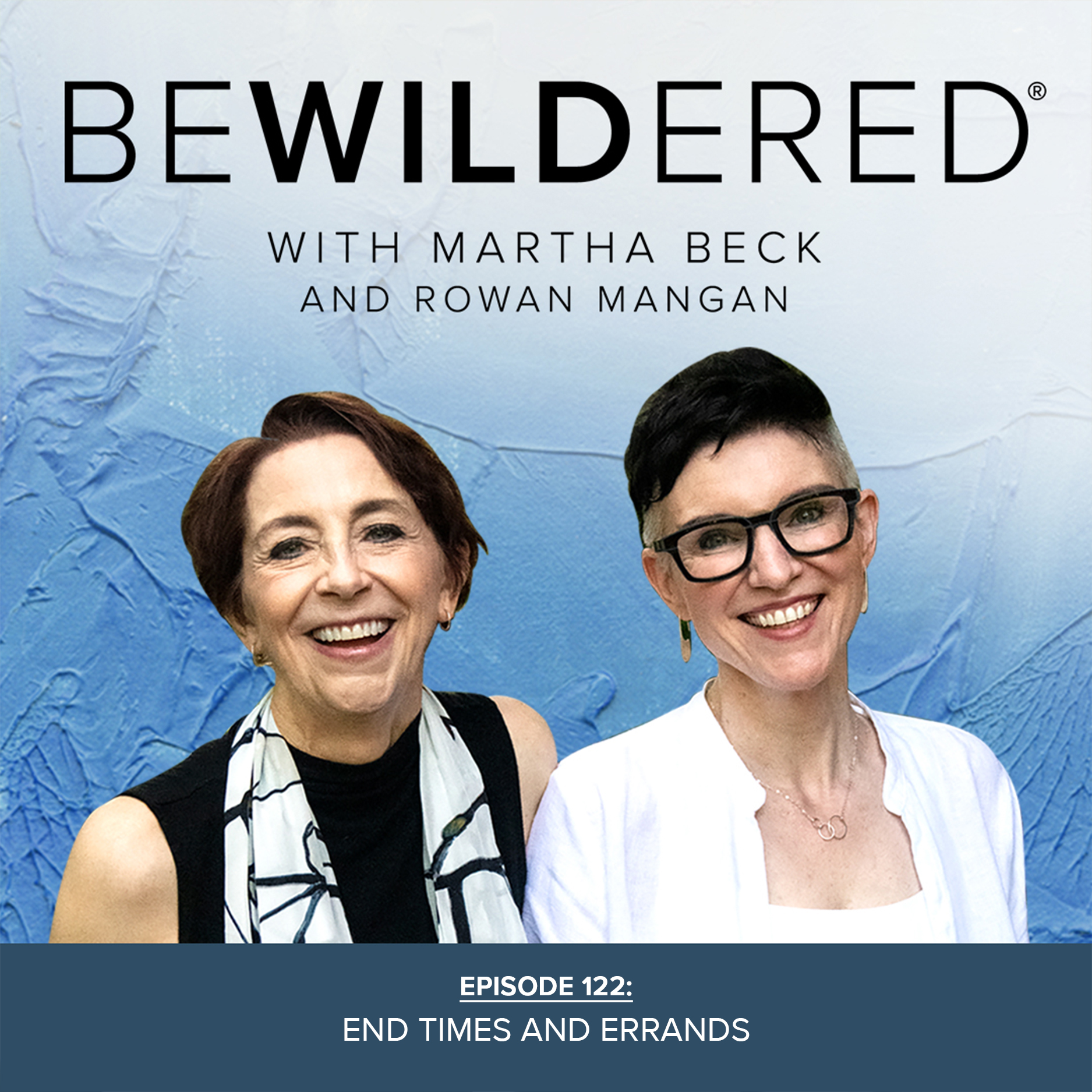
About this episode
How do you continue doing ordinary human-life things while the world feels like it’s collapsing in real time? That's what we're trying to figure out on this episode of Bewildered. We talk about ping‑ponging between school runs, summer camp registration, doctor's appointments, and breaking-news notifications that feel like the apocalypse is upon us. If you've been feeling caught in this same unnerving and exhausting back-and-forth, this episode is for you. Tune in and we'll come to our senses together.



End Times and Errands
Show Notes
Have you been wondering how you’re supposed to continue your day-to-day routine when it feels like the whole world is falling apart? How do you live your life amidst the monumentally, unprecedentedly terrible things that are happening?
We’ve been plagued by this question too, so we decided to dive into it on this episode of Bewildered. We’re talking about the emotional whiplash of bouncing between school runs, summer camp forms, doctor’s appointments, and grocery lists on the one hand, and breaking-news notifications and global events that feel like the literal apocalypse on the other.
It’s not just that it’s an ambient atmosphere of doom and gloom. It’s coming at you all the time. And what we find so difficult right now is finding the energy it takes to transition our perspective throughout the day.
We explore what this constant zooming in and out does to our bodies and nervous systems—how trying to hold both “end times” and “errands” simultaneously can leave us frozen, dissociated, or perpetually braced for impact.
From there, we widen the lens to look at societal collapse, capitalism, colonization, and rape culture, and how they all tie into this moment that feels like an ugly crescendo in our shared human story. Drawing on Martha’s sociology background, we talk about entropy, chaos, and historical moments when entire cultures have faced their own versions of the apocalypse, and what helped some people not only survive, but deepen and transform.
We explore the idea of stepping out of culture and back into nature to come to our senses. It’s not escapism, but rather a way of finding localized pockets of order and beauty that can exist even in the middle of a hurricane. Being a little bit wilder can help you not only survive, but actually stay very buoyant and float along in a very turbulent current.
We share some ways we’re experimenting with creating these small islands of calm, wildness, and genuine connection in our everyday lives, so that we can keep loving, parenting, working, and even laughing—without abandoning the truth of what’s happening in the world or the truth of our own hearts.
If you’d like to sit with us in the chaos, laugh at the absurdity, and explore some surprisingly gentle ways to stay human when everything feels like it’s coming undone, join us for the full conversation!
Also in this episode:
- How to live as a frontiersperson in a drafty zoological haven
- The nighttime shenanigans of the critters in Martha’s attic
- Headsuits, handsuits, and Ro’s trouble with a bodysuit
- Martha waddles across the ice in a martial-arts horse stance.
- Trapdoor underwear and back-flap pajamas
- Ro’s poll for our listeners: Are they called “snaps” or “press studs”?
TALK TO US
You can follow us on our Instagram channel @bewilderedpodcast to connect with our Bewildered community, learn about upcoming episodes, and participate in callouts ahead of podcast taping.
And if you’re a Bewildered fan, would you consider giving us a little rate-and-review love on your favorite podcast player? Ratings and reviews are like gold in the podcasting universe—they help people find us, they help build this beautiful community, and most of all, they help us in our quest to Bewilder the world…
Episode Links and Quotes
- Mouse singing too woo mate (video)
- Nelson Mandela
- Elizabeth Kübler-Ross
- Tunnel in the Sky by Robert A. Heinlein
- The Jungian Shadow
- Thermodynamic Entropy
- Chaos Theory
- The Fibonacci Sequence
- Guns, Germs, and Steel by Jared Diamond
- Tao Te Ching translated by Stephen Mitchell
- The European Enlightenment
- Golden retriever holding the most tennis balls (video)
CONNECT WITH US
- Follow Martha on Instagram
- Follow Ro on Instagram
- Follow Bewildered on Instagram
- Join us in the Wilder Community!
- Listen on your favorite podcast app
- The Bewildered Show Notes
- Is there something you’ve been feeling bewildered about? If so, let us hear from you!
Transcript
Please note: This is an unedited transcript, provided as a courtesy, and reflects the actual conversation as closely as possible. Please forgive any typographical or grammatical errors.
Rowan Mangan:
Marty.
Martha Beck:
Yes.
Rowan Mangan:
Do you ever get the feeling that everything totally sucks?
Martha Beck:
It has occurred to me a few thousand times today.
Rowan Mangan:
Yeah. It’s like we have to live our lives amidst really monumentally, globally, unprecedentedly terrible things happening, right?
Martha Beck:
Yes, they are.
Rowan Mangan:
Not just me, right?
Martha Beck:
Oh, yes.
Rowan Mangan:
Yeah.
Martha Beck:
I mean, not you, just. Sorry.
Rowan Mangan:
Yeah, that’s good. So that’s what we’re going to talk about today, about how do you live and do your everyday human things like learn to put on and take off your own clothes when everything is falling apart and everything sucks in the world.
Martha Beck:
Yeah. And how being a little bit wilder can help you not only survive it, but actually stay very buoyant and float along in a very turbulent current.
Rowan Mangan:
Hope you’ll join us.
Martha Beck:
Hi, I’m Martha Beck.
Rowan Mangan:
And I’m Rowan Mangan, and this is another episode of Bewildered, the podcast for people like us, trying to figure it out. What are you trying to figure out of late?
Martha Beck:
Oh, Lordy. Aside from how to live as a frontiersperson in the forest?
Rowan Mangan:
Mm-hm.
Martha Beck:
Which is basically consuming 90% of our time these days.
Rowan Mangan:
Frontiersperson—could you define that for me?
Martha Beck:
Yes. It’s someone who lives in a house where there is no insulation and wide gaps that allow, I don’t know, mice, rats, squirrels, raccoons, possibly bears to come in and walk around in the attic above your head while you’re sleeping.
Rowan Mangan:
Or not sleeping as the case may be.
Martha Beck:
I don’t know if I mentioned this before. I put on books on tape really loudly because it drowns out the sounds of the wildlife that nightly assault me. And there’s the little attic right above my bed. And I have my own little apartment. It’s very fun. I love my little apartment.
Rowan Mangan:
She’s got a little artist’s garret.
Martha Beck:
Yeah. I’ve got an artist garret. It’s pretty damn good garret. It’s got a big art studio and a beautiful room with the piano in it. And then I’ve got my little bedroom. Well, in my little bedroom, the ceiling is quite low and made of just, I think, plywood, that’s it. They put down some plywood. And I swear to God, I hear things all the time, scratching. One night I heard— something clearly grabbed with its claws the top of the wall and then slid down. Sometimes there’s squeaking. Sometimes there’s like, I know that mice and rats, this is absolutely literally true.
Rowan Mangan:
This is literally true.
Martha Beck:
They sing when they’re in love. They do.
Rowan Mangan:
This is from your David Attenborough observations.
Martha Beck:
Go to the interwebs. Google “mice singing when they’re in love.” They will play you recordings of the mice songs, and it is beautiful. But sometimes when they’re singing in the wall, I’m like, “Get a room guys and not mine.” But then one night, the skittering, the normal level of skittering seemed to be going on, which is, again, I have to drown it out with a full volume audiobook. But this time, the skittering went up the wall and then the plywood in the ceiling began to creak.
Rowan Mangan:
Rhythmically?
Martha Beck:
Rit, rit, rit, rit. More or less rhythmically. And I looked up and I thought I saw the bounce of a heavy creature putting feet down and feet up. I’m pretty sure it was a raccoon, but Lila thinks it’s Sasquatch. And she’s young and has very sharp eyes. Sharp senses. Sharp senses and a quick mind. So yeah, and that isn’t even what I’m trying to figure out. That was just a lead in. But the thing I’m trying to figure out is short, so I’m going to tell it anyway.
Rowan Mangan:
I really thought you just said, “The thing I’m trying to figure out is shorts.” And I was like, “Well, that’s a nice concise kind of… ”
Martha Beck:
I gave up on those years ago. But no, of course, I got a sinus infection living in this drafty zoological haven. And so I went to the doctor and they do this thing, and you’ve talked about it before, when you’re 40 or something, they stop asking you if you’re sexually active and start asking you if you’ve had a recent fall.
Rowan Mangan:
Yeah.
Martha Beck:
So I got a doctor who would not let this go. I had a sinus infection. There was no limb injury involved. And she goes, “So, have you had any recent falls?” And I was like, “No.” She said, “But are you afraid of falling?” I was like, “You mean out of an airplane? Yeah. Who isn’t?”
Rowan Mangan:
I could see you pivoting so smoothly into one of your Martha Beck specials: “Did you know that human beings are born with just two fears, loud noises and falling.”
Martha Beck:
And falling. So of course, I fear falling.
Rowan Mangan:
Since I was born.
Martha Beck:
Right. And she was like, “Yeah, so let’s talk about falling.” And I was like, “No, I’m not going to talk about falling. You’re afraid of falling.” I got really hostile inside and I was like, “You’re a faller. You’re 21 years old. You’re a full-fledged medical doctor and you are afraid to fall.” So it became quite antagonistic and charged, the atmosphere. She was a young resident, right? So they’re always trying to work it on out. And this falling thing, I think she must have had relatives that fall a lot or something.
Rowan Mangan:
I think she was projecting. I think you nailed it the first time. She was just so scared of falling herself that you walked in the door, and she was like, “Huh, I’ve got this one clocked. No worries. This one’s going to say it’s something else, but I’ll sit there and say, ‘Sweetie, is this really about your fear of falling?'”
Martha Beck:
But it links back to the frontiersperson problem because when I got home—like we live in the—
Rowan Mangan:
She fell down.
Martha Beck:
No, but it’s really icy and snowy. We’re living through a really serious winter up in the Catskills. The snow goes on for days and days and days and you shovel it, you turn around and you can’t see where you’ve shoveled. It’s already snowed again. And then it melts and then it turns to ice. It’s really dangerous. So I got so angry at this doctor that I came home and I was like, “I am now going to walk through a field of ice and snow toward my house. Eventually I hope to reach the house, but I must not fall.”
Well, as soon as you decide you must not do something, you get tense, right? I don’t know. I need to guard against falling. So I get out of the car and I took a wide stance.
Rowan Mangan:
Like a jockey.
Martha Beck:
Yeah. And then I kind of crouched to give myself more leverage.
Rowan Mangan:
So you were like a bow-legged little—
Martha Beck:
Well, it’s what I used to do in martial arts. You kind of—it’s a horse stance. And then I started sort of slowly waddling toward the house, but bouncing on each leg so that I would not fall.
Rowan Mangan:
Moderate yourself, ha-ha, who’s falling now?
Martha Beck:
Yes, because I literally was like, “If I fall down and they have to take me back to that doctor, I’m going to lose status.” And then I was like, “And I am trying to be an enlightened human being.” It was a debacle. Yes. It was a debacle.
Rowan Mangan:
Yes. A debacle indeed.
Martha Beck:
A debacle. So that’s what I’m trying to figure out. I’m still working on it. What about you, hon?
Rowan Mangan:
So I was going to say that I accidentally texted someone the other day via Siri that I couldn’t answer her text properly right now because I have 30 hands because she misheard me when I said I have dirty hands because I was gardening.
Martha Beck:
You’re like one of those Indian goddesses.
Rowan Mangan:
Yes. Yeah. And it’s weird because it’s like ironically you should be able to text more easily with 30 hands.
Martha Beck:
Oh my God. Imagine.
Rowan Mangan:
Yeah.
Martha Beck:
So much texture.
Rowan Mangan:
Not you, because it’s all still a bit of a struggle for you. It’s like staying upright.
Martha Beck:
I don’t dare text while I’m walking. I would fall for sure.
Rowan Mangan:
But anyway, that paled into insignificance in what I’m trying to figure out when I just, before recording this had an—this is a vulnerable one. And we haven’t talked about this and you don’t even know about this yet.
Martha Beck:
This is a safe place. No, it isn’t. It totally isn’t.
Rowan Mangan:
What I’m trying to figure out is putting on clothes. And so I have bought a thing, and it’s called a bodysuit. Okay. I think they could have done better with naming that, just BT dubs because everything is a bodysuit.
Martha Beck:
I know. That’s what I’m thinking.
Rowan Mangan:
You wear clothes on your body.
Martha Beck:
I guess it could be a headsuit. If it’s a hat, you would call it a headsuit. Gloves are handsuits. But a bodysuit pretty much is everything else, right?
Rowan Mangan:
So people might not know. Probably everyone else knows what a bodysuit is.
Martha Beck:
I don’t.
Rowan Mangan:
You do. You wear them all the time except you don’t do them up.
Martha Beck:
I have no idea what you’re talking about.
Rowan Mangan:
So, oh shit, maybe this is something they don’t call it in America. In Australia, it’s called a bodysuit. It’s like a top. You’ve got a top, say a t-shirt or a tank top, right? Yeah? You imagining? You know how you tuck things in?
Martha Beck:
Yes.
Rowan Mangan:
This thing tucks all the way around. It goes right under.
Martha Beck:
Like a leotard.
Rowan Mangan:
Leotard-like, but bodysuit in this case.
Martha Beck:
Okay. I did not know what those were called.
Rowan Mangan:
You just didn’t know what they were called?
Martha Beck:
No, sometimes I don’t know the names of things and I just go out anyway.
Rowan Mangan:
Well what you do, which is actually not that silly now that I think about it, given what I’ve just been through, you just wear them with the bits that are supposed to be fastened in one’s undercarriage.
Martha Beck:
Yeah.
Rowan Mangan:
You just wear them flopping about.
Martha Beck:
Can you imagine at my stage of being, if I had them fastened, and then I fell? The carnage.
Rowan Mangan:
So I put on a bodysuit for this podcast.
Martha Beck:
Oh my goodness. This is very in the moment.
Rowan Mangan:
I mean, Marty, because I care. Okay? Because I care, I put on a bodysuit and then I went to the bathroom.
Martha Beck:
That combination.
Rowan Mangan:
I thought that it was fastened with press studs.
Martha Beck:
With what?
Rowan Mangan:
Press studs. Do you know what press studs are?
Martha Beck:
Snaps. They’re not called press studs.
Rowan Mangan:
They are called press studs.
Martha Beck:
How many Australians are there really? Because I promise a lot of Americans are calling them snaps.
Rowan Mangan:
Okay. I really need to take a poll. If you are listening to this, please comment on whatever, I don’t care or whatever you’re listening to and tell me that they’re called press studs.
Martha Beck:
I had to interpolate the data because I have never heard of a press stud.
Rowan Mangan:
But you had never heard of a bodysuit and you wear them every day.
Martha Beck:
But I swear, we should ask our producers in—
Rowan Mangan:
Snaps.
Martha Beck:
Snaps. Yeah, snap. It’s snaps. Well, like that.
Rowan Mangan:
I tell you what, there are no snaps.
Martha Beck:
So what is it? Velcro or something?
Rowan Mangan:
So what it is, it turns out, is like an elaborate system of hooks and eyes.
Martha Beck:
What?! Sorry. I’m going to blow the mic out.
Rowan Mangan:
And I didn’t know.
Martha Beck:
Oh my God, you could get pregnant from this thing.
Rowan Mangan:
I was standing in the bathroom just tapping on my own crotch, just thinking if I pulled a bit harder, I would open it. At one point someone came in. I hadn’t figured it out. So I just stood there. And by the way, these are not commodious bathrooms. The door is like right there. And so I was standing in this very small space just waiting for her to do her thing and leave so that I could get back rooting around in my own cellar trying to figure out how to put together basic clothing items.
Martha Beck:
If we were two different lesbians than we are, that might have been considered a romantic piece of clothing. Yeah? Like the romance of the hook and eye, like unhooking a bra, like that’s a thing.
Rowan Mangan:
No, there’s no way to make this sexy. Okay. Because there is no one who can do a hook-and-eye situation without going “ugh” which is not a sexy sound. Even if you were like doing it for me, I wouldn’t recommend. That’s why you have to wait till someone else leaves. I’m just like, “I’m pulling as hard as I can.” It’s not the way.
Martha Beck:
No.
Rowan Mangan:
It’s not the way.
Martha Beck:
No, it isn’t. It may be what the kids are into these days. What?
Rowan Mangan:
I’ve just been handed a note.
Martha Beck:
Yes?
Rowan Mangan:
By our producer, Drew.
Martha Beck:
That says? Your body suit is climbing up?
Rowan Mangan:
It says snaps.
Martha Beck:
Yes. Ooh. The crowd goes wild.
Rowan Mangan:
Not studs. This is the problem with America, right here. Okay.
Martha Beck:
Really?
Rowan Mangan:
Let’s just undermine my own point a little bit by bumping into the microphone while seated.
Martha Beck:
Wait, wait. I’m sitting, I am basking in what you just said, that the difference between snaps and press studs is the problem with America. That’s the biggest problem we have.
Rowan Mangan:
Yeah.
Martha Beck:
I just went to a simpler place in time than I’ve been in for years. Thank you.
Rowan Mangan:
So Drew used to be on my side when we fought.
Martha Beck:
Well—
Rowan Mangan:
And I see we’ve entered a new era. Okay. He’s underlined it.
Martha Beck:
He has. Yeah. But now I think all our listeners have, and Drew, have an image of you standing in a small bathroom yanking at your own crotch, like some demented pervert.
Rowan Mangan:
Small space. Very small space.
Martha Beck:
And making sounds that at best sound like you were having an extremely difficult bowel movement. That’s at best.
Rowan Mangan:
No, I sounded way cooler than that while I tugged at my own groin. But—
Martha Beck:
I’m quoting you on that.
Rowan Mangan:
Let me just say worse than the tugging and tugging to no avail is the actually trying to put it back together after this. I mean, it was a yoga heavy moment for me.
Martha Beck:
I can only imagine.
Rowan Mangan:
Yeah.
Martha Beck:
Wow. Wow. We need to give you a set of long underwear with a little trap door you can open in the back.
Rowan Mangan:
Aw. Yeah.
Martha Beck:
Yeah. Did they even have those in Australia? I don’t think they ever needed them.
Rowan Mangan:
The little kids’ pajamas with the butt? We dn’t need them, what, because we don’t have butts?
Martha Beck:
No, adults wore them too in America in the 19th century and so on.
Rowan Mangan:
Really?
Martha Beck:
Yeah.
Rowan Mangan:
Why couldn’t they—
Martha Beck:
Pull their pants down? Because they didn’t have things like press studs. I don’t know. Everything was held up by suspenders or whatever, and a lot of people had back flaps. Under their evening coats or whatever. I think.
Rowan Mangan:
Huh. Clothes with trapdoors. Maybe they should make a comeback.
Martha Beck:
Okay. That’s our new idea.
Rowan Mangan:
I feel like this has been a really good way to lead into a podcast where we’re going to talk about the collapse of civilization and the end of the world as we know it.
Martha Beck:
Absolutely. It’s a fun way. It’s a fun way to start talking about the apocalypse.
Rowan Mangan:
Yeah, it sure is.
Martha Beck:
Because now we know the only problem with America is that we call press studs snaps.
Rowan Mangan:
Snapdragons. Snap your finger. Where could it ever be confusing?
Martha Beck:
Oh, snap.
Rowan Mangan:
Card game.
Martha Beck:
Should we do a podcast?
Rowan Mangan:
Let’s.
Martha Beck:
A substantive podcast that’s not just about our private peccadillos.
Rowan Mangan:
I don’t want to promise substance.
Martha Beck:
Okay.
Rowan Mangan:
Hi there. I’m Ro and I’ll be your podcaster for today. Do you know how to tip your podcaster? It’s actually pretty easy. You can rate our pod with lots of stars, all your stars. You can review it with your best superlatives. You can even subscribe or follow Bewildered so you’ll never miss an episode. Then of course, if you’re ready to go all in, our paid online community is called Wilder: A Sanctuary for the Bewildered. And I can honestly say it’s one of the few true sanctuaries online. You can go to wildercommunity.com to check it out. Rate, review, subscribe, join, and you all have a great day now.
So, what I want to talk about today is my own life and why it’s hard.
Martha Beck:
Ah. Everyone’s interested in that.
Rowan Mangan:
It’s a perennial topic on Bewildered. So this is what I’m noticing, Marty. And honestly, I do think that there will be one or two of our listeners who do relate to this a little bit. Right now, living on this timeline, on this planet, but especially in this country, I want to say that listeners from other countries may have less of this effect, but still are still getting it.
Martha Beck:
Right.
Rowan Mangan:
It’s so hard and surreal because the collapse of everything, the just general vibe of collapse is… It’s not just that it’s an atmosphere. It’s not polite enough to just be like ambient sound. It is coming at you all the time. And that’s one thing. If I were just going to be like, wake up in the morning and it’s apocalypse watch and it’s like, “All right, let’s do this.” But for me, what is so difficult right now in living life is the energy it takes to transition my perspective throughout the day, every day, from school run, coat, mittens, car key, move person who wants to do something else, and then get into the car and see a news notification that makes you curl up inside because it’s unprecedentedly awful.
Martha Beck:
Yes.
Rowan Mangan:
And then drive to school and have to listen to K-Pop Demon Hunters. And then you get home and you have a conversation with your partner while you make coffee about, should we set up a college fund? And then you think, “Well, but will college even exist?” And let’s put to the side the American thing of having to save for college from when they’re born. Education is a human right, whatever. And then, so it’s just like, I feel like I’m pulling up into, we’re living through this time, and it really is that bad and it really is that much not going back to how it was, right? It’s really that. And then having to keep pulling focus back down to, “Oh shit, we’ve got to reserve our space in summer camp.” For some reason, it’s like the parenting minutiae and the work minutiae out to— It just seems unreasonable, an unreasonable universe where it’s like the apocalypse should be enough. Please don’t ask me also to weigh in on the parents’ association and update the spreadsheet. Come on, let’s be reasonable here. It’s the both and it’s the— We’ve talked about transitions before on this podcast and about how, especially for those of us who are maybe a little bit neurodivergent, we struggle with that. But I feel like there is something so monumental in the transitioning between zoom out and understand the historical moment as it truly is, and then zoom in and do tiring, boring, everyday things.
Martha Beck:
Yeah. Things that were created for a system that was assumed to be going on indefinitely and now looks to be very much in question.
Rowan Mangan:
Oh, I don’t think there’s—I think in question might be very mild. Yeah.
Martha Beck:
Yeah. All three of us in our partnership have advanced degrees in social science, so we look at it and go, “Oh, for sure, this is what societal collapse looks like.”
Rowan Mangan:
And it’s coming at us so fast.
Martha Beck:
So fast.
Rowan Mangan:
And this is what’s new. It’s been like this grinding thing for a long time. And then recently it’s just the pace has sped up and sped up. And of course we’re living in the phone notification kind of situation where it will not let you rest for a second. I was reading this email from someone who writes scripts for a news podcast, a progressive sort of news podcast recently, and he was saying trying to write those scripts out, he found that he needed a new word for “meanwhile.” He was overusing the word meanwhile because it’s all happening at the same time. That’s also inconsiderate of the universe. Like, give me a second.
Martha Beck:
Yeah. Well, it won’t.
Rowan Mangan:
Yeah. And so that is what I wanted to talk about today because I just know from friends and being online that I’m not the only one who is struggling to hold this duality right now.
Martha Beck:
Yeah, it’s incredible. I mean, I say incredible, but I believe it because all my training has told me, and I’ve said it so many times in my career, that change is ongoing, social change is ongoing, social change is accelerating. Social change is accelerating exponentially and the exponent of exponential change is also increasing exponentially. Mathematically, if you know what an exponent does, that means we are basically at a point of near chaos going into total chaos. I mean, there are things you can predict in it, but it’s almost like a hurricane is hitting the entire human population, a hurricane of change, and it’s taking the forms that hurricanes will take. People in powerful stations will become increasingly—
Rowan Mangan:
Destructive.
Martha Beck:
Destructive, separated from reality, self-absorbed. They will want to continue increasing things like personal wealth, power, and status at a point, but it’s just like, it’s beyond any human conception, how much they want. And so it’s predictable, but we’re just seeing it at this massive level.
Rowan Mangan:
And it’s so interesting how, God, I remember so many years ago, it must have been 2016, I remember someone talking about shadow work and the Jungian idea of the shadow. Was it Jung? And this was, okay, so this was early 2016. And he said, “When a culture leaves its shadow unacknowledged, it comes out in weird ways, and sometimes it runs for president.” And I see what you’re saying and I see that is the shadow of the culture and that in all those characteristics that you describe and it’s like, it’s all coming to a point, like our culture is like rushing at this cliff edge right now, and it is all change, but it’s almost like the law of entropy. Is entropy a law?
Martha Beck:
Yeah.
Rowan Mangan:
The thing of entropy, I would say.
Martha Beck:
Phenomenon.
Rowan Mangan:
The phenomenon of entropy is that change and destruction—destruction sounds like a value judgment—but change and collapse or disaggregation is the same thing.
Martha Beck:
Pretty much. That everything is always proceeding toward less organization. But within that, certain systems like a human being can stay organized as a human being during life, and it’s called a localized system of order. But in order to do that, we have to create more disorder around us by eating and drinking. So we’re disrupting the systems around us to create this localized set of ordered symptoms and then we die and it all goes back to entropy again. So entropy is always increasing, but in that there are these little swirls of organization and I’m bringing this all up because I think it has parallels in what we’re going to be living through.
Rowan Mangan:
Yeah. I mean, that’s actually, that’s a fascinating perspective in terms of thinking about, you could just apply a sort of historical lens suddenly to this moment and you’re going that one of those brief blips where it looks like order is clumping in the swirling chaos of it all is like the second world, like after the second, post-World War II world order, right? That feels to us because of when we were born like normal, but actually it’s not. Or you could say the thing of empires tend to last 250 years. So like boom, had a little empire moment. Now back to the swirling hurricane.
Martha Beck:
Yeah. But at this point, the empire that we’re talking about is basically global, obviously power and wealth centralized in the United States to a huge degree, but affecting everything and all the players in such close communication with each other, right?
Rowan Mangan:
Well, and the kind of culture that skips along the path holding hands with capitalism, like it’s the same beast really, has so come to dominate the world.
Martha Beck:
It hasn’t just come to dominate. I mean, I don’t want to get too academic here, but basically you’ve got a system that has a paradox at its core. This idea that all men are created equal, but the guy who’s writing “all men are created equal” also owns several human beings at that very moment. So it’s a system that claims that everybody’s going to have equality, but is economically based on the necessity that some people will be much more oppressed than others.
Rowan Mangan:
Right. So, and this is so much the way that capitalism and exploitation are the same thing, like exploitation is built into capitalism in the same way that slavery is built into—
Martha Beck:
They’re one and the same.
Rowan Mangan:
The United States. And that’s why the United States has been, I think for the last hundred years or so maybe, maybe a bit longer, has seemed like this kind of standout example of the culture that we’re all perpetuating. And it’s kind of like the child of the moment because it’s so successfully, it’s so successfully exploited and oppressed and raped, pillaged, and destroyed in order to create a momentary glimpse of order.
Martha Beck:
Yeah. Locally, in localized places in times, it looked really sweet, but it was always gobbling resources and oppressing people and getting its hands dirty in ways that were never really brought to light. And now the people who are getting their hands dirty are doing it in plain sight without any apparent consequences. It is very troubling.
Rowan Mangan:
This is like we’re already going into pretty dark places. So lucky we had a big laugh about me not being able to use my own clothes earlier. I saw something the other day that said that part of what this moment is showing, and I’m trying not to use too many specifics because that just changes. So it’s so fluid. But I think you can sort of think of examples that bear this out that what we’re seeing at this moment is the fact that rape culture is the same thing as colonization brought at a different fractal level. And that I had never thought about that in the same way, but it’s what we’re talking about. It’s grab the thing, just like take the person, the country, and whatever, see it for its minerals, the gratification you can take from it, the enrichment you can take from it momentarily that will cause lasting damage.
Martha Beck:
Yeah. Yeah. And because you’re rich and famous and they’re relatively powerless, they’ll just let you. That’s the whole—and that is the outright proclaimed intention of a lot of very significant people. So yes, in the middle of this, we then have to call the plumber and get the thing fixed and make an appointment for, I don’t know, for your insurance, not knowing whether the healthcare system is going to continue existing. So it is a best of times, worst of times, for sure. We have so many good things. We have things like a podcast that we can broadcast all over the world for very little money. Best of times in that way, worst of times in terms of looking forward toward any kind of planable stability.
Rowan Mangan:
Yeah. And I think, I don’t know, I even think best of times, worst of times is still misrepresenting it a bit because we have amazing technology, but I also think that for those of us rich enough to be living off the spoils of this system right now, we’re holding onto the convenience of a lifestyle that is dying in front of our eyes.
Martha Beck:
Oh, when I said that, I meant it’s best of times for some people. Sure. Worst of times for most people, actually.
Rowan Mangan:
Right. But as a whole, we’re in a moment where it feels like the ugliness of this culture that we, this amorphous thing called culture that we sort of problematically describe on this podcast all the time, there is this ugly crescendo happening in this moment, and I mean moment kind of loosely defined. And I just think, okay, so everything’s coming to a head with the disgusting, vile nature of nature of our culture. Let’s have a radical return to nature at the same time. And so I feel like it’s what you always talk about where as we see the dark rising, we trust that because it’s a dualistic world, the light is also rising. It just doesn’t look the same. It’s not as desperate for photo ops.
Martha Beck:
Yeah. Yeah. It doesn’t scream.
Rowan Mangan:
Yeah.
Martha Beck:
And this is what I’ve been obsessed with since I got my doctorate. I’ve been looking at systems that collapse in the way people’s individual lives get impacted by it. And so now I’m looking at this huge scale, but the things that I’ve seen all through my life are still true. In every culture that is undergoing a radical, horrifying collapse. For example, all the cultures that were colonized by the West who spread guns, germs, and steel, horrible plagues that weren’t even noticed in Europe that took out like 95% of the people in the Americas after Columbus lost a pig. So there are many cultures that have gone through horrors and almost been destroyed.
Rowan Mangan:
And like, much more recently than that as well.
Martha Beck:
Of course. Of course. I’m just saying, we don’t even think about the fact that the apocalypse has come before for such huge groups of people. Hundreds of millions in the case I just mentioned. But here’s the thing, I went looking for how to respond to that from a social system and I couldn’t find it in the existing world. And I remember bringing my research to my professors at Harvard and they were like, “Well, what’s the solution?” And I said, “There’s no solution. We’re screwed.” And they were like, they got very unscientific and said, “No, there has to be a solution.”
Rowan Mangan:
And in that moment, a self-help author was born.
Martha Beck:
That is true. I’m going off peace, guys. So they said, “Go back, find something.” And so what I found—now, I have a doctorate in sociology. If there is one person in a room, especially when I was in graduate school, they called it psychology. If there’s two people in a room, it suddenly becomes sociology because it’s about the relationship between those people. So that’s why I chose sociology. The interesting thing is that to find a way to navigate what’s happening now and the ways that people survive those horrors earlier is not a sociological phenomenon. It starts with just one person in the room. It starts with whoever you are. For me, it starts with me. For you, it starts with you and it requires a retraction from all social influence, which is…
Rowan Mangan:
Sorry, can you just… Okay. Give me more context about what you’re talking about here.
Martha Beck:
Okay. So one of the things I found was that wherever European countries had colonized indigenous societies, a tremendous conflict ensued between people who were trying to hold onto their traditional beliefs and the European models that were just overrunning them with materialism and destroying all the historical beliefs and traditional wisdom and all that stuff. So a lot of people went into despair and depression. You find this in the annals of colonization that at a certain point, the people trying to defend their own land gave up because it was so hopeless, but there were individuals who found hope in a different way. And the way they did it was usually by some pattern of going away into nature, which is why Bewildered, the name of this podcast, it’s a pun on “be wilder-ed” because—
Rowan Mangan:
Be wilder, Ed.
Martha Beck:
Be wilder, Ed.
Rowan Mangan:
Ed, we’ve been telling you for years.
Martha Beck:
Damn it, Ed.
Rowan Mangan:
Ed. So can I just interject and say, so is what we’re talking about on some level creating for ourselves the little piece of calm?
Martha Beck:
Absolutely.
Rowan Mangan:
In the swirling hurricane, knowing that it cannot last.
Martha Beck:
That the calm can’t last?
Rowan Mangan:
Yeah. In the system of entropy that we live among and that sort of dominates our inner life as well when we apply. So given that there are going to be insurance companies and summer camp signups, I think what you’re leading us into and I really want to hear about is like how we can make that pocket that feels like order.
Martha Beck:
Well, and it doesn’t just feel like our order. I mean, sorry, this can get a little academic again, but if you look, entropy is one thing. Everything’s proceeding toward disorder, but the way that plays out in physical systems is something, is chaos. Things go into total chaos. This is a situation where nothing can be predicted or controlled. But instead of just making massive white noise, what happens in chaotic systems in nature is that layers of pattern disorder arise. So what happens, what you see when you go through the forest or what you see when you walk in the mountains or look at seashells on the beach, you are seeing chaos bringing pattern disorder to the physical world. So you’ll find the same Fibonacci sequence of measurements in a seashell that you do in the tree foliage that you do in the geology of the mountains or you’ll see things arising that not only seem organized, but they’re beautiful. They’re sumptuous like a fern is something that is just a mathematical pattern of something that is chaotic.
But when we say the word chaos, we think of absolutely no beauty, no order at all, but actually when it’s allowed to be itself, nature brings beauty. It brings systematic patterns of beauty. They can’t be predicted because they’re never exact replicas. So here’s the thing, we were trained to follow culture to know what our lives would be about. When you’re trying to deal with summer camp or college funds, you’re trying to follow the rules of a culture that says, “Listen to us. This is what happens. You have a child. It must go to summer camp. It must go to college.” In the meantime, the reality of the entire society is a hurricane where nothing that the culture has set up is going to last, but the nature of the way creation works is that if you find a way to flow into natural patterns for yourself, you end up in systems of beauty and systems of extraordinary wellbeing in the middle of the hurricane.
Rowan Mangan:
I have a thing.
Martha Beck:
Yes.
Rowan Mangan:
Humans, even in our ways of building culture, are part of nature. So just like the Fibonacci spirals created in the fern or the fossil or whatever it is, replicate each other. So too, does rape culture and colonization. They are part of the Fibonacci spirals that are when the individual psychology of a human being turns into the sociology of the society, the people en masse. And so is part of this process of letting ourselves be more in nature … What I’m suggesting is the culture in some ways, what the culture is doing is completely in alignment with nature. It has to be, yeah. It’s when we react against it in the ways you’re describing and try to hold the culture to its spreadsheet, instead of seeing it as the twirling 30-handed Kali sending text messages and whatever, then that’s where we’re going against our true nature, that it’s actually in our reaction to the culture that we abandon nature.
Martha Beck:
Okay. So at the beginning of this podcast, we said, when we say “culture,” it means there are all these different cultures, but we’re talking about this Western European-based, blah, blah, blah. So you’re talking about culture replicates psychology and it does. Individual psychology is fractaled out, but rape culture has not been the dominant human behavior. Most people, I still believe this, are not rapists. So what you have is hundreds of thousands of years of thousands of civilizations that acted, and some of them were more war-like, some of them were more violent than others, but on the whole, they had to exist in a kind of harmony with the natural world. What you got in the European Enlightenment was this belief that we are now separate and above nature, and we are going to use the left hemispheres of our brains to make straight lines and right angles and shoot people. And that is what we will set up and it will last forever. We will set up all these square buildings and they will last forever. So what you get is a complete aberration.
Rowan Mangan:
Got it.
Martha Beck:
And that aberration does take the form of rape culture, but still, and this is what I found in my research long ago, most people are not rapists. I mean, rapists don’t announce themselves always as much as they are these days, but you really don’t get ahead in most small social groups if you are overtly violent. The group does not like it. It’s the combination of materialism and technology, again, that allowed a few people to dominate more ferociously than had ever happened before, that we’re now seeing come to a crisis state. And we’ve seen it before. Easter Island, right? The people on Easter Island cut down all the trees to make their things. And when they cut down the last tree and looked around for coconuts, it was like,
Rowan Mangan:
Oops. Oh shit.
Martha Beck:
And then they started to eat each other and then not everybody—
Rowan Mangan:
Protein’s important.
Martha Beck:
Yes, it is.
Rowan Mangan:
So I just want to clarify, I was not equating— When I was saying rape culture because I was quoting something that I’d read online, I was not equating that as The Culture, by any means. I was meaning in a very small-c way of characterizing this particular strange moment that we’re living through where—
Martha Beck:
Well, I would say that the culture that dominates our lives and that set up most of these systems is very closely aligned to rape culture.
Rowan Mangan:
And I guess it’s just, I mean, it’s like what Michael was saying all those years ago about we don’t acknowledge our shadow and we don’t integrate it and it ends up being the president and it’s sort of like that’s where we find ourselves.
Martha Beck:
And you have brought me right to the point that I reached 30 years ago, which is, “Ah, I need to integrate this.” The culture needs to integrate its shadow, but cultures don’t act, individuals act. And those people who survived the devastation of their cultures, traditional cultures, found a way to get outside of their culture and start to integrate their own shadows.
I talk endlessly about Nelson Mandela. He was a fiery, young activist, brilliant, idealistic. But when he went to prison for 27 years, he changed into something completely different. He changed into something transcendent. He rose above, I call it the emergent way of thinking. It was neither a traditional way of thinking nor a European modern way of thinking. It was something so individual and so integrated and his friends and fellow prisoners at Robben Island talked about how he was constantly working on himself. He learned Afrikaans.
Rowan Mangan:
I’m just working on myself a lot right now. Sorry, guys. I can’t come out to the yard today. I’m just—
Martha Beck:
But he really did.
Rowan Mangan:
I’m working on this. I’m on a journey. I’m on my journey.
Martha Beck:
Yeah. He wore paisley shirts and stuff. No, it’s not right to even joke about it. It was a horrific situation, but he did, he learned the language of apartheid. He learned the Afrikaans language and his fellow captives were like, “What are you doing?” And when he got out, he took some of the guards and they were in places of honor at his inauguration as president. He had so integrated his own shadow that he could genuinely love across these horrific ideological gulfs and this horrendous rape culture, which it really was all over Africa and certainly in the apartheid years. And that process of integrating the shadow is the way you can get your child to camp and grieve another horror that has happened and not feel torn to pieces by it.
Rowan Mangan:
Yeah. So I feel like you’ve really just reached the point that I reached 65 years ago in my own thinking, Martha. That’s very good. Very good. So why don’t we come back in a minute and talk about how to come to our senses?
Martha Beck:
Oh, that would be nice.
Rowan Mangan:
So Marty Moo, we got to come to our senses.
Martha Beck:
We do.
Rowan Mangan:
The, just, convention alone dictates that eventually we got to come to them.
Martha Beck:
Culture comes to consensus and the consensus is weird.
Rowan Mangan:
The consensus is batshit crazy.
Martha Beck:
Yes, it is.
Rowan Mangan:
So let’s look elsewhere.
Martha Beck:
Yeah, let’s come to our senses for sure. For sure. Now more than ever.
Rowan Mangan:
Yeah. So I feel that, like our audience, I’m in this place of constantly trying to metabolize awful news while trying to go about my everyday life. And I wonder if there’s a way that we can frame up how to be in your senses in this highly unnatural situation where we do still have to do life and we are still in this moment of bombardment.
Martha Beck:
Yeah. Well, I love that you…I mean, the come to your sense, this thing is really literal because the first thing I learned tis that, because I’ve had a few times when my life blew up and in a very small localized way, I thought doom and gloom had come. And what I’ve learned is that the first thing you do, if you stay in the cultural mode of you have to use your calculating brain and figure this out logistically and do the pros and cons and do this sensibly and go to a life coach. People, when they hear that, they think, “Someone’s going to give me the rules.”
And there are no rules out there that are manmade that are human or left-brain-originated that will work. You have to actually literally drop into your body. When you’re trying to do the morning thing with the kid, you get in the car, you hear the horrible news on the radio or whatever it is, there’s a natural inclination to tense, like physically tense. You said something about it makes you want to throw up. It has a physiological effect. A long time ago, I read when I was 10, I read this science fiction book by Robert Heinlein and it had a great premise. These Earthlings, astronauts, they’d found a way to pass through wormholes and land on habitable planets all over the multiverse, but they never knew anything about the place where they would land. So all these people had to be trained to go to places where literally nothing could be anticipated. And they had a really interesting training regimen. And the first thing they were told is, “Do not assume that this planet will work like earth.”
Rowan Mangan:
So you’re just like touching down on a new planet and this is your training program for what to do when you get there.
Martha Beck:
Yeah. And the first thing is don’t expect anything to be the way you expect it. So when I get in the car and I see the bad news, it’s because I expected things to be the way they were when I was 20 like, “Oh, this is not the way the American political system is supposed to be working, but it is.” So it’s my resistance. There’s the horror of what’s happening and then there’s the outrage of “This isn’t the way it’s supposed to be.” And that too is a cultural assumption.
But if I walk out into the world going, “It’s reached the point where every day is a different planet. And if I walk out expecting any kind of continuity to be my shelter, my thing to hang onto, I’m going to be very scared all the time because all the structures are shaking.” But if I go out every day thinking, “Okay, I’ve been trained to adapt to any situation I may encounter. I will not expect tomorrow to look like yesterday.” And we can talk more about that, but if I go out in that basic frame of mind where I’m loose, I’m relaxed, I will adapt, more than anything else, I will observe what’s around me very, very closely before I make big decisions. I am primarily an observer of the planet that I walk out on today, and I expect it to give me things I don’t expect.
That, as a very first step to tell ourselves, it has helped me so much because I would go into outrage, I would spend days and days raging against reality.
Rowan Mangan:
Yeah. I think there’s something… I guess I want to quibble a tiny bit. I don’t think it’s necessarily that we react against the news notification because it’s not how we expect things to be. I think that a big part of this moment is how much abject cruelty we’re exposed to. And so I think what you’re saying about being loose in it, I just want to add that being loose includes allowing yourself to hurt appropriately when you are forced to witness injustice and cruelty.
Martha Beck:
Yeah. And that’s why I said there’s the horror itself, but then there’s the resistance to the horror. So you have to metabolize the horror. You’re absolutely right. You can’t deny that. You can’t say it’s not real. If the abundance of evidence of your senses tells you that it’s real, you have to allow that to be reality. But then when you say, what I’m saying, I used to spend weeks in outrage is just like, “It must not be this way. It must go back to the way it was before,” and the horses are out of the barn and the barn is on fire. It is not going to be the way it was before. What’s it going to be like? I do not know. So the whole thing you said about internalizing the shadow, when something like that hits you, it’s like going onto the new planet and seeing something that is truly horrifying or terrifying or dealing with a real impact that is devastating.
And you have to be able to drop the expectation that things will go well and also embrace your natural nature’s reaction to horrible things, which is you know, Elizabeth Kübler-Ross spelled it out in our reaction to death. It is this process of initial denial like, “I can’t believe this is happening. I don’t want this to happen.” And you’re watching it. So you’re like, “There’s denial.” Then it’s kind of this random blend of anger, resistance, bargaining.
Rowan Mangan:
But that’s all a very left-hemisphere, like conceptual way. And we’re talking about coming to our senses and coming back into our body. And I feel like bargaining, denial, all right, yeah, maybe. But in this moment, for me, my thing is, I just think of those slow-motion videos that you see on social media or on YouTube or whatever where something’s dropped into water and just slow-motion see the water move to absorb the impact of the thing that’s being dropped or some other, like those ultra slow-mo things of something hitting something and it has to ricochet. And I feel like I have to go through that multiple times a day. And I just want to say it’s really hard to be alive in this time and doing these things.
Martha Beck:
It is.
Rowan Mangan:
And I want us to be able to come together with our listeners in saying that, yeah, we’re having to do something that is really messed up.
Martha Beck:
Oh my God, it’s unprecedented. And when I use the labels and stuff, that’s an academic way of saying, so how I experience this, I hear a piece of news that is ungodly horrifying. The first response is nausea for me, usually. The second one is an absolute drop off a cliff into despair. Then there’s a period of numbness, then there’s rage, and all of this is going on as I have to get the oil checked. But I have found that you can get your oil checked while that is happening to you if you allow it. So sorry, I was using the academic language. It is visceral. And if you try to keep it in your left-hemisphere brain and analyze your way through it, you’re not going to do it. You have to be in your body and you have to allow it to impact. So in collisions, drivers who are drunk often survive because they’re not braced.
And the people who are sober, who are clenching, they sustain much more serious injuries because it’s exactly like you just said, the slow-motion thing of somebody being hit, but water is completely relaxed about something being shot into it, right? And we’re 70% water. And so emotionally, psychologically, the whole, what I’ve been calling integrating the shadow is the process of nausea, despair, rage, hopelessness, crying, going out and marching in the streets.
Give your emotions a place to go. If you feel like something, that you want to take an action, go take it, but always be relaxed and allowing your body-mind to have the experience of actually living in the reality of it, instead of trying to brace it all away and analyze it.
That has its place too. But the whole thing is we’re only taught to use the left hemisphere of the brain. When you bring in the right, the right doesn’t exclude the left, so you’re in a whole-brain perceptual situation that includes all your kinesthetics, your movement, and all five senses. And when those are engaged, you can absorb that and learn from it and grow from it and tolerate it. And that like a person who’s drunk and loose in an accident who walks away, you’re going to get injured sometimes anyway. I mean, I’m not saying this is any kind of insurance against harm. I’m just saying it’s a way for us to go through the day looking at harm.
Rowan Mangan:
Drinking heavily.
Martha Beck:
And drinking heavily. That’s right.
Rowan Mangan:
So all right. So let’s come back to our metaphor of every day in this reality that most of us are living right now, and I want to say the obvious, which is we’re living in immense levels of privilege to even be having this shitty time where my news notifications freak me out because they’re not about me.
Martha Beck:
Not yet.
Rowan Mangan:
So stating—yeah. Well, yeah. I definitely want to acknowledge that. And given that that privilege is absolutely there, every day we wake up and we’ve been landed on a new planet, right?
Martha Beck:
Yeah.
Rowan Mangan:
Every day is a new planet. So we land, we observe, right? That’s the first part of our training. And we feel.
Martha Beck:
We feel. You observe and then you let what you observe impact you at a physical, emotional level. You do not hold it at bay except when it becomes so overwhelming that you can’t function at all. And I’ve gone through a couple of those in the last few months. And at that point I use something that one psychologist calls denial with a little D. I say, “Okay, that’s the news. I’m not going to follow this breaking story because I’ve just read 87 posts about some horrible thing that happened with new details in everything on the internet. I am overwhelmed and I’m not actually going to be able to put on my clothes. So what I’m going to do—
Rowan Mangan:
Welcome to my world.
Martha Beck:
I don’t even try with the hook and eyes. No.
Rowan Mangan:
No, you’ve gone back to loin cloths.
Martha Beck:
But I remember really recently I was watching something develop and it was so, so, so utterly beyond horrifying. And after reading hundreds and hundreds of posts for a couple of hours, I said, “I’m going to do something that looks so not responsible from the point of view of like controlling the world. I’m going to go watch videos of animals doing funny, hilarious things. I’m not going to deny that this awful thing is happening, but I’m also not going to deny that somewhere in Idaho, a golden retriever tried to get six tennis balls in his mouth. And that is also true. And I know that we’re trained … The brain has a negativity bias. If it bleeds, it leads. That’s good. We need to be aware. But it can pull us, along with the algorithms and stuff, it can pull us into this incessant observation only of the most horrifying. That’s not real. That’s not presence.
Rowan Mangan:
That’s actually not—I would argue in a way, in the way we’re talking about it, not semantically, but the observation we’re talking about is not fixation. Because if you have landed on a new planet and you don’t know how it works there, like you don’t know how its physics works, you don’t know what’s alive here or what. It might be a blob, or it might be a robot, or it might be a friendly lion, or it might be the tin man.
Martha Beck:
It actually was in some cases. Anyway, go on.
Rowan Mangan:
Wow. So what you’re doing in observing is almost just being the water or the crash test dummy—
Martha Beck:
One hundred percent.
Rowan Mangan:
Or whatever. Let me observe because we’re talking about our senses and not our brains or not even our eyes specifically. And so it’s like, I’m going to be when I’m caught behind between a rock and a hard place, let me be water, let water. So we have to sit or stand or kind of levitate on our new planet that we’ve landed on and see what happens to our bodies. And if they have to move because they’re trying to let—
Martha Beck:
Oh, shaking. I let it like a leaf and I let it happen because that’s one of the things your body needs to do.
Rowan Mangan:
Right. I’m still deep in the physics of another planet metaphor. And also slightly my water getting pierced by a rock that fell from above. So I’m like, I have to move as …
Martha Beck:
Also, you have 30 hands.
Rowan Mangan:
I’ve got 30 hands.
Martha Beck:
Didn’t see that coming.
Rowan Mangan:
Cool planet, though.
Martha Beck:
Okay, so.
Rowan Mangan:
Yeah. So we’re there on the planet and we’re just letting the planet speak to us and tell us about itself. And the planet is each day that we face at the moment, right?
Martha Beck:
And there’s something that you can do. And I do it all the time now. And we’ve been teaching it when we did our retreat in Costa Rica. It’s weirdly effective and there’s a ton of research on it. But when I was a little kid, I used to watch… I used to like to watch ants on the ground. And I don’t know if you ever did this, but if you watch one ant, you’ll just see that one ant moving. Have you ever done this as a kid?
Rowan Mangan:
Yeah. The way that they greet, sometimes they greet—Is that what you’re going to talk about the way they greet?
Martha Beck:
No, no, that’s not quite though I was obsessed with watching them greet each other.
Rowan Mangan:
Yeah, me too.
Martha Beck:
But what I would do—
Rowan Mangan:
We’ve never talked about this. We’ve got so much in common. We should date.
Martha Beck:
Oh my God, you’re right. I thought you’d never say that. Okay. So I would watch the one ant and then there was something I did with my eyes. And I knew if I did this with my eyes that I would suddenly see hundreds of ants and I would be able to see how they were coordinated with each other. And I didn’t realize what I was doing, but it’s called opening the optical attention aperture. Now, I give it the left-hemisphere words because I feel that that buys us legitimacy.
Rowan Mangan:
It’s fine. I just really thought when you said, “I didn’t know what I was doing, but what I was doing was drugs.”
Martha Beck:
Oh, there was that too. No, there wasn’t. And I do it all the time now. I literally do this thing because I’ve read so much brain research on it.
Rowan Mangan:
So tell me what it is again, because I interrupted you.
Martha Beck:
You can do it right now. It will sound so weird, like such a weird response to something horrible on the news. The very first thing I do is I take a really deep breath and I let myself tremble if I need to because that’s normal reaction, and it helps the hormones move through you, the fight-or-flight hormones, because if they get stuck in there, you’ll be miserable for all day. So let yourself shake, let yourself cry, let yourself throw up. But then I literally soften the focus of my eyes. So I’ll look at something like, I don’t know, a flower in a vase on the table and I’ll look at the flower and then I’ll just start looking at the whole room and the flower is there, but it’s equal. And that’s like the little ant. I would just see the one ant and when I let all things be equal in my visual field, I would see thousands of things happening.
So that’s how these astronauts were trained. Because you can’t go to a planet and see, “Oh, here comes a tiny fuzzy blob. I’m going to focus on that forever.” And meanwhile, some great carnivorous thing comes and pounces you from behind, right?
Rowan Mangan:
That’s the unfriendly lion.
Martha Beck:
Yeah. And so they were trained to watch softly. And that’s what I don’t think we know how to do when such horrible, hard things are happening. We think that watching softly is an act of weakness, but what it is, is an act of intelligence, deep, deep intelligence that makes the whole brain come online. Whereas that pointed left-hemisphere thing isolates your visual field.
In fact, there’s one case where this kid who’d been in foster care was so traumatized, he couldn’t read it and it’s because his aperture wouldn’t open enough to see a whole word. He could only see one letter at a time. So they had to teach him to breathe and relax and then his eye gaze open and he could see a word and then a sentence and then a page. So these astronauts would go and their absolute explicit instruction—
Rowan Mangan:
Fictional astronauts.
Martha Beck:
Fictional astronauts was relax, relax, relax. And that’s the last thing we think of doing when there are horrors coming.
Rowan Mangan:
And yet that is what, it turns out, that that’s what every NASA, like the first thing when they train real astronauts—
Martha Beck:
Really?
Rowan Mangan:
That’s all it says. It just says, “Relax. This is fine. It’s not that hard. You’ll figure it out. They did it on Apollo 13. You’ll be fine.”
Martha Beck:
There’s nothing more you need to know.
Rowan Mangan:
Just make sure you’ve got a paperclip.
Martha Beck:
You probably took biology. Don’t worry about it.
Rowan Mangan:
Yeah, it’s fine.
Martha Beck:
But the thing is that when we relax, we think more intelligently. When we relax, we take in more data. It’s that whole thing about the cognitive brain processing 40 bits of information per second, and the entire aperture of perception processing 11 million bits of information per second. You need that 11 million bits per second in an unknown, unknowable environment, which is also dangerous and frightening.
Rowan Mangan:
Yeah. And that includes, that’s not just about see more things, widen your visual field. It’s about what does that breeze on my shoulder mean? It means that my house is not very watertight.
Martha Beck:
There’s a raccoon in the ceiling.
Rowan Mangan:
We talk about with the trackers that we meet in South Africa, it’s every sense is listening.
Martha Beck:
Yeah. If you go out with one of those unbelievable world-class trackers in the African wilderness, they walk with such relaxed—they look almost like they’re sort of strolling, almost idle, and they are watching everything. They are seeing thousands of things that I would never know were there.
Rowan Mangan:
And we’re saying seeing, but it’s all the senses together.
Martha Beck:
Exactly. Yeah. It’s actually more ears than eyes because you can hear things that you can’t see in the brush and everything, but it’s also smell and intuition.
Rowan Mangan:
Well, it’s almost like part of what, you know, the left hemisphere separates things, right? And it’s like our left-hemisphere-dominant culture goes, “This sense and this sense. And sometimes you look and sometimes you hear.” But actually, maybe so much of it, what we call intuition just turns out to be the ability to synthesize all our senses at one time.
Martha Beck:
Yeah. And it changes the functioning of your brain to a place where it’s less anxious and more relaxed. That’s what I wrote a whole book about it. So now when I get the bad news, I vomit, I shake, I cry. And then I—
Rowan Mangan:
She’s so fun at parties.
Martha Beck:
And then I literally say, “Breathe and relax, drop into your body, open the aperture of your attention, everything you see, everything you hear, everything you smell, the texture of the air on your skin, soften enough to feel it all.” And then a kind of calm comes in. And when I’ve been in nature and I’ve seen animals get attacked by predators, they get away, if they get away, they shake, they make sure they’re all right. And then you can see them go [sighing sounds]. And then their ears come up, like antelope I’m thinking of, and their eyes go soft, and they’re just present again, as if the horror had never happened because that’s how they’re going to be ready if it comes again. That is not a stupid way to react. That is the most intelligent way to react, to relax and drop in.
Rowan Mangan:
So Marty, it strikes me that one thing that we can do once we’ve achieved that level of relaxation, that incredibly biointelligent state is instead of bringing up our resistance to what we’re seeing happening, we can bring up what the natural feelings would be if these terrible events were happening in the room, by which I mean the compassion, the goodwill, the kindness, like these sort of contra-cultural right now kind of things, but very human, very natural things and like build our own little island of order within the larger system of entropy and make our garden a place and talk to our plants and talk to our neighbors.
Martha Beck:
Yeah. I think what you’re talking about, the left brain and our dominant culture separate everything and like focus relentlessly on individuation and individual achievement. And everything’s in lines. There are lines of authority, there are lines you wait in, there are lines you follow, there are guidelines, right? But when you drop away from that and you allow yourself to sink into your body, what happens is the right hemisphere comes online, is that the right hemisphere connects. And so what happens to people in a rape culture who are following the lines, who are coloring inside the lines, is they either become tyrants or victims, but people who are living outside the lines. People who are wilder, they naturally extend compassion to each other. And if there’s a rapist there, you’ll know it pretty soon, but most people are not rapists. And if you’re in that soft, relaxed thing, you can connect with people very quickly and people start sharing resources.
And what emerges in the sort of natural fractal form are circles. So you get circles of love, you get circles of mutual nurturance, you get circles of understanding, you get neighborhood circles, you get social circles, you get circles of the seasons, circles of life patterns.
Rowan Mangan:
The spiral medicine garden that you’re going to build.
Martha Beck:
Exactly. And I mean, it’s so interesting that that is such a strong image for me because I’m no gardener, but I just have this overwhelming desire to build a spiral garden. Spirals are one of the most beautiful, basic forms in chaos theory, and they just replicate gorgeously throughout nature. And then, yeah, you’re right. It’s more spiral than circle actually, because it all starts to get bigger and more connected the more people drop into their original nature. And I almost think that when this linear, left-hemispheric culture is so violently out of whack, it actually gives a lot of people the incentive they need to say, “I will investigate my kids’ college fund, but when she gets home from kindergarten, I’m going out to sled with her in the snow because I need to be in my life. And I know that when I’m called to go out and march or run for office or whatever it is, I will. But in the meantime, I’m going to stay here now.
Rowan Mangan:
And that you show yourself the compassion that you want to show the world, you show your kid the compassion and the people immediately around you, that’s the first turn of the spiral. And then as that feeds goodness back into you and nurtures you back, then you can step out and start taking those actions that will change the larger picture, but only if we can do it from a beginning that is not stressed out, exhausted, under-resourced, overwhelmed, right?
Martha Beck:
Yeah. When we’re in the present moment and we’re relaxed, we are fluid and that means we can adapt even to incredibly difficult, unprecedented circumstances. And I love this line in the Chinese book the Tao Te Ching, which says, “When two great forces confront each other, the victory will go to the one that knows how to yield.” So that’s what nature will help us do.
Rowan Mangan:
That’s the sneaky way, and that’s how we…
Martha Beck and Rowan Mangan:
…Stay wild!
Rowan Mangan:
We hope you’re enjoying Bewildered. If you’re in the USA and want to be notified when a new episode comes out, text the word WILD to 570-873-0144. We’re also on Instagram. Our handle is @bewilderedpodcast. You can follow us to get updates, hear funny snippets and outtakes, and chat with other fans of the show. Bewildered is produced by Scott Forster with support from the brilliant team at MBI. And remember, if you’re having fun, please rate and review and stay wild.
We’re also on Instagram. Our handle is @bewilderedpodcast. You can follow us to get updates, hear funny snippets and outtakes, and chat with other fans of the show.
For more of us, Martha’s on Instagram, themarthabeck. She’s on Facebook, The Martha Beck, and she’s on Twitter, marthabeck. Her website is, MarthaBeck.com. And me, I too am on Instagram. Rowan_Mangan. I’m on Facebook as Rowan Mangan. And I’m on Twitter as RowanMangan. Bewildered is produced by Scott Forster with support from the brilliant team at MBI.
Read more
Questions? Comments? Trying to figure something out? Email us! [email protected]
Credits
Wandering The Path by Punch Deck | https://soundcloud.com/punch-deck
Music promoted by https://www.free-stock-music.com
Creative Commons Attribution 3.0 Unported License



0 comments