

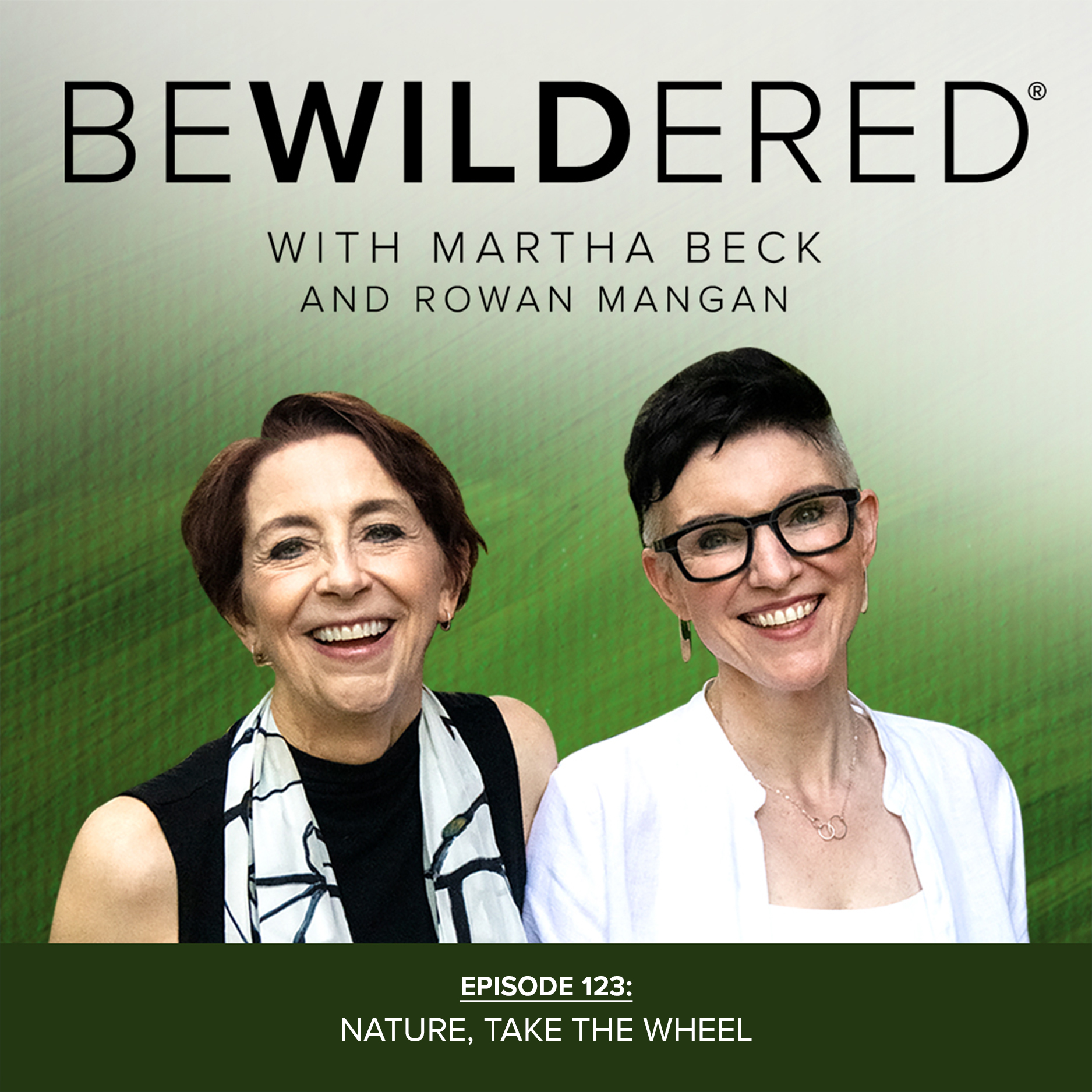
About this episode
When life as you know it crumbles—lost jobs, shaken identities, houses (literal or figurative) in rubble—what if you’re not meant to rebuild the old structure at all? In this episode of Bewildered, we're exploring our deep attachment to “putting it back how it was,” how culture teaches us to fear impermanence, and what becomes possible when we let Nature “take the wheel” to allow something entirely new to emerge. Tune in to grieve, rethink, and reimagine what the next chapter of your life could be.



Nature, Take the Wheel
Show Notes
There you are: Everything is going along just fine, the house of your life feels solid, and then…
BOOM.
The metaphorical earthquake hits, the walls disintegrate to rubble, and suddenly you’re standing in the ruins trying to stack the broken bricks back into a shape that feels familiar.
In this episode of Bewildered, we’re talking about that moment when life as you knew it collapses, and what it means to let nature, not culture, “take the wheel.”
We explore why our nervous systems and our culture are so obsessed with homeostasis: that comfy illusion that we can keep things the same forever. It’s something that shows up everywhere from our careers and relationships to our aging faces and national politics.
There’s a biological pull toward homeostasis, and our culture fights hard against impermanence, so it’s easy for us to believe in the fantasy that we can put things back the way they were. But this only keeps us feeling stuck and anxious.
We talk about how our memory edits the past to make the “old house” look prettier than it ever really was, and how that illusion keeps us from opening ourselves up to new possibilities and the chance to create something better.
So if we stop building the old house, what happens next?
We play with the idea of becoming a “pencil in the hand of God”: Instead of forcing a blueprint from the left brain, we embrace experimenting with imagination, curiosity, and a kind of spiritual “trust fall” into the unknown.
If you’re in a season of layoffs, breakups, health crises, climate anxiety, or just a generalized sense that “the wheels have come off,” this one is for you. Come sit in the rubble with us, grieve what’s gone, and feel into what new thing might be trying to come through your life now.
Tune in for the full conversation, and let’s find out what happens when we stop trying to bring back yesterday and instead choose to follow a wilder way.
Also in this episode:
- Martha grapples with newly acquired echolalia:“Jawohl!”
- Ro gets ghosted by building scientists.
- Man-sized icicles and flash mobs on planes
- Pre-Copernican obscurantists and Russian dolls
- Ro coins “surgery or self-acceptance” (but refuses to accept either).
- “Monkey sad ‘cause house fall down.”
TALK TO US
You can follow us on our Instagram channel @bewilderedpodcast to connect with our Bewildered community, learn about upcoming episodes, and participate in callouts ahead of podcast taping.
And if you’re a Bewildered fan, would you consider giving us a little rate-and-review love on your favorite podcast player? Ratings and reviews are like gold in the podcasting universe—they help people find us, they help build this beautiful community, and most of all, they help us in our quest to Bewilder the world…
Episode Links and Quotes
- Bewildered episode 115: You Gotta Put Down the Duckie if You Wanna Play the Saxophone
- Yongey Mingyur Rinpoche
- Eradication by Jonathan Miles
- Homeostasis
- Keating! The Musical
- Oliver! the Musical
- “Zero Circle” poem by Rumi
- Echolalia
- Charnel houses
- Thelma & Louise
CONNECT WITH US
- Follow Martha on Instagram
- Follow Ro on Instagram
- Follow Bewildered on Instagram
- Join us in the Wilder Community!
- Listen on your favorite podcast app
- The Bewildered Show Notes
- Is there something you’ve been feeling bewildered about? If so, let us hear from you!
Transcript
Please note: This is an unedited transcript, provided as a courtesy, and reflects the actual conversation as closely as possible. Please forgive any typographical or grammatical errors.
Martha Beck:
Hi, I’m Martha Beck.
Rowan Mangan:
And I’m Rowan Mangan. And this is another episode of Bewildered. You know that. You’ve already pressed play on it. You know what it is.
Martha Beck:
The podcast for people trying to figure it out.
Rowan Mangan:
Yes. And today we’re trying to figure out what to do in those moments where everything collapses around us, and we have to accept that things are not as they were.
Martha Beck:
Yep. And we probably can’t make them as they used to be. But there’s an option. There’s an option open that is not trying to rebuild what can’t be rebuilt. It’s the Wilder way.
Rowan Mangan:
Okay, let’s do this! So Marty, what are you trying to figure out?
Martha Beck:
Oh dear. I am trying to figure out if I am really losing my mind and coming unraveled in general, or if I just have bad days because I’ve started doing this weird—it’s not echolalia. Echolalia is where you just say random sounds because you—Karen does echolalia. Like, you’ll say, “Let’s eat,” and she’ll go, “Eatie wheatie wheatie.” Just total, random—but that’s been from childhood, right? But I’ve started doing this thing and I don’t know what is misfiring in my brain. The other day you sneezed.
Rowan Mangan:
I did not.
Martha Beck:
You did. You did. It’s okay to admit it. It’s okay to admit it.
Rowan Mangan:
I did.
Martha Beck:
And I always say, “Bless you” because I had a professor in college, it was in mythology and folklore. I took this class and he was obsessed with doing all the folklore things. so you always had to stop and say, “Bless you.” And invariably, during each lecture with a hundred students, someone would sneeze, and he would stop and say, “Bless you,” and then completely forget the thread of his lecture. And we would just sit there. And then when he started up again, his brain would misfire, and it was just agony. This one time he was going to say, “The hero comes back from the underworld and then they bathe him and clothe him in a toga or a tunic.” But instead he said, “They clothe him in a tuna or a tonic.” And then he just stood there on the stage like staring, amazed, knowing not what to say. And we all started shouting to him, “Toga and tunic, toga and tunic!” Anyway, the other day you sneezed, and in honor of this lovely, frightened man, I meant to say, “Bless you.” But what came out—
Rowan Mangan:
I’d forgotten about this.
Martha Beck:
See, I’m admitting this in public now. I just sat up, straightened my spine, open my mouth and sang, “Ye-es!” I was like, what? No one does that. I was like, that is nowhere. That is not what you do. It was horrifying. I didn’t know it was happening to me. And then I was supposed to be doing a recording for something, and it was supposed to be punchy and on the 32nd beat. Yeah, got it. Yeah. Punch. Get my points across. And then at the end I shouted, “Jawohl!” Jawohl, I think, is a kind of exclamation in German. I don’t even know if it’s good or bad. I think it’s vaguely good. “Jawohl!” I shouted this.
Rowan Mangan:
Wow.
Martha Beck:
Randomly, exactly the same way I sang, not said, but sang, “Ye-es!” in response to you sneezing. I want to know what’s wrong, Roey.
Rowan Mangan:
Yeah.
Martha Beck:
What? That attitude is not going to help me. You’re supposed to say, “You’re fine. I do it all the time. Ye-es!”
Rowan Mangan:
That was very funny. There was that moment, I sneeze, atchoo, you looked up like, I got this one: “Ye-es!” And then we both just made eye contact for a long moment and went, “Did that? That was different.”
Martha Beck:
Wait, I didn’t talk about the underlying fear that I have truly lost my marbles. So I’m trying to figure that out. That’s what’s happening. Jawohl.
Rowan Mangan:
I think you’re fine. Jawohl.
Martha Beck:
Just smack the table.
Rowan Mangan:
Yeah, you got to cut that out.
Martha Beck:
Anyway. What are you trying to figure out?
Rowan Mangan:
So when you go on a plane for a long flight, not a short flight, but when it’s been a number of hours together and you start thinking, “We’re a society now, these people who are sitting around me, when we crash in the Andes or whatever this is…”
Martha Beck:
“I’m going to have to eat these people.”
Rowan Mangan:
“I may have to eat these people.” But before that, I have to be in society with them. And so you sort of, I dunno, I mean I’m realizing as I’m saying this, this is very much a me thing, but I’m like, “Yeah, you’re going to be a problem on the island,” you know, or whatever. And I wonder what the equivalent in life is of the people who get up too soon and open their overhead lockers too soon and stuff like that. You try to think, “How’s this going to play out on the island?” But anyway, so there’s this kind of sense of we’re a society together, we’re up in the air, there’s just us. There’s no one else.
Martha Beck:
You’re bonded by danger and distance.
Rowan Mangan:
Yeah, exactly. Exactly. But then the weird thing happens. You touch down, and you are ejected into airport world. And then there’s just all these people, and it’s like you have to pretend that you weren’t briefly in love.
Martha Beck:
With everyone, with the 300 people on your plane.
Rowan Mangan:
Right. And we had an interesting one of these recently. We were in Costa Rica, we came home, it was night, it was suddenly very cold. It had not been cold in Costa Rica. It became cold in Newark, New Jersey.
Martha Beck:
It was substantially less cold in Costa Rica than it was in upstate New York.
Rowan Mangan:
I think that’s fair to say.
Martha Beck:
Yeah. Yeah. It’s bold but fair.
Rowan Mangan:
And so we are walking out of the plane. We are dealing with losing our entire society to the hordes of airport people. We’re dealing with freezing to death.
Martha Beck:
All of us Costa Rica come-froms.
Rowan Mangan:
All the come-froms. And then with love, sometimes three-dimensional objects are a challenge for you. And there may have been, you know, we were tired. Everyone was tired.
Martha Beck:
What did I say? What did I sing?
Rowan Mangan:
Well, you we’re getting your bag on the escalator, your roll-aboard thing. And I think you dropped something. And then there was a woman behind us who was part of our plane society, and there was just like, we were in airport mode, but we hadn’t fully transitioned into the mode of awkward, “We’re just strangers. We don’t know each other.”
Martha Beck:
That’s right.
Rowan Mangan:
And so she picked up, I think your phone or something that you dropped on the escalator, and you just turned around and looked her in the eye and said, “I just need you to come home with me and look after me.” Word for word. I wrote it down because I was like, “Oh, the Bewildered peeps are going to be hearing about this.”
Martha Beck:
Oh dear. At least I didn’t sing it. At least I just said it.
Rowan Mangan:
That would’ve been really interesting if you turned around and went, [sings] “Come home with me!”
Martha Beck:
I know. It would’ve been like—
Rowan Mangan:
[sings] “Take care of me.”
Martha Beck:
It would’ve been like some sort of Broadway musical thing. I always wondered, as a child, I would see musicals, and I took it very literally that these people, I just saw it as a regular movie and then suddenly everyone would start singing. I watched The Sound of Music. We didn’t have a TV. I was completely, I just read books all the time. So I think I was at that moment where my child self knew that we were all supposed to start singing the same song. Like Oliver, “Consider yourself one of us.” Every plane. You should sing that on every plane. What if you just got in the plane takes off you stride to the front, ostensibly to go to the lavatory, but then you turn around and you just start conducting a rousing version of “Consider Yourself One of Us”?
Rowan Mangan:
Flash mobs on planes. Why has this not happened? We have to do this. It’s a lot of admin, but it’ll be worth it.
Martha Beck:
Oh my God, that is going to be so cool.
Rowan Mangan:
It’ll be so bonding for later.
Martha Beck:
Maybe we could repeat a number in the airport.
Rowan Mangan:
No, it’s only for the plane.
Martha Beck:
Only on the airplane.
Rowan Mangan:
What happens on the plane stays on the plane. Yeah.
All right. Let’s do a podcast.
Martha Beck:
Let’s do it.
Rowan Mangan:
So Marty, what we’re talking about today on Bewildered, the podcast that you and I are now doing…
Martha Beck:
[sings] Ye-es? No one sneezed. No one sneezed. Go ahead. What are we talking about?
Rowan Mangan:
…is you know when you’re building your house, metaphorically.
Martha Beck:
Yeah. I’ve never built a house.
Rowan Mangan:
Yeah, you would try, though.
Martha Beck:
I would.
Rowan Mangan:
It would be a debacle. Say you’re building a house, metaphorically. And in this metaphor, your house is just like you’re going along in your life, you’re building your life in whatever way you’re doing this. This is what your family’s like. This is what your work is like. This is what your home is like. And then one day there’s an earthquake, metaphorically, and the house that you’ve been building is rubble around you. So this could be, to just decode the metaphor, this could just be there’s all these layoffs and suddenly you’re laid off from your job. Something big completely interrupts your happily going along of your life.
Martha Beck:
AI comes in and takes out an entire department and you no longer have a job or something.
Rowan Mangan:
Right. So this has happened, and I think what we can say is the human tendency and the cultural teaching is that you now will pick up that rubble of that house, those blocks, and attempt to refashion them into the house that you had in your mind that was coming along quite nicely. And this sort of makes sense to us. But what we want to talk about today is that moment when the rubble is around, what’s happening there in the larger sense, is potentially, in the scheme of things, something’s coming to say that wasn’t the house, or the house wasn’t going the right way. And we want to talk about that moment and what we need to do in that moment when the meteor falls on our life.
Martha Beck:
Right, and we can’t rebuild it.
Rowan Mangan:
And the fact that you are not supposed to try and make it what it was. Is that fair?
Martha Beck:
Maybe. I mean, I don’t think we can state that as an absolute.
Rowan Mangan:
Oh, I can. [sings] Ye-es!
Martha Beck:
Does this have anything to do with the fact that our house is melting right now?
Rowan Mangan:
No. It is just a metaphor.
Martha Beck:
It is literally melting, folks. There is something called an ice dam in nature. I’m sorry, I have to stop and talk about this. I’m finding that it’s stuck in my throat, and I have to say it. We had just lived through this massive, massive blizzard. There was three feet of snow on the ground, and it was desperately cold. I had talked to you about, “I know cold. I’ve been in Boston, I lived in Boston.” This was actually worse than anything I experienced there. When we came back from the jungle two weeks after the blizzard, none of the snow had melted because it had never been even close to the temperature at which water melts. Except that, and here is what you told me that I’m now going to tell you as if I didn’t know it because it’s for the edification of our listeners, if on your house there forms an icicle the size of three strong men—okay, so think of an icicle. Now make it the size of three strong men.
Rowan Mangan:
Like standing on each other’s shoulders? A big hug?
Martha Beck:
No, standing shoulder to shoulder, gripping the edge of the roof. It is not a hugging situation. There’s no warmth. And this is the key. It is very cold outside, hence the massive icicle. But your house is kept at a temperature in which you can survive—barely, but you can survive. And that means that it’s warm enough to melt water. And so the water from the icicle begins to melt—not out of the house but into the house.
Rowan Mangan:
Because I mean really, it’s only forming an icicle in the first place because of the warmth coming from the house. Because otherwise it would just, I don’t know.
Martha Beck:
I don’t know. I’m not a building scientist. You can call those building scientists. Ro keeps saying we’ve got to call the building scientists.
Rowan Mangan:
The building scientists have ghosted us.
Martha Beck:
Yeah, she’s convinced that she left them in a room too long, and they’ve decided to spurn us.
Rowan Mangan:
No, they have. I’ve been emailing them.
Martha Beck:
I know, but I don’t think it’s you spurning them. I think they looked at that damn house and went, “This is not, we could tank our entire careers by looking at this house.”
Rowan Mangan:
Yeah, well they’ve ghosted us.
Martha Beck:
So yeah, the building scientists, while we were in Costa Rica and Karen was home with Adam and Lila, and she called us and said, “The house is leaking.” And we thought, oh, a busted pipe.
Rowan Mangan:
So we told them to immediately turn off all the heating.
Martha Beck:
So they had no heat, no water. It’s literally negative five degrees. It is horrifically cold, so much snow everywhere. You could not find your way through things. Anyway, it all starts dripping. So we thought: busted pipe. And the plumber came and the pipes were fine, but we had a massive man-sized icicle that was creating a dam pushing melted water into the walls. And guess what? It’s still happening. As we sit here, our kitchen area is full with pots and pans catching the water.
Rowan Mangan:
This is true and absolutely, definitely the truth. Now I just need to be really clear, there are two houses in this podcast so far. One of them is a metaphor for life. The other one is, something’s bad in our house, but it’s not related to the life house metaphor.
Martha Beck:
Or is it?
Rowan Mangan:
Well, you know what? Let’s find out.
Martha Beck:
I personally believe, and I deeply believe this, and I said it on Oprah’s show once if people remember The Oprah Show.
Rowan Mangan:
So if you think it’s not true…
Martha Beck:
I said it on the Oprah Show.
Rowan Mangan:
It’s been said on the Oprah Show.
Martha Beck:
I said that anything that happens to your house is a reflection of your inner life, and anything in your inner life is going to be reflected in your house. I think there’s something really messed up that’s making me sing “Ye-es!” and making icicles flood into our house. Anyway, we can’t even go out and try to hack the icicle because that would void any potential insurance. So we just literally sit there. The wall is torn open. There are all these electrical things with the water running daily through them.
Rowan Mangan:
I know I’m a good listener and this might feel like therapy, but I think…
Martha Beck:
I need to be quiet about it.
Rowan Mangan:
Yeah.
Martha Beck:
[sings] Ye-es! It’s involuntary.
Rowan Mangan:
Oh god, yes.
Martha Beck:
It’s like a sneeze. All right, anyway, maybe it’s a metaphor, maybe it isn’t. But the point is, and you make it solidly, everyone goes through a time, goes through many times, I think, when everything goes to rubble. When it’s not just that the car needs a tune up, the car falls off a cliff and is no more.
Rowan Mangan:
Gotcha. How does that—
Martha Beck:
This is also a metaphor kind of Thelma and Louise-y.
Rowan Mangan:
Yeah, but you’re not Thelma or Louise in this.
Martha Beck:
No, I’m the car. You and Karen are Thelma and Louise. So this is what you were saying and I completely deviated.
Rowan Mangan:
I’m Harvey Keitel running towards the cliff going, “No!”
Martha Beck:
I’d forgotten he was even in it. It was like you mentioned someone random like Paul Newman. I was like, what? Oh boy, Paul Newman is so old no one’s ever—It’s like Paul Newman and Louis the IV are in the same category in most people’s minds today. I’m trying to get to the point, Ro.
Rowan Mangan:
All our reviews are like, “They’re so good at staying on point. They’re really like—
Martha Beck:
Do people actually say that or are you being sarcastic?
Rowan Mangan:
I’m being sarcastic.
Martha Beck:
They literally cannot stick to the point, these MF women.
Rowan Mangan:
Yeah.
Martha Beck:
Okay. The point, and I don’t know why you ever steered me off it, is that we all have these times of like, “Oh, our life looks really trashed, and we need to make it the way it was.” Make it the way it was.
Rowan Mangan:
Yes. And this runs through our cultural training, which is homeostasis. Actually, do you want to just be Encyclopedia Brown for me and just define homeostasis for me? Because I feel like it’s—
Martha Beck:
Homeostasis is a state in which—
Rowan Mangan:
State of homeo.
Martha Beck:
Yeah, which we would know about because we’re homeos. It’s a state in which an organic system can basically move on in its current pattern without much deviation, and it is going to be solid and stable.
Rowan Mangan:
Yeah. It’s like a comfortable status quo of like, yeah, this is how life is going along. And that feels right even to our little cultured minds and our little monkey brains because we’re afraid of everything, and we’re afraid of change. But if we look to nature, the great teacher, we would see that change is constant. And that’s actually, that homeostasis is the aberration, or change is the homeostasis.
Martha Beck:
No, not quite. I’m going to—
Rowan Mangan:
I’m the homeo. You’re the stasis.
Martha Beck:
Okay. The thing is that we are so programmed that, for example, if we get cold, we find a way to warm up. If we get hungry, we eat. If we get restless, we pace around. There is an internal drive to maintain the homeostasis of our bodies and of our minds as well. We do constantly correct to bring ourselves into homeostasis. It’s not always easy, but emotional regulation is another one. You find ways to stay in this zone where you feel like everything’s basically okay. So when something goes—
Rowan Mangan:
To use the language of internet memes, despite the horrors, there is always look at phone in bed.
Martha Beck:
That is true. That is true. And we do all these things that help us go back. And they’ve done really interesting studies, which I think are widely known now, where if somebody is, they did one study where they looked at people who were paralyzed from the waist down in accidents and people who’d won the lottery. And they looked at their emotional state right after the incident, the paralysis and winning the lottery. And of course it was very different, deep grief and sorrow versus elation and happiness. But a year later their happiness was basically equal.
Rowan Mangan:
Homeo.
Martha Beck:
It was homeo. It was stasis. It was basically back to the level they’d been before this thing happened. If they felt shitty before winning the lottery, they felt that way again. If they felt basically happy before being paralyzed, they’d risen to that again. So we do kind of go—there’s this illusion that there is not constant change, that we can sustain things the way they are. And I see this every single day because somehow my phone has intuited—perhaps because it can see my face.
Rowan Mangan:
No, because you click on these things and it knows your patterns.
Martha Beck:
Maybe once I did.
Rowan Mangan:
Oh, come on. I’ve seen the packages arrive at our door.
Martha Beck:
Once. But it is nothing but this constant stream of products that purport, advertisements for products to make a female face look slightly less old. And it’s like everything—they show the before and after, and every single one of them shows that you look 50 now, you will look 30 after you smear this on your face. And nobody ever does. I don’t know how they get the before and after photos. I don’t know what they’re doing.
Rowan Mangan:
AI.
Martha Beck:
Yeah, exactly. The idea is, and you will get here too, I think the vast majority of people get to a point where you’re basically in homeostasis from like 25 to about 45, and then it’s just every day it’s “What fresh hell is this?” And all those products, billions and billions of dollars, are just trying to make it like it was. Make it like it was, put it back the way it was. Because for a while I felt like this was me, and it looked the same, and now it looks different, and I can’t tolerate that. I’m losing my idea of what I should be.
Rowan Mangan:
I’m going to write a self-help book.
Martha Beck:
Really?
Rowan Mangan:
Uh-huh.
Martha Beck:
Quick money, easily won.
Rowan Mangan:
As everyone knows. That’s a sure thing. So I am 45 years of age.
Martha Beck:
Yes you are.
Rowan Mangan:
And there is research that you have a massive like fall off a cliff of aging, very fast aging happens at 44, 45. And I can vouch for that. And I went for a brief period down a bit of a rabbit hole about something about my appearance that I don’t like that I’m not going to mention because I don’t want to draw attention to it.
Martha Beck:
That’s right. Oh my gosh, you mentioned it. You just feel like marked for life.
Rowan Mangan:
I’m now trying not to refer to it in any body language way.
Martha Beck:
I don’t even know what it is, listeners. I don’t.
Rowan Mangan:
And I explored different ways to try and deal with this thing that had begun to happen that didn’t used to happen. And I finally just said to you after, and I made phone calls to ask people, can they help me with this issue? And I said to you one day, I was like, “I think I’m at the point where it’s either surgery or self-acceptance.” And that feels like—
Martha Beck:
Did you make that up?
Rowan Mangan:
Yeah.
Martha Beck:
I thought that was a meme from the internet.
Rowan Mangan:
No, I made that up. Surgery or self-acceptance.
Martha Beck:
Surgery or self-acceptance. Yeah.
Rowan Mangan:
And I still haven’t decided.
Martha Beck:
And guess what? You still want because it really is, like what?
Rowan Mangan:
I don’t accept surgery, and I don’t accept self-acceptance. Neither of those is is viable.
Martha Beck:
This is exactly the topic we’re talking about. Do you try to build it back to be the way it was? And here’s what I have been telling myself since I was like 20 years old, “Don’t do it, Martha.” Number one, because you’re supposed to be on the path to enlightenment and it would look really stupid if you showed up with five pounds of filler in your face. “Yes, I’m just meditating on it.” Like deal with it. Impermanence is a thing. It’s like the number one noble truth of Buddhism. Deal with it.
Rowan Mangan:
Impermanence is so much easier to embrace before it starts happening to you, right?
Martha Beck:
I know, but I just kept telling myself because I was living in Phoenix where there’s a ton of wealthy retirees who are getting a little bit older, and the wives are all gorgeous.
Rowan Mangan:
The wives.
Martha Beck:
It is kind of a Stepford wife kind of experience. You never, sorry. Phoenix is wonderful. It’s just got very strong sunlight. It ages you.
Rowan Mangan:
You just broke Drew. When we break Drew, the producer, that’s when we know that we’ve gone too far.
Martha Beck:
I saw identical twins in an airport.
Rowan Mangan:
Oh my gosh.
Martha Beck:
And one of them lived in Phoenix. You could tell because they looked exactly alike, but the Phoenix one looked like 93 years old and the other one was 30. Sun exposure: It’s not your friend. Okay, wait back to what I was saying.
Rowan Mangan:
Toga, tuna.
Martha Beck:
Toga or tunic. Back to what I was saying. What was I saying?
Rowan Mangan:
No idea. Toga and tunic.
Martha Beck:
Now, oh, I remember. It’s this. I would look at people walking around after their face lifts, and they did not look like they looked before the face lift, but they also did not look like they looked when they were 20 or 30 or 40. They looked like something different. And they all looked exactly alike because I don’t know about this, but I think the plastic surgeons are like, “I will give you this face. It is the ideal face of the world.” And the women say, “Yes, yes.” And then they come out looking like somebody made that face out of skin but not nature. This was something else.
Rowan Mangan:
I have just realized something really profound and I’m going to be super, much more explicit about political stuff than I usually would be in order to make this point because I just think it’s so fascinating. So the “put it back how it was” urge that we have when something happens, which is analogous to “My face, is changing, put it back the way it was,” it’s not necessarily about looking younger, it’s about looking familiar to yourself. So you do these changes to look familiar to yourself, and you don’t. But what I just realized is in America, we have a special term for that appearance now that we didn’t used to have, which is Mar-a-Largo face, which you either know or you don’t know what I’m referring to. And look it up.
Martha Beck:
Google it.
Rowan Mangan:
You can Google it. And what strikes me as so interesting because of my political science bent, is that the—all right, I’m going to say it—one of the things that aspiring fascists do is they create an artificial sense of nostalgia for a time gone by when things were simpler.
Martha Beck:
Perfect. They were perfect back then.
Rowan Mangan:
They were perfect. Everyone was white. No one was gay.
Martha Beck:
That’s right.
Rowan Mangan:
It was like a homophobic-stasis.
Martha Beck:
There you go.
Rowan Mangan:
And so the—in America, let’s just call it Make America Great Again philosophy, which works with Mar-a-Lago face. And it’s like what happens in the society is let’s harken back to a non-existent time when things were simpler, let us try and recreate on our faces a youthful glow that never really was because that’s not what youth is. And it’s just so fascinating the way that culture is doing contortions with itself in order to avoid recreation, reinvention, re-imagining of something into something new. And that’s kind of what I want to push towards in this conversation is when everything is rubble around you, including your own aging face, what if in that moment, we are being asked to imagine something completely new. We are not supposed to get the rubble and try to approximate the house that was. That house is gone, man. And the hardest thing about these moments is you have to put down—this is such a weird callback to an earlier episode—you have to put down the duckie if you want to play the saxophone.
Martha Beck:
That’s right. Yeah.
Rowan Mangan:
So there’s grieving the dream and grieving the illusion of homeostasis that you had five minutes ago.
Martha Beck:
Yeah. And I think it’s particularly desperate, this resistance to impermanence and this obsession with holding something in place. I mean, this really is one of the major issues that is addressed in Buddhist meditation. You sit there and you contemplate impermanence. They’d send people to go sit in charnel houses where dead bodies were and sit there and acknowledge that as you start aging, that’s where you’re headed.
Rowan Mangan:
I love that you’ve got this story from somewhere that you read about kids growing up in Buddhist families and they’re like, “I love my bike.” And the parents are like, “It’s just going to rust and die.”
Martha Beck:
Yes, that’s from Yongey Mingyur Rinpoche. He’s been called the happiest man in the world. They tested his brain. He’s like, happy forever.
Rowan Mangan:
His bike is doing terribly badly.
Martha Beck:
It’s terrible. But his dad would tell him, “This is your new bike, it’s going to die.” I remember when my oldest child was three, and I took them to meet a friend of mine and the friend had a little dog and Kit played under the table with this dog for an hour. And then when we had to leave, Kit stood up and very solemnly said to my friend, “I really like your dog. I hope it never dies.” Because that’s where impermanence takes you. And I fought that. From childhood I was fighting it. Clearly I passed that onto my spawn, my offspring. I remember the first time I had to write a poem for a poetry contest in high school. I was so tense. I did not sleep for five nights and they had to put me on Valium.
Rowan Mangan:
You are such a little nerd.
Martha Beck:
And people think that I must enjoy writing because I write for a living. But I wrote, this is my first poem ever about transience, my word for impermanence. And then a few years later—
Rowan Mangan:
Also a dictionary’s word for impermanence.
Martha Beck:
A few years later, when I was in my first serious romance with a guy, he said to me, this guy who was very politically liberal and very tapped into the needs of the masses, and he said, “What makes you saddest in the world?” And I said, “Transience.” He was like, “It’s awful.” And I’m like, “Yeah, but isn’t it the worst thing you can think of too? Doesn’t it hurt us all?” He thought I was talking about unhoused people.
Rowan Mangan:
Transients.
Martha Beck:
Transient people who went through, like hobos. The worst thing.
Rowan Mangan:
What’s the worst thing in the world than homeless people?
Martha Beck:
For a 19-year-old woman, like it’s hobos. Oh my God. So yes, there’s this whole, there is the biological pull toward homeostasis. And then there is a culture that does not lean into impermanence the way Tibetan culture does, but pulls so hard away from it that it’s like, “Life hack! Build your muscle more! I’m never going to age! Look, I’m injecting stem cells. Look how I’m exercising my brain. I have the brain of a 12-year-old.”
Rowan Mangan:
And they do.
Martha Beck:
That’s another thing I see advertised, by the way.
Rowan Mangan:
12-year-old brains?
Martha Beck:
Play this stupid game where you spell words on a board and your IQ will age you backwards.
Rowan Mangan:
All right.
Martha Beck:
I don’t think it’s absolutely true, Ro. I don’t think it’s true.
Rowan Mangan:
Yeah, but it is an interesting little piece of ethnography that here we are where everything we see around us that is sustaining capitalism is about if you just pedal backwards, you’ll go backwards. That’s not true.
Martha Beck:
It’s not true. And since you brought up politics, I’m going to say this in, this might not be very popular either. Whether you’re on one side or the other, the idea that we can go back to something better that is just like what you remember? Ain’t going to happen.
Rowan Mangan:
And it wasn’t what you think you remember either.
Martha Beck:
It was never. You know, I was just reading a thing yesterday that I’m still grappling with: You don’t ever remember what happened to you; you remember your last memory of what happened to you. And every time you remember something, you edit it and you spin it a little based on your mood, based on what you’ve learned, based on what you feel. And so when you’re remembering what America used to be like, what you’re really doing is you’re referring to your last memory of what America was like. And it was fun.
Rowan Mangan:
Which is what Fox News told you last night.
Martha Beck:
But it’s like when we, again, very ancient reference, we used to have copy machines where you had to put ink toner on them and print them out. And every time you made a copy of a copy—
Rowan Mangan:
And they were purple and it smelled good.
Martha Beck:
And if you made a copy of a typed sheet, it was reasonably legible in this sort of purple ink. But then you’d lose the original and you’d have to make a copy of a copy. And it just started vaguely, it started to vague out. And the more copies you made, the worse it got. That’s what your memory’s doing.
Rowan Mangan:
Do you know what a simulacrum is?
Martha Beck:
Yes. Tell me.
Rowan Mangan:
It’s a copy for which there’s no original. Fredric Jameson.
Martha Beck:
I did not know that. I thought I knew, but I didn’t.
Rowan Mangan:
Yeah. Postmodern literary theory. It’s like you have reproductions that just go round in a circle and they never, there’s another term for it. It’s like there’s no referent for all the referrings.
Martha Beck:
So it just spins.
Rowan Mangan:
And that’s part of what’s so fucked up in our society is that, and that’s the Mar-a-Largo face. It’s like it doesn’t bear any resemblance to either what came before or anything that exists.
Martha Beck:
You’re just swimming in a sea of your own subjective impressions of things.
Rowan Mangan:
Yeah! And actually on the memory thing, that’s so interesting because just in the last few days, I’ve been thinking about what it must be like to be a touring musician. Like if you’re a songwriter, at a certain point you wrote a song, and it was in some way a reflection, a subjective reflection of an experience that you had, arguably. But then if you then spend the next 25 years of your life periodically on tour singing that, and it’s like every time you sing the song, you are changing the original experience that the song was about, but you’re also in relationship with the last time you sang it and the time before and the time before. And those things are referring to each other. And to a certain extent that has more heft at the end of the day is all the retellings and sings than the actual original experience, which was just a moment in time. And I was thinking about, have you seen those things online where—well, it’s not online, but that’s where I saw them—I guess they get a human body or something and they slice it super thin.
Martha Beck:
Okay, is this like a dramedy or?
Rowan Mangan:
Maybe this is a dream I once had, they slice it all super thin and then encase it in super thin plastic or something.
Martha Beck:
This is getting weirder by the minute. I need to know where this is going, please.
Rowan Mangan:
All right, they say it’s like an art exhibit, a human body that’s been sliced.
Martha Beck:
Jesus Christ. Where do you go to look at art?
Rowan Mangan:
So from the side, this body is just paper cuts. Slices. Yeah, just slices hanging from the ceiling. But then if you turn in the front of it, you see this—
Martha Beck:
You see the whole body. You see it foreshortened, and it looks like the whole body.
Rowan Mangan:
Thank you. Yeah. I mean I’m very disturbed by my own pulling that as an example out. But all the layers is what I’m trying to get to. All the layers of where we refer to our ideas of things that aren’t—and then we call them the thing.
Martha Beck:
Yeah, and when you meditate enough, if you meditate enough, you start to see that you’re slicing and slicing and slicing and recombining, and it’s all sort of arbitrary, and it’s moving all the time. And you start to lose your grip on what reality is and actually—
Rowan Mangan:
Quote-unquote reality, right?
Martha Beck:
Actually, I’m doing that now. Yeah. I mean we talk about how nature is coming to our senses and culture is coming to consensus. What we’re talking about now is the multitude of memories inside you building to a consensus that supports what you’re thinking because it can be spun any which way.
Rowan Mangan:
That’s cool.
Martha Beck:
And you’re sort of—we were talking about this yesterday. I was really upset about something. I have no idea what. [sings] Ye-es! And you were like, “Marty, you are turning every memory, every reference into exactly what you want it to mean.” And I was like, “I know, that’s how thinking works.” And you were challenging me to stop doing it, and I was refusing because I wanted to be upset that our house is melting, basically. That’s what I was upset about. The house is melting, and I don’t like it. I don’t want it the way it was before. I want it the way our last house was before, or my most recent memory of our last house.
Rowan Mangan:
There you go. And it’s interesting you just said lose your grip on reality because isn’t that an expression of the culture and the way that our psychology is, we have to grip it. And even if it’s falling apart, we are gripping our memory of the thing. And I think what’s really interesting is I’m excited to talk about what is coming, but before you can get to what is wanting to be born, you have to let go of your grip on reality. You actually have to reach the point of saying, “This is finished. This thing is no longer.”
Martha Beck:
That is coming to your senses to stand in the rubble and not say, “This is something that has to be put back the way it was.” To stand in the rubble and say, “This is rubble. I’m living in a universe of impermanence. Nothing, once totally disorganized, ever goes back to its prior order. Not exactly. Here I stand in the rubble. Where does nature take me from there?”
Rowan Mangan:
Yeah, and I think what has to happen before anything else is the sadness because we are still living in these primate creatures and monkey sad.
Martha Beck:
Monkey sad.
Rowan Mangan:
Monkey sad ’cause house fall down. And so you go, “Oh, monkey.” Right? And then once the monkey has truly let go of that, that’s where I feel like shit gets interesting.
Martha Beck:
Yeah, I think it does.
Rowan Mangan:
Because then you get to be like, or what I like to be like, is let’s pretend that there is an intentionality here, a greater matrix of cause/effect, meaning, and intention of something wanting to be born through this collection of circumstance that we’re calling the rubble of our life as it was. And what if instead of being in our little cultural left hemispheres of “I have to know and I have to build,” we’re just like, “What is wanting to happen here?”
Martha Beck:
Like what knocked down the house so it could build something new, and what are its plans for this place?
Rowan Mangan:
Yeah, and I love that sort of like, “I’m going to be the pencil in the hand of God” is one way to put it or just the whatever.
Martha Beck:
Or just trusting. I mean—
Rowan Mangan:
Or just trusting. Okay. Yeah.
Martha Beck:
It’s like when we were talking about the house, you paraphrased the Christian statement, “Jesus take the wheel,” and you said, “Nature take the wheel.”
Rowan Mangan:
Nature take the wheel.
Martha Beck:
And that felt deeply, bizarrely, comforting to me. And it always does when I get to the truth of impermanence and just collapse into it. Not just to say everything’s gone, but to say, “Something bigger than me, take the wheel.”
Rowan Mangan:
And it’s important because the original thing is “Jesus, take the wheel.” And what’s really important to remember about that is that Jesus couldn’t drive. He had no knowledge of not even an automatic, not even a little buggy.
Martha Beck:
A go-cart. Which wheel do you think he took? Which of the four wheels on the cart did Jesus take?
Rowan Mangan:
Oh my God, that little bastard. He stole our wheels.
Martha Beck:
Well, I think that’s the point that if you let nature take the wheel is going to take the wheels, the wheels will come off. I’m blending metaphors.
Rowan Mangan:
The wheels are already off.
Martha Beck:
They’re off. The wheels have come off.
Rowan Mangan:
Nature take the wheel is to surrender to what is wanting to happen out of this rubble.
Martha Beck:
Yeah, and I really think that is a place where you can either clinging to the side of a cliff or jump. And you don’t know what’s down there. You don’t know if it’s water and you’ll be fine, warm water like a cliff diver. Or if you’re going to have—
Rowan Mangan:
Warm water?
Martha Beck:
It could be a nice warm ocean. You wouldn’t want to fall into the North Atlantic that way. Hey, you’re messing with my metaphor. It’s a beautiful metaphor. You’re on the cliff, everything’s, all is lost.
Rowan Mangan:
Don’t jump off cliffs, people. That’s not what we’re endorsing here. It’s a metaphor.
Martha Beck:
But there is this moment where, well actually there’s a lot.
Rowan Mangan:
If Martha Beck jumped off a cliff, would you jump off?
Martha Beck:
And what I’m saying is you should. No, but there is a long period whenever anything falls into rubble where you have a choice between wanting to rebuild what was there, and maybe you don’t even have a choice, maybe you can’t help wanting it.
Rowan Mangan:
Oh yeah.
Martha Beck:
But there comes a moment where you can say, “It’s time to let it go. It’s time to let it go.” And that has been depicted as a moment of pure loss in a lot of our particular cultures, art and even psychology. But what you’re saying is there’s a level deeper. There’s a deeper level of meaning that is happening right there. And when something falls to rubble, it’s because something else is about to arise. Am I misstating it?
Rowan Mangan:
I think if the house or the house in progress were to still stand, it’s impossible for us in that situation to dream up something completely novel. And so the house gets hit by the meteor or the earthquake or whatever in order for us to be able to enter a state that can imagine something that’s never been imagined before, whether that’s for our life or our planet. And both, I feel like more and more, I feel like it’s both. Everything is a microcosm of the macrocosm of everything. And so I find that it’s like there’s the grief, which is key, but then there’s also, even in the grief, if we can hold onto the sense that this had to be in order for something more beautiful to happen, the reason that I’m so attached ironically to this idea is very much connected to where we are in the political moment as a society is that you can look back 10 years or one year or whatever and say, “If things had gone differently there…” But what you have to, for me, the way that I personally can find meaning in what’s happening at the level of society is that that house was already bullshit. That house was already unstable. It wasn’t a good house. We thought it was.
Martha Beck:
We did our best with it.
Rowan Mangan:
We wanted it to be, but we have the capacity to make something that’s genuinely, just genuinely beautiful.
Martha Beck:
So how do we do that?
Rowan Mangan:
I will tell you right after this.
Martha Beck:
Yay.
Rowan Mangan:
Marty, you were saying that you had, there was a book you were reading recently that was going through this kind of process.
Martha Beck:
I cannot recommend this book enough. It’s so rare that you find a book that is so well-written and so important and so fresh. It’s called Eradication by a guy named Jonathan Miles. And everyone out there must read it. And it’s about a man who is sent to an island where, well, this is right at the beginning of the book, so it’s not going to be a spoiler, but somebody left some goats on this sort of rainforest island, and the goats multiplied and they proceeded to fundamentally change the ecosystem. And this guy is a conservationist. He wants to help with nature. And so he gets this job and his job, he finds out, to save this island, he has to go eradicate the goats. He has to go, they give him a gun and they send him to this island. And here’s this guy who’s been like saving baby pigeons in the city his whole life. And his job is to eradicate what has changed so that this island can be back the way it was. And he’s like, he has to keep telling himself that story, but as he gets away from society, and he’s by himself and he’s with these goats, his natural openness to what is starts to fight with his job, and he starts to fundamentally question can we make nature what it was before?
And it’s just the most beautiful evocation of what happens to him, like his internal shifting based on this, and what happens on the island. You finish that book and you go, “It’s not ever going to be what it was. And there is a way.” Like there’s a forward that is not nihilistic, that is not hopeless, but it’s not what it was before. And it’s sort of to deconstruct ourselves the way this man does into a state of openness. And so you haven’t read it yet, it’s brand-new, read it. Eradication, Johnny Miles. But you were sort of talking about that as being the approach. So at a planetary level, climate change and ecological destruction for humans in the political realm, that’s where your obsessions are. That’s where you like to study and think. So what do you feel about that here?
Rowan Mangan:
Well, I think it’s so interesting applying this to the climate, the ecosystems of the planet, because it’s like for people like us that can really be quite challenging of going the same principle applies that we, the surrender of control to what is and yeah, I mean I just can’t help feeling that everything is a metaphor for something else. And everything is the same thing expressed in different forms at different scales.
Martha Beck:
Russian dolls, nested Russian dolls.
Rowan Mangan:
Russian dolls, but there’s also hexagonal dolls that are still painted in the same outfit and stuff. It’s not just scale, it’s also expressed in all these different fractals, different shapes and ways. And even in story and even in fable or whatever.
Martha Beck:
Well, you know, “Nature, take the wheel” means you’re going to start seeing fractal after fractal after fractal. Nature works in fractals, right?
Rowan Mangan:
Right. And so yeah, it is super interesting to say unless we can accept and grieve what is over, even as the story feels like it’s continuing, and it may not be too late in all of this, if we can actually make the call, I’m calling it: time of death 10:17 AM
Martha Beck:
Oh. Ouch.
Rowan Mangan:
That’s almost a thing that we do in order to create the space that must be created for the new thing to be born. And so politically, one of my great political influences is musical theater. And back in Australia there is a brilliant musical, this is the most niche reference I’ve ever made, called Keating! about a prime minister that Australia had in the eighties and nineties called Paul Keating and who was a very, very unusual type of politician to rise to the top in Australia and had a very different kind of, he was more cultured, more erudite than Australia’s used to seeing in those sorts of positions. But he was an interesting guy and quite fun. And what was the thing he said on the news? Sorry, this is a digression, but it’s funny. He still has a really broad Australian accent, but he was criticizing someone years after he left office and he was on the news just for this soundbite of going, “I mean these bloody pre-Copernican obscurantists.” And it’s just like, what? So the musical Keating about his career and he was ousted in an election that was very much in the spirit of Make America Great Again kind of instincts. And there’s this beautiful song called “Light on the Hill,” and it’s like him looking ahead at the inevitability of the elections, the polls are quite clear what’s going to come. And he says, as a way of summing up the national temper is, “Bring us back our comfy bloody country / Send us back to simple days of yore / Nothing alien or scary / Ladi da or airy fairy / Just put it back the way it was before.” And that swinging back to a, we can say a conservatism that plays on the idea of a simpler time and a nostalgia that’s been misrepresented.
Martha Beck:
I did not know that song. You’ve played me some of the songs and they’re great, but I didn’t remember that. But it’s really interesting that one line, “Nothing alien or scary, la di da or airy fairy.” I mean you could just say it’s a tossed-in lyric, but here’s the thing, when I have been standing in the rubble of my life and I’ve been waiting, sometimes I look to another, like I think another person could rescue me. I could be, I could sell a huge bestseller and get a lot of money or whatever. There are all these methods that I think I can use to find my way back, and they all fail. I’m trying to build out of the rubble, and it fails and it fails and I just go deeper and deeper into a kind of nihilism. And then instead of nihilism, there’s something that is almost like grace where it’s like the back of it breaks, and you just are like, “Okay, well now that’s a lethal injury.” And you lie down and let it die. And without exception, what comes in to save or to build something better—and it always happens—is something alien and scary, la di da or airy fairy. It’s always weirdly miraculous. And it’s so weird because I write self-help and I always end up bringing people to that cliff and saying jump off. And then I become alien and scary and my editors are like, “This is la di da. Give us something solid. Come on, give it to us in the way we were taught to think.” And I can’t because it’s never worked for me.
And my favorite poem about this is from a Sufi mystic, Rumi. Most people listening will probably know Rumi, but it’s a poem called “Zero Circle” and it starts out, “Be helpless, dumbfounded, unable to say yes or no. Then a stretcher will come down from grace and gather us up.” And later it talks about lying mute in a zero circle and miraculous beings come running to help. And the zero circle, what an interesting image like that is. You were talking earlier about the spin of ideas we get into, it’s when the spinning stops and you are just lying in the zero circle, you don’t know anything, you can’t go any which way. You’re just still.
Rowan Mangan:
Also the “still point in the turning world,” to bring Eliot into it, right? That there is something like we’re grasping to find, and poetry is so often the only way you can kind of represent these things where what is the state that we must become in order to allow? And in that same Rumi poem he talks about “And we shall be a mighty kindness.” And that’s how I feel because I’m talking about politics, but I’m also just trying to find a way back to my own idealism. Right?
Martha Beck:
Absolutely.
Rowan Mangan:
It’s not really a granular analytical thing, it’s trying to believe in the goodness of human beings.
Martha Beck:
Yeah and in the sustaining capacity of nature. I mean before politics even entered into it, I was grieving the ecological destruction. There’s a lot of this going on.
Rowan Mangan:
Yeah, I mean it’s a really fucking interesting moment in history to be alive and informed.
Martha Beck:
Sure is.
Rowan Mangan:
And so it does feel like, and the other thing, speaking of poetry and how these things can be expressed through poetry, there’s the thing of when I’m between a rock and a hard place, let me be water. And I sort of feel like the rock and the hard place is—the impossibility of going back is the rock, and the inability to see what’s next is the hard place. And the only thing we can ever do is to try and transcend the head-to-head of those two impossibles.
Martha Beck:
It’s so interesting to have that visual image because “Let me be water,” you’re talking about the rocks and the water and I thought the word “waterfall” when water’s between a rock and a—well, wherever it is, it falls. And I was thinking how as I look back over all, well my most recent memory of all the things in my life that have gone to rubble, there was this moment, and I don’t know how to describe exactly how to do it, but I always wished someone would tell me how so I’m going to say this anyway. There was a moment I was clinging and clinging to steadily diminishing returns of trying to make it back the way it was. And then there was this moment when I was so disillusioned and so out of energy that I couldn’t even jump. And I remember that always as a trust fall, not because I wasn’t afraid, not because I was sure I’d be taken care of, not because I could feel anything buoying me up, but because I had nothing else left. I would just let go of the cliff and fall, and sometimes the fall lasted a while and then, godammit, it a stretcher from grace would come gather me up.
Rowan Mangan:
And I mean just to further torture the metaphor or confuse it, I also think the moment where you say, “Nature, take the wheel” is when you’re going into a massive skid, right? That’s when you say “Nature, take the wheel.” It’s not when you’re happily going along at 45 miles an hour.
Martha Beck:
It is not like a moment that you hope for, and yet it is the moment when you become a mighty kindness.
Rowan Mangan:
Exactly.
Martha Beck:
When you have a quantum leap between what you’ve been and what you are next. And I think that’s the point of it, that it’s not an incremental improvement. It is a quantum leap where matter changes its state. You go from one state of matter to another in a boom of energy. That’s literally what happens at the molecular level. And when you have to do one of these falls, you are falling into an energy field that is becoming a different element.
Rowan Mangan:
Yeah, yeah. I feel like in some way this is just a conversation about how we are to be in relationship with what is around us right now, especially right now. And one form of that relationship is resistance to it. And I feel like on the political side, sometimes we can get, in the most well-meaning way, we can get trapped in the resistance to it and people holding up signs that say “Resist.” But I feel like, and I think I’ve talked about this on Bewildered before, but I feel like resisting the thing reinforces the thing. You’re playing tug of war—you’ve got to find a way to put down the rope. And so we can be pushed into the point where the only thing left is the trust fall. But I wonder is there a way to choose it?
Martha Beck:
I think there is.
Rowan Mangan:
Without having to get pushed to the edge of the cliff.
Martha Beck:
And first of all, I want to address that people think stopping the ceasing to resist means apathy and not caring. And I could not be more—this could not more different than that. I think, I mean what this conversation is doing for me because this is not scripted, I’m actually learning from you real time, is that when we say to each other the unsayable thing, “It can never be the way it was,” and when we love each other through that moment, when we’re on the plane with the other passengers and we say—
Rowan Mangan:
“Consider yourself at home.”
Martha Beck:
And something’s gone wrong and we have to land in a different city and we’re all going to miss our connections and we’re all not getting home tonight. And you look around and there’s resistance, resistance, resistance, and then everybody says, “Okay, this is the way it is.” And at that moment the plane in all seriousness becomes a society of people loving each other.
Rowan Mangan:
I’m going to cry.
Martha Beck:
I think it’s really true.
Rowan Mangan:
That is so true that moment when you go, I have missed the connection. And the relief.
Martha Beck:
We all missed the connection.
Rowan Mangan:
And the relief of not trying to think, “Well, if I can get off and then I’d run and run and run.” And you just go, “No, I’ve missed it.”
Martha Beck:
And I’ve seen this happen where one time I was on a plane that got rerouted to some southern city that was really hot. We had no air conditioning. We were on this plane for six hours and we were supposed to land in Chicago and we couldn’t. And people who were raging at each other because they were inconvenienced and angry and frustrated and scared, when we all accepted where we were, people who had hated the babies on board started giving their, “Here’s a candy bar, can this keep them quiet? What can we do to keep you cool?” Suddenly, people when they went into acceptance, were like angels instead of devils.
Rowan Mangan:
And when you accept and do the painful surrendering that takes us to the point of acceptance, that’s when you are accessible to the new idea. It’s only once you drop the rope that you can be the vessel through which the new thing is born.
Martha Beck:
Oh my gosh. You know what I just realized too? That’s never happened to me when I’m alone. I’ve always thought it was an individual thing. I just was remembering—sorry, totally different story—when I was caught in a high-rise fire, I was pregnant, I had a little 18-month-old, I collapsed. I was losing consciousness in this smoke-filled stairway, and somebody dragged me out, and there were pictures of it on the news, and there was no one behind me, but I could feel myself being—like, talk about a stretcher come down from grace. But what happened was that they had an ambulance in the parking lot, and all these people—the fire was in the basement, so all 10 floors of people had gotten smoke inhalation. And people’s faces around their noses and mouths were black from trying to breathe smoke, and everybody was coughing. And a firefighter came and I was lying on the snow, coughing my lungs out because I was out of oxygen and my 18-month-old was there. He said, “Are you okay?” I said, “I’m not sure. I’m pregnant.” I am going to cry talking about this. He helped me get to my feet. He took my kid, he took me to the ambulance and he opened the back doors and the whole ambulance was full of people sitting there breathing pure oxygen to try to get back some of what they’d lost. They were all covered with soot. And he said, “This woman is pregnant. Can anybody give up their oxygen?” And every single person turned and held their mask out to me.
Rowan Mangan:
Yeah, that’s a stretcher coming down from grace, man.
Martha Beck:
And we are that for each other. And the reason I think that’s important is you can give up on your own and say it’s never going back, and it’s really lonely, but somehow when you do it as community, that’s when the grace comes forward most strongly.
Rowan Mangan:
That’s really interesting because it’s like you’re saying that we have to build a culture with each other—because culture is inevitable—in which we let go of the imperative of culture, which is to control and to keep things as they are. So can we come together in community and allow everything that has been to fall away so that we can become a mighty kindness?
Martha Beck:
Yeah.
Rowan Mangan:
Take off our mask.
Martha Beck:
Yeah. Give other people the mask. Start thinking how do we function as a mighty kindness instead of a collection of people running through hell, hurting.
Rowan Mangan:
Yeah. Going, “We’ll be fine.”
Martha Beck:
“We can make this just the way it was before.”
Rowan Mangan:
“Just a couple more blocks on this rubble.”
Martha Beck:
Yeah. So you know, there’s some kind of hope in that. It’s a weird kind of hope, but it’s a hope, and it really is coming off of nature and letting nature take the wheel. Sorry, coming off of culture and letting nature take the wheel.
Rowan Mangan:
And when we do, that’s how we—
Martha Beck and Rowan Mangan:
Stay wild!
Rowan Mangan:
We hope you’re enjoying Bewildered. If you’re in the USA and want to be notified when a new episode comes out, text the word WILD to 570-873-0144. We’re also on Instagram. Our handle is @bewilderedpodcast. You can follow us to get updates, hear funny snippets and outtakes, and chat with other fans of the show. Bewildered is produced by Scott Forster with support from the brilliant team at MBI. And remember, if you’re having fun, please rate and review and stay wild.
We’re also on Instagram. Our handle is @bewilderedpodcast. You can follow us to get updates, hear funny snippets and outtakes, and chat with other fans of the show.
For more of us, Martha’s on Instagram, themarthabeck. She’s on Facebook, The Martha Beck, and she’s on Twitter, marthabeck. Her website is, MarthaBeck.com. And me, I too am on Instagram. Rowan_Mangan. I’m on Facebook as Rowan Mangan. And I’m on Twitter as RowanMangan. Bewildered is produced by Scott Forster with support from the brilliant team at MBI.
Read more
Questions? Comments? Trying to figure something out? Email us! [email protected]
Credits
Wandering The Path by Punch Deck | https://soundcloud.com/punch-deck
Music promoted by https://www.free-stock-music.com
Creative Commons Attribution 3.0 Unported License



0 comments