

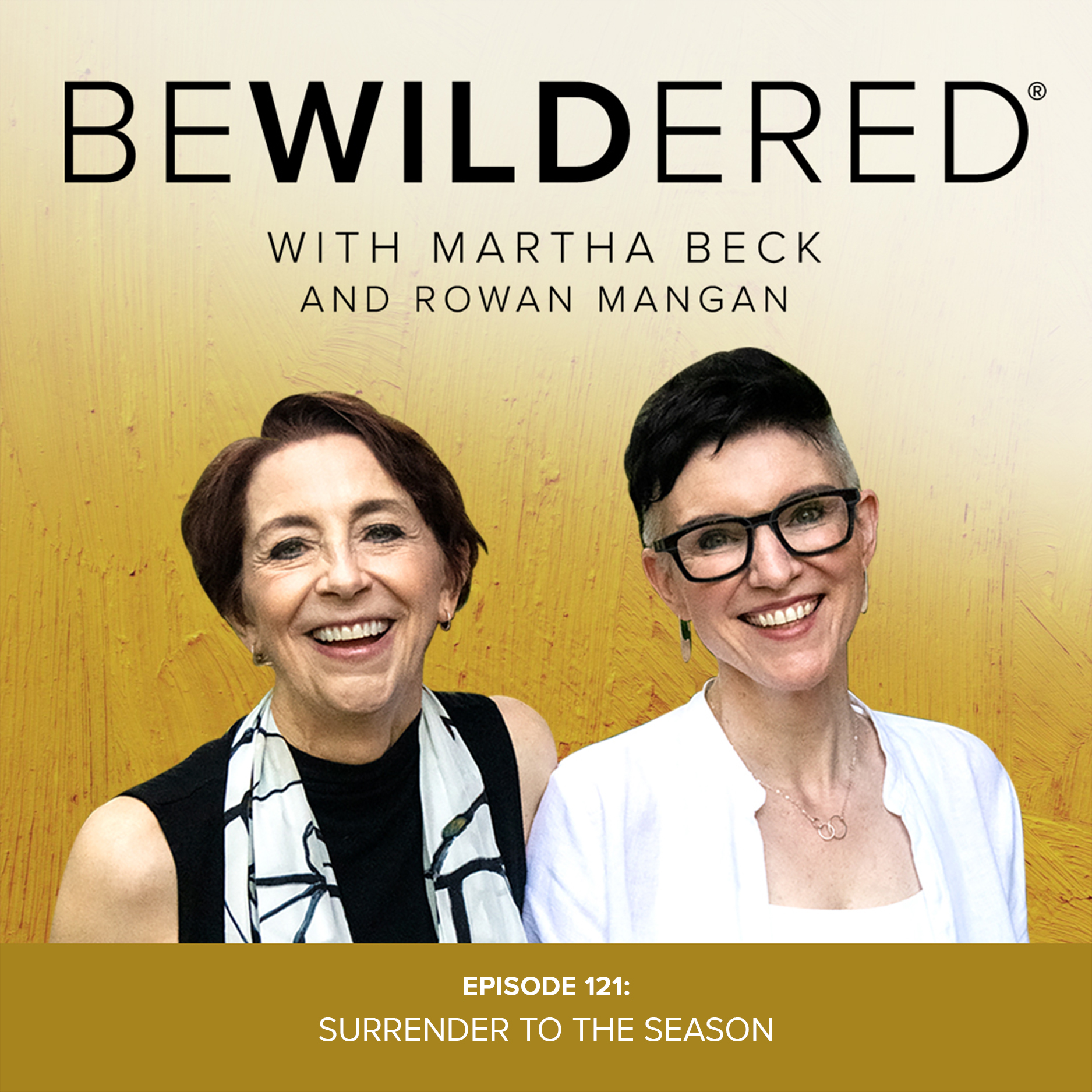
About this episode
How are you weathering the season you’re in? In this episode of Bewildered, we talk about what it really means to surrender to the season, whether it’s an upstate New York winter, perimenopause, a busy parenting era, or the “my foot hurts and I think my gums are receding” phase of life. We talk about how culture tries to flatten all seasons into one endless, brightly lit, 69-degrees-and-productive-all-the-time moment, and why our bodies, souls, and sanity refuse to go along with that plan. Join us!



Surrender to the Season
Show Notes
How are you weathering your current season?
In this episode of Bewildered, we get honest about what it really means to surrender to the season you’re in—whether that’s an upstate New York winter, the onset of perimenopause, a busy parenting era, or the “my foot hurts and I think my gums are receding” phase of life.
We talk about how culture tries to flatten all seasons into one endless, artificially lit, always productive moment—blueberries in January, tomato seedlings under grow lights, and a life that feels like high summer all year long.
Our bodies, souls, and sanity, however, refuse to go along with that plan. Because we’re part of Nature, our rhythms are cyclical, and our energy is always changing. There’s a deep, primal “Fuck it, I don’t want to!” that winter brings up, and it’s different from “I might actually freeze to death out there.”
Anxiety can happen when we constantly anticipate a projected future (“winter is coming”) instead of in the actual season we’re in right now. Pushing a season before it’s ready can kill the growth that’s still happening under the surface.
We explore how honoring the literal seasons around us can help us honor the metaphorical ones within us: the springtimes of new beginnings, the summers of ease and excess, the autumns of harvest and gratitude, and the winters of rest, gestation, and jewels of wisdom.
If you’re tired of pretending you’re always supposed to be in the same season, this episode invites you to snuggle up, get some hot cocoa, and surrender—not into apathy, but into celebration, gratitude, adaptation, and the uniquely beautiful season you’re in right now. Join us!
Also in this episode:
- Martha takes on a jolly-yet-creepy uncle persona to speak Spanish.
- Ro buys machines to avoid everyday effort (like holding a book).
- Lila takes a bath and says she wants to “flee the facility.”
- The “refreshing” cold of frozen eyeballs and horizontally blowing snow
- Perimenopause, “croning,” and a rich tapestry of night sweats
TALK TO US
You can follow us on our Instagram channel @bewilderedpodcast to connect with our Bewildered community, learn about upcoming episodes, and participate in callouts ahead of podcast taping.
And if you’re a Bewildered fan, would you consider giving us a little rate-and-review love on your favorite podcast player? Ratings and reviews are like gold in the podcasting universe—they help people find us, they help build this beautiful community, and most of all, they help us in our quest to Bewilder the world…
Episode Links and Quotes
- A New Earth by Eckhart Tolle
- The Book of the Eskimos by Peter Freuchen
- “Splinter” – Ani DiFranco
- If This Isn’t Nice, What Is? by Kurt Vonnegut (six seasons idea)
- Anchorites
- “Summertime” – Louis Armstrong and Ella Fitzgerald
- A Game of Thrones by George R. R. Martin
CONNECT WITH US
- Follow Martha on Instagram
- Follow Ro on Instagram
- Follow Bewildered on Instagram
- Join us in the Wilder Community!
- Listen on your favorite podcast app
- The Bewildered Show Notes
- Is there something you’ve been feeling bewildered about? If so, let us hear from you!
Transcript
Please note: This is an unedited transcript, provided as a courtesy, and reflects the actual conversation as closely as possible. Please forgive any typographical or grammatical errors.
Rowan Mangan:
So Marty, this episode of Bewildered is called “Surrender to the Season.”
Martha Beck:
Indeed it is.
Rowan Mangan:
There are seasons that we experience.
Martha Beck:
Yes.
Rowan Mangan:
In the outside weather.
Martha Beck:
Weather seasons.
Rowan Mangan:
In our own lifetimes.
Martha Beck:
Lifetime weather season.
Rowan Mangan:
In the work that we do, in the people that surround us.
Martha Beck:
In each and everything we make.
Rowan Mangan:
There you are.
Martha Beck:
There are different seasons.
Rowan Mangan:
And the thing about it is, ugh, surrender. Just give up. That’s what I say.
Martha Beck:
Yeah, but that is not what the culture says. The culture says, “Don’t.” But we say—
Rowan Mangan:
We say celebrate it.
Martha Beck:
Surrender to the season and even celebrate the season. It’s a way to be happy.
Rowan Mangan:
It’s how we’re talking today. Hope you enjoy it.
Martha Beck:
Hi, I’m Martha Beck.
Rowan Mangan:
And I’m Rowan Mangan, and this is another episode of Bewilded. It’s the podcast for people trying to figure it out. Isn’t it?
Martha Beck:
It is. We’re trying to figure it out, and week by week, we keep trying. Do we figure it out?
Rowan Mangan:
Hell, no.
Martha Beck:
Not really. No, not ever.
Rowan Mangan:
No.
Martha Beck:
What are you trying to figure out these days?
Rowan Mangan:
I’m trying to figure you out.
Martha Beck:
Oh. Good luck, lassie.
Rowan Mangan:
I mean, you are complex and yet so simple. You are such a sweet, simple little creature. For instance, just before we came over here to our studio, you were wandering through our coworking space, and you did spy some photographs on a wall and I watched your little face go, “Ooh.” And you just stood there, completely unselfconscious, going, “Ooh”. Not actually making that noise, but because we’re in an audio context, I’m trying to show the expression on your face with that noise. “Ooh.”
Martha Beck:
You know why though? It was perforce, it was not like I had an option. I had to. Well, the lip, the embouchure, the position of the lips. I told you, there was a picture of a woman playing a flute.
Rowan Mangan:
What were you expected to have done?
Martha Beck:
My mirror neurons just reacted. It’s not my fault. “Ooh.”
Rowan Mangan:
And then the thing that was really on my mind about you and your cute little brain and your little face.
Martha Beck:
Why do you think it’s cute?
Rowan Mangan:
It’s very cute. And it’s that you have a new thing that you do because we try to—we speak to each other in many languages.
Martha Beck:
It’s true.
Rowan Mangan:
Some of them not known to humanity.
Martha Beck:
Yes.
Rowan Mangan:
But we have been trying to practice our Spanish because regular listeners will know that we Duolingo. Duolingamos. Duolingo, duolingas.
Martha Beck:
For as long as three minutes a day.
Rowan Mangan:
Yeah. And that’s kind of the issue, isn’t it? Is that we’re both—we have things we do when we can’t get to the word, and one of them is go to French.
Martha Beck:
That’s true.
Rowan Mangan:
You very irritatingly go to a mixture of Chinese and Japanese, neither of which I speak.
Martha Beck:
Sometimes German. Not that I speak that either, but kind of.
Rowan Mangan:
But then when we try to speak Spanish and we cannot find the word, there’s this new thing that you do where you have a persona of someone who speaks—of you who speaks Spanish.
Martha Beck:
“Necesito un boligrafo.” Yeah.
Rowan Mangan:
But that’s not the personality.
Martha Beck:
Oh. “Por favor, no.”
Rowan Mangan:
The personality of this person is very like a jolly, slightly creepy uncle at Christmas where you just start going, you’re desperately trying to think of the word. So you’re like mid-sentence talking to me, and then you just go “Ha ha ha.” And like holding your mouth in this weird way because it’s trying to—
Martha Beck:
In a Spanish way.
Rowan Mangan:
Wait, make your mouth more Spanish. That will help the words come out.
Martha Beck:
You know, it is true. Each language has a certain way you have to hold your mouth. Spanish is in the front of your mouth, I finally discovered. French is like way back in the back. I just said something in French. I don’t know what it was, but it was passionate.
Rowan Mangan:
I think it was related to the Watergate scandal. All right. So that’s it. Just this little version of you that goes, “Ha-ha.”
Martha Beck:
Oh my God. I am having—anybody who does Duolingo will know that there is, I don’t know what it is in other language-learning modules, but in Spanish it’s Lily, who is a sort of snarky teenager and calls you and wants to talk to you about things.
Rowan Mangan:
Yeah. She’s AI also.
Martha Beck:
I know. I did figure that out. I don’t actually think anybody’s like—
Rowan Mangan:
I’m telling the listener.
Martha Beck:
Yeah. Oh, okay. Got it. All right.
Rowan Mangan:
I’m helping you, right?
Martha Beck:
So I kid you not, when the lesson turns out to be Lily calling me, I literally go out into a flop sweat. I start shaking. My brain is completely paralyzed. I can’t think of anything unless it’s in maybe Chinese. And Lily is calling. And I either just defer, “Can’t speak now,” or I take a deep breath and I just am all in. And she says something about, “When did you receive your diploma?” And I’m like, “Life isn’t about diplomas, Lily. It’s about the compassion we feel for another, not only for humans, but for all living beings.” And I’m just ranting, just—here’s the thing.
Rowan Mangan:
You don’t want to use the past tense.
Martha Beck:
That’s true. Here’s the thing about all the European languages. Just say it in English with that accent. Nine times out of 10, you’re going to get the right word. I remember asking our friend Katya if you said that in German “bear” was “bahr” or something. And she’s like, “No.” And I said, “What is it? ” She said, “Bear.” And almost anything with an -ion on it, just pronounce it in Spanish, you’ve got a cognate. Whereas Chinese: There was not one cognate.
Rowan Mangan:
It was really hard for you. I’m really sorry about that.
Martha Beck:
But it makes everything else seem really easy, but I think they may send help for me because these rants I do with Lily are truly demented.
Rowan Mangan:
They, for a little while, when they first introduced that feature, they would have a surprise call from Lily, not like, “Here’s my lesson from today.” And someone was telling us that he was in bed with his spouse, decided to quickly get the Duolingo because you get penalized if you don’t do it.
Martha Beck:
Oh, you do.
Rowan Mangan:
And so he’s on his phone. His spouse is asleep. And then he opens his phone to do his Duolingo and suddenly he’s like … And he’s like, “Lily, no ahora, Lily. No ahora.” Like getting caught.
Martha Beck:
It is. It’s a fun and lovely world.
Rowan Mangan:
Yes. And I love the creepy uncle that you become when you speak Spanish.
Martha Beck:
Thank you.
Rowan Mangan:
So anyway, what are you trying to figure out, Marty?
Martha Beck:
You’re always trying to figure me out. So I’m like, it’s tit for tat. And you can make what you want of that phrase. You just had to go there, right? Those who don’t have visuals will not know what I just was talking about, but imagine it. It wasn’t tat. That’s what I’ll say. So here’s the thing, though. You seem to be on an absolute pell-mell, determined course to eliminate all forms of effort that have to do with everyday life. And the way you do it is you buy machines that do things that machines are not needed to do.
Rowan Mangan:
Like what?
Martha Beck:
Well, last night I came in and you were like strapped into this contraption. You were holding your arms out and around them were wrapped these nylon straps and the straps were attached to what appeared to be—
Rowan Mangan:
This sounds like lesbian sex toys and it’s not.
Martha Beck:
No, no, no. It appeared to be like some kind of alien with two tiny legs and two big ones. And it was convulsing itself on your neck and you were going, “Oh,” and doing a very slow and terrifying dance that involved your arms out. The thing is on your neck. It’s like chewing at you like a mountain lion trying to kill a goat, like right there at the base of the neck. It’s munching away, this alien, and you would go down into sort of a crouch, and then hold one leg up and then crouch, other leg up. I have footage.
Rowan Mangan:
I didn’t start dancing until you started filming.
Martha Beck:
That’s what you think. You just weren’t conscious of the dance.
Rowan Mangan:
It’s this hard thing because it massages on both sides equally.
Martha Beck:
Oh, massage. Okay.
Rowan Mangan:
But I only needed it on the one side. So simultaneously it was like, “Oh yeah, that,” and also “Ow!” on the other side. And so I was like, “Ow, Ooh,” you know?
Martha Beck:
Then what I know now? It is a matter of weeks, possibly days, before I come in and you will have a more advanced machine that you can target to one or the other sides of your body because if it happens, you will look for a machine that does it. And that is just all human activity across the board.
Rowan Mangan:
Yeah. We’ve talked about this before, and I think it’s a brilliant thing about me. I will say as a side note, that was all Karen buying that machine. I just am the only one good-hearted enough to use this thing that someone’s sunk our money into. But yeah, don’t you ever feel like you should Google: “Is there something that makes it easier to hold a book up in your hand?” And inevitably, in this glorious late capitalist world we live in, there is that thing.
Martha Beck:
You know what I Google?
Rowan Mangan:
And it is available for $2.99 for a pack of 25 that you never need more than one.
Martha Beck:
Do you know what I Google?
Rowan Mangan:
Landfill.
Martha Beck:
“How do I strengthen my hand? What exercises can I do so that holding a book up is easier?”
Rowan Mangan:
Oh, yes. Yeah. That’s our two personalities.
Martha Beck:
Yeah. And it’s why I am seeing the dim horizon of my life and you are just coming on dawn. Yeah. Sunset to the analog world. Morning for the digital and machine. Yeah, I’m not making any sense.
Rowan Mangan:
No, I mean, I’m following you. It’s a stretch.
Martha Beck:
I would rather do things with biological forms, and you could be a head in a jar and your entire life would be taken care of by the things.
Rowan Mangan:
How dare you? If I was a head in a jar, what would my alien rub?
Martha Beck:
You make a solid point. The jar, probably.
Rowan Mangan:
It is a creepy looking thing. I’ll give you that. I mean, it is very much the Sigourney Weaver Alien.
Martha Beck:
Yeah, this thing.
Rowan Mangan:
Yeah. And it does kind of pulsate.
Martha Beck:
Yes. And it’s very, I will say it’s almost incredibly hard to make something that is a massager and does not look like a sex toy.
Rowan Mangan:
It’s true.
Martha Beck:
Yeah. Although, I went—
Rowan Mangan:
Let’s dig in a bit further. I think this is going really well.
Martha Beck:
I went to get a massage, and I went to this place near our home in Woodstock, Woodstock, New York. And there was this long, it looked like a cigarette holder, but it had bristles. No, I’m going to take you over and check it out because I said, and it was like “Special gift for Christmas.” And I was like, “What the hell?” I couldn’t figure it out. So I took it to the woman at the counter and I said, “What does this do? ” And she said, “Well, I don’t know, but that company generally provides pleasuring instruments.” And I’m like, “Sex toys?” I said. And she’s like, “Yes.” I’m like, “What for either gender could you do with a bristly cigarette holder that would not be sheer torture?”
Rowan Mangan:
A bristly cigarette holder.
Martha Beck:
I’ve got to show it to you. It’s so bizarre.
Rowan Mangan:
Did you buy it?
Martha Beck:
God, no! You would have because you need something to put your head in a jar.
Rowan Mangan:
Put my, stick head on a cigarette holder.
Martha Beck:
Yeah, I have no idea. So if anybody out there knows—
Rowan Mangan:
Keep it to yourself.
Martha Beck:
Keep it to yourself. Because I don’t know. No.
Rowan Mangan:
Do you remember, I don’t know if we’ve talked about this on Bewildered before. There was someone we met, we didn’t know them very well. I desperately hope they don’t listen to this podcast, but one of our first social encounters with them that was planned, we were given a gift, and it was like quite literally a vagina steamer for us to share.
Martha Beck:
Probably everybody out there is going, “You didn’t have your own vagina steamer? Ya losers.” I mean, it’s a thing now. We just didn’t know.
Rowan Mangan:
We didn’t know.
Martha Beck:
We were living in the woods. You’d think you’d know more if you were living in the woods, but no.
Rowan Mangan:
No. We had herbal tea. It’s not like we didn’t know anything about steam and herbs.
Martha Beck:
We just—
Rowan Mangan:
Wrong orifice.
Martha Beck:
Exactly. Yeah. I’m not even going to go down that rabbit hole because you could get into comparisons and burn patterns that are possible if you use it incorrectly, for either the tea or the steamer.
Rowan Mangan:
Yeah. Listen, I just want to say, I think we should be really proud of ourselves because this is going really well. And I don’t think we have anything to be ashamed of.
Martha Beck:
Except I’ve ruined your Christmas present now.
Rowan Mangan:
Okay. It’s a bristly cigarette holder.
Martha Beck:
What the hell are we talking about?
Rowan Mangan:
You know what I think? Let’s do a podcast.
Martha Beck:
What?
Rowan Mangan:
Yeah.
Martha Beck:
But what will our listeners think? “They actually got to a point? When has that ever happened?”
Rowan Mangan:
So today, Marty, we’re going to talk about a thing called—that we named, and therefore it is called—”Surrender to the Season.” And what we mean by that, if you can imagine such a thing, is you know the season that it is outside—hot, cold, leaves, no leaves? Surrender to that. Just give up.
Martha Beck:
Okay. Let’s go.
Rowan Mangan:
It’s all over.
Martha Beck:
Good job. Let’s call that a wrap. No, it’s been very, very interesting. And I mean this with great love.
Rowan Mangan:
Oh gosh.
Martha Beck:
It makes me shriek with laughter inside myself to watch an Australian encounter an upstate New York winter because I mean, upstate New York winter is not quite as bad as the Boston winters I had to cope with as a teen.
Rowan Mangan:
Really? You’ve never talked about it endlessly.
Martha Beck:
Yeah. But you know, so you’d think you would know, but it’s that—
Rowan Mangan:
Yeah, like you know, but you don’t know, know.
Martha Beck:
It’s like somebody who encountered—I remember in Singapore when I lived there for a year, my Chinese teacher going, “Yes, and it’s always, it gets cool at night here.” And I’m like, “You want to know cool? You should try the top of the Rocky Mountains where I grew up.” And she’s like, “Yes, it gets very refreshing there.” And I was like, “And more than refreshing.” And she’s like, “Cold. So refreshing.” And I was like, “No, let me tell you, your eyes begin to water because your eyeballs are freezing solid and then your eyelashes freeze together. That’s how cold it is.” And she’s like, “Ohhh.”
Rowan Mangan:
Sounds refreshing.
Martha Beck:
So refreshing. She just couldn’t get past it. Drinking an iced tea was the coldest she’d ever been. And I really wanted to just—I loved her, but I wanted to take her and just dip her in a snowstorm and see that look of shock and understanding that I see in your eyes every day.
Rowan Mangan:
It’s a lot.
Martha Beck:
It’s a lot.
Rowan Mangan:
It’s a lot. There’s that thing that I said to you a couple of weeks ago where I got out to gas up the car or something and I was like, “Marty, I think if I stayed out here much longer, I could die.” I’m not even exaggerating. I think that it is possible that it could be so cold I might just expire.
Martha Beck:
Right. Yeah. And you’re not used to your body giving you that message.
Rowan Mangan:
No.
Martha Beck:
When I went to look for the Northern Lights with some friends in the Arctic Circle, it’s very frustrating.
Rowan Mangan:
Tell me you didn’t just go out looking, just wander off into the—
Martha Beck:
As you go out, they drive north from the edge of the Arctic Circle and you’re going north to the North Pole. The feeling, you don’t need to even actually experience what’s outside. I was in a bus, a heated bus. We went right from a log cabin that was heated to a bus that was heated and we’re driving along, but you know, your entire body knows that if you are out there for 30 seconds, you’re dying, you’re dead. It was terrifying. Just to be there was terrifying. And so I identify with what you’re going through because I’m used to the cold we’re getting now, 15, 16 degrees. And by the way, that’s Fahrenheit, not centigrade. 15 degrees Center Hide. Center Hide? 15 degrees centigrade—anyone can cope with that, but Fahrenheit is a different proposition. So it’s very sweet to see you park the car at the house and then put on full gear because every heating device known to man is already in the car. So that you basically have to strip down to your underwear to be okay in the car because the seat is heated. The car itself is heated. There’s heat everywhere, right? Heat. And then you get to that, and instead of just grabbing your coat and hoofing it to the house in a butch way, like me.
Rowan Mangan:
How dare you accuse me of not being butch?
Martha Beck:
Sorry, honey, but you just have a few more winters to go through. You get completely bundled up before you get out of the car to go to the house, which is adorable.
Rowan Mangan:
Yeah. I’m still alive.
Martha Beck:
You are. And that is to your credit. But here’s the deal.
Rowan Mangan:
Oh, can I just say one thing?
Martha Beck:
Yes, please.
Rowan Mangan:
There are noises that you don’t know about. And I was like, “What the hell is that? ” And you’re like, “That’s the sound of snow and ice falling off the house.” That was a new one.
Martha Beck:
Yeah. I really have, all kidding aside, it is delightful to watch you experience a northern winter. It’s like having two five-year-olds. But you’re a nice one who doesn’t, as Lila said yesterday, “I want to flee the facility.”
Rowan Mangan:
What the fuck is she talking about when she says shit like that?
Martha Beck:
Where does she get that?
Rowan Mangan:
I want to flee the—I swear to God, because you can’t make that up. No one’s going to make that up that their five-year-old said, “I want to flee the facility.”
Martha Beck:
And she’s like, “I want to fwee the faciwity.”
Rowan Mangan:
You know what? That’s really troubling. We should discuss that offline.
Martha Beck:
Oh God.
Rowan Mangan:
That’s troubling.
Martha Beck:
It is. There’s so many troubling things.
Rowan Mangan:
Do you think it’s possible that we’re all part of an experiment and she’s the only one who’s aware of it?
Martha Beck:
I think so. When she gets in the bathtub and says, “Look, it’s an ocean of chlorine and sunshine.” What? Where did she—
Rowan Mangan:
Something’s wrong.
Martha Beck:
Where’d she freaking get that?
Rowan Mangan:
Something’s wrong.
Martha Beck:
We’re not even making these up. She said them.
Rowan Mangan:
You can’t make it up.
Martha Beck:
Yeah. Okay. Anyway, I—
Rowan Mangan:
Surrender to the season.
Martha Beck:
Surrender to the season. And what you said to me the other day was interesting to me because my way is you don’t surrender to the winter. Having lived through winters where I had to get up and walk to school in my choir-outfit dress, no matter what the temperature was, I was like, you hate it when you’re a kid. You weep because you have to go out in it. And then you’re like, “Oh, okay. I’ll toughen up,” and you just do it. And that gets sustained. So I’ll jump out of the car to pump gas and I don’t put my coat on and everything and I stand there in the 13 degrees and you’re like, “You’re going to die out there.” And I’m like, “No, I know this. I’m not going to die.” But you were bringing— So to me, it’s like winter, summer, same requirements, same behaviors. Get out there and pump the gas like you would in the summer, right? But you said something about how winter is a different thing.
Rowan Mangan:
Yeah.
Martha Beck:
It’s not the same to live here in the winter.
Rowan Mangan:
Winter commands respect.
Martha Beck:
Yes, it does.
Rowan Mangan:
I am from a country or at least a part of Australia where summer’s hot and winter’s cold, but the range is not that great. And I used to think it was amazing and almost impossible the way that I heard Northern Hemisphere people, but especially Americans would refer to past times by the season. “I remember last fall” or whatever. And I would think, “How do you know? How can you know what it was? ” I mean, that just doesn’t…But I look here and the entire freaking landscape, it’s a different place.
Martha Beck:
Yeah. It’s a markedly different place with different requirements and different pressures.
Rowan Mangan:
And especially winter.
Martha Beck:
Yeah. When you’re in a place that has seriously cold winters, here’s the thing. We talk about culture versus nature on this, that culture is coming to consensus and it tries to make us all into these automatons that were meant to serve the industrial revolution. We’re all supposed to be factory cogs in the great materialist machine and all that. And so in the winter—you know, in the summer, you show up and punch the clock. In the winter, you show up and punch the clock. There is no difference. And I had learned to just think that, but it’s not true at all. It is very different to get up in September, dress your kid, and take him to school, versus getting up out of a warm bed when it’s still dark and trying to get yourself warm enough and then trying to force a very strong human being into a snowsuit against their will.
Rowan Mangan:
Yeah, that’s not for the weak.
Martha Beck:
No, it isn’t. And it is heavy physical labor and it takes a lot of time. And by the time you get to get to school, you’re pretty much done for the day.
Rowan Mangan:
Yeah. Well, that’s certainly true for me. So everything you’re talking about, I agree with in that it’s cold and dark and snowsuits. But there’s another layer of it that I feel like we’re all in our household really confronting with our first Catskills winter, which is there’s this inner level of “Fuck it, I don’t want to.”
Martha Beck:
Oh, it’s deep.
Rowan Mangan:
That is separate from, “I will die of this cold.” It’s just like, “I don’t want to.” And some really fundamental part of me believes with every fiber of its being that I don’t have to.
Martha Beck:
Well, yeah, and I think we shouldn’t have to. I remember one of my favorite books that I’ve ever read was called The Book of the Eskimos. And I don’t think that’s a politically correct term.
Rowan Mangan:
I think it’s gone back to being correct.
Martha Beck:
Okay. Well, this was written in 1906 by a guy who, I think he was Danish, but he went to Greenland, fell in love with an indigenous woman. And then he lived most of his life in Greenland, which is some harsh winter, I’m here to tell you. And basically—
Rowan Mangan:
The winter expert here, ladies and gentlemen.
Martha Beck:
Yeah, the Greenland expert. I’ve read about it. He said they would basically just lay in supplies during the short warm season. And in that part of the north, they built homes out of stone, but home is a pretty strong word for it. It was more a dugout that was under a big rock, like a boulder. And then everybody would go in there and lie down. And that is basically how they spent the winter, which was long. And they would get out to get their food, but they’d just basically lay there in the dark, which never ended.
And they would tell stories and sing songs, but they were lying down in the dark. And that’s how they conserved enough calories. And they were all bunched up together, so they were warm, not unlike the ladybugs that are hibernating in the top of the roof in our house.
Rowan Mangan:
Yeah, there’s fewer every day. But okay, so here’s the thing is I don’t want to do that either. I just want to be very clear in case I’m powerfully manifesting something from the universe right now. When I say I don’t want to go out and do shit, I do not mean that I want this dugout-in-the-dark thing. I want soft blanket, central heating, marshmallows in hot chocolate, just to be very clear, six to eight seasons of a show I’ve never seen before, but that is brilliantly written and a full-time live-in au pair.
Martha Beck:
Okay.
Rowan Mangan:
Got it?
Martha Beck:
I do think that’s the way. As long as you also have a machine that climbs onto your back and massages you while you dance slowly around the living room.
Rowan Mangan:
That’s more my speed. Yeah.
Martha Beck:
No, but you’re right. There’s something biological. There’s a social aspect to it. There’s a biological aspect to it. And really, truly, I think that when you are undergoing an icy, long night/short days winter, to force your body to show up at the office at exactly the same time—as if we had an office, but hypothetically—and pretend that you feel the same way you feel in the summer and then leave after dark. I mean, when I was going to school, it was like pitch dark by four in the afternoon, and it was so depressing.
And I remember the freshman library, everybody would go to stay and they closed it at 11:00. And it had these double doors, kind of the airlock arrangement. And everybody would be kicked out of the library, but only the first bank of doors. And then we would just cluster.
Rowan Mangan:
Like ladybugs.
Martha Beck:
Like ladybugs, yes. Or Greenlanders of yore. Not your Greenlanders, Greenlanders of, oh, I’m just digging myself in deeper—like the Greenlanders. I’m sorry. Okay. So we would all be in the airlock, all of us freshmen, looking out at this heinous cold and the snow would be blowing horizontally because the wind was so bad.
Rowan Mangan:
Oh my God.
Martha Beck:
And people would just stand there and cry.
Rowan Mangan:
Yeah. Very wisely.
Martha Beck:
Yeah. And then when you had to go out in it and the tears froze to your face.
Rowan Mangan:
Oh my God.
Martha Beck:
Brutal. It was so brutal. And then I saw an episode of 30 Rock where they’re in New York, 30 Rockefeller Plaza, and then they go to Boston to shoot a show and all of them just freeze in place and they start going, “The cold, the cold!” And it was very validating.
Rowan Mangan:
I feel like there’s a lot of validation that you are yet to receive—
Martha Beck:
This is trauma.
Rowan Mangan:
—for having lived in Boston for a while.
Martha Beck:
I have joke about it being trauma, but it actually was because the first year I was there, my coat got stolen and I didn’t have warm outerwear. I just had to run everywhere to stay warm. And I remember going to art class with my sketchbook and I’d be running and every time both of my feet were off the ground at the same time, the sketch would become a sail and just blow me sideways or backwards. And I’d land on ice and just be pushed like a sailing ship until I hit like a snowbank and then I’d have to dig in and try to fight my—It was like some kind of Jack London dystopic nightmare.
Rowan Mangan:
Sweetie, I feel like maybe we need to put some time aside, not in front of mics to process this. Yeah.
Martha Beck:
Okay. Yeah. Back to now. All right.
Rowan Mangan:
Okay. So if your season is that, what she was just describing, don’t surrender to that in the sense of don’t go towards the light right now. I’m much more in the, “Let’s just go ahead and lie down on the couch and not torture ourselves with the industrial revolution’s demands.” We’re little hibernaties, we need a little sleeping bag.
Martha Beck:
Yeah, we do.
Rowan Mangan:
And we Just need seven or eight seasons of a really good show that involves espionage of some sort.
Martha Beck:
Okay. We have extraordinary privilege in so many ways, and one of the aspects of our privilege is that we get to adapt our schedule—except for Lila’s school schedule, which is still tapped into the larger culture. But we can basically say we’re going to go to bed at eight o’clock. We’re going to sleep until—
Rowan Mangan:
And we do.
Martha Beck:
And we do. We’re going to sleep until seven the next morning because who doesn’t need 11 hours of sleep in the winter? No one I like. And then still get up a little bit like, “Oh, really?” And just truckle around a little bit during the brightest part of the day.
Rowan Mangan:
Truckle is a good word.
Martha Beck:
I just made it up.
Rowan Mangan:
Yeah.
Martha Beck:
But here’s the thing. If you’re too integrated into culture—as we are with the school system—you have to fight that impulse. And so it’s fighting, fighting, fighting. And it’s not just winter. It’s like that Ani DiFranco song says that nobody goes outside in the summer because we can’t even bring ourselves to sweat. What’s that line?
Rowan Mangan:
Yeah. “Sweat in the summer, shiver in the winter, just enough to know you’re alive.” Yeah.
Martha Beck:
Yeah. And the fight is to say that it’s always 69 degrees in a dry, brightly lighted area where we put machines together as machines.
Rowan Mangan:
You know what is occurring to me as you say this, and I’m sorry because I’m just completely derailing your point, but is that whenever we talk about, “Oh, Lila goes to school, blah, blah, blah.” We get comments that say, “Why are you even forcing her into the school system? You should be homeschooling, blah, blah, blah.” And so I was just in this little interesting little thought bubble of my own where it was like, “But you know what? We all contain multitudes.” And just as those Greenlanders of yore would have lost their freaking minds, let’s be honest, in that hole, right?
Martha Beck:
Yeah.
Rowan Mangan:
Part of surrender, part of what we always come to when we’re about our nature is also adapt, right? And one of the things that our kid’s neurotype, and to some extent, our various neurotypes respond well to, is some external structure.
Martha Beck:
Yes.
Rowan Mangan:
Right? And so it’s like, it’s complex.
Martha Beck:
No, but it’s interesting because you said the Greenlanders would go out of their minds and maybe they did, but from what I recall from The Book of the Eskimos is that they surrendered to that being the necessity. So they did not lose their minds. I don’t know if they did some deep form of meditation or what they did, but there are people who, there were anchorites in Europe who would lock themselves in caves and meditate for the rest of their lives for the glory of God.
Rowan Mangan:
But there are weird people in every society.
Martha Beck:
All right. Well, maybe if you have to surrender more, there are more weird people because surrender makes you look weird according to… It’s also normative for us to be up and talking and entertaining ourselves. Maybe that’s not what their nature wanted to do. But okay, and here’s the deal.
Rowan Mangan:
We’re trying to thread needles.
Martha Beck:
I know. But okay, you didn’t derail the point at all because part of what we’re talking about is not just literal weather. It is also the season of your life, the season of your age group or whatever, and what needs to happen at those times. And if you’re in the springtime of your life, you need outward—you’re coming into bloom. So it can be autumn, summer, winter, fall in the weather sense. But if you’re a little kid, there’s so much joy in exploring the world. You’re like a little seedling that’s coming out of the ground basking. And now scientists tell us that plants actually play when they’re growing. Isn’t that wild?
Rowan Mangan:
That’s so beautiful.
Martha Beck:
And there’s so much joy. And if you look at the light celebrations all over the world in the dark nights, whether you’re Southern, Northern, it depends on where you are when the dark time comes. But in the Northern Hemisphere, during the dark winter months that we’re in now, there are celebrations with lights everywhere, with candles, with bonfires, with carrying lights around, carrying a lantern around. And there’s this jubilance that goes with you don’t fight the cold and the dark. You find joy within it.
Rowan Mangan:
Oh yeah.
Martha Beck:
And that’s part of the surrender to the season. If you just sat there thinking, “I wish it were summer. I wish it were summer,” you’d never invent cocoa and marshmallows, right? You’d be like, “Where’s my iced tea? Why is it so cold here?”
Rowan Mangan:
“This must be really refreshing.”
Martha Beck:
And winter isn’t the only one you have to surrender to. There are different things that happen in each season. And I think if you can flow into joy in response to what’s happening around you, that’s the nature, that’s the natural way.
Rowan Mangan:
Yeah. And it’s kind of interesting to imagine each of us embodying a range of seasons. There is a quite literal, in our kitchen where we come in the back door, there’s this coat rack that is just this enormous human lurking in our kitchen right now because there’s 17 coats. I don’t know why. There’s only five people, but there’s 17 coats on there all the time. And so there’s that happening. And then at the same time, there are people in their 60s, there are people in their 40s, there are people in their 30s, there is person in their 30s, and there is a person in their—
Martha Beck:
Five.
Rowan Mangan:
“I want to flee the facilities.” And so we’re all living through these different facets, but it’s all seasonal. And I had a really interesting thing happen, a conversation with Karen the other day that I’m just trying to decide how much I talk about perimenopause on this podcast, but let’s just go there.
It’s so beautiful. It’s so beautiful.
Martha Beck:
Perimenopause is?
Rowan Mangan:
Yeah. It’s so beautiful to wake up in a tiny puddle of your own sweat after two hours of sleep. It’s just like, it’s part of the seasons. It’s the rich tapestry of night sweats.
Martha Beck:
Would that be autumn? That would be autumn.
Rowan Mangan:
Yeah. I feel like there are many seasons.
Martha Beck:
All right. We can talk about that later. Tell me more about perimenopause.
Rowan Mangan:
Oh, please. And so I’m complaining about these symptoms quite a lot. And then I was saying to Karen, at the time we’re recording this, that it had been kind of a dark week in the news. I don’t know if you guys could imagine that such a thing, but I bumped into Karen in our house, chatty, chatty, how you doing? How’s the day going? And I said to her, “You know, I’m aware of this sense of a very slow-burning rage deep within my spirit right now as I read the news and so on.” And she’s like, “Oh, you’re becoming a crone. You’re going through the perimenopause and you’re accessing your power.” And it’s like, every now and again, I mean, also, but like—
Martha Beck:
She just rears back on her hind legs and just zings one.
Rowan Mangan:
Zings one. And she just said it like she was telling me what the guy at the post office said.
Martha Beck:
Right.
Rowan Mangan:
It’s so wild how she does that.
Martha Beck:
That’s probably what the guy at the post office did say.
Rowan Mangan:
Can you imagine?
Martha Beck:
No, that’s Karen’s wisdom.
Rowan Mangan:
That’s Karen.
Martha Beck:
When it comes out, it’s something.
Rowan Mangan:
Yeah. And I was just like, “Oh my God.” And actually she said, “You’re croning.” And Marty and I were having a funny time with the, you’re crowning, you’re croning.
Martha Beck:
If you’ve ever given birth to a child, there’s a moment when you’re crowning and that’s when they see the head and you get—and they give you a mirror to look at it. And when you said you were croning, that was the image I had of the crown of your head coming out through that particular opening.
Rowan Mangan:
So you’re like giving birth to yourself as an—so you imagine crowning, but they hold up the mirror and you see these old granny-hair little glasses knitting coming out. And it’s like, “Hello, dear.”
Martha Beck:
Benjamin Button. Oh my God. Yeah. So that is one of the seasons. Kurt Vonnegut said something about how there should be at least six. And between winter and spring, there was one he called Unlocking.
Rowan Mangan:
Oh, that’s good.
Martha Beck:
Yeah. I don’t remember what the other one he added was, but you can sort of slice it depending on what the weather’s like in your neck of the woods. There are all kinds of little seasons within seasons within seasons. And then you’re right, there are all these fractal seasons in human life where Lila’s clearly bursting out in the spring. We have little seedlings in our indoor garden where they just, you plant a seed and you go and there’s nothing, there’s nothing, there’s nothing. And then I swear to God, I went and checked on them before I went and watched a sitcom with Adam, came back, boom, six tomato plants in a half an hour.
Rowan Mangan:
And that is just the ultimate—sorry, derailing you again—but those seedlings that we’re diligently putting under the grow light, I get up at seven, turn on the grow light, turn it off at eight o’clock when we go to bed—and we’re trying to grow freaking tomato plants?
Martha Beck:
We’re pretending it’s summer.
Rowan Mangan:
We’re pretending.
Martha Beck:
We’re not surrendering to the season.
Rowan Mangan:
And if you’ve ever had your tomato seedlings burn in the frost, something’s wrong there. That’s not meant to be.
Martha Beck:
All of us from the north are going, “Really? That happens every year.” No, but you said to me when you came out of there, “We’re not supposed to be growing plants.” Like, plants are not supposed to be coming out of the ground right now. No, no.
Rowan Mangan:
Yeah.
Martha Beck:
Yeah, because you can feel the sort of—we have so many accommodations to make it seem like it’s always the same time. You go to the supermarket, you can always get fresh, you can always get blueberries, though they’re not available anywhere within 10,000 miles, you will get them.
Rowan Mangan:
Yeah.
Martha Beck:
Andt here’s something lost. I mean, between my studio and the househouse, there’s like a little path that I have to go outside. And I go back and forth probably every morning, every night, and in between several times. And it means like 10 seconds outside, even if it’s five degrees.
Rowan Mangan:
I will say it’s about 30 seconds.
Martha Beck:
Is it? Okay. Anyway, this is how quickly one’s body remembers the seasons because when we lived in Pennsylvania where it was also cold, I never left the house, pandemic. We’d get up, put on our pajamas, turn on the Zoom things, and order food to be delivered. We never left, and that’s kind of how I lived in Pennsylvania. And now I have to walk back and forth for 30 second periods, just little—and I feel so much more physically attuned to the world, to the earth.
Rowan Mangan:
Yeah.
Martha Beck:
And it’s actually like a nutrient that I was missing. It feeds something in me, even though it’s very, very cold and icy—it’s perilous. There are animals out there and I would’ve thought it was a negative thing, but it feels like, “I’m back on Earth. I’m back on Earth.”
Rowan Mangan:
Just enough to know you’re alive.
Martha Beck:
Yeah. And there’s an intimacy with the planet and the animals and everything. Hearing the coyotes, how at night where their voices carry so far in that cold, dry air, and it’s a weird disconcerting sound, but it’s like, “Right, Earth. I remember Earth.”
Rowan Mangan:
Yeah.
Martha Beck:
And so yeah, you were saying that about the tomatoes and I was thinking, well, how are we going to live next winter differently?
Rowan Mangan:
Yeah. And that’s kind of what it circles around too, right? Is where we’re in a season in a literal sense around us, we’re in different seasons in our lives, we’re in seasons, in mini seasons, and in between seasons, our work, our different businesses that we try to run are in their own seasons as well, requiring different qualities of energy. So I feel like when we get to the point of saying, how do we come to our senses, it’s about how do we accommodate the demands or the requests that the seasons bring? And what do our bodies and our souls need? And yet, we live in a culture. So how do we do that?
Martha Beck:
We’ll tell you that right after this.
Rowan Mangan:
So Marty, we have seasons, there are seasons, there are lives, there are businesses, there are many different parts of selves that experience seasons. Talk to me about coming to our senses within them.
Martha Beck:
Right. So in modern materialist culture, pretend there are no seasons, try to make everything consistent all the time, everything predictable and identical, no matter what time of year. But in reality, there are these qualities of season. And it’s interesting because almost every indigenous culture has a four-part division that is connected to the directions of the compass and everything. Even though not everybody has four seasons, it seems to have that quality to it. There’s a beginning, there’s a springtime. Well, there’s a birth, a death and rebirth. There’s an internalized period of growth that metaphorically maps to pregnancy where everything is happening internally: under the soil, inside the mind and soul and heart, inside the body. So everything’s very internal, and it doesn’t look like much on the surface, but if you push it to come to fruition, you’ll kill it, right? It’s gestational. So there’s that, and that’s the winter. And then the spring is this period of incredible dynamism and freshness and innocence and exploration. And those are the qualities of the beginning time, the springtime.
Rowan Mangan:
Mm-hmm.
Martha Beck:
And then there is—the qualities of summer are when the exploration gets more relaxed and there’s, I don’t know, what are the qualities of summer?
Rowan Mangan:
I feel like summer has this quality of excess and bounty and ease. And almost there’s sort of the, I think about high summer and a sort of bacchanalian solstice where it’s excess.
Martha Beck:
Yeah. And the song: “Summertime and the living is easy/ fish are jumpin’/ the cotton is high.” Like everything is easier and there’s a kind of languid rhythm to things. And also because it’s often hot, so you don’t want to be that active, but people hang out and like sip mint julips and commune in the summer. If you surrender to the season, there’s a way to celebrate each one.
Rowan Mangan:
Yeah.
Martha Beck:
Then there’s autumn, which is bring in the harvest.
Rowan Mangan:
Yeah, I was going to say agriculturally, it’s sort of about, it’s very “winter is coming” kind of thing, but it’s actually around here, a just almost unbearably beautiful time to—and I hate the feeling of using fall to focus on winter, you know what I mean? It’s actually like a really great time to go, “Stop thinking about winter.”
Martha Beck:
No, I mean, it’s really interesting to look at the way the Puritans girded themselves for winter, which is: “Brace yourself, things are going to get ugly,” and hoard everything, and the way the indigenous people taught them to celebrate the autumn, which is gratitude, gratitude, gratitude, gratitude.
Rowan Mangan:
Yes.
Martha Beck:
Every time I’ve been to a Native American ceremony, and I’ve been to several, it’s amazing. There are hours spent on gratitude. And these people have been so wrongly treated, like their whole history is just one long tragedy and they’re sitting there—sorry.
Rowan Mangan:
That’s a terrible thing to say about people’s entire history being tragedy.
Martha Beck:
I’m sorry. But what has happened to those cultures since Columbus brought the plague that killed one of about out of every five people on earth in the American continents, it’s horrible. And there’s—
Rowan Mangan:
There’s a lot of tragedy and there’s a lot to be proud of. And there’s a lot of beautiful lineage and beautiful stories.
Martha Beck:
And joy and wisdom and depth. And that’s why I was going to the ceremonies. I was trying to find and learn from that. And I felt like such a—talk about a tiny spriglet. And here were these people who talked for hours about how grateful they were. There was no mention of “the hard time is coming.” It was just like, “Look what we’ve been given. Look at the sunset. Look at the rainbow.” I remember somebody saying, “It’s a full circle, imagine it going under the ground.” And people just drenched in beauty. They didn’t have that.—and I don’t want to be sentimentalizing it or anything like that, but I really learned how to celebrate the autumn.
Rowan Mangan:
It’s so interesting because I feel like a lot when we have these conversations where we try to characterize our culture, this idea of the silo of grain or whatever, like the hoarding of food that gets done ahead of the winter is a sort of trope that is familiar to us. And I’ve never thought before about the obsession with the future as being a form of scarcity, and not being able to dwell in the beauty of the fall without obsessing about the scarcity of the winter to come is actually another really unfortunate tendency of the culture we live in.
Martha Beck:
You know what? You know what our culture does is it takes the absolute best characteristics of each season and tries to make it persist all the way across. So, if it’s cozy and you’re getting lots of presents because it’s wintertime and there are these gift-giving ceremonies in winter, there should always be a lot of material stuff. You should always be getting a lot of presents. If it’s spring and there’s action and there’s growth and new life, that should just keep going. It doesn’t matter if you’re 70, it can be the springtime.
Rowan Mangan:
Have nine children!
Martha Beck:
Exactly. And if it’s the summer and everything is easy, then everything should always be easy. And then it’s the autumn and the harvest is in, then it should always be harvest because of this obsession with, “I don’t want to let this go.” And so there are these parallel things. There are: “I am terrified about what is happening and about the negative aspects of each season. I don’t want to be too hot. I don’t want to be too cold.” And there is an obsession with hanging on to the most positive aspects of every season. And neither of those surrenders to the fact that everything’s always moving.
Rowan Mangan:
Yeah. It’s funny, I was just thinking about the Game of Thrones thing where the Starks, the people of—yeah, the Starks, the words of their clan are: “Winter is coming.” That is what they say to identify themselves is “winter is coming,” not “winter’s here,” not “spring is coming.” You know what I mean? It’s like we look at the future as though it looms over us in such a way that we’re always looking there, and we’re never here.
Martha Beck:
And the one emotion inevitably associated with living in a projection of the future is fear. If you’re always living with an eye on the future, and you’re never actually where you are, that’s highly associated with anxiety. And mindfulness is one of the most prominent ways to get out of anxiety. And it’s so simple, you just come here. And for us right now, that means that I find ways to celebrate getting—I have a new little ritual that you didn’t know about. I take my clothes for the next day every nigh,t and I tuck them into bed next to me and I curl around them and sleep with the clothes I’m going to wear the next day, so they’re warm and I can just slither out of my pajamas and into my clothes and not have to worry about it. But that’s a surrender to the season. Okay, I’m going to adapt and I’m going to have a good time. It’s fun.
Rowan Mangan:
It’s Martha Beck slithering into her clothes that she’s just slept in. Okay, you do you, boo. All right, so here’s what I think. Okay. I think that what you’re talking about with the ceremonies and the gratitude is that that’s key to me. If we’re wanting to—what do we surrender into? We don’t surrender into apathy and nihilism. We surrender into celebration and gratitude.
Martha Beck:
And adaptation, too.
Rowan Mangan:
Yeah. And ritual. I mean, my God, ceremony, all these beautiful traditions that we can draw on. Each season has amazing sort of things that we can do to come together with other people in recognition of what’s happening as the wheel turns or whatever, right? But it’s also to celebrate where we are each season, to accept that you’ll never at the height of summer get cozy.
Martha Beck:
No, you don’t want to be cozy. You don’t want to curl up in a cuddle puddle.
Rowan Mangan:
You lose the snuggle in the summer. So let’s celebrate the snuggle.
Martha Beck:
Celebrate the snuggle. See, I do think the celebration is the key. And also the way of dealing with it creatively. I’m thinking about how beautiful the clothing is that’s come out of being freezing cold, whether it’s the furs used by the Inuit people or the gorgeous sweaters they learn to knit in Ireland with the pattern of each family so that when inevitably the men were killed at sea, their bodies could be identified by sweater patterns.
Rowan Mangan:
Aw. Sweet.
Martha Beck:
So fun. So sweet. And then you go to someplace where it’s usually warm like Hawaii, and they’re making these incredible arrangements of flowers to wear just because it’s beautiful. And all of it is like, “I am present in this environment. What beauty can I make? What love can I express?” And then apply that to the season of your life because as we’ve been doing this, I’m like, “My foot hurts and I think my gums are receding.” And you said, “Surrender to the season.” And I’m like, “Oh yeah, this is that season. That’s what happens.” I asked my dentist about it. He said, “That’s just genetic.”
Rowan Mangan:
Yeah.
Martha Beck:
All right, I’m going to find a way to celebrate it. And as you say, one of the things we fight most is aging, which is croning, right? Karen’s seeing it as a really positive thing, and so do we, but there’s always that moment when you’re in a group of people who’s had a lot more work done than you have, like a lot, or maybe you’ve never had any work done. And you told me once to think to myself in those situations, “Surgery or self-acceptance?”
Rowan Mangan:
Those are your two options.
Martha Beck:
Yeah. And I’ve never been a fan of elective surgery, so self-acceptance it is! Now, am I going to make that into something beautiful for the winter?
Rowan Mangan:
Yeah. Yeah. And to let the winter be a thing without obsessing about death and decay and the inevitable breakdown of your mortal form.
Martha Beck:
But here’s the thing, that’s coming. I disagree. I would celebrate the hell out of that.
Rowan Mangan:
But what we’re saying is be in this. Don’t be in the next thing.
Martha Beck:
Right.
Rowan Mangan:
Be in this. Celebrate where you are and the beauty of now.
Martha Beck:
Absolutely. And what you said made me remember something that made winter much more exciting for me. And that is Eckhart Tolle in A New Earth talks about how you push into the world as a physical being until you get to midlife, and you’re just trying to master your body and then relationships and then career and all of that. And then you’re finally kind of getting on top of it in your 40s, and then you start heading back towards spirit, toward the disintegration of the body. And what we generally do is fight like crazy to keep spring always springing, right?
Rowan Mangan:
Mmm.
Martha Beck:
But he says, “Think about the body as a vehicle for light, and you learn to live in it so as to keep it alive.” There’s another writer, I can’t remember who, who says that the ego is a vehicle. So the ego, the selfishness, the grasping, the hoarding, it’s a vehicle to take the body to the point where it can achieve, experience enlightenment, and then it drops away like an eggshell. And the ego just, it takes the body there, it drops away, and if you don’t have an ego and your body is aging, if you’re in the winter, it’s like the first morning you wake up and there’s snow everywhere, is that not beautiful? I mean, and that’s another—I kid, but to see you look at a snowfall, and to see you and Lila just the wonder of this gorgeous thing, snowfall in a pine forest. It’s just, you can’t describe it. And then the morning comes and it’s full of light.
Rowan Mangan:
Yeah.
Martha Beck:
And I used to, as a kid, I would take my crayons and try to color somehow the look of sunshine on snow and how the prisms and the crystals are shooting tiny beams of all colors of light at the same time. And I would sit there with the whole box of crayons trying to draw that and just going, “I can’t do it. ” Like what if that’s what aging is? What if you’re just full of different prisms of light, and you’re not thinking, “Oh, it’s so cold and I wish there were cherries growing.”
Rowan Mangan:
Yeah. And like, isn’t this interesting?
Martha Beck:
Yes.
Rowan Mangan:
Isn’t it interesting—and isn’t it interesting that I didn’t think this would happen to me?
Martha Beck:
Never!
Rowan Mangan:
I thought this was something someone else’s body did.
Martha Beck:
Literally, Ro, I have never. All these people that I knew got old, and I never did. Like, I never turned 60.
Rowan Mangan:
I was smart enough to avoid it.
Martha Beck:
There were all these people turning 60 around me and I didn’t. And then one day I did and I was outraged.
Rowan Mangan:
Isn’t that wild?
Martha Beck:
Outraged.
Rowan Mangan:
Yeah.
Martha Beck:
And the one emotion that they most find in people who are aging is surprise.
Rowan Mangan:
Can attest. Can attest.
Martha Beck:
Yeah. And like getting used to that is something that—God, let’s celebrate it because there are jewels glinting from the snow. There really are.
Rowan Mangan:
Yeah, absolutely. And the more we can celebrate the season we’re in, the more we can…
Martha and Rowan:
Stay wild!
Rowan Mangan:
We hope you’re enjoying Bewildered. If you’re in the USA and want to be notified when a new episode comes out, text the word WILD to 570-873-0144. We’re also on Instagram. Our handle is @bewilderedpodcast. You can follow us to get updates, hear funny snippets and outtakes, and chat with other fans of the show. Bewildered is produced by Scott Forster with support from the brilliant team at MBI. And remember, if you’re having fun, please rate and review and stay wild.
We’re also on Instagram. Our handle is @bewilderedpodcast. You can follow us to get updates, hear funny snippets and outtakes, and chat with other fans of the show.
For more of us, Martha’s on Instagram, themarthabeck. She’s on Facebook, The Martha Beck, and she’s on Twitter, marthabeck. Her website is, MarthaBeck.com. And me, I too am on Instagram. Rowan_Mangan. I’m on Facebook as Rowan Mangan. And I’m on Twitter as RowanMangan. Bewildered is produced by Scott Forster with support from the brilliant team at MBI.
Read more
Questions? Comments? Trying to figure something out? Email us! [email protected]
Credits
Wandering The Path by Punch Deck | https://soundcloud.com/punch-deck
Music promoted by https://www.free-stock-music.com
Creative Commons Attribution 3.0 Unported License



0 comments