

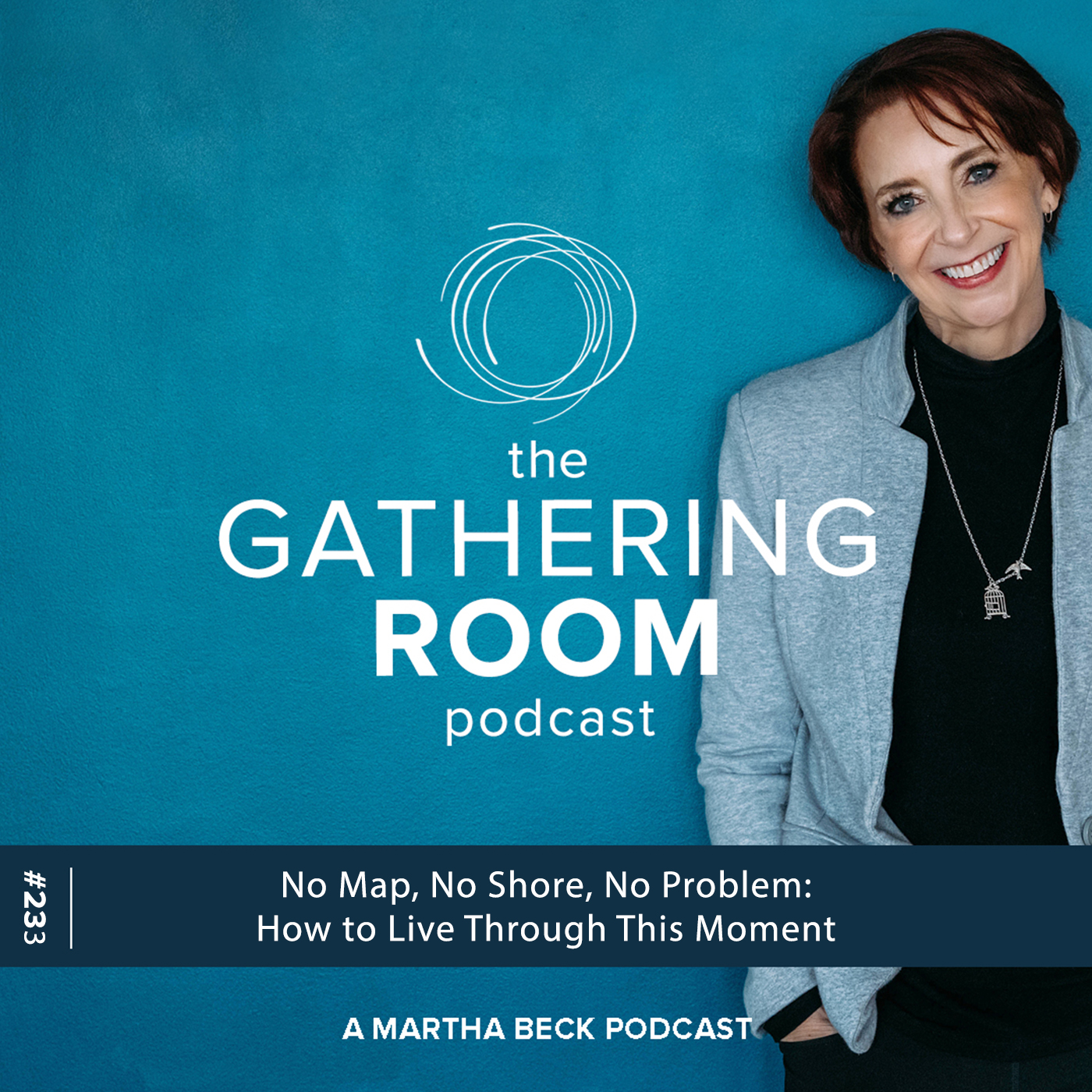
About this episode
In this extended episode of The Gathering Room, I talk about what it means to live through a time of social unraveling, and how we can still find our way, even without guarantees or clear paths ahead. I explore how to navigate systemic collapse through Wayfinding—regulating our nervous systems, resisting panic and polarization, grieving fully, creating beauty, and building circles of community, integrity, and calm, generative action. If you’ve been feeling alone or overwhelmed, this episode is for you.



No Map, No Shore, No Problem: How to Live Through This Moment
Show Notes
How do we find our way in a world where the systems we’ve relied on are breaking down?
In this special extended episode of The Gathering Room, I’m talking about what it means to live through a time of social unraveling, and how we can still find our way, together, without any guarantees or clear paths ahead.
From massive winter storms, to the breakdown of systems, to the sense that the institutions we’ve counted on are no longer reliable, many of us are feeling terrified and angry, wondering what to do. My background in sociology led me to suspect, long ago, that a moment like this would come, and I’ve spent my life developing and teaching skills to navigate exactly this kind of prolonged instability. I call it “Wayfinding,” and anyone can become a Wayfinder.
SEVEN PSYCHOLOGICAL STAGES
There are seven psychological stages people tend to move through when a powerful society begins to lose its effectiveness and stability. For each stage, I describe what it feels like, how we tend to get stuck there, and how you can respond as a Wayfinder.
- Stage 1: Cognitive dissonance: You sense something is deeply wrong, but part of you is in denial. The Wayfinder response is to return to the present moment as often as you can, and create pockets of peace inside yourself and with a trusted community.
- Stage 2: Alarm and hypervigilance: Threat perception spikes, and the nervous system goes into fight-or-flight. The Wayfinder tools of Kind Internal Self Talk and nervous system regulation help you soothe your vagus nerve and return you to coherence.
- Stage 3: Identity fixation: This is the “choose a side and cling to it” stage, where righteousness and polarization feel safer than ambiguity. As a Wayfinder, you move back into integrity, use your discernment, and follow your inner compass.
- Stage 4: Grief and disillusionment: The realization hits that things will not go back to “normal,” and grief, betrayal, and exhaustion arise. The Wayfinder response is to grieve fully while also turning toward compassion and creativity.
- Stage 5: Pragmatic acceptance: This is where we stop asking, “What should be happening?” and start asking, “What works now?” As Wayfinders we begin to act together in grounded, realistic ways.
- Stage 6: Reconstituting ethics: Instead of outsourcing morality to institutions, we turn inward to find what we truly value. Shared inner work can lead to a new, more compassionate society, built from the ground up rather than imposed from above.
- Stage 7: Generative engagement: As Wayfinders we mentor, teach, and offer our specific gifts to our communities. I see my own role as someone who can think about society and offer frameworks and skills that help people stay steady and creative.
WAYFINDER TOOLS
We are in a “chrysalis of change” where catalytic events in the world are melting us down the way a caterpillar melts into liquid. We need communities to hold us as we dissolve and re-form.
I share some specific Wayfinder concepts and tools you can use right now:
- Inner compasses: I talk about the four compasses (physical, emotional, mental, spiritual), and how simply noticing what tenses your body and what relaxes it can guide your next steps.
- Community as chrysalis: I share how my own Wayfinder and Wilder communities have kept me sane, and I encourage you to form or deepen your own circles.
- Art as survival skill: I tell the story of how, in the middle of my own crushing grief and rage, what I most wanted to do was make a painting. By following that impulse, I was able to shift into the right hemisphere of my brain, ease the pain, and access creativity about what to do next (including this conversation).
- Circles, not pyramids: I describe how I see the future as more of a mycorrhizal network under a forest (quiet, mutual, responsive) than a rigid hierarchy. Instead of lines of authority and isolation, we move in circles of care, creativity, and shared responsibility.
- Scales of action: I walk through four levels where your presence matters: yourself (regulate your own nervous system), your household or close circle, your wider community, and the cultural level, where storytelling is the most powerful force of all.
Again and again, I return to the core message that one coherent, regulated human being can entrain thousands of others toward coherence, simply by being calm in the midst of chaos.
In the second half of the episode, I respond to live questions from The Gathering Room community. We explore finding steadiness amid sadness, regulating the nervous system, trusting your inner truth, loving across divides, and remembering that creativity in chaos isn’t frivolous, but foundational.
I close by reading a powerful Hopi prophecy from the year 2000 that feels uncannily appropriate for this moment. It speaks of a river that is flowing very fast, and of those who will suffer by trying to cling to the shore instead of letting go and moving into the middle of the current with eyes open and heads above water.
This prophecy reminds us that the time of the lone wolf is over, that we are to gather ourselves, banish the word “struggle” from our vocabulary, and remember that “we are the ones we’ve been waiting for.”
We’re living through collapse, but we’re also living through the birth of something exquisitely new, and we Wayfinders can choose how we show up for it. Join me for the full conversation and let’s explore the possibilities together.
Episode Links
- Wayfinder Life Coach Training
- Wilder Community
- Hopi Prophecy, 2000
- The Way of Integrity by Martha Beck
- Beyond Anxiety by Martha Beck
CONNECT WITH US
Transcript
Martha Beck:
I am going to get started now because even though people haven’t stopped popping in, this is a special Gathering Room for me today. So welcome, welcome, all of you from all around and I’m going to dive right in.
So a lot of you are being affected by the massive storm that has hit the US, the whole country, which is a vast country, right? You can see here the snow is well up past my window here in upstate New York. It’s about hip height here, but we still have power. We still have systems of neighbors that are coordinating snow plowing and things like that. In other words, I am still living among in a state of enormous privilege where millions of people have lost power. Millions of people are seeing destruction to their homes and properties and lives. And it’s a cliche to say our hearts and minds are with you, but they really are.
Even more, I want to talk—and this is the subject of this entire Gathering Room—about the disruption that is not just coming from the weather, which is, by the way, also influenced by what humans are doing on the earth, but not just coming from the weather, but the breakdown in systems that has taken precious lives and disrupted many, many more.
This loss of life and this horrific destruction coming from the very institutions that people rely on to keep them safe. This is a very real time to be concerned at the very, very least. Petrified perhaps, but I’d prefer you not stay petrified. So this whole Gathering Room is going to be about what I call “wayfinding,” which is a system of finding your way through a world that has become chaotic.
If you’ve been through the Wayfinder Life Coach Training that one of the first things I do is tell you it’s not a life coach training program. It’s a wayfinding program. It’s meant to teach you to build a life that works in any circumstances, and it takes into account the breakdown of social norms. And then you can teach other people about it for sure, but it’s actually finding your way through horrific situations. And I love the fact that the recent graduates have been that I’ve seen chatting with each other online. They don’t say “I’ve finished coach training.” They say, “I’ve finished wayfinder training” because that’s what it is.
I didn’t even know what a life coach was when I created that system. And I’ve never really bought into this sort of psycho/health thing. It’s always been based on my training as a sociologist and my research, which left me believing long ago that I would live through a time of increasing chaos and unpredictability and that it would get very, very scary at some point.
In other words, I’ve always suspected that this moment would come, this moment in the history of the world, and specifically in US history, but it branches out and affects everyone. I hoped it wouldn’t. I hoped I wouldn’t see this, but I sort of suspected that I would. What we’re seeing right now is, when I started graduate school, a friend of mine said, “Oh, you’re going into sociology, you mean the labeling of the incredibly obvious?” And I laughed because yeah, it kind of is that way when everything’s working right. But the reason I wanted to study this was to know what happens during historical moments like the one we’re living through when prolonged socioeconomic unraveling begins to occur.
And lately I’ve been getting emails from people, some of them know my work, some of them have just stumbled over me or whatever, and they’re saying, “What should we do? What should we think?” I will write back to you, but I haven’t written those emails back yet because I’ve been sitting and pondering and really going deep inside to figure out what can I offer right now that might help people. Because I’ve been studying this my whole life, and I have a set of skills, a set of things that I teach people all the time about how to survive this.
There are powerful, calming ways to handle this moment in history, but we have not been culturally trained to use them. We’ve actually been trained to just rely on these systems that are now breaking down. So if I seem a little bit academic and whatever during this little, I’m going to talk for half an hour today, I usually do 15 minutes. If I see more academic and left-brained than usual, it’s because the emotional overload of the implications of everything that has been happening can get pretty heavy.
And one of the dangers of this time is that we can go into that heaviness and be paralyzed by it. And for me, one of my reactions—not for everybody because everyone’s different. That’s the core part of Wayfinder training is no one has the same set of responses, and no one has exactly the same thing to offer as the next person. It’s not about making people the same, it’s about making them truly themselves.
So for me, one of the ways I deal with it, with heart-stopping, crushing grief and anger is to get analytical and figure it out and think of next steps and find my own power and stand in it. So before I get started on this talking about this, we always do a meditation on The Gathering Room. A lot of you asked for it, and so we do it every single Gathering Room.
And today, it’s the Space, Silence, and Stillness meditation if you’ve never done it before. And for all of those of us who have done it, I would really like you to think for just a minute before we start about any sense of fear or insecurity that you may be carrying inside you right now. And also think about the people who are undergoing unthinkable things right now all around the world, but also to a degree in the United States that we haven’t seen basically since ever. It’s unprecedented.
So find those anxieties and imagine yourself just putting them in a crystal bowl in front of you. And they’re made of precious gems. They’re not something we want to throw away. They’re important, they’re precious, but right now we’re going to keep them in this crystal bowl, and we’re going to go to a place where we don’t have to carry that in the same way. We’re going to go to the part within us that I think will survive our physical death, to the consciousness that is always safe because it’s eternal.
That said, we’re going to ask the strange question, and this is not meant to be answered, it’s meant to baffle the brain. The question is: Can I imagine the distance between my eyes? So repeat that to yourself a few times. Allow the eye gaze to soften. Think to yourself: Can I imagine the space between my eyes and the screen or the surface I’m looking at?
Just ask it as a question: Can I imagine the space between the crown of my head and the base of my spine? Almost all my atoms are made up almost completely of empty space. Can I imagine all the space inside the atoms of my body? Can I imagine that that space is continuous with all space in the universe and that it is continuous with the atoms of everyone listening to this broadcast or watching it? Can I imagine the space that holds us all? Can I imagine the stillness in which the noise occurs that is always holding us safe?
Can I imagine the silence beneath sound? Can I imagine that the space, the stillness, and the silence are alive and loving, wildly loving? Can I imagine myself suspended in this saturated field of love that I share with every human being and every sentient being on this planet and throughout the universe? Can I imagine all of us together in that space?
So from there, from what one system of therapy calls Self with a capital S, the Self that is not afraid, let’s look at ways we can get through what is happening right now. You Wayfinder Coaches out there, this is for you and anybody who might be considered an advisor to help other people. I’m going to point to ways your training is helping you deal with the current moment. And I want to, if anybody else wants to find out, like find a Wayfinder Coach, sign up for Wayfinder Training, whatever, I’m going to be teaching you specific skills that can really help at a time of extended social collapse.
So when this happens, and it’s a very distinct thing. When a very powerful society starts to lose its efficacy, you get systemic breakdown, sort of the way we saw the Soviet Union break apart rather suddenly it appeared from within my lifetime. The way the Roman empire fell apart over a much larger period of time. There are stages that societies go through that show they are not going to stay the way they have been in the past.
It doesn’t mean everybody’s going to die. It means that none of the systems that we’ve relied on until now can be relied upon in the future. Some of them may survive, but we can’t really count on it. And that can be quite frightening. And as the social collapse, the social unraveling commences and continues, you see these marked signals that it’s happening, like a widening gap between the poor and the wealthy, distrust in government institutions, the patchwork application of the justice system. So what is considered murder and dealt with in a very specific manner in some parts of the country is excused and called justified in other parts of the country.
There’s a lack of predictability about what the system is going to do at any given place. So that goes on, and if you want to Google it and look at it, you can see that there are several stages that you look for. There are about nine of them that sociologists look at. And the US right now is already gone through about six of the nine, maybe seven.
There are different ways to address this. Some of you may feel a move to take political action, to go march on the streets, to run for office, whatever it is. My particular field where I can try to help is in establishing an inner response to a very unstable situation. You can get internal stability to deal with external instability. All right.
And to that end, I’m going to talk about seven stages of psychological response to living in a society that is collapsing. And I’m going to tell you what each one is, let you know you may be feeling it, help you check for it, and then give you a way or two to deal with each one. Okay? Here we go.
The first stage is cognitive dissonance. It’s when people sense instability, but they’re like, “No, nothing’s really going to change.” I was talking to a friend the other day and I said, “Yeah, I think this is quite serious. I think this will get bigger, not smaller.” And she said, “Wow, I feel like, I feel so validated because I’m nervous, but all my friends say nothing bad’s going to happen.” And I don’t think it’s coincidental that that person happened to be born into a situation where the folks around her probably have the wealth to ride out the situation.
So a lot of people at the top of the social pyramid are saying, “Well, no, nothing bad’s going to happen. It’s all fine. We just have to swing the pendulum back a little. The contradictions are minimized. There’s like no, no, no.” But some people are like, “I don’t feel safe, I don’t feel good.” And the emotional tone of this is feeling confused and irritated and fatigued, and you just can’t rest.
That’s when it first starts to sort of penetrate that this environment around you is profoundly unstable, and you need to be looking for other ways to address your life. So what is the Wayfinder response? There are two responses that are typical. One is to just pretend there’s nothing bad happening, and that just leads to erosion of trust because bad things are happening. And then there’s the catastrophic thing: “Oh, we’re all going to die and everybody’s, there’s no way out of this.” That just paralyzes us.
Neither one of those is true. What’s true is that we need to become very alert and aware in the space we are in right now. So I call this: “Be here now and then.” So “be here now” means come back to this moment, to this breath. We can all do this. “Whew. Oh, I’m in a room where there’s snow all around me, but I’m safe. I’m warm.” Somebody out there’s in a plane. We’re all over the world right now. I assume most of us are sitting in rooms, and we’re all right in this moment. And we have to come back to that, even though everything may be going to pieces around us. Being able to center and come in is—any mindfulness training will teach you that. “Be here now and then” means, to me, it means that sometimes you won’t be able to hold this, but it’s enough to say, “I will come back to myself when I remember to.”
And the more catastrophic things seem to be happening, the more you’ll remember to come back to yourself and create sort of localized moments of peace that help you take a rest from the catalytic events around you. Sorry, that’s a Wayfinder term. “Catalytic event” is a term we use to talk about something that affects your life in a way that won’t let you go back to the way it was before. Some changes come and go. This one is no.
As somebody with sociological training, I can tell you the horses have escaped the barn, and the barn is on fire. The horses aren’t going back to that barn, not ever again. It doesn’t mean the world is ending, but it does mean that we need to create localized moments of peace within ourselves first and foremost and create what we call a chrysalis of change. So that means a community of people that you can reach out and connect with maybe in real life, ideally in the flesh, but also online.
The community of Wayfinders that I have online and my other community—Ro and I run this community called Wilder—those are both really, really important touchstones for me. Without those, without that community, I think I’d be losing my mind. But I have the company of smart, compassionate, insightful, ingenious human beings who mean so genuinely well.
So I have a community, and I know to keep a community. If your community is only you and three friends, get it, connect with it, and spend time together allowing each other to fall apart emotionally, into grief, into anger, and hold each other safe. Because a catalytic event, we compare it to a caterpillar having that trigger that says, “Go into the chrysalis and become a butterfly.” And the first stage is to meltdown to liquid. So when you’re confronted with a society that’s basically in meltdown, it’s going to make you meltdown.
That’s the first thing that happens in cognitive dissonance once it starts to really get its teeth into you. And finding community and always coming back to the present moment, those are the first responses. Okay? So you can do it right now. Come down to where you are, start breathing deeply, let your breath localize and center you, and then we can go on to the next step.
So the next step happens when threat perception spikes, and people start to really see frightening things happening. And stage two is called Alarm and Hypervigilance. And this means we kind of go into a fight-or-flight state, and we start to feel scattered and oscillate between doom and denial, feel frantic. The emotional tone is urgency, anger: “We have to do things! We have to do things!” Now there’s a big risk here and that is to mistake the panic for wisdom.
I just wrote a whole book about how anxious thinking tells us, “I can solve this problem, I can solve this problem,” but actually we need to find a state of creativity outside of anxiety to come up with real answers to any problem we’re facing ever. So the whole Wayfinder stance is instead of—recognize the anxiety, but refuse to let it run the show.
So after you’ve centered yourself, which is step one, you don’t confuse your panic with wisdom. Instead, you go inside and you start to notice what regulates your nervous system. One regulated nervous system in a crowd of people can calm the whole crowd. If we can hold ourselves deeply in a place of peace, and not trust panic, and find sources of softness and compassion within ourselves and outside ourselves, if we can do that, we can move away from the anxiety and into wisdom.
So the thing I have found most powerful as a tool, as a skill here is something I call Kind Internal Self Talk. And it just means saying things to yourself and other people that are compassionate and gentle: “This is okay, we’re all right in this moment. We’re going to figure this out. We’ve got each other. It’s going to be okay.” It may sound inane, but the actual repetition of the sound brings your nervous system back into regulation.
It doesn’t even matter if you believe what you’re saying, a calm, steady, low human voice, not deep bass, but if you lower your voice to a calm, slow paced, steady tone, it actually affects the vagal nerves that create a lot of the fight-or-flight responses. And that calming voice will literally turn down the volume on panic. And it’s not about thinking things through. It’s literally the sound and the emotion of those things you say to yourself and to one another that helps you come out of panic. So don’t trust panic, go into wisdom, and do it with kindness to each other. And also for you Wayfinders, this means touching into your inner compass.
So we talk about four different compasses, emotional, physical, emotional, mental, and spiritual. They’re always acting inside each of us and we all have a set, I believe. This is my Wayfinder belief set. You don’t have to accept it, but I believe we all have the instructions for our destinies and our next best step coded into us and that no one else’s best next step is yours. But if you can tune in to the compasses, for example, by just noticing what makes your body tense and what makes it relax—you’d think that’s a small thing to notice. It’s immense. It is one of the most powerful things you have to steer your way through life.
So the Wayfinder path is to find the inner compasses: Notice how the body responds to an idea, to a plan, to something you hear on the news. If it’s tensing and anxious, that’s probably not true for you. Notice how your mood starts to shift. If something fills you with despair, it’s probably not true for you in that moment. If it gives you hope in the midst of grief and you feel yourself relaxed, that’s your emotional compass at work.
So I don’t have time to teach you all the compasses right now. It’s enough to know that if something calms and relaxes you, it’s probably a good idea to follow that. And if it makes you tense and frantic, it’s not a good advisor. That’s your compass saying, “Don’t go there.”
Okay. Stage three is where people get, they decide, “Okay, everything’s falling apart. I’m going to choose sides.” And they heavily identify with one side or another, and everything becomes polarized. It’s called “identity fixation,” and it’s an attempt to reduce uncertainty and to anchor us as individuals into an ideology or a tribe that we feel will protect us so that we don’t have to look at the complexity of morality, the complexity of system collapse or morally ambiguous situations. It makes everything black and white.
So there’s us and there’s them, and we’re not going to listen to each other, and we’re just going to silo and breed more rage. The emotional tone is righteousness, certainty, hostility. In my previous book, The Way of Integrity, I talk about how righteousness is actually, it’s a psychological form of violence because it says, “I am right and I will beat you to death with my rightness and it will be a fair death.” No, no, nobody gets to beat anybody else to death with an ideology. Things are more complex than that.
And if we get to the point of identity fixation, disastrous things follow. One of the things that makes me proudest right now of my fellow Americans and many people that have reached out to me from around the whole planet, is the willingness to stay in the paradox, in the ambiguity, to remain soft, to not be absolutist. The absolutist positions are creating, they escalate the collapse and they’re very, very bad for us as individuals. So it’s really dangerous if you get stuck in this part of the process, the identity fixation.
And so the Wayfinder path is to find integrity and examine everything for the truth. Learn to sharpen your discernment. If you read about people who have survived, for example, the decline into fascist states, the thing that stands out the most is their ability to discern what was true and what was not true. Because you’ll get all kinds of stories, and they will be spun and they will be doctored and they will be screamed at you.
And if you don’t have an internal sense of discernment, it’s very, very confusing, and you can get really lost. So examining everything for truth, this is a big part, the main part of Wayfinder training is this right here: how to find what’s true and isn’t, how to find what’s yours and isn’t, how to find what’s integrity and what isn’t.
So what I would tell you right now is just trust your intuition. I’m going to quote Goethe: “When you trust yourself, you will know how to live.” So don’t let anything convince you not to trust what you deeply, deeply know. Feel what you feel. Know what you know. Say what you mean. And do what you want to the extent that you are safe doing that. Find a community where you can feel what you feel. Know what you know. Say what you mean and do what you really think is right.
If you lose that, you lose everything. But we can have it. I have it because of my Wayfinders. You can all have it because of each other. Anyone on this broadcast could reach out to anyone else, and we can start to link so that we don’t lose our discernment of what’s true.
Okay, now stage four is the one I was, day before yesterday I was profoundly into this one. It’s grief and disillusionment. It’s when the realization arrives that the system will not return to what it was. And the feelings are sadness, betrayal, exhaustion. And getting stuck here leads to chronic despair. So while you must give yourself space to grieve—that first step, and the Wayfinder tools are facilitate the grieving process by allowing it to happen as a healthy normal reaction to an awful, unhealthy environment. So allow the grieving process, but at the same time, go deeply into compassion and think about things creatively. Actually make art. And over and over and over I read in sociological treatments of social collapse, it is art that saves the people.
It is poetry, it is song, it is painting, it is dance, it is drama. The arts keep wonder alive, keep the heart alive, and they give us access to the right hemisphere of the brain, which is by far the most powerful way to solve problems.
So there’s a whole aspect of Wayfinder Training that is about preserving wonder and preserving creativity and preserving an attachment to beauty. Make a beautiful garden, cook a beautiful meal, redesign your furniture so it looks prettier. I know this seems really, really odd as a response to things completely falling apart, but it is that. When I dropped in and used my own Wayfinder skills and looking at my compasses, what did I want to do? I wanted to make a painting.
All right. I was so grief stricken and so sad and angry that it seemed like such a stupid thing to do. But as I started making the, as I started drawing before doing the painting, I felt my brain leaving that panicky left hemisphere and the despair that can come from it. And I felt myself going into the right side of my brain. And the pain eased a lot and I started to think of ways to go forward including making this broadcast.
Okay, there are stages that follow. I don’t think most people are yet to these stages, so I’m going to go through them pretty quickly here. Stage five is pragmatic acceptance. You go, “Okay, it’s not going to be like it’s going to be. So instead of thinking what should be happening, I’m going to be asking what works now?” Now a lot of you are in places where the system isn’t working. What works now? What works if the climate is going to hell? What works if you can’t call on your government to be just and fair?
This deep pragmatism has—the emotions are realism, cautious hope, sobriety. I know a lot of my sober friends have this in them. The people who are in rehab or recovery from addictions, things like that. They’re really good at this place because they’ve been to chaos. That whole thing of “our lives have become unmanageable,” that’s what’s happening to all of us. Whether or not we have addictions, it’s happening to us socially.
So Wayfinders, we call this square three. Square one is when a catalytic event has just hit you. Square two is when you learn to dream again. And square three is when you start actually doing things with other people to build something new. And as I said, I don’t think that’s happened quite yet, but it will. I promise you, it will.
So the time of individualism is over. We move forward collectively. Our culture taught us to think in lines. Lines we wait in, lines of authority we follow, lines we’re not supposed to color outside of. But we grow from this in circles, circles of compassion, circles of care, circles of the seasons, circles of love. We move in groups of people who share one another’s burdens. Individualism is one of the most destructive things. Rampant, absurd individualism is part of what’s dysfunctional about Western culture. And as we move forward from unraveling, we’re going to have to do it together. And that’s actually really good news.
Stage six is when you start to reconstitute an ethics system. And the biggest part of this is that instead of looking to institutions to know what’s right or wrong, we start going internally. So when I left my growing-up religion, all the rules about what was sin and what was virtue had to go out the window, and I had to go internally to see what I actually valued.
The emotional tone of this is steadiness, humility, and deep insight that we come to alone and then share with one another. And it creates a consensus of ideologies that are connected to those pragmatic circles that help us love and heal one another. So that’s coming up. Look forward to that for yourself.
And finally, there’s something called generative engagement where people really start mentoring, teaching each other. People start to realize, “I have specific skills that I can offer to my community, and there’s a way it can help.” And they start to teach each other and offer each other help. I don’t really weather well when I go out to march in the cold, I’m not really, I’m physically frail, but I can think about society. So this is the offering I have for you now, and that I hope is going to keep going.
This generative engagement from everybody from their inner resources, moving to connect with each other. And it’s like taking thousands, millions of brilliant, beautiful pieces of fabric and sewing them together into an absolutely divine quilt that covers us all. And then comes the creation of a new system. From that grows, like flowers in the springtime, a new system, and it grows not by decree from above, but from the art, from the companionship, from the love that people find in themselves when they allow society to break down around them and refuse to give up.
We don’t need powerful ideological leaders as much as we just need calm grownups. And there are a few, I’m going to close this in just a second and take questions, but I also wanted to say there are scales of action. The first thing is look to yourself, take really good care of yourself. Second: your household or circle of friends, make sure that you’re talking, make sure you’re loving each other, make sure you let each other cry and rage and you’re still there to hold each other. Then there’s community: Reach out, join something, gather with people, in your neighborhood online, whatever it is, especially care for people who are in very real danger right now. And I know the people of Minnesota have been doing that, and my admiration and love for you is beyond expression.
And then finally there’s the level of culture. And this sounds like it’s not powerful, but it is the most powerful, and that is the storytelling: the way we tell the story of what is happening now means everything for what we create next. Wayfinding is all about looking for patterns of meaning and compassion even in the worst circumstances, turning around what looks like an absolute disaster to see it as inspiration and the birth of something beautiful.
And we want to live in such a way right now as individuals, households, communities, we want to live in such a way that the stories we tell about this historical moment to future generations are filled with courage and wonder and wisdom and quiet power.
I’m going to finish this by reading a prophecy from a Hopi elder that was given in the year 2000. So that’s a while back, but I think it really applies right now, and it comes from a culture that did live in circles. The Hopi people had a very longstanding, beautiful, peaceful connection with the land and with each other and with living beings. So one of their sacred teachers said this:
“You have been telling people that this is the Eleventh Hour. Now you must go back and tell the people that this is the Hour, and there are things to be considered. Where are you living? What are you doing? What are your relationships? Where is your water? Know your garden. It is time to speak truth, create community, be good to each other and do not look outside yourself for a leader. This could be a good time!
“There is a river flowing now very fast. It is so great and swift that there are those who will be afraid. They will try to hold on to the shore. They will feel they are being torn apart and will suffer greatly. Know the river has its destination. The elders say we must let go of the shore. Push off into the middle of the river. Keep our eyes open and our heads above the water. And I say see who is in there with you and celebrate.
“At this time in history, we are to take nothing personally, least of all ourselves, for the moment that we do, our spiritual growth and journey come to a halt. The time of the lone wolf is over. Gather yourselves. Banish the word ‘struggle’ from your attitude and your vocabulary. All that we do now must be done in a sacred manner and in celebration. We are the ones we’ve been waiting for.”
So with that, I am going to open for questions, and there are a bunch. So let’s see how many I can get to. All right.
Question: “Buried in sadness and anger. I know underneath it all is rooted in deep love and compassion. How do I move from that place?”
You don’t move from that place, my love. You are not alone here. If you could see all the people on this broadcast right now and those who will listen to it in the future, you would find yourself amid thousands of people who are in deep love and compassion, even though we are also sad and angry. And we don’t ask you to move from that place. We surround you, we embrace you within it. And not just physical people, but I believe forces from other metaphysical realities are holding each of us going through this really frightening, legitimately enraging moment.
And if we allow ourselves to be there and can find our breath, can find a tiny little flame that says, “I’m not alone. Part of me, my higher self knew this would happen. There are thousands like me, we are reaching for each other. It’s going to be okay.” If you can do that, then the grief will take you all the way through. In The Way of Integrity, I write about Dante trying to get out of this wilderness by climbing a mountain to get up to paradise, but he can’t. He has to go through hell first. He has to go down, down, down. But not alone, not alone. So be where you are. Find people who can connect with you and share compassion with each other. That is what we need to do right now.
Comment: “Our family has been drawn to hosting potluck with people we’ve always wanted to know better. Your Gathering Room has extended to a gathering home for us.” Gosh, that’s brilliant. See, that’s the kind of creative problem solving that actually saves people when governments go down and when wars come in. Thank you for giving us that idea and setting that example of creativity and outreach. That is so, so important.
Question: “What if taking a deep breath is hard?”
I’m so with you. What you do is you take the deepest breath you can, and then you blow all the air out of your lungs so that you have to breathe in again. And this will probably make you cry. A lot of us don’t breathe deeply because it makes us shake and cry—two things that we’re told not to do in the culture we live in most of the time. It’s a good time to shake and cry. The nervous system regulates itself through the shuddering, the physical shuddering of tears and of just trembling.
And when you start to breathe deeply, you access those primordial physiological mechanisms that bring you back to regulation. And regulation is what we need. One—I’m going to repeat it—one regulated, coherent individual jewel can entrain a crowd of thousands of people out of chaos and into coherence.
Coherence is very strong, but if you have to go through shuddering and shaking and crying to get there, it’s worth it. You don’t want to hold that poison inside you. Let it out. That’s what’ll happen when you breathe.
Question: “When life feels chaotic and money stress is loud and daunting, how do you tune in to your meaning-making systems to identify your next steps? Any meditations or visualizations to help?”
Ro is reminding me that Wayfinder Training is full of these and that you’d be surprised how much the culture has programmed you to follow the story of money to the point where you feel like you’re living as a captive, completely captive. It’s not a coincidence that this whole socioeconomic system of this country was based on the unpaid labor of millions of people. And that physical survival has been used as a kind of club to keep people in their places, supposedly.
A lot of it falls apart when you start to look with great discernment and when you start to gather. You can get past the ways the culture has taught you to be afraid about money. I’m telling you, it’s not just survival fear, it’s cultural learning, and it can go. It takes some training, it takes a community that doesn’t share that. I know you can find one—the ones I know, others that I don’t know, whatever. Find your people and learn to see past the myth that we have to do everything the system says or we’ll die of starvation.
Question: “ow do you trust yourself and others? I tend to trust others more than myself. And in trying to find my own wisdom, find I am cutting out people I love, admire, and trust because I don’t want to lose me.”
I’m not quite sure of the wording there, it’s a little complicated. But I really understand that you trust others more than you trust yourself. You’ve been trained to do that since before you could talk. That is a really big part of our cultural training. However, within you is an instinct that has evolved through hundreds of millions of years. In The Way of Integrity, I call it your “sense of truth.” And all it takes, when Wayfinders train, it’s so interesting, you can bring a belief that you’ve had for your whole life that you can’t be trusted and you need to follow someone else’s rules, and you start to examine that with the help of another trainee, and it falls apart like sugar in the rain.
It just like poof. It is nothing. In the Bible, it talks about sand in a storm and how it just falls away, and only if you build yourself on something that is a rock, which just means reality as it actually is, that’s the only stability. And the moment you really get into a place where you can examine everything you are told by the system, by the media, by people in power, the moment you learn that there is this rock you can stand on within yourself and it has a physical feeling, it has an emotional feeling, it has a mental and spiritual feeling, this sense of truth, this sense of integrity, then you not only can trust yourself, you will know whom else to trust.
And then when I finally got to this point in my life, everything shifted radically because I was leaving the entire social system that had raised me, didn’t trust anyone, didn’t trust myself. The moment I got myself into integrity and started to find other people who were like that, it was the difference between a life that was constantly in chaos and a life that just is astonishingly blessed. I know you can have that. I’ve watched people get that, coaching them, training them. I know this happens. I know we can do this. Everyone out there listening to this has this superpower of knowing in our guts what is real and we can all learn to access it.
All right, question: “How can we reconcile the Wayfinder approach as we watch folks, who appear to be wayfinders at heart, being taken? I’m really struggling with this.”
Yeah, that’s why it’s great to have a community of people who are at your level of training. And then you can look at the people who are maybe in that stage of identity fixation where they’re really polarized and shouting political things that seem really extremist and are leading to violence and all this stuff. And the thing you can trust is that if somebody isn’t building on the truth of their own life, they will suffer.
And a lot of the people who scream loudest in anger and righteousness are suffering the most. And there’s this quality called, there’s a process called an “extinction burst” where if there’s a way of doing something that has always worked for us and it stops working—like the system of government in the US right now—there’s a period of time where we desperately try to trust it more. We try to bring it back because we don’t want to get to that stage of grief and disillusionment because that’s painful. But if that’s true, right after the extinction burst comes the “Okay, this is the way it is, this is how it is.” And then there’s this profound return to humility, return to pragmatism, return to gathering together. And you cannot force another person to do that.
Trying to force people to think what you think is totalitarianism. So all you can do is trust that the greatest teacher of all is suffering. And that if people aren’t following a way that’s true for them, they’re going to suffer more and more until they have a breakthrough on their own. And if you’re there to say, “I have loved you through the period of identity fixation, I am loving you here through the period of grief and disillusionment, I’m going to love you into my community. Let’s find out what we can do. Let’s find out what beauty we can make,” you would be amazed some of the people who come out of the most radical psychological isolation and finally collapse into the truth, which is kind of what the broader society is ultimately going to do.
Another question: “My partner of 10 years is on the opposite side of the political spectrum. He does not believe that there’s really anything wrong. This is the most difficult thing for me.”
Yeah, that would be. And I’m sure you love your partner very, very much. And for this reason, you need to quietly connect with a community of people who are at the stage of pragmatism. Because they will never tell you, “Leave your husband or force him or your partner and force him to believe what you believe.” They’ve been down that road, it didn’t work. They went through grief, collapse, and acceptance and now they’re in, “Well what works?” Not what should be, but what works right now. And you may find that what works is that you quietly read and connect with people online and become a Wayfinder in whatever capacity you want to do it in. And you quietly keep that out of your conversations for a while because it feels like—it’s not a secret, but it just doesn’t feel productive. It doesn’t feel pragmatic.
And then as you start to find steadiness and start to gain more stability and joy, very often people who have been sort of pitted against each other find common ground when the destruction finally gets to their actual experience. As I said, the very first one is slight cognitive dissonance where you’re telling yourself “It’s fine, nothing’s going on, it’s all great.”
And people who are higher in the socioeconomic pyramid are going to stay in the “Nothing’s wrong. It’s all going to be fine” longer than other people. If you’re at the bottom of the socioeconomic pyramid—if you are a person of color, if you are female, if you are trans, if you are an immigrant—if you’re any of these things, the collapse is coming to your door first.
So in general, you can expect people who are the privileged of the society, it’s going to take them a while. And you can view that with compassion and still educate yourself and find your people, find your community, find your garden as the Hopi elder said, metaphorically or literally, and treat others with love at all times and see what comes of it.
Question: “My inner compass seems to be buried underneath the agony and the anxiety and the despair, even though I know it’s there. How can I align when the usual strategies just aren’t working?”
Here is what you can do. There are right now 466 people watching this live. They’ve been here for a while. So I don’t think that they’re thinking it’s complete balderdash. I don’t know if you know those 400-odd people, some not so odd, those 400-plus people, but you could. You could reach out to them. And if you can connect with a community, and again, Wayfinders have a community, but Ro and I started a community when this political moment seemed inevitable very much because we needed to have people to go to when our anxiety and despair get too high. And we’re not ahead of it. We’re with other people. We’re not in lines, we’re in circles. We’re rising like water, not like pyramids. And we hold each other.
When a catalytic event comes and you go through what we call death and rebirth in the Wayfinder way, you cannot hold it together. But others can hold you, and we will want to. There are so many people right now who would get so much joy and hope out of the chance to hold another person who is in anxiety and despair. Just hold them emotionally, energetically, physically, and say, “I am here for you.” It seems like not that much in such a huge crisis. It is everything. It is everything.
So find those people, find someone, even if—for me, it’s often like books by people who are already dead, I don’t care, or spirit guides, whatever, wherever you need to start. But ultimately other human beings are the best source of stability and renewal when the feelings are just too much. And they will be. They will be. But you’ll get over it. Breathe. Come here, come home.
Question: “How do you see our work in corporate systems shifting as relates to creating a new normal?”
This is the most exciting thing for me. My whole adult life, I’ve been trying to envision what would come next. I knew something had to, I didn’t know if it would come during my lifetime, but I think it starts with a shift of consciousness, a shift of the way we define ourselves in the world. I think it’s going to be much more focused on the right hemisphere of the brain. That is, much more mutuality, much more art, of all the arts, much more cultivation, like the cultivation of gardens, of forests, of children. I think it’s going to be much more like the what’s called the mycorrhizal network, the network of algae and fungi under the forest that are constantly filtering nourishment, different chemicals, water, all the things the plants need, the forest needs.
They’re all being shifted by this very humble-seeming network of fungi that know, that have this weird evolutionary wisdom that says what to nourish when and where. And I believe that that’s in us. And when we break down the pyramid-shaped consciousness that this culture has put into us, we feel that, and we live that as a natural consequence. And I have studied this in indigenous societies. I have watched it form in the Wayfinder community and in the Wilder community. I know this is available to us. When we let go of the social constructs of this really oppressive cultural model, and we are just ourselves going inward to know what our ethics are, we become part of this system that knows broadly how to shift nutrients to the part of the world, not just people, but also animals, plants, clean water, whatever. There’s an instinctive knowing that I believe is connected to the earth itself, that will come forward in us, come up in us. What will the actual structures look like? I’m not sure, but I know they’ll go in circles, not in lines.
I’m researching and writing about this now, but it’s just barely coming up. We are going to make it, y’all. This is the thing. This collapse is happening, and that means that the reawakening is happening. That means that the new thing is coming. There is not just doom ahead of us. There is astonishing beauty, astonishing, original, joyful ways to be together and to be human and alive on this earth.
Okay, question: “Do you think this collapse is just in the US or does it extend to the world?”
I think it’s based on the colonization of the entire globe by western European countries in the 17th, 18th, 19th centuries. And so I think it extends pretty much to everywhere. Because everywhere that those cultures have taken over, which is pretty much everywhere, the roost is being ruled in the same way. And the factors that have caused it to break down in the US are working on other countries as well.
Now it’s very patchy. One of the characteristics of collapse is that it’s not a uniform thing. Patches of really beautiful, gorgeous society-making things are happening all over the world, and a lot of you are participating in them in all the countries that you’ve come in from as we gather together here. And I’m so grateful you’re out there because this time it’s us becoming the bad guys. Well, you could argue we’ve—America has—been pushing its weight around for a very long time. But yeah, I think it is going to touch every aspect of the world, but in patches. And there will be islands of safety and creativity even within the most difficult and frightening moments of collapse.
Yeah. Someone else says: “I’m having a hard time with creativity when people are suffering.”
I hear you. And what we’ve been taught is when people are suffering, the way to help them is to become very upset ourselves. Very, very intense suffering. And right now, as I said, I’m warm. Millions in the US have lost power. I am in a state where nobody is ripping people out of their apartments and their cars. I’m seeing what’s happening, and I am in anguish and outrage beyond anything I can describe.
But I also know that if I broke my leg and I was lying there screaming for help and you came up able-bodied and healthy, I would not want you to break your own leg and lie down on the floor next to me and shout in pain. I would not want you to share my pain. I would want you to see it and get creative about helping me. How can I put on a splint? How can I get her to a doctor?
If you think creatively, you think constructively. So when you see agony, feel your own agony and then say, “Whew, okay, I’m going to come back to where I’m alive. I’m using both sides of my brain and I’m going to think, what can I do?” That is the pragmatic action phase. It is pure creativity. And I know if I fell out of a building and broke every bone in my body and doctors were trying to help save all my entire system, I would not want them to be immobilized by panic or grief.
I would want them calm, creative, even interested, like, “We’re going to fix this. We’re the grownups in the room. We are the ones we’ve been waiting for.”
And last question, someone says: “What are a few non-negotiable things you do every day?”
The first one is connect with community. I always, in the past always, would’ve said meditation, internal focus because I was very individualistic, very, I’m shy, I’m not very good at crowds. So everything was about going off by myself. Not now. It’s connecting with people, going and seeing what people are saying in those communities that I’ve mentioned. Find your community. I connect, connect, connect.
In our household, we have communion times. There’s morning communion where we connect and love each other, and there’s afternoon communion instigated by my son Adam who has Down syndrome, and he knows what’s what. “Now we sit together, we hang out,” he says. Hang out. That is non-negotiable. And the next thing is think of just one thing I can do—and I’d love to invite you all to do this as we finish—think of one thing that I don’t have to fix in my own life, but where I can hold calm stability. Like my breath. I can keep my breath calm. Every time I keep myself in coherence, I am a vibration that is entraining the chaos that is trying to do all the damage.
Chaos spreads very easily, but weirdly, at an energetic level, it’s quite weak. Coherence in a time of chaos is very hard to find because you have to go out of the fight-or-flight reaction and into calm creativity. But if you can do that, which I do through breath and different exercises, and I train people to do it in any number of ways, if you can do that, you actually have the power to bring others into coherence just by your presence.
So here we are in The Gathering Room, present with each other at a time when chaos is expanding and I think will continue to accelerate. And as I said, this is not doom and gloom. This is a deep breath, and keep your compasses, find the way to what comes next because it is going to be exquisite. We are the ones we’ve been waiting for. I love you all so much. Be well.
Read more
Questions? Comments? Trying to figure something out? Email us! [email protected]
Credits
“Illuminate” by Punch Deck | https://soundcloud.com/punch-deck
Music promoted by https://www.free-stock-music.com



0 comments