

About this episode
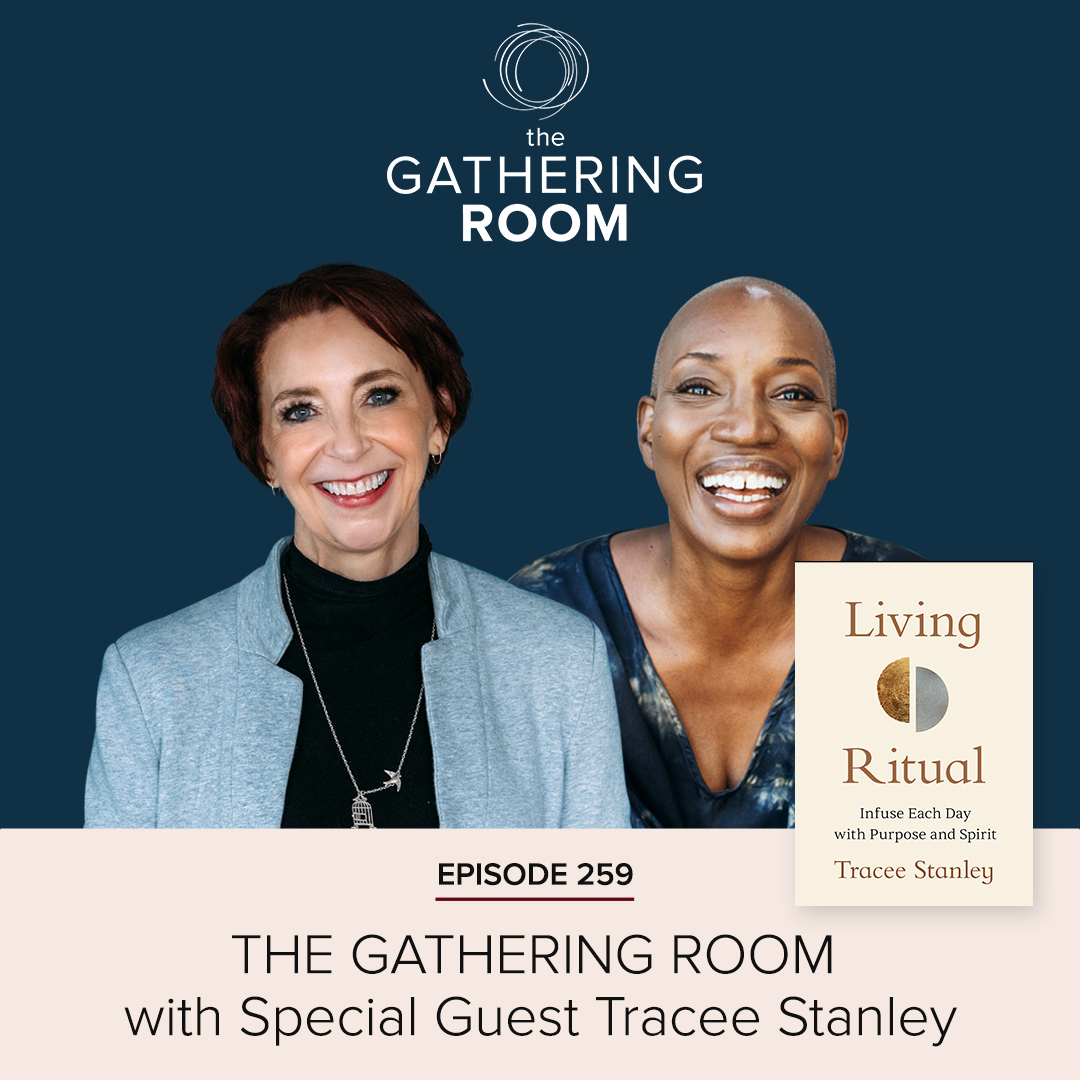
Sometimes there’s a book that stops me in my tracks, and that’s what happened when I found the work of Tracee Stanley. Today she joins me to talk about her new book, Living Ritual, which is timely not just for me, but for all of us. We discuss distraction as the great thief, how to honor transitions with sacred intention, and the new consciousness rising in the world. Tracee also shares her beautiful Purpose Stone ritual. If you long to add more meaning to your daily life, this conversation is for you.



Special Guest: Tracee Stanley
Show Notes
There’s a particular kind of book that stops me in my tracks and says, “Wait. Stop.” Tracee Stanley’s Radiant Rest did that to me, and so does her brand-new book, Living Ritual: Infuse Each Day with Purpose and Spirit, which I feel is arriving on this earth at exactly the right moment.
Tracee is an author, teacher, and one of the most luminous humans I’ve ever had the privilege of talking to, and in this conversation we explore what it means to weave the sacred back into everyday life.
How Tracee Found Her Path
Tracee’s journey began on a balcony in South Africa, watching a sunrise, when time seemed to dissolve and she suddenly felt interconnected with everything around her. She didn’t yet have language for what happened, but a friend recognized it immediately and took her straight to a spiritual bookstore, loading her arms with Way of the Peaceful Warrior, Illusions, and the works of Khalil Gibran. That moment of awakening set her on the path that inspired her to write Radiant Rest, The Luminous Self, and now Living Ritual.
Ritual as Liberation, Not Obligation
We talked about the difference between mindless habit and genuine ritual. The first is imposed from the outside, whereas the latter is generated from within. Tracee’s daily practice includes waking before sunrise to chant, drinking tea, mind-mapping, and consciously noticing the natural transitions of her day instead of letting them blur into distraction.
Her core teaching is that ritual is a liberation practice because, as she puts it, “the root of our bondage is that we don’t know ourselves.” She says that the antidote to overwhelm isn’t adding more to your plate, it’s taking away distractions.
The Attention Economy and Our Phones
We got into something I feel strongly about: how our devices have become, as Tracee calls them, “energetic appendages,” infiltrating the subtle body itself. She pointed out that the West is remarkably skilled at commodifying things and making money—turning ancestral practices into marketable products. True integration, she says, only happens through consistent, daily devotion, not a single dramatic ceremony followed by a return to a corporate desk.
Honoring Life’s Thresholds
One of my favorite parts of our talk was about the liminal spaces we rarely acknowledge in Western culture—things like divorce, menopause, illness—moments our ancestors held with sacred ritual and community, but which we now hide in shame.
Tracee described menopause as a space where “something is dying and yet something else is waiting to be born,” and she emphasized that ritual brings a sense of certainty and belonging precisely when life feels most out of control.
The Purpose Stone Ritual
Tracee generously walked me through one of my favorite practices from Living Ritual: the Purpose Stone. You find a stone that calls to you, and you whisper your purpose into it three times at a sacred moment like sunset.
Then you carry the stone with you everywhere—your pocket, your desk, your nightstand—repeating your purpose to the stone until that purpose comes to be. (My ADHD brain has already made peace with the fact that I’ll probably lose mine and need a spare!)
A New Consciousness Rising
Tracee and I both share the sense that a genuinely new, awakened consciousness is emerging on this planet. The youngest children seem to be born already knowing what took us decades of practice to learn. What is rising in the world is a deep yearning for an older way to do things, for a more healing way to do things, and Tracee’s work gives us access to that.
I consider Tracee Stanely to be one of the clarion voices of this new consciousness. Her new book Living Ritual: Infuse Each Day with Purpose and Spirit is essential reading for anyone feeling the pull back toward ancestral ways of meaning, connection, and rest. Join us for the full conversation to find out more.
You can also order Living Ritual: Infuse Each Day with Purpose and Spirit by Tracee Stanley here: https://www.traceestanley.com/livingritual or at any major bookseller. Follow Tracee Stanley on Instagram at @tracee_stanley
Episode Links
CONNECT WITH US
Transcript
Martha Beck:
Welcome to The Gathering Room, all of you. It’s so great to be in the same one room all around the world again.
As you know, I’ve started talking to authors of books I dearly love on the podcast sometimes. So today I am absolutely delighted to bring to you Tracee Stanley, whose work found me at exactly the time I needed it. You know how certain books—I read a lot of books. I read two or three books a week, and they just all kind of go in, go in, go in and then there’ll be one that’s like, “Wait, stop.” That’s what happened to me when I read Tracee Stanley’s Radiant Rest. It was something that I knew in my marrow from just because we’re born knowing it, but nobody had articulated it for me, not the way Tracee Stanley does.
And the reason she can articulate things that are deep and sacred and powerful in a way nobody else has quite done is that I believe she absolutely lives what she teaches. I have just met her. You will meet her mere minutes after I met her, but you can’t write a book that deep and good and impactful unless you are walking the talk, and not many people walk this talk. So Tracee Stanley, welcome, welcome, welcome, welcome to The Gathering Room.
Tracee Stanley:
Thank you so much for having me.
Martha Beck:
Yeah. And I was talking about Radiant Rest because that was a game changer for me, but we’re talking about another book today and there’s a third one, The Luminous Self that I’m running to get that I haven’t read yet. But you can see here the luminous self that Tracee is. And she’s got a new book coming out which is called Living Ritual: Infuse Each Day with Purpose and Spirit. And even more than Radiant Rest, this book I think is timely for me, but also for all of us. It is timely on the earth. I think it’s arriving just on time. And that’s what I want to talk to Tracee about as we get to know each other. So welcome, Tracee, again. And can you tell me how you got started on the path that you have been living and writing on?
Tracee Stanley:
Oh, wow. Well, the path started a long time ago on a balcony in Tombrose Cliff, South Africa, where I was living at the time. And I was just minding my business watching the sunrise, and something happened where everything for, I don’t know, it seemed like it was an hour, but it was probably less than a minute—everything just went still. I felt interconnected to everything. I knew answers to questions that I had had for a long time and I didn’t know what happened to me. I knew something happened. It felt like something was revealed inside of me. I didn’t feel like it was something that really happened to me. And so I started to go on a quest to find out what was it that happened to me. And—
Martha Beck:
Say more!
Tracee Stanley:
Well, luckily at that time, I had one friend, after asking many friends and telling them about the experience and he said, “Oh, I know exactly what happened to you. I need to take you to the spiritual bookstore.” And we walked into the spiritual bookstore and he loaded me up with a bunch of books. He loaded me up with Way of the Peaceful Warrior, with Celestial Prophecies, with Illusions, with Khalil Gibran. And I started reading these books, and my mind just started to shift in a way where I suddenly felt like things were making sense and I was getting kind of a different perspective on life than I didn’t have before.
And in my mind’s eye, I kind of saw myself one day maybe doing the same thing with my writing or movies and things that I was doing to help other people answer those questions. And so that was the beginning of the path.
Martha Beck:
Wow. It’s so interesting. South Africa is a place where awakening events always seem to happen to me, and I would call what happened to you an awakening. I used to think that awakening meant you were perfect and you were cooked forever. Now I think it’s catching a glimpse of a reality beyond what we see as reality that is actually far more real and that then sets us on a path where we are relentlessly in search of what that is.
Tracee Stanley:
I’m so glad to hear you say it that way because I’ve often thought that it’s not a sustained experience.
Martha Beck:
No. It’s like a garden. You have to water it, you have to weed it, you have to love it. And that’s what your new book Living Ritual is about. Gosh, I have so many things I want to ask you. I don’t know what to ask first. Okay, this is what I’m going to ask you. You had this awakening experience. I had one when I was 29. I’ve been on this quest ever since. I think that more and more people are going through this. And I think it’s destined, this is my own belief, destined to reach a kind of critical mass at some point. Or maybe not destined, but there is the possibility that it will reach a critical mass of human beings who just don’t see things the way we’ve been seeing them for the last 5,000 years where everything’s in dominance hierarchies, and everything is about plunder and destruction and pillage and that, basically, is human life. I think there’s a new model arising, and I think it’s arising from inside people like you. So I think all the time, what would—because I’m a sociologist, I have a PhD in sociology. So I think, “What would a society look like if everybody lived from this perspective?” And one of the things I’ve thought recently, because I was just in South Africa and I didn’t have any power for a while and I didn’t have a clock of any kind. And I thought, “What organizes society when you don’t have clocks?” And the answer that came to me was ritual. And I went right back to the same thing you talk about in the introduction to Living Ritual, a visit to Bali where I got up and all around me people were doing these amazing, quite elaborate, deeply sacred ceremonies. And I thought, “Oh, I got here at just the righ time. They’re having their yearly ceremony.” And the next day I got up and they had a whole new one going. The whole damn thing was ceremony. And it’s one of the few countries that was not colonized, destroyed, pillaged, enslaved, and all the other horrors that have happened around the world and are so dominant in the culture that now seems to control almost everything.
So when I started to read your book, I thought, “This actually would order the day, would order the seasons, would order the weeks and months in a society of people who are not bound to their clocks with some iron factory whistle.”
How do you—because you speak so beautifully about the ritualized—and not, y’all, it’s not like “I am a robot, I do ritual.” It’s the opposite of that. And she talks about the difference between mindless habit and ritual. And just talking about waking up and savoring the moment between waking and sleeping. That level of specificity and attention I’ve only heard in meditation circles. And you bring that—have you managed to bring that to every aspect of the day from that moment on? What is your life like right now?
Tracee Stanley:
I really try to. I really try to. I feel like that teaching came to me maybe 20 years ago when I learned about the Sundias, which are these kind of transitions and junctures that happen in the day. And the teaching was that you wake up and you wake up before the sunrise and you chant a special mantra to the sun. And when I started doing that, it wasn’t too long afterwards that I thought about, “Well, what about when the moon is rising? I can chant to the moon. What about when the sun is setting? I can chant to the sun setting. What about when I’m walking through a doorway in my own home?”
And so that was how the weaving started to begin. And I think it’s really a good thing to mention that I think sometimes when we do our spiritual practices, we feel like, oh, we need to set aside two hours to be able to do X, Y, and Z. Or we can only do the spiritual practices when we’re on retreat. And then what happens when we come home, it all falls apart. So I was always looking for ways to continue weaving in small moments and micro moments. And so my day is really getting up before the sunrise, chanting a mantra, having tea, doing a mind-map practice, which I absolutely love. And then figuring out what is the day holding for me? What are the things that I have to do that are things like this? I have a podcast or I have a class I have to teach later. And being able to make sure that I schedule in advance periods of time. So I’m scheduling in those transitions as well. And I’m also noticing the natural transitions during the day. And I feel like that allows for more ease to happen throughout the day. It allows me to land and show up and be my full self and not be harried because I’m still distracted from the phone call or the thing that happened five minutes before I got on the phone.
So for me, those things are really important. And what has also happened is that there have been people in my household, like my stepson, who have decided to kind of join in on, “Oh, I like sitting outside and watching the sunrise and just being quiet and journaling. And I like doing tea in the morning.” And so some of these things have actually rubbed off on him because he’s curious. It’s like, what is it that you’re doing? He wouldn’t call it ritual, but that’s what’s happening.
Martha Beck:
Right. And I think that’s the beauty of it. I think calling it ritual and deciding we’re now going to follow the steps. There’s something about that that is, again, it’s very externally imposed where everything that you do in both the books of yours that I’ve read is generated from within. And there’s such a difference between the feel of those two things. You can do the same steps in the same order and the origin of the intention changes completely changes everything. So I’m going to ask you a question. I’m sure you’re going to get a lot. I take this back to the time when I had my first awakening experience. I had this experience of pure love and acceptance and the divine that completely blew my mind. I was 29 years old. I had three children under four, one with Down syndrome. So I had to do therapies with him all day. I was finishing my doctorate at Harvard and I was working as an assistant professor and I had a chronic debilitating illness.
If I had heard then, if you had come before me as you do now, this incredible, luminous, radiant being saying, “Yeah, I really noticed the day unfolding.” I would’ve said, “My day doesn’t unfold. It hits me like a damn avalanche. It has me plowed under. I am gasping for breath five minutes in, and there are three people screaming at me and those aren’t even the children.” I would’ve been quite… Because I was such a product of the whole nasty, capitalist, white supremacist monstrosity we call society, I would’ve been like, “Ugh, now you’re telling me I have to do more?” That’s the way I would’ve heard it.
Tracee Stanley:
Right. There’s another thing you have to do now.
Martha Beck:
Yeah. So I’m wondering for those who are kind of in that situation now, how do you work with people who are there?
Tracee Stanley:
Well, the first thing I would say is taking something away as opposed to adding something is the solution in that case. And this is something that I think we all need to take away a little bit. The most powerful ritual that we need in today’s time is moving away from distraction. So how many times do we say, “Oh, I don’t have time. I have this, I have that.” But if you sit down and you write a list of all the distractions that you have, all of the times where you’re plugged into AI or you’re plugged into media or you’re plugged into YouTube, just going down a rabbit hole to kind of self-soothe or to just procrastinate, whatever those reasons why we might be doing that, we could actually reclaim so much more of our time. So not just time are we reclaiming. We need to reclaim our five senses and all of our attention back to us, which these things are very depleting.
Martha Beck:
Yeah, they are.
Tracee Stanley:
So that would be the first thing that I would ask someone to do is to just get off the devices for a little bit.
Martha Beck:
Oh, those devices, they are—talk about the attention economy. You mentioned that in your work that our attention is the most valuable thing the capitalist system can take from us.
Tracee Stanley:
Yeah, absolutely.
Martha Beck:
And it is making ravenous bids for our attention at any moment. But I’ve noticed I’ve never met anyone who doesn’t spend a fairly significant amount of time spinning our wheels in these devices. It does not feel like… And they put down the phone and they say, “Ugh, that was wasted time.” It is mesmerizing and it is vacuous. It’s like eating cotton candy for breakfast, lunch, and dinner. But to put it down feels terrifying to a lot of people at the same time. It’s like an addiction.
Tracee Stanley:
Yeah. I mean, it almost feels like the people that I know that are close to me that I would say have an addiction to their device, it’s almost as if the device is an energetic appendage. It’s like if you try to take the phone away, it’s like someone’s trying to take a part of my body away. And that’s what’s happened. It feels like the phone has infiltrated the subtle body.
Martha Beck:
Yes.
Tracee Stanley:
And has become somehow part of the subtle body in our awareness and we really need to disconnect that.
Martha Beck:
Yeah, we do. I was just remembering a friend of mine who’s very successful, very wealthy, and he did a psychedelic ceremony. And by the way, I want to talk about ceremony at greater length because I think people are starting to be attracted to it in all kinds of ways. Some healthy, some less healthy. But he went to this one, I don’t know what type of substance, psilocybin mushrooms, I think. And the one message he got for a whole night sitting up and asking how to make his life better is that he just kept hearing in his head, “Put down your phone. Put down your phone.” This very firm, loving, but very firm teacher saying that one thing. So actually that alone would carve out enough time for you to filter some rituals into your life. And I love the way you find the sacred. I’m not going to even say ritual. You find sacred acts in everyday moments, and your whole attention seems to have been specialized. You’ve been directing it that way so that you see it where a lot of us don’t. How do you develop that ability to say, not after the fact, but in the moment, “Oh, this could be a practice. This could be sacred.”
Tracee Stanley:
Well, I really feel like that’s what the distraction robs us of. Distraction robs us of noticing. When we slow down, we notice. When we realize that there’s something to notice, we notice. Anybody who’s ever had a baby or had to take care of a little baby, like a newborn baby, is really focused on noticing every single breath, making sure that every single breath and every single finger is there when the baby is born. But we don’t bring that kind of attention to most things.
Martha Beck:
That’s really true. Somebody I met who was doing meditation said that when she had a baby, she’d been watching her breath for years and years. And she said she had never known what it was like to watch breath until she watched her baby breathing. I love that. If only we loved ourselves as much as we love our new babies.
Tracee Stanley:
Exactly. Yeah.
Martha Beck:
So you talk about how… I love this daily thing. There are also macro applications, like people who are going through big transitions, who are aching and reeling. And a lot of people go in search of spiritual books when they’ve just had a serious impact on their lives, a divorce, an accident, an illness or whatever. And you talk about reclaiming life transitions so that you’re not just like, oh, going through menopause or whatever it is, that you’re doing that with sacred intention and with an aspect of ritual. Could you talk more for somebody out there who’s going, “I’m really hurting right now. My life is changing. How can this be good?” What would you say to them?
Tracee Stanley:
Yeah, I would say that we haven’t been taught in Western culture, first of all, to acknowledge these kinds of transitions that sometimes seem negative. The divorce is negative, the menopause is negative. These are the things that you have to hide. You can’t talk about it. You can’t tell anyone. Well, our ancestors had sacred rituals for all of these things. They paid attention to all of these things. They honored all of these things. Sometimes we would go out into the forest and we would come back with a new name.
And we don’t have that. And I do think that’s something that is actually tearing apart the fabric of our society because we’re not coming together in communal spaces to hold each other through, let’s just say, menopause. And so in menopause, something is dying and yet something else is waiting to be born.
There’s a part of us that is being left behind and a part of us that is being welcomed. And we need to be able to acknowledge that. And if we can have other people around us who’ve been through the same threshold and made it through, it actually helps us to feel connected. It helps us to have a sense of belonging. And those are all things that, again, harping on the distraction, the distraction makes us feel isolated. It makes us feel like we don’t belong. It separates us from community. And so ritual, whether it’s a small ritual, or what I recommend in the book, is kind of like a monthly ritual where you kind of do a little bit of a check-in to see what is it that has changed?
Martha Beck:
Oh, wow. I love that.
Tracee Stanley:
What is it that I need to bury and let go of? And what is it that I’m welcoming? Because in the process of menopause, which could last anywhere from a year to 10 years, you are going to be in the midst of transition. And being in that liminal space of transition is very uncomfortable. We’re not attuned to be in the space of the unknown. And in the case of menopause, menopause is this space of the crone. And the crone wisdom is all about the liminal space. It’s all about the unknown. It’s all about partnering with the unknown. So what I would say is it’s just something that we need to do because even science now has proven that doing something with intention, doing something as a sacred act, doing something consistently and with devotion actually starts to anchor you Because there’s… Oh, sorry, go ahead.
Martha Beck:
Oh, I was just saying there are studies on longevity where they look at people who have lived healthy lives beyond a hundred years old. And one thing they all share is that they have rituals and rituals they share with their families or friends on a daily basis. And some of the rituals look like they would kill you. Like, “I have a cigar every night” or “I drink a glass of fine brandy every night.” But the fact of the ritual and the bonding is so powerful that it more than overwhelms the substance effect apartly. Yeah.
Tracee Stanley:
That’s amazing. That’s amazing. Yeah. And I think it allows us to let go of a little bit of anxiety around whatever transition we might be in because the ritual is actually bringing a sense of certainty. It’s something that you know you’re going to do once a month or you know you’re going to do once a day. And so you have some kind of control over that ritual when the rest of life feels like it’s uncertain and maybe even out of control.
Martha Beck:
I look at my life now and I look back on the life that I just described to you when I was 29. Now that same child with Down syndrome still lives with me, even though he’s middle-aged now. And partly because of him, we have drifted back into a more ancient way of being. He insists on ritual. At one point—he doesn’t talk much, but he just said, “No work after five. Five is family time.” We sit down, he has one glass of wine. People are shocked that I let him. He’s an adult. He has a glass of red wine. Nobody else drinks. And that is—we used to call it “wine time,” but I kept getting into trouble. It’s family time. There’s morning communion. We always have morning communion.
And this is still, there’s a five-year-old running around in the mix too. It’s very complicated, but everything has drifted to a ritual way of timekeeping and of going through the day and of going through the seasons. I want to hark back to what you said about our ancestors. One of the awakening things that happened to me in South Africa was I dreamed I was going to be visited by my ancestors. I knew I was, and I was terrified of them. And then the air filled with the sweetest feeling, this gentle feeling. And I thought, “They’re here.” I didn’t see them. And they said, “Yes, we have a message for you.” And I was like, “What is it?” And they said, “Relax.” And then they went away and I told some friends from the Shanghan tribe that this had happened and they looked at me like, and they ran away.
And I was like, “What did I do?” If you have a dream that you’re being visited by the ancestors, you have to see a shaman right away. And they ran off to find one. And she came back, this little woman from Mozambique who spoke no English and threw the bones for me and said, “You’ve got to take the wisdom of our people to the people in the developed world. It’s gotten out of hand. You got to fix this.” So I spent a long time researching the traditions of pre-modern, so-called pre-modern civilizations. And the prominence of ceremony and ritual is so strong across the globe, people who never knew each other at all times of history until now.
And as I said a minute ago, a lot of friends and clients that I have now are going into ceremonies by going to Peru and visiting the shaman there, going to Africa and having… And they tend to center around substances. I think if you’ve got a really well-trained, disciplined, ethical shaman, that’s a really good idea. Substances without that are much more problematic. But that is the pivot point of the village’s life in pre-modern societies. And I’m watching it become the pivot to modern’s way of life only clumsily, skilllessly, thinking that it’s all about taking a drug when that is not the point. So I really wanted you to speak to this growing number of people. And it’s a lot of people, Tracee. I don’t know if you run into this too.
Tracee Stanley:
I have run into this. There’s a lot of people. And the thing that I would say, I have never done any kind of substances. And it’s funny because people will read Radiant Rest, who I know who have done a lot of ayahuasca and different things and they’re like, “Oh, I get it now why you don’t have to do any of these substances. You’re having this experience anyway. This is available to you without the substance.” And what I would say is that the West is very good at commodifying things.
Martha Beck:
Yes.
Tracee Stanley:
The West is very good at figuring out how to make money. And somehow, I think also with social media, when you start to see people on their quest for enlightenment, realization, healing, whatever those things might be, there’s a sense that we might be missing out on something. And I’ve got to get myself to Peru right away. And I think that the thing is that ritual is a liberation practice, and it’s a liberation practice because the root of our bondage is that we don’t know ourselves.
Martha Beck:
Say more.
Tracee Stanley:
I feel like the stories that I hear from friends who are doing substances and doing things and going to ayahuasca ceremonies or whatever kind of ceremonies they’re going to, is that they touch into this light within them that they never had access to before. So who am I to tell anyone don’t go and do that because my whole teaching is really rooted in this idea that there’s a place inside of us that’s beyond all sorrow and beyond all conditioning that we have access to.
And that is from the yoga sutras. And yet at the same time, what I think I see the most is, and this might be because of the commodification, this might be because there’s so much money in these ceremonies now, that there’s not an integration process.
So the thing that happens when you’re in ritual is that there is integration. There’s integration because it’s something that you’re doing every single day. It’s not something that you go and do for five days and then come home and come back to your normal life and try to figure out how do you process and how do you sit with the information that has been downloaded to you or whatever has been revealed to you, and now you have to go back to your corporate job.
Martha Beck:
Yeah. Oh my gosh, right? It’s terrible. It’s like people have their little soft skin is all exposed and then they’re shoved into a freezer. And then they want to go back. And again, I think many people attribute the effect to this substance when it’s not, it’s the ceremony. It’s the ceremony.
Tracee Stanley:
It’s the ceremony. It’s the portals that are being opened for you.
Martha Beck:
Yeah. And I really want to say to everybody out there, if you feel this yearning for the ancient ways, if you feel this yearning for meaning and anchoring and ritual and holding space and integration, Tracee Stanley’s work is freaking amazing. Lots of people are writing to these points and very few of them are hitting the bullseye the way you do. That’s why I wanted you on the podcast. I want to do a quick plug for Radiant Rest. After that meeting I had with the shaman, I started researching all kinds of things. And somebody gave me a bootleg copy of his guru doing Yoga Nidra. And he never taught it. I couldn’t find a book on it anywhere. And I would play this tape and do the practice and talk about altered—I was having the most psychedelic experiences, sometimes awake, sometimes asleep, but my dreaming got all weird and wonderful. And I’ve been looking for a book on it forever and then I got yours. And it’s like this book, and by the way, get it on audiobook. Tracee’s voice is amazing. It brought me into that state and became a ritual for me to listen to you going through that because… And then I don’t have to do it all by myself because I lost the bootleg thing in a move. But now I have your book and I’m like, ahh. It’s so lovely to have someone standing up as the medicine woman and saying, “I got this, lie down.”
God, I want you to have that experience, people, because Tracee really gives you rest. It’s something Jesus said in the New Testament, “Come unto me all ye that labor and are heavy laden and I will give you rest.” Tracee gives us rest. But I want to go back to the current book. So we’ve talked about restoring meaning. We’ve talked about transitions. We’ve talked about a sense of control and order in the face of anxiety, which is absolutely epidemic. Now I would love you to share the Purpose Stone Ritual if you could because you say that was one of your favorites.
Tracee Stanley:
Yes.
Martha Beck:
And I love free samples. So if we could just get a free sample of the Purpose Stone Ritual right here and now, that would just make my day.
Tracee Stanley:
Amazing. Yes. I love the Purpose Stone. So I teach a lot about sanculpa, creating an intention and about dharma, finding your kind of life’s calling, your soul’s calling. And so the Purpose Stone is very simple. You basically find a beautiful stone or maybe you’ve been gifted a crystal or you’ve been on a hike and you find some rock that you just love. And you make a decision: “This is going to be my Purpose Stone.” And I’m going to hold this rock here even though it’s a little bit too big for a Purpose Stone. You hold it in your hands and you really think about this idea of, “What is my purpose? Maybe I don’t know what my soul’s purpose is right now, but maybe I have something that I know I feel like I need to do, I have to do, that I’ve been born to do.”
And you basically hold the stone in your hands and maybe you do this at sunset or a special time. Maybe you even decide to wear something beautiful or something that calls to you. It doesn’t need to be elaborate. And you just speak your purpose into the stone as though you are whispering the secret of your purpose into the stone three times. And what you do then is then you decide, so you need a stone that’s small enough for you to hold into your hand or put into your pocket without being too heavy. And you basically take that stone with you everywhere. You put it in your pocket. When it comes time to sleep, you hold it in your hand.
And if you wake up in the middle of the night and you realize that you don’t have the stone, you basically find the stone and you pick it up again and you hold it in your hand. And when you wake up in the morning, you are still holding the stone and you remember the purpose and you repeat it to yourself three times. And when you go to your office, you set the stone in front of your computer or whatever it is that you might be doing so that it reminds you of your purpose. And you hold that stone, you don’t let go of that stone and you don’t lose that stone. And eventually, I promise you, that purpose will come to be. When you go to sleep, you’re holding the stone, you repeat the purpose to yourself three times, you let yourself go to sleep and you keep holding that stone.
Martha Beck:
Oh, that’s gorgeous. And my ADHD self is going, “I’m going to lose that stone.”
Tracee Stanley:
People do lose the stone. Sometimes they lose the stone and then they say, “Wow, I can’t believe I’m that distracted that I lost my purpose. Okay. Now I’m going to find another stone and I’m going to pay more attention.”
Martha Beck:
Yeah. Yeah. I always say that and then I see a brochure with penguins on it and I forget everything I’ve ever learned in my entire life. But I am totally doing the Purpose Stone ritual. I’m just going to give myself an ADHD outlet where I’m going to have a spare.
Tracee Stanley:
You have a spare. Or you get a little penguin. Instead of a stone, you get a little ceramic penguin that you hold.
Martha Beck:
And then I’m going to see something about koalas and be back… It’s a real thing. I feel so validated by the neurodivergent studies. It’s a real thing. Nevertheless, I’ve been able to really build my life around these rituals because actually, holding the stone is part of the development of this new consciousness that I’m so obsessed with. And as you’re speaking, I feel in your, well, and in your books and in everything, I feel in your frequency the exact pitch and vibration of your version of what I call this new consciousness, which is the awakened consciousness. And I wanted to talk to you more about that because we can sort of stay in the tidy. I do this my whole career. I’ve stayed within the tidy little confines of, “And this will increase your intuition. And you could even make, I don’t know, a vision board” or whatever and pretended to be very flippant about it.
But in fact, I am not more serious about anything in my life than this evolution into a new way of being in the world. And I really wanted to ask you, as you’ve gone through your life, have you had a sense of being involved in a larger, a collective shift of this kind? What’s been your experience?
Tracee Stanley:
Yeah. I do feel as though things kind of went from, oh, I’m here with my one or two friends who are kind of geeking out on yoga and mantra and all of these different things. And then slowly it started to build. And then the next thing I knew, I was like, “Oh, there are people who are waking up. People are waking up. This is amazing. People are being called to wake up. However they get to the place of waking up, they’re being called to wake up.” And then the next thing that I noticed, and now we’re let’s say 25 years into the path, is that my stepkids were born awake. That’s the thing that’s like, yes, there is a new consciousness on earth and people are being born into this awakeness where you haven’t read a single sacred text. You haven’t studied with a single teacher, and yet you have an understanding that everything is connected. And if someone says, “Oh yeah, we’re all interconnected.” It’s like, “Well, duh, of course we’re all interconnected. I talk to the plants and the trees.” So I think that there is something happening. I don’t know if it’s all of the practices that the previous generation was doing and that this Gen Z generation is already awake in a way that we never were, that we had to learn, that we had to read about, that we had to sit in quietude and suddenly something happened during the sunrise. But I do feel the time is here.
Martha Beck:
That’s so interesting. And you had this experience in South Africa, but when you were young, I always had this sense, “I have to help start this. I have to help. Something has to happen.” I didn’t know what it was at all for years and years. I knew it was sort of some vague change in the way people think, and then I thought it would be through studying psychology or whatever. And then it became a focus on spiritual awakening. And I’m wondering if you were like me, if you were born with that just kind of stuck in your craw.
Tracee Stanley:
I wasn’t born with that. I think what I was born with, though, is this access to the liminal space because I always had dreams and a lot of times my dreams were premonitions or messages. And it wasn’t something that seemed… I didn’t really have an outlet to go asking about it, but I knew that I needed to pay attention and that I needed to remember.
Martha Beck:
Wow. That’s so interesting. And I always felt like as I got older, I got the feeling that there is some loving presence with me that I sort of converse with. And I was thinking about it when you said this, because once I was out on a walk and I thought, “I think I know I’m supposed to wake up.” And I said, “How many people in my biological children’s generation are like this?” And they said, “About one in a thousand.” And then I said, “Well, what about the babies being born now?” And they said, “Every one of them.”
Tracee Stanley:
Oh, wow.
Martha Beck:
And I’ve noticed that with young children, just what you say, astonishing things being said by tiny little ones who just seem to know. And what a shock it must be to arrive in this world awake when it’s still as broken as it is right now.
Tracee Stanley:
And it’s very broken, and hopefully they are seeing ways in which to fix them. I think that those of us who are waking up and are on a spiritual path, I do believe that there are antidotes being shown to us.
Martha Beck:
Say more.
Tracee Stanley:
For me in my writing, when I get a download of this, something like, “The Luminous Self needs to be written” or something like, “Say yes to writing Radiant Rest,” I look for the antidote for what is happening in the world and how can I bring forth the antidote? And it’s not like I’m making up antidotes because these antidotes have been here for thousands of years in the yoga sutras and the vedas. It’s just my unique way of having a relationship with them. It’s my unique way of practicing them in modern times as a householder, not as a reishi in the forest or in a cave somewhere. And so I do think that if we really pay attention, we have solutions to what is harming the world. And the distraction is the thing that’s keeping us from being able to see the solutions and put those antidotes into practice every day.
Martha Beck:
I think that’s so true. And there are things that just drift through my mind. And then there are things that are, as you said, “Do this now.” And it’s a calm, quiet thing. And you talk in Rituals about the sacredness of gardening. And one of the things that happened to my family was I was just going along and they were like, sorry, they. This loving voice I hear just said to everyone in my family, “Move to upstate New York.” We were like, “Okay.” And then it was. “Start gardening.” “Okay.” I don’t even question anymore. I’ve never gardened in my life. But then looking at the talking points that your folks sent over, you talk about creating connection with ancestral lineage with rituals around gardening and seed saving. And I started talking about this and it turned out that a lot of people have felt compelled to do this, which makes me think—it’s so weird, I think, “Okay, it’s esoteric practice.” No, it’s potatoes. It can go from the most pragmatic to the most ethereal. And I wanted you to talk a little bit about that connection to the natural world and what you have felt yourself returning to that other people could benefit from that seems so practical, like plant a garden or walk in the woods.
Tracee Stanley:
I love that question. And I also love hearing how you got the message to move because I got a very similar message in a dream.
Martha Beck:
Oh yeah?
Tracee Stanley:
And the planet Jupiter came to me and started introducing their moons. And the moon started describing the landscape where I needed to live, where I needed to move to. And the landscape was basically mountainous and it needed to be a place where you could see the sun rising and the sun setting and the moon rising and the moon setting. Very, very specific kind of geography. And they never said, “This is where.” And as I was in that space between being asleep and waking up, so again in the liminal space, and I think it’s my practice of Yoga Nidra that allowed me to capture that moment, the words “Santa Fe” came through. And my husband had never been to Santa Fe.
Martha Beck:
Wow.
Tracee Stanley:
But I had been to Santa Fe 20 years ago and always loved it. And now here we are six years later in Santa Fe.
Martha Beck:
That’s amazing. It’s so interesting. There’s something I call “jumping the tracks.” And I first did it when my son was diagnosed with Down syndrome. I was six months pregnant and I just had this much time to make a decision, terminate or not. And I’m very pro-choice, but I just didn’t want to end the pregnancy that way. So I felt very guilty about bringing him into the world with a disability. And I started to see that I could choose. I could choose to see his life as being very subordinate and deficient by the lights of my culture. Or I could do this thing I call jumping the tracks where I let go of all certainty and allowed myself to entertain all interpretations of what he was. And the thing that stuck most was that he was a spiritual master. So for a while I tried to live on both tracks.
I tried to keep going, do my Harvard stuff and be in academia and also believe that I lived with a three-year-old spiritual master with Down syndrome. And what I found over time was the cultural track tended to pull me into it, but then I would experience despair and misery and exhaustion. And then I would be like, “I’m jumping the tracks.” And I would go completely into this world of the miraculous of the mystery. And that’s how I got acquainted with the concept of awakening and ritual and all these things. But it seems to me you’ve jump the tracks pretty thoroughly. Is there ever a time when you’re like, “I have to go into the structures of the world. I will jump the tracks back to their way of thinking,” or do you just not have that? Do you just stay on this other side of the tracks?
Tracee Stanley:
No, I think sometimes you have to, right? Because sometimes I think in a lot of ways, and I love this way of reframing it, that’s what spiritual teaching is about is that I’ve had an experience or I have some knowledge or some information or some wisdom and I’m reaching my arm across the tracks, which means that I have to sometimes come over to the other side to help you come to the middle or to give you information or to give you an inspiration or to make a suggestion for a book or a teacher that might help you. So I think that happens all the time. And I think that’s part of being able to work in the liminal space is that you can’t just… I mean, yes, you can, you can just stay in the liminal space. But as a householder, I have to go back and forth.
There’s a husband in my house, there’s a stepson in my house, there’s a business, there’s all these different things. If I stayed on the other side of the tracks all the time, I think it would be really difficult to be able to navigate. And I think that that is key also to integration.
Martha Beck:
Oh yeah.
Tracee Stanley:
The integration that we were talking about. And just to take it all the way back to the garden, I don’t want to—
Martha Beck:
Oh yes, please. Sorry.
Tracee Stanley:
Is that I think one of the people ask a lot about ancestors. And one of the things that I found to be very helpful, because I’ve been gardening for a long time and people seem surprised when they’re like, “Oh, you have such a lush garden in New Mexico.” And it’s like, yeah. This is a jumping the track also, thinking about what’s possible in my gardening. And at the same time thinking of, and this was something that just kind of came down through me. And it’s funny because it sounds from what you were sharing before, that this is also a message that a lot of people are getting is start growing your ancestral foods. What were the ancestral foods that your ancestors ate before colonization?
Martha Beck:
Wow.
Tracee Stanley:
And start imbibing those, start eating those and start noticing. Is there any change? Is there any message? Is there anything happening in the dream space? Are you feeling more rested, more nurtured?
Martha Beck:
That really goes along with my experience. The further I go… Actually, when you were talking about liminal space, I though, oh, this is a little ping for me because since “limen” means “threshold,” maybe we are the people that live on the threshold. Maybe the other side is when you’re dead. When you live purely in it. And then you live purely without spirituality, that’s modern Western culture. But then to live in the liminality of it makes us accessible to both sides.
Tracee Stanley:
I think it’s part of that same thing that you were talking about is that the awakening, the new consciousness. It’s like how do a bunch of people get the same idea to plant an ancestor garden?
Martha Beck:
Right. Okay. So if there are enough of us on that threshold, in ancient cultures, they sometimes said the threshold was magical because it was neither in nor out. It is no place and you are no one, nowhere, when you’re in a liminal space, but that means you can be everyone, everywhere. So the dissolution of ego means the connection with all the spirit that is one being, that is all of us. And it does feel to me as if rising through that, through the people who are willing to be liminal, is this deep yearning for an older way to do things, for a more healing way to do things. And your work gives us access to that in both the spiritual, esoteric ways and in the most humble, pick up a rock, put a seed in the ground, notice one breath, put your foot on the ground in the morning and pay attention, put down your phone and notice.
To me, you feel like one of the sort of clarion voices of the new consciousness. One of the great teachers where people who have had no access to this can come to your work and just find the floodgates opening for themselves because of the life you’ve lived.
Tracee Stanley:
I really receive that and I receive it with a lot of responsibility because this world is in trouble.
Martha Beck:
Yeah. It is. And we are all fractal forms of the natural world, and the natural world is hurting, and we are hurting. And when we leave the liminal space entirely, the world without any touch of the mystery is one of—it’s despair. “I’ve seen everything done under the sun and all is futility and striving after wind.” Somebody said that in Old Testament times, but you get there very quickly if you have no deeper meaning than “Life is a bitch, get your toys, and then die.”
Tracee Stanley:
Yeah.
Martha Beck:
Despair is just right staring at you in the face. And every problem, every transition, every morning you have to get up and go to work again can feel like a death knell.
And then you read Tracee Stanley’s work, you connect with her. And that which has been looking for the old ways rises up and says there is hope. There is a way. There are ways and they are gentle and they are kind and they are easy to access and you are not alone in them. That is what you’re saying to all of us. And I’m just so grateful for your life and your work.
Tracee Stanley:
Oh, thank you so much, Martha. That means the world to me. Thank you. Thank you.
Martha Beck:
Thank you.
Read more
Questions? Comments? Trying to figure something out? Email us! [email protected]
Credits
“Illuminate” by Punch Deck | https://soundcloud.com/punch-deck
Music promoted by https://www.free-stock-music.com



0 comments