

About this episode
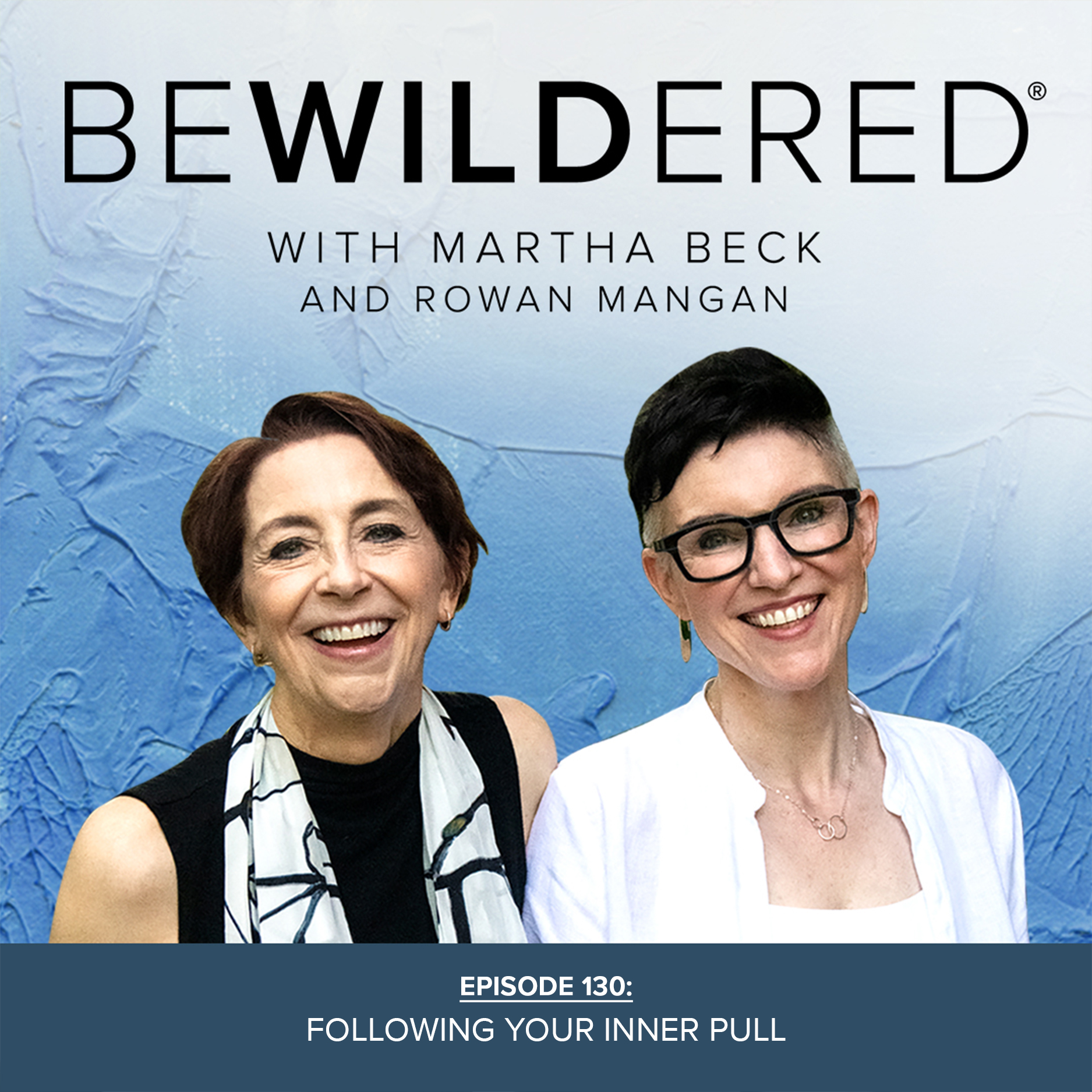
Have you ever kept pushing toward something that keeps pushing back? We’ve all been there. In this episode of Bewildered, we’re talking about the “push” and the “pull” and what it means to “jump into the river.” Many of us spend our lives pushing toward things that repel us, just because the culture tells us to. But when we stop pushing, we become susceptible to the pull—when we’re drawn toward the things we yearn for, and they’re drawn toward us. It’s mutual and it’s magical... Tune in to hear more!



Following Your Inner Pull
Show Notes
We’ve all experienced it, but we’ve rarely articulated it. There’s the “push,” like two magnets repelling each other, when you spend your energy driving toward something that drives you right back. And then there’s the “pull”: when you’re drawn toward something you truly want, and it’s drawn toward you. It seems to be mutual, it’s quite magical, and it’s what we’re talking about on this episode of Bewildered.
A Peculiar Incident at the Marketing Meeting
During a recent work meeting, we both suddenly were seized with a very strong feeling that we would like to write marketing emails for a new product that’s being developed. And for both of us, it’s fair to say, this was a relatively novel kind of experience.
In the past it’s been difficult for us to write these emails—we’ve had to push ourselves incredibly hard. So the weird thing was that after the meeting, we both said, “That’s not a push. It’s a pull.”
The Difference Between the Push and the Pull
The push is what it sounds like. You’re dog-paddling upstream through quicksand. You’re setting rewards for yourself just to get through it. Our modern, Western, rational culture tells us this is just something we have to do, and that the way to navigate it is with a pros-and-cons list and a projected Return On Investment.
The pull, on the other hand, is like a strange, unexpected tailwind. Something grabs your attention, and instead of calculating whether it makes sense, you start leaning toward it. And when you follow it, things tend to unfold in ways a pros-and-cons list could never predict.
The Third Thing: When the Pull Pulls Back
One of our community members over in Wilder offered us a brilliant insight: When she’s fallen in love, even before knowing someone well, there’s a felt sense that the other person is also pulled toward her. That got us thinking.
What if the pull is rarely one-directional? What if, when something is drawing you toward it, it’s also being drawn toward you?
This is what we’re calling “the third thing.” When you’re painting a still life with an orange and a banana, you’re actually painting three things: the orange, the banana, and the interstitial space between them. That space forms a visual image, too, and it’s part of the whole picture.
We think that’s true of the pull, too.
What Culture Gets Wrong About Decision-Making
We’re trained to approach every opportunity rationally: list the pros, list the cons, follow the longer column. And there are contexts where that makes sense. If you’re selling hamburgers, sure, run the numbers.
But when it comes to investing your energy in your one wild and precious life, there’s no formula for how much joy you’re going to get out of something. You can only make an educated guess. So what ends up happening is that we rely entirely on past experience, which keeps us locked in the same patterns.
The pull doesn’t work like that.
How to Start Following the Current
Think of your life as a river. You can’t see the whole river because you’re in it. But every now and again, a rock appears. A small, unexpected pull. And if you hop to that rock, another one appears. And another. Slowly, you realize you’ve been traveling somewhere, and the journey has been, if not easy, at least alive.
What we’re playing with is the idea that maybe when you’re exhausted from pushing against a current that keeps pushing back, you drift into range of the magnet that was trying to find you all along.
What would happen if you lived life not as a series of tasks, but as a series of magnets? You don’t have to have a magic wand. You can just have curiosity and an adventurous spirit. Who knows where it might take you? ✨
Also in this episode:
- Ro’s nemesis Sandra, the 54-year-old kindergartner
- Hiding Easter eggs in Bearsville and threatening the Tooth Fairy
- Lila has her own way of cleaning up a ginger ale spill.
- Artax the horse and the Swamps of Sadness (Sorry, Gen X.)
- The one thing that cures Martha’s insomnia without fail
- How 400 pounds of soil became Ro’s North Star
TALK TO US
You can follow us on our Instagram channel @bewilderedpodcast to connect with our Bewildered community, learn about upcoming episodes, and participate in callouts ahead of podcast taping.
And if you’re a Bewildered fan, would you consider giving us a little rate-and-review love on your favorite podcast player? Ratings and reviews are like gold in the podcasting universe—they help people find us, they help build this beautiful community, and most of all, they help us in our quest to Bewilder the world…
Episode Links and Quotes
- Bewildered episode 125: “The End of the Hustle”
- Samsara
- Australian Drop Bears
- The Neverending Story
- “Get Back” by the Beatles
- The Way of Integrity by Martha Beck
CONNECT WITH US
- Follow Martha on Instagram
- Follow Ro on Instagram
- Follow Bewildered on Instagram
- Join us in the Wilder Community!
- Listen on your favorite podcast app
- The Bewildered Show Notes
- Is there something you’ve been feeling bewildered about? If so, let us hear from you!
Transcript
Please note: This is an unedited transcript, provided as a courtesy, and reflects the actual conversation as closely as possible. Please forgive any typographical or grammatical errors.
Martha Beck:
Hi, I’m Martha Beck.
Rowan Mangan:
And I’m Rowan Mangan, and this is another episode of Bewildered, the podcast for people trying to figure it out, like us.
Martha Beck:
Yeah. And today we’re talking about something I think we’ve all experienced, but rarely articulated.
Rowan Mangan:
Yeah. And we’re talking about it as “the pull” and “the push.”
Martha Beck:
Yeah.
Rowan Mangan:
“The push”: When for some reason, like with a magnet that is positive, positive, it’s pushing you, you’re pushing back against it. And for some reason we can get into quite a…
Martha Beck:
We can spend our lives, because we’ve been told to by the culture, pushing toward something that repels us and it feels like we repel it as well, very much like those two magnets deflecting each other.
Rowan Mangan:
And if we stop fighting that, we are susceptible to “the pull.” And that’s when things that do want us are drawn towards us or we’re drawn towards them.
Martha Beck:
Drawn toward them. It seems to be mutual. It’s quite magical.
Rowan Mangan:
And that’s what we’re talking about today, the push and the pull. Let’s talk about it.
Martha Beck:
So what are you trying to figure out, Ro?
Rowan Mangan:
Well, Marty, I hope this is okay to say, but I’m a little bit freaked out by someone in my daughter’s kindergarten class.
Martha Beck:
Ooh.
Rowan Mangan:
There’s like this one kid in her class who is, I want to say an old soul, but not like an old soul like, “I’ve been around for thousands of years and seen—”
Martha Beck:
Many lifetimes. So wise.
Rowan Mangan:
Lifetimes. She’s more like, “I’m 54 and I work at the dentist’s office and my name’s Sandra.”
Martha Beck:
Is it really Sandra? Just to be clear, it is not Sandra.
Rowan Mangan:
It’s not Sandra, that bitch. No. No, I’m kidding. But yeah, she’s very quiet and thoughtful and she has a really deep voice. This little tiny thing. And she mutters to herself under her breath in a way where you think she’s probably judging your car or something. You know what I mean?
Martha Beck:
I want to hear what she’s muttering.
Rowan Mangan:
I want to hear, but she’s really short.
Martha Beck:
Something like, “You can’t microwave my food in a restaurant. I’ll send it right back. Spin your head. I’m going to slap you silly.”
Rowan Mangan:
Yeah, but she’d sort of do it in a more passive-aggressive way than that. You can see her just being kind of like—
Martha Beck:
What if people are just born like that and then when they’re 54, you meet them? What if the 54-year-olds we know who are acting like 54-year-olds have always been that way.
Rowan Mangan:
Were like always that way. They’ve just hit their moment in life.
Martha Beck:
Yeah. So you could say, “My child has an old soul. He’s about 47.” Or 82. There could be a lot of 82-year-olds running around that kindergarten going, “Oh, my knees hurt,” or something. I don’t know.
Rowan Mangan:
That’s just our kid because she doesn’t look where she’s going.
Martha Beck:
Oh, that’s true. And it must be said, Lila has her ways as well.
Rowan Mangan:
Yeah.
Martha Beck:
She spilled ginger ale on the table the other day, said, “Oh.” Put her face down, sucked up the entire pool, moving her head around it, and then sat back and said, “Huh, I should do that more often.” What kind of soul does she have? Some weird aberrant …
Rowan Mangan:
I should do that more often?
Martha Beck:
I should do that more often.
Rowan Mangan:
She went to school and her teacher told me, she was like, “I got to have some really good time hanging out with your kid today. It was really fun. She’s quite a character. She kept saying, ‘Drum roll, please’ between sentences.”
Martha Beck:
The other day she said, “To be fair, most T-Rexes were red.”
Rowan Mangan:
What?
Martha Beck:
What are you talking about?
Rowan Mangan:
To be fair, Marty.
Martha Beck:
To be fair. Or she said, she told me the other day, “Muffy, I hate to say this, but I just have to. I’m really warm.”
Rowan Mangan:
I hate to say this.
Martha Beck:
But I really have to.
Rowan Mangan:
The thing is, she very much enjoys an idiom.
Martha Beck:
She loves a turn of phrase.
Rowan Mangan:
She loves a turn of phrase.
Martha Beck:
Where is she even getting hese? Not from kids’ TV. Nobody in kids’ TV says, “To be fair, most T-Rexes were red.”
Rowan Mangan:
Maybe it’s my friend quote-unquote “Sandra” at school.
Martha Beck:
I have to say, I never, ever—I hate to say this, but I really have to—I never take Lila to school or pick her up. You and Karen do all that because I had a shift earlier in my life.
Rowan Mangan:
To be fair.
Martha Beck:
To be fair, I did.
Rowan Mangan:
You already welped some.
Martha Beck:
But yeah, I think maybe your exhaustion is making you a tiny bit hypersensitive to the other kids in the room as you drag yourself in there in the morning when no human being should be awake at that hour.
Rowan Mangan:
I don’t know. I just think Sandra’s judging me.
Martha Beck:
Well, yeah, for sure.
Rowan Mangan:
I’m like, I feel like maybe wear each other’s nemesis too, because I can’t say that I’m not a little bit muttering under my breath about her now at this point.
Martha Beck:
That’s true. Publicly.
Rowan Mangan:
Yeah. I’ve said this before, but you have friends whose sickest burn when they’re talking about people who aren’t there is that they’re a young soul, and I enjoy that so much. Yes. And you have to say it with that slightly… “Aw, it’s not her fault. She’s just a young soul.”
Martha Beck:
That’s right.
Rowan Mangan:
I mean, that’s Samsara for you.
Martha Beck:
Right, right. “Now she’s 103, but her name is still Tiffany.”
Rowan Mangan:
Oh man, that’s so deep. Hey Marty, what are you trying to figure out?
Martha Beck:
Well, you know with me, it’s always about the animals.
Rowan Mangan:
Yes.
Martha Beck:
Always. And I fully knew that we were moving into an area renowned for its bears. Yes. And I talk about bears often, but it’s because it’s a real issue for me. Yeah. It’s a real shissue. What were you going to say?
Rowan Mangan:
I was going to reveal the name of the town we live in.
Martha Beck:
Well, go ahead.
Rowan Mangan:
Bearsville.
Martha Beck:
Bearsville. We live in Bearsville.
Rowan Mangan:
So what I’m saying is there were clues that we were going to come into this situation.
Martha Beck:
The traffic signs, the yellow signs that have the black silhouette of a bear crossing the road.
Rowan Mangan:
Yeah. Name of the town, signs. The fact that the first day we moved in a bear was in—
Martha Beck:
A bear was there.
Rowan Mangan:
In the driveway. Yeah.
Martha Beck:
Yeah. Just going, “I’ll take those leftovers now.” He was so sweet. Well, that’s the thing is the place is filthy with bears and everybody’s fine. I have a friend who I’ve known forever, but she lives up here, so it’s been really fun getting to know her better. And she was telling me, she doesn’t live in Bearsville, but she lives very close by. And she told me that they have on her property these trees that have buds in the spring, or maybe it’s another time of year. Anyway, they’re delicious to the bears. And she said, “We have bears that just go up one tree and stay there for a week. And at night we open the windows so we can hear the munching.”
Rowan Mangan:
Aww.
Martha Beck:
Isn’t that darling? Anyway, so I shouldn’t worry. They’re so innocuous, these bears. But then we had an incident where you and I were hanging out, Karikoo, sound asleep, zonked.
Rowan Mangan:
Fast asleep.
Martha Beck:
And we ended up talking till 2:00 in the morning, which is what you do when you really like somebody. And Karen was there, just asleep. She really likes us too. Anyway—
Rowan Mangan:
You’re painting such a word picture.
Martha Beck:
I am. And then I went out and I always do the same thing. I take my little bag and my flashlight and I walk out to go to my bed.
Rowan Mangan:
Getting off to your annex.
Martha Beck:
To my annex, which is 50 steps away. And I say, “Hey, bears,” because that’s what you’re supposed to do.
Rowan Mangan:
No, come on, let’s be fair. You open the door and you say with a kind of world weariness that always amuses me a little bit: “Hey bears. You again.” You’re kind of like Sandra going, “Mondays, am I right?”
Martha Beck:
All the people that I know named Sandra go through my head. And then I remember: old soul. Okay. And I think you may have even mentioned this, but it’s a daily occurrence in our life. And so I go out at 2:00 in the morning and I said, “,Hey bears.”
Rowan Mangan:
And the bear said…
Martha Beck:
A bear said [knock knock]. There were two very heavy footsteps, and I thought no. And then I thought, why is a very large man standing on our property at 2:00 in the morning in Bearsville? And then I thought, those were some very heavy steps. And then I heard [grumbles] very low.
Rowan Mangan:
That was me.
Martha Beck:
And I pointed my flashlight. I tried to get to see, and I think that’s why I went [grumbles]. He didn’t like the flashlight. And then it started to move, the sound, and I was like, “Okay, I’ll just go to my room.” But at the last minute I couldn’t. So I ran upstairs, you were finally zonked out asleep in your room and I jumped on you and went, “There’s a bear outside. There’s a bear out there. There’s a bear out there!” And you walked me home bravely. And then you tried to walk home alone, but I wanted to walk you because of bears.
Rowan Mangan:
Yeah, we almost got ourselves in quite the pickle.
Martha Beck:
Just running back and forth like some sort of failed logic problem all night long. We would’ve had to wake Karikoo up.
Rowan Mangan:
Lucky for you, I was born with a very low sense of physical danger. I never worry.
Martha Beck:
Born of complete naivete, I think.
Rowan Mangan:
Yeah. Oh, completely. No, I don’t deny it but it’s handy.
Martha Beck:
But you’re Australian, you should be afraid of anything that moves. Oh, but we’re not in Australia. So when you’re not in Australia, the threat level goes down so far.
Rowan Mangan:
Well, and it’s like bears are teddy bears in Australia. There are no bears. Well, there’s drop bears. There’s drop bears, but they only really go for foreigners, honestly.
Martha Beck:
Look it up.
Rowan Mangan:
So the idea of a bear who I… I still have my bear that I got when I was three years. It’s like, “It’ll be fine, Marty.” I’m like, “Please.”
Martha Beck:
You should have heard those footsteps. Anyway, and I went and looked at the footprints the next day and it was a big bear. It was like a 350-pound bear or a very small bear with really huge feet, like a bigfoot, a bear bigfoot where the bears around believe in it, but never see it.
Rowan Mangan:
Maybe it was like six deer with some bear feet.
Martha Beck:
So here’s the thing.
Rowan Mangan:
Go on.
Martha Beck:
Then it became Easter.
Rowan Mangan:
It became Easter.
Martha Beck:
Yes. It became Easter. And we had all these plans and all three of us had plans. All three of us went shopping for Easter candy, chocolate eggs to hide.
Rowan Mangan:
Can I confess something?
Martha Beck:
Yes.
Rowan Mangan:
I have a lot of anxiety around things like Easter and Christmas and tooth fairy and all of those. I have a lot of performance anxiety. And so anyway, I just need to put that in because she’s being really nice, but I bought most of the excessive amounts of chocolate.
Martha Beck:
You think what?
Rowan Mangan:
Do we need to do something about… The Easter Bunny. The Easter Bunny brings the…
Martha Beck:
Well, we were just supplementing it. The way you buy presents at Christmastime, even though there’s a Santa Claus.
Rowan Mangan:
Right, right, right. Good save.
Martha Beck:
And talk about performance anxiety with the tooth fairy. When my third child, Ellie, lost her first tooth, we put it under her pillow and said, “There will be a nice shiny quarter for you.” And we opened it. We put it in a plastic bag and we pulled it out, my ex-husband and I.
Rowan Mangan:
And the tooth fairy.
Martha Beck:
And the tooth fairy. And she had put in with her tooth, she had put a note that said, “Dear Tooth Fairy, leave a dollar, or else.” Do you think, I mean, and that was the first tooth she lost. Can you imagine? I had to start saving up right away for her deciduous teeth to plop out of her head.
Rowan Mangan:
I am with Ellie on this one. 25 cents in the ’90s?
Martha Beck:
You’re right. You’re right. So, okay. So performance anxiety, right?
Rowan Mangan:
Yeah.
Martha Beck:
Look, child, I brought you a handpowered egg beater for Christmas. Yeah.
Rowan Mangan:
Mow my lawn and you can have ye a tuppence.
Martha Beck:
Tuppence. All right. So it’s Easter. I’m fully aware that our place is crawling with bears, but you have memories from Australia of that beautiful little glint of a pastel-colored foil under a leaf.
Rowan Mangan:
In Australia, you hide the chocolate eggs. That’s how it goes. The chocolate eggs are what gets hidden. There’s none of this “Here’s your basket, we’ve saved you the work” stuff that I’m aware of unless it’s changed.
Martha Beck:
You get an empty basket.
Rowan Mangan:
No, I never got a basket. Use your hands. That’s what they were for. What do you got pockets for?
Martha Beck:
How are you going to get to hell if you have no hand basket? Oh, you’re in hell. I’m sorry. I’m dissing Australia. I don’t mean that. It’s a gorgeous place. It’s fabulous.
Rowan Mangan:
All right. So I just need to set that scene that in Australia you hide chocolate eggs.
Martha Beck:
Yeah.
Rowan Mangan:
Right? Okay.
Martha Beck:
So we had purchased mountains of stuff and Karikoo was gone. So we sat there, we watched our TV at night, we missed Karen. And then it was like—
Rowan Mangan:
We had to go to devote a moment of silence for Karen who was in Canada.
Martha Beck:
And then Ro was like, “Goodnight, sleep well.” And I said, “Isn’t this the night we do that?” And she was like, “Oh shit.”
Rowan Mangan:
I nearly forgot.
Martha Beck:
It’s that weird thing where you’re so obsessed with something and you prepare and prepare and then you’re late to it or you sleep through it or something. It was this terrifying moment. So of course we’re like, “Oh my God, we got to get us a second wind.” We got all the chocolate, we gathered it around to supplement the Easter Bunny. And then we were out the door almost and it was like one of those cartoon things where you’re running and then you just stop.
Rowan Mangan:
Stop. Yeah.
Martha Beck:
And we just—
Rowan Mangan:
Like Wile E. Coyote a minute after he goes off the cliff.
Martha Beck:
And before that then I looked at Ro and I said, “Bears. Bears.”
Rowan Mangan:
“Bears. Oh, bears would like this.” Yeah. And so we were going to… Well, with the Easter Bunny’s help, we were going to cover the, well…
Martha Beck:
Completely cover the yard in chocolate.
Rowan Mangan:
Yeah. Not really a smart move thinking about it.
Martha Beck:
Right. So if you’re in an area where number one, the bears are waking up from their hibernation because in a weird parallel, they come out of a big hole where you thought they might be dead for Easter, which is where who knows?
Rowan Mangan:
Whoa.
Martha Beck:
Right? That you thought they were dead, the rock is rolled aside, there is a bear.
Rowan Mangan:
Bear is risen.
Martha Beck:
I’m not saying that it’s not true that… I don’t know what happened in the high and far off time, but what I do know is around Easter, those bears roll away the rocks and they come out and they are not dead.
Rowan Mangan:
But they are hungry.
Martha Beck:
Hungry. And very inquisitive. And they can smell a piece of chocolate from a distance of 19 miles.
Rowan Mangan:
Just like our Lord Jesus Christ. Famously.
Martha Beck:
And then of course, back in the day, in the Holy Land, Jesus saw his shadow and went back in for six more weeks of winter. It’s confusing to be me.
Rowan Mangan:
It’s confusing. Anyway, we saved—
Martha Beck:
We saved Easter and the Easter Bunny helped us hide all the eggs in the house. And they’re probably still in many places we haven’t discovered them.
Rowan Mangan:
She found one last night.
Martha Beck:
See, that was the great joy of my Easter as a child. We had 10 kids, eight kids, and two adults living in the house. Maybe there were extras. I can’t count that high. But the joy of it in this completely chaotic house with eight kids was that you would literally be—and all we went for were hard boiled eggs. There was no chocolate involved. We were in a cult, right? No offense.
Rowan Mangan:
And egg cult.
Martha Beck:
I’m offending every religion I know.
Rowan Mangan:
No offense, Mormons, but you are in a cult.
Martha Beck:
So I remember finding an egg when we were getting ready for the 4th of July. We were still discovering hard boiled eggs in the house. Yeah. That’s what happened. And you know what? What? The bears would’ve liked that too. It’s probably a good thing they never did it outside. Yeah.
Rowan Mangan:
There you go. I think we’ve all learned a valuable lesson today.
Martha Beck:
Which is?
Rowan Mangan:
Let’s do a podcast.
Martha Beck:
Oh, why not? Let’s do it.
Rowan Mangan:
So Marty. Today’s podcast is on a topic that you and I started chatting about after a peculiar event took place in our lives.
Martha Beck:
Yes.
Rowan Mangan:
We both suddenly were seized during a work meeting with a very strong feeling that we would like to write marketing emails for a new product that is being developed. And for both of us, I think it’s fair to say, that this was a relatively novel kind of experience.
Martha Beck:
It’s like saying, “Wow, I’m looking forward to that root canal.”
Rowan Mangan:
Yeah, and yet both of us were like, “Oh yeah, let’s do that.” And I actually, I said, “Yeah, I can do that. Although it’d probably be better if Marty was there too.” And you’re like, “I can do that.”
Martha Beck:
“I want to do that.” Yeah. And
Rowan Mangan:
It was so different from the kind of energy of, “All right, well, I guess what makes sense is that I’ll write it and I’ll come to you and get some more…”
Martha Beck:
We have done this in the past and it is, it’s kind of like—
Rowan Mangan:
Root canal sounds exciting.
Martha Beck:
I would literally prefer having a tooth pulled or whatever than to have to do an entire set of marketing emails. It’s grinding. And we used to do it and we’d say—
Rowan Mangan:
We do it.
Martha Beck:
It’s kind of the old model of business.
Rowan Mangan:
If you get an email that says “Love, Martha”—
Martha Beck:
Oh, we did it.
Rowan Mangan:
She totally wrote it.
Martha Beck:
Absolutely. But I mean, we’re really pretty picky about that, actually. What? Oh.
Rowan Mangan:
We would never hire a copywriter.
Martha Beck:
You’ve got that deer-in-the-headlights, look. Okay. So the old model of business is very much like, “Oh, we have, the marketing folks have given us an assignment. We know this is how it works. We’re going to make this happen. Aren’t we? We’re going to make it happen. Yes.” We’re sitting there setting goals and giving ourselves rewards if we… And so it’s been hard to do this in the past. We’ve had to push ourselves incredibly hard. And so the weird thing was that we both said after the meeting, “That’s not a push. It’s a pull.”
Rowan Mangan:
Yeah, we both felt weirdly compelled, and it was so unusual. It was objectively so unusual for us both to be kind of straining to get to work on this particular type of task that we kind of took a minute, didn’t we? And we were just like, “What’s going on here?” And the answer is we don’t know.
Martha Beck:
And we don’t know.
Rowan Mangan:
We don’t know what’s going on.
Martha Beck:
But we kind of do also because…
Rowan Mangan:
I love you. It’s both our personalities in like one moment.
Martha Beck:
We knew that we were talking about something real, first of all. Because we’ve both been through enough of life to recognize that one feeling is associated with a type of experience as it plays out, they’re just like, if you push yourself, push yourself, you get, it’s hard. It’s hard. It makes you grumpy. You burn out really quickly. You don’t want to do it again. You hate everybody. It’s pretty intense if you keep pushing and pushing and pushing. And we’ve both done it. And we both had the experience of being pulled towards something.
Rowan Mangan:
Yeah. The thing is that I think some of the time or a lot of the time, and I don’t know how universal this is, but I think for me, and probably for you, usually when this happens, it’s a little bit more predictable. Like you have something you want to do that you’re running towards like a little puppy dog and it’s just pulling you towards it. And then the things that feel like ugh, you’re more like you’re in quicksand and you have a rope or you’re—I’m so sorry to all the Gen X and elder millennials listening, but maybe you’re like Artax, the horse in The Neverending Story. But anyway, I won’t bring up that collective trauma. It doesn’t matter. You’re in quicksand with a rope. That’s it.
Martha Beck:
Yeah.
Rowan Mangan:
There is no horse in a bog.
Martha Beck:
You’re dragging yourself along.
Rowan Mangan:
Yeah. Yeah.
Martha Beck:
And it’s hard.
Rowan Mangan:
It’s hard. So we had this one experience of like, “That’s weird that we feel pulled towards something that shouldn’t feel pully.” And we were like, “What’s that?” And we started thinking about it.
Martha Beck:
Yeah. And thinking about how through our lives there have been things and moments where we were pulled undeniably, like inexorably. There’s sometimes when you know what you like, and this is what you were saying about predictability, if you give me a list of things I like, I can pick them out and predict that I will want to go toward that. So it’s a pull, but it’s slight and it’s consistent. But then sometimes there will be a thing that I shouldn’t like in my own sort of personal history.
Rowan Mangan:
Worldview. Yeah.
Martha Beck:
Yeah, because there are many things that I’ve done them two or three times, like trying to stay awake at the accountant’s office. I have the worst insomnia in the world and I used to go in to my accountant and he would start explaining money, and I would literally wake up with my head on his desk asleep, drooling. Oh my God, Karen was there.
Rowan Mangan:
Thank God for Karen.
Martha Beck:
And there was one time they actually just put me to bed on a couch in a neighboring office so they could… And I don’t fall asleep. Anyway, except there and talking about that. So I know that’s a push. To try to even stay awake to talk about money is a push, let alone pushing for something that is just about money. Cannot do it. But this experience of writing the copy defied the odds. And I started thinking where else have there been things that generally feel like a push to me, but suddenly they’re a pull? And I actually, looking back on a lifetime of that, I realized that there’s like a series of pulls. You were comparing it to a river. There’s a river that wants me to go to different locations on the landscape.
Rowan Mangan:
And all it can do is provide you with rock to rock, right?
Martha Beck:
Yeah.
Rowan Mangan:
So if you’re like traveling along through your life and you’re just like, this thing pops up, an email comes into your inbox about something, or someone mentions something in passing or you see something in a magazine or something and you go boing-boing-boing. And I feel like that’s the rock. That’s the next rock. And what I was saying to Marty is, what if we’re in the flow of this whole river? But we can’t see the river. We’re in the damn river. You can’t see the river, but like if you could zoom up, you would actually see that in these peculiar little pulls, if you’ll follow them, if you won’t, you’re going to spend your whole life dog-paddling up river, which is fine if you like that sort of thing.
Martha Beck:
It’s good exercise.
Rowan Mangan:
Yeah. But how delicious if we like trained our sensitivity towards like whoosh, whoosh, flowing.
Martha Beck:
Finding the current.
Rowan Mangan:
Flowing from pull to pull.
Martha Beck:
Yeah.
Rowan Mangan:
Pull, pull, pull.
Martha Beck:
From pull to pull. From rock to rock.
Rowan Mangan:
Rock to rock, pull to pull. Sorry. I can’t talk.
Martha Beck:
But here’s the thing, that is not something that modern culture teaches us to do. It’s very, very different from the way decision making is made from a rational perspective, right?
Rowan Mangan:
Right. And so I think what the culture would say about opportunities that arise, like let’s put it in that frame. An opportunity arises one way or another, something that you haven’t encountered before and you can move towards it or away from it, right? I think what culture would say is—
Martha Beck:
Our culture, modern, Western, blah, blah, blah.
Rowan Mangan:
Yes. In the vernacular of our show, by “culture” we mean the dominant culture that many of us live in today. If it’s not your culture, don’t send us emails. We’re sorry.
Martha Beck:
Okay, go.
Rowan Mangan:
I completely forgot what I was talking about.
Martha Beck:
You’re going from rock to rock.
Rowan Mangan:
Culture, culture, culture. Culture would say, “Opportunity arises, make a pros and cons list.” Right?
Martha Beck:
Yes.
Rowan Mangan:
These are the pros. These are the reasons I should go towards it. These are the cons, these are the… And the cons are going to say things like, “Haven’t done it before, seems scary, inconvenient. Boring.” Actually, it’s less likely to be boring. And so what I think we’re trained to do is see which one of those columns has the more items in it.
Martha Beck:
Right.
Rowan Mangan:
And follow that. And so it’s like, it’s a rational way of navigating.
Martha Beck:
Yeah. It’s return on investment. It’s calculating everything according to the reward you’re going to get. Minimize the effort, maximize the reward.
Rowan Mangan:
But you know what?
Martha Beck:
What?
Rowan Mangan:
It’s not—like return on investment, you can’t know ahead of time. So it’s only ever a projected return on investment, right?
Martha Beck:
That’s true.
Rowan Mangan:
And that’s key, I think, because we’re not working, we’re not living, we’re not doing life in an environment where it is easy to project ROI.
Martha Beck:
That’s really true.
Rowan Mangan:
Whether we’re talking financially, if we’re talking about business or whatever, or if we’re just talking emotional ROI or experiential ROI. How the fuck should we know how to do any of that anymore?
Martha Beck:
And we never, actually, we have never been able to predict any of that. So what we end up doing is making everything—
Rowan Mangan:
Honey, I think if you’d stayed awake, the accountant might’ve had something to say about, “We’ve never been able to predict ROI.” I think there probably are some formulae.
Martha Beck:
Yes. Yes, certainly in the formal sense where you’re selling hamburgers or whatever, yes, you could look at ROI. But in terms of investing all your energy into this one wild and precious life, there’s no way of knowing how much joy you’ll get out of something. You can generally predict, but you cannot pin it down. You cannot say, “This is going to be more rewarding to me as a being” and know it for sure until you get there. And so we go on experience, “I didn’t like this. I didn’t like this. I didn’t like this. This probably won’t be fun either.” And if you’re doing that just with your mind, you’re going to stay in pretty much the same pattern. Anything that gives you positive reinforcement, you’re going to repeat, and anything you don’t know about, you’re going to avoid because you don’t know and uncertainty is anathema from this perspective.
Rowan Mangan:
Right. Yeah. And so in a way, your experience is going to fill out the pros and cons lists itself.
Martha Beck:
Yes. But that’s not the way culture tells us to plan it. It’s like, make sure you know what’s going to happen and plan something you know will be good And you know will bring you—
Rowan Mangan:
Right.
Martha Beck:
And so we really know we don’t like marketing copy.
Rowan Mangan:
We understand that’s important, Carmen.
Martha Beck:
Yes. By the lights of rational expectation, we should go away from it and assign it to somebody else. But that felt like, “No!” I was like, “No, I want to do it.”
Rowan Mangan:
I know.
Martha Beck:
And it wasn’t like, “Ugh, I’ll do it.”
Rowan Mangan:
Yeah. Yeah. And so we started thinking about what if we’re kind of being remote-controlled a little bit sometimes. I don’t think it’s like every time, every moment, like walking on sunshine. I just mean that every now and again when you have those little, “Huh, that’s an unexpected little tailwind into a direction.”
Martha Beck:
The other day in Wilder, our little online community—
Rowan Mangan:
Not so little.
Martha Beck:
It’s not so little. And it’s full, in terms of soul, it’s immense. The most amazing people are there. So I was talking about pull and push and how we sort of feel pulled towards something. And one of our fabulous people, Tracy, Tracy Obershon, said it’s so interesting to her that when she’s fallen in love, even if she hasn’t really known the person very well, there’s a sense when you interact with someone where that’s just happening, that they’re also pulled toward you. So I was thinking, yeah, it’s so interesting because you’d think if love were just random, then the good-looking, sexy, rich people would just be mobbed by people who want them and they would only fall in love with each other, and it would be a miserable sort of numbers game.
But that’s not how it works. When someone is pulled towards someone else, I started looking back over my life and thinking, there is this—it has turned out that they were also pulled toward me. And it’s not just in love situations, it’s in work and different things. So we started talking about what I called “the third thing.” So when I taught art, I was a teaching fellow at Harvard, my wonderful professor/mentor, Will Ryman, would tell the students when you put two objects up to do a still life, like it’s an orange and a banana or whatever, you actually are drawing three things because there’s the orange, there’s the banana, and then there’s the interstitial space between them. And it also forms a visual image. And if you’re not careful and you’re not taking care of the third thing, it can destroy the picture because the third thing is always there. So talking to Tracy, I was like, here we are. We’re feeling pulled. Something else feels pulled to us. Just take it as a hypothesis. When you’re feeling pulled to something, let yourself imagine that it’s being pulled to you too. And that the third thing, what looks like empty space is actually like mechanizing the whole process.
Rowan Mangan:
Or it’s gravity. It’s a gravitational force kind of pulling you together. And what I love about this idea of the third thing as well is like there’s any number of metaphors like magnet is the other one. And then we’re back to magnetic north and compasses.
Martha Beck:
Yeah, being pulled, pulled, pulled.
Rowan Mangan:
And I just love the idea of thinking about how we navigate life as just with a little sprinkle of fairy dust on it and imagining, well, what if that nudge, the way your tiny ad in a magazine or something—that feels like a very old-fashioned kind of example—but that just grabs your eye and you’re like, can’t stop thinking about it.
Martha Beck:
Yeah.
Rowan Mangan:
But I love the idea that there is like, I don’t know, that there’s something there that is not like a “God on high with your destiny,” but more like it’s a little Easter egg in the video game, or there’s something there that your higher self would like to experience or learn or someone you’d like to encounter while you’re here.
Martha Beck:
So instead of like, I love this, I love talking about this, you know I do. And even, it’s funny talking about the culture because even in when people do want a little fairy dust, like one of the many years ago when the film The Secret came out, and the secret was that whatever you think about you’ll get. And like people have been, that wasn’t a secret. People have been working on that one for a long time, and it doesn’t work for most of us most of the time, but it also felt like hmm, there’s a reason that book really caught on. And maybe it’s because people, first of all, let me say that people that I knew at that time were like, “I’m going to manifest abundance. I’m going to manifest the love of my life or whatever.” And they started working on it and they would work on it all and they would make it a push. Like, “I know I have it, I have to get my vision board exactly right.” And then they would do it and they’d be like, “Oh no, but I’m feeling like, I have to feel as if I already have the thing. I have to get happier. I have to get happier.” Putting $100,000 bills on the roof of their… Like, we make everything into a push, but here’s my point. The real thing is that we can live as if we’re a magnet being just pulled toward things. We can live life not as a series of tasks, but as a series of magnets.
Rowan Mangan:
Yeah. And like being, I don’t know, like manifesting stuff feels so much, just feels so materialist and like I just want to go whitewater rafting. Do you know what I mean? I just want to… What about the moving through space of it? Instead of the law of attraction and attracting stuff and attracting the car you want, what if it’s like, I want to go towards that? That feels yummy. And then you get to have agency and you get to, and you don’t have to have a magic wand. You can just have curiosity and an adventurous spirit.
Martha Beck:
Yeah, I love that. And talking to Tracy and the community the other day, I started to be so amazed. Have you ever played with magnets when you were a little kid? Did you first play with them?
Rowan Mangan:
Dude, I play with magnets every day. I have fidget toys.
Martha Beck:
Fidget toys. Just the feeling of that pull or push through space is like, what is happening? This is magic. Magic. It really feels like magic.
Rowan Mangan:
Mind you, so does microwave, but…
Martha Beck:
Well, it all feels pretty magical to me, I have to say, anything except keeping seven years of records so that you can pay your taxes. No. That one is an active push for me.
Rowan Mangan:
Okay. No accountants.
Martha Beck:
Oh, interesting because it’s not… I’m actually, the push is coming reciprocally too. If I’m pushing myself to do something, maybe that something is pushing away from me.
Rowan Mangan:
“Your Honor, I couldn’t do my taxes. They didn’t want me to do them. Do you see?”
Martha Beck:
“They are magnetically opposed to me.”
Rowan Mangan:
“It was equal. I didn’t want to do them. They didn’t want to be done by me.”
Martha Beck:
So that’s really an interesting thing. Maybe the whole current of the place, the push and the pull, maybe when you’re doing something that you really don’t like and you’re pushing harder and harder to make yourself do it, and then you sort of surrender to exhaustion or whatever, so you don’t do it and you get pushed away from it, maybe it puts you in range of the magnet that’s trying to pull you. Maybe if you never leave the push magnet, you never feel the pull.
Rowan Mangan:
That makes so much sense to me.
Martha Beck:
That’s the kind of sense we like to make: non. No, it’s not non.
Rowan Mangan:
Well, yeah, because I always believe in this, and I know we must have talked about it before here, but in this idea of surrender as something to dive into joyfully rather than something to fall into in complete despair and exhaustion. And I mean, you’ve talked about it before, leaf in the stream. It’s literally the metaphor we’re playing with today is the current. But yeah, like I was saying before, that like remote control or tailwind or whatever, it’s just like, it’s so fun to think, “Why do I want to turn left at this intersection? What’s around the corner?” And I remember, I don’t know, again, I don’t know if this is universal, but when I was young, from childhood right up to probably early 20s, there was a lot more fairy dust on stuff. There was a lot more awe and wonder. And some of that’s how the brain works. Some of that’s the kind of life you’re leading at that sort of time and all kinds of different reasons. But I can remember feeling like I was on adventures a lot more. And it’s really fun to kind of think if I just jiggle my availability, if I let go of pushing so hard against magnets that don’t even want me attaching to them, then I could be writing marketing copy right now.
Martha Beck:
Oh, the joy.
Rowan Mangan:
The joy. Amazing.
Martha Beck:
It’s interesting you talk about this. You don’t know if it’s universal because I’ve had the opposite experience. Growing up, I felt no degrees of freedom. I didn’t feel any degrees of freedom when I—
Rowan Mangan:
Not even when you were out in the woods with your bow and arrow?
Martha Beck:
No.
Rowan Mangan:
You didn’t feel freedom?
Martha Beck:
No. I knew what my life had to be. I knew I was—
Rowan Mangan:
Oh, you mean possibility?
Martha Beck:
Yeah. I liked going to school, but I had to go to school. There was no thought of “I’m off on an adventure” ever, because I knew that I had to… The things I had to do were all… you know, I believed what the people around me told me was true. And what they were telling me was true is that even your thoughts are under scrutiny. You are not allowed to even think about something that isn’t coherent with the gospel, the “true church.” This is one of the things that’s so interesting in our relationship. There is no way to communicate what it is like to grow up thinking your role is so set. You will get to be 20, you’ll get married, you’ll have kids, that’s your life. You will have 12 kids. That’s your life. Watch The Sound of Music 430 times because that’s your life. And when I left that religion, that was the hardest pull, the hardest push I’ve ever had. I was pushing myself to be good my whole life, and it just pushed back. There was something in me, there was something in the world that pushed me away from that and then pulled me incredibly hard out into something completely anomalous and new and terrifying to me. And that was when I started thinking life is a big adventure.
Rowan Mangan:
Oh, interesting. Yeah. Well, there you go. I mean, and it just shows that when we can make ourselves available to that worldview, when we can stop pushing against all the systems or the institutions or whatever it is that are providing that push. And I think we get so hypnotized by the process of pushing away and being pushed away and how exhausting it is and everything.
Martha Beck:
But it’s what we’re supposed to do.
Rowan Mangan:
Yeah.
Martha Beck:
Yeah.
Rowan Mangan:
But you can get so stuck in it. And so it does seem like at any point, if you choose to just kind of take a breath and step out of the struggle, that it’s this close.
Martha Beck:
Yes.
Rowan Mangan:
It’s so close if you want to start following the river, this current.
Martha Beck:
Yeah. And it is… I want to talk about how you feel for it and what it feels like.
Rowan Mangan:
Yes.
Martha Beck:
But there is this tendency to have in our minds a kind of religion. Mine was a literal religion, but maybe you are an obsessive reader of Martha Stewart Living Magazine, and you really think that the rule is you have to get up at five and grow a garden, you have to throw dinner parties at this kind of, at this time, you have to put white—
Rowan Mangan:
That’s literally my dream.
Martha Beck:
It is. You have to put, well, the house has to be absolutely without any clutter whatsoever and painted in the specific Martha Stewart colors.
Rowan Mangan:
That’s my nightmare.
Martha Beck:
So whatever it is in your head that says, “This is what I have to do or I will be socially shamed and I will be shamed inside because I won’t think I’m a good enough homemaker, mother, man,” whatever it is. The religion in your head, some of us have looser religions than others. Mine was very tight, right? Very jammed in there. I was trying so hard to be good. And that’s how we do bad things because we’re trying so hard to be good. Anyway, the difference between running on that, on the prescriptions and the rules and the law that is written either in The Book of Mormon or in Martha Stewart Living or Mechanics Digest or wherever—that’s a real thing, I think. The difference between running on book learning and running on internalized religious principles about whatever and actually putting yourself into that river, like the feel of a magnet, it’s not like anything else you’ll ever feel. It defies so much of what you’ve ever experienced in the past. You drop a rock, it falls. Unless it’s a magnet and you drop it near another magnet, and then it goes up suddenly. It breaks the rules in the most confounding way. And I think I’m always trying to help people do that, and they’re just unfamiliar with following the pull.
Rowan Mangan:
So we want to come to our senses, right? Culture says come to consensus, write your pros and cons list, be your housewife self. And we want to come to our senses. So in this case, in this conversation, what that means is we want to stop pushing long enough to be able to learn to follow the current and where kind of the adventure of life wants to take us, let’s say. So can you help us to understand what’s the coming-to-our-senses process with this? What does it feel like?
Martha Beck:
It’s really fascinating. Okay. So everybody’s familiar with the push. Everybody, every single person out there has at some point just buckled up and said, “I’m going to have to do this even though I don’t like it.”
Rowan Mangan:
We did an episode about the hustle recently that was very much on this topic.
Martha Beck:
Where you push and you push and you push and it’s really familiar. Most people don’t love school. I loved school, so it was a pull for me. So I would look around me and think, “Why are these people so miserable in school? School is the best thing ever invented.” Exactly fits my skillset and something—the third thing—wanted me there. So the push is characterized by a sense of heaviness, like a physical sense of heaviness. Exhaustion, you get up in the morning, you already feel the weight of it. It grinds, and maybe it is a magnetic push where you start to go toward the thing and you start to, you will go to do anything. People talk about writer’s block. When you sit down to write, that’s when your house suddenly does need cleaning, and you get up and you do all the things. So you’ll be sort of ricocheting away from it. You have to kind of, you’ll sit down to think about it. Your mind drifts. It is like trying to push a magnet toward an opposite, or is it the opposite polarity that—?
Rowan Mangan:
No, same.
Martha Beck:
The same polarity that deflects. And it is like that. It’s like you move up closer to what you’re meaning to do and your mind goes off, and then sometimes your body goes off too. And a lot of times people will end up doing things that are self-soothing instead, like, “I have to work on this and it doesn’t want me to work on it and I don’t want to work on it.”
Rowan Mangan:
“Maybe if I give myself some ice cream, I’ll be able to work on it.”
Martha Beck:
Yeah. And you could not want the ice cream at all, but that’s sort of a cultural paradigm: “Well, you can eat, you can smoke, you can, whatever it is, everybody needs a little treat sometimes.” Or shopping—Ro would buy herself soil. That’s a thing she does these days. She keeps going off, y’all, it’s really, you know, I’ve heard people say, “My wife is spending way too much money at the, I don’t know, the fur store.” Excuse me. Well, Ro goes sneaking off in the car and she’s going to be shopping. And what she will come back with is 400 pounds of soil. So anyway, that’s something that you can do to self-soothe if you were trying to do marketing copy that you didn’t want to do.
Rowan Mangan:
That soil is my North Star. Okay?
Martha Beck:
It is.
Rowan Mangan:
That soil could not be a bigger pull. It’s pulling me in the car towards it, right? It’s pulling me. I’m loving it. It’s loving me. Pull. And then you’ll be eating the tomatoes of glory.
Martha Beck:
Well, that soil has certainly…now, there’s a sufficient mass to pull you gravitationally. It doesn’t need to be a magnet.
Rowan Mangan:
Oh my God.
Martha Beck:
I mean, all we have is dirt.
Rowan Mangan:
This woman who says, “Never cook” then gets worried about the price of dirt.
Martha Beck:
I’m not worried about the price of it. It’s the compulsive manner in which you purchase it.
Rowan Mangan:
Oh my God, you’re so funny.
Martha Beck:
And it weighs, it’s 50 pounds a piece. I’ve never seen you lift more weight in your life. It’s a bit compulsive.
Rowan Mangan:
It’s the pull.
Martha Beck:
Com-pull-sive. Okay.
Rowan Mangan:
Nope. I won’t hear it because I know what it feels like to be pulled.
Martha Beck:
There you go.
Rowan Mangan:
And I’m being pulled towards making a garden. And you can’t shame me for my dirt. I’m very comfortable with my dirt.
Martha Beck:
Are you?
Rowan Mangan:
Yes.
Martha Beck:
All right. I guess that will be now the fourth person in our relationship, a huge mound of dirt that you’re deeply in love with. No, it’s wonderful. You’re going to grow us all the food in the universe. I love you. Buy more soil, honey. It’s good.
Rowan Mangan:
Oh my God. This is going so weird.
Martha Beck:
Okay. Get back. Get back. Okay.
Rowan Mangan:
Like the Beatles once said.
Martha Beck:
“Get back, get back to where you once belonged.” Okay. So we all know what the push feels like and the grind and the deflection and all of that. So instead of taking that, it’s the meaning you make of that.” I’m supposed to do this, but I’m a lazy bastard and I never get things done.” Okay? That kind of thing, there’s the self-soothing that we do when we’re trying to push, and then there’s the self-loathing that comes up. And it’s just a mass of difficulty and pain because we’re trying to push towards something that is actively pushing us away. And the third thing in the middle is saying, “That’s not right for you.”
Rowan Mangan:
Do you think that part of the suffering of that situation comes from the idea that we’re… Do you think that the culture sells us the idea that things like that, that are that kind of deep push should feel like a pull and that that’s where the self-loathing and all those behaviors to do, those compulsive behaviors come from us thinking that there’s something wrong with us because it doesn’t feel like a way to live your life.
Martha Beck:
Yes. And the reason I’m spending so much time on it is that a lot of people think, “Well, if I don’t push, I’m just going to sit around doing gambling online or something. I’m going to do something bad.”
Rowan Mangan:
Well, and also “If I don’t push, if I don’t do something that I hate, I won’t get my reward in heaven.”
Martha Beck:
That’s right.
Rowan Mangan:
Or on the corporate ladder. Yeah. That’s what I’m saying is that it’s all the same story that misery leads to joy in some way.
Martha Beck:
Reward, yeah. Absolutely. And it does in the short term, if all you do is keep the same mindset. So what it feels like to get pulled, you actually have to be out of the mindset of the “culture tells me where I’ll get my reward and I have to do my chores.” You kind of have to drop out of culture and be sort of a freewheeling, independent object that is drawn to its own specific places. And for me, even as a little kid, school was that. School pulled me. I loved school, and school loved me. And when you’re in a place where you’re actually following the pull and you’re not just getting a reward to make yourself feel better for not pushing, if you actually free yourself from the push, if you let it propel you away from it, and then you start to feel the things that are calling you, there’s a sense of surprise. That’s my favorite part about it. Like, what is happening? This happened in our meeting the other day. As silly an example is as if, “What is happening? I don’t want anyone else writing that marketing copy. I want to write it.” And it seemed so fun. And same thing happened. I was with a steady partner, had been for decades. You came along, and both of us were like, “What’s happening? Why are we pulled? Why are we being pulled? Why does this… What?” And I don’t know how you felt it, but it was like one of the most intense pulls I’ve ever had in my life. And I didn’t know you well enough to realize what an absolute score I was making in terms of—
Rowan Mangan:
Soil.
Martha Beck:
Yes. The amount—
Rowan Mangan:
The soil you would one day have.
Martha Beck:
The amount of soil this person would bring into my life.
Rowan Mangan:
That’s right, baby.
Martha Beck:
No, actually it blows me away because we talk about following the river and feeling the pull and not knowing why you’re going there. And you kind of tried to make up… People made up reasons why we got together. “Well, their sex life was boring” or whatever.
Rowan Mangan:
“She was a gold digger.”
Martha Beck:
Yeah, we’ve heard it all. And in fact, all I knew was the pull. I didn’t know you as well as I did. And then all these things about you sort of… I sort of discovered after it already happened, and I was like, “This is exactly the person I…” I mean, everything you brought was so perfect that I would never have thought I would find it in one single person.
Rowan Mangan:
And you didn’t.
Martha Beck:
Yeah, that’s right.
Rowan Mangan:
That’s why we have two partners.
Martha Beck:
But it’s weird. I mean, Karen just left for 10 days to go galavanting with her sisters. And when the three of us were back together again, it’s like “Ahh…”
Rowan Mangan:
Thank God.
Martha Beck:
It was the magnet clicking again and trying to push away from it, trying to say, “This is too weird, we can’t do this” was one of the most brutal pushes I’ve ever tried to do. So much that a couple of hours of it would almost destroy me. I mean, it was so intense.
Rowan Mangan:
Yeah. I mean, we talk about our relationship and us getting together a lot because I think it was so countercultural.
Martha Beck:
And counter what we intended.
Rowan Mangan:
Yeah, no, the internalized culture is just as alive and well in us as in anyone else. And what happened was we did it anyway. The pull was so intense that we did it anyway, but with all these physics metaphors that I can’t really work with because I don’t really understand physics, something happened where we kind of split the atom a little bit because everything in our lives at the time exploded when we got together. Socially it was like…
Martha Beck:
Yeah. Yeah.
Rowan Mangan:
Everything went completely crazy, and it was a really tough year or two.
Martha Beck:
Oh my God. People did not approve.
Rowan Mangan:
No. And a lot of people projected a lot of stuff. Anyway, it doesn’t matter. But the point was that sometimes it’s big energies that you’re working with here. Not all the time, thank God, because that’s a heady kind of thing.
Martha Beck:
And for true, it is the culture will fight you when you try to do this. And that was our little posse of people we hung out with, that was our culture. And then when we got together, that culture was like, “Oh no, no, no, no.” And we lost it, right? And it was like, what? What just happened to us? And what I think is true for the individual, there’s also a group dynamic where there are times in your life where you’re pushed and pulled into your own stream where you will then leave the sort of pool, the waterfall, whatever it was.
Rowan Mangan:
The eddy.
Martha Beck:
The eddy. Let’s call it the eddy. You’ll leave the eddy where you’d been circling for a while and go off and people will be like, “What? Come back.” And you’re like, “I will try.” And you can’t.
Rowan Mangan:
No.
Martha Beck:
Yeah.
Rowan Mangan:
No, that’s right. Yeah, it’s cool. And I mean, you talk about changeback attacks, this is a great moment to mention that term because if anyone… I’m picturing people listening going, “Well, actually, I think I’m being pulled in this direction.” And having done this a few times, we can say it’s probably the right thing to do if it genuinely feels that way, but you will get a bit of blowback.
Martha Beck:
Yeah. And that’s why I was so cautiously saying it’s not just giving yourself treats or anything because sometimes the people around you will say, “You’re off your rocker. You should not be doing this. Clearly you’ve slipped off the true path because you’re doing dysfunctional things and that is not okay.” So they will push you away from the thing that is pulling you. It does not make any sense. They’ll try to drag you into the thing that is a push for you and try to keep you from the thing that feels like a pull.
And so if you genuinely are doing stuff like online gambling to cope with your sense of being pushed, they will be able to say, “There, you’re a bad person when you’re not pushing.” But you’re not a bad person, you’re self-soothing because the push is so painful. And then when you follow the pull, it’s a totally different feeling. Soothing yourself is soporific. It makes you feel less energetic, more self-loathing. When you go with the pull, you are on a wild ride and you feel it and it’s exhilarating and it’s beautiful. And you say to your friends, “Something amazing has happened to me.”
Rowan Mangan:
And they’re like, “We’re worried about you.”
Martha Beck:
Yeah. And “There’ll be none of that, please.”
Rowan Mangan:
“We’ve been talking about you a lot and we don’t think it’s okay.”
Martha Beck:
Yeah. So yeah, I’ve had that every single time I’ve followed the pull. I’ve had a lot of cultural blowback every single time. So that’s why I wanted to really say this feeling of the pull, feel two magnets and then sense where there’s something that strong.
Rowan Mangan:
In each direction, in either direction, like where are you trying to move towards something that you don’t want it and it doesn’t want you?
Martha Beck:
And you know what? It is not a plan for what we should do to defeat the oppressor, but it is a genuinely seditious plan.
Rowan Mangan:
It is. Yeah.
Martha Beck:
Because it’s leaving all culture and saying, “No, I’m going to follow the third thing, whatever it is, the pull of my higher self or whatever, I’m going to do that. And that means I will not be subjected to any culture or any religion.”
Rowan Mangan:
Any dogma.
Martha Beck:
Any dogma.
Rowan Mangan:
I’m impervious.
Martha Beck:
Right. And you can’t talk me out of it because I know what a pull feels like. Yeah.
Rowan Mangan:
Yeah. And I think when we are in the river and we are following the pull, then that we’ve got to be… staying wild.
Martha Beck:
Rephrase.
Rowan Mangan:
We’re leaving this in by the way.
Martha Beck:
Oh, shit. Okay. Just say it again.
Rowan Mangan:
Okay. So I think it’s fair to say that when you’re following the pull and you’re in your river and you’re pushing against the push, but you’re letting go and you’re in the river and you’re flowing against the tide with the tide. That’s how we…
Martha Beck:
Stay wild.
Rowan Mangan:
Stay wild.
Rowan Mangan:
We hope you’re enjoying Bewildered. If you’re in the USA and want to be notified when a new episode comes out, text the word WILD to 570-873-0144. We’re also on Instagram. Our handle is @bewilderedpodcast. You can follow us to get updates, hear funny snippets and outtakes, and chat with other fans of the show. Bewildered is produced by Scott Forster with support from the brilliant team at MBI. And remember, if you’re having fun, please rate and review and stay wild.
We’re also on Instagram. Our handle is @bewilderedpodcast. You can follow us to get updates, hear funny snippets and outtakes, and chat with other fans of the show.
For more of us, Martha’s on Instagram, themarthabeck. She’s on Facebook, The Martha Beck, and she’s on Twitter, marthabeck. Her website is, MarthaBeck.com. And me, I too am on Instagram. Rowan_Mangan. I’m on Facebook as Rowan Mangan. And I’m on Twitter as RowanMangan. Bewildered is produced by Scott Forster with support from the brilliant team at MBI.
Read more
Questions? Comments? Trying to figure something out? Email us! [email protected]
Credits
Wandering The Path by Punch Deck | https://soundcloud.com/punch-deck
Music promoted by https://www.free-stock-music.com
Creative Commons Attribution 3.0 Unported License



0 comments