

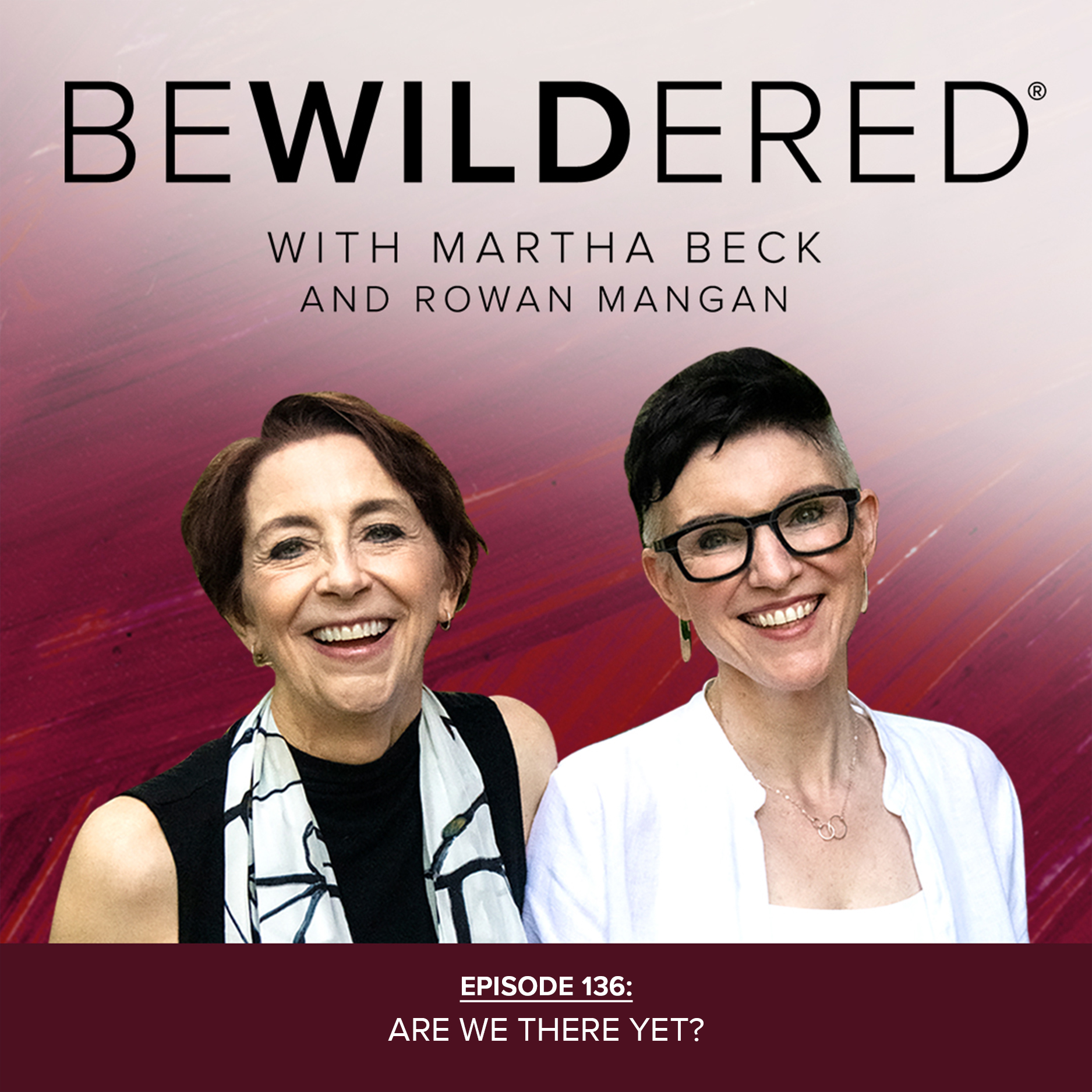
About this episode
We’re all chasing a destination—that big promotion, that perfect relationship, that hundred million dollars—convinced that once we arrive there, life will finally stop life-ing and everything will fall into place. This time on Bewildered, we dig into why relationships, body, and money are “the biggies,” why the place we want to go always recedes like a desert mirage, and how coming to our senses means realizing we’ve already reached our destination: this exact moment, right here, right now. Join us!



Are We There Yet?
Show Notes
This time on Bewildered, we’re talking about the endless quest for the destination. You know, the place where once we get that promotion, that relationship, that bank balance, then it’s “happily ever after.” What could possibly go wrong?
We Hate Our Kitchen
We start where we always start: with real life. Our kitchen, mangled by a winter of rain and melting ceilings, has become our bête noire, and every night around 6:30, Martha cleans it while ranting about chicken stock and stuck drawers.
But we noticed something: We keep telling ourselves that once the kitchen is fixed, birds will sing, the sun will shine, and we’ll skip through meadows because everything in our lives will finally work. We talk about it constantly: “Imagine our lives when the kitchen is done.”
The Endless Quest for the Destination
We realized this isn’t just about our kitchen but about the human tendency to fixate on a future point where “life will stop life-ing.” We talk about “the biggies” that people convince themselves will deliver permanent safety once achieved—you know, things like the perfect partner, the ideal body, or millions of dollars in the bank.
We’ve even heard people justify embezzling, marrying for money, or injecting themselves with stem cells, all in pursuit of a stasis that never actually arrives.
Chasing a Desert Mirage
We land on the idea that this destination we’re all racing toward works exactly like a heat mirage in the desert. It glitters just out of reach, receding the closer we get. We talk about how our culture reinforces this through every rom-com and action movie that ends in “happily ever after,” as if the story stops the moment the conflict resolves.
We point out that Cinderella and Snow White didn’t actually live happily ever after. They lived happily for a while, and then they died—which is a much truer ending than one we’ve been sold.
What We’re Really Craving Is Certainty
We dig into why this obsession with a fixed, unchanging destination is really a stand-in for our fear of death—the only true state of permanence we know of.
We reference Don DeLillo’s novel about a drug that eliminates the fear of death (not death itself) and talk about how the knowledge of death makes us human, while the fear of it makes us dysfunctional. We conclude that pursuing an unchanging destination is, in a strange way, courting the very stillness we’re most afraid of.
Coming to Our Senses
Martha shares the story of her old car GPS that malfunctioned—except it spoke up at the exact moment she dropped into deep presence at a stoplight, telling her, “You have reached your destination.”
We riff on Eckhart Tolle’s The Power of Now to make the point that there is only one destination we’ll ever actually arrive at, and we’re already there: this exact moment. We land on the truth that “now” always catches us, even when people, money, or our bodies can’t—and that’s the trust fall we’re doing every single day.
Also in this episode:
- Ro’s “great little guy” who hangs on the wall
- Martha improvises some minty-fresh earplugs.
- Karen just wants to know the sports scores, not watch the games.
- Ro and Lila’s horrendous bath-bedtime catastrophe
- Why you should never pour concrete into a ceiling
- “Action movies: They blow me away.” —Martha Beck
TALK TO US
You can follow us on our Instagram channel @bewilderedpodcast to connect with our Bewildered community, learn about upcoming episodes, and participate in callouts ahead of podcast taping.
And if you’re a Bewildered fan, would you consider giving us a little rate-and-review love on your favorite podcast player? Ratings and reviews are like gold in the podcasting universe—they help people find us, they help build this beautiful community, and most of all, they help us in our quest to Bewilder the world…
Episode Links and Quotes
CONNECT WITH US
- Follow Martha on Instagram
- Follow Ro on Instagram
- Follow Bewildered on Instagram
- Join us in the Wilder Community!
- Listen on your favorite podcast app
- The Bewildered Show Notes
- Is there something you’ve been feeling bewildered about? If so, let us hear from you!
Transcript
Please note: This is an unedited transcript, provided as a courtesy, and reflects the actual conversation as closely as possible. Please forgive any typographical or grammatical errors.
Martha Beck:
Hi, I’m Martha Beck.
Rowan Mangan:
And I’m Rowan Mangan, and this is another episode of Bewildered, the podcast for people trying to figure it out.
Martha Beck:
Like you, like me, like all of us.
Rowan Mangan:
Yes, indeed.
Martha Beck:
What are we talking about today?
Rowan Mangan:
Oh Marty, the endless quest for the destination, for the place we need to get to, the place where once we get that promotion, that relationship, that bank balance, then—
Martha Beck:
Happily ever after.
Rowan Mangan:
Everything will be fine and life will be manageable and things will stay still.
Martha Beck:
Perfect.
Rowan Mangan:
Yeah.
Martha Beck:
Sounds good to me.
Rowan Mangan:
What could possibly go wrong?
Martha Beck:
Let’s find out. So Roey, whatcha trying to figure out?
Rowan Mangan:
I’m trying to figure it all out piece by piece, step by step. Today’s piece truly is about a little guitar. I bought a little guitar.
Martha Beck:
You did.
Rowan Mangan:
I wanted to take it to Greece with me.
Martha Beck:
You did take it to Greece with you.
Rowan Mangan:
I did. It was just a little guy. He’s just a little guy.
Martha Beck:
He sings on the wall.
Rowan Mangan:
He’s not a full-size guitar. He’s just a little guy and—
Martha Beck:
Goes on the plane.
Rowan Mangan:
He’s a three-quarter guy, and he goes on a plane, and I love him very much, but he’s a better guitar than I have had recently in my life. And Marty did discover this.
Martha Beck:
Yes.
Rowan Mangan:
And she discovered it by singing.
Martha Beck:
You don’t want to know how that sounds.
Rowan Mangan:
She sang and sang and then my little guy on the wall, he sits on the wall. He’s so cute.
Martha Beck:
It really is a cute guitar.
Rowan Mangan:
His pronouns are he/him.
Martha Beck:
Oh, sorry, sorry, sorry. Okay.
Rowan Mangan:
So he’s on the wall, Marty starts singing, he starts singing.
Martha Beck:
Yeah. It’s true.
Rowan Mangan:
And this culminates in Marty sort of like impersonating a siren.
Martha Beck:
Well, first I shouted something to Karen who was downstairs and then I was like, Karen, and the guitar went: [vocalizes] Only twangier. He was just hanging on the wall. “Wa-wa,” he said. So then I had to start singing to him.
Rowan Mangan:
Yeah, you sang to him and then you just started going, “Woo hoo!”
Martha Beck:
Yes.
Rowan Mangan:
And he was there going, “All right.”
Martha Beck:
He went [vocalizes]
Rowan Mangan:
He sarcastically went [vocalizes]
Martha Beck:
I love that guitar.
Rowan Mangan:
I love that little guy. He’s a great little guy. He came with me to Greece. You didn’t, I noticed.
Martha Beck:
Nope. I wasn’t invited.
Rowan Mangan:
Well, that’s true.
Martha Beck:
You kept him right close to you.
Rowan Mangan:
And then I found the perfect tool, which was a strap-on, a strap-on thing that turns my guitar into a backpack. And thus did he come around with me everywhere.
Martha Beck:
It was amazing. Yeah.
Rowan Mangan:
It was great. So you now scream “woo-hoo” in my bedroom.
Martha Beck:
A lot of spouses would be pleased with that development.
Rowan Mangan:
Ah, listen, I’m not complaining. I’m just trying to figure it out, babe.
Martha Beck:
Okay. All right.
Rowan Mangan:
What are you trying to figure out?
Martha Beck:
Mine is tangentially related to yours. Because it of course has to do with Ani DiFranco. You went to Greece, hung out with a bunch of people, including Ani DiFranco. We went to one of her concerts in Albany, New York, a few weeks ago, right?
Rowan Mangan:
Yeah, it wasn’t a concert. It was an event, but yeah, it was for a book.
Martha Beck:
Oh, well, this was a concert. I don’t remember when the last concert was.
Rowan Mangan:
It was in New York.
Martha Beck:
But I do remember that the reason I don’t typically go to concerts is that I’m very noise sensitive. My ears are very noise sensitive.
Rowan Mangan:
And concerts famously are noise-based events.
Martha Beck:
They are. Oh my God, my absolute worst scenario are those clubs where it’s tung, tung, tung, that everybody seems to love and they go in and take drugs and dance. And for me, it’s like the equivalent, it hurts my ears.
Rowan Mangan:
Well, that’s what the drugs are for.
Martha Beck:
Oh, that makes sense.
Rowan Mangan:
To make it bearable.
Martha Beck:
Because it’s like, “We’re going to play some really mediocre music, but at the same time we’re going to kick you in the shins for two hours really hard.” What is the appeal? I don’t know. Go in and have pain. All right. But Ani DiFranco’s music is not mediocre and I love it. I love to listen to it.
Rowan Mangan:
Nice save.
Martha Beck:
Yeah. Yeah. But the concert venue tends to crank up the volume quite a bit. And so we went to a concert. We were sitting there. The music started, it was great and it was painful. And I was like, why didn’t I bring earplugs? Because I’ve actually, a sound expert once told me, “You should probably be wearing earplugs when you go to any big event where there’s a lot of noise. It saves your hearing. You can still hear, it’s so loud.” I was like, “Damn it, I don’t have any earplugs with me.” Then I thought, what do I have in my purse that could double as earplugs? And I thought, well, I think I have a tissue. I could wad it up and stuff it into my ears. Then I was feeling around: no tissue. I didn’t have a tissue. I was getting desperate. And then I thought… So I had some gum.
Rowan Mangan:
Oh my God.
Martha Beck:
I’m sorry.
Rowan Mangan:
Chewing gum.
Martha Beck:
Well, the thing about it is it’s sticky at first chew. But after you’ve chewed it for a while, it loses its stick and it basically becomes a sort of plasticine substance, right? It does.
Rowan Mangan:
Still sticky.
Martha Beck:
No. No, you haven’t chewed a piece of gum to death the way I do when I’m writing. I mean, I chew gum to death when I’m writing. So I thought I know what to do. So I took a piece of gum and I chewed it really hard. Through a couple of songs. I thought, okay, I think it’s ready.
Rowan Mangan:
Oh, that’s when I turned to you and I’m like, are you okay? Because there was something about how you were moving that felt weird.
Martha Beck:
That was a little bit later.
Rowan Mangan:
Oh, was it?
Martha Beck:
I got it what I thought was thoroughly chewed. I secretly took it out of my mouth and made two little wads out of it. It was tolerably non-sticky. Put it in my ears. It was perfect. Everything was going great.
Rowan Mangan:
This is no reflection about Ani’s music at all.
Martha Beck:
No! The fact that I would even go to her concert says how much I love them. Love them. Because the dynamics are a really important part of her music too, like the loudness and softness. So it’s important to feel the whole thing, but in my case—
Rowan Mangan:
With a little bit of sugar-free?
Martha Beck:
Muffling. So it was working beautifully for a couple of songs. But you know that feeling when you put mint in your mouth and it’s really strong?
Rowan Mangan:
Oh, like it goes ouchy cold?
Martha Beck:
Yeah. That started happening to my ears and it crawled into my ears and it went into my brain. I’m convinced of it. I was enjoying the music very much. And the same time, my head was being perforated from both directions through my ears by minty freshness.
Rowan Mangan:
So it was almost as though you were smoking two menthol cigarettes through each of your ear holes.
Martha Beck:
Yes. Similar to that. Yes. And then stuffed them in my ears while still lit. And that was when you turned to me and said, “Are you all right? Is there anything going on?” And I thought I could say my ears are full of gum, but then—
Rowan Mangan:
Well, you could just say, “My ears are full of minty freshness”?
Martha Beck:
No, it was time for the truth or nothing at all. And I just couldn’t imagine you actually staying with me if I filled my ears with gum at an Ani DiFranco concert, which, in fact, is what I did. And now I’m trying to figure out how to… I’m coming clean on the podcast so you can’t just leave me immediately.
Rowan Mangan:
Yeah.
Martha Beck:
I mean, if I’d done it at any concert, it would’ve been problematic. At an Ani concert I think it was pretty much divorceable.
Rowan Mangan:
Look, I will say the doing it is fine. The talking about it is fine. The talking about it on a podcast that Ani might conceivably listen to, that’s where I’m like, “Mmm, divorce.”
Martha Beck:
Yeah. You make a solid point. You make a solid point.
Rowan Mangan:
But, you know…
Martha Beck:
I think eventually it hurt so much I took the gum out of my ears, and I was okay. That’s a ringing endorsement.
Rowan Mangan:
I’m so glad to hear it, honey. I’m so glad to hear it.
Martha Beck:
I just want to say I can’t wait to go to the next Ani concert. Honest to God, you’re going to get me some special… I know what’s going to happen. You’re going to get me a special earplug that allows me to feel and experience the entire range of both tone and volume, just a little bit less painfully. I know you, you’re going to do that, or you’re going to leave me. Which will it be?
Rowan Mangan:
I do know of some very good earplug-type things called Loops—not a sponsor of the show, should be.
Martha Beck:
Of course you do.
Rowan Mangan:
That I use for my own audio sensitivity as an autistic individual. It takes the edge off sound. I mostly just use it around our kid. Takes the edge off sound. You can still hear. But no, I won’t divorce you. I won’t give you my special earplugs, and I simply will not invite you in future.
Martha Beck:
[gasps] Oh, that’s tantamount to separation at least. No, no, no. I’m going with you. I’ll find the Loop thingies. The loopholes. Oh, that’s so bad. We may have to edit that out.
Rowan Mangan:
Yeah.
Martha Beck:
Ew. There’s no such thing as a funny pun, right?
Rowan Mangan:
Not lately.
Martha Beck:
Okay, let’s get off this topic. Let’s talk about something else.
Rowan Mangan:
So Marty, today we have a topic that I think a lot of our listeners will be able to relate to. We don’t have a final title yet at the moment of recording, but we’re going to go with something like “We Hate Our Kitchen…”
Martha Beck:
Oh, we do.
Rowan Mangan:
“…How About You?”
Martha Beck:
Yeah.
Rowan Mangan:
I mean, not do you hate our kitchen—trust me, if you knew it…
Martha Beck:
You would.
Rowan Mangan:
You would. But we think that this is kind of relatable because maybe you also hate your kitchen. I don’t know.
Martha Beck:
Or some part of your house. There’s something that’s not working, right? But not to the extent that our kitchen is not working at the moment.
Rowan Mangan:
Let me tell you something that we haven’t talked about before on Bewildered, I’m pretty sure. Because until we specifically decided to talk about our kitchen, I would say it’s probably a taboo topic, but I’m going to go there.
Martha Beck:
Okay.
Rowan Mangan:
So regular listeners know that we live an incredibly regimented life, regimented by ritual and routine.
Martha Beck:
Yes.
Rowan Mangan:
And one aspect of this routine that happens between 6:29 and 6:31 of an evening is that I will escort our nearly six-year-old at time of recording upstairs to begin the horrendous bath-bedtime catastrophe. And what happens in the rest of the house then is that Karen, who’s borderline comatose having been up since 4:00 AM at this point—
Martha Beck:
It’s 6:30. I mean, how late do you expect the woman to stay up?
Rowan Mangan:
I know. I mean, it’s not reasonable. So she’s exhausted and needs to go and put a cold compress on her head for a while. And this is when Marty begins the cleaning of the kitchen. And Adam sits stoically in the living room, waiting.
Martha Beck:
Sphinx-like.
Rowan Mangan:
Yes.
Martha Beck:
“I’m fine.” “You doing okay?” “I’m relaxing.”
Rowan Mangan:
But you are not relaxing.
Martha Beck:
Well, I’m cleaning the kitchen, isn’t it?
Rowan Mangan:
You are cleaning the kitchen, it is. And I am moving around between rooms upstairs. Stairs are open, can hear the goings on. So I vaguely hear Karen watching Instagram reels about politics. But what I mostly hear as I move around is I hear the complaining of Marty. She begins the complaining. And usually this takes the form of a rhetorical question to Karen about why we have so many of something or what is bad.
Martha Beck:
It’s true.
Rowan Mangan:
It’s like this whole persona that you go into. I would say your fans out there, your public have not seen this .
Martha Beck:
My kitchen-cleaning self.
Rowan Mangan:
Kitchen-cleaning part.
Martha Beck:
Oh, it’s a full alter ego. It really is.
Rowan Mangan:
Do you wanna do a little demo?
Martha Beck:
Well, it comes so naturally to me onsite, but it’s like, okay, first of all, listeners may recall if they have no lives whatsoever that previous winter at time of recording, I like that you’ve started saying that. I’m going to say it all the time now. Previous winter, our house froze on the outside and then melted on the inside so that all the snow and ice that was on the outside melted through the walls, through the roof, through the ceilings, through the electrical systems, and the house insulation. First, the house began raining and we had to put pots and buckets everywhere. It’s like two degrees outside. But inside it’s raining heavily. And this went on for weeks. We weren’t even allowed to go and mess with it on account of the electricals and whatnot and the insurance.
Rowan Mangan:
There was something, “If you make this better, we won’t pay.”
Martha Beck:
“You can get no insurance.” So after it stopped raining, it just started melting, like lumps of wall falling off, chunks of ceiling, which turned out to be made of concrete or some bizarre sand or some material.
Rowan Mangan:
The people who had built and then worked on our house were on some really bad drugs.
Martha Beck:
Seriously bad drugs.
Rowan Mangan:
They had been spiked with something. You should not be pouring concrete into a ceiling. It just doesn’t follow.
Martha Beck:
It doesn’t work. Okay. And the kitchen was one of the main sites of the melting, drizzling nightmare. So now—
Rowan Mangan:
Also kind of an important room in our family life.
Martha Beck:
Yeah. So now there’s no ceiling, just beams, but not like cool, nifty, decorative beams, just nasty-ass, stoned-builder pieces of wood.
Rowan Mangan:
And where there was rain, there is now the gentle rain of insulation that is kind of flaking off and it feels like sort of Chernobyl-like.
Martha Beck:
Oh yes, very.
Rowan Mangan:
In a heavy wind, the gray matter drifts over you and you inhale it into your lungs thinking, “This can’t be good. Can it?”
Martha Beck:
Probably not. And this on top of the original insult, which was that like the rest of the house, the kitchen was prepared for sale by being painted with some sort of really cheap whitewash that was available for Tom Sawyer and Huckleberry Finn who whitewashed the fence. And whoever whitewashed it did not sweep it first.
Rowan Mangan:
No. That would be excessive.
Martha Beck:
So there’s grit and hair and all this crap. We thought, “Oh, we’re just going to clean that out. We’ll give that a good scrub.” It doesn’t scrub up.
Rowan Mangan:
Doesn’t scrub up.
Martha Beck:
So it’s got this nasty-ass coat of white paint that keeps chipping, and it’s full of pieces of chewed gum, which should be in someone’s ears somewhere. Let’s be honest. I’m collecting them. No, I’m not. They’re disgusting.
Rowan Mangan:
She just gave me a really scared little side eye there when she mentioned the gum to see how mad I actually am. She just did a little like…
Martha Beck:
But then all the counters and stuff are made of some wood that was never finished. And I think the inspection would’ve said if that was black mold that we’re seeing on the kitchen counter.
Rowan Mangan:
All we know is it’s mold and it’s very dark.
Martha Beck:
It’s very dark in color. Everything in that kitchen looks lethal, looks radioactive, looks, frankly, like the aftermath of some—
Rowan Mangan:
Natural disaster.
Martha Beck:
Well, I’m trying to think of a tactful way to say some communist system that left the buildings all messed up. That’s not good. I don’t want to insult communists.
Rowan Mangan:
Yeah. In fairness, I don’t think it was communism itself that did it, not that I’m defending communism. It was just poor management.
Martha Beck:
Yeah. Anyway, the communist places I went to were pretty bad. Sorry, we may want to cut this. I’ve been to some communist places.
Rowan Mangan:
I used to live in the People’s Republic of Cork, Ireland.
Martha Beck:
Is that a communist nation?
Rowan Mangan:
It’s not, but they do have T-shirts.
Martha Beck:
What are we even talking about?
Rowan Mangan:
There’s economic systems, and then there’s vibes.
Martha Beck:
Yeah.
Rowan Mangan:
Yeah.
Martha Beck:
What were the kitchens like in Cork? Because…
Rowan Mangan:
I really couldn’t tell you.
Martha Beck:
Because our kitchen is like Chernobyl. For sure.
Rowan Mangan:
Okay. Yeah.
Martha Beck:
And so yes, as I begin to try to wrest some sort of—and that’s rest with a W—wrest some sort of order and perhaps even a shred of beauty out of what is there to work with in our kitchen. Plus half the drawers are stuck shut. We don’t know what’s in there. There’s probably body parts or something. It’s not good. So there’s no place to put anything. And I clean it every night. And to do that, in order to do that, I require a certain amount of venting about it.
Rowan Mangan:
And so what happens is she goes in there, she begins to rinse plates, and then she just suddenly gets furious about how many packets of chicken stock we have and starts yelling to Karen, “Do you know how many containers of chicken stock we have here?”
Martha Beck:
We have a lot. Yeah, so I complain a lot. So basically the kitchen is a bête noire for me, a “black beast” as they say in France.
Rowan Mangan:
And we noticed recently that because we plan to fix this kitchen, we’re not just complaining into the void.
Martha Beck:
I am. But no, there is a dim, dim hope for me on the horizon.
Rowan Mangan:
We have a hope that one day we will fix our kitchen up and at that point, oh, it will be so clean. It won’t be clean like the rest of the house has been since we moved in. It will be clean like what we need from a kitchen.
Martha Beck:
Yes. It will be perfect.
Rowan Mangan:
It will be so nice. And then suddenly with this new bright kitchen morning that we step into, birds will sing and the sun will shine, and we will skip through meadows, and everything in our lives will work.
Martha Beck:
We all talk about it.
Rowan Mangan:
When the kitchen’s done.
Martha Beck:
When the kitchen’s done. We all talk about it, all three of us. “The kitchen will be done. Imagine our lives when the kitchen is done.”
Rowan Mangan:
So Marty and I started noodling around the idea that why is it that we have this idea or this tendency towards taking a future moment and something that will happen—please God, let it happen—and not just we, us, individuals here talking to you, but I think it’s fair to say humans have a tendency to be like, “When this happens, then everything will be okay.” And the happily-ever-after kind of idea, the idea that at a certain point, more or less arbitrary except in the eyes of the culture, life will stop changing and being difficult and being uncertain.
Martha Beck:
And different people have different ideals. And I must say, as a coach, I’ve had front-row seats to thousands of people’s “dream come true. everything’s going to be perfect.” And for a lot of people, it’s the perfect relationship. “If I can just get a relationship, that’s it.” And everything is on hold. Nothing can be good until there’s that relationship.
Rowan Mangan:
But woo, when it comes…
Martha Beck:
Yeah. Oh, everything’s going to be perfect. Yeah. And their body isn’t the way they want it to be. So they’re going to make their body that way. And then when their body’s that way, everything’s going to be perfect forever and ever. And people who have bodies like that are always happy forever and ever. Relationships, body and money. Those are the biggies.
Rowan Mangan:
Soon as I’ve just got a comfortable million dollars in the bank.
Martha Beck:
And I’ve watched people say a million dollars, $10 million, $20 million, $100 million. “When I get to a hundred million, I’ll be okay.”
Rowan Mangan:
“I thought it was only going to be $10 million, then I got to the $10 million, and you know what? It’s just not enough.”
Martha Beck:
No, I’m serious. I have heard that with dead seriousness from more than one person, more than five people, even.
Rowan Mangan:
Yeah.
Martha Beck:
It’s always out ahead. It’s always the perfect thing. And it’s always when everything will come to a stop. You know?
Rowan Mangan:
Yes. And that idea of stopping is really key because it’s almost like we think whether it’s our kitchen or our bank account or our body or our relationship status, at that point, life will stop life-ing. Human will stop human-ing. Time will stop passing. And it’s very… I think that we can stop, like you were saying, “Until that relationship’s there, I don’t have to do shit.”
Martha Beck:
That’s right. Yeah.
Rowan Mangan:
We can do that, and then we can also put off until that day a lot of positive stuff as well.
Martha Beck:
Yeah, because everything depends on that. And when that comes, everything else will fall into place. “When I have the right relationship, well, then I’ll be able to write my novel.” You know, all this stuff about, “Well, when the situation’s right for me, I’ll be able to do all the things. Future me will do that.” We do a “future me” episode. And the other thing that’s really chilling for me, not trying to be funny at all, I have heard so many people describe that end, the idea of the perfect ideal, justifying the most horrifying memes—means. Memes. Okay, that wasn’t serious.
Rowan Mangan:
We can send some really bad memes when she gets out.
Martha Beck:
But that end, the perfect stasis as an end justifies—I’ve had people flat-out tell me they were embezzling from their companies and that they had taken millions of dollars from other people. I have had people tell me that they, in cold blood, married somebody they hated because of the money. And the thing that is chilling about it is they never say, “Oh my God, I did the worst thing. I married someone for his money and I really don’t like him.” They’re like, “Well, yeah, I don’t like him, but there’s the money. So once he dies, and I have that…”
Rowan Mangan:
Yeah.
Martha Beck:
Or “It’s not the most ethical thing that I did, but in the interest of security, I just did it to be secure.”
Rowan Mangan:
Right. And nevermind that you don’t actually feel secure having done that, but you’re still working towards it, right? You’re still working towards it.
Martha Beck:
I don’t think most of our listeners will fall into that category, but it’s something I’ve seen.
Rowan Mangan:
Well, and I mean, I think it’s interesting that all of it probably comes down to some form of a sense of “Then I’ll feel safe, then I’ll feel secure, then I’ll feel sure.” I think the relationship one can be slightly different because it can have different kind of meanings to different people depending on more emotional stuff. But I think that sense of baseline uncertainty and insecurity will cease at this point that I have designated. And it’s so interesting when you actually kind of interrogate the kitchen, interrogate the idea there. It really is like at that point, the fairytale will be complete and the music will swell and the camera will pan out because this is a happily ever after now. There is some very childlike thing that we do.
Martha Beck:
Well, it’s heavily culturally fortified because every movie you go see from a rom-com, boy meets girl, boy loses girl, girl gets chewed up by a wheat thresher, girls goes to hospital, boy finds— whatever it is. They always end up together and then it’s perfect and okay. And all the problems have stopped. Action movies, they blow me away because… Okay. Yes, they do.
Rowan Mangan:
“Action movies: They blow me away.” –Martha Beck.
Martha Beck:
Because the hero and the heroine are running through all the danger and their friends get blown up in front of them and everything’s awful and there are monsters chasing them and whatnot. And then they get past. They kill the monster. Everything’s fine. They don’t have PTSD after that from seeing all their friends get killed. They don’t lose control of their bladders because they’re so terrified by monsters in the night after that. Nothing bad is ever going to happen to them because they’ve reached the point where they fixed the plot. The plot’s done. The monster’s dead. They’ll never have another problem, it’s kind of assumed.
Rowan Mangan:
It’s the end of the story. That’s so interesting because how weird that we are waiting to start life until the end of the story.
Martha Beck:
Oh my gosh, that’s so true.
Rowan Mangan:
The story is the whole point that we’re here. And I think most people would agree with that on the surface. And yet what this tendency is doing is going, “Rush to the end of the story.” It’s so funny, Karen, our beloved Karen, has this thing with TV shows and books and everything where she doesn’t care how they go about it. She just needs to know what happened. And I don’t care if you’re talking about the mildest comedy in the world. “But what happened?” No, it doesn’t matter what happened because it’s the friends we made along the way, Kookoo. And she’s just like, “But what happened?” And this is the thing is that the story, we’re rushing to the end of the story, but that’s the end of the story.
Martha Beck:
Yeah. She always wants to know the score of all the football games. She used to watch football a lot. She was a much better lesbian back then. She watched every football game. And now she just checks the scores all the time.
Rowan Mangan:
Sounds like a country song. “I used to watch football. Now I just check the scores.”
Martha Beck:
Oh yeah, that’s good.
Rowan Mangan:
It’s melancholy.
Martha Beck:
Get your little guitar down and sing to it. See what it says.
Rowan Mangan:
You start going, “Woo-hoo!”
Martha Beck:
I’ll do it. I’ll be your backup “woo-hoo.” Yeah. But she’s like, “What’s the score of the Bucks and the Pirates game or the, I don’t know, the Frogs and the Tweedle-Dees?” I don’t know a lot about football.
Rowan Mangan:
Terrible lesbian.
Martha Beck:
Yeah, terrible lesbian. Anyway, it’s like, what if they just sat on the football field, all the players in uniform and just flipped a coin and came to a score agreement every quarter and then sent it to Karen because she’s not watching them play.
And the whole point, I thought, was to watch them smashing each other. It’s the game itself that is worth watching, but she only wants to know the score. And you know why? I think it’s an anxiety response because as she would tell you, almost all her quirks are based on anxiety. And I think that we’ve talked before about how we live in this kind of left-brain-dominated society where anxiety is very, very… It’s everywhere. It’s ubiquitous in the culture, and the triggers that cause anxiety are ubiquitous. And maybe anxiety wants to know the end, wants to get to the end, doesn’t enjoy the game, just needs to know the score.
You know? And by the same token, we look at the life we’re leading and say, “Okay, yes, it’s a mess, but in the future when the scores come in, it’ll be fine. Don’t pay attention to how I’m playing the game. I’m going to win the game in the end. The score will be in my favor.” I’m not making any sense, am I?
Rowan Mangan:
Well, I think the point about the score is that it’s a number and that’s certain. The score at the end of the game is a number which we can understand and it’s certain. Good or bad, it’s done now.
Martha Beck:
Very left-brain-dominated.
Rowan Mangan:
Very left brain.
Martha Beck:
Measure it, count it.
Rowan Mangan:
Yeah. Measure it, count it and it’s over. It’s over. And it’s like we’re here for the game, but we’re getting into a froth where all we can fixate on is the score at the end.
Martha Beck:
It’s so crazy because what we fear above all else is the moment when the game is over, our own death, right?
Rowan Mangan:
Yeah.
Martha Beck:
And yet we’re just waiting until the game is over to live.
Rowan Mangan:
Right. Because there’s this idea that at some point in the future, life can become this strangely unbiological thing where everything is fine and continues to be fine, and everything’s perfect and nothing hurts and we aren’t aging and we aren’t changing and there aren’t surprises and bad things don’t happen. And that is kind of the life bits. That’s excising the bits that are lifey from life. And so you’re actually just floating around in lukewarm goop is not really living and yet that’s kind of what we’re pushing towards.
Martha Beck:
To an ideal that never changes, that never deteriorates. It’s not even biological. Anything physical—entropy is happening all the time. Even the sun will die. Everything is always shifting, always changing. Nothing’s going to reach stasis in our, not in the physical universe.
Rowan Mangan:
And that’s terrifying.
Martha Beck:
And that is terrifying. The one most certain thing—entropy—is the most terrifying. That does not seem functional, like psychologically functional, does it?
Rowan Mangan:
Right.
Martha Beck:
Let’s take the one thing that is absolutely sure, and let’s make that the thing you’re most terrified of and the thing you think you have to stop.
Rowan Mangan:
And let’s take the thing that is most certain and most sure and we make it the thing that you think has to stop so that you will feel certain and sure and secure.
Martha Beck:
Yeah.
Rowan Mangan:
No, that’s not how it works.
Martha Beck:
Wow. Wow. And those are the things that people have told me they’ve violated their ethics for. “I just did it to feel secure, and security is above everything else.” They get the money or they get into the relationship or whatever. Then they stop violating their ethics to get into the situation and they throw everything at, “Well, I have to control that person so that they never change so that nothing ever changes between us. I have to control my money so it doesn’t flow anymore. It’s just always there. Always there. Never getting less, never changing.” And everything, again, is justified by the idea of stasis, like immortality. I’ve talked to people who are having themselves injected with stem cells and things because they just want their bodies to stop changing literally forever. When are you going to accept death? After 200 years, after a thousand years? Never. Never.
Rowan Mangan:
Yeah.
Martha Beck:
What?
Rowan Mangan:
Yeah. And so interesting, I must have talked about this before because it’s this weird touchpoint in my life that I think about all the time, but Don DeLillo wrote a novel that affected me very deeply at a young age.
Martha Beck:
White Noise.
Rowan Mangan:
In which a drug is developed which eliminates the fear of death. It doesn’t eliminate death. It eliminates the fear of death.
Martha Beck:
I would take that.
Rowan Mangan:
And people who take it cannot make any coherent sense, and they cannot feel, and they don’t work anymore as humans. They’re like radio stations being tuned from one station to another. They basically speak in commercials.
Martha Beck:
So he was thinking the fear of death is what makes us human.
Rowan Mangan:
Yeah. It’s what gives the meaning and the texture.
Martha Beck:
I would say that the knowledge of death does, but I’d say the knowledge of death makes us human, but the fear of death makes us crazy. What if you knew you were going to die, you accepted it, and, I mean, isn’t that kind of… I used to be terrified to die and I was much more dysfunctional, but I’ve lost much of my fear of death, but I still know that there’s death. And the knowledge of death makes me human the way Don DeLillo was saying the fear did. The fear went away. The knowledge stayed. The acceptance of death actually I think has made me more human, more functional than the fear of death did.
Rowan Mangan:
Interesting. Yeah. And I mean, you got to bring death into it because—
Martha Beck:
Aren’t we fun?
Rowan Mangan:
We are. I mean, we’re just a delight. We go to rock concerts and we put chewing gum in our ears. I mean, that’s just a good time.
Martha Beck:
Then we turn on the microphones and talk about death.
Rowan Mangan:
But there is that echo where what we’re all talking about when we say, “Once I’m married, then I’ll be able to whatever, feel good about myself. Once I get my hundred million in the bank, then I’ll feel good about myself.” What we’re really saying is we crave death. The only thing that is the happily ever after. That’s it. That’s the only thing that at least to our human perception can be that thing.
Martha Beck:
Yeah.
Rowan Mangan:
I mean, no.
Martha Beck:
You can sustain that.
Rowan Mangan:
If you just talk about the body, then it’s still going to be going downhill for a while.
Martha Beck:
That’s true.
Rowan Mangan:
Even after. But I mean, experientially it’s going to be better if all you prize is arrival, destination. I mean, that’s our destination.
And an unchanging, a destination where nothing ever changes. And death is the only destination where nothing ever changes so far as we know. We don’t know.
And so if we’re living lives, to some extent, fending off the fear of death by fixating on a destination that kind of resembles death a little bit, but is in denial of it at the same time, what the fuck are we doing? What is our relationship to the idea of destination?
Martha Beck:
Yeah. It’s an obsession with destination and a definition of destination that cannot be met. So we define the destination as like one of those heat mirages in the desert. When you’re driving through the desert, you see what looks like a pool of water and it always goes away. It always recedes. It looks like you’re almost out of the desert. So you keep driving toward it and it keeps glittering just out of reach. And so you obsess about this thing that is purely imaginary. Then you live in ways that are not ideal because you say, “Well, I’ll fix this all when I get to the destination.” Or you do flat-out awful things because “it’s going to get me to the destination and the end justifies the means.” So you’re living in at best dysfunction and at worst, real flagrant violation of your own ethics in pursuit of a mirage. And everything in the culture is telling you, “Well, that makes sense.”
Rowan Mangan:
Yeah.
Martha Beck:
“Let’s make movies about that. Every story ends with the perfect destination where nothing ever changes again. Happily ever after.
Rowan Mangan:
Let’s just find out the score.
Martha Beck:
They didn’t live happily ever. Never ever. Cinderella, Snow White. They never lived happily ever after because you know what happened? They lived happily for a while, and then they died. And that’s how the story… It’s actually a much truer way to end a story. “Happily ever after” is not the end. They always died.
Rowan Mangan:
But it is the end because you are then living in an eternal state of the music swelling and the camera panning out, zooming out, and it’s just slowly zooming out for all time. And that is what “ever after” is. It’s this fictional, endless moment of fluff.
Martha Beck:
Yeah. It’s like the couple staring into each other’s eyes at the wedding and it never changes. It’s the person going, “Yeah, it’s a hundred million dollars.” And just staring at it for eternity. Like what good is $100 million when you’ve been staring at it for like 10,000 years? Yeah. It’s not even— these moments that we want to last forever would not work if they lasted forever.
Rowan Mangan:
Yeah, that’s right. That’s right. We’re all tangled up in a pretzel, as our friend Kate would say. And so what we must do at this point is figure out how to come to our senses.
Martha Beck:
Absolutely. Let’s do that.
Rowan Mangan:
Let’s do that. So Marty, how do we come to our senses?
Martha Beck:
Yes. The consensus is move toward a never ever changing destination, which is impossible and messes up your mind.
Rowan Mangan:
Yeah.
Martha Beck:
How do we come to our senses? I had an experience of this and we were kind of talking about the kitchen and I remembered this and I thought, huh, this pertains. This was back in the days before the really, really cool GPS stuff we have now where everybody just puts the map in the car and goes. This was the very, very early car GPSs.
Rowan Mangan:
Those were hard.
Martha Beck:
Yeah. You had to turn it on, park the car. It wouldn’t work unless the car was, you had to program it while the car was parked. Then you had painstakingly spell in on a keyboard where you had to go. And then it would be like, oh, I got a typo, go back. It took forever.
Rowan Mangan:
It’s like typing something into Netflix search at the moment with your remote control.
Martha Beck:
And then it would talk to you about “Turn left at the next intersection.” I think I called ours Simone. “Turn left at the next intersection.” They had all these silky-voiced people doing the GPS voices. So I never used mine. We had this car. This was back when I was married to a dude, and he loved all the new computer stuff. So he was a very early adopter and this was a very early model. It was just a nightmare. I kept it off. So one day I was driving along listening to a cassette tape on the car. That’s how long ago it was. And the cassette tape was on driving meditation. Now people laugh at that because they think meditation means falling asleep. Actually, meditation means being very, very alert and present and aware. So this driving meditation was actually one of the things they said is it’ll make you a safer driver. So you’re driving along and you’re paying close attention to what’s in front of you, but also to your peripheral vision and you’re softening your gaze and opening the aperture of your attention. And it’s really a powerful meditation. And everything’s like at the same time, as I’m really aware of the traffic, I’m finding myself in a sense of peace. I’m so present there with just… I’m not thinking about what’s going on at home or the world or anything. I’m just there watching everything around me. And I stop at a stoplight and I dropped into a really deep place.
Now the GPS was off. It was turned off. It never ever did anything when it was turned off except at that moment. I’m at this stoplight. I drop into this deep meditation and I hear, “Oh, you have reached your destination.” And it was off so I didn’t know. I though there was someone in the car with me. It freaked me out. I was like, “What, what, what, what?” And then I looked at it and it was dark. I tried to turn it on. It wouldn’t go on because I wasn’t in park. I mean, the motor was still running. And it was just one of those eerie things that happened because it corresponded with such an intense experience of presence. And it was like something came through the electronics of the car in that moment. Something was pulled by the intense presence of my consciousness into saying, “Yes, you’re doing it. This is good. This is where you want to be.” So it was a very powerful experience for me.
Rowan Mangan:
And I love that it used that word destination because I feel like it’s a beautiful analogy, the GPS, and it sort of fits with a lot of the stuff we talk about, which is life as kind of navigation. And I do think that… Well, I’ll speak for myself. There’s definitely in me a desire to look ahead to destination for all kinds of reasons. But when you say that and I sit in it, what I think there is to realize in coming to our senses here is that while we’re consciousness in a meat suit for this short duration of time while we’re doing this game, there is only one destination and we’re already there. The destination is this exact moment because honestly, where else are you ever going to… Have you ever not been in the present moment? This is it. This is it. You have reached your destination and check it out. In this exact moment, I’m pretty sure I’ve got everything I need.
Martha Beck:
And when you check the present moment, when I’m in the car, okay, so I wasn’t even at home. I wasn’t even technically stationary. I was still going somewhere. I don’t remember where I was going, but I was in a vehicle that was moving around a lot and that was my destination because I was in it at the moment. And when you look at any present moment, you can find that the security you thought you would get from the perfect marriage, the full bank account, the ideal body according to you, or whatever it is, you will find that the sensations you hope to get from that, the sense of, “Oh, everything’s pretty much okay.” All you have to do is open the aperture of your attention and go, “Oh yeah, I’m okay. I’m here.” That’s the best it’s ever going to get. And that’s not saying, “Oh, it’s never going to get better.” That’s great.
Rowan Mangan:
It’s awesome. It’s awesome. And this is the best place to read about this is Eckhart Tolle’s The Power of Now.
Martha Beck:
Of course. Yeah.
Rowan Mangan:
Incredible book. And so we’re riffing on that.
Martha Beck:
Yeah. How amazing was it that when Eckhart Tolle wrote this book and they printed 4,000 copies, It ended up selling millions and millions of copies. And his point was: Now is where you are. And that’s literally all he had to… And people all over the world, including myself were going, “What?”
Rowan Mangan:
This is incredible!
Martha Beck:
I never thought that, right? So how does the culture blind us to this one incontrovertible truth?
Rowan Mangan:
So here’s what I think. I think it is always found in paradox. And I think that it’s easier for us little meat suit monkey people to go, “There is a future point. I can’t see it, but I’m just going to believe in it where security and certainty and finished and all of those things and knowability and stuff, they exist there. What we’re less comfortable with is “Every day for the rest of my life, I’m going to wake up and face uncertainty. There will not come a time where there’s no uncertainty. There will not come a time of total—of feeling completely secure in my body, in my relationship, in my finances, in my status as a human being in the world.
Martha Beck:
In my goddamn kitchen.
Rowan Mangan:
In my goddamn kitchen.
Martha Beck:
I will be complaining about that every day.
Rowan Mangan:
Yeah. Yeah. Because on some level, what you’re really complaining about is being in a meat suit on planet Earth.
Martha Beck:
Yeah. And having to clean the kitchen every day and having it slowly erode again.
Rowan Mangan:
Yes, exactly.
Martha Beck:
Because that’s what things do.
Rowan Mangan:
You’re railing against impermanence. Because no matter how many times you wash the dishes, we keep eating off them. And then they get dirty again.
Martha Beck:
Until we stop eating and then the worst things happen.
Rowan Mangan:
Oh my God. It’s such a fascinating loop, right?
Martha Beck:
But I like—you were saying the other day that people are waiting for a windfall. And when I was a kid, we would actually go out. Windfall literally means the fruit that is blown off of trees when it’s windy.
Rowan Mangan:
I didn’t know this.
Martha Beck:
And you can have fruit that’s like… The neighbors had a fruit tree and the fruit would blow into our yard, and that meant it was ours. You get to keep your windfall fruit. That was the rule, literally, in the community. So we’d go and gather it and that’s what a windfall is. You get, “Oh, and then everything’s going to be fine. I have my bushel of peaches” or whatever it is. And you were saying we all wait for the windfall for the perfect thing. And instead, every day turns out to be one of those trust falls where you stand up and your friends are there to catch you and you fall backward like a plank and you just count on them to catch you.
Rowan Mangan:
And I feel like in some… Well, I mean, it’s very relatable. In some strange way, we are more afraid of having to continue to live in uncertainty for the rest of our lives than we are postponing our lives to a future time when it won’t be that way anymore.
Martha Beck:
Oh my God. That really is chilling. It’s a postponement of our willingness to be alive until we can be certain.
Rowan Mangan:
Yeah. Yeah.
Martha Beck:
Because do not tell me that life is trust fall after trust fall after trust fall. They always make me nervous. Even talking about it makes me nervous. And I kind of do this for a living. But yeah, it’s there. Maybe it’s part of our equipment. Maybe it’s cultural training that says the trust fall’s not okay because that’s all there is.
Rowan Mangan:
Yeah. Yeah. And I mean, I think it’s both because I think that we build culture out of our own… All our mental processes end up creating the shape.
Martha Beck:
A macrocosm of our microcosm.
Rowan Mangan:
But I do think it’s fascinating to say, to kind of bring the whole loopiness of this loop full circle is that it is true that every day you’re going to have to do a trust fall into uncertainty and hope that something catches you. Jump and the net will appear every single day. It will never not be that way. It will never be done until you’re dead. Sorry, but that’s how it is. Right? But it’s actually not true.
Martha Beck:
Tell me.
Rowan Mangan:
There actually is a time when everything will be certain and secure, and it’s not just when you’re dead. There is another time. Don’t worry. It’s right fucking now.
Martha Beck:
It’s now. So don’t think about, “Tomorrow I have to get out of bed and do a trust fall.” Do it now. Right now, are you okay? Right now, if you stop trying to force your heart to beat, is it still beating? Right now, if you try to make sure none of your loved ones ever die, they’re not actively dying right now so far as you can tell. And if they were, that would be all you ever had to cope with in that moment. Now always catches you.
Rowan Mangan:
Yes.
Martha Beck:
People don’t always catch you. Your body won’t always catch you. Your money won’t always catch you, but now will always catch you. And when you start living that way and you go, “Oh, I’ve reached my destination,” it’s weird how much living with less fear makes it much more like what we think of as happily ever after.
Rowan Mangan:
Right. Exactly. It’s just dwelling in the moment and saying you have reached your destination. You’ve reached your destination.
Martha Beck:
And what happened in that car that day was so simple. It was like a hundred thousand other car trips I’d taken around town. But what was different about that day was I was really there. I was profoundly and deeply there watching all the motion around me and watching. And there was a kind of kaleidoscope quality to the traffic moving. And if you’ve looked in a beautiful kaleidoscope, it’s quite awe-inspiring. For a moment, you forget to think about anything else and it’s just beauty. And it was just an ordinary day, an ordinary car trip. And that’s what was really happening around me. And when I actually went home to that spot, everything, all my longings were fulfilled by now sitting in a car.
Rowan Mangan:
You’ve reached a destination any time, any single moment in time you have reached your destination—if you choose to.
Martha Beck:
That’s good enough for me, I think. I think that’s a good way to return to our true nature.
Rowan Mangan:
Now back to this kitchen.
Martha Beck:
That’s the exception.
Rowan Mangan:
That’s the only exception is the kitchen.
Martha Beck:
So I’m going to go home today. We’re going to go home together. You’re going to cook dinner, then I’m going to clean up and I’m going to complain. Okay?
Rowan Mangan:
Absolutely.
Martha Beck:
Because that’s part of the beauty of the moment.
Rowan Mangan:
Yeah.
Martha Beck:
My kvetching is part of the kaleidoscopic now of our kitchen that is always perfect, but actually it’s really true. When I tidy it up as tidy, as well as I can, and I’m really present with what we’ve got, and I look out the window, and the sun is usually setting then and these gorgeous clouds over the mountains. And clouds are always available, and they’re free and they don’t care if the kitchen is a mess. And I hear you upstairs putting our kid to bed, and someday the kid won’t be there, but there will be something else upstairs. And when I become completely alert to that to the point where I’m not thinking about anything else, the trust fall is like, that’s when now catches you before you even know you’re falling. And sustaining that moment of falling into now, I think I’m going to use that as my replacement for obsessing about getting everything perfect.
Rowan Mangan:
Me too. Me too. I think we find perfection in the now and that’s surely how we’re going to…
Martha Beck and Rowan Mangan:
…stay wild.
Rowan Mangan:
Thanks for being a Bewildered listener. I want to take a moment to formally invite you to join our online community, Wilder, which is where Marty and I go when we need to come to our senses. Wilder is the best place in the world to connect with other people who are trying to live by their true nature and not by the culture. Find us at wildercommunity.com. Meanwhile, Bewildered podcast is recorded at Upstate Podcast Studio. It’s edited by Scott Forster and only exists because of the incredible team at Martha Beck Inc. Please rate us, review us, join the Wilder community. And don’t forget, stay wild.
We’re also on Instagram. Our handle is @bewilderedpodcast. You can follow us to get updates, hear funny snippets and outtakes, and chat with other fans of the show.
For more of us, Martha’s on Instagram, themarthabeck. She’s on Facebook, The Martha Beck, and she’s on Twitter, marthabeck. Her website is, MarthaBeck.com. And me, I too am on Instagram. Rowan_Mangan. I’m on Facebook as Rowan Mangan. And I’m on Twitter as RowanMangan. Bewildered is produced by Scott Forster with support from the brilliant team at MBI.
Read more
Questions? Comments? Trying to figure something out? Email us! [email protected]
Credits
Wandering The Path by Punch Deck | https://soundcloud.com/punch-deck
Music promoted by https://www.free-stock-music.com
Creative Commons Attribution 3.0 Unported License



0 comments