

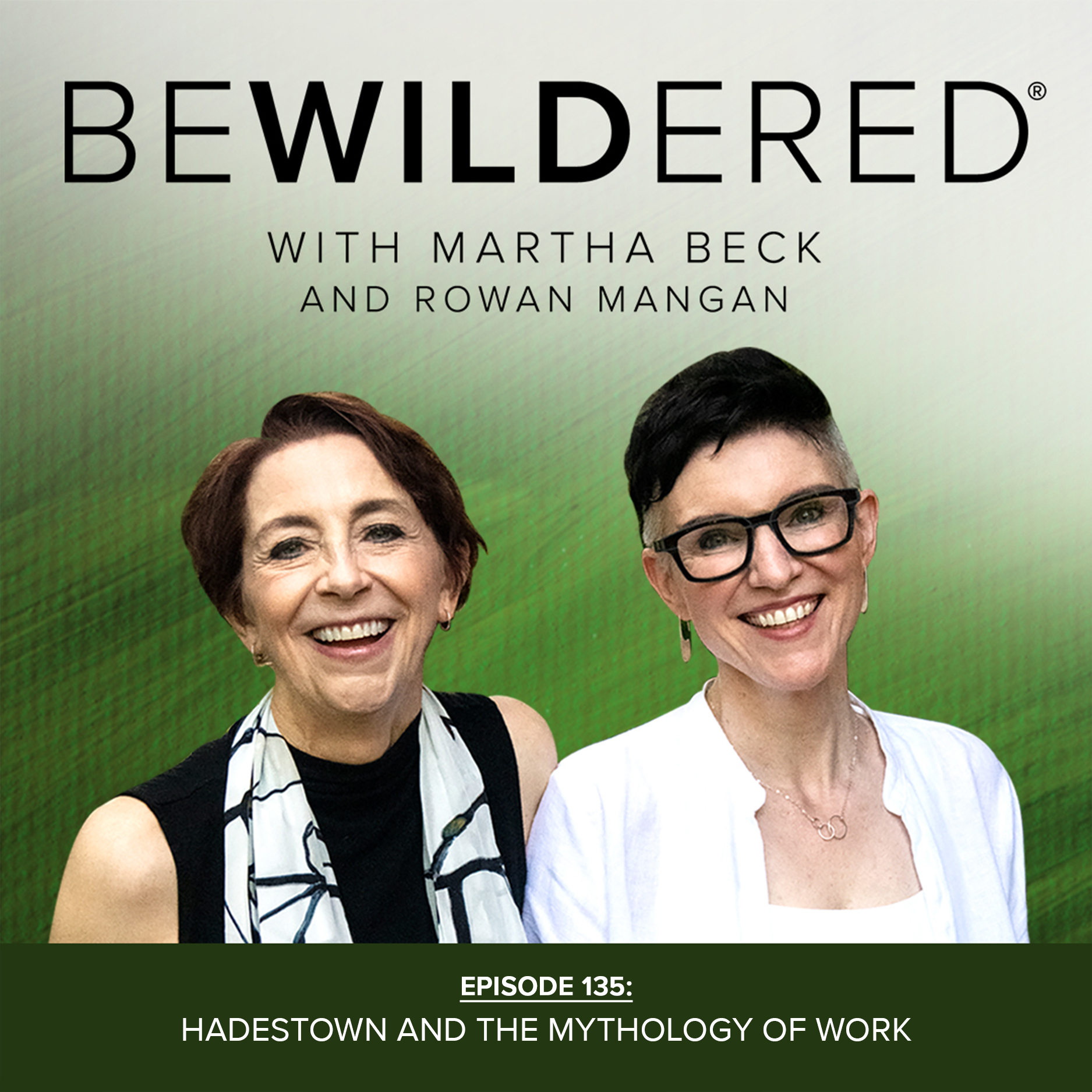
About this episode
This time on Bewildered, we’re doing something kind of interesting… Using the brilliant Broadway musical Hadestown by Anaïs Mitchell, we explore how we feel about work, money, “the man,” patriarchy, capitalism, and the grind that feels like hell. But as Anaïs Mitchell points out so beautifully—and as we’re discovering for ourselves—there’s a crack in the wall of hell. We’re looking for that crack in expectancy theory, pattern interrupts, and the transcendent enchantment of art. Join us to hear more!



Hadestown and the Mythology of Work
Show Notes
Work, money, and the wall
Have you ever felt like if you stop working—even for a moment—everything will fall apart?
Most of us have been taught some version of that story: Work hard, keep your head down, don’t question the system, and maybe you’ll be okay. But what if that story isn’t true? What if it’s not a law of nature, but a myth we’ve inherited?
On this episode of Bewildered, we’re using the brilliant Broadway musical Hadestown by Anaïs Mitchell to explore how we feel about some of our favorite topics: work, money, “the man,” patriarchy, capitalism, and the grind that can start to feel like Hell.
Why we build the wall
At the center of the conversation is the devastating logic of Hadestown’s song “Why We Build the Wall”: We work to stay free, but the work is never done, the war is never won, and the wall we build is the very thing that keeps us trapped. It’s a perfect expression of the cultural story so many of us have absorbed—that if we just keep grinding, we’ll be safe. But safe for what? And free in what sense?
We talk about how this story may go all the way back to agrarian hierarchy, hoarding, and the old equation of labor with survival. We look at wealth inequality, billionaires and zillionaires who are still hungry, and the eerie persistence of a system that never seems to produce enough for anyone—except maybe more work.
The crack in the wall
As Anaïs Mitchell points out so beautifully, there’s a crack in the wall of hell. And that’s where we go looking. We explore the idea of the “pattern interrupt”: the moment that shocks us out of the spell and lets us see the story from above.
Sometimes that comes through illness, mortality, or some other life event that breaks the trance. But sometimes it comes through something much gentler and more available: expectancy theory, enchantment, imagination, art, the sky, and remembering your name.
Art, enchantment, and remembering your name
We also talk about why art matters so much here. When a story like this is made into art, it lifts us beyond the level of consciousness that created the trap in the first place. It helps us step off the rotating stage, look up, and notice that the wall may not be as solid as we were taught to believe.
If you’ve been wondering why work feels so loaded, why the grind has started to feel unbearable, or how to find the crack in the wall for yourself, this is a conversation you won’t want to miss. Join us!
Also in this episode:
- Martha gets conned by the “Banana Skin Lady.”
- Ro considers penning “My Two Trunks: A Memoir.”
- The meaninglessness of trillions and zillions
- Taped-together glasses and building the wall with HTML
- Meditating with chipmunks until everything pixelates
- Prehensile body parts and the animals that have them
TALK TO US
You can follow us on our Instagram channel @bewilderedpodcast to connect with our Bewildered community, learn about upcoming episodes, and participate in callouts ahead of podcast taping.
And if you’re a Bewildered fan, would you consider giving us a little rate-and-review love on your favorite podcast player? Ratings and reviews are like gold in the podcasting universe—they help people find us, they help build this beautiful community, and most of all, they help us in our quest to Bewilder the world…
Episode Links and Quotes
- Hadestown by Anaïs Mitchell
- Orpheus and Eurydice Greek myth
- “Why We Build the Wall” song from Hadestown
- “Make Them Apologize” song by Ani DiFranco
- Pygmalion in the Classroom – 1965 experiment
CONNECT WITH US
- Follow Martha on Instagram
- Follow Ro on Instagram
- Follow Bewildered on Instagram
- Join us in the Wilder Community!
- Listen on your favorite podcast app
- The Bewildered Show Notes
- Is there something you’ve been feeling bewildered about? If so, let us hear from you!
Transcript
Please note: This is an unedited transcript, provided as a courtesy, and reflects the actual conversation as closely as possible. Please forgive any typographical or grammatical errors.
Martha Beck:
Hi, I’m Martha Beck.
Rowan Mangan:
And I’m Rowan Mangan, and this is another episode of Bewildered, the podcast for people trying to figure it out. Just like us. And we are doing something kind of interesting today. We’re using a brilliant Broadway musical, Hadestown by Anaïs Mitchell, to explore how we feel about some of our favorite topics: work, money, the man, patriarchy, capitalism.
Martha Beck:
The grind. It’s Hell. But as Anaïs Mitchell points out very beautifully, and as I think we discover on our own, there’s a crack in the wall of Hell.
Rowan Mangan:
There’s a crack in the wall. Listen to find out more.
So what are you trying to figure out, Marty?
Martha Beck:
I am trying to figure out my relationship to bananas. Bananas.
Rowan Mangan:
I did not expect you to say that.
Martha Beck:
Why would you?
Rowan Mangan:
Is it like a—what form of relationship, like check this box, married?
Martha Beck:
Not exactly. It all came about when I was sitting in an airport in South Africa waiting for them to open my gate. So I was just sort of in the general area before you go through security and stuff. And it was quite empty. And I was just sitting on a chair in a bank of chairs that had no other people around me. And a woman came, lovely woman came, sat down just two chairs away from me. And I thought, that’s unusual.
Rowan Mangan:
That’s a little close.
Martha Beck:
But I was watching my phone, doing things, looking at videos of iguanas, whatnot. And then she said, “Madam, your skin is like the skin of a banana.”
Rowan Mangan:
Oh, yeah.
Martha Beck:
In this beautiful, I don’t even know what accent. They have 11 languages in South Africa, some lilting African language accent. She said, “Madam, your skin is like the skin of a banana.” And it put me into one of those things, you know how we say like, “Why is this happening to me? Why is this happening to me?” At first, I was in the first table: “Why is this happening to me?”
Rowan Mangan:
Why am I being compared to a banana?
Martha Beck:
And secondly, I was, “Wait, why IS this happening to me?” And the first, I saw immediately a few options. Number one, my skin really is like the skin of a banana to the point where strangers feel compelled to tell me about it. And then I though, wait, wait, wait. Okay. Number one, if it were a really old banana, I would believe because old bananas are not like young bananas because bananas have no pores and I think that’s the ideal. I think you want to be poreless.
Rowan Mangan:
Right.
Martha Beck:
Yeah, I have this makeup that’s called “pore blurring.” And I’m like, do people really get up and go, “Wow, my pores look really blurry today.” Anyway, so I’m thinking, all right, well, if it were a large… But then if I didn’t have pores, I would have to pant because I wouldn’t have the ability to cool my body so I’d have to pant like a dog.So my mind went down that rabbit hole. But then almost immediately, and this happened in a flash, I was like option two: There’s something seriously wrong with A, this woman’s eyes or B, this woman’s mental situation. And then the third option came up, which was this woman needs money, which seemed to me to be the correct answer.
Rowan Mangan:
Can I interject with another possibility before you go on?
Martha Beck:
Yes, please.
Rowan Mangan:
Yes. What if someone was punking her and came up to her and was like, “Hey, you know what white people really love to hear?” They’re like, “The more yellow you say their skin is, the more of a compliment it is.”
Martha Beck:
I think it was more she was looking at texture.
Rowan Mangan:
Well, we don’t know. And I would also add, from what you’ve said so far, based on the evidence as I read it, she didn’t say it looks like banana skin. No. She simply said it is like banana skin.
Martha Beck:
That’s true.
Rowan Mangan:
It might’ve just seemed slippery.
Martha Beck:
Exactly. Unless she was referring to an overripe banana, which I think is far more like—
Rowan Mangan:
It gets very thin.
Martha Beck:
Well, it gets wrinkly and spotted with brown things. It’s a good comparison. But what did she mean? A young banana or an old banana? I think she was so hungry that everything looked like food of some kind, which is alarming.
Rowan Mangan:
“Good afternoon, Madam. I could eat your face.”
Martha Beck:
Oh my God. That’s a great line. Did you used to use that before we got together?
Rowan Mangan:
That’s how I used to pick up women in bars.
Martha Beck:
Exactly. But then you know what? My third suspicion was actually confirmed because she actually then did say, “I’m so hungry.” Actually, there was more discussion about the skin and how I had to then say, “Oh, well, your skin is beautiful. I didn’t know what to compare it to. What do I compare it to?”
Rowan Mangan:
A summer’s day.
Martha Beck:
Could be something like that. I didn’t know what would be insulting, and that—it was a whole thing. So I was stammering a lot and then she said, “I’m so hungry.” And you’ve got to understand, I had just been listening to, and I will never stop talking about it. What? Why are you laughing at me?
Rowan Mangan:
Because it is quite funny to go, “You look like a banana. I’m so hungry.” You could have just offered her like a little lick.
Martha Beck:
Well, that’s the horrifying thing. You have to peel those suckers. She wasn’t just thinking about having herself a little nibble. She wanted to peel me. That’s how hungry she was. “I’m so hungry I want to peel you and eat your insides.”
Rowan Mangan:
Oh my God.
Martha Beck:
It’s horrifying. I’m going to never eat a banana. Again, can you see why it’s spun my whole world out of control? Anyway, I had just listened to approximately 250, I’m not even exaggerating, near-death-experience stories.
Rowan Mangan:
There you go.
Martha Beck:
And they all talked about, they have a life review and they just looked back and thought, “Why was I not kinder to people? Why didn’t I not give money to the hungry?”
Rowan Mangan:
There were so many people I could have told that their skin looked like a fruit.
Martha Beck:
I know. Well, immediately I though, okay, this woman, she’s working a con. And she started going into, “Yes, it’s smooth.” She did say it was smooth, which is not true, but nice of her to say it. But under the influence of all these near-death experiences, I just grabbed some South African rand and said, “You want some money?” And then she was like, “Shh. Don’t show anyone.” I was like, “Damn it, she really is working the con.” And I just took it at face value. I was just throwing her approximately $6. It was not like I gave her everything that we’d ever owned, but she clearly was because she was looking around. And she was in uniform. She was working there.
Rowan Mangan:
Oh, okay.
Martha Beck:
She was an employee.
Rowan Mangan:
She was double working.
Martha Beck:
Yeah. And I thought maybe it was her job to just tell people they had the skin of a banana or whatever.
Rowan Mangan:
I wouldn’t have thought you’d need a uniform for that job.
Martha Beck:
You make a solid point.
Rowan Mangan:
I feel like that would be more of a kind of freestyle thing.
Martha Beck:
That’s right. Anyway—
Rowan Mangan:
Or you could dress as a banana.
Martha Beck:
Anyway, it was quite unexpected because I thought that would conclude the interaction. I had taken my banana compliment. She had taken the money. Once we had this whole thing, after I’d waved it around in the air for a while, she was like… So then we did this whole thing where she gradually oozed over onto the seat right next to me and put her hand on it, wiggled her fingers out of sight so that I could slide the aproximately $6 into her little wiggle hand. And then she was so thrilled. I don’t know what part of the con this was, except maybe she thought I was kind of a sugar mama and she wanted a long relationship because then she called her mother to introduce me to her mother. And then she had to call her children to tell them. And she told everyone how much money I had given her and that she was going to buy everyone a pizza. And her kids were adorable. Her mother was just this amazing African Gogo, like I was in love with the whole family. I didn’t need that. I’d given her the money. I was a banana. Everything was fine.
Rowan Mangan:
It was fine.
Martha Beck:
And now I feel like I owe her something. We’ve started a relationship. I know her mother. I know her kids.
Rowan Mangan:
Well, just visit next time you’re there.
Martha Beck:
Yeah. What if she tells me I have the skin of a pizza?
Rowan Mangan:
Oh, that would not be good.
Martha Beck:
Anyway, so I’ve been pondering that as I use my pore-blurring makeup. I’m like, “Is this making me look more or less like a banana? And do other people, are they just holding back thinking, ‘That woman looks like a banana’ and not telling me?”
Rowan Mangan:
I’m not. I can only speak for myself. I think it’s one of those things, I can only tell you my truth.
Martha Beck:
I can tell that I’ve put far more time into this than anyone else will ever want to put. So let us talk about what you’re trying to figure out.
Rowan Mangan:
All right. Well, I mean, I could spend more time on the banana thing, but if you want, we’ll move on.
Martha Beck:
You have the skin, my love, of a fine cheese.
Rowan Mangan:
Okay. It really depends what kind. It’s not unrelated to what I’m trying to figure out.
Martha Beck:
Really?
Rowan Mangan:
Uh-huh. So where shall I begin? I’m talking about the aging process, a woman’s body, gravity as a factor. I have a personal trainer who’s obsessed with telling me where my hands, elbows, other things should be relative to the nipple line, and it drives me insane.
Martha Beck:
He does that, doesn’t he?
Rowan Mangan:
I’m like, dude, the nipple line is a very subjective thing. You cannot just say it and expect that to be clear. Furthermore, I was in Greece recently. Don’t know if I’ve mentioned it. And people had guitars everywhere. Guitars, guitars, guitars. Ani DiFranco was there, poet laureate of the show.
Martha Beck:
Oh my God.
Rowan Mangan:
She has a song that begins, “My breast is cradled in the curve of my guitar.” Beautiful image, right?
Martha Beck:
Lovely.
Rowan Mangan:
And I thought of that when I was reaching down behind my guitar to find my breast so that I could lug it up and place it on the guitar somewhere because otherwise I couldn’t do a bar chord. You know what I’m saying? And so it’s just sort of interesting. I started thinking the other day about… Imagine an elephant had two trunks.
Martha Beck:
Okay.
Rowan Mangan:
That’s what my front torso is starting to look like. Two trunks hanging down. And there’s that sort of thing where if there’s no support structure in place, which I prefer, honestly.
Martha Beck:
Oh my God, me too. Nobody’s burning that thing for me.
Rowan Mangan:
But there’s that… No, no, no. I prefer without.
Martha Beck:
Oh, really?
Rowan Mangan:
I prefer without.
Martha Beck:
I prefer with.
Rowan Mangan:
No. But it’s like that thing where my body moves and then this—
Martha Beck:
They follow half a second later?
Rowan Mangan:
Well, they go out the other way and then they come back. It’s just like my two trunks, man. I don’t know what to do about it.
Martha Beck:
My Two Trunks: A Memoir.
Rowan Mangan:
Yeah. Yeah. But I am going to kill that guy next time he says “nipple line.”
Martha Beck:
Yeah, because this is the thing. You have a baby, don’t even tell me what happens to those. I would wake up in the night when I first got pregnant. You couldn’t see my belly getting bigger at all yet. But those things in the front, they had lives of their own. I could hear them talking to each other. They were planning to take over.
Rowan Mangan:
They’re probably talking to each other about how their skin looks like a banana.
Martha Beck:
Banana. Yeah. And then you have the baby and that’s a whole ‘nother nightmare. Then it’s like, I think I wrote somewhere, it’s like they bring you a baby and say, “Feed this baby.” Talk to your trainer about what your nipple line does at that point. What if it just starts… Say to him, “Sir, what if you were talking about your nipple line and suddenly it just dramatically altered and started sprinkling Kool-Aid on people?” Because that’s what happens when you have a baby. Milk comes out of those things. Actual milk.
Rowan Mangan:
Now people know, I know, that it’s not really what I’m talking about, but if you would like to, I feel like this—
Martha Beck:
Where’s that in your workout story? And then I think what you’re talking about, it reminds me of a quote from Maya Angelou.
Rowan Mangan:
Okay.
Martha Beck:
Not one of her poems, but I heard her say this in an interview. She said, “My breasts are in a competition to see which will be the first to reach my knees.”
Rowan Mangan:
Yeah. Yeah. No, that’s very much my thing. But I believe that what happens to… And I’m a lesbian. All right.
Martha Beck:
Wait, wait, what? You are?
Rowan Mangan:
I have a little bit of data to support. Okay. So here’s the thing. Mammaries in general are different from mine because I think I have very stretchy skin. All right? And so I think what happens with most women and with Maya Angelou’s boobs… I haven’t spent a lot of time thinking about Maya Angelou’s boobs, but I am now.
Martha Beck:
What kind of lesbian are you?
Rowan Mangan:
It’s nice. But there’s just a way in which most women’s breasts look like what a water balloon, a full water balloon looks like when you put it on a table with the little knot being the nipple in the middle.
Martha Beck:
This is getting very detailed and technical. Okay, go on.
Rowan Mangan:
This is what it’s like in here, baby. Okay. Yeah. Mine are like, if you could imagine someone—
Martha Beck:
Are you sure you want to go here?
Rowan Mangan:
Yeah, I really do. If you could imagine, so we’ve got water balloon, right? Nice plump. Then you’ve got imagine getting two condoms and filling them with water, right?
Martha Beck:
I don’t know how to imagine it. That’s why I turned lesbian.
Rowan Mangan:
That’s what I’m working with. And it’s just like, come on, you know? Come on.
Martha Beck:
Honey, you have the breasts of a banana.
Rowan Mangan:
Oh, thank you. Oh, lovely. All right. Well, that’s cleared everything up, I think.
Martha Beck:
Also, elephants do have breasts between their legs that get…
Rowan Mangan:
Yeah. Yeah. They have got water balloon breasts. They do. I look at those breasts quite frequently.
Martha Beck:
They would look great in a bikini.
Rowan Mangan:
Yeah. It’s fine. That’s why I specifically referenced the trunk. I was trying to draw a different kind of analogy.
Martha Beck:
Well, then what you’ve done then is I think it goes a shade too far because trunks are extremely prehensile and have as many nerve endings as fingertips and can pick up peanuts and things.
Rowan Mangan:
Oh my God. Can you imagine if your boobs were prehensile?
Martha Beck:
That’s what your boobs have been trying to be. Right?
Rowan Mangan:
All right.
Martha Beck:
Just offer them peanuts. See what happens.
Rowan Mangan:
I go to sleep and they just crawl across the room and pick up the remote control.
Martha Beck:
Yeah. When you’re pregnant, they totally do that. Yeah. They have minds of their own.
Rowan Mangan:
When we lived in Pennsylvania, I sometimes used to call it “Prehensile-vania.”
Martha Beck:
Oh, that’s nice.
Rowan Mangan:
I just have one more thing. Dolphins have prehensile penises. Now I—
Martha Beck:
But so do elephants, actually. Yeah. And they’re huge.
Rowan Mangan:
The hunted becomes the haunted.
Martha Beck:
I know. Even you’d think an elephant would be hung like an elephant, but it is beyond. Yeah. I mean, literally, I saw a virtual, an AI image where they’d taken a photograph of an elephant.
Rowan Mangan:
Are you Googling AI?
Martha Beck:
No, I was just looking for pictures of elephants because I was painting a picture of an elephant, and they accidentally had included the male unit as a fifth leg because that’s what it looks like. Only it’s prehensile.
Rowan Mangan:
Okay.
Martha Beck:
If it gets prehensile, hit it with a pencil.
Rowan Mangan:
Okay. So I think we’ve cleared everything up. I have an idea. Should we do a podcast?
Martha Beck:
Why? Why would we? With the banquet of thoughts available to us at this moment?
Rowan Mangan:
You’re welcome.
Martha Beck:
So, yes. What are we podding about today?
Rowan Mangan:
Well, I don’t know about you, but I don’t want to have a job. I don’t want to work. I don’t want to try hard. I don’t want to strive.
Martha Beck:
God, I am so with you in this.
Rowan Mangan:
And the thing is, it’s not just us, right? We keep talking to friends, and we don’t even bring it up. It’s not like, “Oh, TGIF, am I right?” No, I’m not talking about that.
Martha Beck:
No, this is a new level.
Rowan Mangan:
Yeah. People everywhere are like, “I’m done.” Or versions of the Sunday scaries that are so intense. My friend told me, “I have this thing that I have to do and every time I think about it, I want to throw up. And I’ve never been like that before.”
Martha Beck:
Yeah. And that person works like a lumberjack night and day.
Rowan Mangan:
And in Wilder, our community, people are talking about, “How do I work less?”
Martha Beck:
“I’m done with this.” I have a long history of just pick up the cat of nine tails, slap myself on the back and say, “You are lucky to work as a writer. Get to work. Stay up all night.” And I did it.
Rowan Mangan:
Can attest.
Martha Beck:
And I can’t do it. Not anymore.
Rowan Mangan:
What’s going on?
Martha Beck:
I don’t know. I thought I was just old.
Rowan Mangan:
It’s so interesting because—so something’s happening and it is making us ponder: Work? Money? Because when you start thinking about work, you probably start thinking about money quite quickly afterwards.
Martha Beck:
When I start thinking about not working at all, which is what I want to do, then I start thinking about money quite promptly.
Rowan Mangan:
Yes. Yes. And so you and I have been going round and round the mulberry bush, right, like a monkey and a weasel for I’d say maybe a few weeks at this point.
Martha Beck:
Can I be the weasel? Because I like to go pop.
Rowan Mangan:
Oh yeah. I’m the monkey in this.
Martha Beck:
All right, good.
Rowan Mangan:
There was never any question. Right. Yeah. So we’ve been talking about this and talking around it and how does… And we had a number of revolutionary thoughts, but we just keep coming back to circling the drain of work, job, thing. Drudgery.
Martha Beck:
Yeah, I actually think we talk about Bewildered is coming to your senses instead of coming to consensus. Culture is consensus. Wilder is your senses. I think the culture’s fangs and claws sink into us most deeply on this issue.
Rowan Mangan:
Agree.
Martha Beck:
You must work to survive. You know, the biblical injunction to Adam: “By the sweat of thy face, shalt thou eat thy bread all the days of thy life.” You will work and you will work until you’re desperate just to survive.
Rowan Mangan:
Yeah. What’s that about?
Martha Beck:
I think it’s about agrarian society and how as soon as surplus was available, people started hoarding resources. Whereas in hunter-gatherer societies, they never did, and they worked approximately four hours a week.
Rowan Mangan:
It’s the “once you can have more, you can never have enough” of it all.
Martha Beck:
Yeah, it’s weird. I mean, I’ve really looked at this because I’ve been studying how societies collapse and stuff. And one of the things that is really consistent is the idea that the way we treat work as this absolute basic reality that we must adhere to—and that we give our lives to work for survival—does not exist before you get agrarian cultures with pyramid-shaped hierarchy structures where people at the top were hoarding. And then they would force the peasants, whatever the society was, wherever it was, they would force the peasants to work to create the grain. The priestly caste, the king, the emperor, whatever would take almost all the grain and just eke out a little bit of it to the peasants. So they had to work constantly to survive. And the more they produced, the more was taken from them. And we’re still there. We’re still there.
Rowan Mangan:
In fact, you could argue we’re more there than we have ever been if you look at wealth inequality.
Martha Beck:
Oh my God. Yeah. It’s insane.
Rowan Mangan:
It’s bonkers. Completely insane. It’s bonkers. We’ve got a trillionaire. It’s ridiculous. Lila just asked me, my daughter just asked me yesterday how many, what was it? How many minutes in a zillion days? I love getting questions like this. I’m really ready for them. And I started thinking about zillion and I’m like, zillion is as meaningless as trillion. And yet.
Martha Beck:
Yeah. We’ll have a zillionaire with us soon because it’s an exponential growth curve, right? And the poor get poorer, right? There are more…
Rowan Mangan:
A rising tide may lift all boats, but this tide isn’t rising.
Martha Beck:
No, it’s not. Only the zillionaires are rising. So as we’ve been talking about this, I keep going to this song. Remember when we went to see Hadestown?
Rowan Mangan:
Hadestown.
Martha Beck:
Okay. Anaïs Mitchell, brilliant, brilliant creator of this fabulous Tony-winning Broadway musical about Hell and about the story of Orpheus and Eurydice. Look it up.
Rowan Mangan:
Just go to Hadestown.
Martha Beck:
Go to Hadestown. It’s an amazing show. Anyway, there’s a scene in there where Hades, the god of the underworld—so the devil, essentially—is supervising all the subjects of Hadestown.
Rowan Mangan:
He’s like an industrial… He’s styled as the kind of, what do you call that? The guy?
Martha Beck:
A tycoon. A magnate.
Rowan Mangan:
Yeah. Yeah. That kind of thing. A titan of industry.
Martha Beck:
A titan of industry. Yeah. He’s this basso profundo. This music is… His voice goes lower than I’ve ever heard a human voice go.
Rowan Mangan:
It’s amazing.
Martha Beck:
And there are all these people in this sort of factory setting, and they’re wearing sort of ’30s, ’40s style factory overalls and things. They’re covered with grime and they’re just hammering away, and they’ve forgotten their names. They’ve forgotten who they are. They just work and work and work, building a wall. And there’s a song that the devil sings about the wall and why we build the wall.
Rowan Mangan:
And it’s called, for your Googling pleasure—
Martha Beck:
“Why We Build The Wall.”
Rowan Mangan:
“Why We Build the Wall.” And I really think that if you want, pause this, go listen to the damn song, come back because—
Martha Beck:
It’s incredible.
Rowan Mangan:
Yeah. It’s a really amazing song.
Martha Beck:
But can we summarize it? Because I think that song, I think Anaïs Mitchell has thought this through in such a clean, logical way, and it’s so devastatingly clear.
Rowan Mangan:
So we’re taking the song today to be the analogy for the grind.
Martha Beck:
The lyrics build and he’s asking them, “Why do we build the wall, my children?” He infantilizes them and he’s the patriarch, right?
Rowan Mangan:
It’s a call and response. So he calls out to them, and then they, as one, respond.
Martha Beck:
And they start with, “We build the wall to keep us free.” And then he says, “How does the wall keep us free?” And it’s because it keeps out the enemy.
Rowan Mangan:
And the enemy is poverty. And we build the wall to keep us free. That’s why we build the wall. We build the wall to keep us free.
Martha Beck:
And speaking of the poor, “they want what we have got. We have what they have not. So we build the wall to keep us free.” And then the last thing is, “What do we have that they have not?” And the thing they have is “We have a wall to work upon.” That’s it.
Rowan Mangan:
And “our work is never done, and the war is never won. And we build the wall to keep us free. That’s why we build the wall.”
Martha Beck:
Absolutely devastating.
Rowan Mangan:
So you’ve got this circular logic that is premised on: As long as we have the work to do—and we always will because it’s never done—then we are elevated in some way. We have freedom from poverty. It’s just this amazing…
Martha Beck:
Yeah. We are free because we have jobs, and these jobs take away our names, our joie de vivre, our ability to access sunlight, everything. But we have them, and that keeps out poverty. But does it? What is poverty? You start to think watching this show, is it poverty to live in a factory where you never see the sun and you just grind out labor day after day after day until you die?
Rowan Mangan:
I just want to say this musical is so brilliant because the whole thing is actually set, even though it’s a Greek myth being retold now, it’s actually set in a Depression-era kind of context. So you’re looking at poverty and unemployment as actually genuinely being a starvation emergency kind of thing, which is just all in the background of the thing. So you can see where it’s like, well, I do have this factory line kind of level.
Martha Beck:
And it was in that context after the Depression where Hitler created concentration camps where it said over the entryway to Auschwitz: “Work makes you free.” And that’s where they were putting the people that they were killing. I mean, the irony is so thick. You need an industrial saw to cut it. And we’re still sort of living in that paradigm.
Rowan Mangan:
And the “work makes you free” over the concentration camp gates. The “we’re not in poverty because we have this work that never ends” and “we’re fighting a war that will never be won.” And there’s something about even in the production, the stage goes round and round and there is such a sense of… It is just relentlessly going. And the whole of capitalist patriarchy that we always go on about. Is built into that one song and it is chilling.
Martha Beck:
Yeah. And there’s no real answer in the musical except that at some point somebody talks about a crack in the wall, and it doesn’t explore that at length. That’s not what it’s setting out to do. But that’s really intriguing because everybody I know—and I—are thinking, “I am so tired of building this wall. I’m just barely…” The thought pattern, no matter how poor or rich I’ve been in my life, is always “Got to kep working, got to keep working, got to keep working. The moment I stop working, everything will go to hell. We’re all going to die.” It’s extreme.
Rowan Mangan:
Yeah.
Martha Beck:
It’s almost phobic and it’s what—that cannot be my true nature.
Rowan Mangan:
No. So what I think is that we in our culture, in this culture, however defined, but pretty much everywhere at this point. But my God, America is kind of the epicenter of work culture. Here, we are told this story, “Work will make you free.” And the story is this circular logic that is in “Why We Build the Wall.” We build the wall to keep us free. Which is very similar to the stage going round and round and it’s inescapable. It just keeps going. There needs to be some sort of pattern interrupt because the culture keeps us so stunned and motionless in the posture of “I must work until I die.” Or, in some ways even worse, “I must work until I retire.” This idea of “And then I will cease to work.”
Martha Beck:
Why is that bad?
Rowan Mangan:
Because there’s like the, you’ll be working and you’ll be relevant and you will have purpose in the world and power in the world, and then you just retire and you retire as though to bed, as though you take to your bed and you don’t step forth into a… You just retire like a little balloon slowly going in the corner, going down over.
Martha Beck:
In a work culture, that is to lose all relevance.
Rowan Mangan:
Yeah. And also there’s, I don’t know if it’s as much here, but in Australia there’s a very strong thing of “When I retire, then I’ll be able to fulfill my dreams.” And so it holds this utopian… I don’t know, I just feel like all of these, they’re all strategies that the culture uses to keep us in this mode because the billionaires are still hungry. The trillionaires are still hungry.
Martha Beck:
Still hungry.
Rowan Mangan:
And they always will be. And so what we have to look for as people who are trying to figure it out, as people who are trying to find our true nature, is we have to look for that crack in the wall that Persephone points to in Hadestown. And she is the one who can remember the sky. And she’s like, “No, there’s a crack in the wall.” And so our job in this culture that is so obsessed with the story of work is to find this crack, find where the loopholes are, find where it’s not true, find where it is a con being enacted upon us, rather than a simple description of the world.
Martha Beck:
Oh, I love that. And I think you used the term “pattern interrupt.” This pattern, I’ve watched it for my entire life. I’ve watched people caught in this pattern. I’ve been caught in this pattern myself. And I’m thinking as you’re talking, what is the crack in the wall? What fractures it? And it’s almost like when you’re driving and you hit a big crack, it shocks you sort of awake and your heart speeds up. I’m almost thinking of it as that. You’re thinking, you’re thinking, “Okay, I must work to live. I must work to live.” What smacks into that so hard that it breaks open the sky for you? I think some people get there through what they think is going to be a catastrophic blow. I have had so many clients tell me that being diagnosed as terminally ill set them free, and it was because they stopped working.
Sometimes they still went to their jobs, but they were like, “This is not me.” They had a radical… It’s not like they went off the grid and started living in the forest. They went off the grid mentally. They began to think of themselves as something other than a worker on the line. They thought of themselves as something that was in the sky. It was going to be basically, it’s horrible, but I’m quoting them exactly: “It set me free because suddenly none of it mattered because the big basic fear wasn’t ‘I have to keep working.’ It’s ‘I’m going to die. And if I don’t work, I can make that not true.'” And then they were told, “No, you are going to die.” And they accepted it. I mean, not happily at first, but as soon as they did that, the mesmerizing story of Hades—”we’ve got to keep working on the wall because the enemy is poverty and the only way…” They were like, “Okay, if I have to keep working or I’ll die, that means if I’m about to die, I don’t have to work.” And not all of them quit their jobs. Some of them started to find a lot more value in their jobs, but there was something about the internal shift away from the fear of death that set them free from work.
Rowan Mangan:
So I’ll tell you something interesting, though, as a counterpoint to that. And this is sort of speaking to how deep into the culture this work thing goes is I have a friend, a friend of my mum’s who got a very… It wasn’t stage four. It wasn’t like, “You’ve got six months,” but she got a cancer diagnosis that was pretty grim. It was like a late stage-three situation. And all she could do was sit down with her sick leave, try and figure it out, try and figure it out. And I said to my mum, “But what if she dies?” And mum’s like, “What if she doesn’t die? She’s got to figure out her sick leave.”
Martha Beck:
Well, let me make two points clear because I was very, very… I take your point. First of all, not everybody I’ve coached who has had a cancer diagnosis or a terminal diagnosis of any kind, not all of them were set free by it. A significant minority in a dramatic way. That’s why I brought it up.
Rowan Mangan:
Sure. And I only say that because it’s like that to me, that story of our friend Penny is so like the injustice and the inhumanity of the system.
Martha Beck:
It’s horrific. Horrific.
Rowan Mangan:
She still has to come and build the wall for the zillionaires.
Martha Beck:
It’s absolutely horrific.
Rowan Mangan:
Even though she is facing it. It sucks.
Martha Beck:
I had the two points and I absolutely agree, but the two points were not everybody was set free, but some were. The second point is those who felt set free behaved in a way that literally allowed them to feel free. As I said, not all of them quit their jobs, but they all changed the way they worked. This not a preplanned discussion. I am groping for what is the answer to this predicament right now as we speak? But I have seen people find the crack in the wall and they didn’t die. They wouldn’t have been talking to me about it if they had. But they had lost their fear of death. And so one of them said, “I had all these things that I had to do and I needed a certain amount to live and I had it all calculated. And I was sitting with my husband, we were doing this. And then he said, ‘That’s not what we need to live. That’s what we need to live in certain ways.'” And she was like, “Well, you’re right. We don’t really need that much.” And she really boiled it down to what they actually needed to live. Now, she did not quit her job. She kept working, but in a state of such liberation after her chemo and everything, she went back. But she did it because she liked the work. She did it because she felt like she was actually doing something interesting. But she was willing to live with much less. And this is the thing, the zillionaires are still hungry. I think if we have… Here’s the interesting thing. It pitches us to the place where we are hungry no matter how much we have. That’s what it has to depend on, that even when the billionaires are billionaires, they need their employees to keep working to give them more money. They don’t have enough. And boy, I have met some of them and I have heard this from their own mouths.
Rowan Mangan:
Okay. So a pattern interrupt can be a shocking diagnosis, but I don’t believe it has to be.
Martha Beck:
No, it doesn’t.
Rowan Mangan:
I don’t think that this wall, that capitalism/work/culture, whatever tells us that we have to build day in, day out, I don’t believe that the only crack in that is you’re going to die. “Shit. Oh fuck, I’ve got 10 minutes left. I’ll go look at a sunset.” I don’t think that that’s what we’re facing. I think the crack in the wall is actually much more accessible because it’s about disbelieving the story.
Martha Beck:
Can I tell you something that happened to me once that I think was this? I may have told it on the podcast before, but it bears repeating because it was a weird moment. So I had moved to California. I’d been meditating in the woods all day with birds. Birds and chipmunks and whatever. Didn’t talk to people. Right in the middle of that whole thing—and I was meditating deeply, I was very happy to never go back to society. I just wanted to drift away. I wanted to awaken and just leave somehow. And during that time I went to New York City. I met with my agent and she said, “I want to take you to meet this editor. She has an idea for a book she wants you to write.” So we went and I was in this big New York skyscraper and everything, and they started pitching this book idea.
And I kept looking at them and I was still in the forest. I couldn’t come into the Manhattan office with all the manuscripts piled around. And I remember looking out the window at this long concrete canyon and saying out loud, “Oh, you think this is real?” And they were like, “What?” And I just sort of held my hands out of the city and I said, “Do you think this is real?” Because sitting there in the forest, I had had these moments when everything would pixelate and it wasn’t like I would rub my eyes, same thing. And then it would all just turn into light. And I saw, “Oh, this is just a video game. This is all projected by consciousness.” I know this sounds very lofty, but it was like it would happen moment to moment to moment for hours at a time. I would just sit there going… I was gasping in astonishment as the world dissolved. Every second it dissolved and came back into being, dissolved and came back into being. And sitting there in that office, I was like, “You think this is real? Well, if it’s real, why would we kill more trees?” And my agent didn’t exactly dump me at that moment, but our relationship ended. Yeah. She was like, “Well, thanks a lot.” But it was a pattern interrupt for me because everything in me said, “You’ve got to keep writing books to keep the money coming in. There are people depending on you. You employ people.” It was absolute: I have to keep writing books. And I was just like, “A lot of this isn’t real.” And nothing bad happened to me. Nothing bad happened. I had less money for a while. And then I wrote another book because I really wanted to, and it did really well. But I didn’t write it the way I wrote it when I was in that before I’d gone to the woods.
Rowan Mangan:
Right. So I still think there’s access to the crack in the wall that is much simpler than meditating in the woods or getting the diagnosis.
Martha Beck:
Sure. Absolutely.
Rowan Mangan:
I think that if we can pause for a second on our rotating stage and just look at the story and say, “Is it true?” And this is where I start getting so woo-woo that I don’t know if this is even going to track for people. But one of the things that I’ve said to you in these conversations we’ve been having is, what if the whole time we were supposing a cause and effect—I go to work, therefore I get money. And I was like, we’re assuming that. What if that’s bullshit? What if that money was just going to come? We don’t know. It’s ones and zeros. It’s computers. It’s not real. It’s not real, New York. So what if that was always the correlation and causation thing? I worked and because I felt downtrodden, I felt like I was getting my little consolation prize of the money of my paycheck that I was then going to spend on ready meals, takeout, booze, everything to numb myself about how shitty I felt when I was at my job. Boom. Your turn.
Martha Beck:
You said something the other day that was, it was so true for me. You said, “Work is actually the drug we use to make ourselves feel safe.” In my life, it’s never been the source of money. I have always done this lash yourself to the grindstone thing. And especially as an author, you don’t know where the hell, like it comes from random places. Almost no one gets rich from writing books. I mean, it’s just not a thing, y’all. If you’re thinking you’re going to write a book and make a fortune.
Rowan Mangan:
We’re so funny as entrepreneurs because we’re just always stumbling around going, “What about this?” To the universe, holding it up like a baby lion. “This? Is this the thing? Do you want to reign? No? Okay, cool. I’ll keep holding it, but how about this guy?”
Martha Beck:
Oh, and I remember connecting myself to my computer, learning to create a website and getting so into nerd world that I was coding HTML at the time and CSS all day long, and my glasses fell apart and I taped them together and then the tape fell apart and I ended up taping the lenses to my face with transparent tape so I could keep coding so that I could get an online presence back when the internet wasn’t even a thing yet. And I was like, “This is the way I have to go. This is how I’ll make money.” Never made a dime. I worked I don’t know how many thousands of hours. I didn’t do it. And yet, I had money from somewhere. Not a lot, but I had money. It’s weird.
Rowan Mangan:
Okay. This is so exciting. All right. So here’s what I think. About to get woo-woo. Just bear with me or don’t. All right. So money comes because we believe it’s going to come. So if we’re in the story, we believe it’s going to come because we clock in at 9:00 AM and we clock out at 5:00 PM and you have decided that coding a website yourself rather than going to someone who knows how to do it is the way. And also that stuff is really addictive because I had that too.
Martha Beck:
It’s so addictive. It’s like weirdly—it’s delicious.
Rowan Mangan:
Anyway, it’s all AI now. So during that time, your energy was in a state of “money’s coming.” Because you were believing the story, “I work, I tape my spectacles to my face and that way money comes.” And so even though the aperture was quite small because you were still like, “It comes because I build the wall. I build the wall with HTML.” Yeah. So you’re doing that. Okay. Or, “This much is coming in, salary, clock in, clock out.” What if our feeling was just like, “I believe the money will come because I step outside into the morning sunlight with a cup of coffee, and I look at the sky.” All right. So yeah, must be nice. Must be nice. Yeah.
Martha Beck:
Yeah, okay. Keep going.
Rowan Mangan:
And that aperture of accepting goodness is wider. The question then becomes how do you get rid of the fear? Because you still have the story built into your DNA somewhere. Okay.
Martha Beck:
So here’s the thing. A lot of people are going to be like, “You are just defying materialist logic.” And we are because I don’t believe in materialism. Yes, you are. Because I think material… Here’s the thing. Sorry, I’m just going to do this and you can look it up later. I don’t think that consciousness is an artifact of matter. I don’t think that the brain evolved, and then it decided to create consciousness. I believe that matter is an artifact of consciousness. I believe that consciousness preexists matter and that that’s what I was seeing in the forest and that that’s how matter comes into being. In which case, yes, your state of consciousness is actually writing the code. There’s a metaphor right there that says, “Here’s the aperture for money.” So I know that a lot of people are going to go, “Oh, you stupid new age people. ‘If I think it, it will come.'” Yes, there is a level at which that is fatuous and stupid. But if you really drill into the wisest minds that have ever lived on Earth, like the Dantes and the Descartes and the Platos and the Laozis, they went to the crack in the wall. I mean, Plato’s cave is a whole metaphor about that. Everybody thinks you have to stay lashed in this cave and somebody gets out and says there’s a whole world where there’s no wall. And they say, “You’re crazy. We hate you. Go away.”
Rowan Mangan:
You know who else should be on that list? Laozi and Plato and everyone?
Martha Beck:
Yeah.
Rowan Mangan:
Banana face lady. Because she was at work in her uniform. And she’s like, “What if I just go tell some white lady who was an American that she looks like a banana? Maybe she’ll just give me money.” Sure enough. Sure enough.
Martha Beck:
You know what? And here’s where I get to the bridge between the total woo-woo, “How do you get there? I do not see reality disassembling in front of my eyes, so what the hell do I do about my stupid job?” Here’s the thing. I could feel as she came up and sat down next to me, what was going to happen.
Rowan Mangan:
With her little twiddle fingers.
Martha Beck:
I could feel her state of psychology, and I did not feel like she was going to try to take money unduly. I felt immediately that she was coming to do something she did not feel good about doing and that she felt… No, she was going to con me. She was going to get money, and she didn’t feel good about it. She felt like she had to, but she didn’t really want to. She wasn’t that kind of person. Do you know what I mean? But no, to your point, she knew this would work. She absolutely knew this would work. She had no doubt. And because of that, I was charmed by her con. I actually was charmed.
Rowan Mangan:
It wasn’t really a con. She just said, “I’m hungry. Would you give me some money?”
Martha Beck:
That’s the banana part. I don’t have skin like a banana, let’s face it. But no, the buttering me up, the appeal to my ego and stuff.
Rowan Mangan:
It’s just good manners. Tell someone they look like a banana before you ask them for money.
Martha Beck:
I dare you to do that to a stranger when we’re walking home tonight.
Rowan Mangan:
Sold.
Martha Beck:
But my point is not that the mechanics of that are any model or anything. The point is that we have an energetic sense of what is happening in reality that is not purely things we can measure with a ruler and a measuring cup and a set of scales. There is stuff going on. I mean, look at a certain president in history who somehow seems to get exactly what he wants to happen no matter how flagrantly he does things that would put other people in prison. Right?
]
Rowan Mangan:
Yeah.
Martha Beck:
Nixon was the most hated man in the world and wow, he has been one-upped a few thousand times. There is something about people’s perspective, the belief with which they go out into the world that says, “I will accept my living from this or I will accept it from that. ” And some people have it set to, “I must tell some woman she has a banana face.” And some people have, “I have to go to the factory.” And some people have, “I can do anything I want. I could walk up to someone and shoot them in broad daylight and get away with it.”
Rowan Mangan:
“I’m a trust fund baby. You can trust me.”
Martha Beck:
Yeah. If you look around, there’s actually more evidence for the energy creating wealth than there is for sheer material labor and rational exchange building wealth.
Rowan Mangan:
Yes. Expectation. Expectation.
Martha Beck:
Expectancy theory.
Rowan Mangan:
The thing about expectation is that you’ve got to genuinely expect it. And that means overcoming all the obstacles that have been trained into us by this very successful story about building the wall. And so in just a sec, I want you, Martha Beck, to tell us how we come to our senses.
Martha Beck:
I will do that.
Rowan Mangan:
Good.
Martha Beck:
So here’s the thing. In sum, we have this story we’ve been hypnotized to believe. And it is that we have to keep working and working to keep away poverty and that’s the only way to do it. And the fear of not having enough keeps it very, very active. And that is partly based on our totally materialist version of the world where it’s all just about labor in, dollars out, and “I’m going to die and there will be no more me and I have to stave that off at all costs, even though I know it’s going to happen.” So we’re caught in this horrifying thing of denying death while we know we can’t deny death. Okay. Then you started talking about the maybe, and this is where you saw the crack in the wall. And I think my takeaway from this conversation is there is a crack in that wall.
And the crack in the wall comes when you can look at the mechanism we’ve been describing, the way Anaïs Mitchell does and helps the audience do. And suddenly we see it from a distance. And it’s that thing that Einstein said about no problem can be solved at the level of consciousness that created the problem. The way you go up a level is to make a… It’s called, what is it? There’s something in mathematics called a strange loop. And the way you solve the paradox of this equation is to go to a meta statement. You have to look at the equation itself and see that it’s paradoxical and then you’re outside the paradox. So you just went to a meta statement. We all did. If you look at this and say, “This logical loop that we’re in is horrifying, devastating. It’s not helping anybody except the zillionaires and even they are still hungry.”
So what if we imagine something different? What if we imagine that our state of energy is affecting the way our lives flow materially and otherwise? And you said you have to really expect it. And it reminded me of, there’s something called expectancy theory.
And in ancient experiments that can’t be repeated because they are now considered horrifying, psychologists went into classrooms where like first grade classrooms where teachers had maybe 20 kids and they would randomly tell the teacher half of the 20 kids, this half, they’re dumb. They’re below average IQ. This half, much above average. And they would just divide the class that way. They’d come back at the end of the year and the students that the teacher expected to do well were sailing along, just no problem at all with schoolwork. The ones that had been assigned to the “stupid” category were failing. And the teacher did not know that this was random. It was the teacher’s, she was the pivot point. She was the one expecting and it affected all these kids and what they were able to do. And what that says to me, and what it said to the researchers then, is that the expectation of one person has a mighty effect over all the people and systems around them.
We don’t even know how to calculate that, but it’s there. So just seeing that crack in the wall and getting beyond it means that when you’re not hypnotized by it, that’s like telling the teacher, “That’s bullshit.That is bullshit. These kids are all perfect. Let them soar in their own way.” You break that dichotomy and suddenly everything is possible.
Rowan Mangan:
Right. Okay. So this is it. So we’re trying to break the cultural story, which is the equivalent of “These kids are dumb, these kids are smart,” is “If you work, you’d be just all right as long as you keep working. If you don’t work, some terrible but unspecified bag-lady style—
Martha Beck:
Well, you’ll die. Ultimately it’s “You’ll die.”
Rowan Mangan:
Yeah, you’ll die. Yeah. Ultimately. So then we just have to find the mechanism for remembering to step off the rotating part of the stage and look at it. And I think to me, part of the answer is in the question because when I look at something as magnificent as Hadestown, I am watching the story that I’m told be made into art, which elevates it so far beyond what it can be in a prosaic context like this.
Martha Beck:
Yes. You’re getting out of the level of consciousness that created the paradox because her art has gone to a different level where it’s looking down and now you’re up there.
Rowan Mangan:
Yes, that’s true. But it’s also true that art itself is a category that can excite our psychology, I think, and inspire us towards something. And that’s why I was, I think, resistant to just remembering death or mortality or whatever as the only way to step out because I feel like we can be inspired or enchanted by art, by beautiful art, by a beautiful day, by a sunset.
Martha Beck:
I actually, in one of our conversations this week, I think the crack in the wall is enchantment. I think if you are grinding away and you’re looking down and you’ve forgotten your own name, all you have to say is, “This is bullshit.” And how do you know? Because it’s horrible. It’s hell. It’s literally hell. “This is hell. This is not where I’m going to stay. I refuse to stay.” Well, where do you go instead? Toward what enchants you. And everything in that musical is about the magic of Persephone and Orpheus and everything. So not that we have to put everything into this musical, but the idea of getting beyond the level of consciousness that created the paradox, created the prison, is to say, “This is bullshit and I will look for something that enchants me and it will lift me.” And it typically ends up being something creative and often artistic.
It can just be a state of being. Some people just wake up.
Rowan Mangan:
There’s a chant in Hadestown that the workers do that it just goes, “Keep your head, keep your head low. Keep your head, keep your head low if you want to keep your head.” And that’s the thing: Don’t keep your head low. Look around, look up, look, find the sky, remember your name. And that’s the enchantment which gets us out of the loop.
Martha Beck:
And that is certainly a good way to…
Rowan Mangan and Martha Beck:
…Stay wild!
Rowan Mangan:
Thanks for being a Bewildered listener. I want to take a moment to formally invite you to join our online community, Wilder, which is where Marty and I go when we need to come to our senses. Wilder is the best place in the world to connect with other people who are trying to live by their true nature and not by the culture. Find us at wildercommunity.com. Meanwhile, Bewildered podcast is recorded at Upstate Podcast Studio. It’s edited by Scott Forster and only exists because of the incredible team at Martha Beck Inc. Please rate us, review us, join the Wilder community, and don’t forget: Stay wild.
Rowan Mangan:
We hope you’re enjoying Bewildered. If you’re in the USA and want to be notified when a new episode comes out, text the word WILD to 570-873-0144. We’re also on Instagram. Our handle is @bewilderedpodcast. You can follow us to get updates, hear funny snippets and outtakes, and chat with other fans of the show. Bewildered is produced by Scott Forster with support from the brilliant team at MBI. And remember, if you’re having fun, please rate and review and stay wild.
We’re also on Instagram. Our handle is @bewilderedpodcast. You can follow us to get updates, hear funny snippets and outtakes, and chat with other fans of the show.
For more of us, Martha’s on Instagram, themarthabeck. She’s on Facebook, The Martha Beck, and she’s on Twitter, marthabeck. Her website is, MarthaBeck.com. And me, I too am on Instagram. Rowan_Mangan. I’m on Facebook as Rowan Mangan. And I’m on Twitter as RowanMangan. Bewildered is produced by Scott Forster with support from the brilliant team at MBI.
Read more
Questions? Comments? Trying to figure something out? Email us! [email protected]
Credits
Wandering The Path by Punch Deck | https://soundcloud.com/punch-deck
Music promoted by https://www.free-stock-music.com
Creative Commons Attribution 3.0 Unported License



0 comments