

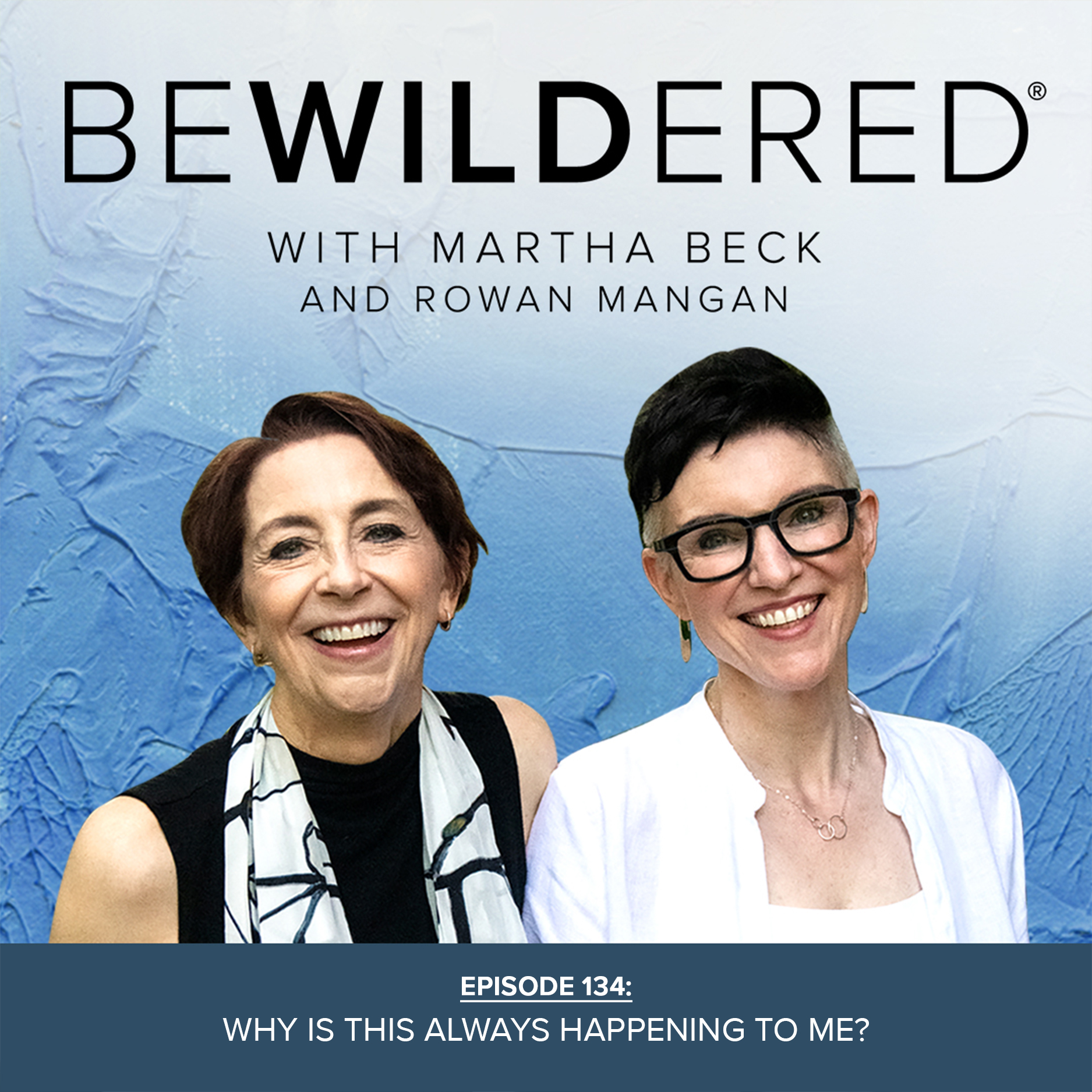
About this episode
Trying to figure out why something always happens to you? In this episode of Bewildered, we’re talking about recognizing patterns that repeat in our lives, what causes them, and how they feed the culture (and the culture feeds them). By shifting the story from “Why is this happening to me?” to “Why is this happening to me?”, we become curious detectives of our own psychology. Join us to learn how you can shift your patterns, change your story, and become more free and joyful in your life.



Why is This Always Happening to Me?
Show Notes
Are You Stuck in a Pattern?
If you’re trying to figure out why something always happens to you, you might be stuck in a pattern. In this episode of Bewildered, we explore the patterns of behavior that seem to repeat over and over again in our lives.
Whether it’s “I always end up being the fifth wheel,” or “People always end up not liking me,” or you continually find the one toxic person in a stadium of 60,000 people, it can feel like the world is just happening to you.
Because we are completely unaware of the mechanics of these patterns, they live in our blind spots. We don’t realize how we might be helping to create them in the world, or how our perceptions are filtered to see exactly what we expect to see.
Where Do Our Patterns Come From?
So, how do these patterns get imprinted on us? Often, it goes all the way back to basic Pavlovian conditioning in our childhoods. As we try to figure out what the world is and how it works, we pick up cues from the people who raised us. If a parent is struggling, we might learn to associate dysfunction—like the smell of whiskey, or walking on eggshells—with safety and survival. We universalize these experiences, believing them to be the basic fabric of reality.
The nervous system also locks in patterns through trauma. If something crashing into us teaches us a specific danger signal, our nervous system might later trigger a massive panic attack over a minor tremor, trying to stave off a disaster we don’t even realize we’re expecting. The result is a kind of automaton quality, where we play out a childhood algorithm imposed upon us unconsciously.
How to Shift Your Story and Regain Your Agency
When you don’t see the patterns you’re stuck in, they will just dog you to the end of your days. But as you start to become self-aware—maybe through journaling exercises like morning pages—you can observe your conditioning and test whether you actually believe it “for reals.”
You begin to realize that the pattern is sustained by a story, and shifting the story is the way to shift the pattern. Saying, “I’m this way because of my childhood and that’s just how I am,” can make you the victim of the story of your own victimhood. It becomes a repetition compulsion of its own.
The journey to breaking free starts with shifting your question from “Why is this happening to ME?” to “Why IS this happening to me?”
The moment there’s a part of you that goes, “Okay, how could I respond differently?”, you start gaining the power to shift the pattern. You can choose a bigger story—one that stops doing the bidding of the culture to the detriment of your true self.
When we bring awareness to our patterns, we reclaim our agency, and we stop being remote-controlled by the culture. This is the way to bring more freedom and joy to our lives and…stay wild. ✨
Also in this episode:
- Martha’s struggles with her “tiny square butler” aka smartwatch
- Ro creates an unbelievable conspiracy theory to console Lila.
- Seal noises, a baking sheet, and a Technicolor scream
- Church parties and the Five of Pentacles
- Farmer McGregor and groundhogs named Apophenia
- Ivan Pavlov’s lifelong love of drool
TALK TO US
You can follow us on our Instagram channel @bewilderedpodcast to connect with our Bewildered community, learn about upcoming episodes, and participate in callouts ahead of podcast taping.
And if you’re a Bewildered fan, would you consider giving us a little rate-and-review love on your favorite podcast player? Ratings and reviews are like gold in the podcasting universe—they help people find us, they help build this beautiful community, and most of all, they help us in our quest to Bewilder the world…
Episode Links and Quotes
- The Artist’s Way by Julia Cameron
- Ivan Pavlov
- Repetition Compulsion
- Apophenia
- Conditioned Emotional Reactions
- Eddie Izzard stand-up: Englebert Humperdinck bit
- Wilder Community
CONNECT WITH US
- Follow Martha on Instagram
- Follow Ro on Instagram
- Follow Bewildered on Instagram
- Join us in the Wilder Community!
- Listen on your favorite podcast app
- The Bewildered Show Notes
- Is there something you’ve been feeling bewildered about? If so, let us hear from you!
Transcript
Please note: This is an unedited transcript, provided as a courtesy, and reflects the actual conversation as closely as possible. Please forgive any typographical or grammatical errors.
Martha Beck:
Hi, I’m Martha Beck.
Rowan Mangan:
And I’m Rowan Mangan, and this is another episode of Bewildered. You know, it’s the podcast for people trying to figure it out.
Martha Beck:
Yeah. And if you’re trying to figure out why something always happens to you…
Rowan Mangan:
Why is it happening to me?
Martha Beck:
Why is it happening to me? We’re talking about patterns that repeat in your life, what causes them, how they feed the culture and the culture feeds them, and how you can change them and be more free and joyful in your life.
Rowan Mangan:
I’d give it a listen. I hope you do too.
What are you trying to figure out these days, Marty Beck?
Martha Beck:
As usual, I’m trying to figure out how to cope with modern communication technologies.
Rowan Mangan:
Ah, yes.
Martha Beck:
To wit, the tiny square butler that I wear upon my wrist that is my little smartwatch thing. Yeah.
Rowan Mangan:
Tiny square butler.
Martha Beck:
So for those who do not have them or have not dealt with them in any way, it’s very clever. My little watch will—it receives texts. I see little texts that do come up and they go bing. Now answering a text on the tiny watch, it’ll come up as a tiny, infinitesimal keyboard that I have to tap with one fingertip. Not a good option. So the watchmakers, or maybe the butler itself, created a list of possible responses. And I don’t know if you’ve ever, like you’re sorting through looking for the appropriate response. Our assistant will say, “You have a call in 10 minutes.” And I’ll text back something like, “Sure, go ahead,” or something dumb. Anyway, I thought this feature was going to save my life and in fact, it almost did the opposite. So trigger warning for any of you who have had food poisoning.
Rowan Mangan:
Uh-oh.
Martha Beck:
Yes. So there is a wonderful restaurant that serves perfectly good food that you and I have shared. And on two consecutive weeks we ate this food, and we shared the food. It wasn’t like this food was bad.
Rowan Mangan:
From the same dish.
Martha Beck:
From the same actual plate. So the first time I got a bit of a bug, started to feel yucky, threw up a couple of times, got rid of the food and I was like, “Whoa, yuck. I hate food poisoning.” The next week, I know this restaurant is amazing, and I love the food. So we shared a dish again. This time, I didn’t just get like “I don’t like food poisoning,” I started to feel, “Oh, this is like poisoning. This is like Prince Geoffrey in Game of Thrones, frothing at in the mouth, lying… I have been poisoned.” So I crept to my bedroom as you’ll recall. I said, “I’m not feeling good.” And I crept off to my bedroom and I almost couldn’t—
Rowan Mangan:
It was kind of like I looked at you as you went, and it was like a sea lion moving across the ground and screaming at the same time. No, not screaming, moaning.
Martha Beck:
That’s just the way I ordinarily walk. Look, I was—
Rowan Mangan:
[Moans like a sea lion] Am I wrong?
Martha Beck:
No, because the purging was trying to occur, but I didn’t want it to occur out in the open, so I was trying to compensate.
Rowan Mangan:
You were trying to compensate for the Technicolor scream.
Martha Beck:
With sound. It worked. I got to my room, and I got to the bathroom in time. But then I just fell to the floor of the bathroom and I said, “Go away. I don’t want you to see me like this.” So you and Karen went off to the other place where you were watching TV, and I was lying on the floor and I was like, “Holy crap. I’ve been poisoned.” And I couldn’t even pull myself up to the toilet level. I was lying with my face on the floor of the bathroom. It was bad. So I thought, what?
Rowan Mangan:
Can I ask a question?
Martha Beck:
Yes.
Rowan Mangan:
That might get me killed, but not by you.
Martha Beck:
Sure.
Rowan Mangan:
When you were thinking, “I’ve been poisoned, I’ve been poisoned,” did you at any time suspect the Kremlin? Because that’s what would’ve gone through my mind.
Martha Beck:
Who else? Because your little devious Australian mind, I don’t know where you come up with these things. No, I was thinking more of the North Koreans myself.
Rowan Mangan:
So that’s how you asked for a baking sheet.
Martha Beck:
I wanted a baking sheet. Well, the thing I wanted most was I wanted somebody to help me. I was at the point of, “Oh my goodness.”
Rowan Mangan:
You wanted someone who wasn’t allowed to see you like that to also help you.
Martha Beck:
That’s right. I had sent you away.
Rowan Mangan:
Butler!
Martha Beck:
But I though, “Okay, I’ll call them. I can call on my phone.”
Rowan Mangan:
On your watch.
Martha Beck:
On my watch. So I got my watch because I was in no shape to go find my phone. So I got the watch up and I managed to make a phone call to you and I went, “I’m really, really sick. I think I need help and I need a baking sheet because—to throw up in.”
Rowan Mangan:
On. On?
Martha Beck:
On. And then I pressed send, but I couldn’t tell if you’d really heard it or anything. So then I went to the list of possible options and I started going through it.
Rowan Mangan:
To see if one conveyed, “Call an ambulance.”
Martha Beck:
I was blind with pain. So I thought I was texting “Thank you.” And instead I said, “Just kidding.”
Rowan Mangan:
That’s right.
Martha Beck:
Just kidding. So then you were like—
Rowan Mangan:
Please help me.
Martha Beck:
I don’t think we need to go over there. “Just kidding.” So then I was like, “Oh no, they’re not coming.” So I called again and I just could make little sounds that seals do, and I sent that. Then I tried to go to the text and I said, “Haha.” And I’m like, this tiny butler’s going to end my life. I’m trying to call for help and it keeps contradicting me in the most frustrating possible way. It was horrifying.
Rowan Mangan:
We should seriously write a pilot screenplay for a sitcom based on this. This is so funny.
Martha Beck:
It was so horrifying because I was like, every time it sent back a hee-hee-ho kind of text, I was like, “They’re going to believe me less the next time. They think I’m just toying with their minds.”
Rowan Mangan:
Do you remember that old Eddie Izzard bit where he announces in the middle of—now Suzy Izzard, of course—she announces in the middle of the show that Engelbert Humperdink is dead. And then she’s like, “No.”
Martha Beck:
And everybody’s like, “Oh, ho ho.”
Rowan Mangan:
And then she goes, “Mm-hm.”
Martha Beck:
“Oh no, he really is. ”
Rowan Mangan:
This is what your watch was doing to you. You’re like, “I need an ambulance.” And the watch is like, “Did you fall for it? Ha ha.” I mean, it felt kind of gaslighty between the two of you, you and your watch.
Martha Beck:
Oh, you think, for you. You weren’t blinking out. Fortunately, Karen has almost a phobic response to even the hint that anybody might be physically uncomfortable in the slightest. So she ended up coming over just to check, and I sent you away because I didn’t want you to see me that way. So yeah, there was a lot of ambivalence going on the entire evening, but that really frayed my last nerve when it said, “Just kidding.”
Rowan Mangan:
Just kidding. I love it.
Martha Beck:
Never been so serious in my life. So what are you trying to figure out, Roey?
Rowan Mangan:
Uh, lying to your child.
Martha Beck:
Oh, yeah. Yeah.
Rowan Mangan:
It’s a—that sure is something that I swore I never was going to do.
Martha Beck:
Yeah. I love the sound those life resolutions make as they go whooshing by.
Rowan Mangan:
Whooshing past into the pit of despair.
Martha Beck:
What are you lying to Lila about?
Rowan Mangan:
Well, it’s Karen’s fault.
Martha Beck:
Well, it generally is.
Rowan Mangan:
Karen cannot bear, like per your last story, she does not like illness, pain, suffering, be it physical or emotional. And she saw a reel on Instagram that when its message was conveyed, it was going to create suffering in our daughter. So she’s like, “I need you to have a talk to Lila.” And so there is a toy. I don’t want to get sued, so I’m not going to say what it is. There is a toy that turns out to give kids cancer. No big deal. I mean, I don’t know if it does.
Martha Beck:
Is it a pogo stick?
Rowan Mangan:
I didn’t see the reel.
Martha Beck:
Okay.
Rowan Mangan:
But Lila loves this toy. I would go so far to say Lila collects this toy.
Martha Beck:
Oh.
Rowan Mangan:
She loves the scent of it because it is so freaking toxic-smelling.
Martha Beck:
I know.
Rowan Mangan:
Yeah. So anyway, Karen’s worried. Lila comes tripping outside while I am trying to fight to the death with a groundhog that in another part of our yard I find delightful and endearing. But when it crosses into my fenced garden yard, I become Mr. McGregor in Peter Rabbit. And so I was fighting to put up a little fence thing around my beans.
Martha Beck:
Your human beans.
Rowan Mangan:
Farmer.
Martha Beck:
Fight the groundhogs.
Rowan Mangan:
Fighting a groundhog. Lila comes out and says, “Mommy, Kookoo said that you wanted to talk to me about my [beep] toy.
Martha Beck:
Oh boy.
Rowan Mangan:
And I was like, “Oh, she did? Right now with the stakes in the—?”
Martha Beck:
Groundhogs are coming at you constantly.
Rowan Mangan:
Groundhogs. Yeah. And it’s so funny because it’s like when I think we talked on this podcast about at Easter when we were—hide your children before I say this next bit—where we decided…
Martha Beck:
The Easter Bunny couldn’t come outside to hide chocolate eggs.
Rowan Mangan:
Because it would’ve been eaten by bears, similar.
Martha Beck:
This was our suspicion.
Rowan Mangan:
By bears. Yeah. So what we used as the kind of like, let’s lay this out for our child in that instance was “We’ve just seen on the news…” because it doesn’t matter.
Martha Beck:
That’s right.
Rowan Mangan:
Right? It’s about conveying that news has been relayed.
Martha Beck:
Right.
Rowan Mangan:
Okay. So I didn’t want to say, “Kookoo was looking at Instagram and who knows what she saw.” So I, as any good parent would, said, “Everyone got a letter from the government saying that your toy is bad and the government came to our house.” Remember, I’m fighting groundhogs here. I’m having to, I’m on the spot.
Martha Beck:
Yeah. And creating unbelievable conspiracy theories in this child’s mind. But go on. No, you were doing well. You were doing your best.
Rowan Mangan:
“All the parents got a letter from the government, followed up by a visit from the government where they did carefully, probably in hazmat suits with those litter picker-uppers, like dispose of the, or take the toys back to the factory.” Lila is inconsolable.
Martha Beck:
Oh, God.
Rowan Mangan:
Absolutely inconsolable. I’m still staking the ground and trying to imagine how wide a groundhog is. And she was just sobbing. I mean, I see why Karen made me do it. It was not good. And she’s like, “Maybe they’ll find a way to remake it so that it’s not toxic.” She’s very interested in things being toxic.
Martha Beck:
Yeah. She’s going to be a toxic scientist of some kind.
Rowan Mangan:
Yeah. So she’s inconsolable. And at that moment she says, “I hope someone told them at the sweet shop.” And I realized she’s been getting these fucking toys from the sweet shop. No one at the sweet shop is watching Paranoid Parent Instagram.
Martha Beck:
Yes.
Rowan Mangan:
She’s going to go there because Karen takes her there every Sunday for Sunday Treat Day. Obviously. So then I have to do this whole thing about, “Oh, well, I think the government’s maybe counting on us. No. I feel like the government has a pilot program for people to notify. No, that’s not going to…” And anyway, so something’s going to happen on Sunday, and it’s going to happen to Karen.
Martha Beck:
Are you going to hurt her badly?
Rowan Mangan:
She’s going to go to the sweet shop. There’s going to be that toy. It’s going to be there. And her chickens are going to come home to roost.
Martha Beck:
Oh, boy.
Rowan Mangan:
I really am turning into you with my animal metaphors.
Martha Beck:
You are. Yes, you are. Yeah. My heart is racing with fear.
Rowan Mangan:
But what can I do? I can’t make the shop not stock the thing.
Martha Beck:
Tell her to go to another shop.
Rowan Mangan:
There is no other shop! Another sweet shop, are you out of your mind?
Martha Beck:
Is it the Willy Wonka Factory or something?
Rowan Mangan:
I wish it was.
Martha Beck:
She could go to a gas station.
Rowan Mangan:
All right.
Martha Beck:
They have sugar everywhere.
Rowan Mangan:
All right. Well, we’ll see if that eventuates. Stay tuned.
Martha Beck:
Oh yeah, it is. It is a slippery slope when you start lying to your kid about publicly available things.
Rowan Mangan:
Hi there. I’m Ro, and I’ll be your podcaster for today. Do you know how to tip your podcaster? It’s actually pretty easy. You can rate our pod with lots of stars. All your stars. You can review it with your best superlatives. You can even subscribe or follow Bewildered so you’ll never miss an episode. Then of course, if you’re ready to go all in, our paid online community is called Wilder: a Sanctuary for the Bewildered. And I can honestly say it’s one of the few true sanctuaries online. You can go to wildercommunity.com to check it out. Rate, review, subscribe, join, and you all have a great day now.
So Marty, I had an exciting morning yesterday. I now do morning pages.
Martha Beck:
Oh yes. And that is the Julia Cameron exercise where you write freehand three pages every morning. It’s really awesome. Yeah.
Rowan Mangan:
It’s a brain dump. It’s fabulous. And I was doing my morning pages and I was like, “Nyananana” because that’s sort of, when I brain dump, this is what comes out: “Nyananananaa.”
Martha Beck:
Have you been plagiarizing from my morning pages?
Rowan Mangan:
Someone should set that to music.
Martha Beck:
It is music. Go on.
Rowan Mangan:
It is music when I complain to my pages. Anyway, I was doing a “nyanana” because I was like, and I always do this and “lalala.” And then I was like, “Wait a minute. I always do this.” And I was like, “Why do I do it and when do I do it and where do I do it?” And I found all these wheres and all these whens. Didn’t really get to the why.
Martha Beck:
No, because that—
Rowan Mangan:
That’s what I’m hoping we can get to today.
Martha Beck:
So you have a pattern.
Rowan Mangan:
I have a general pattern.
Martha Beck:
A pattern of behavior and circumstance that seems to repeat and repeat and repeat in your life?
Rowan Mangan:
Mm-hm.
Martha Beck:
So having coached people all these many years, this is what you start to see if you’re on the other side of their story. You watch them talk about the fact that they basically are replicating a very similar situation over and over and over in different areas of their lives. And it often goes back all the way to childhood and they’re very frustrated and frequently they cannot see it. It’s in their blind spots. It’s obvious when you just hear them talk for a few hours, but they don’t see it. So your morning pages serve that function of getting you to go, oh, you noticed I’m repeating a pattern.
Rowan Mangan:
And it is so invisible.
Martha Beck:
Yeah.
Rowan Mangan:
It’s fascinating when you see that blinding flash of the obvious like, “Oh, I always…Oh my God, I always!”
Martha Beck:
Yeah. And you actually were way ahead of the game by saying, “I always,” because most people just say, “It always. It always happens to me. This always happens to me.” Because you are completely unaware of the mechanics of it and how you might be helping to create that in the world and how your perceptions are filtered to see exactly what you expect to see. So it really does feel like the world is just happening to you in similar patterns all the time. Like you always end up… People have different patterns. “I always end up being the fifth wheel on the car” or “I always end up winning. I don’t know how. It just happens to me.” Or “I always end up being the one to do all the work while everyone else goes home.” And they’ll say, “I did it at work and then I quit my job and then it happened at home. I can’t believe it happened at home.”
“It happened.” That is the language of a blind spot. I’m not saying you’re a bad person if you’re doing it, but if you’ve got that feeling, “Why does this always happen to me?” You’re in a pattern.
And psychologists have different explanations for why it repeats. It could just be blind chance. Not blind chance, but blind conditioning. We can talk more about that in a minute. But the other thing is from Freud on, they called it a repetition compulsion and say it keeps repeating in order to be resolved.
Rowan Mangan:
Can you give some concrete examples of the kinds of patterns that you see as a coach?
Martha Beck:
Really simple example. Someone thinks, “People end up not liking me.” But they go in with the supposition that people aren’t going to end up liking them, and so they go in prickly and bristly and angry in advance. And so they create a situation where everybody’s afraid to approach them or in fact doesn’t like them very much, but they have no awareness of how they’re coming across. So they don’t know that their behavior is generating the pattern.
Rowan Mangan:
All right. So I’ll tell you one of mine.
Martha Beck:
Okay.
Rowan Mangan:
If we’re doing concrete, right? Yeah. So I always pull this one tarot card called the Five of Pentacles. And it’s like the…[vocalizes]
Martha Beck:
That’s the technical interpretation.
Rowan Mangan:
Of the tarot deck. I don’t know if you’re seeing a pattern in the way that I characterize my own self-inquiry. So the Five of Pentacles depicts two people standing outside a church, looking in the window: “Oh, I wish we could go in there. It looks so warm and festive.”
Martha Beck:
And everyone’s having a party inside.
Rowan Mangan:
Yeah. it’s a church party.
Martha Beck:
And it’s snowing and icy outside.
Rowan Mangan:
Freezing cold. Everyone inside is having fun. They’re like, “Well, I never get invited to the church parties. Nanana, poor me.” But here’s the twist: The door of the church is open. Dude, they could just walk in the fucking church if they wanted to go to the church party, which probably, let’s be honest, is a little bit lame. And so it’s so fun with tarot because if I pull this card a lot, and I do, and I believe that it’s because it’s my spirit guides talking to me, okay? Sue me. That I can see all these places where I show up with the energy of “I’m not going to be included,” which is I guess a variation of your “People aren’t going to like me” one. But it’s like this huge wounding around the idea that I won’t be included in a group. And it involves massively overreacting to minor situations. I’m trying to play out what these things look like and not understanding why other people don’t see how big a deal it is to me. Everyone’s like, “Well, you could have come. It’s fine. The door of the church is open. It literally is a church party, mate.” So I shouldn’t keep insulting church parties.
Martha Beck:
No, that’s where we all want to be is the point here, which is a whole different way to get in trouble. Okay, let’s move on.
Rowan Mangan:
Anyway, so that has been fascinating for me. And now we have the shorthand of that pattern for me. We can say, “Oh, that’s five of pentacles.”
Martha Beck:
You know what’s a big pattern for me?
Rowan Mangan:
What?
Martha Beck:
Life coaching.
Rowan Mangan:
Hahaha.
Martha Beck:
Because seriously, I am so bad at human interaction. I don’t know what to do. And all I did was go to school. School felt safe. School felt comfortable and the teachers were in charge. So somebody comes and says, “Hi, how are you doing?” And I’m like, “I can fix you. Now, sit down. I’ve got this.” And they’re like, “You don’t have to.” I’m like, “Oh yes, I actually do.” And then they’re like, “Cool.” And finally I started charging for it, but I cannot stop it. I can’t not do it. I mean, now I’m aware of the pattern, but boy, when I don’t feel safe…
Rowan Mangan:
You just life coach.
Martha Beck:
I just put on the hat, man.
Rowan Mangan:
I feel like we should put that in our sitcom pilot that we’re writing. Because I just think the idea of someone who, whenever she’s under stress, begins frantically life coaching everyone around her. Like you’re in a car accident and the paramedic is trying to cut you out. You’re like, “Where else has that shown up in your life?”
Martha Beck:
Actually, that’s a really good question to detect patterns.
Rowan Mangan:
I know.
Martha Beck:
As a paramedic, there’s a reason he became a paramedic, right? Because he was always helping mom and dad out of their predicaments.
Rowan Mangan:
So let’s talk about that. Let’s talk about how these patterns get imprinted on us. Because I’m going to guess, because we’re talking about therapy stuff, that it’s something to do with our childhood. Oh yeah. Yeah?
Martha Beck:
It is. And even infancy is about… I mean, we were talking about this and you said, “Well, what are the theories?” And I said, “It goes all the way back to the basic Pavlovian conditioning.” So if you’ve never heard of this, Pavlov was a dude. He had dogs. He fed them, he measured their saliva. It was all fine.
Rowan Mangan:
That was his pattern.
Martha Beck:
That was his pattern.
Rowan Mangan:
Where else? He measures his wife’s saliva. He measures the saliva of his crossing guard.
Martha Beck:
The man was obsessed. And he would ring a bell and feed the dogs and they drooled like crazy, which I’m sure gave him a lot of happy moments.
Rowan Mangan:
Then he measured that.
Martha Beck:
Yes, he did. And then he tried just ringing the bell without giving them food, and they still drooled like crazy. So he said not even their psychology, but their biology was conditioned that when they had a certain stimulus, bing, their bodies got ready to process food and produced quantities of his favorite substance. So that is, it’s simple behavioral reinforcement. Yeah. It later became behaviorism. If you reinforce something positively—here, I’ll go to the sweet shop with you, get you an illicit toy. That creates a lot of behavior to make that happen again. And if there’s something negative that happens, “Ooh, mom is now hunting groundhogs and I’m traumatized by it and telling me bad news about my toys.” You do a lot of things to try to keep that from happening again. But here’s the tricky part. If you’ve got something positive that’s working for you, that’s fantastic. You know, “Be polite. People like it better.” If that’s your pattern, keep it. It’s fine. It works. But the patterns that come up as blind-spot patterns are the things that we don’t realize we’re doing to try to fend off disaster or please someone who was really not okay. We were trying to please, say, a parent who was a drug addict. And so now we act in this sort of codependent way and sort of magnetize ourselves toward addiction and all these patterns that recur and recur and recur all the way through our lives.
Rowan Mangan:
Or like if you had a parent who just kept measuring the saliva of everyone in your family. You’d be like, “Oh no. He’s going to measure saliva if I do that. If I open my mouth.”
Martha Beck:
That’s right.
Rowan Mangan:
“So I’ll keep my mouth closed all the time.”
Martha Beck:
And that person would have a terrible fear of bells.
Rowan Mangan:
That’s right.
Martha Beck:
Yeah. So the thing is, it happens so young, often. It’s even pre-verbal. We start to intuit people’s moods and what sets them off and what makes them happy. And to the extent that that situation is not functional for us or it’s not based in the truth or whatever, we replicate those patterns into adulthood to our own disadvantage. We suffer from it.
Rowan Mangan:
And I think one of the reasons why these patterns can be so invisible is that when you are that young, your whole point is, “What is the world? Show me what it is. What is it to have a body and live in three dimensions and have other creatures around me and stuff like that? How does it work?” And so at the same time as you’re learning, “Oh, I can walk now,” you’re also learning “When my parent does this particular thing, that’s a danger signal, that’s a red flag, or time to go upstairs” or whatever it is. And so you’re not aware that that’s a specific thing and that’s a universal thing.
Martha Beck:
No, it’s all universal to you at that point. You universalize everything.
Rowan Mangan:
And so it gets built into: “This is the fabric of reality. This is just what people do.” And that’s why when I’m reenacting my five of pentacles, I’m like, “Why don’t you understand why I’m so upset about this? Anybody would be.”
Martha Beck:
Exactly.
Rowan Mangan:
And everyone’s just like, “It’s a church party.”
Martha Beck:
You’re absolutely right. And the other place that it sinks in very deeply and it can happen even when we’re adults is anything traumatic. And I mean seriously traumatic. Weirdly, if something slight happens to us while we’re in a pattern, it can feel massive even when it… What you’re talking about is you get even slightly non-included, even in anticipation of it, and it feels like a massive earthquake to you. And other people are like, “But that’s just a tremor.” So that’s one thing. But if something really bad happens like a car accident or something, you can get… It’s so interesting how the nervous system works. If, say, you’re looking at a yellow balloon, and then there’s a car accident and you’re a passenger and you get seriously injured, and then later you see a bright yellow thing, your nervous system goes right back to “We are now in a life-and-death situation” and you’ll have a massive panic attack or something.
So those are the two things: socialization and trauma. Really the nervous system just takes that, locks it in and says, “Okay, respond in the following way or bad things will happen.”
Rowan Mangan:
Right.
Martha Beck:
And then it puts us in all kinds of dysfunctional situations when that’s actually not true, but we’re acting it out because we think it’s true.
Rowan Mangan:
Or it’s not even at the level of thinking. I think this is the thing is that there’s a kind of automaton quality to it, whether it’s in your reaction or whether it’s in the behavior that you use to stave off a reaction that you’re anticipating that you don’t even realize you’re anticipating.
Martha Beck:
And it’s so weird because these patterns get inculcated in us sometimes in a very simple situation like something crashes into you. But the reaction to it is incredibly subtle because our minds are so complex and subtle, we’ll pick all kinds of little cues and tells and we create them. And this is why in 12-step groups for codependence, they’ll say, “I grew up with alcoholic parents and now I could go into a football stadium with 60,000 teetotalers and one alcoholic, and I would find that alcoholic and I would make a relationship.” People often talk about this as “I spin this pattern out of nothing, but it always happens to me.”
Rowan Mangan:
Talk a bit more about the stadium, though. So is this the idea where you go towards something that’s familiar?
Martha Beck:
Yes, partly.
Rowan Mangan:
Even if it’s familiar in a bad way, familiar still feels…
Martha Beck:
Yeah.
Rowan Mangan:
Is it that? Like why is that person finding the one alcoholic in the stadium?
Martha Beck:
So we all have these complex feelings about the people who raised us because the people who raised us were living in the world, which is hard, and they weren’t perfect because no one is. But we saw them as children, that was our exemplar of love. That’s love, that’s belonging, that’s tribe, that’s how I survive. So if you have parents who are alcoholics, you learn to associate the smell of whiskey with “That’s how I survive. I need someone who smells like that.”
Rowan Mangan:
Ohhh, okay.
Martha Beck:
We’ve talked about how both your parents smoked when you were little, and I’m not saying anything negative about them. I have nothing but—
Rowan Mangan:
It was the 80s.
Martha Beck:
But cigarette smoke makes you feel safe.
Rowan Mangan:
Yeah, it does.
Martha Beck:
And I was raised believing that smoking was a venal sin and cigarette smoke, though I love the smell, makes me very edgy. Like, who’s sinning?
Rowan Mangan:
It’s like how… oh, I hope this isn’t bad to say. Tell me to cut it if it is, but how you’ve said that when you were going through leaving the Mormon church and this is like the opposite version. And if you saw a family of people and there was a bottle of wine on the table—
Martha Beck:
Yes, I would relax.
Rowan Mangan:
You would relax because you would know they weren’t Mormons.
Martha Beck:
Yes.
Rowan Mangan:
And that was probably subliminal as well, to some extent.
Martha Beck:
Actually I noticed it immediately because it was such a switch of the pattern. At first it was like, “Danger, danger.” And then it became like, “Oh good.” So that was when I had already started seeing my own patterns and changing them. And that, I think, is really, that is a really key difference between a life that continuously becomes easier and a life that stays very difficult.
Rowan Mangan:
Oh, that’s interesting.
Martha Beck:
If you don’t see the patterns you’re stuck in and you have some patterns that aren’t functional, they will just dog you to the end of your days. But if you start to become self-aware and you start to examine your life the way you’re doing in your morning pages, you start to go, “Oh, there’s a different intelligence that is saying I’m not totally conditioned. I’m not totally the victim of my conditioning. I can observe this and test what my conditioning is telling me and see whether or not I like it and believe it for reals.”
Rowan Mangan:
Yeah. I mean, it’s that automaton thing that I was saying, right? That you’re stuck in a program of “If this, then that.” And you’ve got no agency. You’re just playing out a childhood algorithm that was imposed upon you probably unconsciously as all these things are. I was just saying to you earlier, a lot of these patterns that we enact are probably three, four generations old. Your parents are probably showing you like, “Don’t do that, don’t do that, don’t do that.” And it’s because of something that a great, like an ancestor that they didn’t meet did and got in big trouble for, then they gave to their kid. I feel like with these things, they’re so great to notice, and they’re so unimportant, maybe, to track back to their source and try to… It doesn’t matter as much the why as the, “Oh, I’ve got it.”
Martha Beck:
I’m really glad you brought this up because it’s really, really interesting. When I started coaching, I was very much in the whole “find the source of the trauma and you need to dig into that and remain on it and the talking cure will get past it.” And so somebody would say, “I don’t like Bob. I have to work with Bob and I hate Bob.” “Why do you hate Bob? Let’s go back to the people Bob reminds you of and let’s go back to the original point when you got hurt by that in childhood.” And we’d find that and then we’d just keep talking about it and talking about it and talking about it. Meanwhile, they’re still having to go to work with Bob. And the only thing that changed is, “I know why I don’t like you, Bob.” And at a certain point, it started to feel really stale. It wasn’t shifting. And that’s when I started to do what I now call thought work where I would just say,” Okay, we know where that came from. Now, is Bob really that, or are you looking through the lens of your pattern? And even if Bob is kind of like the people who raised you, are you responding in the same way? Could you shift your behavior? Could you find your power in the situation?” And that proved to be far more effective for people.
Rowan Mangan:
Right, because I think there’s like two layers of us losing agency. There’s the losing agency of importing a pattern when we’re a kid and then reenacting it, right? That is a lack of agency, especially when you’re doing it into your 60s and 70s. You’re not able to choose in the moment, but then there is also a lack of agency, it seems to me, this might be controversial, that if you say, “I’m like this because of X,”—this is controversial, actually.
Martha Beck:
It is.
Rowan Mangan:
You can become the victim of the story of your victimhood to the extent that the story has power over you the way that a pattern as a result of the story can have power over you.
Martha Beck:
What you begin to realize is that the pattern is sustained by story, and shifting the story is the way to shift the pattern.
Rowan Mangan:
Yeah. And it’s not to say the story isn’t true. It’s to say that telling the story becomes a repetition compulsion of its own.
Martha Beck:
Yes, it can.
Rowan Mangan:
And then you have to be the person to whom that happened and you can’t make different choices anymore. And I’ve seen people who have been in therapy for so long, they’re so disempowered.
Martha Beck:
I know. We’re going to get in so much trouble for this.
Rowan Mangan:
I know. Not all of them. I’m not saying that that’s therapy. I’m not. I love therapy. I’m just saying that it can happen that way, that you can be as disempowered by your story about your own victimization.
Martha Beck:
So let me just like—
Rowan Mangan:
Get me out of trouble.
Martha Beck:
Now I’m getting worried because we’re going to get in trouble. If you’re in, say you grew up with alcoholic parents, now you’re married to somebody who smells like whiskey and it’s horrible and they’re abusive and you’re stuck in it because you were socialized for it, it is a really bad situation. You really have been harmed by the situation now, but when you realize that there is a pattern at play that started out for you earlier and has played out in many situations, you have the power to then shift the story [from] “This always happens to me. I end up around alcoholics” to, “Okay, somehow I got the pattern of choosing alcoholics. Somehow when this person is acting abusively toward me, I don’t stand up for myself. Okay. I now am noticing the parts where I participate in the pattern.” And at first you’re absolutely right. Believing what you believe, there’s nothing else you could do. But the moment there’s—in one therapy system, they call it unblending—the moment there’s a part of you that goes, “Okay, how could you respond differently?” The moment you start to change that story, you gain power. You start gaining power to shift the pattern. And I think you’re right, the saying, “I’m this way because of my childhood and that’s how I am and this situation is happening to me and that’s all there is.” I think that was a product of early versions of therapy that has like worked to help a lot of people stay stuck.
Rowan Mangan:
I love what you said in one of your books about the journey from “Why is this happening to me?” to “Why IS this happening to me?”
Martha Beck:
Yeah. Why is it?
Rowan Mangan:
Why IS it happening to me? And you go on with different emphasis on different words, but like that initial journey is so interesting. And I guess for me because I love story and I love plot, I like a plot to move. I love to move from, “Why is this happening to me?” morning pages: “Dear diary, Marty was mean to me, she made me do a podcast.”
Martha Beck:
That’s true.
Rowan Mangan:
“Because of my childhood.”
Martha Beck:
That’s just the truth. I’m going to a party at the church. You stay here. Make another podcast.
Rowan Mangan:
I guess they’re probably doing podcasts without me now.
So then it’s like the, why the nanana? Oh! And then the plot gets to advance, and you figure out it’s not food poisoning. It’s the Kremlin.
Martha Beck:
It’s the Kremlin. Well, no, here’s the interesting thing. There were times when I shifted the story that I really thought, “I’m going to find…” I really thought my story was true and the only truth. So I had to make up a different story because the story was boring and horrible, but I really thought it was the truth. And the biggest example for me, I always bring it out because it was this huge one for me was when my son was diagnosed with Down syndrome. I could not see the benefit in that. I could not see anything but tragedy and captivity and it goes back. It goes back. Of course, it goes back to my childhood patterns. But I remember at a certain point going, “This story sucks. I refuse.” And I was actually looking for another story like, “What is another story I could tell?” And then I started to realize there were all these things I’d been editing out of my own story, and there were times that I was having experiences that would be called paranormal or metaphysical, and I had edited my story because that was not the way an academic thinks.
That is not the way a social scientist thinks, this magical thinking. No, no, no. And I started to go, “Wait a second, I do see things that my loved ones are seeing when they’re far away. And it checks out, and this is reliable. What is the world, actually?” And I decided I am going to find a story of the world where everyone’s life makes sense no matter what their disability, no matter what their injuries, no matter what, I am going to find this story. And I set out to do it deliberately and since then, I’ve come to… I choose it.
Rowan Mangan:
Oh my God, I love this so much. Okay. Paradigms, right? Worldviews. We look and we see there are things we notice— coffee machine, caffeine—appealing, right? There are things that we don’t notice. I can’t tell you what they are.
Martha Beck:
Psychic experience. That didn’t happen.
Rowan Mangan:
And we’re sustaining, we’re perpetuating our worldview, and it has to do with our self-image and it has to do with, I don’t know, our fucking childhood, our education.
Martha Beck:
Socialization and trauma.
Rowan Mangan:
It has to do with our culture.
Martha Beck:
And here we have it.
Rowan Mangan:
And here is where we finally kind of land on the relevance of this topic to this podcast is that I have a hunch that all… No, no, no. Let’s not be outrageous. Some of our patterns—
Martha Beck:
A few?
Rowan Mangan:
That we perpetuate through time in our lives are actually part of doing the bidding of the culture to the detriment of our true selves. So you could say, in a paradigm of Harvard, intellectualism, all of that, in telling that story, Adam’s life didn’t make sense.
Martha Beck:
That’s right. Yeah.
Rowan Mangan:
So, you found a bigger story. And maybe that’s all we’re ever doing is finding a bigger or different story, and then it’s a bigger or different culture, and it’s still a culture. But I feel like the burning desire in me for finding the patterns that I have and recognizing them as patterns, whether I stop doing them or not, I don’t know, but if I can find them and see them when I am unconsciously sending the culture forward in time aspects of the patriarchy or whatever, however you want to classify it as, that I’m then putting into my kid, right? No, I want to be aware of that because the whole point is if you don’t have awareness, you can’t have agency, you’re just remote-controlled through your life.
Martha Beck:
And culture is… you know, I started out talking about the people who socialize us, but then we’re socialized throughout our life course by the folks who are sharing common cultures. And if we have a story that matches the culture’s story, even if it’s really painful—like “women are inferior to men,” that story—people internalize it. Women believe it, and men believe it. Everybody believes it. It gets installed. It causes untold suffering and so do racism and ableism and ageism, all the isms, they cause all this pain, but the culture goes, “Oh yeah, mm-hm, right.” In other ways, I grew up Mormon, I believed it all. Then I left Utah and it was like, “Whoa, nothing’s the same out here.” So I was in a different culture and it smashed into my childhood culture, and then I could question a lot of patterns. But when you’re stuck in a painful story that the culture believes as well, if you start to say, “I’m going to tell a different story,” you will get change-back attacks like there is no tomorrow. Change-back attacks are when you start to break a pattern, tell a different story, and all the forces that have socialized you rear up and say, “Get back in your cage.” Because if you break the story and you benefit from it, the culture—you’re going to fracture the culture.
Rowan Mangan:
You’re going to fracture the culture, you’re going to trigger the people who have socialized you into that worldview because they were also socialized or traumatized into that belief system. So they’re going to be emotionally legitimately triggered if they’re unexamined in the same way. Their patterns are activated. So it’s fucking powerful conditioning.
Martha Beck:
It really, really is.
Rowan Mangan:
And I would also say that before you can even get to the point that you’re talking about, they’re so much more invisible because you know how I was saying like, “I don’t understand why you think it’s not a big deal that you guys are in the church party without me” because that’s a difference with us. But what if it was just, like it was reinforced in every other person as well, the story. So it’s like they’re double invisible, triple invisible.
Martha Beck:
I mean, my God, think about the days when being gay was so, so negatively seen. I mean, people were put in prison for it. So like everything in the culture was keeping people in the closet. And you would think, I mean, “Don’t ask, don’t tell”—it’s a perfectly benign system.
Rowan Mangan:
That’s right.
Martha Beck:
Of course I don’t have these feelings for other women. Are you kidding? How bizarre would that be?
Rowan Mangan:
Actually, “Don’t ask, don’t tell” is quite progressive.
Martha Beck:
Yeah, it is. It’s very liberating. Only it’s a lie and you don’t get to live as yourself, and I am eternally grateful that I live in a—you know, I grew up in a time and place where it was a no, no, no. I never even thought the thought that I might be gay because I was so socialized to think that that was horrific. And then to have seen people break the pattern and say, “No, I refuse to be shamed. I refuse to be imprisoned. I refuse to be castigated because I’m gay.” And people broke the culture by saying, “I will claim my identity, and I will retell the story. And it’s too bad if you want to keep the old story, I’m going to keep mine now too in peace and love.” And they created, all those early people created an environment where we can just sit here and be married and not think twice about it most days, right?
Rowan Mangan:
Yeah.
Martha Beck:
So the liberation is a real thing and the shift of the culture as a result of individuals daring to break their own patterns, that to me is a real revolutionary possibility. That is the definition of countercultural: to question and retell your own painful stories.
Rowan Mangan:
So in this case, I’m so interested that you brought up homosexuality as an application of this for the culture, because it’s forcing me to empathize with people who would have held very homophobic views, right? Because that’s where the pattern is, is you hear about that someone might be gay and you feel disgust and you feel aversion and horror and that’s someone in their pattern. And then enough people walk by them with rainbows and saying pride, not shame. And slowly that loosens the stimulus to response.
Martha Beck:
Well, that is really true and that is amazing. But when they do research on this, they find that the thing that actually shifts people is watching a gay person be gay and look normal, feel normal, just walk around being gay and not… Or two gay people. I read a memoir by a woman who was the first colonel in one branch of the military service who was a woman and she was gay. And when it came out, somebody found out, she got kicked out of the military, and her father I think was military too and he was horrified. And in her book she talks about hanging out with her partner and her father coming and being just so freaked out and after about four days going, “Well, this is just normal.” It’s the normals, it’s the living.
Rowan Mangan:
The foldng sheets of it.
Martha Beck:
The living, the tiniest little quotidian aspects of life without that story, that is incredibly powerful. So even if you don’t have the energy to hold up the rainbow signs, being yourself, even when it might be uncomfortable or people might have a different story, that’s unbelievably powerful.
Rowan Mangan:
So what about examples of the kinds of psychological behavioral patterns in ourselves about ourselves that also work on that macro cultural level?
Martha Beck:
Okay. Okay. So here I can go back to the thing where I always try to fix people because that’s how I feel safe because teachers were always in charge, and I’d just become a teacher and I know where I am. Well, what that does is it establishes a relationship where I don’t mean to do this, but by saying, “I’ll be the expert,” I’m putting myself above other people. They become students, and I am the teacher. And I try really hard to be a good teacher and to not think of myself as any better than my students. I’m constantly doing that and it creates this weird kind of groveling from above relationship. It’s a nightmare. One of my kids calls it the Baby God pattern where I both put myself under people like, “Oh, I’m not offensive. I’m just like a baby, but I’m also godlike, and I can fix you.” It’s a really stupid pattern and I do it. But you were the first person to just call me out on that in real time to say, “Marty, you’re climbing up on a pedestal here. Just be a friend. Just like connect with people, give them their power. Don’t think you have to fix them. Don’t think that you have to be perfect and don’t think that they can’t help you as much as you help them.” You really sort of helped me articulate that whole thing. And what happened then is I have this whole life coaches, I train life coaches online and stuff and there are like thousands of them now. And what happened now, I go on for quarterly calls and I interact with people and it used to be, “I’ve come to give you a missive from my position on high.” And now it’s like, “Hey y’all, as colleagues, what are we doing now?” And even if I’m the one talking, I don’t feel above, and I don’t feel singled out even. I feel like a friend among friends. Yeah.
Rowan Mangan:
So if you’re breaking that pattern in yourself where you see it, how does that relate to how the people’s individual patterns could be playing out in the culture?
Martha Beck:
Well, it creates this dynamic. And actually if you’re at the center of a circle or if you’re in a circle of people where you’re really significant, everything ripples out from your personal individual behavior. And if you’re seen as a leader like I am in that particular group, that effect is enormous. I mean, I’ve worked with huge corporations, hundreds of thousands of people and they all reflect the personality of the guy, the leader who started the company. It’s wild. So as I’ve done that over the last 10 years—because you’ve really helped me see the pattern, change the pattern—as I’ve done that, what’s happened is that there’s more, people seem to feel more capable. They don’t want to me to be capable. They know that they themselves are capable. They don’t like seem to seek my attention as much, though they’re very gracious with their attention to me.
It’s just like the whole thing took a big deep breath and relaxed, and I feel like I was creating a pyramid structure—authority at the top—and it relaxed into this fluid pool that is my model for a new way of being in society. And it’s remarkable how I’ve watched everyone change around me because I changed the story in myself.
Rowan Mangan:
It’s fascinating, isn’t it? It’s like the feelings that we have are there and they’re also projector screens.
Martha Beck:
It’s incredible.
Rowan Mangan:
Going out and influencing the behavior of so many people.
Martha Beck:
It’s amazing. And actually, I’m so sorry, but I’m going to get very didactic for a minute. As we’re talking about this, I’m like, “Okay, so if you have a pattern like this and how do we get to our true nature again?” Here’s what the culture is doing. And the first thing I think we’ve already talked about, which is start noticing the story, “Why is this happening to me?” It becomes, “Why IS this happening to me?” in a much more self-possessed way. And then the next thing is to befriend the part of yourself that is stuck in this pattern to not say, you know, you’ve been making fun of yourself, “Oh, five of pentacles.” But actually if you were only to mock or degrade that aspect of yourself, the pattern would get stronger because only love fixes it. So if you can say to that part of yourself, “I can look back and see why you feel that way. And that was hard. Let me sit with you. Let me hear your story. Let me show you the abundance that’s around you now and all the people who want you to come to the church parties and let me be your friend in this instead of letting you run the pattern and me get ashamed and miserable about it.”
Rowan Mangan:
Yeah. I think, I mean, this is nitpicky, but I think actually that I’m at the point with that one where laughing at it is part of being… I’m laughing at it as a friend.
Martha Beck:
And that’s the ultimate place because when we start to laugh at the pattern, the pattern no longer, it doesn’t have the same teeth and fangs. It can’t actually stay fixed in us. Being able to laugh genuinely at it—not in self-mockery, but as, “Oh my God, that is so silly. The Baby God thing is so ridiculous.” When that laughter comes, there’s a freedom from the story in that. There’s a joy in freedom that comes when you can say, “That was me. ” We were watching a comedian the other day and he said something, Chris Fleming, he’s hilarious and he said something that I think was based in something quite painful, but he’d come to the point of such beautiful laughter. He said, “I’m an empath. If any of you felt even half as much empathy as I do, you would be bedridden.” And I think he probably was, but to joke like that about it shows that he’s embraced that part of himself to the point where it has healed, and now he can bring it together with other people and I’m sure there were empathetic people in the audience who began to laugh at their own pattern because he was laughing at it in himself.
If he tried to laugh at them, that would be aggressive and cruel, right? But there’s something about truly befriending ourselves and then laughing with.
Rowan Mangan:
Yeah, that’s what I was going to say is let’s not laugh at.
Martha Beck:
Let’s laugh with.
Rowan Mangan:
Let’s laugh with because it’s, God, it’s such a big difference.
Martha Beck:
It’s such a big difference. Yeah.
Rowan Mangan:
So the way we bring them into visibility, I think this is the first thing because what can you do with an invisible thing?
Martha Beck:
Yeah. What do you do with a blind spot you’re not aware of? “Look at what’s in your blind spot.” How?
Rowan Mangan:
And so first of all, morning pages. Obviously. But I think the key is actually in your litle formulation of when you hear yourself saying, “Why is this happening to me?” you stop and you ask the question, “Why IS this happening to me?” And that is so cool because it is like detective work. When you get curious about your own psychology, it’s actually quite dopamine-y. It’s quite delightful because you’re like, “That’s what I was doing in fifth grade when I did that. Oh my God, I already had those pieces in place and oh my God, I can see this relationship. I was doing the same thing and da, da, da.” And I mean, obviously a lot of this stuff is painful. I’m not trying to pretend that it isn’t, and I’m using lighter-hearted examples, but it’s the process of coming to understand how we are remote-controlled sometimes and why we do some of the things we do that later you’re like, “Dude, why would you do that? ”
Martha Beck:
Right.
Rowan Mangan:
And see if there’s an answer to that. “Why would I do that?”
Martha Beck:
Can I do something incredibly nerdy? There’s a word for that feeling when it clicks into place and you’re like—apophenia.
Rowan Mangan:
Oh, I knew that one.
Martha Beck:
Apophenia. Yes. Oh, life is all about apophenia.
Rowan Mangan:
It’s the word for the pinboard and you’ve got the pins and you’ve got the red yarn or the red wool that goes between them and all the newspaper articles and the red. And then you stand back and you’re like, “Ohh!” Apophenia.
Martha Beck:
“It’s a conspiracy! It all fits together!” Bing, bing, bing, bang. Your brain lights up with dopamine. It’s awesome.
Rowan Mangan:
I’m surprised there’s not more girls called Apophenia.
Martha Beck:
I know.
Rowan Mangan:
Or boys.
Martha Beck:
Let’s rename Lila.
Rowan Mangan:
Okay.
Martha Beck:
Or at least all the groundhogs.
Rowan Mangan:
All the groundhogs can be called Apophenia because that’s how we…
Martha Beck and Rowan Mangan:
…stay wild.
Rowan Mangan:
Stay wild.
Rowan Mangan:
We hope you’re enjoying Bewildered. If you’re in the USA and want to be notified when a new episode comes out, text the word WILD to 570-873-0144. We’re also on Instagram. Our handle is @bewilderedpodcast. You can follow us to get updates, hear funny snippets and outtakes, and chat with other fans of the show. Bewildered is produced by Scott Forster with support from the brilliant team at MBI. And remember, if you’re having fun, please rate and review and stay wild.
We’re also on Instagram. Our handle is @bewilderedpodcast. You can follow us to get updates, hear funny snippets and outtakes, and chat with other fans of the show.
For more of us, Martha’s on Instagram, themarthabeck. She’s on Facebook, The Martha Beck, and she’s on Twitter, marthabeck. Her website is, MarthaBeck.com. And me, I too am on Instagram. Rowan_Mangan. I’m on Facebook as Rowan Mangan. And I’m on Twitter as RowanMangan. Bewildered is produced by Scott Forster with support from the brilliant team at MBI.
Read more
Questions? Comments? Trying to figure something out? Email us! [email protected]
Credits
Wandering The Path by Punch Deck | https://soundcloud.com/punch-deck
Music promoted by https://www.free-stock-music.com
Creative Commons Attribution 3.0 Unported License



0 comments