

About this episode
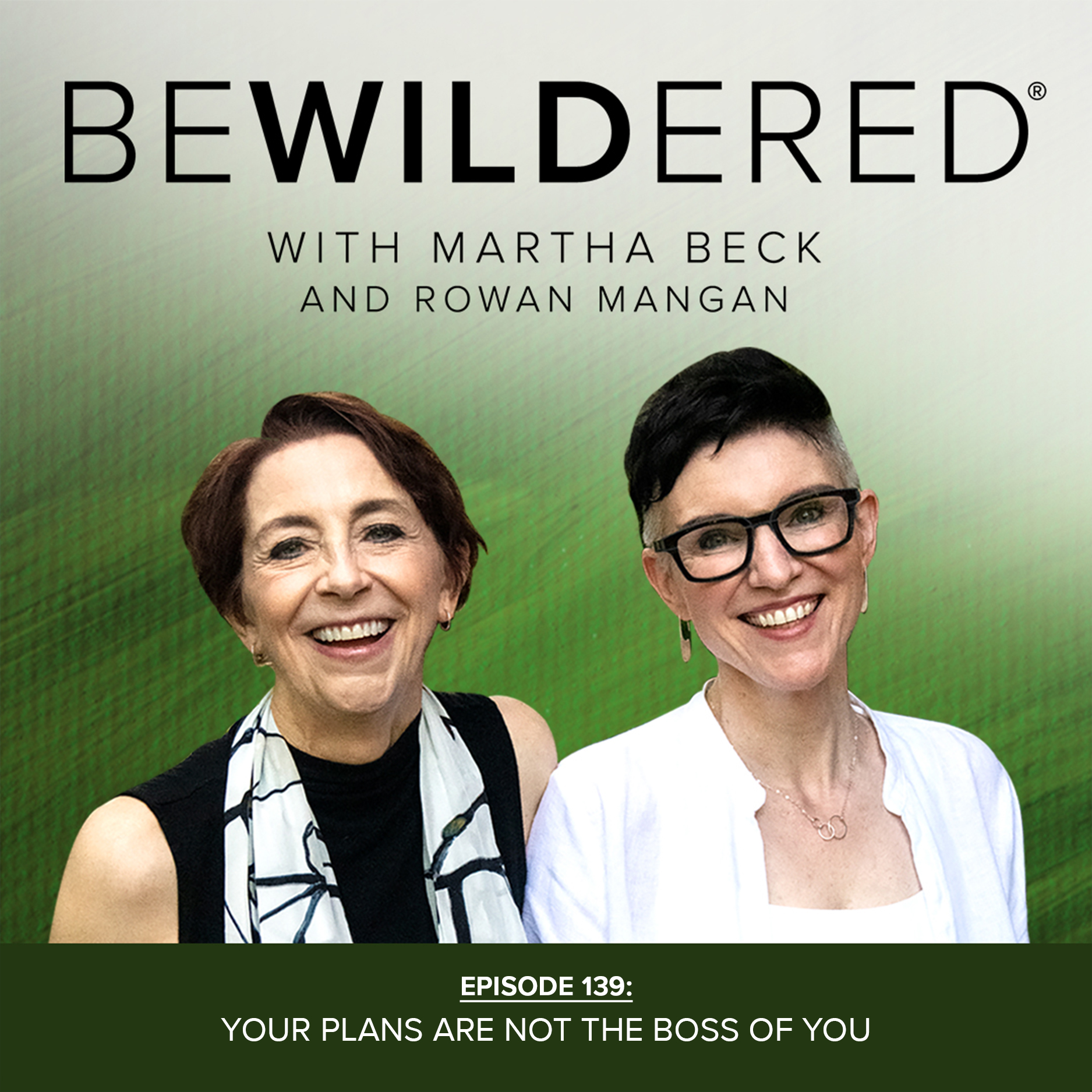
Have you been outsourcing your knowing to apps, rings, and to-do lists...but you still feel overwhelmed? We’ve been there. On this episode of Bewildered, we talk dog crates, corn patches, and cushion forts: all the places we retreat to when another “fabulous plan” hits the wall. We also share about our timid shelter dog Rumi, a marathon runner who couldn’t feel his own exhaustion, and why surrendering to love beats surrendering to schedules. We’ve got plenty of personal stories in this one—join us!



Your Plans Are Not the Boss of You
Show Notes
We’ve all had fabulous plans for our life…and then they just don’t work. Maybe you feel fantastic, but your app says your resilience is down. Maybe you feel terrible, but your app says it’s time to get up and exercise. Somewhere along the way, we started outsourcing our knowing to apps, to-do lists, schedules, and other people—and then we don’t know what the hell we’re doing with our lives anymore.
This time on Bewildered, we’re talking about what happens next: the overwhelm, the shutdown, and the strange comfort of retreating into what we’re calling our “crates.”
Meet Rumi (and Her Crate)
We’ve got a new shelter dog. Her name is Rumi (or Jelly, if you ask Martha) and she’s obsessed with her crate. She wants no part of the outside world, and it turns out there’s a lot of wisdom in that. Dogs are den animals. Small enclosed spaces feel safe to them. So we started wondering: What if we sometimes need a crate too?
We talk about our own versions of the crate, from corn patches to cushion forts. We explore what happens when the plan falls apart and you have to retreat into your own version of the crate. And is that actually such a bad thing?
The Marathon Runner Who Couldn’t Feel His Own Body
One of the many stories in this episode is about a marathon runner Martha met on a train in Europe. He’d had the perfect training schedule, laminated even, for a race he was sure he’d win. Then he hit the wall. When Martha asked him how he’d felt during training, he had no idea what she meant. He just pointed at his schedule. That moment says everything about what happens when we hand our knowing over to a plan and stop listening to our own bodies.
Outsourcing Your Knowing vs. Authorizing It
We dig into the difference between authorizing your own knowing and outsourcing it—to a smartwatch, a ring, a schedule, or a cultural expectation of what your life is supposed to look like by a certain age. We talk about the moment when a useful tool becomes a higher power you subject yourself to before you even check in with yourself, and how to catch that moment before it costs you your health.
Fight, Flight, Flop, or Fawn: Recognizing When You’ve Lost Yourself
We break down the defense cascade—fight, flight, flop, and fawn—and how each one shows up when we’ve pushed past the point where continuing to meet an external plan becomes what we’re calling a “life of crime” against ourselves. We talk about surrender, what it actually means (it’s not what we were taught), and why giving your knowing over to love is different from giving it over to a schedule.
If you’ve ever wondered why you can’t just make yourself “stick to the plan,” or why your body seems to be rebelling against a life that looks perfect on paper, this episode is for you.
Also in This Episode
- Ro appreciates any profession that has toys that go with it.
- Martha’s distinguished seminar outline…and a raccoon.
- Crabapples, “chook checks”, and bears in skinny jeans
- Going “full mammal” in a house full of red flags
- Under a desk at the United Nations
- One of Ro’s favorite metaphors ever about the culture
TALK TO US
You can follow us on our Instagram channel @bewilderedpodcast to connect with our Bewildered community, learn about upcoming episodes, and participate in callouts ahead of podcast taping.
And if you’re a Bewildered fan, would you consider giving us a little rate-and-review love on your favorite podcast player? Ratings and reviews are like gold in the podcasting universe—they help people find us, they help build this beautiful community, and most of all, they help us in our quest to Bewilder the world…
Episode Links and Quotes
- “My IQ” song by Ani DiFranco
- Rumi Jalāl al-Dīn
- Interoception
- “Hitting the wall” in marathon running
- The Way of Integrity by Martha Beck
- Fight, Flight, Freeze, Fawn, and Flop
- Article on interoception in sports
CONNECT WITH US
- Follow Martha on Instagram
- Follow Ro on Instagram
- Follow Bewildered on Instagram
- Join us in the Wilder Community!
- Listen on your favorite podcast app
- The Bewildered Show Notes
- Martha’s Substack—The Pyramid and The Pool
- Is there something you’ve been feeling bewildered about? If so, let us hear from you!
Transcript
Please note: This is an unedited transcript, provided as a courtesy, and reflects the actual conversation as closely as possible. Please forgive any typographical or grammatical errors.
Martha Beck:
Hi, I’m Martha Beck.
Rowan Mangan:
And I’m Rowan Mangan. And this is another episode of Bewildered, the podcast for people who are trying to figure it out.
Martha Beck:
Yes. And today we’re trying to figure out those moments when you have a fabulous plan for your life and it is not working.
Rowan Mangan:
Yeah. Or when you feel fantastic, but your app says, “Oh, your resilience is down.”
Martha Beck:
Yes. Or when you feel very down and your app says, “Get up and exercise. It’s time.”
Rowan Mangan:
Sometimes we outsource knowledge to other things, be they to-do lists, other people, apps.
Martha Beck:
Yes, we outsource our authority and then we don’t know what the hell we’re doing with our lives.
Rowan Mangan:
It can lead to overwhelm and in a contorted metaphorical kind of way, it can lead to us retreating into our dog crates. And if that doesn’t make any sense to you, you’re going to love this episode of Bewildered.
Martha Beck:
So, Rowie?
Rowan Mangan:
Yeah.
Martha Beck:
What are you trying to figure out?
Rowan Mangan:
Well, Marty, there’s a thing that I don’t think we talk about enough in society. It’s not something that comes up. And I want to be the one to break the taboo. I’m talking about how, when your house has melted, and there’s a particular kind of awkward situation that happens, in my recent experience, where people must come to the house to fix it.
Martha Beck:
Yes. They must.
Rowan Mangan:
You know how they must? And because so many things can go wrong in one house, you wouldn’t think, but it can, this, then that, then that, everything’s falling down or falling up. And so these people who come to fix things, they end up encountering each other.
Martha Beck:
They do.
Rowan Mangan:
And there’s a particular kind of energy that goes when you have to say, “Oh no, Steve’s here for the roof that’s falling down. Oh no, James is here. He’s going to the basement to look at the boiler that doesn’t work.” And then there’s this moment where they kind of look at each other and size each other up. And in a way it makes me feel very feminine and taken care of.
Martha Beck:
Do their beards stand on end when they see each other?
Rowan Mangan:
A little bit. Yeah. It’s a bit like that. It’s like, “I know I can fix this lesbian house. Can you?” And it’s nice, but it’s also like there’s this sort of thrill of excitement that goes along with it. Do you know what I’m talking about?
Martha Beck:
I think you’re just inhaling testosterone, which we very rarely get a good whiff of that stuff. So you might be overly sensitive to it.
Rowan Mangan:
I don’t know. I’m there and I’m trying to make explanations and they’re just like grr…
Martha Beck:
It is kind of like Vikings because they have so much weaponry.
Rowan Mangan:
They do.
Martha Beck:
I don’t know. I suppose those are called tools, but as Ani DiFranco says, any tool is a weapon if you hold it right. And they have a lot of weapons.
Rowan Mangan:
They do.
Martha Beck:
And I don’t even know what the weapons are for, but they clank as they walk. And then I just picture these, if not Vikings, then definitely from the dark ages warrior clanky class, the clanky class of people. They come around the corner, clankity, clank, clankity, clank, and it’s like, “Bring me my welding torch.”
Rowan Mangan:
Yeah, it’s sort of like that. Yeah. I just want to take a moment to appreciate any profession that has toys that go with it. And a lot of them do. Think of a doctor. They get toys, coat, stethoscope. Come on, stethoscope in this day and age? Are you kidding me? Right. That’s called an affectation at this point, guys.
Martha Beck:
An accountant carrying a slide rule. No, I’m not buying it. No.
Rowan Mangan:
An abacus.
Martha Beck:
Right. Clickity, click, clickity, click. Clank, clank, clank.
Rowan Mangan:
Love it. Love it.
Martha Beck:
Is that what you’re trying to figure out what? Because I am always in complete—I flee the moment the first clank hits my ears and I’m gone. They never see me.
Rowan Mangan:
That’s because you’re wearing your apron, your tall apron. And you don’t want them to laugh.
Martha Beck:
I have my own clanky bits.
Rowan Mangan:
We all do, sweetie.
Martha Beck:
But yeah, I’m afraid to clank in their presence because they have a lot bigger toys.
Rowan Mangan:
They do. What I’m trying to figure out is just how to smooth that moment, how to make that a positive rather than aggressive or confrontational moment when you have to introduce people fixing different parts of your house to each other.
Martha Beck:
Gosh, it is really awkward.
Rowan Mangan:
Because it feels a little bit like I’m cheating on one with the other, but it’s like, “You’re not a plumber, so you can’t expect me to ask you to fix the plumbing.”
Martha Beck:
I think we should just make pies and then hold pie in different places so that we’ll just bait them to different areas.
Rowan Mangan:
We really don’t understand anything about men, do we? This is a real reach.
Martha Beck:
When the bear came to our house the other day to graze on the crabapple tree and he stood up like this to eat the crabapples. It was exactly the same feeling as hearing the clinkety clink, clinkety, clink. That’s a big and muscular creature, I thought.
Rowan Mangan:
Yeah, a big muscular creature who’s still wearing skinny jeans.
Martha Beck:
I didn’t notice that the bear was wearing skinny jeans.
Rowan Mangan:
Yeah. He’s wearing low cut skinny jeans, low rise skinny jeans.
Martha Beck:
Well, he had a huge upper body.
Rowan Mangan:
That’s what I’m saying.
Martha Beck:
It’s a big bear.
Rowan Mangan:
Yeah. So what are you trying to figure out?
Martha Beck:
Well, now I’m lost in this because God knows we’re going to be having people clanking around our house to the end of the next century. Yeah. Things have melted significantly. No, I continue to descend into a hell pit of mistaken emails and texts.
Rowan Mangan:
Mistaken emails and texts?
Martha Beck:
Yeah. When you send the wrong thing, thinking it’s another thing. You write a text to one person and send it to another accidentally.
Rowan Mangan:
Because you sent the text to the person the text was about. Oh, that’s the worst feeling.
Martha Beck:
Yeah. Well, last time, I don’t know if it’s the last time people heard this, but we talked about how I almost sent this butt text that was just, it was literally about butts.
Rowan Mangan:
It was a butt text in a sense that it wasn’t meant to be written, but it was also a butt text in a sense that it was about my butt.
Martha Beck:
Yes, but to be sent to a distinguished colleague. Anyway, something similar happened again.
Rowan Mangan:
Uh-oh.
Martha Beck:
This was email. Yes. And I’m going to a very sort of select and distinguished kind of retreat center. It’s very high tone, high education, and they wanted to be sure that I was well prepared. So they sent me an email and it said, “We trust you are well-prepared for the seminar. Here’s the schedule. An evening, a day, a morning, an afternoon, another day. Please send us your outline.” So I was like, “Of course, but of course.” And I went to type…[vocalizes]
Rowan Mangan:
That’s the noise of Marty writing an outline.
Martha Beck:
If I slowed it down, you’d hear all the words. Anyway, the thing is when I go into my email to send the email, I never write it, actually never write it in the email form because otherwise I will hit it with my elbow and send it and it will be malformed and yeah—what?
Rowan Mangan:
You write it in the email, but you don’t fill out the—
Martha Beck:
Well, I never hit reply and then write an actual reply. I mean, unless it’s just like, I don’t care if it’s about butts. So this time I wrote a very detailed outline in another document, select all, control X. It’s in the memory of the computer. I go to my computer email, computer email. But then once you’re there, especially if you have a bit of touch of the ADD, there are a lot of emails in there.
Rowan Mangan:
So I hear.
Martha Beck:
And some of them are more interesting than others. Well, right now, one of my dear friends is on a real tear about raccoons. She saw a raccoon on the road. It was very sad. Anyway, she’s really into raccoons and we’ve been trading emails. And so I went in, I just wrote her a note and sent that off. And then I went in and I said to the distinguished person, “I understand why you want the outline. Here’s my outline for the weekend.” Paste, send: an emoji of a raccoon. This is my entire outline for the week.
Rowan Mangan:
Questions or concerns?
Martha Beck:
Yeah, I’m thinking of going with that outline actually.
Rowan Mangan:
Baby, it’s so on brand.
Martha Beck:
Yeah, I know.
Rowan Mangan:
Should we do a podcast?
Martha Beck:
I guess we shall. It can’t be worse than my recent correspondence history.
So you know how sometimes really evil Machiavellian people wait until you’re in a group of people and then they say something to you that they would never say in private because you could then slap them upside the head. But with a group, what are they supposed to do?
Rowan Mangan:
Yeah.
Martha Beck:
Well, that’s what I’m doing right now.
Rowan Mangan:
Oh!
Martha Beck:
Yes, because lately, things have happened that have caused me to hold my tongue physically with both hands.
Rowan Mangan:
It is a very long tongue.
Martha Beck:
So first, I think you’re going up the evolutionary chain. First, you got a bunch of plants and planted them in the house in the winter.
Rowan Mangan:
That’s true.
Martha Beck:
And they lushly overtook the house. So I was like, “Okay, this is the era of earth before animal life.” Then you did move to the outside garden, and I have to say, it is gangbusters. It is beautiful. We’ve been eating food from the garden and everything, but it is something to take care of. It’s a lot of somethings to take care of. I mean, we’ve been out there picking off teeny tiny caterpillars off our kale.
Rowan Mangan:
One time.
Martha Beck:
I did it one time. You do it every day, right?
Rowan Mangan:
Yeah. They’re getting quite large. They’re easier to spot now.
Martha Beck:
When I can see them from the house and go after them with a slingshot, I’m your girl. But I didn’t say anything because I did take care of a lot of things. Yes, you’re working basically double time. You’ve got a child who is not the easiest kid ever on the face of the earth. Your wonderful mother is here. There’s a lot going on in your life.
Rowan Mangan:
Yeah. Got chickens.
Martha Beck:
Well, I was getting to that because now it’s the time of the dinosaurs.
Rowan Mangan:
Oh, I see. We’re going through the planets.
Martha Beck:
All birds are direct descendants of the dinosaurs. So there were the plants and then there were other things, but then there were dinosaurs and you got the dinosaurs and they came, they were tiny and inoffensive.
Rowan Mangan:
Fluffy, if anything.
Martha Beck:
Yes, but requiring a lot of equipment. And now they’re huge and inoffensive, requiring a lot of equipment, and you need to go check on them a lot because: bears.
Rowan Mangan:
Yeah, we do a chook check before bed.
Martha Beck:
That’s an Australian thing. A chook is a chicken in Australia because they were sailing across the water on these ships for an enormous amount of time and they had to throw all their extra letters overboard. So all the words, all English words in Australian are shortened. So a chicken is a chook. Anyway, I thought, “Dinosaurs require care, but she seems to know what she’s about. I know she’s only getting five hours of sleep a night at this point.” So I really didn’t have to hold my tongue at this juncture. And then you said, just looking at your phone, “Oh, look at this sweet shelter dog. No one will adopt her.” And I was like, “Are you effing kidding me? You’re going mammal at this point? You’re going sensitive, needy mammal?”
Rowan Mangan:
Going full mammal.
Martha Beck:
And I didn’t say anything. I did not say anything because you are an intuitive and sensitive person.
Rowan Mangan:
So here’s the thing. We weren’t looking for a dog.
Martha Beck:
No. No, we were not.
Rowan Mangan:
We weren’t, as you might say, in the market for a dog.
Martha Beck:
Opposite. I was actually, I’m looking at the dog we have and thinking, “Oh, he’s the best dog and he’s getting so old. Let’s enjoy him for a while.” Definitely not looking to add dog.
Rowan Mangan:
But then I saw this video of a little dog and there were a few red flags along the way.
Martha Beck:
Oh my God, you think?
Rowan Mangan:
Looking back.
Martha Beck:
Our house is full of red flags. There are red flags posted and waving in every corner and they say on them, if you look, “Don’t get another dog.” They were there all along, honey.
Rowan Mangan:
But there was a little video of a little dog and I saw it and something—now, sometimes you get a divine nudge. Sometimes it’s hard to know whether or not this was that. I got a nudge that said, “You should probably get this dog,” but I don’t know if it was like I was being spoken to by my higher self or if it was just that part of you that goes, “Oh, the poor little thing.”
Martha Beck:
Why now? Were your defenses down? I find sometimes that when I get exhausted and people are sort of pushing my boundaries, I have a harder time setting boundaries. Is that what happened?
Rowan Mangan:
No. No, it’s amazing because I just very calmly, and this is why I do, even though it’s not clear to us now, I do still think that there was guidance that led us towards this particular—
Martha Beck:
I think “us” is a strong word.
Rowan Mangan:
That led me towards this particular clump of red flags that now lives in our house. But I felt very calm. I felt very certain even when the shelter volunteer growled at me in her special way.
Martha Beck:
Wait, the shelter volunteer growled at you.
Rowan Mangan:
She growled at me. She said, “Well, you’ve got your work cut out for you.”
Martha Beck:
Oh Lord.
Rowan Mangan:
And I was like, “That’s not a great sales pitch.” But I pressed on.
Martha Beck:
Yes, you did.
Rowan Mangan:
Because that’s what you do.
Martha Beck:
Yep. That’s what you do. See, I’ve been waiting until whoever out there is watching this could defend me in case this is the moment you decide to say that you’ve had enough of me, which is the reason I’ve held my tongue ’til now. But now you have to say it publicly over this, and I frankly think everyone’s going to side with me.
Rowan Mangan:
Oh, that’s so funny because I am 100% certain everyone’s siding with me because this is a cute little dog.
Martha Beck:
She’s not little.
Rowan Mangan:
Oh, she’s littler than me.
Martha Beck:
You can barely lift her and you have to lift her all the time. She’s actively fighting being lifted.
Rowan Mangan:
She’s a timid dog, you could say. She’s not endowed with a huge amount of self-confidence at this point. Who knows where she’ll go? I think she’ll flourish under our love and attention. The only thing that maybe I didn’t fully take into account is the—so I brought it up. What do you think? There’s this dog, I think that I’m being divinely guided to get the dog. Karen says, “I can get behind this if it’s something that would be really good for Lila.” Right?
Martha Beck:
It’s about Lila. If the dog loves Lila. Meanwhile, I was looking at Karen the way horses look at each other when they realize the barn is on fire. But I got to say, you’ve always come through swimmingly. I never think you’re going to pull it off and you always do.
Rowan Mangan:
I know. I’m just sitting here looking forward to the day when I say, “So Marty, you now love our dog Rumi so much that you’re taking her in a backpack on your hikes and just loving on her and asking her to come and hang out with you.” It’s going to happen.
Martha Beck:
That would be nice, except if it happened, I think Lila might physically injure me.
Rowan Mangan:
Yeah. So our kid is where the new dog is not endowed with a lot of self-confidence, the same cannot be said of our daughter who very, very strongly feels that “this is my dog and I’ll do what I want to do.” And when grownups say, “Okay, let’s just be super gentle with the dog,” that energy doesn’t translate. And basically the dog’s regressed. She now hates life at our house more than the shelter.
Martha Beck:
Well, she’s been there, what, 48 hours?
Rowan Mangan:
Our house, yeah.
Martha Beck:
This very raw. We’re presenting this to you in a very raw and vulnerable way.
Rowan Mangan:
It’s basically an intervention.
Martha Beck:
Yeah, it is. It really is. And you get to sit in a circle and write a letter to say how Ro’s getting this dog has affected your life and what you’ll have to do if she keeps getting things. Because the next thing’s going to be a primate, honey, and I’m not sure that—
Rowan Mangan:
I did the primate first.
Martha Beck:
That’s true.
Rowan Mangan:
The primate is the whole problem.
Martha Beck:
Fair point.
Rowan Mangan:
The primate is coming on six years old and a more complex species than I was anticipating.
Martha Beck:
Yeah. A more energetic and resilient creature than I expected.
Rowan Mangan:
Yeah. I mean, there’s cute stuff because she got a big label, like sticky label and did some drawings for the dog and then stuck it on the inside of the dog’s crate and the drawings were there and then there were some words and they said, “Owoooh.”
Martha Beck:
Oh, that’s nice.
Rowan Mangan:
Yeah, to help her settle in.
Martha Beck:
That’s sweet.
Rowan Mangan:
Yeah.
Martha Beck:
I know. I’m sure there’s abundant hope, but I’m telling you this is a complex situation.
Rowan Mangan:
That’s fair. That’s fair. I cannot deny it.
Martha Beck:
And out of this has come our topic for today.
Rowan Mangan:
Yep. Just when you thought there was no topic, here it comes.
Martha Beck:
And it has to do with our dog, Rumi Jalāl al-Dīn. I call her “Jelly” because Rumi sounds like an adjective.
Rowan Mangan:
Can you once introduce our beloved dog without telling me what’s wrong with the name?
Martha Beck:
Frankly, no.
Rowan Mangan:
I’m starting to think you’re the problem here.
Martha Beck:
I’m just calling the dog Jelly because she quivers.
Rowan Mangan:
She does quiver.
Martha Beck:
She does quiver. Anyway, Jelly has been living in her crate, and it looks as if we have a caged dog. So I know all of you out there who don’t understand dog crate psychology, it sounds like a terrible thing to have this little cage that is just big enough for the dog to sort of move around in comfortably and leave her there for long periods of time. But in fact, dogs are den animals and they like small enclosed spaces. It feels safe to them.
Rowan Mangan:
Yeah.
Martha Beck:
And Jelly is obsessed with her crate and wants no part of the outside world.
Rowan Mangan:
Yeah. Yeah. And the more Lila loves her, the further back in the crate the puppy goes.
Martha Beck:
Yeah. Lila’s love is of the aggressively—it’s almost a contact sport, really.
Rowan Mangan:
Yeah.
Martha Beck:
She’s basically a cannonball on legs and—
Rowan Mangan:
She loves this dog so much.
Martha Beck:
So much.
Rowan Mangan:
She yells it from rooftops, you know?
Martha Beck:
Yeah.
Rowan Mangan:
She shouts it every time she comes into the room.
Martha Beck:
“I love you.” It’s so weird. I mean, how many human relationships are this way where one person is just aggressively screaming, “I love you,” and the other person needs to be loved, but doesn’t like the screaming?
Rowan Mangan:
Yeah.
Martha Beck:
But that’s not our point.
Rowan Mangan:
I mean, it’s a funny thing that we all go through when we first encounter the whole crate-of-dog thing and we’re like, “Oh, it’s a cage.” Then you realize, “Oh, she loves her cage. Oh, we love our prisons.” But it was funny because I was feeling quite overwhelmed earlier today from the dog and child of it all. It’s also like it’s the week before school starts.
Martha Beck:
A lot of things have happened.
Rowan Mangan:
There’s a lot. There’s a lot of moving pieces, shall we say. So I was feeling a bit overwhelmed, and that’s when Lila came to me and said, “Do you want to spend some time in my fort?” I feel like I’m so often just rushing past her going, “I’m trying to work. I’m trying to work. I’m trying to raise your dog.” And I was just like, “You know what? I do feel like spending some time in your fort.” So I climbed in. She sort of made it, it’s like a fort. It doesn’t matter what she made it out of.
Martha Beck:
Cushions, made of cushions.
Rowan Mangan:
Cushions, blanket, you get it. Cubby, we would say in the old country. And I climbed in and I snuggled down there and we watched, ironically, we watched a video on YouTube Kids about animals escaping from their human enclosures.
Martha Beck:
That’s no mistake. There’s no such thing as coincidence.
Rowan Mangan:
And I snuggled in there and I was like, “Maybe Rumi’s got the right idea. Maybe we should all just hunker down in our crates sometimes. Maybe the world really is that overwhelming, and inside the crate is a blanket that smells like your shelter and a squeaky toy, and people don’t really demand too much of you. Every now and again, a small human will come up and yell at you and try to full body tackle you.
Martha Beck:
That happens.
Rowan Mangan:
But the rest of the time, nummy, num, num, num.
Martha Beck:
Yeah. And the need to retreat to one’s crate, I think it’s misunderstood among humans in the same way that humans tend to misunderstand the dog crate thing, where if you go hunker in your corner and refuse to speak to anyone for a few, I don’t know, days, people think that’s a bad thing, and they try to get you out and get you to go dancing. I remember when I was pregnant, sick, devastated because of Adam’s Down syndrome already diagnosed, and people kept trying to take me out to do fun things. Are you high?
Rowan Mangan:
They probably were.
Martha Beck:
Do you not—yep, I wouldn’t doubt it. Anyway, it’s just a different mindset, and I don’t know if everybody out there is going, “Well, that’s wonderful. You should have gone out dancing. You would’ve gotten over the vomiting and grieving. It would’ve been great.” I needed to vomit and grieve in my own little cubby.
Rowan Mangan:
Enclosure.
Martha Beck:
Enclosure, yeah. And it reminded me when you said that you and Lila had been in the fort, it reminded me of this time when I was in high school, when I was fully leveraged in all the extracurriculars and things like speech contests and—
Rowan Mangan:
“I was fully leveraged.”
Martha Beck:
I was, and writing contests and all these contests.
Rowan Mangan:
Sometimes the way Marty talks, high school was genuinely the high point of—
Martha Beck:
It was. It was way worse than college. And I was taking some of the hardest classes at Harvard. Did I mention Harvard? I mean, I literally took, yeah, hard courses. Anyway, wasn’t as bad as high school at all because I was just torn in a thousand directions. And one day I was talking to my English teacher. I was supposed to enter another writing contest. They were entering me in all these. The teachers were entering me and things, and then they’d tell me I was entered and I’d have to go compete.
Rowan Mangan:
“You are entered.”
Martha Beck:
Yeah. “We have entered you for this into this contest.” I wouldn’t even know about it till the day it happened sometimes.
Rowan Mangan:
I feel like you shouldn’t be an English teacher if you say, “You are entered.” That doesn’t feel grammatically safe.
Martha Beck:
Well, it is grammatical, but it’s shocking. Anyway, just live with that.
Rowan Mangan:
Okay. So they would tell you—
Martha Beck:
Anyway, so there’s my English teacher, and I went in to do this. I was supposed to sit down and I got my instructions and she was supposed to do this thing and I had a timed essay or something. Anyway, so I did the thing and I handed it in and I was just a shell because I hadn’t been sleeping and I was so anxious all the time. And then she said, “Well, okay, tomorrow we’ve got you entered in something else and it’s after school and you can’t go home.” And I was like, “Oh my God.” I had so much homework and it was really bad. I still haven’t gotten over this part of my life.
Rowan Mangan:
Clearly there’s some more therapy to be had on this.
Martha Beck:
It was really bad. Anyway, usually I was pretty good at holding it together, but I just sat there at my desk and just tears just started pouring down my face and I didn’t move my face or my breathing or anything, but I could not stop the tears. So I just got up and walked to the back of the room and closed myself in her office. I didn’t even ask. So I came out half an hour later after I’d tried to dry my face, and she told me a story, which I have really truly treasured for all these years. She told me she actually left high school to marry her high school sweetheart. He was 19. She was 17. By the time she was 21, she had four kids. Yeah. And she wasn’t pregnant when she got married, by the way. Good Mormon people.
Rowan Mangan:
All right.
Martha Beck:
Yeah.
Rowan Mangan:
Not sure how relevant that is to the story, but let’s keep going.
Martha Beck:
I’m just saying it was her fault. Anyway, she said somewhere in there, they were living out in this farmhouse and she had this idea and she had grown a patch of corn because corn, if you’ve ever seen one of the movies where people run through the corn and they’re lost and it’s a corn maze. I mean, corn is quite Little Shop of Horrors frightening.
Rowan Mangan:
Children of the Corn.
Martha Beck:
Yeah. Yeah. Corn is pretty creepy, really. Anyway, she grew this—
Rowan Mangan:
It’s delicious.
Martha Beck:
It’s delicious. She grew this big corn patch and she grew it in the spring and by summertime it had gotten large. And when the kids would just get too much for her, she would just find time to take herself out and disappear into the corn. And she would just lie down in the corn and listen to them screaming for her for hours. And she would just be like, “No, I will not come out.” She was like, “Martha, you have to get yourself a corn patch. You need a corn patch stat.” Yeah.
Rowan Mangan:
Stat.
Martha Beck:
And I’m like—
Rowan Mangan:
Like, “Don’t enter me in a corn patch now.”
Martha Beck:
Yeah, right. “You have been entered in a corn patch.” Oh God. All right. So anyway, I have remembered that. And the corn patch has become my metaphor for the crate, which is also a metaphor for wherever you go to curl up and just recuperate.
Rowan Mangan:
Yeah. And let overwhelm take you. So I feel like we go to our crate/fort/corn patch and we hunker down in there, and then our minds inevitably turn to the things we were supposed to be doing because most of us don’t write “hunker down in corn patch” on our to-do list for the day, though God knows we should.
Martha Beck:
Oh my God, we should.
Rowan Mangan:
And so there’s this moment when you succumb to overwhelm and you disappear into the proverbial corn patch and you have to confront the fact that the day is not going as anticipated in the left-hemisphere cultural mindset that we may have been in under the influence of caffeine earlier today.
Martha Beck:
When we saw the dog video.
Rowan Mangan:
And we saw the dog video and thought, “I’ll get that before lunch and then I’ll get to inbox zero by 2:00.” Yeah. And so what—
Martha Beck:
Raccoon emoji and send.
Rowan Mangan:
And send. So it’s like our little parts are in conflict and I just feel like there must be some way that we can—how do we reconcile the existence of the plans out there in the world, the things that must get done with the, “I want a crate.”
Martha Beck:
I need to go in the corn patch crate, corner, cubby, fort.
Rowan Mangan:
I need crate time.
Martha Beck:
Crate.
Rowan Mangan:
And so what happens when that happens, because it does happen. I had a friend when we lived in Bangkok, we used to talk about going under the desk. Sometimes, some days just, and this is work in an office, in her case at the United Nations. Got to go under the desk sometimes. Just go under there.
Martha Beck:
But okay, here’s something. I’m not sure that we’re representative. Maybe the people who would listen to this or watch this, but I don’t think we’re representative of most people. I don’t think most people need a crate as much as I do, or a corn patch or whatever it is. I think some people are just fine not under the desk ever. I feel I have to be devil’s advocate here because we’ve been generalizing. You have your plans and they just don’t go to, nothing goes to plan. And so you end up needing to go into a crate or whatever. And I know a lot of people who don’t seem to need that. They’re super happy and they don’t go in the crate.
Rowan Mangan:
Are you sure?
Martha Beck:
I was talking to a client the other day and I was suggesting this and she was like, “What are you talking about? I never get tired.”
Rowan Mangan:
But overwhelm. They made a word for overwhelm.
Martha Beck:
Maybe just for people like us. And maybe that was just for people in wartime where for us—
Rowan Mangan:
Wartime? Oh, overwhelm. I thought you were suggesting we introduce a new metaphor for the crate/fort thing, which is like the underground bunkers in World War II where people would go when the blitz started.
Martha Beck:
We could go anywhere with this, frankly. But now the deal is that we really understand the thing of “I make a plan. I can’t do that plan. I mean, I think I should be able to do the plan.” And here’s the thing, is it culture that lies to us and says, “Plan this, it’ll be easy”? Or is it that most people out there just have lots more energy than we do and it goes in a lot more useful directions? And so those people have created the culture that says, “This is the plan that you should be able to stick to.” Does everybody get overwhelmed? I don’t know because I think if they do, nobody talks about it.
Rowan Mangan:
They don’t talk about it. It’s exactly, oh my God, it’s exactly like when there are two different people coming to your house to fix different things. Don’t you find that people don’t talk about that either?
Martha Beck:
They don’t.
Rowan Mangan:
I’m starting to get that it’s giving conspiracy, you know? It’s giving conspiracy.
Martha Beck:
So anyway, I just did want to say that if you’re listening to this and going, “What? I never get tired and my plans always work perfectly.”
Rowan Mangan:
Then I don’t think they’re like, “I should listen to a podcast called Bewildered.” They’re like, “I should listen to a podcast called On Top of the World.”
Martha Beck:
Yes. And maybe they do. So for all of us bewildered people, I think this really is an issue. I have another story and I don’t think I’ve told it on the podcast yet. And it really was a moment when it crystallized for me that someone was trying to meet a cultural definition of possibility when he was truly, truly—it was not possible. So I’m in a train going, going from Germany south. Anyway, it was somewhere in Europe and this guy gets on and he sits down across from me and he just looked crushed. He just sat there and put his head in his hands and he was rocking. And I was like—
Rowan Mangan:
You were like, “You’ve come to the right place. I’m a life coach.”
Martha Beck:
Yeah. Part of my series, The Traveling Life Coach. I just sit on trains.
Rowan Mangan:
You’re like, “Camera crew. Come on over.” Actually, Marty, it’s not a bad idea.
Martha Beck:
It’s like one of those Long Island medium shows where the Long Island medium goes around in crowds and just says to people, “Your father’s coming through. He’s stepping forward.” And maybe I could just go out there and go, “Your life is shit. Your life is shit. You need to go in a crate. Bye.” I could do that.
Rowan Mangan:
You could just offer them a crate.
Martha Beck:
We’d be rich. Okay. And then I’d get overwhelmed and have to go in a crate, which is kind of the story of my career. Anyway, this guy is in a fetal position and I finally say to him, “Are you all right?” And he’s like, “No, I’m not. This was supposed to be a big day for me and I have failed. I have completely failed.” Of course, he spoke flawless English because everyone in Europe does, but I think he was Swiss. And I must say that when it comes to things working as they are meant to, the Swiss are particularly emphatic in my experience.
Rowan Mangan:
That is an organized people.
Martha Beck:
And so he was Swiss and he was a marathon runner. And he had entered this marathon and it was going to be his best race ever. And this thing happened to him, which is called hitting the wall.
Rowan Mangan:
Which is when you’re running a marathon and instead of staying on the right, you unfortunately steer your body into a hard object, AKA a wall.
Martha Beck:
Splat.
Rowan Mangan:
I love how you said that. “This thing happened to me…” I just love that you were like, “It’s called hitting a wall” instead of saying, “I call it hitting a wall.”
Martha Beck:
No, it’s called “hitting the wall.” And if you knew anything about marathon, it wouldn’t be funny at all.
Rowan Mangan:
If I knew anything about marathoning, nothing would be funny.
Martha Beck:
You’d just be pasted into a wall somewhere in Switzerland.
Rowan Mangan:
Oh, the Ani DiFranco lyrics about that if you ever want to hear them.
Martha Beck:
Yes, I do. About hitting the wall?
Rowan Mangan:
Yeah. “Who’s going to give a shit? Who’s going to take the call when you find out that the road ahead is painted on a wall?”
Martha Beck:
Well, I think that’s where we end here. Thank you again, Ani DiFranco. Anyway, there’s a thing. There’s a thing when you’re running, you set out too fast and it’s not— like in a 10K race or whatever, you might fade if you go out too fast, you slow down and everybody overtakes you. But in a marathon, if you go out too fast, you run the risk of getting to this place where you’ve eaten up all the glycogen in your muscles. So there’s literally nothing for your little cells to use to process oxygen into movement and your muscles just literally stop, and you fall down.
Rowan Mangan:
It’s more like you hit the floor. That’s what they should call it.
Martha Beck:
That is true. That is true. I’ll send a memo.
Rowan Mangan:
I mean, in a way, isn’t a floor just a ground wall?
Martha Beck:
A floor is a ground wall. I will send a note to the establishment to get them to change it and the entirety of the note will be an emoji of a squirrel.
Rowan Mangan:
Fantastic.
Martha Beck:
So I said to this man, “Okay, so you hit the wall. You don’t need to be ashamed.” Ro! It’s not that funny!
Rowan Mangan:
Just ignore me. Just ignore me.
Martha Beck:
Okay. I usually do. I wish I hadn’t ignored you when you were saying, “I think this dog, she’s a real problem animal, terrified of children. Let’s do it.” So anyway, I said, “Well, you overtrained.” And he was like, “No, this is why I was going to win. I had this perfect training regimen.” And he got out this laminated training schedule and it had all these distances he was supposed to run and times when he was going to do speed intervals, exactly what he was supposed to eat, exactly what time he was to eat, what time he was to work out, what time he was to sleep, all building toward the day of the marathon.
Rowan Mangan:
Can I just serious point of clarification here? In my mind, he’s on the train with his little number stuck to him.
Martha Beck:
He had a little rolling bag.
Rowan Mangan:
But was he in his marathon shorts?
Martha Beck:
He was in marathon clothes. He’d taken his number off in shame.
Rowan Mangan:
Okay. Okay, because I couldn’t understand why he had his laminated thing.
Martha Beck:
He had a pair of sweats on and a t-shirt, and then he had his little roll-aboard.
Rowan Mangan:
I don’t know much about marathons, but I don’t think you should be toting a bag like that. That could make you hit the wall.
Martha Beck:
I think the next time we go to the airport, we should form a new sport where people have to run into walls carrying with their roll-aboards along. It would give everyone something to watch and cheer for and feel good about in the airport. Anyway, he has this schedule and it’s like perfection. And I said, “But how did you feel?” And he was like, “No, no, no. Look, look, look here. It has all the things.” And I said, “But how did you feel when you were running in training?” And he just looked at me like, “No, look at this schedule.” And I kept saying, “But were you tired?” And he was, “It says right here.” And there was literally no information arising from the interoception of his own body. It was completely outsourced to this calculated plan that did indeed look super awesome. It looked like it would work. It was very impressive.
Rowan Mangan:
We talked once about “authorize your knowing” and “outsource your knowing” is the alternative to that, right?
Martha Beck:
Interesting. Yeah.
Rowan Mangan:
You outsource knowing. And I think this is the deal that we get to. We make plans, then the plans become what we consult instead of our bodies. And then things can get really quite out of control before the warning signs in your body get. The sirens are wailing pretty hard by the time you’re like, “Oh right, because I should have seen if I was tired before I ran a marathon.”
Martha Beck:
Yeah. You know what else I’ve noticed? And I’ve seen that happening in our house too. I’ve seen you do it. I’ve seen me do it. It’s when you get a device that tells you—you have no say in the matter, by the way. It tells you, mine will come in the middle of the night, “Beep, beep, beep, time to stand up.” You don’t know me. Like, on a 13-hour flight, “Beep, beep, beep, stand up.” They just told us not to. “Doesn’t matter. Stand up.” And who set these goals for me? Sometimes my watch comes up and it says, “You want to change your goals?” I have no goals. What are you talking about? So there’s that. And still, and still, I look to see if I’ve closed all my freaking rings.
Rowan Mangan:
I know.
Martha Beck:
And you, speaking of rings, you got a ring that was telling you all manner of things about how your body was functioning.
Rowan Mangan:
It was so ridiculous. Marty would say in the morning, we always greet each other as chronic insomniacs, like, “How did you sleep? Did you sleep?” It’s like, “How did you get through the war?” And she would say, “How did you sleep?” And I go, “I’ll just open my app and find out.”
Martha Beck:
That’s right.
Rowan Mangan:
So anyway, I don’t do that anymore.
Martha Beck:
And both of us would then get concerned about how we were running our lives because these external objects were telling us things that we are perfectly capable of sensing in a given moment.
Rowan Mangan:
Yes. And…I think that there is something deeply comforting as someone who experiences overwhelm and creates the circumstances that give me overwhelm. I acknowledge that, but—
Martha Beck:
“She’s timid. This’ll work.” Okay. I’ll stop, sweetheart. I really will.
Rowan Mangan:
No, you won’t. And that’s okay. No, I deserve it. So we are little creatures and it’s really nice sometimes because overwhelm happens, decision fatigue happens, and sometimes it’s like, you know, and we write a to-do list so that in a way we can make it our higher power for a while. So we do outsource our knowing to various things and we have to do a better job of deciding what they are, right?
Martha Beck:
That’s true.
Rowan Mangan:
So this is the thing is it’s like, all right, so if you’re overwhelmed or tired or having a tough time with the enormous burden of being a human being on a dying planet—
Martha Beck:
Now we’re all going into our crates.
Rowan Mangan:
Go in your crate and listen carefully. What if instead of outsourcing our knowing to a device, an app, a list, a robot, what if we instead just gave it to Whatever? Like, “You do this, Whatever is up there, whatever kind of higher power, higher self, spirit guide, God… Do this hard thing. I’m going to give you my knowing. You have it for a while.”
Martha Beck:
I think this is potentially one of the pivotal moments that when you look back over your life, the moments when you did that, what you just said, are some of the most powerful turning points.
Rowan Mangan:
I was literally not sure if you were about to shoot me down or agree with me. That was so weird.
Martha Beck:
Now you know how I feel because when Ro agrees with me strongly, I mean strongly, like if I write something and she’s reading it and she loves it, she looks furious. She gets angrier and angrier in the face as she reads, and then she’ll say, “It’s awesome.”
Rowan Mangan:
It’s awesome. Okay.
Martha Beck:
Okay. So here’s it. Okay, let me just break it down. I want to break this down.
Rowan Mangan:
All right. I want to do it too.
Martha Beck:
We do have this overwhelming tendency to externalize authority, and I did want to spend a bit more time on that because I think we need to look at the places where we lose ourselves, lose our self-perception, because the plan looks more important. About that moment when you slip out of yourself and suddenly what your watch or your ring or whatever, what that is saying or the plan you’ve written down for your life. We’ve talked before about friends who said, “I will be married by 30,” or whatever it was, and then authorize the plan above what they were feeling.
Rowan Mangan:
It’s like the plan should be your little butler and instead you become the butler to the plan.
Martha Beck:
Yeah. And I really wanted, we were sort of talking about that. And before we go to the next point, which is crucial, that moment of losing oneself because we see Lila trying so hard to be exuberant and smooshy face with this terrified dog, and we’ve had to tell her, “No, you can’t go anywhere near that dog.” The difficult thing is she’s really too little to be able to betray her feelings at that level. So we’re actually having to force it. And I do think living in a world where we have to collaborate and where people are living in very highly structured and mechanized environments, we’re going to be surrounded by circumstances where we sort of have to make plans that intersect with the way life is meant to be lived in society. But also what we’re trying to do with Lila is: “We know you want to smoosh that dog and the dog also has rights and must not be smooshed. Give her three days to settle in, three weeks to feel safe and three months to show you her real personality. And Lila, you’re just going to have to.” I’ve gone into this weird parenting place where instead of saying, “Go and follow all your instincts,” it’s like, “Now, shut them down for a minute.” But—know that you’re shutting them down. Know that it’s not wrong to want to cuddle the dog. So you make a plan for your life or for running the marathon or whatever it is. You need to have the plan. If the plan works, then sticking with it and even pushing yourself to stick with it sometimes is okay. In fact, it’s really laudable, but there’s a moment when we lose ourselves, when it suddenly becomes sort of a crime against ourselves to keep pushing toward a plan when our inner self is rebelling and saying, “Absolutely not. I cannot do that.”
Rowan Mangan:
And do you think that that moment might be responsible for going too far into that is when we end up in our crate? Because we’ve got to a point where the disjunct is so extreme that it’s like shut all systems down, in the crate.
Martha Beck:
Yeah, I think if we don’t allow ourselves back in the crate at that point, if we don’t follow our true nature, and at that point it really is fire alarm time. You and I have both gotten to places where our physical health was failing catastrophically because we were pushing so hard to do things that society told us were perfectly normal and reputable and admirable. They just didn’t work for our biology or our psychology or our souls. The moment when in high school did I slide all the way off my inner knowing and just start showing up and doing whatever they told me.
Rowan Mangan:
Well, in a way, when you’re a kid, even if you’re a teenager, you’re so susceptible to that because you’re still trying to figure out the planet and you’ve got people who with really confident voices telling you. Right.
Martha Beck:
But we’ve both had people with really confident voices tell us to do the most ridiculous things and gone along with it for a while and then went, “Wait, no.”
Rowan Mangan:
Yeah.
Martha Beck:
So that moment when we lose ourselves and keep pushing is so important. I watched you, when Lila was born, push yourself to virtual physical collapse because you had a new baby. That’s the way it is. And you did it knowingly and you did it basically according to plan, but then there were days when it was wrong and you had to get help, from my perspective.
Rowan Mangan:
Totally.
Martha Beck:
So that’s what I wanted to say to the peeps that if you’re pushing yourself toward a goal you love, it’s okay to be stressed sometimes. You just have to find that moment where it becomes wrong and when you’re actually doing violence to yourself. And that’s part of the next step that you said, which is when that moment comes and you’re in your crate and you don’t know what to do because your life is more complicated than a dog’s life and now plans are crashing to the ground all around you and you’ve backed out of your own wedding and whatever it is, right? I’m not even kidding with that.
Rowan Mangan:
Yeah, yeah. Sure.
Martha Beck:
And you’re curled up in some motel in your wedding dress going, “I could not do it.” And then there’s this moment when not only does your physiology and your psychology tell you it’s wrong to keep going, but you literally can’t keep going at all and you surrender. I heard this word all my young adult life when I was depressed and anxious and everything, “Just surrender.” I was like, “How? I give up. I give up. I don’t want to fight anymore.” I didn’t know what it meant to surrender, but what you just said was actually the dynamic of surrender. So could you say it again? You’re in your crate and you say to whatever.
Rowan Mangan:
Yeah, “You take this one. I’m done. I’ve done as much as I can do.” You said this great thing about this exact moment when you were doing your PhD, and you said something like, “If you want another freaking PhD, there’s plenty out there, but if you want another one out of this body, you are going to have to do it because I’m out.”
Martha Beck:
Yeah, I remember sitting there. I’d taken each child to a different daycare preschool. Adam had special school because he needed occupational therapy. My oldest kid was going to kindergarten. My youngest at the time, Ellie, needed to go to a daycare, and they had to be dropped off within five-minute intervals in different parts of town. And then I had to be on campus giving a lecture at exactly. And then I went to a faculty meeting and they were talking about who would serve on this or that committee. And the whole time I was like, “Got to write my dissertation. Got to write my dissertation. I’m just here doing this so I can get my PhD.” I did exactly what you said. I just looked around and I was like, “Screw this. I’m not doing it. I refuse.” I always thought surrender was like, “Thy will be done, not mine.” And this was something really different. It was like, “Fuck it. No.”
Rowan Mangan:
Yeah.
Martha Beck:
And I’d been trying to do the whole self-sacrificing kind of surrender and it wasn’t working. I couldn’t.
Rowan Mangan:
It’s so funny because when you said “what I’d been taught surrender meant,” I thought you were going to say, “Put your arms in the air and get down on your knees. Literal surrender like the cops are here and you’ve decided a life of crime’s not going to pay.” And actually in a weird way, so then what you said was New Age, la-la, therapy culture “Surrender, it’ll be fine.” Actually, what you’re talking about is much closer to the actual little definition of surrender. “I’m putting my hands in the air. I surrender. I give up on this life of crime and I put my hands out to be cuffed and I’m done.”
Martha Beck:
Yeah. And actually, a few minutes ago I said there’s a moment when you lose yourself and when just going with the outside plan becomes a crime. And if you push yourself past that, I have coached dozens of people and I’ve had many friends who pushed themselves past the point where continuing to fulfill social expectations was a crime. And virtually all of them ended up using substances to try to have the energy to keep going. Sometimes prescribed, sometimes illegal, sometimes just mainlining over-the-counter stimulants or whatever it was.
Rowan Mangan:
That’s not what mainlining is.
Martha Beck:
Oh, what is it?
Rowan Mangan:
Mainlining is [gestures]
Martha Beck:
Yeah, I don’t know. But turning to substances almost completely because their biorhythms weren’t responding to what they were demanding of their bodies.
Rowan Mangan:
Yeah.
Martha Beck:
I should surrender that sentence. Got this. So I have seen people live a life of crime in that sense, trying to be good.
Rowan Mangan:
Oh, that’s so cool.
Martha Beck:
And it really—
Rowan Mangan:
The life of crime as being the crime against yourself. The crime against humanity in this body that is being mistreated by a potentially innocent mistake of giving too much power to the external list or whatever it is, even a convention or a norm or a goal.
Martha Beck:
The crime is trying so hard to be good. The crime is trying so hard to do it right in an insane system, to be the best little young representative of the party that is stabbing people because you really believe in the ideology of the party and you think you’re doing good, but in fact, it’s wrong. It’s just wrong.
Rowan Mangan:
Yeah. I wish someone had written a book about integrity and the way it’s a really good idea to just be one thing and not betray who you essentially are.
Martha Beck:
Sounds stupid. I wrote it. I wrote one.
Rowan Mangan:
She wrote an excellent book called The Way of Integrity that’s kind of about this. And we didn’t mean to edge towards it, but it’s so important, this thing of “To thine known self be true.” And we do circle it a lot because I feel like where culture intersects with nature, this is where we turn to a life of crime with the best possible intentions.
Martha Beck:
Yeah. And how do you end up when you’re deep in a life of crime and you can’t get out of it, you try to get out and then they pull you back in.
Rowan Mangan:
Right, because you are in a crime family and the crime family is called society and its expectations. This is one of my favorite metaphors ever.
Martha Beck:
Yeah, because you have always wanted to live a life of crime.
Rowan Mangan:
I have! You’re right.
Martha Beck:
So far all you do is keep buying so many animals. It’s really wrong.
Rowan Mangan:
But it’s all fine as far as the township is concerned. I’m above board.
Martha Beck:
Oh yeah, yeah, yeah. We are to code. Don’t come for our animals.
Rowan Mangan:
Please don’t come and inspect us. We’ve already got six people doing things.
Martha Beck:
So anyway, and when I see people who are living that life of crime and can’t get out of it, two things are almost always true. First is they have become numb to interoception. They can’t feel the inside of their own bodies. I remember one man saying to me, I said, “So feel your hands. How do your hands feel?” And he goes like this, “They feel like hands.” I was like, “But how do they feel inside?” And he just looked at me like I was insane, like, “They’re hands.”
Rowan Mangan:
“They look like hands, they feel like hands. What can I tell you?”
Martha Beck:
But asking that poor marathon runner on the train, “How did you feel?” He was just like, “What do you mean? the schedule was clear.”
Rowan Mangan:
“Can I refer you once again to the flow chart?”
Martha Beck:
“Are you stupid? Here it is.” So that failure of interoception emotionally and physically: How do you feel? And it’s such, we have a culture of “Don’t be touchy-feely.” Mostly men. Women are much more able to deal with the question, “How do you feel?” without rolling their eyes. But I’ve talked to a lot of men who I’m like, “So how does this feel? You’re making this really big decision for your company,” some CEO, “How does it feel?” And they’re just like, “Oh, how does it feel? How does it feel?” Because they think it’s smarmy and stupid. Well, you know what? When they used to try to test football quarterbacks in the pro leagues to see which guys would be the best quarterbacks, you have to be very smart to be a quarterback. You have to keep a million things in your head and be able to make very quick decisions. So they got all these guys with very high IQs and they were not doing as well as other guys. And then they looked at the people who were doing really well. And what they found was they were highly attuned to their own emotions and physical sensations. And when there was a play and they’d pull back and they’d start to read what was going on with the defense and what was happening on the field, it was moving too fast for them to think through a solution. So they would say, “Well, I felt…” Afterward when they were asked, “Why did you change the plan and do it perfectly in a way that was unprecedented?” And they’d say, “Well, that place felt dark. And over there, that felt really shiny and delicious. That made me happy. That made me not happy.” Or “I felt my body pulling to that side.” And they were responding to subconscious cues from their whole neural system. And I think that’s always happening to us. And we’re given a plan by society. And instead of saying, “How does that feel inside physically and emotionally?” We just hear with our minds, “This is the way to do it. Your ring will tell you when you’re tired.”
Rowan Mangan:
Yeah. So how do we recognize the moment where a useful tool like a to-do list, there’s a moment that you’ve described that there’s a moment where we kind of override. When these things come into conflict and we override ourselves and our natures in favor of whatever little robot or list we’ve handed our power to. How do you recognize that moment when it’s happening?
Martha Beck:
I think your whole system goes into fight or flight because it knows. So the two kinds of nervous system, the parasympathetic and the sympathetic—parasympathetic is rest, relax, digest, do all the fall in love, do all the things, raise your babies. The other one, the sympathetic system is the defense cascade or the fight-or-flight system. And it’s very, very sensitive and it’s very accurate. And for me, because I’ve thought a lot about this because I have lived a life of crime in this way on many occasions and then I’ve had to surrender. So we still have to get back to that. But there comes a moment when I become irritable because I usually go to fight first. That’s why I have a reputation as a nickel-plated bitch. Because when I’m really going against myself, my first thing is frustration, irritation. I start to lose my temper. Other people—
Rowan Mangan:
Like this guy? This guy is like van life. It’s like you can’t see me for dust when I go into that state.
Martha Beck:
But I’ve also seen your body just refuse.
Rowan Mangan:
Oh yeah, flop.
Martha Beck:
Yeah, that’s part. So the defense cascade is fight, flight, but it’s also, so fight, fight back against the bear, flight, run away from bear.
Rowan Mangan:
Van life.
Martha Beck:
Another one is flop where you just become limp.
Rowan Mangan:
Which is often what we’re doing in our crate.
Martha Beck:
That could also be faint by the way, because the body, when you are caught in a situation that’s bad for you and you can’t escape and your body judges, okay, there’s no way up, it kind of feigns death to try to preserve energy and maybe get out alive in time. And then there’s a weird one that both of us have done called fawn. And that is when you’re doing this in a social environment. So I may push myself too hard in a workout and then I always regret it, but in a social environment I go way further.
Rowan Mangan:
Yes. You’re phenomenal at this actually.
Martha Beck:
You’re—hello. Are you fawning to me right now?
Rowan Mangan:
No, I don’t think I do it as much as you.
Martha Beck:
You’re probably right. Because as we’ve said many times, I love humanity and I love each and every person watching this podcast and I do not like people. And when you’re in a social situation and you don’t feel safe, one way to keep you safe as a social primate is to please everyone. So all you people pleasers out there, it’s not a benevolent selflessness. It’s fear that’s making you try to please people. And it’s not a good basis for relationships or anything else. And that’s a life of crime. A people pleaser’s life is a life of crime, and it will take you down. And there’ll be a lot of people going, “Why is she down? Why she went into that crate? Does she not love us?” I love them. I love them. I just don’t like people. So that’s the whole thing. As you slip into, instead of, “I will stay up five nights in a row because this baby is sick and it’s my job. I have decided to get them through it if I can,” that’s okay. That is not a life of crime. If it’s something you desperately want from your core and it’s hard to get, that is not a life of crime. But the moment you start to go into the defense cascade and you hate everybody and you cannot imagine getting up, your body just, when it’s really pushed, it basically creates that hitting-the-wall phenomenon.
Rowan Mangan:
I call it hitting the couch.
Martha Beck:
I also hit the couch, but more with my fists. We must never try to hit the couch at the same moment. It could get ugly. So yeah, if you fall, pick your poison, fight, flight, flop, fawn.
Rowan Mangan:
But once those things start to come up, it’s a clue that you are no longer using this external authority as a helper and it has become your higher power and it’s become the thing you subject yourself to before checking in on yourself. And I think if we can get better at catching that earlier, then we’re not going to need to be in the crate so much.
Martha Beck:
Gosh, I’ve heard so many people say, “Why can’t I make myself do this? Why can’t I just make myself do this?” Trying so hard to go to plan when sitting there watching them, it’s obvious that is destroying their lives. They must not do it. And they’re just like, “Why can’t I do it?” So if you’re thinking that, “Why can’t I make myself do that?” probably because it’s really, really wrong for you and it’s time to break what looks like the rules of life in order to keep a deeper rule of life, which is “To thine own self be true.”
Rowan Mangan:
Yeah. And it’s kind of interesting for me coming back full circle to our little dog, Rumi. You say she’s not little, but she is little. She’s only seven months old.
Martha Beck:
She’s a baby.
Rowan Mangan:
And she’s only ever known the shelter. And so I have my plans for the day and then I’ve got a problem dog in the day. And I can see that where my inbox is here, if I spend a minute empathizing with the dog’s reality, this feels like an existential terror that she’s going through. And so for me, it’s like the inbox is moot. I’m going to sit on the floor and just be chill with this dog for a while.
Martha Beck:
Well, what you’re doing is making an assessment about the meaning of your own life at that moment.
Rowan Mangan:
That’s true.
Martha Beck:
“What am I actually doing here?” There comes a moment where if it’s hurting you, you might not notice it as much. If it starts to hurt those around you or someone else needs you, you’re more likely to notice it. And at that point you have some decisions to make. Do I put the printed-out schedule of society up as my higher power, or do I choose what I most deeply feel is the meaning of my life? Basically, you’re talking about love. “Do I choose the rules from outside me or do I choose love for myself, for other beings?” And that’s the point where I think you say, “Go ahead, cuff me.” It’s—the person you are surrendering to is not the society. It’s love.
Rowan Mangan:
Yeah.
Martha Beck:
And it’s not just mushy squishy. It has its own plans that will create…You’ll have to climb mountains if you’re going to live by an ethic of compassion and integrity. You’re going to have to climb some mountains. It’s going to get really gnarly in there. But having gone through horrible things for my own sense of integrity, I can tell you it’s not a life of crime. There is something so stable when you’ve made the decision from that place, when you’ve surrendered to that, the panic is gone. Even if you’re scared to death, it’s weird. It’s like you can be sitting there being celebrated for performance or achievement or whatever and be in an absolute panic inside even though everything looks perfect on the outside. Or you can be in the middle of volleys of death threats and be completely okay. I’ve kind of done both in my little way, not in the hugest way, but in a pretty significant way. And yeah, give yourself away to the culture and no amount of success will feel like enough. Take yourself back, offer your life to compassion and integrity, and nothing can really shake you.
Rowan Mangan:
Yeah. And that sounds like a pretty good recipe to…
Martha Beck and Rowan Mangan:
Stay wild.
Rowan Mangan:
Thanks for being a Bewildered listener. I want to take a moment to formally invite you to join our online community, Wilder, which is where Marty and I go when we need to come to our senses. Wilder is the best place in the world to connect with other people who are trying to live by their true nature and not by the culture. Find us at wildercommunity.com. Meanwhile, Bewildered podcast is recorded at Upstate Podcast Studio. It’s edited by Scott Forster and only exists because of the incredible team at Martha Beck Inc. Please rate us, review us, join the Wilder community. And don’t forget, stay wild.
We’re also on Instagram. Our handle is @bewilderedpodcast. You can follow us to get updates, hear funny snippets and outtakes, and chat with other fans of the show.
For more of us, Martha’s on Instagram, themarthabeck. She’s on Facebook, The Martha Beck, and she’s on Twitter, marthabeck. Her website is, MarthaBeck.com. And me, I too am on Instagram. Rowan_Mangan. I’m on Facebook as Rowan Mangan. And I’m on Twitter as RowanMangan. Bewildered is produced by Scott Forster with support from the brilliant team at MBI.
Read more
Questions? Comments? Trying to figure something out? Email us! [email protected]
Credits
Wandering The Path by Punch Deck | https://soundcloud.com/punch-deck
Music promoted by https://www.free-stock-music.com
Creative Commons Attribution 3.0 Unported License



0 comments